Data-Driven Adaptive Resource Allocation for Reliable Low-Latency Uplink Communications in Rural Cellular 5G Multi-Connectivity
Pith reviewed 2026-07-01 08:45 UTC · model grok-4.3
The pith
Partial duplication approaches the reliability of full multi-connectivity while cutting overhead in rural 5G uplink.
A machine-rendered reading of the paper's core claim, the machinery that carries it, and where it could break.
Core claim
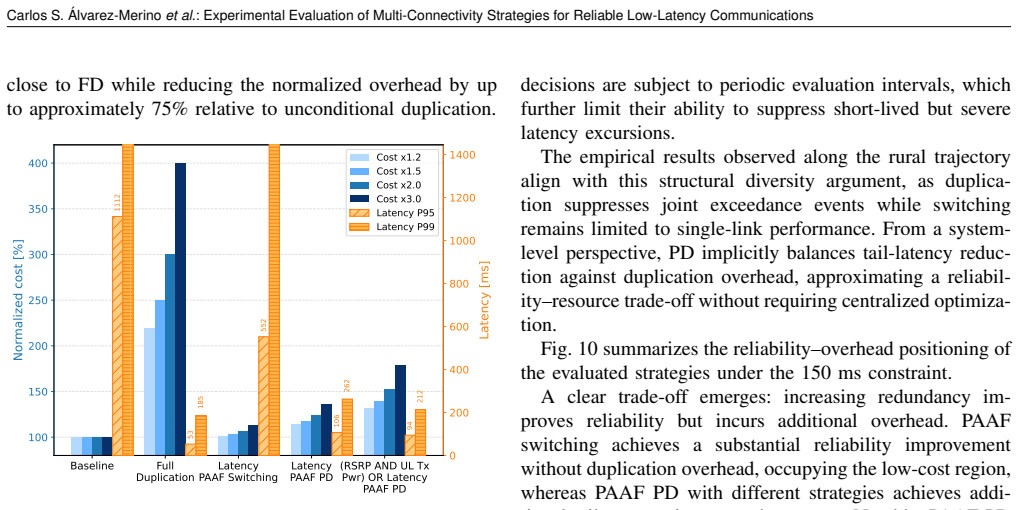
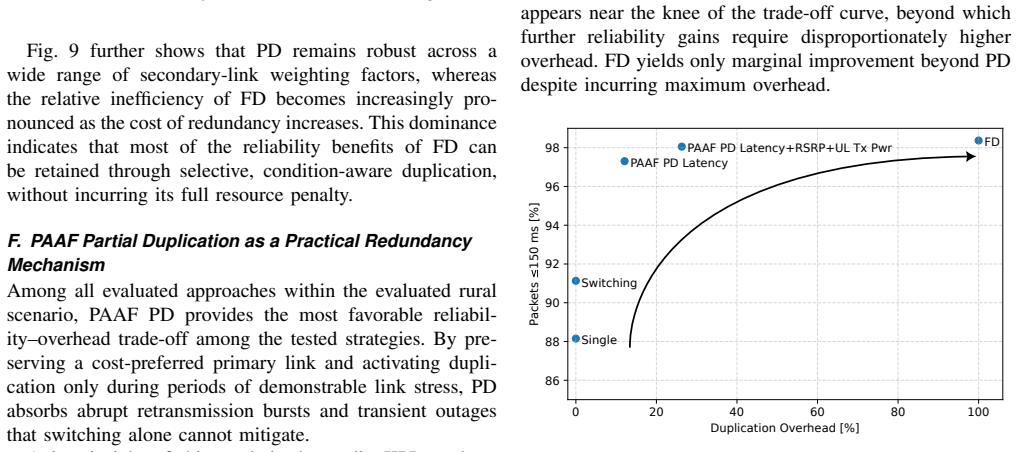
Measurements indicate that in coverage-constrained scenarios, performance appears to be strongly influenced by uplink power-limited operation and partially correlated impairments across operators. Several multi-connectivity strategies are evaluated, including link aggregation, switching-based policies, and conditional packet duplication. A Primary-Anchored Adaptive Failover (PAAF) framework is introduced to selectively activate redundancy based on radio, latency and service cost considerations. The results suggest that Partial Duplication (PD) approaches can approach the reliability of multi-connectivity while substantially reducing duplication overhead in the evaluated rural scenario.
What carries the argument
The Primary-Anchored Adaptive Failover (PAAF) framework, which selectively activates redundancy based on radio, latency and service cost considerations.
If this is right
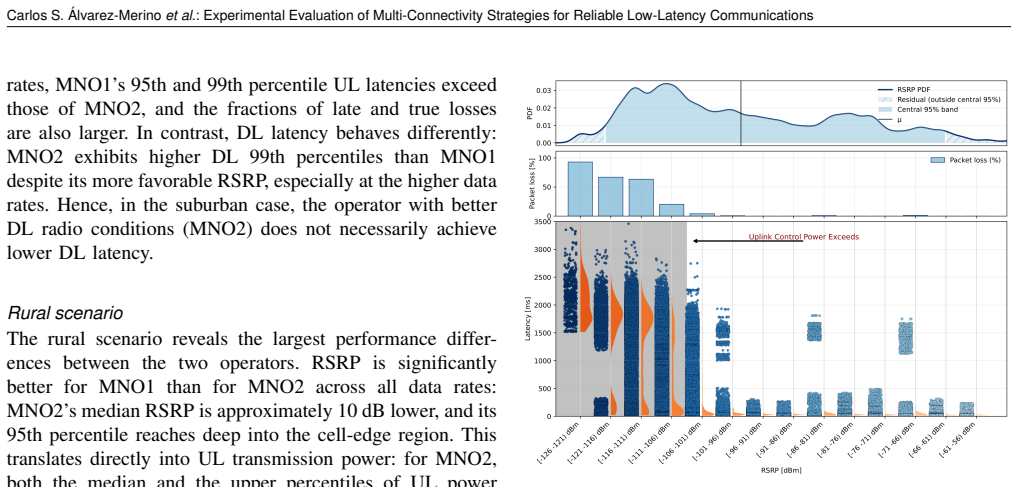
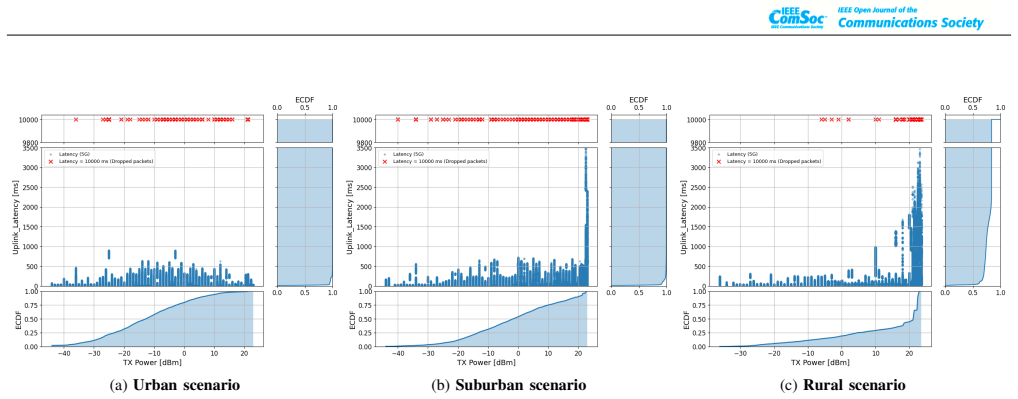
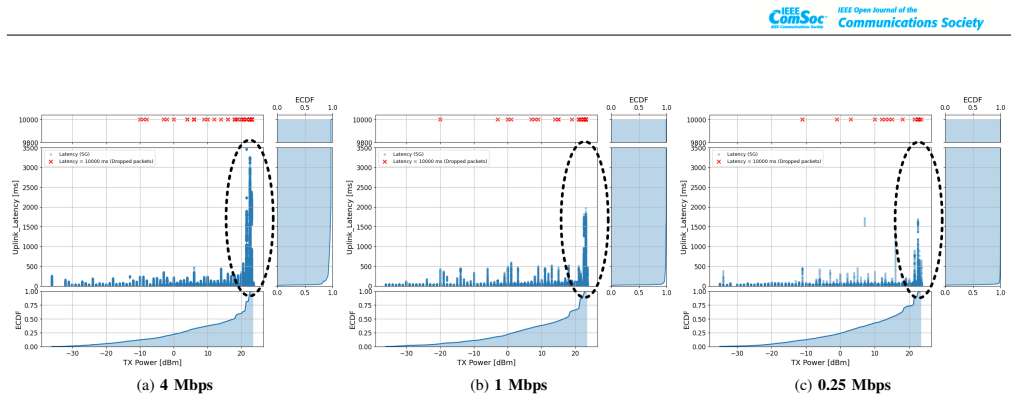
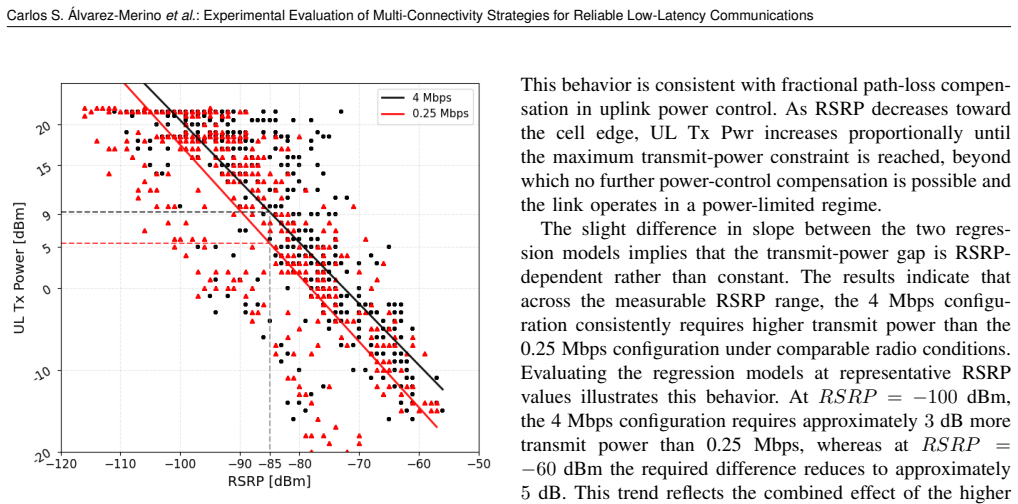
- Uplink performance in rural areas is limited by power control rather than coverage indicators such as RSRP.
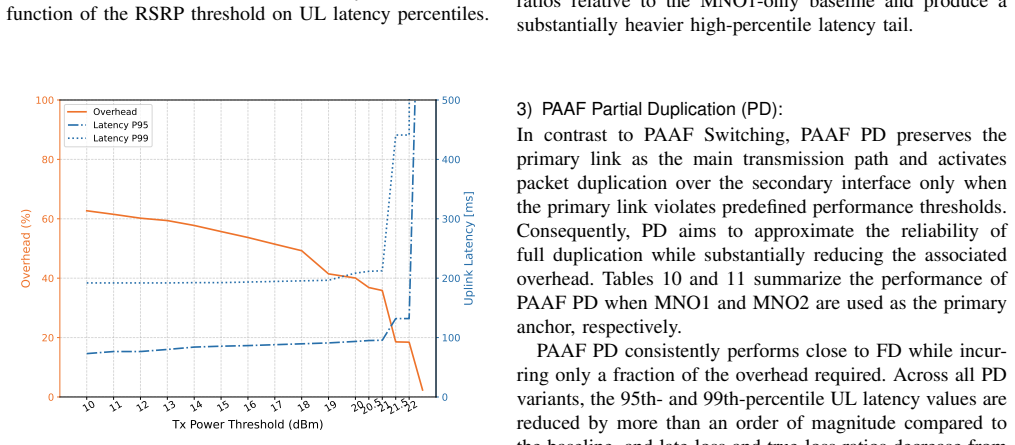
- Partial duplication strategies can achieve near-equivalent reliability to full multi-connectivity at lower overhead.
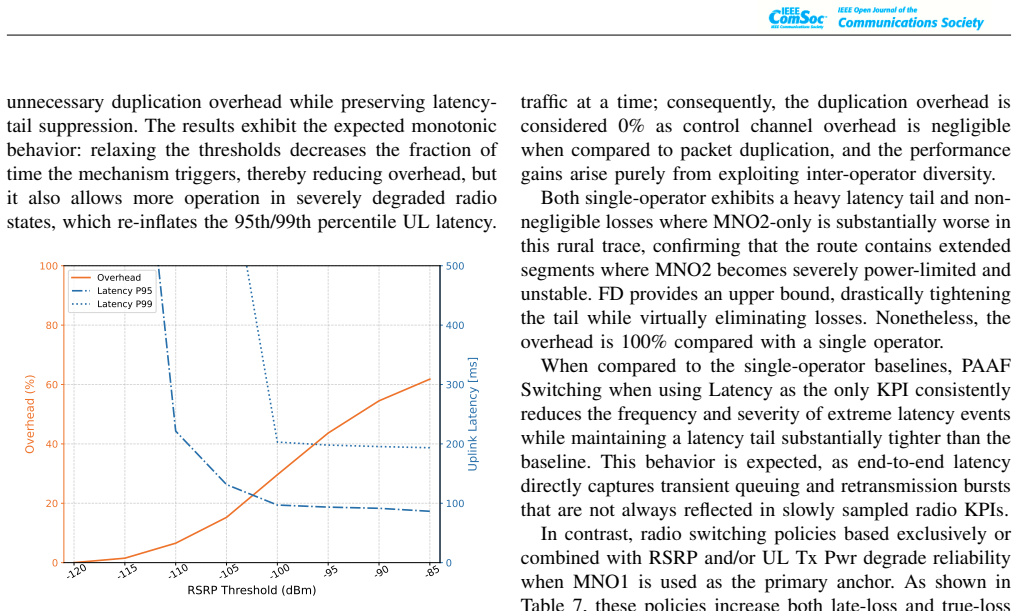
- Adaptive policies can be tuned using real-time radio and latency data to optimize resource allocation.
- Latency and packet loss metrics provide better guidance for reliability than coverage indicators alone.
Where Pith is reading between the lines
- The same selective redundancy logic could support uplink-dominant telemetry in other constrained wireless environments.
- Operators might apply data-driven monitoring to dynamically adjust duplication across multiple sites.
- Further campaigns in varied rural terrain would test whether partial impairment correlation holds beyond the measured locations.
Load-bearing premise
The measurement campaigns conducted in the specific rural locations are representative of typical rural 5G deployments and the observed partial correlation of impairments across the two operators is a general property.
What would settle it
A new set of rural measurements showing fully correlated packet losses and impairments between operators, with no benefit from partial duplication, would falsify the overhead-reduction claim.
Figures

read the original abstract
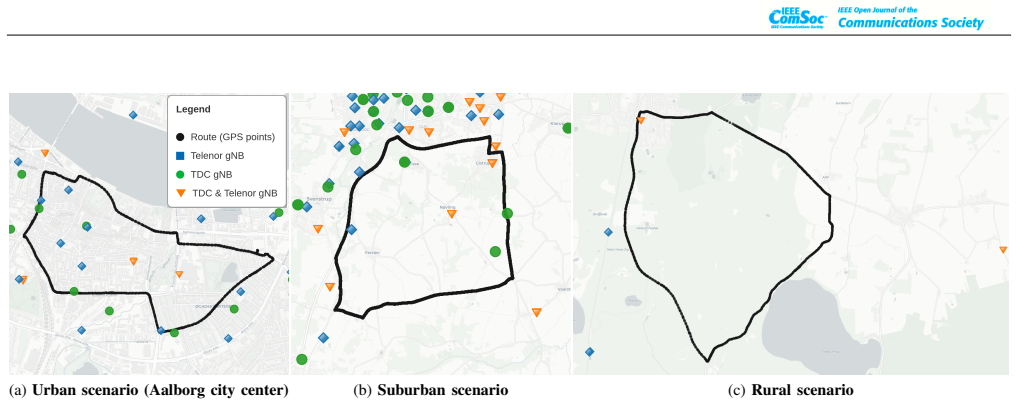
Reliable low-latency communication is a key requirement for mission-critical and mobile autonomous systems, including teleoperation, autonomous navigation, and real-time uplink-dominant telemetry applications. While commercial 5G networks often provide adequate downlink performance, uplink performance in rural deployments may be constrained by radio-resource limitations and uplink power-control mechanisms. This paper presents a comprehensive experimental evaluation of multi-connectivity strategies over commercial 5G Non-Standalone networks, based on measurement campaigns conducted in urban, suburban, and rural environments. The study analyzes per-packet uplink and downlink latency, packet loss, and radio-layer KPIs across two mobile network operators. The measurements indicate that latency and reliability cannot be inferred solely from coverage indicators such as RSRP. In coverage-constrained scenarios, performance appears to be strongly influenced by uplink power-limited operation and partially correlated impairments across operators. Several multi-connectivity strategies are evaluated, including link aggregation, switching-based policies, and conditional packet duplication. A Primary-Anchored Adaptive Failover (PAAF) framework is introduced to selectively activate redundancy based on radio, latency and service cost considerations. The results suggest that Partial Duplication (PD) approaches can approach the reliability of multi-connectivity while substantially reducing duplication overhead in the evaluated rural scenario.
Editorial analysis
A structured set of objections, weighed in public.
Referee Report
Summary. The paper reports results from measurement campaigns across urban, suburban, and rural commercial 5G NSA networks of two operators. It analyzes per-packet uplink/downlink latency, loss, and radio KPIs, concluding that these cannot be inferred from RSRP alone and are affected by uplink power limits and partially correlated impairments across operators. Several multi-connectivity policies are evaluated, including a proposed Primary-Anchored Adaptive Failover (PAAF) framework that selectively activates redundancy; the central claim is that Partial Duplication (PD) approaches the reliability of full multi-connectivity while reducing overhead in the evaluated rural scenario.
Significance. The work supplies empirical data from real commercial networks on uplink constraints in rural 5G and demonstrates a practical, cost-aware adaptive policy (PAAF) for selective redundancy. If the measurements hold, this is useful for mission-critical uplink applications where full duplication is resource-expensive. The multi-environment campaigns and direct comparison of operators are strengths.
major comments (1)
- [Measurement Campaigns] The description of the measurement campaigns lacks detail on data exclusion rules, how latency and loss metrics were computed consistently across operators, and statistical power; these omissions are load-bearing because the central claims about partial impairment correlation and PD performance rest directly on the reliability of those measurements.
minor comments (2)
- [PAAF Framework] Clarify the precise decision rules and thresholds inside the PAAF framework, including how radio KPIs, latency estimates, and service cost are combined.
- [Abstract] The abstract states the PD benefit holds 'in the evaluated rural scenario'; the manuscript should explicitly scope all claims to the tested sites and operators rather than implying broader transferability.
Simulated Author's Rebuttal
We thank the referee for the detailed feedback. The single major comment identifies a genuine gap in the description of our measurement methodology. We address it directly below and commit to revisions that strengthen the evidential basis for our claims.
read point-by-point responses
-
Referee: [Measurement Campaigns] The description of the measurement campaigns lacks detail on data exclusion rules, how latency and loss metrics were computed consistently across operators, and statistical power; these omissions are load-bearing because the central claims about partial impairment correlation and PD performance rest directly on the reliability of those measurements.
Authors: We agree that the current manuscript provides insufficient methodological transparency on these points. In the revised version we will insert a new subsection (Section III-C) that explicitly states: (i) the data exclusion rules applied (e.g., removal of packets lacking complete radio reports, duplicate timestamps, or GPS fixes outside the campaign area); (ii) the precise formulas and post-processing steps used to compute per-packet uplink/downlink latency and loss, including how operator-specific timestamp offsets were aligned; and (iii) statistical power details, including the number of packets retained per scenario, bootstrap confidence intervals for the reported reliability figures, and a sensitivity analysis showing that the observed partial correlation between operators remains statistically significant under alternative exclusion thresholds. These additions will directly support the claims regarding impairment correlation and the performance of partial duplication. revision: yes
Circularity Check
No significant circularity; empirical measurement study with no derivation chain
full rationale
The paper presents measurement campaigns across urban/suburban/rural sites with two operators, reports per-packet latency/loss/KPIs, and evaluates strategies (link aggregation, switching, conditional duplication, PAAF) directly on the collected data. No equations, fitted parameters, or self-citation chains are used to derive claims; the central suggestion that PD approaches multi-connectivity reliability with lower overhead is an empirical observation from the specific traces, not a reduction of any model to its inputs. The reader's assessment of score 0.0 is consistent with the absence of any load-bearing derivation.
Axiom & Free-Parameter Ledger
Reference graph
Works this paper leans on
-
[1]
IEEE Transactions on Multimedia pp
Bai, W., Zhang, Y., Guo, Q., Liu, W., Du, S., Hu, J., Cheng, S., Ning, Z.: Dynamic query management and internal consistency representation based transformer for online vectorized hd map construction. IEEE Transactions on Multimedia pp. 1–15 (2026)
2026
-
[2]
In: Computer Vision – ECCV 2020
Carion, N., Massa, F., Synnaeve, G., Usunier, N., Kirillov, A., Zagoruyko, S.: End- to-end object detection with transformers. In: Computer Vision – ECCV 2020. pp. 213–229. Springer International Publishing, Cham (2020)
2020
-
[3]
IEEE Robotics and Automation Letters9(6), 5735–5742 (2024)
Chen, P., Jiang, X., Zhang, Y., Tan, J., Jiang, R.: Mapcvv: On-cloud map construc- tion using crowdsourcing visual vectorized elements towards autonomous driving. IEEE Robotics and Automation Letters9(6), 5735–5742 (2024)
2024
-
[4]
In: 2020 IEEE Winter Conference on Applications of Computer Vision (WACV)
Djuric, N., Radosavljevic, V., Cui, H., Nguyen, T., Chou, F.C., Lin, T.H., Singh, N., Schneider, J.: Uncertainty-aware short-term motion prediction of traffic ac- tors for autonomous driving. In: 2020 IEEE Winter Conference on Applications of Computer Vision (WACV). pp. 2084–2093 (2020)
2020
-
[5]
IEEE Open Journal of Intelligent Transportation Systems4, 527–550 (2023)
Elghazaly, G., Frank, R., Harvey, S., Safko, S.: High-definition maps: Comprehen- sive survey, challenges, and future perspectives. IEEE Open Journal of Intelligent Transportation Systems4, 527–550 (2023)
2023
-
[6]
In: 2025 IEEE 28th International Conference on Intelligent Transporta- tion Systems (ITSC)
Fritz, D., Lagamtzis, D., Mink, M., Schober, S.: ADVNTG: Autonomous Driving Vehicle and Neural Transformer-Based HD Map Generation Using Crowd-Sourced Fleet Data. In: 2025 IEEE 28th International Conference on Intelligent Transporta- tion Systems (ITSC). pp. 1954–1959. IEEE, Gold Coast, Australia (Nov 2025)
2025
-
[7]
ISPRS International Journal of Geo-Information 13(3) (2024)
Guo, Y., Zhou, J., Li, X., Tang, Y., Lv, Z.: A review of crowdsourcing update methods for high-definition maps. ISPRS International Journal of Geo-Information 13(3) (2024)
2024
-
[8]
Hao, X., Zhao, Y., Ji, Y., Dai, L., Hao, P., Li, D., Cheng, S., Yin, R.: What really matters for robust multi-sensor hd map construction? In: 2025 IEEE/RSJ International Conference on Intelligent Robots and Systems (IROS). pp. 1298–1304 (2025)
2025
-
[9]
In: Proceedings of the IEEE/CVF Conference on Computer Vision and Pattern Recognition (CVPR) Workshops
Hubbertz, M., Colling, P., Han, Q., Meisen, T.: Inferring driving maps by deep learning-based trail map extraction. In: Proceedings of the IEEE/CVF Conference on Computer Vision and Pattern Recognition (CVPR) Workshops. pp. 2450–2459 (June 2025)
2025
-
[10]
In: The Fourteenth International Conference on Learning Representations (ICLR) (2024)
Li, T., Jia, P., Wang, B., Chen, L., Jiang, K., Yan, J., Li, H.: Lanesegnet: Map learning with lane segment perception for autonomous driving. In: The Fourteenth International Conference on Learning Representations (ICLR) (2024)
2024
-
[11]
In: European Conference on Computer Vision (2023)
Liao, B., Chen, S., Jiang, B., Cheng, T., Zhang, Q., Liu, W., Huang, C., Wang, X.: Lane graph as path: Continuity-preserving path-wise modeling for online lane graph construction. In: European Conference on Computer Vision (2023)
2023
-
[12]
In: Computer Vision – ECCV 2024
Liao, B., Chen, S., Jiang, B., Cheng, T., Zhang, Q., Liu, W., Huang, C., Wang, X.: Lane graph as path: Continuity-preserving path-wise modeling for online lane graph construction. In: Computer Vision – ECCV 2024. pp. 334–351. Springer Nature Switzerland, Cham (2025)
2024
-
[13]
In: International Conference on Learning Representations (2023)
Liao, B., Chen, S., Wang, X., Cheng, T., Zhang, Q., Liu, W., Huang, C.: Maptr: Structured modeling and learning for online vectorized hd map construction. In: International Conference on Learning Representations (2023)
2023
-
[14]
International Journal of Computer Vision pp
Liao, B., Chen, S., Zhang, Y., Jiang, B., Zhang, Q., Liu, W., Huang, C., Wang, X.: Maptrv2: An end-to-end framework for online vectorized hd map construction. International Journal of Computer Vision pp. 1–23 (2024) 14 D. Fritz et al
2024
-
[15]
In: Proceedings of the IEEE/CVF Conference on Computer Vision and Pattern Recognition (CVPR)
Lilja, A., Fu, J., Stenborg, E., Hammarstrand, L.: Localization is all you evaluate: Data leakage in online mapping datasets and how to fix it. In: Proceedings of the IEEE/CVF Conference on Computer Vision and Pattern Recognition (CVPR). pp. 22150–22159 (June 2024)
2024
-
[16]
IEEE Robotics and Automation Letters11(4), 4793–4800 (2026)
Liu, G., Zhang, D., Xu, C., Zhang, X., Zhang, Z., Zhao, J., Wu, Z., Zhang, J.: City-scale lane-level mapping from crowdsourced trajectories and satellite imagery. IEEE Robotics and Automation Letters11(4), 4793–4800 (2026)
2026
-
[17]
In: International conference on machine learning
Liu, Y., Yuan, T., Wang, Y., Wang, Y., Zhao, H.: Vectormapnet: End-to-end vec- torized hd map learning. In: International conference on machine learning. PMLR (2023)
2023
-
[18]
Journal of Sensor and Actuator Networks14(1) (2025)
Lyu, H., Berrio Perez, J.S., Huang, Y., Li, K., Shan, M., Worrall, S.: Online high- definition map construction for autonomous vehicles: A comprehensive survey. Journal of Sensor and Actuator Networks14(1) (2025)
2025
-
[19]
In: 2024 IEEE 27th International Conference on Intelligent Transportation Systems (ITSC)
Mink, M., Monninger, T., Staab, S.: Lmt-net: Lane model transformer network for automated hd mapping from sparse vehicle observations. In: 2024 IEEE 27th International Conference on Intelligent Transportation Systems (ITSC). pp. 1203– 1210 (2024)
2024
-
[20]
IEEE Robotics and Automation Letters8(8), 5077–5083 (2023)
Qin, T., Huang, H., Wang, Z., Chen, T., Ding, W.: Traffic flow-based crowdsourced mapping in complex urban scenario. IEEE Robotics and Automation Letters8(8), 5077–5083 (2023)
2023
-
[21]
IEEE Transactions on Intelligent Vehicles9(10), 5973–5994 (2024)
Tang, X., Jiang, K., Yang, M., Liu, Z., Jia, P., Wijaya, B., Wen, T., Cui, L., Yang, D.: High-definition maps construction based on visual sensor: A comprehensive survey. IEEE Transactions on Intelligent Vehicles9(10), 5973–5994 (2024)
2024
-
[22]
In: Proceedings of the AAAI Conference on Artificial Intelligence (2025)
Xu, L., Wu, Z., Qiu, W., Pang, S., Bai, X., Mei, K., Xue, J.: Redundant queries in detr-based 3d detection methods: Unnecessary and prunable. In: Proceedings of the AAAI Conference on Artificial Intelligence (2025)
2025
-
[23]
In: Proceedings of the IEEE/CVF Winter Conference on Applications of Computer Vision (WACV)
Yuan, T., Liu, Y., Wang, Y., Wang, Y., Zhao, H.: Streammapnet: Streaming map- ping network for vectorized online hd map construction. In: Proceedings of the IEEE/CVF Winter Conference on Applications of Computer Vision (WACV). pp. 7356–7365 (January 2024)
2024
-
[24]
IEEE Transactions on Intelligent Transportation Systems26(12), 21502–21525 (2025)
Zhang, Y., Qian, Y., Meng, C., Zhang, R., Yi, H., Wang, C., Yang, M.: Local vectorized high definition map construction for autonomous driving: A compre- hensive review. IEEE Transactions on Intelligent Transportation Systems26(12), 21502–21525 (2025)
2025
discussion (0)
Sign in with ORCID, Apple, or X to comment. Anyone can read and Pith papers without signing in.