Principal Matroid Determinants
Pith reviewed 2026-05-08 01:52 UTC · model grok-4.3
The pith
Realizable matroids produce principal determinants defined via resultants and associated hypergeometric systems whose singular loci are conjectured to coincide with those determinants.
A machine-rendered reading of the paper's core claim, the machinery that carries it, and where it could break.
Core claim
We develop a theory of principal determinants and hypergeometric systems for realizable matroids. Our framework parallels the toric theory of Gel'fand, Kapranov, and Zelevinsky, but with the combinatorics of matroids and their flats replacing the usual role of polytopes and their faces. The principal A-determinant is replaced by the principal matroid determinant, defined as a specialization of a resultant. The GKZ hypergeometric system is replaced by the matroid hypergeometric system, a holonomic D-module of combinatorial nature whose singular locus is conjectured to be the principal matroid determinant.
What carries the argument
The principal matroid determinant, obtained as a specialization of a resultant, which is conjectured to serve as the singular locus of the matroid hypergeometric system constructed from the flats of a realizable matroid.
If this is right
- The matroid hypergeometric system is holonomic by construction.
- Its singular locus is given by the principal matroid determinant under the stated conjecture.
- The entire construction depends only on the matroid structure and applies uniformly to any reciprocal linear space arising from a realizable matroid.
- The principal matroid determinant is an explicit algebraic invariant obtained from a resultant.
Where Pith is reading between the lines
- The framework supplies a purely combinatorial route to locate singularities that previously required geometric or polyhedral data.
- Explicit low-rank examples can be used to test the conjecture by direct Gröbner-basis calculation of the singular locus.
- The same replacement of polytopes by flats may produce analogous combinatorial versions of other GKZ-style invariants such as Euler characteristics or periods.
Load-bearing premise
The substitution of matroid flats for polytopes and faces preserves the holonomicity of the resulting D-module and the identification of its singular locus with the principal determinant.
What would settle it
An explicit computation, for any small realizable matroid such as the uniform matroid of rank 3 on 6 elements, in which the characteristic variety of the matroid hypergeometric system differs from the zero set of the associated principal matroid determinant.
Figures

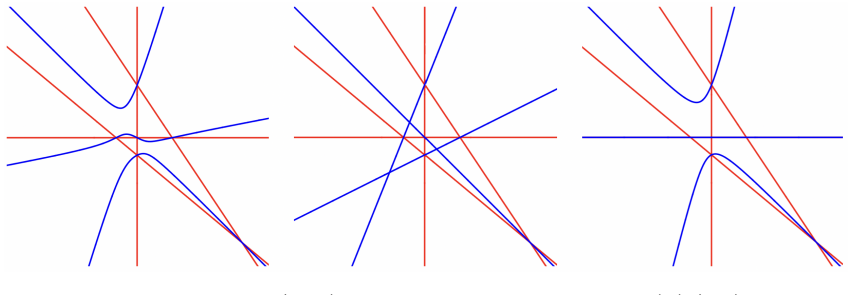
read the original abstract
We develop a theory of principal determinants and hypergeometric systems for realizable matroids. Our framework parallels the toric theory of Gel'fand, Kapranov, and Zelevinsky (GKZ), but with the combinatorics of matroids and their flats replacing the usual role of polytopes and their faces. In this analogy, the toric variety is replaced by a reciprocal linear space. The {principal $A$-determinant} is replaced by the {principal matroid determinant}, defined as a specialization of a resultant. The GKZ hypergeometric system is replaced by the {matroid hypergeometric system}, a holonomic $D$-module of combinatorial nature whose singular locus is conjectured to be the principal matroid~determinant.
Editorial analysis
A structured set of objections, weighed in public.
Referee Report
Summary. The paper develops a theory of principal determinants and hypergeometric systems for realizable matroids, paralleling the GKZ toric theory but replacing polytopes and faces with matroid flats. The toric variety is replaced by a reciprocal linear space; the principal A-determinant becomes the principal matroid determinant, defined as a specialization of a resultant; and the GKZ hypergeometric system is replaced by the matroid hypergeometric system, asserted to be a holonomic D-module of combinatorial nature whose singular locus is conjectured to equal the principal matroid determinant.
Significance. If the analogy is made rigorous and the conjecture verified, the work could extend D-module techniques to matroid combinatorics and provide new combinatorial descriptions of singularities arising from resultants. The explicit construction of the principal matroid determinant via resultant specialization is a concrete, potentially useful contribution independent of the conjecture. However, the overall significance remains provisional given the conjectural status of the singular-locus claim and the absence of explicit checks that holonomicity survives the combinatorial substitution.
major comments (1)
- [Abstract] Abstract: the statement that the matroid hypergeometric system 'is a holonomic D-module' is presented as established, yet the manuscript provides no derivation showing that the replacement of polytope faces by matroid flats preserves the characteristic variety or the differential-algebraic properties that guarantee holonomicity in the GKZ setting; this preservation is load-bearing for the claim that the system is 'of combinatorial nature' and for the subsequent conjecture on its singular locus.
Simulated Author's Rebuttal
We thank the referee for the careful reading and for highlighting the need for precision regarding the status of holonomicity. We address the single major comment below.
read point-by-point responses
-
Referee: [Abstract] Abstract: the statement that the matroid hypergeometric system 'is a holonomic D-module' is presented as established, yet the manuscript provides no derivation showing that the replacement of polytope faces by matroid flats preserves the characteristic variety or the differential-algebraic properties that guarantee holonomicity in the GKZ setting; this preservation is load-bearing for the claim that the system is 'of combinatorial nature' and for the subsequent conjecture on its singular locus.
Authors: We agree that the abstract asserts holonomicity as established while the manuscript constructs the matroid hypergeometric system by direct analogy (replacing faces by flats and using the resultant specialization for the principal determinant) without supplying a separate derivation that the characteristic variety remains Lagrangian or that the D-module remains holonomic after the combinatorial substitution. The paper does not contain such a proof. In the revised version we will change the abstract to describe the system as 'a D-module of combinatorial nature, conjecturally holonomic' and add a short paragraph in the introduction that explicitly notes the analogy to the GKZ case, states that holonomicity is expected to persist but is not proved here, and clarifies that the singular-locus conjecture is therefore conditional on this property. This revision removes the overstatement and makes the logical dependence transparent. revision: yes
Circularity Check
No significant circularity detected; claims rest on external GKZ analogy without self-referential reduction.
full rationale
The abstract and description define the principal matroid determinant explicitly as a specialization of a resultant and introduce the matroid hypergeometric system as the direct combinatorial replacement of the GKZ system (polytopes and faces by flats), asserting holonomicity on the basis of that parallel. No equations, definitions, or self-citations in the provided text reduce any central claim to a fitted parameter, a renamed input, or a self-citation chain that is itself unverified. The framework is presented as a new construction whose properties are conjectured or derived from the established toric case rather than tautologically assumed; therefore the derivation chain does not collapse by construction.
Axiom & Free-Parameter Ledger
axioms (2)
- domain assumption Realizable matroids admit a linear representation over a field, allowing combinatorial flats to replace polytope faces.
- ad hoc to paper The resultant and D-module constructions from GKZ theory extend formally when polytopes are replaced by matroid flats.
invented entities (2)
-
principal matroid determinant
no independent evidence
-
matroid hypergeometric system
no independent evidence
Reference graph
Works this paper leans on
- [1]
-
[2]
C. Améndola, N. Bliss, I. Burke, C. R. Gibbons, M. Helmer, S. Hoşten, E. D. Nash, J. I. Rodriguez, and D. Smolkin. The maximum likelihood degree of toric varieties.Journal of Symbolic Computation, 92:222–242, 2019
work page 2019
-
[3]
F. Beukers. AlgebraicA-hypergeometric functions.Inventiones mathematicae, 180(3):589–610, 2010
work page 2010
- [4]
- [5]
- [6]
-
[7]
A. Cayley. On the theory of elimination.Cambridge and Dublin Mathematical Journal, 3:116– 120, 1848. Reprinted in: Collected Mathematical Papers of Arthur Cayley, Vol. 1
-
[8]
C.D. Concini andC.Procesi. Wonderfulmodelsofsubspacearrangements.Selecta Mathematica, New Series, 1(3):459–494, 1995
work page 1995
-
[9]
J. P. Dalbec and B. Sturmfels. Introduction to Chow forms. In N. White, editor,Invariant Methods in Discrete and Computational Geometry, pages 37–58. Kluwer Academic Publishers,
-
[10]
Proceedings of the Curaçao Conference, June 13–17, 1994
work page 1994
-
[11]
P. Dey, P. Görlach, and N. Kaihnsa. Coordinate-wise powers of algebraic varieties.Beiträge zur Algebra und Geometrie / Contributions to Algebra and Geometry, 61(3):473–505, 2020
work page 2020
-
[12]
A. Dickenstein, E. M. Feichtner, and B. Sturmfels. Tropical discriminants.Journal of the American Mathematical Society, 20(4):1111–1133, 2007
work page 2007
-
[13]
A. Dimca.Sheaves in topology. Springer Science & Business Media, 2004
work page 2004
- [14]
-
[15]
A. Esterov. The discriminant of a system of equations.Advances in Mathematics, 245:534–572, 2013. 32
work page 2013
-
[16]
Exton.Multiple Hypergeometric Functions and Applications
H. Exton.Multiple Hypergeometric Functions and Applications. Halsted Press (Ellis Horwood Ltd., John Wiley & Sons), New York; Chichester, 1976
work page 1976
- [17]
- [18]
-
[19]
J. Franecki and M. Kapranov. The Gauss map and a noncompact Riemann-Roch formula for constructible sheaves on semiabelian varieties.Duke Math. J., 104(1):171–180, 2000
work page 2000
-
[20]
I. M. Gel’fand, M. M. Kapranov, and A. V. Zelevinsky. Generalized Euler integrals andA- hypergeometric functions.Advances in Mathematics, 84(2):255–271, 1990
work page 1990
-
[21]
I. M. Gel’fand,M. M. Kapranov,and A. V. Zelevinsky. Hypergeometric functions,toric varieties and Newton polyhedra. In M. Kashiwara and T. Miwa, editors,Proceedings of the ICM-90 Satellite Conference “Special Functions”, volume 108 ofSpringer Proceedings in Mathematics, pages 104–121. Springer Japan, 1991
work page 1991
-
[22]
I. M. Gel’fand, M. M. Kapranov, and A. V. Zelevinsky.Discriminants, resultants, and mul- tidimensional determinants. Mathematics: Theory & Applications. Birkhäuser Boston, Inc., Boston, MA, 1994
work page 1994
-
[23]
I. M. Gel’fand, A. V. Zelevinsky, and M. M. Kapranov. Hypergeometric functions and toral manifolds.Funktsional’nyi Analiz i ego Prilozheniya, 23(2):12–26, 1989
work page 1989
-
[24]
D. R. Grayson and M. E. Stillman. Macaulay2, a software system for research in algebraic geometry. Available athttp://www2.macaulay2.com
-
[25]
R. Hattori and N. Takayama. The singular locus of Lauricella’sFC.Journal of the Mathematical Society of Japan, 66(3):981–995, 2014
work page 2014
-
[26]
R. Hotta and T. Tanisaki.D-modules, perverse sheaves, and representation theory, volume 236. Springer Science & Business Media, 2007
work page 2007
-
[27]
J. Huh. The maximum likelihood degree of a very affine variety.Compositio Mathematica, 149(8):1245–1266, 2013
work page 2013
- [28]
-
[29]
M. M. Kapranov. A characterization ofA-discriminantal hypersurfaces in terms of the loga- rithmic gauss map.Mathematische Annalen, 290(2):277–286, 1991
work page 1991
- [30]
-
[31]
M. Kashiwara and P. Schapira.Sheaves on Manifolds: With a Short History.«Les débuts de la théorie des faisceaux». By Christian Houzel. Springer Science & Business Media, 2013
work page 2013
-
[32]
N. M. Katz and G. Laumon. Transformation de Fourier et majoration de sommes exponentielles. Publications Mathématiques de l’IHÉS, 62:145–202, 1985
work page 1985
-
[33]
TheChowform ofareciprocallinearspace.Michigan Mathematical Journal, 68(4):831–858, 2019
M.KummerandC.Vinzant. TheChowform ofareciprocallinearspace.Michigan Mathematical Journal, 68(4):831–858, 2019
work page 2019
-
[34]
D. Maclagan and B. Sturmfels.Introduction to Tropical Geometry, volume 161 ofGraduate Studies in Mathematics. American Mathematical Society, Providence, RI, 2015
work page 2015
-
[35]
S.-J. Matsubara-Heo. Euler and Laplace integral representations of GKZ hypergeometric functions I.Proceedings of the Japan Academy, Series A, Mathematical Sciences, 96(9):75–78, 2020. 33
work page 2020
-
[36]
S.-J. Matsubara-Heo. Hypergeometric discriminants.arXiv:2505.13163, 2025
-
[37]
S.-J. Matsubara-Heo, S. Mizera, and S. Telen. Four lectures on Euler integrals.SciPost Physics Lecture Notes, 75, 2023
work page 2023
-
[38]
L. Matusevich, E. Miller, and U. Walther. Homological methods for hypergeometric families. Journal of the American Mathematical Society, 18(4):919–941, 2005
work page 2005
-
[39]
L. G. Maxim, J. I. Rodriguez, B. Wang, and L. Wu. Logarithmic cotangent bundles, Chern- Mather classes, and the Huh-Sturmfels involution conjecture.Communications on Pure and Applied Mathematics, 77(2):1486–1508, 2024
work page 2024
-
[40]
S. Mizera and S. Telen. Landau discriminants.Journal of High Energy Physics, 2022(8):1–57, 2022
work page 2022
- [41]
-
[42]
A. Postnikov, V. Reiner, and L. Williams. Faces of generalized permutohedra.Documenta Mathematica, 13:207–273, 2008
work page 2008
-
[43]
N. Proudfoot and D. Speyer. A broken circuit ring.Beiträge zur Algebra und Geometrie, 47:161–166, 2006
work page 2006
-
[44]
T. Reichelt, M. Schulze, C. Sevenheck, and U. Walther. Algebraic aspects of hypergeometric differential equations.Beiträge zur Algebra und Geometrie, 62(1):137–203, 2021
work page 2021
- [45]
-
[46]
A.-L. Sattelberger and B. Sturmfels. D-modules and holonomic functions. InVarieties, Poly- hedra, Computation, volume 22 ofEMS Series of Congress Reports. European Mathematical Society, 2025
work page 2025
-
[47]
A.-L. Sattelberger and R. van der Veer. Maximum likelihood estimation from a tropical and a Bernstein–Sato perspective.International Mathematics Research Notices, 2023(6):5263–5292, 2023
work page 2023
-
[48]
M. Schulze and U. Walther. Irregularity of hypergeometric systems via slopes along coordinate subspaces.Duke Math. J., 142(3):465–509, 2008
work page 2008
-
[49]
M. Schulze and U. Walther. Hypergeometric D-modules and twisted Gauß–manin systems. Journal of Algebra, 322(9):3392–3409, 2009
work page 2009
-
[50]
B. Sturmfels and J. Tevelev. Elimination theory for tropical varieties.Mathematical Research Letters, 15(3):543–562, 2008
work page 2008
-
[51]
S. Telen and M. Wiesmann. Euler stratifications of hypersurface families.arXiv:2407.18176, 2024
-
[52]
S. Weinzierl. Feynman Integrals.UNITEXT for Physics, 2022. Saiei-Jaeyeong Matsubara-Heo Graduate School of Information Sciences, Tohoku University 6-3-09 Aramaki-Aza-Aoba, Aoba-ku, Sendai 980-8579, Japan saiei@tohoku.ac.jp Simon T elen Max Planck Institute for Mathematics in the Sciences Inselstrasse 22, 04103 Leipzig, Germany simon.telen@mis.mpg.de 34
work page 2022
discussion (0)
Sign in with ORCID, Apple, or X to comment. Anyone can read and Pith papers without signing in.