MultiHedge: Adaptive Coordination via Retrieval-Augmented Control
Pith reviewed 2026-05-07 17:17 UTC · model grok-4.3
The pith
Retrieval-augmented LLM coordination delivers more robust allocation decisions under shifting conditions than scaling model size alone.
A machine-rendered reading of the paper's core claim, the machinery that carries it, and where it could break.
Core claim
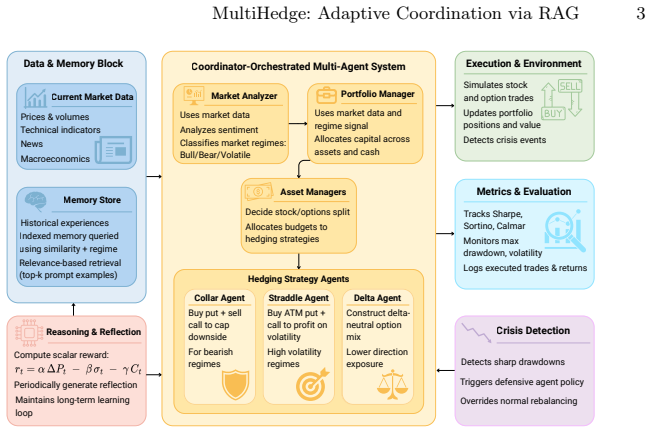
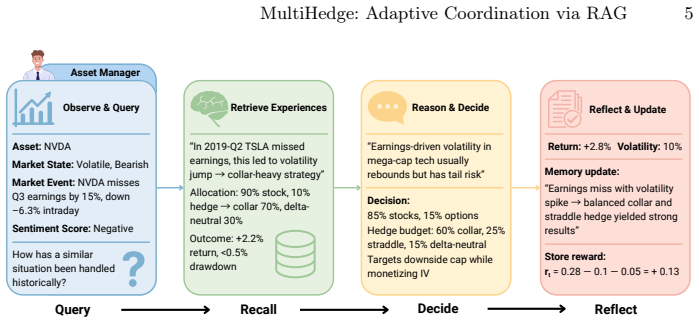
MultiHedge is a hybrid architecture where an LLM produces structured allocation decisions conditioned on retrieved historical precedents, and execution is grounded in canonical option strategies. In a controlled evaluation using U.S. equities, the key result is that memory-augmented retrieval confers greater robustness and stability than increasing model scale alone. The study contributes evidence that memory and architectural design play a central role in the robustness of modular decision systems.
What carries the argument
MultiHedge hybrid architecture, in which LLM decisions are conditioned on retrieved historical precedents and grounded in canonical option strategies.
If this is right
- Memory-augmented retrieval improves generalization across shifting regimes in modular pipelines.
- Hybrid LLM-plus-rule systems achieve greater stability under uncertainty than either pure learning or pure rule-based baselines.
- Architectural choices around memory matter more for robustness than raw increases in model scale.
Where Pith is reading between the lines
- If the result holds, designers of adaptive systems could prioritize curated memory stores over further model enlargement.
- The same retrieval-conditioning pattern might stabilize coordination in non-financial domains such as supply-chain or robotic task allocation.
- A direct next test would replace equity data with synthetic regime-shift sequences to isolate whether the stability gain is domain-specific.
Load-bearing premise
Retrieved historical precedents are relevant enough that the LLM can translate them into better allocation decisions without introducing new instability or bias.
What would settle it
A trial in which historical precedents are deliberately mismatched to current conditions and MultiHedge shows higher variance or lower returns than the rule-based and learning-based baselines.
Figures
read the original abstract
Decision-making under changing conditions remains a fundamental challenge in many real-world systems. Existing approaches often fail to generalize across shifting regimes and exhibit unstable behavior under uncertainty. This raises the research question: can retrieval-augmented LLM coordination improve the robustness of modular decision pipelines? We propose MultiHedge, a hybrid architecture where an LLM produces structured allocation decisions conditioned on retrieved historical precedents, and execution is grounded in canonical option strategies. In a controlled evaluation using U.S. equities, we compare MultiHedge to rule-based and learning-based baselines. The key result is that memory-augmented retrieval confers greater robustness and stability than increasing model scale alone. Our paper contributes a controlled computational study showing that memory and architectural design play a central role in robustness in modular decision systems.
Editorial analysis
A structured set of objections, weighed in public.
Referee Report
Summary. The manuscript introduces MultiHedge, a hybrid architecture in which an LLM generates structured allocation decisions conditioned on retrieved historical precedents, with execution grounded in canonical option strategies. In a controlled evaluation on U.S. equities, MultiHedge is compared to rule-based and learning-based baselines. The central claim is that memory-augmented retrieval confers greater robustness and stability than increasing model scale alone.
Significance. If the key empirical comparison were properly demonstrated, the result would indicate that retrieval and memory mechanisms can outperform pure scaling for robustness in modular, non-stationary decision systems. This would be a useful contribution to hybrid LLM architectures for adaptive control. The controlled computational study framing is a strength, but the absence of the required ablation leaves the main claim unevaluated.
major comments (1)
- Abstract: The key result asserts that 'memory-augmented retrieval confers greater robustness and stability than increasing model scale alone,' yet the evaluation is described only as a comparison to rule-based and learning-based baselines. No ablation that holds the LLM fixed while removing the retrieval/memory component, nor any baseline using a larger-scale LLM (more parameters, longer context, or greater compute) without retrieval on the same regime-shift task, is reported. This leaves the central claim unsupported by the presented experiments.
minor comments (2)
- The abstract supplies no quantitative metrics, baseline specifications, statistical tests, or error analysis, which should be added to allow readers to assess the strength of the robustness claims.
- Clarify whether any of the learning-based baselines are themselves LLMs and, if so, their scale relative to the MultiHedge LLM.
Simulated Author's Rebuttal
We thank the referee for the detailed and constructive feedback. The identification of the missing ablation is a valid concern that directly impacts the strength of our central claim. We agree that the current experiments do not fully isolate the contribution of retrieval-augmented memory versus model scale, and we will revise the manuscript to address this gap.
read point-by-point responses
-
Referee: Abstract: The key result asserts that 'memory-augmented retrieval confers greater robustness and stability than increasing model scale alone,' yet the evaluation is described only as a comparison to rule-based and learning-based baselines. No ablation that holds the LLM fixed while removing the retrieval/memory component, nor any baseline using a larger-scale LLM (more parameters, longer context, or greater compute) without retrieval on the same regime-shift task, is reported. This leaves the central claim unsupported by the presented experiments.
Authors: We acknowledge that the manuscript as written does not contain the requested ablations. The reported comparisons are limited to rule-based and learning-based baselines, without an explicit removal of the retrieval component (holding the underlying LLM fixed) or a direct scale-only baseline using a larger model on the same regime-shift evaluation. In the revised version we will add: (1) an ablation that disables retrieval while using the identical LLM and option-execution layer, and (2) a larger-scale LLM baseline (increased parameters or context length) without retrieval, evaluated on the identical U.S. equities regime-shift task. These additions will provide direct empirical support for the claim that memory-augmented retrieval improves robustness beyond scale alone. revision: yes
Circularity Check
No circularity; empirical comparison without derivations or self-referential reductions
full rationale
The paper describes a hybrid LLM-plus-retrieval architecture and reports results from a controlled evaluation against rule-based and learning-based baselines. No equations, fitted parameters, ansatzes, or derivation chains appear in the provided text. The central claim is framed as an empirical observation from the study rather than a mathematical reduction to prior inputs or self-citations. Absence of any load-bearing self-citation, uniqueness theorem, or renaming of known results means the derivation chain (which is not present) cannot reduce to its own inputs by construction.
Axiom & Free-Parameter Ledger
Reference graph
Works this paper leans on
-
[1]
AI Communications7(1), 39–59 (1994)
Aamodt, A., Plaza, E.: Case-based reasoning: Foundational issues, methodological variations, and system approaches. AI Communications7(1), 39–59 (1994)
work page 1994
-
[2]
In: Recent Challenges in Intelligent Information and Database Systems
Bańka, F., Chudziak, J.A.: Options pricing platform with neural networks, llms and reinforcement learning. In: Recent Challenges in Intelligent Information and Database Systems. pp. 202–216. Springer Nature Singapore (2025)
work page 2025
-
[3]
Bańka, F., Chudziak, J.A.: Deltahedge: A multi-agent framework for portfolio options optimization. In: PACIS 2025 Proceedings. No. 25 (2025)
work page 2025
-
[4]
Quantitative Finance19(8), 1271–1291 (2019)
Buehler, H., Gonon, L., Teichmann, J., Wood, B.: Deep hedging. Quantitative Finance19(8), 1271–1291 (2019)
work page 2019
-
[5]
Guo, T., et al.: Large language model based multi-agents: A survey of progress and challenges (2024)
work page 2024
-
[6]
Finance Research Letters62, 105227 (Apr 2024)
Kirtac, K., Germano, G.: Sentiment trading with large language models. Finance Research Letters62, 105227 (Apr 2024)
work page 2024
-
[7]
In: Advances in Neural Information Processing Systems (NeurIPS) (2020)
Lewis, P., Perez, E., Piktus, A., Petroni, F., Karpukhin, V., Goyal, N., Küttler, H., Lewis, M., et al.: Retrieval-augmented generation for knowledge-intensive nlp tasks. In: Advances in Neural Information Processing Systems (NeurIPS) (2020)
work page 2020
- [8]
-
[9]
Liu, X.Y., Xiong, Z., Zhong, S., Yang, H., Walid, A.: Practical deep reinforcement learning approach for stock trading (2022)
work page 2022
-
[10]
Journal of Simulation4(3), 151–162 (2010)
Macal, C.M., North, M.J.: Tutorial on agent-based modelling and simulation. Journal of Simulation4(3), 151–162 (2010)
work page 2010
-
[11]
Malekzadeh, P., Poulos, Z., Chen, J., Wang, Z., Plataniotis, K.N.: Ex-drl: Hedging against heavy losses with extreme distributional reinforcement learning (2024)
work page 2024
-
[12]
Puterman, M.L.: Markov Decision Processes: Discrete Stochastic Dynamic Pro- gramming. Wiley (1994)
work page 1994
-
[13]
Shu, Y., Yu, C., Mulvey, J.M.: Dynamic asset allocation with asset-specific regime forecasts (2024)
work page 2024
-
[14]
In: Proc The 36th International Conference on Tools for Artificial Intelligence (ICTAI 2024) (2024)
Szydlowski, K.L., Chudziak, J.A.: Toward predictive stock trading with hidformer integrated into reinforcement learning strategy. In: Proc The 36th International Conference on Tools for Artificial Intelligence (ICTAI 2024) (2024)
work page 2024
-
[15]
Xiao, M., Jiang, Z., Qian, L., Chen, Z., He, Y., Xu, Y., Jiang, Y., Li, D., Weng, R.L., Peng, M., Huang, J., Ananiadou, S., Xie, Q.: Retrieval-augmented large language models for financial time series forecasting (2025)
work page 2025
-
[16]
Zhang, W., et al.: A multimodal foundation agent for financial trading: Tool- augmented, diversified, and generalist (2024)
work page 2024
discussion (0)
Sign in with ORCID, Apple, or X to comment. Anyone can read and Pith papers without signing in.