Learning-Based Dynamics Modeling and Robust Control for Tendon-Driven Continuum Robots
Pith reviewed 2026-05-07 15:50 UTC · model grok-4.3
The pith
A GRU dynamics model optimized end-to-end lets tendon-driven continuum robots track accurately and reject unseen payloads without self-excited oscillations.
A machine-rendered reading of the paper's core claim, the machinery that carries it, and where it could break.
Core claim
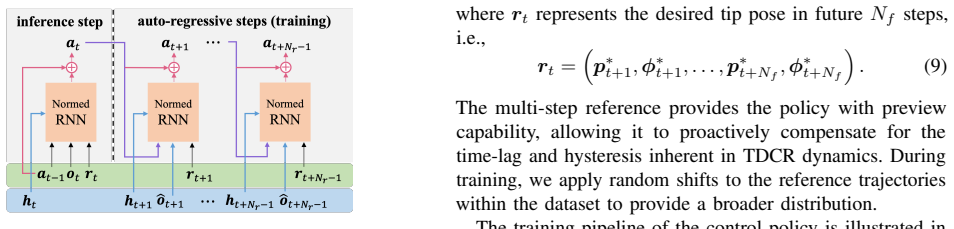
The central claim is that a GRU-based dynamics model with bidirectional multi-channel connectivity and residual prediction suppresses compounding errors during long-horizon auto-regressive rollout. Treating the trained model as a gradient bridge then permits direct back-propagation to optimize an end-to-end neural policy that implicitly compensates for frictional hysteresis and transmission compliance. On a physical three-section TDCR the resulting controller delivers accurate tracking, maintains performance under previously unseen payloads, and removes the self-excited oscillations that Jacobian methods produce.
What carries the argument
GRU-based dynamics model with bidirectional multi-channel connectivity and residual prediction, acting as a differentiable gradient bridge for end-to-end neural policy optimization.
If this is right
- Accurate end-effector tracking is maintained on hardware despite frictional and compliant nonlinearities.
- Performance remains stable when the robot carries previously unseen payloads.
- Self-excited oscillations that appear under Jacobian-based controllers are eliminated.
- The policy learns compensation for hysteresis and transmission effects without explicit analytic terms.
Where Pith is reading between the lines
- The same modeling-plus-gradient-bridge pattern could be tried on other soft or cable-driven mechanisms whose physics resist closed-form description.
- Controllers trained this way might transfer more readily from simulation to hardware because the learned dynamics already capture real behavior.
- Replacing analytic Jacobians with learned bridges could shorten the design cycle for new continuum robot prototypes.
- The bidirectional residual structure may prove useful for other long-horizon prediction tasks in robotics where error accumulation is the main obstacle.
Load-bearing premise
The chosen GRU architecture with its bidirectional channels and residual terms actually keeps prediction error from growing over many future steps, which is required for the policy to learn useful compensations.
What would settle it
If the physical three-section robot under the learned controller still shows self-excited oscillations or loses tracking accuracy when an unseen payload is applied, the claim that the framework outperforms Jacobian methods would be refuted.
Figures



read the original abstract
Tendon-Driven Continuum Robots (TDCRs) pose significant modeling and control challenges due to complex nonlinearities, such as frictional hysteresis and transmission compliance. This paper proposes a differentiable learning framework that integrates high-fidelity dynamics modeling with robust neural control. We develop a GRU-based dynamics model featuring bidirectional multi-channel connectivity and residual prediction to effectively suppress compounding errors during long-horizon auto-regressive prediction. By treating this model as a gradient bridge, an end-to-end neural control policy is optimized through backpropagation, allowing it to implicitly internalize compensation for intricate nonlinearities. Experimental validation on a physical three-section TDCR demonstrates that our framework achieves accurate tracking and superior robustness against unseen payloads, outperforming Jacobian-based methods by eliminating self-excited oscillations. For implementation details and source code, please refer to https://github.com/ZiqingZou/ContinuumControl.
Editorial analysis
A structured set of objections, weighed in public.
Referee Report
Summary. The manuscript presents a differentiable learning framework for dynamics modeling and control of tendon-driven continuum robots. It introduces a GRU-based dynamics model incorporating bidirectional multi-channel connectivity and residual prediction to reduce compounding errors in long-horizon autoregressive rollouts. This model acts as a gradient bridge for end-to-end optimization of a neural control policy via backpropagation, enabling implicit compensation for nonlinear effects such as frictional hysteresis and transmission compliance. Experimental validation on a physical three-section TDCR is claimed to demonstrate accurate tracking, superior robustness to unseen payloads, and elimination of self-excited oscillations relative to Jacobian-based baselines.
Significance. If the empirical claims are supported by detailed quantitative evidence, the work contributes a practical end-to-end differentiable pipeline for robust control of continuum robots, which are challenging due to their nonlinear dynamics. The physical-robot experiments and direct comparison to standard Jacobian methods constitute a strength, as does the focus on suppressing autoregressive drift through residual and bidirectional modeling choices. This approach could inform similar learning-based control strategies in other soft or continuum robotic systems.
major comments (1)
- [Experimental Validation] The abstract and experimental validation section assert that the framework achieves accurate tracking and superior robustness against unseen payloads while outperforming Jacobian-based methods by eliminating self-excited oscillations, yet supply no quantitative metrics, data collection details, training procedures, error bars, or statistical comparisons; this prevents assessment of the central performance claims.
Simulated Author's Rebuttal
We thank the referee for the constructive feedback and positive assessment of the significance of our work. We address the major comment point-by-point below and will revise the manuscript accordingly to improve clarity and completeness of the experimental validation.
read point-by-point responses
-
Referee: The abstract and experimental validation section assert that the framework achieves accurate tracking and superior robustness against unseen payloads while outperforming Jacobian-based methods by eliminating self-excited oscillations, yet supply no quantitative metrics, data collection details, training procedures, error bars, or statistical comparisons; this prevents assessment of the central performance claims.
Authors: We acknowledge that while the experimental validation section includes figures demonstrating the performance, the text does not sufficiently highlight the quantitative metrics, and details on data collection and training are somewhat brief. We agree this makes it difficult to fully assess the claims. In the revised manuscript, we will expand Section V to include explicit numerical results (e.g., mean and standard deviation of tracking errors for various conditions), detailed data collection protocols (number of trials, sampling rates, payload specifications), training procedures (optimizer, epochs, loss functions), and statistical comparisons. We will also add error bars where missing and include a summary table of key performance metrics. The abstract will remain at a high level as is conventional, but we will ensure the experimental section provides all necessary quantitative evidence. revision: yes
Circularity Check
No significant circularity identified
full rationale
The paper's core chain consists of (1) training a GRU dynamics model on data with standard architectural choices (bidirectional multi-channel connectivity + residual prediction) to reduce autoregressive error accumulation, then (2) using the trained model as a differentiable simulator to backpropagate gradients into an end-to-end neural policy. Neither step reduces to its inputs by construction: the dynamics model is fitted to observed trajectories and evaluated on held-out or physical data, while the policy optimization is a standard RL-style gradient descent whose performance is measured by external tracking and robustness metrics on unseen payloads. No self-citation is invoked as a load-bearing uniqueness theorem, no fitted parameter is relabeled as a prediction, and no ansatz is smuggled in. The experimental claims remain falsifiable against Jacobian baselines on the physical hardware.
Axiom & Free-Parameter Ledger
free parameters (2)
- GRU network weights
- Neural control policy weights
axioms (2)
- domain assumption The learned dynamics model is differentiable
- ad hoc to paper Residual prediction and bidirectional connectivity suppress compounding errors in long-horizon rollouts
discussion (0)
Sign in with ORCID, Apple, or X to comment. Anyone can read and Pith papers without signing in.