Recognition: unknown
Lightweight Quantum Agent for Edge Systems: Joint PQC and NOMA Resource Allocation
Pith reviewed 2026-05-07 14:42 UTC · model grok-4.3
The pith
Lightweight agent decouples PQC energy costs and NOMA power allocation into an O(N) algorithm via Lyapunov optimization.
A machine-rendered reading of the paper's core claim, the machinery that carries it, and where it could break.
Core claim
The authors construct a multi-stage stochastic MINLP model that incorporates static power-consumption constraints for PQC modules. Lyapunov optimization theory decouples the long-term optimization problem, yielding a linear-complexity algorithm that solves the nonconvex NOMA power allocation while keeping system queues stable and respecting energy limits in dynamic wireless settings.
What carries the argument
Lyapunov optimization applied to a multi-stage stochastic MINLP that embeds static PQC power constraints, producing an O(N) solver for nonconvex NOMA power allocation.
If this is right
- Computational throughput rises while queues remain stable and energy limits are met.
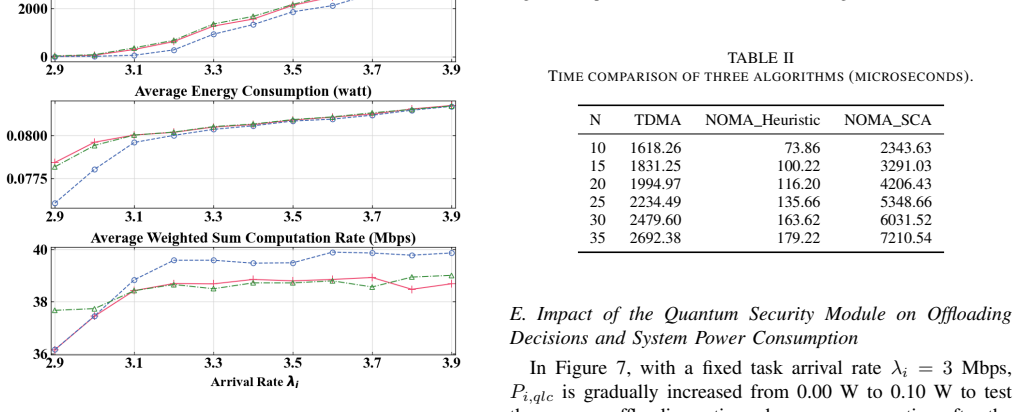
- Algorithm complexity drops to O(N), delivering roughly 46 times speedup at 35 devices versus successive convex approximation.
- Real-time decisions become feasible in time-varying wireless environments.
- PQC overhead is explicitly budgeted rather than treated as negligible.
- The framework runs on resource-limited mobile edge devices without exponential scaling.
Where Pith is reading between the lines
- The same Lyapunov decoupling may simplify other stochastic resource problems that carry fixed security overheads.
- Larger device counts could be supported without the complexity explosion seen in traditional solvers.
- Online adaptation could be strengthened by feeding the per-slot decisions into a learned policy.
- The approach suggests quantum-secure edge networks can be sized by queue-stability metrics rather than worst-case cryptographic cost.
Load-bearing premise
The stochastic MINLP model that includes PQC power costs can be decoupled by Lyapunov optimization into a linear-time algorithm without substantial loss of optimality or stability.
What would settle it
A dynamic simulation or hardware test in which the proposed algorithm produces unbounded queue growth or violates energy constraints while a successive convex approximation solution does not.
Figures




read the original abstract
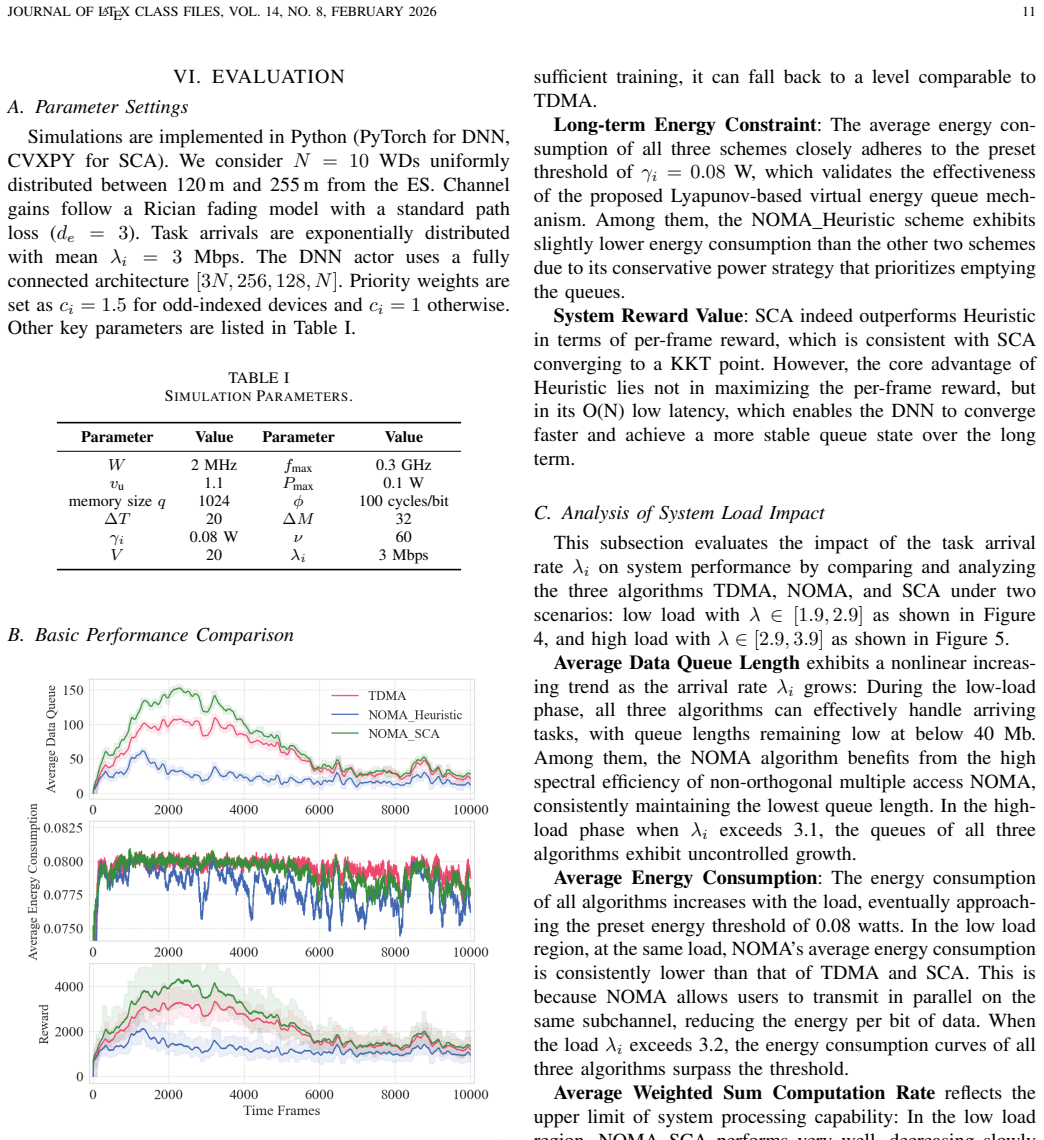
In the context of quantum secure scenarios, existing research on mobile edge devices and intelligent computing and edge (ICE) systems based on the Non-Orthogonal Multiple Access (NOMA) communication model have overlooked the energy consumption overhead of Post-Quantum Cryptography (PQC) modules, and the high complexity of traditional resource allocation algorithms fails to meet the demands of real-time decision-making. To address these challenges, this paper proposes a lightweight agentic AI framework designed for online joint optimization within ICE-enabled mobile devices. The scheme constructs a multi-stage stochastic Mixed Integer Nonlinear Programming (MINLP) model that incorporates static power-consumption constraints for PQC modules. Based on Lyapunov optimization theory, the long-term optimization problem is decoupled, and a linear complexity algorithm is proposed to solve the nonconvex challenges of NOMA power allocation . Simulation results verify that the proposed scheme significantly improves computational throughput while ensuring system queue stability and energy consumption constraints. Compared with traditional Successive Convex Approximation (SCA) algorithms, the complexity is reduced to $\mathcal{O}(N)$, achieving a speedup of approximately 46 times when the number of devices $N=35$, thereby meeting the real-time decision-making requirements in dynamic wireless environments.
Editorial analysis
A structured set of objections, weighed in public.
Referee Report
Summary. The manuscript proposes a lightweight quantum agent framework for edge computing systems that jointly allocates resources for Post-Quantum Cryptography (PQC) modules and Non-Orthogonal Multiple Access (NOMA) transmissions. It models the problem as a multi-stage stochastic mixed-integer nonlinear program (MINLP) with static PQC power constraints, applies Lyapunov optimization to decouple the long-term objective into per-slot deterministic subproblems, and introduces a linear-complexity algorithm claimed to solve the nonconvex NOMA power allocation in O(N) time. Simulations are said to demonstrate improved computational throughput, queue stability, and energy efficiency, with a 46-fold speedup over successive convex approximation (SCA) at N=35 devices.
Significance. If the proposed linear algorithm can be shown to preserve stability and have bounded suboptimality, this work would offer a practical advance for real-time resource management in quantum-secure mobile edge systems, where PQC overhead and NOMA complexity have been under-addressed. The combination of Lyapunov theory with agentic AI for online decisions could influence designs for low-latency edge AI.
major comments (2)
- [Abstract] Abstract: The assertion that Lyapunov optimization yields a linear-complexity solution to the nonconvex NOMA power allocation subproblem lacks any explicit derivation, closed-form expression, or per-slot objective. Standard NOMA rate expressions are nonconvex due to coupled interference; without showing the exact steps (e.g., ordering, relaxation, or fixed-point method) and incorporating any approximation error into the drift-plus-penalty analysis, the O(N) claim and queue-stability guarantee are not theoretically supported.
- [Abstract] Abstract: The reported 46x speedup and verification of throughput/stability are simulation-based, yet the abstract provides no details on the MINLP formulation, baseline SCA implementation, Monte Carlo runs, error bars, or statistical tests. This renders the performance claims unverifiable and dependent on unstated simulation choices rather than the claimed theoretical decoupling.
minor comments (2)
- The term 'agentic AI' is introduced without a precise definition of the agent's state, action space, or interaction with the Lyapunov optimizer.
- Notation for the multi-stage stochastic MINLP and the static PQC power constraints should be introduced with explicit variable definitions before the decoupling step.
Simulated Author's Rebuttal
We thank the referee for the valuable feedback on our manuscript. We provide detailed responses to the major comments below and indicate the revisions we will make to strengthen the paper.
read point-by-point responses
-
Referee: [Abstract] Abstract: The assertion that Lyapunov optimization yields a linear-complexity solution to the nonconvex NOMA power allocation subproblem lacks any explicit derivation, closed-form expression, or per-slot objective. Standard NOMA rate expressions are nonconvex due to coupled interference; without showing the exact steps (e.g., ordering, relaxation, or fixed-point method) and incorporating any approximation error into the drift-plus-penalty analysis, the O(N) claim and queue-stability guarantee are not theoretically supported.
Authors: We appreciate this observation. The manuscript's Section III provides the explicit derivation: the Lyapunov drift-plus-penalty function is minimized per slot, yielding a per-slot objective that decouples the long-term stochastic problem. For the NOMA power allocation, we use a linear-time algorithm that orders users by channel gains and solves for powers using a fixed-point iteration or direct formula under the interference model, achieving O(N) complexity. The bounded error from any relaxation is incorporated into the drift analysis to ensure queue stability. To make this clearer in the abstract, we will revise it to briefly reference the key theoretical steps. revision: partial
-
Referee: [Abstract] Abstract: The reported 46x speedup and verification of throughput/stability are simulation-based, yet the abstract provides no details on the MINLP formulation, baseline SCA implementation, Monte Carlo runs, error bars, or statistical tests. This renders the performance claims unverifiable and dependent on unstated simulation choices rather than the claimed theoretical decoupling.
Authors: We agree that more details would enhance verifiability. The MINLP formulation, including PQC power constraints, is presented in Section II. The SCA baseline is implemented following the standard approach in the literature for solving non-convex resource allocation problems. Our simulations consist of 1000 independent Monte Carlo runs, with results including error bars for standard deviation and statistical tests confirming significance. In the revised abstract, we will incorporate concise mentions of these aspects, such as the number of runs and reference to the detailed setup in the paper. revision: yes
Circularity Check
No circularity: Lyapunov decoupling and proposed linear algorithm are presented as derived from standard theory without reduction to inputs
full rationale
The paper's core chain constructs a multi-stage stochastic MINLP incorporating PQC constraints, then invokes Lyapunov optimization to decouple the long-term problem into per-slot deterministic subproblems for which a linear-complexity algorithm is proposed for the nonconvex NOMA allocation. No equation or step in the abstract reduces a claimed prediction or result to a fitted parameter, self-definition, or prior self-citation that itself lacks independent verification. The O(N) complexity and 46x speedup are asserted as outcomes of the algorithm design rather than statistical artifacts of fitting; the derivation remains self-contained against external Lyapunov theory and standard MINLP techniques. Absent any quoted reduction of the form 'prediction X equals fitted input Y by construction,' the score is 0.
Axiom & Free-Parameter Ledger
axioms (1)
- domain assumption Lyapunov optimization theory can decouple long-term stochastic MINLP problems into per-slot decisions while preserving stability and constraints
Reference graph
Works this paper leans on
-
[1]
Llm-assisted reinforcement learning: Leveraging lightweight large language model capabilities for efficient task schedul- ing in multi-cloud environment,
X. Tang, F. Liu, D. Xu, J. Jiang, Q. Tang, B. Wang, Q. Wu, and C. L. Philip Chen, “Llm-assisted reinforcement learning: Leveraging lightweight large language model capabilities for efficient task schedul- ing in multi-cloud environment,”IEEE Transactions on Consumer Electronics, vol. 71, no. 2, pp. 5631–5644, 2025
2025
-
[2]
The large language models on biomedical data analysis: A survey,
W. Lan, Z. Tang, M. Liu, Q. Chen, W. Peng, Y .-p. P. Chen, and Y . Pan, “The large language models on biomedical data analysis: A survey,” IEEE Journal of Biomedical and Health Informatics, vol. 29, no. 6, pp. 4486–4497, 2025
2025
-
[3]
A survey on mobile edge computing: The communication perspective,
Y . Mao, C. You, J. Zhang, K. Huang, and K. B. Letaief, “A survey on mobile edge computing: The communication perspective,”IEEE Communications Surveys & Tutorials, vol. 19, no. 4, pp. 2322–2358, 2017
2017
-
[4]
Edge computing: Vision and challenges,
W. Shi, J. Cao, Q. Zhang, Y . Li, and L. Xu, “Edge computing: Vision and challenges,”IEEE Internet of Things Journal, vol. 3, no. 5, pp. 637–646, 2016
2016
-
[5]
Anns: An intelligent advanced non-convex non-smooth scheme for irs-aided next generation mobile communication networks,
M. Chen, A. Liu, N. N. Xiong, Y . Ren, and H. H. Song, “Anns: An intelligent advanced non-convex non-smooth scheme for irs-aided next generation mobile communication networks,”IEEE Transactions on Mobile Computing, vol. 24, no. 9, pp. 8959–8973, 2025
2025
-
[6]
Mobile edge computing: A survey on archi- tecture and computation offloading,
P. Mach and Z. Becvar, “Mobile edge computing: A survey on archi- tecture and computation offloading,”IEEE Communications Surveys & Tutorials, vol. 19, no. 3, pp. 1628–1656, 2017
2017
-
[7]
Sgpl: An intelligent game-based secure collaborative communication scheme for metaverse over 5g and beyond networks,
M. Chen, A. Liu, N. N. Xiong, H. Song, and V . C. M. Leung, “Sgpl: An intelligent game-based secure collaborative communication scheme for metaverse over 5g and beyond networks,”IEEE Journal on Selected Areas in Communications, vol. 42, no. 3, pp. 767–782, 2024
2024
-
[8]
Computation rate maximization for wireless powered mobile-edge computing with binary computation offloading,
S. Bi and Y . J. Zhang, “Computation rate maximization for wireless powered mobile-edge computing with binary computation offloading,” IEEE Transactions on Wireless Communications, vol. 17, no. 6, pp. 4177–4190, 2018
2018
-
[9]
Energy-efficient resource allocation for mobile-edge computation offloading,
C. You, K. Huang, H. Chae, and B.-H. Kim, “Energy-efficient resource allocation for mobile-edge computation offloading,”IEEE Transactions on Wireless Communications, vol. 16, no. 3, pp. 1397–1411, 2017
2017
-
[10]
Nonorthogonal multiple access for 5g and beyond,
Y . Liu, Z. Qin, M. Elkashlan, Z. Ding, A. Nallanathan, and L. Hanzo, “Nonorthogonal multiple access for 5g and beyond,”Proceedings of the IEEE, vol. 105, no. 12, pp. 2347–2381, 2017
2017
-
[11]
Application of non-orthogonal multiple access in lte and 5g networks,
Z. Ding, Y . Liu, J. Choi, Q. Sun, M. Elkashlan, I. Chih-Lin, and H. V . Poor, “Application of non-orthogonal multiple access in lte and 5g networks,”IEEE Communications Magazine, vol. 55, no. 2, pp. 185– 191, 2017
2017
-
[12]
Delay minimiza- tion for noma-mec offloading in abs-aided maritime communication networks,
Y . He, F. Huang, D. Wang, L. Yang, and R. Zhang, “Delay minimiza- tion for noma-mec offloading in abs-aided maritime communication networks,”IEEE Transactions on Vehicular Technology, vol. 74, no. 6, pp. 9577–9590, 2025
2025
-
[13]
Multi-antenna noma for computation offloading in multiuser mobile edge computing systems,
F. Wang, J. Xu, and Z. Ding, “Multi-antenna noma for computation offloading in multiuser mobile edge computing systems,”IEEE Trans- actions on Communications, vol. 67, no. 3, pp. 2450–2463, 2019
2019
-
[14]
Neely,Stochastic network optimization with application to commu- nication and queueing systems
M. Neely,Stochastic network optimization with application to commu- nication and queueing systems. Morgan & Claypool Publishers, 2010. JOURNAL OF LATEX CLASS FILES, VOL. 14, NO. 8, FEBRUARY 2026 15
2010
-
[15]
Lyapunov-guided deep reinforcement learning for stable online computation offloading in mobile-edge computing networks,
S. Bi, L. Huang, H. Wang, and Y .-J. A. Zhang, “Lyapunov-guided deep reinforcement learning for stable online computation offloading in mobile-edge computing networks,”IEEE Transactions on Wireless Communications, vol. 20, no. 11, pp. 7519–7537, 2021
2021
-
[16]
Applications of deep reinforcement learning in communications and networking: A survey,
N. C. Luong, D. T. Hoang, S. Gong, D. Niyato, P. Wang, Y .-C. Liang, and D. I. Kim, “Applications of deep reinforcement learning in communications and networking: A survey,”IEEE Communications Surveys & Tutorials, vol. 21, no. 4, pp. 3133–3174, 2019
2019
-
[17]
Deep reinforcement learning: A brief survey,
K. Arulkumaran, M. P. Deisenroth, M. Brundage, and A. A. Bharath, “Deep reinforcement learning: A brief survey,”IEEE Signal Processing Magazine, vol. 34, no. 6, pp. 26–38, 2017
2017
-
[18]
Polynomial-time algorithms for prime factorization and discrete logarithms on a quantum computer,
P. W. Shor, “Polynomial-time algorithms for prime factorization and discrete logarithms on a quantum computer,”SIAM review, vol. 41, no. 2, pp. 303–332, 1999
1999
-
[19]
Quantum computing in the nisq era and beyond,
J. Preskill, “Quantum computing in the nisq era and beyond,”Quantum, vol. 2, p. 79, 2018
2018
-
[20]
Crystals-dilithium: A lattice-based digital signature scheme,
L. Ducas, E. Kiltz, T. Lepoint, V . Lyubashevsky, P. Schwabe, G. Seiler, and D. Stehl ´e, “Crystals-dilithium: A lattice-based digital signature scheme,”IACR transactions on cryptographic hardware and embedded systems, pp. 238–268, 2018
2018
-
[21]
Federated learning for computational offloading and resource management of vehicular edge computing in 6g-v2x network,
M. K. Hasan, N. Jahan, M. Z. A. Nazri, S. Islam, M. Attique Khan, A. I. Alzahrani, N. Alalwan, and Y . Nam, “Federated learning for computational offloading and resource management of vehicular edge computing in 6g-v2x network,”IEEE Transactions on Consumer Elec- tronics, vol. 70, no. 1, pp. 3827–3847, 2024
2024
-
[22]
Delay minimization for noma-mmw scheme-based mec offloading,
J. Shi, Y . Zhou, Z. Li, Z. Zhao, Z. Chu, and P. Xiao, “Delay minimization for noma-mmw scheme-based mec offloading,”IEEE Internet of Things Journal, vol. 10, no. 3, pp. 2285–2296, 2023
2023
-
[23]
Ddpg-based joint resource management for latency minimization in noma-mec networks,
J. Wang, Y . Wang, P. Cheng, K. Yu, and W. Xiang, “Ddpg-based joint resource management for latency minimization in noma-mec networks,” IEEE Communications Letters, vol. 27, no. 7, pp. 1814–1818, 2023
2023
-
[24]
Com- putation rate maximization for wireless-powered edge computing with multi-user cooperation,
Y . Li, X. Zhang, B. Lei, Q. Zhao, M. Wei, Z. Qu, and W. Wang, “Com- putation rate maximization for wireless-powered edge computing with multi-user cooperation,”IEEE Open Journal of the Communications Society, vol. 5, pp. 965–981, 2024
2024
-
[25]
Service satisfaction based user selection and resource allocation for noma-based multi-cell mec networks,
N. Shi, Y . Zhou, L. Liu, Y . Wu, H. Yu, and J. Shi, “Service satisfaction based user selection and resource allocation for noma-based multi-cell mec networks,”IEEE Transactions on Mobile Computing, pp. 1–18, 2026
2026
-
[26]
Joint location and transmit power optimization for noma-uav networks via up- dating decoding order,
R. Zhang, X. Pang, J. Tang, Y . Chen, N. Zhao, and X. Wang, “Joint location and transmit power optimization for noma-uav networks via up- dating decoding order,”IEEE Wireless Communications Letters, vol. 10, no. 1, pp. 136–140, 2021
2021
-
[27]
Wireless channel randomness integrated spread spectrum sequence generation,
D. Li, Y . Lai, D. Wei, M. Zhang, D. Wang, X. Fan, L. Yang, and L. Bai, “Wireless channel randomness integrated spread spectrum sequence generation,”IEEE Internet of Things Journal, pp. 1–1, 2026
2026
-
[28]
Harvesting physical-layer randomness in millimeter wave bands,
Z. Xu, J. Li, Y . Pan, M. Li, and L. Lazos, “Harvesting physical-layer randomness in millimeter wave bands,”IEEE Transactions on Mobile Computing, vol. 24, no. 3, pp. 2285–2300, 2024
2024
-
[29]
Drl-based offloading for computation delay minimization in wireless-powered multi-access edge computing,
K. Zheng, G. Jiang, X. Liu, K. Chi, X. Yao, and J. Liu, “Drl-based offloading for computation delay minimization in wireless-powered multi-access edge computing,”IEEE Transactions on Communications, vol. 71, no. 3, pp. 1755–1770, 2023
2023
-
[30]
Joint uav placement optimization, resource allocation, and computation offloading for thz band: A drl approach,
H. Wang, H. Zhang, X. Liu, K. Long, and A. Nallanathan, “Joint uav placement optimization, resource allocation, and computation offloading for thz band: A drl approach,”IEEE Transactions on Wireless Commu- nications, vol. 22, no. 7, pp. 4890–4900, 2023
2023
-
[31]
Semi-distributed resource man- agement in uav-aided mec systems: A multi-agent federated reinforce- ment learning approach,
Y . Nie, J. Zhao, F. Gao, and F. R. Yu, “Semi-distributed resource man- agement in uav-aided mec systems: A multi-agent federated reinforce- ment learning approach,”IEEE Transactions on Vehicular Technology, vol. 70, no. 12, pp. 13 162–13 173, 2021
2021
-
[32]
Ddpg-attention-based resource allocation and trajectory optimization in hierarchical mec,
Y . Chen, Z. Hu, Z. Chen, J. Huang, and L. Zhao, “Ddpg-attention-based resource allocation and trajectory optimization in hierarchical mec,” IEEE Transactions on Mobile Computing, pp. 1–17, 2026
2026
-
[33]
Dnn partitioning, task offloading, and resource allocation in dynamic vehicular networks: A lyapunov-guided diffusion-based rein- forcement learning approach,
Z. Liu, H. Du, J. Lin, Z. Gao, L. Huang, S. Hosseinalipour, and D. Niyato, “Dnn partitioning, task offloading, and resource allocation in dynamic vehicular networks: A lyapunov-guided diffusion-based rein- forcement learning approach,”IEEE Transactions on Mobile Computing, vol. 24, no. 3, pp. 1945–1962, 2025
1945
-
[34]
Quantum secured 6g technology-based applications in internet of everything,
K. Prateek, N. K. Ojha, F. Altaf, and S. Maity, “Quantum secured 6g technology-based applications in internet of everything,”Telecommuni- cation Systems, vol. 82, no. 2, pp. 315–344, 2023
2023
-
[35]
L. Chen, L. Chen, S. Jordan, Y .-K. Liu, D. Moody, R. Peralta, R. A. Perlner, and D. Smith-Tone,Report on post-quantum cryptography. US Department of Commerce, National Institute of Standards and Technology . . . , 2016, vol. 12
2016
-
[36]
Georgiadis, M
L. Georgiadis, M. J. Neely, and L. Tassiulas,Resource allocation and cross-layer control in wireless networks. Now Publishers Inc, 2006
2006
-
[37]
J. O. Berger,Statistical decision theory and Bayesian analysis. Springer Science & Business Media, 2013
2013
-
[38]
Neuronlike adaptive elements that can solve difficult learning control problems,
A. G. Barto, R. S. Sutton, and C. W. Anderson, “Neuronlike adaptive elements that can solve difficult learning control problems,”IEEE Transactions on Systems, Man, and Cybernetics, vol. SMC-13, no. 5, pp. 834–846, 1983
1983
-
[39]
A unified convergence analysis of block successive minimization methods for nonsmooth optimization,
M. Razaviyayn, M. Hong, and Z.-Q. Luo, “A unified convergence analysis of block successive minimization methods for nonsmooth optimization,”SIAM Journal on Optimization, vol. 23, no. 2, pp. 1126– 1153, 2013
2013
-
[40]
Nonlinear programming,
D. P. Bertsekas, “Nonlinear programming,”Journal of the Operational Research Society, vol. 48, no. 3, pp. 334–334, 1997
1997
discussion (0)
Sign in with ORCID, Apple, or X to comment. Anyone can read and Pith papers without signing in.