Discovery of Quasar Variability and Early Accretion Disk Signatures at Cosmic Dawn
Pith reviewed 2026-05-09 18:23 UTC · model grok-4.3
The pith
Variability observations show that an early quasar's accretion disk is geometrically thin and optically thick.
A machine-rendered reading of the paper's core claim, the machinery that carries it, and where it could break.
Core claim
The central claim is that multi-filter infrared variability and X-ray variability have been measured in a quasar at redshift corresponding to 850 million years after the Big Bang, and that the spectrum of this variability matches the expected emission from a geometrically thin, optically thick accretion disk with an overlying corona. This provides the first observational evidence for standard disk structure at such early times when quasars accrete at high Eddington ratios.
What carries the argument
The variable spectrum built from the amplitude of brightness changes across infrared filters and X-ray bands, which encodes the radial temperature profile of the accretion disk.
If this is right
- Accretion-disk structure can be measured directly at redshifts corresponding to the first billion years.
- Variability becomes a viable tool for probing accretion physics and black-hole masses during the epoch of early supermassive-black-hole growth.
- Large samples of variable high-redshift quasars will become available with wide-field time-domain surveys, enabling population studies.
- The same variability techniques used locally can now be applied at cosmic dawn.
Where Pith is reading between the lines
- Thin-disk models appear to remain valid even at the high accretion rates and dense environments expected at cosmic dawn.
- This approach could help test whether rapid black-hole assembly requires non-standard accretion modes.
- Future multi-epoch spectroscopy will be needed to confirm the disk origin of the variability for fainter sources.
Load-bearing premise
That the multi-filter infrared variability directly traces emission from the accretion disk without significant contamination from the host galaxy, dust reprocessing, or other sources.
What would settle it
Follow-up spectroscopy or higher-resolution imaging that separates the variable flux into disk, host-galaxy, and dust components; if the disk fraction is small, the thin-disk conclusion would fail.
Figures


read the original abstract
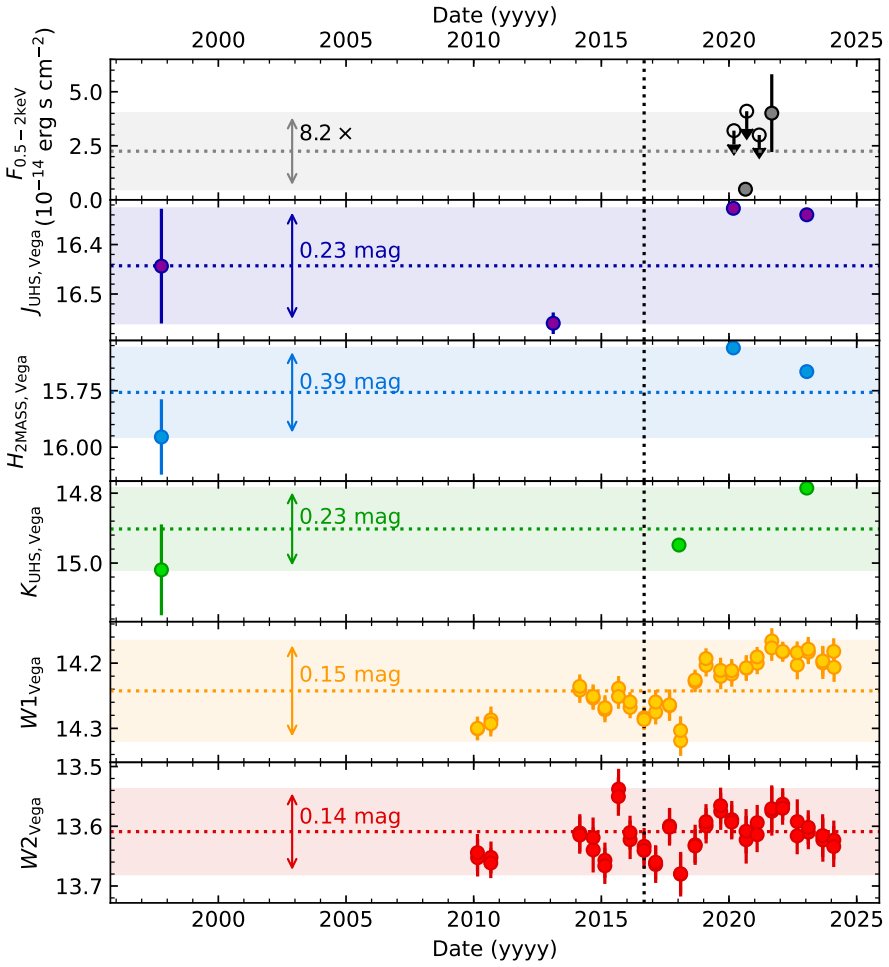
In the nearby universe, quasars are well known to exhibit variability in their brightness over time, offering a powerful tool to probe the physics of accretion onto the SMBH and directly measure the mass of the SMBH. However, detecting variability in early quasars remains challenging. Here, we report the detection of multi-wavelength infrared and X-ray variability in a quasar observed just 850 million years after the Big Bang. The infrared variability spans five filters, tracing rest-frame ultraviolet and optical emission from the accretion disk, while the X-ray variability probes the corona. The variable spectrum reveals that the accretion disk has a geometrically thin, optically thick structure. This provides observational constraints on the accretion disk structure at early times, when quasars are accreting at high Eddington ratios and reside in extreme environments. Our findings demonstrate the feasibility of characterizing accretion physics using variability in the early universe, laying the groundwork for studies exploiting upcoming facilities such as the Rubin Observatory and Roman Space Telescope. These facilities will discover large samples of variable high-redshift quasars, enabling population-level variability studies of accretion physics and black hole masses, filling key missing ingredients in understanding early SMBH growth.
Editorial analysis
A structured set of objections, weighed in public.
Referee Report
Summary. The paper reports the detection of multi-filter infrared variability (five filters) and X-ray variability in a quasar at z ≈ 7, observed 850 Myr after the Big Bang. The wavelength dependence of the IR variability is used to infer that the accretion disk has a geometrically thin, optically thick structure, providing early constraints on accretion physics at high Eddington ratios.
Significance. If substantiated with the necessary supporting data, this would be a notable result as one of the earliest direct probes of accretion disk geometry in the reionization-era universe. It demonstrates the viability of variability-based studies for constraining SMBH accretion and masses at cosmic dawn and sets the stage for population-level analyses with upcoming facilities such as Rubin and Roman.
major comments (2)
- [section presenting the variable spectrum and its interpretation] The central claim that the variable spectrum reveals a geometrically thin, optically thick disk depends on the five IR filters tracing pure rest-frame UV/optical accretion-disk emission. At z ≈ 7 the observed-frame IR bands include rest-frame wavelengths susceptible to variable contributions from host-galaxy starlight or dust-torus reprocessing, especially at high Eddington ratios. No quantitative decomposition, fractional-contribution limits, or host-subtraction test is presented to demonstrate that non-disk components contribute <20 % in any filter; without this the derived spectral shape cannot securely constrain disk geometry.
- [results section on variability detection] The abstract states a detection of IR and X-ray variability but supplies no light curves, photometric uncertainties, or statistical significance metrics (e.g., reduced χ², false-alarm probability, or σ levels) for the variability amplitudes. These elements are required to evaluate whether the reported signals exceed noise, systematics, or alternative explanations such as microlensing or variable dust extinction.
minor comments (2)
- [introduction] The abstract and introduction would benefit from explicit comparison to existing high-redshift quasar variability searches or theoretical thin-disk models at high Eddington ratio to better contextualize the novelty.
- [figures] Any figures displaying light curves or the variable spectrum should include error bars on all data points and clear labeling of the five IR filters and their corresponding rest-frame wavelengths.
Simulated Author's Rebuttal
We thank the referee for their constructive and detailed report. We address each major comment below and will revise the manuscript to incorporate the suggested improvements.
read point-by-point responses
-
Referee: [section presenting the variable spectrum and its interpretation] The central claim that the variable spectrum reveals a geometrically thin, optically thick disk depends on the five IR filters tracing pure rest-frame UV/optical accretion-disk emission. At z ≈ 7 the observed-frame IR bands include rest-frame wavelengths susceptible to variable contributions from host-galaxy starlight or dust-torus reprocessing, especially at high Eddington ratios. No quantitative decomposition, fractional-contribution limits, or host-subtraction test is presented to demonstrate that non-disk components contribute <20 % in any filter; without this the derived spectral shape cannot securely constrain disk geometry.
Authors: We agree that a quantitative demonstration of accretion-disk dominance is essential to securely interpret the variable spectrum. Although the observed variability timescales strongly favor a disk origin over host-galaxy or torus contributions, we will add an explicit decomposition in the revised manuscript. This will use multi-band SED modeling with host-galaxy and torus templates to derive fractional-contribution limits, showing non-disk components remain below 20% in each filter. The updated analysis and limits will be presented in the section on the variable spectrum. revision: yes
-
Referee: [results section on variability detection] The abstract states a detection of IR and X-ray variability but supplies no light curves, photometric uncertainties, or statistical significance metrics (e.g., reduced χ², false-alarm probability, or σ levels) for the variability amplitudes. These elements are required to evaluate whether the reported signals exceed noise, systematics, or alternative explanations such as microlensing or variable dust extinction.
Authors: We will add the light curves, photometric uncertainties, and full statistical metrics (including reduced χ² values, false-alarm probabilities, and significance levels) explicitly to the results section and reference them from the abstract in the revised manuscript. We will also expand the text to discuss and rule out alternative explanations such as microlensing and variable dust extinction using the multi-epoch, multi-wavelength data. revision: yes
Circularity Check
No circularity: purely observational detection with direct interpretation
full rationale
The paper reports multi-filter IR and X-ray variability detections in a z~7 quasar and interprets the wavelength dependence of the variable flux as evidence for a thin, optically thick accretion disk. No equations, parameter fits, predictions, or derivations appear in the abstract or described content. The central claim follows from the observed amplitudes across filters without reduction to self-defined inputs, fitted parameters renamed as predictions, or load-bearing self-citations. This is a standard observational result whose validity rests on data quality and contamination controls rather than any internal construction loop.
Axiom & Free-Parameter Ledger
Reference graph
Works this paper leans on
-
[1]
Fausnaugh, M.M.,et al.: Space Telescope and Optical Reverberation Mapping Project. III. Optical Continuum Emission and Broadband Time Delays in NGC 5548. Astrophys. J.821(1), 56 (2016)
work page 2016
-
[2]
Cackett, E.M.,et al.: Supermassive Black Holes with High Accretion Rates in Active Galactic Nuclei. XI. Accretion Disk Reverberation Mapping of Mrk 142. Astrophys. J.896(1), 1 (2020) 18
work page 2020
-
[3]
Pozo Nu ˜nez, F., Ba˜nados, E., Panda, S., Heidt, J.: Accretion disc reverberation mapping in a high-redshift quasar. Astron. Astrophys.700, 8 (2025)
work page 2025
- [4]
- [5]
- [6]
-
[7]
York, D.G.,et al.: The Sloan Digital Sky Survey: Technical Summary. Astron. J.120(3), 1579–1587 (2000)
work page 2000
-
[8]
Bellm, E.C.,et al.: The Zwicky Transient Facility: System Overview, Performance, and First Results. Publ. Astron. Soc. Pac.131(995), 018002 (2019)
work page 2019
-
[9]
Fan, X., Ba ˜nados, E., Simcoe, R.A.: Quasars and the Intergalactic Medium at Cosmic Dawn. Annu. Rev. Astron. Astrophys.61, 373–426 (2023)
work page 2023
-
[10]
Abramowicz, M.A., Czerny, B., Lasota, J.P., Szuszkiewicz, E.: Slim Accretion Disks. Astro- phys. J.332, 646 (1988)
work page 1988
- [11]
- [12]
-
[13]
Curti, M.,et al.: JADES: Insights into the low-mass end of the mass-metallicity-SFR relation at3< z <10from deep JWST/NIRSpec spectroscopy. Astron. Astrophys.684, 75 (2024)
work page 2024
- [14]
-
[15]
Wright, E.L.,et al.: The Wide-field Infrared Survey Explorer (WISE): Mission Description and Initial On-orbit Performance. Astron. J.140(6), 1868–1881 (2010)
work page 2010
- [16]
- [17]
-
[18]
Meisner, A.M., Lang, D., Schlafly, E.F., Schlegel, D.J.: Eight-year Full-depth unWISE Coadds. Res. Notes Am. Astron. Soc.6(3), 62 (2022)
work page 2022
-
[19]
Skrutskie, M.F.,et al.: The Two Micron All Sky Survey (2MASS). Astron. J.131(2), 1163– 1183 (2006)
work page 2006
-
[20]
Dye, S.,et al.: The UKIRT Hemisphere Survey: definition and J-band data release. Mon. Not. R. Astron. Soc.473(4), 5113–5125 (2018)
work page 2018
-
[21]
Schneider, A.C.,et al.: The Second and Third Data Releases from the UKIRT Hemisphere Survey. Astron. J.170(2), 86 (2025)
work page 2025
- [22]
-
[23]
Kara, E., Garc ´ıa, J.: Supermassive Black Holes in X-Rays: From Standard Accretion to Ex- treme Transients. Annu. Rev. Astron. Astrophys.63(1), 379–430 (2025)
work page 2025
-
[24]
Cackett, E.M., Horne, K., Winkler, H.: Testing thermal reprocessing in active galactic nuclei accretion discs. Mon. Not. R. Astron. Soc.380(2), 669–682 (2007)
work page 2007
-
[25]
Kelly, B.C., Bechtold, J., Siemiginowska, A.: Are the Variations in Quasar Optical Flux Driven by Thermal Fluctuations? Astrophys. J.698(1), 895–910 (2009)
work page 2009
-
[26]
Netzer, H.: The Physics and Evolution of Active Galactic Nuclei. Cambridge Univ. Press, Cambridge (2013)
work page 2013
-
[27]
Shakura, N.I., Sunyaev, R.A.: Black holes in binary systems. Observational appearance. As- tron. Astrophys.24, 337–355 (1973)
work page 1973
-
[28]
Edelson, R.,et al.: Space Telescope and Optical Reverberation Mapping Project. II. Swift and HST Reverberation Mapping of the Accretion Disk of NGC 5548. Astrophys. J.806(1), 129 (2015)
work page 2015
-
[29]
Nature627(8003), 281–285 (2024)
Abuter, R.,et al.: A dynamical measure of the black hole mass in a quasar 11 billion years ago. Nature627(8003), 281–285 (2024)
work page 2024
- [30]
- [31]
- [32]
- [33]
-
[34]
Lang, D.: unWISE: Unblurred Coadds of the WISE Imaging. Astron. J.147(5), 108 (2014)
work page 2014
-
[35]
Barbary, K.: SEP: Source Extractor as a library. J. Open Source Softw.1(6), 58 (2016)
work page 2016
-
[36]
Bertin, E., Arnouts, S.: SExtractor: Software for source extraction. Astron. Astrophys. Suppl. 117, 393–404 (1996)
work page 1996
-
[37]
Schlawin, E.,et al.: Jwst noise floor. i. random error sources in jwst nircam time series. Astron. J.160, 231 (2020)
work page 2020
- [38]
-
[39]
Predehl, P., et al.: The eROSITA X-ray telescope on SRG. Astron. Astrophys., 1 (2021)
work page 2021
-
[40]
First X-ray catalogues and data release of the western Galactic hemisphere
Merloni, A.,et al.: The SRG/eROSITA all-sky survey. First X-ray catalogues and data release of the western Galactic hemisphere. Astron. Astrophys.682, 34 (2024)
work page 2024
- [41]
- [42]
-
[43]
Science373(6556), 789–792 (2021)
Burke, C.J.,et al.: A characteristic optical variability time scale in astrophysical accretion disks. Science373(6556), 789–792 (2021)
work page 2021
-
[44]
Peterson, B.M.: An Introduction to Active Galactic Nuclei. Cambridge Univ. Press, Cam- bridge (1997)
work page 1997
- [45]
-
[46]
Peterson, B.M.,et al.: On Uncertainties in Cross-Correlation Lags and the Reality of Wavelength-dependent Continuum Lags in Active Galactic Nuclei. Publ. Astron. Soc. Pac. 110(748), 660–670 (1998) 21
work page 1998
-
[47]
Peterson, B.M.,et al.: Central Masses and Broad-Line Region Sizes of Active Galactic Nu- clei. II. A Homogeneous Analysis of a Large Reverberation-Mapping Database. Astrophys. J. 613(2), 682–699 (2004)
work page 2004
-
[48]
Breedt, E.,et al.: Long-term optical and X-ray variability of the Seyfert galaxy Markarian 79. Mon. Not. R. Astron. Soc.394(1), 427–437 (2009)
work page 2009
- [49]
- [50]
-
[51]
Zu, Y ., Kochanek, C.S., Kozłowski, S., Udalski, A.: Is Quasar Optical Variability a Damped Random Walk? Astrophys. J.765(2), 106 (2013)
work page 2013
-
[52]
Netzer, H.: Continuum reverberation mapping and a new lag-luminosity relationship for AGN. Mon. Not. R. Astron. Soc.509(2), 2637–2646 (2022)
work page 2022
-
[53]
Montano, J.W.,et al.: Optical Continuum Reverberation in the Dwarf Seyfert Nucleus of NGC
-
[54]
Astrophys. J. Lett.934(2), 37 (2022)
work page 2022
-
[55]
Weisenbach, L., Schechter, P.L., Pontula, S.: “Worst-case” Microlensing in the Identification and Modeling of Lensed Quasars. Astrophys. J.922(1), 70 (2021)
work page 2021
- [56]
-
[57]
Planck Collaboration,et al.: Planck 2018 results. VI. Cosmological parameters. Astron. As- trophys.641, 6 (2020) 22
work page 2018
discussion (0)
Sign in with ORCID, Apple, or X to comment. Anyone can read and Pith papers without signing in.