Recognition: unknown
Spectral- and Energy-efficient Multi-BS Multi-RIS Pinching-antenna Systems: A GNN-based Approach
Pith reviewed 2026-05-09 18:48 UTC · model grok-4.3
The pith
A three-stage graph neural network jointly optimizes pinching-antenna placement, RIS phase shifts, beamforming, and base-station association to raise sum rate and energy efficiency in multi-BS multi-RIS systems.
A machine-rendered reading of the paper's core claim, the machinery that carries it, and where it could break.
Core claim
The central claim is that the three-stage GNN, trained end-to-end without labels, consistently delivers higher sum rate and energy efficiency than representative system and learning baselines, generalizes to unseen counts of user equipment, reconfigurable surfaces, and base stations, and runs in milliseconds, while also confirming that increasing the number of pinching antennas enlarges the performance gains.
What carries the argument
The three-stage graph neural network that converts the multi-BS multi-RIS pinching-antenna configuration into heterogeneous and homogeneous graph inputs and produces joint decisions on antenna placement, phase shifts, beamforming vectors, and user association.
If this is right
- Pinching antennas raise both sum rate and energy efficiency, and the improvement grows with the number of antennas per base station.
- The same trained GNN works across different numbers of users, surfaces, and base stations without retraining.
- Inference remains at millisecond scale, allowing online use rather than offline planning.
- Joint optimization of placement, phases, beamforming, and association is required; separate optimization loses most of the reported gains.
Where Pith is reading between the lines
- Similar graph-based learning could handle other movable-element problems such as fluid antennas or swarm-based access points.
- Hardware prototypes would need to test whether the spacing and phase constraints assumed in the model hold under real waveguide losses.
- The energy-efficiency objective may favor different antenna densities than the sum-rate objective when power consumption of the waveguides is modeled more precisely.
Load-bearing premise
The idealized model with perfect channel state information, ideal unit-modulus phase shifts, and fixed inter-antenna spacing constraints accurately reflects the dominant limits of real pinching-antenna hardware and propagation.
What would settle it
Field measurements or simulations that include realistic channel estimation errors and non-ideal phase-shift responses, showing that the GNN-derived configurations produce lower rates or efficiency than simpler fixed-antenna baselines, would falsify the performance claims.
Figures



read the original abstract
This paper investigates coordinated downlink transmission in a multi-base station (multi-BS) multi-reconfigurable intelligent surface (multi-RIS)-assisted pinching-antenna (PA) system, where each user equipment (UE) is associated with a single BS and each BS is equipped with movable PAs deployed on parallel waveguides. We formulate sum rate (SR) and energy efficiency (EE) maximization problems by jointly optimizing PA placement, RIS phase shifts, transmit beamforming, and BS-UE association under constraints of inter-PA spacing, power budget, and unit-modulus phase shift. To address the resulting highly coupled mixed-variable problem, we propose a three-stage graph neural network (GNN) that integrates heterogeneous and homogeneous graph representations and is trained end-to-end in an unsupervised manner. Extensive numerical results demonstrate that the proposed three-stage GNN consistently outperforms representative system and learning baselines, generalizes well to unseen numbers of UEs, RISs, and BSs, and maintains millisecond-level inference time. Besides, the results validate the effectiveness of the proposed design from both system and architectural perspectives. Moreover, PAs are shown to enhance SR and EE, and the performance gain is enlarged with increasing number of PAs.
Editorial analysis
A structured set of objections, weighed in public.
Referee Report
Summary. The paper formulates sum-rate and energy-efficiency maximization problems for a multi-BS multi-RIS pinching-antenna downlink system by jointly optimizing PA positions along waveguides, RIS phase shifts, transmit beamforming, and BS-UE association subject to inter-PA spacing, power, and unit-modulus constraints. It proposes an unsupervised three-stage GNN that combines heterogeneous and homogeneous graph representations to solve the resulting non-convex mixed-integer program and reports that the learned policy consistently outperforms representative system and learning baselines, generalizes to unseen numbers of UEs/RISs/BSs, and achieves millisecond inference times.
Significance. If the performance claims hold, the work supplies a scalable, end-to-end trainable learning architecture for a practically relevant class of high-dimensional non-convex wireless optimization problems that incorporate movable antennas and RISs. The unsupervised training regime, explicit handling of heterogeneous graph structure, and reported generalization across system sizes are genuine strengths that could enable real-time deployment; the demonstration that additional PAs improve both SR and EE is also useful.
major comments (2)
- [Numerical results] Numerical results section: all reported gains are relative to other heuristics and learning baselines; no small-scale instances are solved to (near) optimality via exhaustive search, branch-and-bound, or tight convex relaxations. Consequently the absolute sub-optimality gap of the three-stage GNN remains unknown, which directly weakens both the outperformance and generalization statements.
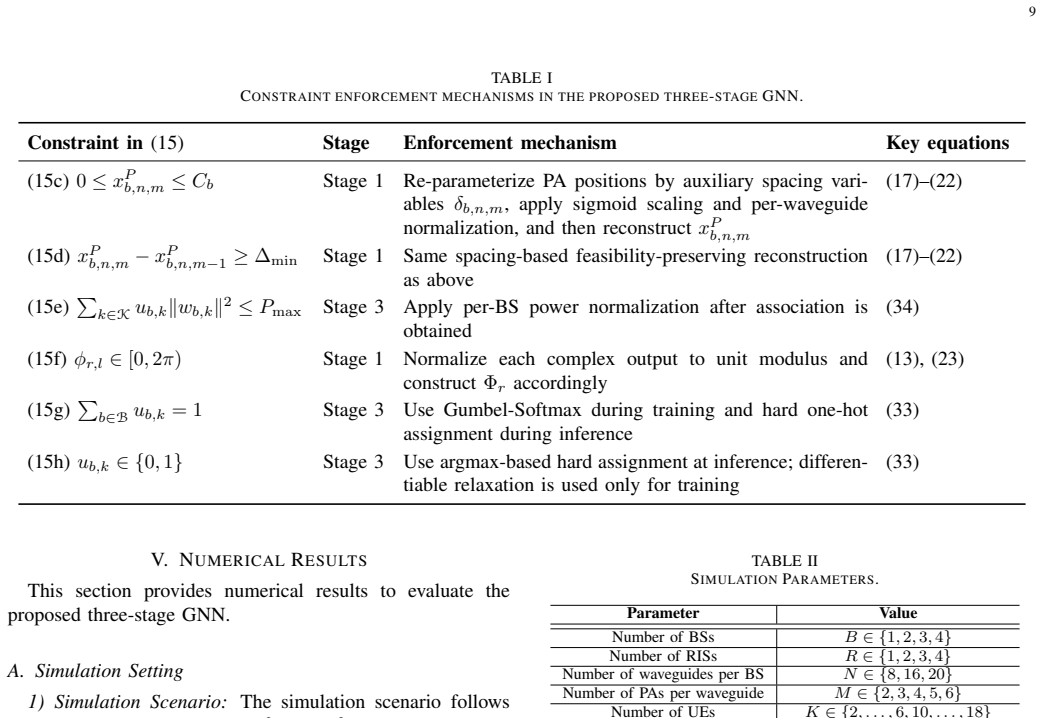
- [Problem formulation and GNN architecture] Problem formulation and GNN training: the unsupervised loss is stated to be the SR/EE objective, yet the manuscript does not detail how the unit-modulus and minimum-spacing constraints are enforced inside the GNN output layers or how the mixed-integer association variables are relaxed/rounded during training. This leaves open whether the reported performance already incorporates feasible solutions or requires post-processing whose effect is unquantified.
minor comments (2)
- [Abstract] The abstract and introduction repeatedly refer to a 'three-stage GNN' without a concise one-sentence description of what the three stages compute; adding this would improve readability for readers outside the immediate sub-field.
- [GNN architecture] Notation for the heterogeneous graph (nodes for BSs, RISs, UEs, PAs) is introduced but the precise edge-feature definitions and message-passing functions are only described at a high level; a small table summarizing node/edge types and their dimensions would aid reproducibility.
Simulated Author's Rebuttal
We sincerely thank the referee for the constructive and detailed review. We appreciate the recognition of the significance of our three-stage GNN approach for multi-BS multi-RIS pinching-antenna systems. Below we provide point-by-point responses to the major comments, with clarifications and commitments to revisions that address the concerns without misrepresenting the work.
read point-by-point responses
-
Referee: [Numerical results] Numerical results section: all reported gains are relative to other heuristics and learning baselines; no small-scale instances are solved to (near) optimality via exhaustive search, branch-and-bound, or tight convex relaxations. Consequently the absolute sub-optimality gap of the three-stage GNN remains unknown, which directly weakens both the outperformance and generalization statements.
Authors: We agree that absolute sub-optimality gaps on small instances would strengthen the validation of outperformance and generalization. However, the joint optimization is a high-dimensional non-convex mixed-integer program (continuous PA positions, beamforming, phases plus discrete associations), rendering exhaustive search or branch-and-bound intractable even for modest sizes (e.g., 2 BSs, 2 RISs, 4 UEs) due to exponential complexity in the discrete variables and the need for high-precision continuous optimization. In the revised manuscript we will add a dedicated subsection with results on the smallest tractable instances using tight convex relaxations (SDP for beamforming/phases) and limited enumeration over associations to quantify gaps where computationally feasible, along with a discussion of why full optimality verification is prohibitive at the scales of interest. This partial revision directly addresses the comment while reflecting the practical limitations of the problem class. revision: partial
-
Referee: [Problem formulation and GNN architecture] Problem formulation and GNN training: the unsupervised loss is stated to be the SR/EE objective, yet the manuscript does not detail how the unit-modulus and minimum-spacing constraints are enforced inside the GNN output layers or how the mixed-integer association variables are relaxed/rounded during training. This leaves open whether the reported performance already incorporates feasible solutions or requires post-processing whose effect is unquantified.
Authors: We thank the referee for highlighting this omission in the current manuscript. In the revised version we will expand Section III (GNN Architecture) and the training description to explicitly detail constraint handling: unit-modulus RIS phases are enforced by construction via direct parameterization of output angles θ with phase shifts e^{jθ}; minimum inter-PA spacing is incorporated through a differentiable penalty term in the unsupervised loss (or a post-output projection layer); mixed-integer BS-UE associations use a continuous softmax relaxation over logits during training so that the SR/EE loss remains differentiable, followed by argmax rounding at inference. We will also add numerical quantification of the performance difference between relaxed and rounded solutions to show the effect of any post-processing. These additions will confirm that reported results correspond to feasible solutions and clarify the end-to-end training process. revision: yes
Circularity Check
No circularity: GNN trained unsupervised on objective; results are simulation comparisons, not self-defined quantities
full rationale
The paper formulates a non-convex joint optimization problem and proposes a three-stage GNN trained end-to-end unsupervised to directly maximize the SR/EE objective under the stated constraints. Reported gains are obtained by running the trained GNN on test instances and comparing against independent system and learning baselines; no step reduces a claimed prediction or performance metric to a quantity fitted or defined only by the authors' own prior parameters or self-citations. The approach is self-contained against external benchmarks.
Axiom & Free-Parameter Ledger
axioms (2)
- domain assumption Perfect channel state information is available at the central controller.
- domain assumption RIS elements can achieve any phase shift on the unit circle.
Reference graph
Works this paper leans on
-
[1]
On the road to 6G: Visions, requirements, key technologies, and testbeds,
C.-X. Wanget al., “On the road to 6G: Visions, requirements, key technologies, and testbeds,”IEEE Commun. Surv. Tutorials, vol. 25, no. 2, pp. 905–974, Second Quart., 2023. 13
2023
-
[2]
Smart radio environments empowered by reconfigurable intelligent surfaces: How it works, state of research, and the road ahead,
M. Di Renzo, A. Zappone, M. Debbah, M.-S. Alouini, C. Yuen, J. de Rosny, and S. Tretyakov, “Smart radio environments empowered by reconfigurable intelligent surfaces: How it works, state of research, and the road ahead,”IEEE J. Sel. Areas Commun., vol. 38, no. 11, pp. 2450– 2525, Nov. 2020
2020
-
[3]
Wireless communications through reconfigurable intelligent surfaces,
E. Basar, M. Di Renzo, J. de Rosny, M. Debbah, M.-S. Alouini, and R. Zhang, “Wireless communications through reconfigurable intelligent surfaces,”IEEE Access, vol. 7, pp. 116753–116773, 2019
2019
-
[4]
Intelligent reflecting surface-aided wireless communications: A tutorial,
Q. Wu, S. Zhang, B. Zheng, C. You, and R. Zhang, “Intelligent reflecting surface-aided wireless communications: A tutorial,”IEEE Trans. Commun., vol. 69, no. 5, pp. 3313–3351, May 2021
2021
-
[5]
Reconfigurable intelligent surfaces: Principles and opportunities,
Y . Liu, X. Liu, X. Mu, T. Hou, J. Xu, M. Di Renzo, and N. Al-Dhahir, “Reconfigurable intelligent surfaces: Principles and opportunities,”IEEE Commun. Surv. Tutorials, vol. 23, no. 3, pp. 1546–1577, Third Quart., 2021
2021
-
[6]
Reconfigurable intelligent surfaces for energy efficiency in wireless communication,
C. Huang, A. Zappone, G. C. Alexandropoulos, M. Debbah, and C. Yuen, “Reconfigurable intelligent surfaces for energy efficiency in wireless communication,”IEEE Trans. Wireless Commun., vol. 18, no. 8, pp. 4157–4170, Aug. 2019
2019
-
[7]
Intelligent reflecting surface assisted secrecy communication: Is artificial noise helpful or not?
X. Guan, Q. Wu, and R. Zhang, “Intelligent reflecting surface assisted secrecy communication: Is artificial noise helpful or not?”IEEE Wireless Commun. Lett., vol. 9, no. 6, pp. 778–782, Jun. 2020
2020
-
[8]
Robust and secure wireless communi- cations via intelligent reflecting surfaces,
X. Yu, D. Xu, and R. Schober, “Robust and secure wireless communi- cations via intelligent reflecting surfaces,”IEEE J. Sel. Areas Commun., vol. 38, no. 11, pp. 2637–2652, Nov. 2020
2020
-
[9]
Multicell MIMO communications relying on intelligent reflecting surfaces,
C. Panet al., “Multicell MIMO communications relying on intelligent reflecting surfaces,”IEEE Trans. Wireless Commun., vol. 19, no. 8, pp. 5218–5233, Aug. 2020
2020
-
[10]
Movable antennas for wireless commu- nication: Opportunities and challenges,
L. Zhu, W. Ma, and R. Zhang, “Movable antennas for wireless commu- nication: Opportunities and challenges,”IEEE Commun. Mag., vol. 62, no. 6, pp. 114–120, Jun. 2024
2024
-
[11]
A tutorial on fluid antenna system for 6G networks: Encompassing communication theory, optimization methods and hard- ware designs,
W. K. Newet al., “A tutorial on fluid antenna system for 6G networks: Encompassing communication theory, optimization methods and hard- ware designs,”IEEE Commun. Surv. Tutorials, vol. 27, no. 4, pp. 2325– 2377, Fourth Quart., 2025
2025
-
[12]
Pinching-antenna systems (PASS): A tutorial,
Y . Liu, H. Jiang, X. Xu, Z. Wang, J. Guo, C. Ouyang, X. Mu, Z. Ding, A. Nallanathan, G. K. Karagiannidis, and R. Schober, “Pinching-antenna systems (PASS): A tutorial,”IEEE Trans. Commun., vol. 74, pp. 4881- 4918, 2026
2026
-
[13]
Flexible-antenna systems: A pinching-antenna perspective,
Z. Ding, R. Schober, and H. V . Poor, “Flexible-antenna systems: A pinching-antenna perspective,”IEEE Trans. Commun., vol. 73, no. 10, pp. 9236–9253, Oct. 2025
2025
-
[14]
Modeling and performance analysis for movable antenna enabled wireless communications,
L. Zhu, W. Ma, and R. Zhang, “Modeling and performance analysis for movable antenna enabled wireless communications,”IEEE Trans. Wireless Commun., vol. 23, no. 6, pp. 6234–6250, Jun. 2024
2024
-
[15]
Movable-antenna enhanced multiuser communication via antenna position optimization,
L. Zhu, W. Ma, B. Ning, and R. Zhang, “Movable-antenna enhanced multiuser communication via antenna position optimization,”IEEE Trans. Wireless Commun., vol. 23, no. 7, pp. 7214–7229, Jul. 2024
2024
-
[16]
MIMO capacity characterization for movable antenna systems,
W. Ma, L. Zhu, and R. Zhang, “MIMO capacity characterization for movable antenna systems,”IEEE Trans. Wireless Commun., vol. 23, no. 4, pp. 3392–3407, Apr. 2024
2024
-
[17]
Movable-antenna po- sition optimization: A graph-based approach,
W. Mei, X. Wei, B. Ning, Z. Chen, and R. Zhang, “Movable-antenna po- sition optimization: A graph-based approach,”IEEE Wireless Commun. Lett., vol. 13, no. 7, pp. 1853–1857, Jul. 2024
2024
-
[18]
Movable antennas meet intelligent reflecting surface: Friends or foes?
X. Wei, W. Mei, Q. Wu, Q. Jia, B. Ning, Z. Chen, and J. Fang, “Movable antennas meet intelligent reflecting surface: Friends or foes?”IEEE Trans. Commun., vol. 73, no. 11, pp. 12756–12770, Nov. 2025
2025
-
[19]
Optimal multiuser trans- mit beamforming: A difficult problem with a simple solution structure,
E. Bj ¨ornson, M. Bengtsson, and B. Ottersten, “Optimal multiuser trans- mit beamforming: A difficult problem with a simple solution structure,” IEEE Signal Process. Mag., vol. 31, no. 4, pp. 142–148, Jul. 2014
2014
-
[20]
Machine learning for large-scale optimization in 6G wireless networks,
Y . Shi, L. Lian, Y . Shi, Z. Wang, Y . Zhou, L. Fu, L. Bai, J. Zhang, and W. Zhang, “Machine learning for large-scale optimization in 6G wireless networks,”IEEE Commun. Surv. Tutorials, vol. 25, no. 4, pp. 2088–2132, Fourth Quart., 2023
2088
-
[21]
Deep learning in mobile and wireless networking: A survey,
C. Zhang, P. Patras, and H. Haddadi, “Deep learning in mobile and wireless networking: A survey,”IEEE Commun. Surv. Tutorials, vol. 21, no. 3, pp. 2224–2287, Third Quart., 2019
2019
-
[22]
Beamforming design for large-scale antenna arrays using deep learning,
T. Lin and Y . Zhu, “Beamforming design for large-scale antenna arrays using deep learning,”IEEE Wireless Commun. Lett., 2019, doi: 10.1109/LWC.2019.2943466
-
[23]
DeepTx: Deep learning beamforming with channel prediction,
J. M. J. Huttunen, D. Korpi, and M. Honkala, “DeepTx: Deep learning beamforming with channel prediction,”IEEE Trans. Wireless Commun., vol. 22, no. 3, pp. 1855-1867, Mar. 2023
2023
-
[24]
Deep learning enabled multicast beamforming with mov- able antenna array,
J.-M. Kang, “Deep learning enabled multicast beamforming with mov- able antenna array,”IEEE Wireless Commun. Lett., vol. 13, no. 7, pp. 1848–1852, Jul. 2024
2024
-
[25]
Graph neural networks for scalable radio resource management: Architecture design and theoretical analysis,
Y . Shen, Y . Shi, J. Zhang, and K. B. Letaief, “Graph neural networks for scalable radio resource management: Architecture design and theoretical analysis,”IEEE J. Sel. Areas Commun., vol. 39, no. 1, pp. 101–115, Jan. 2021
2021
-
[26]
Graph neural networks for wireless communications: From theory to practice,
Y . Shen, J. Zhang, S. H. Song, and K. B. Letaief, “Graph neural networks for wireless communications: From theory to practice,”IEEE Trans. Wireless Commun., vol. 22, no. 5, pp. 3554–3569, May 2023
2023
-
[27]
GNN-based beamforming for sum-rate maximization in MU-MISO networks,
Y . Li, Y . Lu, B. Ai, O. A. Dobre, Z. Ding, and D. Niyato, “GNN-based beamforming for sum-rate maximization in MU-MISO networks,”IEEE Trans. Wireless Commun., vol. 23, no. 8, pp. 9251–9264, Aug. 2024
2024
-
[28]
GNN- enabled optimization of placement and transmission design for UA V communications,
Q. Wang, Y . Lu, W. Chen, B. Ai, Z. Zhong, and D. Niyato, “GNN- enabled optimization of placement and transmission design for UA V communications,”IEEE Trans. Veh. Technol., vol. 73, no. 11, pp. 16789– 16802, Nov. 2024
2024
-
[29]
Graph neural network enabled fluid antenna systems: A two-stage approach,
C. He, Y . Lu, W. Chen, B. Ai, K.-K. Wong, and D. Niyato, “Graph neural network enabled fluid antenna systems: A two-stage approach,” IEEE Trans. Veh. Technol., vol. 74, no. 10, pp. 16625–16629, Oct. 2025
2025
-
[30]
Graph neural network enabled pinching antennas,
X. Xie, Y . Lu, and Z. Ding, “Graph neural network enabled pinching antennas,”IEEE Wireless Commun. Lett., 2025, doi: 10.1109/LWC.2025.3584919
-
[31]
GPASS: Deep learning for beamforming in pinching-antenna systems (PASS),
J. Guo, Y . Liu, and A. Nallanathan, “GPASS: Deep learning for beamforming in pinching-antenna systems (PASS),” arXiv preprint arXiv:2502.01438, 2025
-
[32]
RIS- assisted downlink pinching-antenna systems: GNN-enabled optimization approaches,
C. He, Y . Lu, Y . Xu, C.-Y . Chi, B. Ai, and A. Nallanathan, “RIS- assisted downlink pinching-antenna systems: GNN-enabled optimization approaches,” arXiv preprint arXiv:2511.20305, 2025
-
[33]
BS-RIS-user association and beamforming designs for RIS-aided cellular networks,
S. Liu, P. Ni, R. Liu, Y . Liu, M. Li, and Q. Liu, “BS-RIS-user association and beamforming designs for RIS-aided cellular networks,” inProc. IEEE/CIC Int. Conf. Commun. China (ICCC), Xiamen, China, 2021, pp. 563-568
2021
-
[34]
Downlink beamforming with pinching-antenna assisted MIMO systems,
A. Bereyhi, S. Asaad, C. Ouyang, Z. Ding, and H. V . Poor, “Downlink beamforming with pinching-antenna assisted MIMO systems,” inProc. IEEE Int. Conf. Commun. Workshops (ICC Workshops), Montreal, QC, Canada, 2025, pp. 1-6
2025
-
[35]
Joint transmit and pinching beamforming for pinching antenna system (PASS): Optimization-based or learning-based?,
X. Xu, X. Mu, Y . Liu, and A. Nallanathan, “Joint transmit and pinching beamforming for pinching antenna system (PASS): Optimization-based or learning-based?,”IEEE Trans. Wireless Commun., vol. 25, pp. 11449- 11464, 2026
2026
-
[36]
Graph neural network-based ac- tive and passive beamforming for distributed STAR-RIS-assisted multi- user MISO systems,
H. A. Le, T. Van Chien, and W. Choi, “Graph neural network-based ac- tive and passive beamforming for distributed STAR-RIS-assisted multi- user MISO systems,”IEEE Trans. Commun., vol. 73, no. 10, pp. 9299- 9312, Oct. 2025
2025
-
[37]
Beamforming design and association scheme for multi-RIS multi-user mmWave systems through graph neural networks,
M. Liu, C. Huang, A. Alhammadi, M. Di Renzo, M. Debbah, and C. Yuen, “Beamforming design and association scheme for multi-RIS multi-user mmWave systems through graph neural networks,”IEEE Trans. Wireless Commun., vol. 24, no. 9, pp. 7940-7954, Sept. 2025
2025
-
[38]
Hybrid MRT and ZF learning for energy-efficient transmission in multi-RIS-assisted networks,
W. Guo et al., “Hybrid MRT and ZF learning for energy-efficient transmission in multi-RIS-assisted networks,”IEEE Trans. Veh. Technol., vol. 73, no. 8, pp. 12247-12251, Aug. 2024
2024
-
[39]
Categorical reparameterization with Gumbel-Softmax,
E. Jang, S. Gu, and B. Poole, “Categorical reparameterization with Gumbel-Softmax,” inProc. ICLR, 2017, pp. 1920-1931
2017
-
[40]
Wang et al., ‘Heterogeneous graph attention network,” inProc
X. Wang et al., ‘Heterogeneous graph attention network,” inProc. ACM WWW, pp. 2022-2032, 2019
2022
-
[41]
Deep complex networks,
C. Trabelsi, O. Bilaniuk, Y . Zhang, D. Serdyuk, S. Subramanian, J. F. Santos, S. Mehri, N. Rostamzadeh, Y . Bengio, and C. J Pal, “Deep complex networks,” inProc. ICLR, 2018, pp.1-19
2018
-
[42]
Velickovic, G
P. Velickovic, G. Cucurull, A. Casanova, A. Romero, P. Lio, and Y . Bengio, ‘Graph attention networks,” inProc. ICLR, pp. 1–12, 2018
2018
-
[43]
Delving deep into rectifiers: Surpassing human-level performance on ImageNet classification,
K. He, X. Zhang, S. Ren, and J. Sun, “Delving deep into rectifiers: Surpassing human-level performance on ImageNet classification,” in Proc. ICCV, pp. 1026-1034, 2015
2015
-
[44]
Adam: A method for stochastic optimization,
D. P. Kingma and J. Ba, “Adam: A method for stochastic optimization,” inProc. ICLR, pp. 1–15, Feb. 2015
2015
discussion (0)
Sign in with ORCID, Apple, or X to comment. Anyone can read and Pith papers without signing in.