MU-SHOT-Fi: Self-Supervised Multi-User Wi-Fi Sensing with Source-free Unsupervised Domain Adaptation
Pith reviewed 2026-05-22 09:55 UTC · model grok-4.3
The pith
MU-SHOT-Fi recovers multi-user Wi-Fi activity classification performance under domain shifts using only unlabeled target data
A machine-rendered reading of the paper's core claim, the machinery that carries it, and where it could break.
Core claim
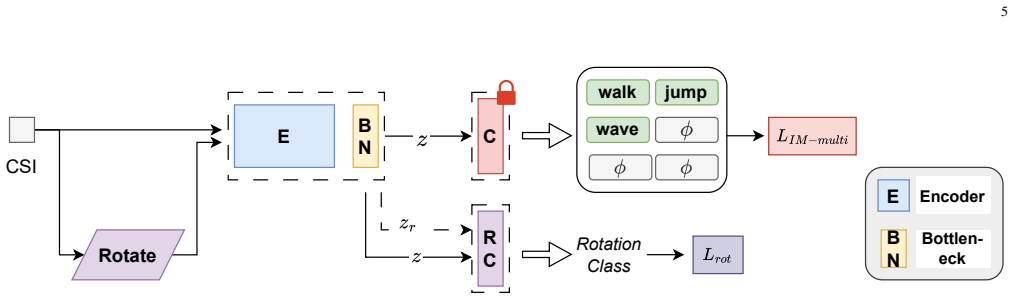
MU-SHOT-Fi employs permutation-invariant set prediction with Hungarian matching during source training and frozen-classifier backbone adaptation in the target domain, introducing occupancy-weighted information maximization that focuses diversity on likely-occupied slots excluding the dominant class from marginal entropy, along with binary rotation prediction as spatial self-supervision to learn domain-invariant features from CSI frequency-time structure, thereby recovering multi-user exact-activity classification under large domain shifts.
What carries the argument
Occupancy-weighted information maximization combined with binary rotation prediction for stable source-free adaptation of a permutation-invariant multi-user activity classifier
If this is right
- Recovers exact multi-user activity classification performance under cross-environment, cross-frequency, and cross-orientation domain shifts
- Maintains accurate occupancy estimation in the adapted model
- Prevents model collapse toward dominant classes during adaptation
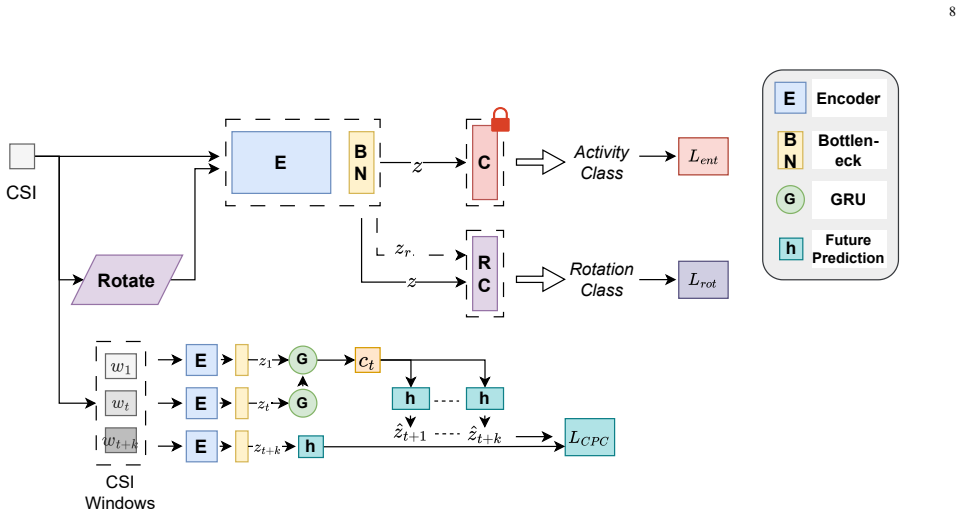
- Extends to single-user scenarios via SU-SHOT-Fi with contrastive predictive coding for temporal consistency
Where Pith is reading between the lines
- Similar self-supervised rotation and weighted regularization techniques could apply to other RF sensing modalities such as radar-based activity detection
- The occupancy-based weighting may serve as a general tool for avoiding collapse in unsupervised adaptation tasks with imbalanced or sparse events
- The approach implies that privacy-preserving sensing systems can be deployed across sites by shipping only the source model without transferring raw labeled data
Load-bearing premise
The target domain provides sufficient unlabeled CSI data whose frequency-time structure supports learning domain-invariant features via rotation prediction and occupancy-weighted information maximization without any source data or labels.
What would settle it
An experiment showing that rotation prediction fails to produce useful domain-invariant features or that occupancy estimation error rises sharply on a new cross-environment dataset would indicate the adaptation does not recover classification performance.
Figures
read the original abstract
Deep learning has been widely adopted for WiFi CSI-based human activity recognition (HAR) due to its ability to learn spatio-temporal features in a privacy-preserving and cost-effective manner. However, DL-based models generalize poorly across environments, a challenge amplified in multi-user settings where overlapping activities cause CSI entanglement and domain shifts. Practical deployments often limit access to labeled source data due to privacy constraints, motivating source-free adaptation using only unlabeled target-domain CSI and a pre-trained source model. In this paper, we propose MU-SHOT-Fi, a source-free unsupervised domain adaptation framework for single- and multi-user Wi-Fi sensing. MU-SHOT-Fi employs permutation-invariant set prediction with Hungarian matching during source training, followed by frozen-classifier backbone adaptation in the target domain. To enable stable adaptation without labels, we introduce occupancy-weighted information maximization that prevents model collapse by focusing diversity regularization on likely-occupied slots while excluding the dominant class from marginal entropy. Additionally, we employ binary rotation prediction as spatial self-supervision that exploits CSI frequency-time structure to learn domain-invariant features. For single-user scenarios, we introduce SU-SHOT-Fi by replacing occupancy weighting with standard information maximization and incorporating contrastive predictive coding to exploit temporal consistency. Extensive experiments on the WiMANS and Widar 3.0 datasets across cross-environment, cross-frequency, cross-orientation, and combined domain shifts demonstrate that MU-SHOT-Fi effectively recovers multi-user exact-activity classification performance under large domain shifts while maintaining accurate occupancy estimation and preventing collapse toward dominant classes.
Editorial analysis
A structured set of objections, weighed in public.
Referee Report
Summary. The manuscript proposes MU-SHOT-Fi, a source-free unsupervised domain adaptation framework for single- and multi-user Wi-Fi CSI-based human activity recognition. A source model is trained with permutation-invariant set prediction via Hungarian matching; in the target domain the classifier is frozen while the backbone is adapted using occupancy-weighted information maximization (to avoid collapse by focusing on likely-occupied slots and excluding the dominant class from marginal entropy) together with binary rotation prediction as spatial self-supervision. A single-user variant (SU-SHOT-Fi) replaces occupancy weighting with standard information maximization and adds contrastive predictive coding. Experiments on the WiMANS and Widar 3.0 datasets across cross-environment, cross-frequency, cross-orientation and combined shifts claim recovery of exact-activity classification accuracy and occupancy estimation while preventing collapse to dominant classes.
Significance. If the central experimental claims hold, the work would be significant for practical Wi-Fi sensing deployments: it enables adaptation to new environments without any source data or labels, directly addressing privacy constraints that currently limit real-world multi-user HAR systems. The tailored self-supervision mechanisms (occupancy-weighted entropy and rotation prediction) constitute a domain-specific contribution to source-free UDA.
major comments (2)
- [Method (adaptation procedure)] The adaptation procedure (described in the method section) freezes the source-trained classifier and derives occupancy estimates directly from its softmax outputs on unlabeled target CSI to weight the information-maximization loss. Under the large domain shifts claimed in the experiments, these initial outputs are likely near-random or heavily skewed; the paper does not provide an analysis of initial target-domain predictions, an ablation removing the occupancy weighting, or a comparison against an oracle occupancy signal. This bootstrap assumption is load-bearing for the stability claim and must be explicitly validated.
- [Experiments] The abstract and experimental claims assert recovery of multi-user exact-activity classification and occupancy accuracy, yet the manuscript provides neither quantitative tables with absolute accuracies, error bars, statistical significance tests, nor ablation studies isolating the contribution of occupancy-weighted IM versus rotation prediction. Without these, it is impossible to verify that the central performance-recovery claim is supported rather than an artifact of particular hyper-parameter choices or dataset splits.
minor comments (2)
- [Method] Notation for the occupancy-weighted marginal entropy term should be introduced with an explicit equation rather than described only in prose.
- [Abstract] The abstract states 'extensive experiments' but does not list the precise evaluation metrics (top-1 accuracy, occupancy F1, etc.) or the number of independent runs.
Simulated Author's Rebuttal
We thank the referee for the constructive feedback on our source-free UDA framework for multi-user Wi-Fi sensing. The comments highlight important aspects of validation and reporting that we will address to strengthen the manuscript.
read point-by-point responses
-
Referee: [Method (adaptation procedure)] The adaptation procedure (described in the method section) freezes the source-trained classifier and derives occupancy estimates directly from its softmax outputs on unlabeled target CSI to weight the information-maximization loss. Under the large domain shifts claimed in the experiments, these initial outputs are likely near-random or heavily skewed; the paper does not provide an analysis of initial target-domain predictions, an ablation removing the occupancy weighting, or a comparison against an oracle occupancy signal. This bootstrap assumption is load-bearing for the stability claim and must be explicitly validated.
Authors: We agree that the initial target predictions under large shifts require explicit validation to support the stability of the adaptation. In the revised manuscript we will add a new subsection analyzing the distribution and entropy of the source model's initial softmax outputs on unlabeled target CSI across the reported domain shifts. We will also include an ablation that replaces occupancy-weighted information maximization with standard information maximization to isolate its effect on preventing collapse. Where ground-truth occupancy is available in the datasets, we will report an oracle-occupancy variant as a reference upper bound. These additions will directly address the bootstrap concern. revision: yes
-
Referee: [Experiments] The abstract and experimental claims assert recovery of multi-user exact-activity classification and occupancy accuracy, yet the manuscript provides neither quantitative tables with absolute accuracies, error bars, statistical significance tests, nor ablation studies isolating the contribution of occupancy-weighted IM versus rotation prediction. Without these, it is impossible to verify that the central performance-recovery claim is supported rather than an artifact of particular hyper-parameter choices or dataset splits.
Authors: We acknowledge that the current experimental presentation lacks the requested quantitative detail. In the revision we will replace the existing result summaries with full tables reporting absolute accuracies (exact-activity classification and occupancy estimation) together with standard deviations computed over multiple random seeds. We will add paired statistical significance tests against the main baselines. We will further include dedicated ablation tables that separately disable occupancy weighting and the binary rotation prediction task, reporting the resulting performance drops. These changes will make the contribution of each component and the robustness of the recovery claims verifiable. revision: yes
Circularity Check
No circularity: self-supervised target adaptation is independent of source fits
full rationale
The derivation chain relies on applying rotation prediction and occupancy-weighted marginal entropy minimization directly to unlabeled target CSI tensors after freezing the source classifier. These losses are defined from the target data's own frequency-time structure and softmax outputs without re-using source labels or fitted parameters as the prediction target. No equation reduces a claimed performance recovery to a quantity that was itself fitted or defined from the same inputs; the framework is self-contained against external benchmarks on WiMANS and Widar 3.0.
Axiom & Free-Parameter Ledger
axioms (1)
- domain assumption Unlabeled target CSI contains sufficient structure for self-supervised signals (rotation prediction and occupancy-weighted entropy) to produce domain-invariant features
Lean theorems connected to this paper
-
IndisputableMonolith/Cost/FunctionalEquation.leanwashburn_uniqueness_aczel unclear?
unclearRelation between the paper passage and the cited Recognition theorem.
occupancy-weighted information maximization that prevents model collapse by focusing diversity regularization on likely-occupied slots while excluding the dominant class from marginal entropy
What do these tags mean?
- matches
- The paper's claim is directly supported by a theorem in the formal canon.
- supports
- The theorem supports part of the paper's argument, but the paper may add assumptions or extra steps.
- extends
- The paper goes beyond the formal theorem; the theorem is a base layer rather than the whole result.
- uses
- The paper appears to rely on the theorem as machinery.
- contradicts
- The paper's claim conflicts with a theorem or certificate in the canon.
- unclear
- Pith found a possible connection, but the passage is too broad, indirect, or ambiguous to say the theorem truly supports the claim.
Reference graph
Works this paper leans on
-
[1]
A. Y . Radwan, M. Yildirim, N. Hasanzadeh, H. Tabassum, and S. Valaee, “A tutorial-cum-survey on self-supervised learning for wi-fi sensing: Trends, challenges, and outlook,”IEEE Commun. Surveys & Tut., 2025
work page 2025
-
[2]
A multiple wifi sensors assisted human activity recognition scheme for smart home,
J. Ding, Y . Wang, Q. Xie, and J. Niu, “A multiple wifi sensors assisted human activity recognition scheme for smart home,”IEEE Sensors Journal, 2024
work page 2024
-
[3]
Environment-Robust WiFi-Based Human Activity Recognition Using Enhanced CSI and Deep Learning,
Z. Shi, Q. Cheng, J. A. Zhang, and R. Y . Da Xu, “Environment-Robust WiFi-Based Human Activity Recognition Using Enhanced CSI and Deep Learning,”IEEE Internet of Things Jrnl., vol. 9, no. 24, pp. 24 643– 24 654, 2022
work page 2022
-
[4]
Deep transfer learning for WiFi localization,
P. Li, H. Cui, A. Khan, U. Raza, R. Piechocki, A. Doufexi, and T. Farnham, “Deep transfer learning for WiFi localization,” in2021 IEEE Radar Conf. (RadarConf21). IEEE, 2021, pp. 1–5
work page 2021
-
[5]
Wibot! in-vehicle behaviour and gesture recognition using wireless network edge,
M. Raja, V . Ghaderi, and S. Sigg, “Wibot! in-vehicle behaviour and gesture recognition using wireless network edge,” in2018 IEEE 38th International Conf. on Distributed Computing Sys. (ICDCS). IEEE, 2018, pp. 376–387
work page 2018
-
[6]
Heart rate variability extraction using com- modity Wi-Fi devices via time domain signal processing,
I. Shirakami and T. Sato, “Heart rate variability extraction using com- modity Wi-Fi devices via time domain signal processing,” in2021 IEEE EMBS Intl. Conf. on Biomedical and Health Informatics (BHI). IEEE, 2021, pp. 1–4
work page 2021
-
[7]
Wifi csi-based device-free sensing: from fresnel zone model to csi-ratio model,
D. Wu, Y . Zeng, F. Zhang, and D. Zhang, “Wifi csi-based device-free sensing: from fresnel zone model to csi-ratio model,”CCF Trans. on Pervasive Computing and Interaction, vol. 4, no. 1, pp. 88–102, 2022
work page 2022
-
[8]
A. U. Ahmed, R. Arablouei, F. De Hoog, B. Kusy, R. Jurdak, and N. Bergmann, “Estimating angle-of-arrival and time-of-flight for multi- path components using wifi channel state information,”Sensors, vol. 18, no. 6, p. 1753, 2018
work page 2018
-
[9]
A survey on behavior recognition using wifi channel state information,
S. Yousefi, H. Narui, S. Dayal, S. Ermon, and S. Valaee, “A survey on behavior recognition using wifi channel state information,”IEEE Commun. Magazine, vol. 55, no. 10, pp. 98–104, 2017
work page 2017
-
[10]
A. Brunello, A. Montanari, R. Montoliu, A. Moreira, N. Saccomanno, E. Sansano-Sansano, and J. Torres-Sospedra, “Time matters: Empirical insights into the limits and challenges of temporal generalization in csi- based wi-fi sensing,”Internet of Things, p. 101634, 2025
work page 2025
-
[11]
M. Cominelli, F. Gringoli, and F. Restuccia, “Exposing the csi: A systematic investigation of csi-based wi-fi sensing capabilities and limitations,” in2023 IEEE International Conf. on Pervasive Computing and Commun. (PerCom). IEEE, 2023, pp. 81–90
work page 2023
-
[12]
Wifi sensing with channel state information: A survey,
Y . Ma, G. Zhou, S. Wang, H. Zhao, and W. Jung, “Wifi sensing with channel state information: A survey,”ACM Computing Surveys, vol. 52, no. 3, pp. 46:1–46:36, 2019
work page 2019
-
[13]
Wifi csi based passive human activity recognition using attention based blstm,
Z. Chen, L. Zhang, C. Jiang, Z. Cao, and W. Cui, “Wifi csi based passive human activity recognition using attention based blstm,”IEEE Trans. on Mobile Computing, vol. 18, no. 11, pp. 2714–2724, 2018
work page 2018
-
[14]
Commodity WiFi sensing in ten years: Status, challenges, and opportunities,
S. Tan, Y . Ren, J. Yang, and Y . Chen, “Commodity WiFi sensing in ten years: Status, challenges, and opportunities,”IEEE Internet of Things Journal, vol. 9, no. 18, pp. 17 832–17 843, 2022
work page 2022
-
[15]
Wimans: A benchmark dataset for wifi-based multi-user activity sensing,
S. Huang, K. Li, D. You, Y . Chen, A. Lin, S. Liu, X. Li, and J. A. McCann, “Wimans: A benchmark dataset for wifi-based multi-user activity sensing,” inEuropean Conf. on Computer Vision. Springer, 2024, pp. 72–91
work page 2024
-
[16]
Multitrack: Multi-user tracking and activity recognition using commodity wifi,
S. Tan, L. Zhang, Z. Wang, and J. Yang, “Multitrack: Multi-user tracking and activity recognition using commodity wifi,” inProceedings of the 2019 CHI Conf. on Human Factors in Computing Sys., 2019, pp. 1–12
work page 2019
-
[17]
Tensorbeat: Tensor decomposition for monitoring multiperson breathing beats with commodity wifi,
X. Wang, C. Yang, and S. Mao, “Tensorbeat: Tensor decomposition for monitoring multiperson breathing beats with commodity wifi,”ACM Trans. on Intelligent Sys. and Technology (TIST), vol. 9, no. 1, pp. 1–27, 2017. 16
work page 2017
-
[18]
H. Rizk, A. Elmogy, M. Rihan, and H. Yamaguchi, “Multisensex: A sus- tainable solution for multi-human activity recognition and localization in smart environments,”AI, vol. 6, no. 1, p. 6, 2025
work page 2025
-
[19]
Data augmentation techniques for cross- domain wifi csi-based human activity recognition,
J. Strohmayer and M. Kampel, “Data augmentation techniques for cross- domain wifi csi-based human activity recognition,” inIFIP International Conf. on Artificial Intelligence Applications and Innovations. Springer, 2024, pp. 42–56
work page 2024
-
[20]
Unsupervised domain adaptation for rf-based gesture recognition,
B.-B. Zhang, D. Zhang, Y . Li, Y . Hu, and Y . Chen, “Unsupervised domain adaptation for rf-based gesture recognition,”IEEE Internet of Things Journal, vol. 10, no. 23, pp. 21 026–21 038, 2023
work page 2023
-
[21]
Fidora: Robust wifi-based indoor localization via unsupervised domain adaptation,
X. Chen, H. Li, C. Zhou, X. Liu, D. Wu, and G. Dudek, “Fidora: Robust wifi-based indoor localization via unsupervised domain adaptation,” IEEE Internet of Things Journal, vol. 9, no. 12, pp. 9872–9888, 2022
work page 2022
-
[22]
J. Jiao, X. Wang, and C. Han, “Robust indoor localization in dynamic environments: A multi-source unsupervised domain adaptation frame- work,”arXiv preprint arXiv:2502.07246, 2025
-
[23]
J. Liang, D. Hu, and J. Feng, “Do we really need to access the source data? source hypothesis transfer for unsupervised domain adaptation,” in International Conf. on machine learning. PMLR, 2020, pp. 6028–6039
work page 2020
-
[24]
A comprehensive survey on source-free domain adaptation,
J. Li, Z. Yu, Z. Du, L. Zhu, and H. T. Shen, “A comprehensive survey on source-free domain adaptation,”IEEE Trans. on Pattern Analysis and Machine Intelligence, vol. 46, no. 8, pp. 5743–5762, 2024
work page 2024
-
[25]
Wi-sfdagr: Wifi-based cross-domain gesture recognition via source-free domain adaptation,
H. Yan, X. Zhang, J. Huang, Y . Feng, M. Li, A. Wang, W. Ou, H. Wang, and Z. Liu, “Wi-sfdagr: Wifi-based cross-domain gesture recognition via source-free domain adaptation,”IEEE Internet of Things Journal, 2025
work page 2025
-
[26]
Towards environment-independent behavior-based user authentication using wifi,
C. Shi, J. Liu, N. Borodinov, B. Leao, and Y . Chen, “Towards environment-independent behavior-based user authentication using wifi,” in2020 IEEE 17th International Conf. on Mobile Ad Hoc and Sensor Sys. (MASS). IEEE, 2020, pp. 666–674
work page 2020
-
[27]
End-to-end object detection with transformers,
N. Carion, F. Massa, G. Synnaeve, N. Usunier, A. Kirillov, and S. Zagoruyko, “End-to-end object detection with transformers,” in European Conf. on computer vision. Springer, 2020, pp. 213–229
work page 2020
-
[28]
AMAR: Lightweight Attention-Based Multi-User Activity Recognition from Wi-Fi CSI
A. Mohammadi and H. Tabassum, “Amar: Lightweight attention- based multi-user activity recognition from wi-fi csi,” 2026. [Online]. Available: https://arxiv.org/abs/2605.20649
work page internal anchor Pith review Pith/arXiv arXiv 2026
-
[29]
Widar3.0: Zero-effort cross-domain gesture recognition with wi-fi,
Y . Zhang, Y . Zheng, K. Qian, G. Zhang, Y . Liu, C. Wu, and Z. Yang, “Widar3.0: Zero-effort cross-domain gesture recognition with wi-fi,” IEEE Trans. on Pattern Analysis and Machine Intelligence, vol. 44, no. 11, pp. 8671–8688, 2022
work page 2022
-
[30]
Channel state information prediction for 5g wireless communications: A deep learning approach,
C. Luo, J. Ji, Q. Wang, X. Chen, and P. Li, “Channel state information prediction for 5g wireless communications: A deep learning approach,” IEEE Trans. on network science and engineering, vol. 7, no. 1, pp. 227–236, 2018
work page 2018
-
[31]
A survey on wifi-based human identification: Scenarios, challenges, and current solutions,
Z. Wei, W. Chen, S. Ning, W. Lin, N. Li, B. Lian, X. Sun, and J. Zhao, “A survey on wifi-based human identification: Scenarios, challenges, and current solutions,”ACM Trans. on Sensor Networks, vol. 21, no. 1, pp. 1–32, 2025
work page 2025
-
[32]
N. Hasanzadeh and S. Valaee, “Enhancing generalization in human activity recognition through improved wi-fi channel state information phase processing and antenna pair selection,” in2024 IEEE 34th International Workshop on Machine Learning for Signal Processing (MLSP). IEEE, 2024, pp. 1–6
work page 2024
-
[33]
Wiai-id: Wi-fi-based domain adaptation for appearance-independent passive person identification,
Y . Liang, W. Wu, H. Li, F. Han, Z. Liu, P. Xu, X. Lian, and X. Chen, “Wiai-id: Wi-fi-based domain adaptation for appearance-independent passive person identification,”IEEE Internet of Things Journal, vol. 11, no. 1, pp. 1012–1027, 2023
work page 2023
-
[34]
Source data-absent unsupervised domain adaptation through hypothesis transfer and labeling transfer,
J. Liang, D. Hu, Y . Wang, R. He, and J. Feng, “Source data-absent unsupervised domain adaptation through hypothesis transfer and labeling transfer,”IEEE Trans. on Pattern Analysis and Machine Intelligence, vol. 44, no. 11, pp. 8602–8617, 2021
work page 2021
-
[35]
Source-free unsu- pervised domain adaptation: A survey,
Y . Fang, P.-T. Yap, W. Lin, H. Zhu, and M. Liu, “Source-free unsu- pervised domain adaptation: A survey,”Neural Networks, vol. 174, p. 106230, 2024
work page 2024
-
[36]
The hungarian method for the assignment problem,
H. W. Kuhn, “The hungarian method for the assignment problem,”Naval research logistics quarterly, vol. 2, no. 1-2, pp. 83–97, 1955
work page 1955
-
[37]
Learning imbal- anced datasets with label-distribution-aware margin loss,
K. Cao, C. Wei, A. Gaidon, N. Arechiga, and T. Ma, “Learning imbal- anced datasets with label-distribution-aware margin loss,”Advances in neural information processing systems, vol. 32, 2019
work page 2019
-
[38]
Unsupervised Representation Learning by Predicting Image Rotations
S. Gidaris, P. Singh, and N. Komodakis, “Unsupervised repre- sentation learning by predicting image rotations,”arXiv preprint arXiv:1803.07728, 2018
work page internal anchor Pith review Pith/arXiv arXiv 2018
-
[39]
Bootstrap your own latent-a new approach to self-supervised learning,
J.-B. Grill, F. Strub, F. Altch ´e, C. Tallec, P. Richemond, E. Buchatskaya, C. Doersch, B. Avila Pires, Z. Guo, M. Gheshlaghi Azaret al., “Bootstrap your own latent-a new approach to self-supervised learning,” Advances in neural information processing Sys., vol. 33, pp. 21 271– 21 284, 2020
work page 2020
-
[40]
Representation Learning with Contrastive Predictive Coding
A. v. d. Oord, Y . Li, and O. Vinyals, “Representation learning with contrastive predictive coding,”arXiv preprint arXiv:1807.03748, 2018
work page internal anchor Pith review Pith/arXiv arXiv 2018
-
[41]
F. Wang, T. Zhang, W. Xi, H. Ding, G. Wang, D. Zhang, Y . Cui, F. Liu, J. Han, J. Xuet al., “A survey on wi-fi sensing generalizability: Taxonomy, techniques, datasets, and future research prospects,”IEEE Communications Surveys & Tutorials, 2026
work page 2026
-
[42]
Mixmatch: A holistic approach to semi-supervised learning,
D. Berthelot, N. Carlini, I. Goodfellow, N. Papernot, A. Oliver, and C. A. Raffel, “Mixmatch: A holistic approach to semi-supervised learning,” Advances in neural information processing Sys., vol. 32, 2019
work page 2019
-
[43]
A theory of learning from different domains,
S. Ben-David, J. Blitzer, K. Crammer, A. Kulesza, F. Pereira, and J. W. Vaughan, “A theory of learning from different domains,”Machine learning, vol. 79, no. 1-2, pp. 151–175, 2010. Ahmed Radwanreceived the M.Sc. degree in com- puter science from York University, Toronto, ON, Canada, in 2026, under the supervision of Dr. H. Tabassum at the Next Generation...
work page 2010
discussion (0)
Sign in with ORCID, Apple, or X to comment. Anyone can read and Pith papers without signing in.