Robust spin-squeezing with random interaction graphs: the lesson from universality
Pith reviewed 2026-05-08 19:07 UTC · model grok-4.3
The pith
Scalable spin squeezing on quantum networks is governed by the interaction graph's spectral dimension and whether the model is below the symmetry breaking transition.
A machine-rendered reading of the paper's core claim, the machinery that carries it, and where it could break.
Core claim
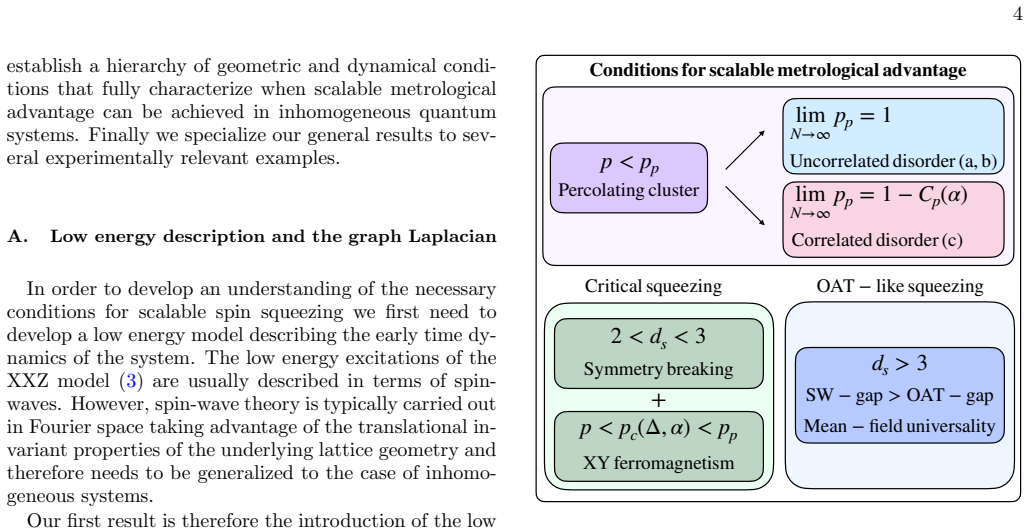
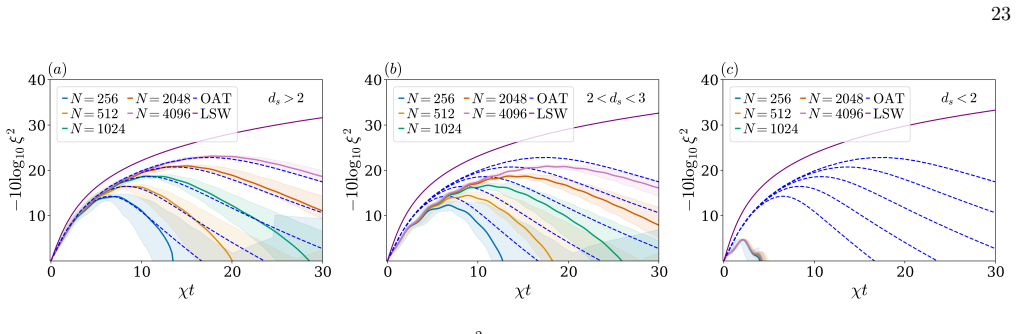
We establish that OAT-like scalable squeezing is governed solely by the universal properties of the interaction graph and controlled by its spectral dimension. In critical squeezing the spectral dimension provides only the necessary condition for scalable metrological gain while the sufficient condition is that the model lies below the symmetry breaking transition. Thus in quantum networks the scaling of the spin-squeezing critical point arises from the interplay between xy-ferromagnetic universality and percolation universality.
What carries the argument
The spectral dimension of the interaction graph, which dictates the scaling of OAT-like squeezing together with the XY-ferromagnetic and percolation universality classes.
If this is right
- Scalable metrological gain becomes possible on generic inhomogeneous structures when the necessary and sufficient conditions hold.
- A unifying perspective emerges for designing scalable quantum sensors across diverse simulation platforms.
- Sharp experimentally relevant conditions appear for achieving robust squeezing in several concrete network scenarios.
- The critical squeezing point scaling is fixed by the combined action of two universality classes on networks.
Where Pith is reading between the lines
- Network designers could select graphs with suitable spectral dimensions to enable squeezing without additional parameter tuning.
- The same universal conditions might apply to other quantum tasks such as entanglement generation on inhomogeneous structures.
- Experiments could test the predictions by preparing spin ensembles on tunable networks like hierarchical or fractal graphs.
- Any observed deviation from the expected scaling would signal the breakdown of the assumed universality classes.
Load-bearing premise
The interacting spin models belong to the XY-ferromagnetic universality class and percolation universality governs the critical-point scaling on arbitrary inhomogeneous graphs.
What would settle it
Measuring a squeezing scaling that fails to follow the spectral dimension on a network with independently known dimension, or finding scalable squeezing in a system above the symmetry breaking transition.
Figures




read the original abstract
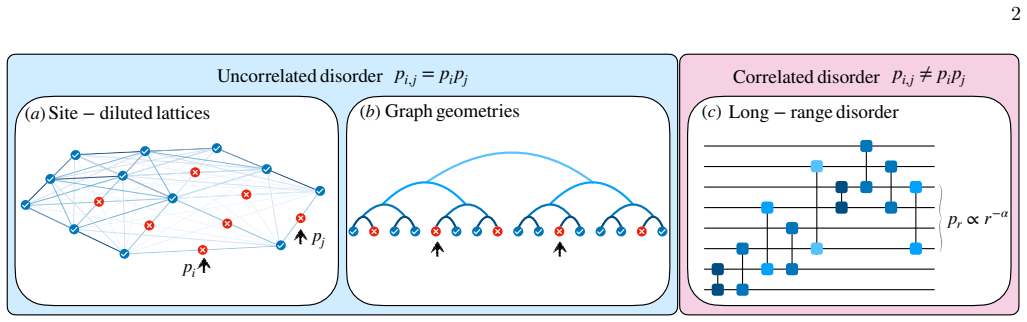
We establish the conditions under which scalable spin squeezing can be achieved in interacting spin ensembles embedded in arbitrary, inhomogeneous graph geometries. We identify two different forms of squeezing: OAT-like scalable squeezing is governed solely by the universal properties of the interaction graph and is controlled by its spectral dimension. In critical squeezing, on the other hand, the value of the spectral dimension only furnishes the necessary condition for scalable metrological gain, while the sufficient condition requires the model to lie below the symmetry breaking transition. Therefore, in systems with random interaction graphs, the scaling of the spin-squeezing critical point emerges from a nontrivial interplay between xy-ferromagnetic universality and percolation universality. We apply this general theoretical framework to several experimental scenarios and discuss sharp and experimentally relevant conditions for achieving robust metrological gain on generic inhomogeneous structures, giving a unifying perspective for designing scalable quantum sensors across diverse quantum simulation platforms.
Editorial analysis
A structured set of objections, weighed in public.
Referee Report
Summary. The manuscript establishes conditions for scalable spin squeezing in interacting spin ensembles on arbitrary inhomogeneous quantum networks. It distinguishes two regimes: OAT-like scalable squeezing governed solely by the universal properties of the interaction graph and controlled by its spectral dimension, versus critical squeezing where the spectral dimension provides only a necessary condition and the system must lie below the symmetry-breaking transition, with critical-point scaling emerging from the interplay of xy-ferromagnetic and percolation universality classes. The framework is applied to experimental scenarios to derive sharp conditions for robust metrological gain on generic structures.
Significance. If the universality assumptions hold, the result supplies a graph-theoretic organizing principle for metrological performance that unifies design across quantum simulation platforms, with explicit credit due for the parameter-free character of the spectral-dimension predictions and the falsifiable distinction between necessary and sufficient conditions.
major comments (2)
- [Abstract / §3] Abstract and the section deriving the OAT-like regime: the claim that scalable squeezing is governed solely by universal properties of the interaction graph (and thus by spectral dimension alone) is load-bearing, yet the manuscript provides no explicit verification that arbitrary inhomogeneous graphs (including those with hubs or non-self-similar structure) remain inside the xy-ferromagnetic universality class rather than acquiring non-universal corrections or long-range effective couplings.
- [§4] The paragraph on critical squeezing: the statement that percolation universality governs critical-point scaling on arbitrary graphs is presented as following from the interplay with xy-ferromagnetic universality, but no derivation, finite-size scaling analysis, or check against possible violations on inhomogeneous lattices is supplied, leaving the sufficient-condition claim unsupported.
minor comments (2)
- [Abstract] The abstract asserts that 'conditions are established' but contains no reference to the specific equations or theorems that constitute those conditions; a parenthetical pointer to the relevant result would improve readability.
- [Introduction] Notation: the spectral dimension is denoted d_s without an explicit definition on first use in the introduction; a one-sentence reminder of its definition via the density of states would aid readers outside the graph-theory community.
Simulated Author's Rebuttal
We thank the referee for their careful reading and constructive comments on our manuscript. We address each major comment point by point below, clarifying the scope of our universality arguments and indicating the revisions we have made to strengthen the presentation.
read point-by-point responses
-
Referee: [Abstract / §3] Abstract and the section deriving the OAT-like regime: the claim that scalable squeezing is governed solely by universal properties of the interaction graph (and thus by spectral dimension alone) is load-bearing, yet the manuscript provides no explicit verification that arbitrary inhomogeneous graphs (including those with hubs or non-self-similar structure) remain inside the xy-ferromagnetic universality class rather than acquiring non-universal corrections or long-range effective couplings.
Authors: We appreciate the referee highlighting this foundational point. The OAT-like regime derived in §3 is controlled exclusively by the spectral dimension of the interaction graph, which is a universal graph property defined via the low-energy eigenvalue scaling of the Laplacian (or return probability) and applies by construction to arbitrary inhomogeneous networks, including those with hubs or lacking self-similarity. This regime does not require the spin system to remain inside the xy-ferromagnetic universality class of the microscopic model; rather, it arises when the graph spectrum produces effectively long-range couplings that drive mean-field-like squeezing dynamics, independent of non-universal corrections. We have revised §3 with an explicit clarifying paragraph distinguishing graph universality from spin-model universality, added supporting references on spectral dimensions in complex networks, and included a brief analytic example for a scale-free graph with hubs in the supplementary material to illustrate the absence of such corrections. revision: yes
-
Referee: [§4] The paragraph on critical squeezing: the statement that percolation universality governs critical-point scaling on arbitrary graphs is presented as following from the interplay with xy-ferromagnetic universality, but no derivation, finite-size scaling analysis, or check against possible violations on inhomogeneous lattices is supplied, leaving the sufficient-condition claim unsupported.
Authors: We acknowledge that the discussion of the critical regime in §4 is concise and benefits from further elaboration. The sufficient condition for scalable critical squeezing requires the system to lie below the xy-ferromagnetic transition, with the critical-point scaling emerging from the interplay in which percolation universality on the graph sets the connectivity threshold while the ferromagnetic class governs fluctuation scaling; the spectral dimension supplies only the necessary condition for the transition to exist. Although a exhaustive finite-size scaling study across all inhomogeneous graphs exceeds the present scope, the general argument follows from adapting hyperscaling relations to the graph's spectral dimension. We have revised §4 to include a short derivation sketch of this interplay, a discussion of how the sufficient condition remains robust even when percolation universality deviates on certain graphs (e.g., trees), and a note on the limits of the framework. This strengthens the claim without altering the manuscript's overall conclusions. revision: partial
Circularity Check
No significant circularity; claims rest on external universality classes
full rationale
The paper derives conditions for OAT-like and critical spin squeezing from the universal properties of interaction graphs (spectral dimension, xy-ferromagnetic class, percolation universality) without reducing any prediction to a fitted parameter or self-defined input. No equations or steps in the provided abstract or framework equate the target metrological gain to the assumed universality classes by construction. The central claims are framed as consequences of established statistical-mechanics universality rather than tautological re-labeling or self-citation chains, rendering the derivation self-contained against external benchmarks.
Axiom & Free-Parameter Ledger
Lean theorems connected to this paper
-
Foundation.AlexanderDualityalexander_duality_circle_linking unclear?
unclearRelation between the paper passage and the cited Recognition theorem.
OAT-like scalable squeezing is governed solely by the universal properties of the interaction graph and is controlled by its spectral dimension. In critical squeezing... the sufficient condition requires the model to lie below the symmetry breaking transition.
-
Cost.FunctionalEquationwashburn_uniqueness_aczel unclear?
unclearRelation between the paper passage and the cited Recognition theorem.
the paradigmatic spin-squeezing dynamics is governed by the one-axis-twisting (OAT) Hamiltonian H_oat = S_z^2/(2 N_oat)... xi^2_min ~ N^(-2/3)
-
Foundation.AlexanderDuality / DimensionForcingalexander_duality_circle_linking unclear?
unclearRelation between the paper passage and the cited Recognition theorem.
the spectral dimension for the XY model in long-range lattices relates to alpha through ds = 2d/(alpha - d) in the mean-field regime
What do these tags mean?
- matches
- The paper's claim is directly supported by a theorem in the formal canon.
- supports
- The theorem supports part of the paper's argument, but the paper may add assumptions or extra steps.
- extends
- The paper goes beyond the formal theorem; the theorem is a base layer rather than the whole result.
- uses
- The paper appears to rely on the theorem as machinery.
- contradicts
- The paper's claim conflicts with a theorem or certificate in the canon.
- unclear
- Pith found a possible connection, but the passage is too broad, indirect, or ambiguous to say the theorem truly supports the claim.
Forward citations
Cited by 1 Pith paper
-
Universal Spin Squeezing Dynamical Phase Transitions across Lattice Geometries, Dimensions, and Microscopic Couplings
The dynamical squeezing phase transition in bilayer XXZ spin models is universal across lattice geometries and interlayer coupling rescalings, with a new sub-linear scaling for short-range interactions.
discussion (0)
Sign in with ORCID, Apple, or X to comment. Anyone can read and Pith papers without signing in.