Universal Spin Squeezing Dynamical Phase Transitions across Lattice Geometries, Dimensions, and Microscopic Couplings
Pith reviewed 2026-05-15 05:59 UTC · model grok-4.3
The pith
A dynamical squeezing phase transition persists across all lattice geometries and coupling strengths in power-law spin models.
A machine-rendered reading of the paper's core claim, the machinery that carries it, and where it could break.
Core claim
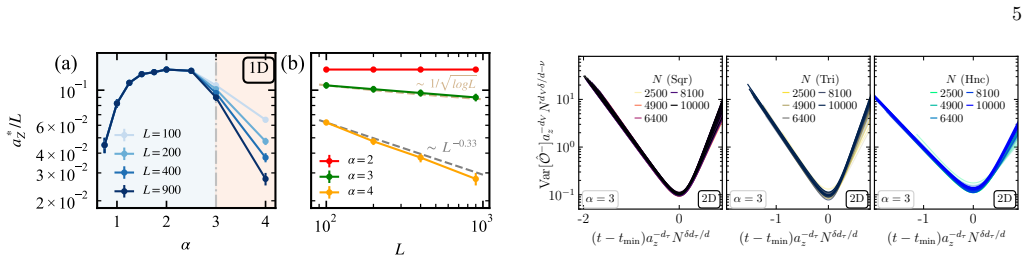
Combining Bogoliubov instability analysis with discrete truncated Wigner simulations, the transition persists across all four lattice geometries and a wide range of λ with critical exponents consistent within error, providing evidence for a non-equilibrium universality class. The Bogoliubov theory recovers a_Z^* ∝ L for α < d+2 and gives the analytical form a_Z^* ∝ L^{2/(α-d)} for α > d+2, uncovering a previously unrecognized sub-linear regime for short-range interactions. Tuning λ demonstrates the transition can be driven purely through interaction engineering.
What carries the argument
Bogoliubov instability analysis of the power-law interacting bilayer XXZ spin model, which locates the critical aspect ratio a_Z^* separating fully and partially collective squeezing phases.
If this is right
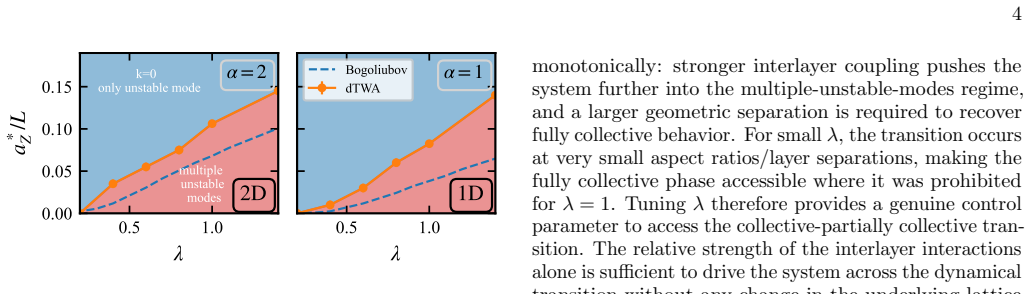
- The transition can be driven by tuning interlayer coupling strength λ at fixed layer spacing.
- This provides a route to control entanglement generation in Rydberg-array, polar-molecule, and trapped-ion platforms.
- New sub-linear scaling applies for short-range interactions, expanding the reachable parameter space.
- Universality holds independent of specific microscopic lattice details within the tested class.
Where Pith is reading between the lines
- The same universality might appear in other non-equilibrium spin systems with tunable range and geometry.
- Engineering via λ could enable squeezing protocols that avoid lattice redesign in current hardware.
- Direct tests in 1D ladders versus 2D bilayers would confirm the dimension-dependent crossover in scaling.
Load-bearing premise
The Bogoliubov instability analysis combined with discrete truncated Wigner simulations accurately captures the full quantum many-body dynamics without significant corrections from higher-order terms or finite-size effects.
What would settle it
Observation that critical exponents differ significantly across lattice geometries or that measured a_Z^* scaling deviates from L^{2/(α-d)} in the short-range regime α > d+2.
Figures



read the original abstract
Recent work has identified a dynamical squeezing phase transition in power-law interacting bilayer XXZ spin models, separating a fully collective phase with Heisenberg-limited squeezing from a partially-collective phase with universal critical scaling. Here we test and establish the universality of this transition along two qualitatively different microscopic axes: lattice geometry, by studying square, triangular, and honeycomb $2\mathrm{D}$ bilayers as well as $1\mathrm{D}$ ladders, and a symmetry-preserving rescaling $\lambda$ of the interlayer couplings relative to the intralayer ones. Combining a Bogoliubov instability analysis with discrete truncated Wigner simulations, we find that the transition persists across all four lattice geometries and over a wide range of $\lambda$ with critical exponents consistent within error, providing strong evidence for a genuine non-equilibrium universality class. The Bogoliubov theory recovers the previously identified scaling $a_Z^* \propto L$ in the long-range interacting regime $\alpha < d+2$, and yields an analytical scaling $a_Z^* \propto L^{2/(\alpha-d)}$ for the critical aspect ratio with system size for $\alpha>d+2$, with $\alpha$ the power-law exponent in dimension $d$. This uncovers a previously unrecognized sub-linear regime for short-range interactions. By tuning $\lambda$ we vary the interlayer coupling strength at fixed layer spacing, demonstrating that the dynamical transition can be driven purely through interaction engineering without modifying the underlying geometry. These findings provide a versatile route toward controlling entanglement generation in Rydberg-array, polar molecule, and trapped-ion platforms with applications in quantum sensing and simulation.
Editorial analysis
A structured set of objections, weighed in public.
Referee Report
Summary. The manuscript investigates the universality of a dynamical spin squeezing phase transition in power-law interacting bilayer XXZ spin models. It examines the transition across four lattice geometries (square, triangular, and honeycomb 2D bilayers plus 1D ladders) and a symmetry-preserving rescaling λ of interlayer versus intralayer couplings. Combining an analytical Bogoliubov instability analysis with discrete truncated Wigner (DTW) simulations, the authors report that the transition persists with critical exponents consistent within error, recover the known scaling a_Z^* ∝ L for long-range interactions (α < d+2), and derive a new analytical scaling a_Z^* ∝ L^{2/(α-d)} for short-range interactions (α > d+2).
Significance. If the central claims hold, the work establishes a genuine non-equilibrium universality class for dynamical squeezing transitions that is independent of microscopic lattice details and tunable via interaction engineering. The analytical derivation of the previously unrecognized sub-linear scaling for short-range cases (α > d+2) is a clear strength, as is the demonstration that the transition can be driven purely by rescaling λ without altering geometry. These results offer concrete guidance for entanglement generation in Rydberg-array, polar-molecule, and trapped-ion platforms.
major comments (1)
- [Numerical results section] Numerical results section: The headline claim of a new sub-linear scaling a_Z^* ∝ L^{2/(α-d)} for α > d+2 rests on DTW trajectories faithfully reproducing the Bogoliubov instability threshold. The manuscript provides no quantitative assessment of truncation errors or higher-order cumulant corrections in the short-range regime, where the effective interaction range is finite; such corrections could introduce an L-dependent shift in the apparent critical aspect ratio, undermining the extracted exponent even if DTW error bars appear consistent.
minor comments (1)
- [Abstract and methods] Abstract and methods: The ranges of λ, system sizes L, and the precise definition of error bars on the critical exponents are not stated, making it difficult to assess the claimed consistency 'within error' across geometries.
Simulated Author's Rebuttal
We thank the referee for their detailed review and constructive feedback on our manuscript. We are pleased that the significance of the work is recognized and address the major comment below.
read point-by-point responses
-
Referee: [Numerical results section] Numerical results section: The headline claim of a new sub-linear scaling a_Z^* ∝ L^{2/(α-d)} for α > d+2 rests on DTW trajectories faithfully reproducing the Bogoliubov instability threshold. The manuscript provides no quantitative assessment of truncation errors or higher-order cumulant corrections in the short-range regime, where the effective interaction range is finite; such corrections could introduce an L-dependent shift in the apparent critical aspect ratio, undermining the extracted exponent even if DTW error bars appear consistent.
Authors: We acknowledge the validity of this comment. The current manuscript does not provide a detailed quantitative assessment of truncation errors or higher-order cumulant corrections specifically for the short-range interaction regime. To address this, we will revise the Numerical results section to include such an analysis. We will add comparisons of DTW simulations with different truncation levels and estimates of the impact of higher-order terms on the critical aspect ratio a_Z^*. This will confirm that any L-dependent shifts are negligible compared to the observed scaling, thereby supporting the sub-linear exponent 2/(α-d). We believe this addition will fully resolve the concern. revision: yes
Circularity Check
No significant circularity; scaling derived analytically from Bogoliubov equations
full rationale
The paper derives the new scaling relation a_Z^* ∝ L^{2/(α-d)} for α > d+2 directly from the Bogoliubov instability analysis of the model's dispersion relation, without fitting parameters or redefining inputs. Discrete truncated Wigner simulations are used only for numerical confirmation of the transition's persistence across lattices and λ values, not to define or force the analytical exponents. References to prior work recover the long-range scaling a_Z^* ∝ L but do not bear the load for the short-range result or universality claim. No self-definitional loops, fitted predictions, or ansatzes smuggled via citation appear in the core derivation chain. The analysis remains self-contained against external benchmarks.
Axiom & Free-Parameter Ledger
axioms (2)
- domain assumption Validity of Bogoliubov instability analysis for identifying the dynamical transition
- domain assumption Accuracy of discrete truncated Wigner simulations in capturing the quantum squeezing dynamics
Reference graph
Works this paper leans on
- [1]
-
[2]
A. Browaeys and T. Lahaye, Many-body physics with individually controlled rydberg atoms, Nat. Physics16, 132 (2020)
work page 2020
-
[3]
M. Saffman, T. G. Walker, and K. Mølmer, Quantum information with rydberg atoms, Rev. Mod. Phys.82, 2313 (2010)
work page 2010
-
[4]
M. Morgado and S. Whitlock, Quantum simulation and computing with rydberg-interacting qubits, AVS Quan- tum Science3, 023501 (2021). 7
work page 2021
-
[5]
M. A. Baranov, M. Dalmonte, G. Pupillo, and P. Zoller, Condensed matter theory of dipolar quantum gases, Chem- ical Reviews112, 5012 (2012)
work page 2012
-
[6]
J. L. Bohn, A. M. Rey, and J. Ye, Cold molecules: Progress in quantum engineering of chemistry and quantum matter, Science357, 1002 (2017)
work page 2017
-
[7]
S. A. Moses, J. P. Covey, M. T. Miecnikowski, D. S. Jin, and J. Ye, New frontiers for quantum gases of polar molecules, Nat. Phys.13, 13 (2017)
work page 2017
- [8]
-
[9]
R. Blatt and C. F. Roos, Quantum simulations with trapped ions, Nat. Physics8, 277 (2012)
work page 2012
- [10]
-
[11]
M. A. Norcia, R. J. Lewis-Swan, J. R. K. Cline, B. Zhu, A. M. Rey, and J. K. Thompson, Cavity-mediated collec- tive spin-exchange interactions in a strontium superradi- ant laser, Science361, 259 (2018)
work page 2018
-
[12]
E. J. Davis, G. Bentsen, L. Homeier, T. Li, and M. H. Schleier-Smith, Photon-mediated spin-exchange dynamics of spin-1 atoms, Phys. Rev. Lett.122, 010405 (2019)
work page 2019
-
[13]
T. D. Farokh Mivehvar, Francesco Piazza and H. Ritsch, Cavity qed with quantum gases: new paradigms in many- body physics, Advances in Physics70, 1 (2021)
work page 2021
-
[14]
L. Du, P. Barral, M. Cantara, J. de Hond, Y.-K. Lu, and W. Ketterle, Atomic physics on a 50-nm scale: Realization of a bilayer system of dipolar atoms, Science384, 546 (2024)
work page 2024
-
[15]
S. Hawaldar, P. Shahi, A. L. Carter, A. M. Rey, J. J. Bollinger, and A. Shankar, Bilayer crystals of trapped ions for quantum information processing, Phys. Rev. X 14, 031030 (2024)
work page 2024
-
[16]
D. Barredo, V. Lienhard, S. de L´ es´ eleuc, T. Lahaye, and A. Browaeys, Synthetic three-dimensional atomic struc- tures assembled atom by atom, Nature561, 79 (2018)
work page 2018
-
[17]
M. Schlosser, S. Tichelmann, D. Sch¨ affner, D. O. de Mello, M. Hambach, J. Sch¨ utz, and G. Birkl, Scalable multilayer architecture of assembled single-atom qubit arrays in a three-dimensional talbot tweezer lattice, Phys. Rev. Lett. 130, 180601 (2023)
work page 2023
-
[18]
J. Choi, H. Zhou, H. S. Knowles, R. Landig, S. Choi, and M. D. Lukin, Robust dynamic hamiltonian engineering of many-body spin systems, Phys. Rev. X10, 031002 (2020)
work page 2020
- [19]
-
[20]
P. Scholl, H. J. Williams, G. Bornet, F. Wallner, D. Barredo, L. Henriet, A. Signoles, C. Hainaut, T. Franz, S. Geier, A. Tebben, A. Salzinger, G. Z¨ urn, T. Lahaye, M. Weidem¨ uller, and A. Browaeys, Microwave engineering of programmable xxz hamiltonians in arrays of rydberg atoms, PRX Quantum3, 020303 (2022)
work page 2022
-
[21]
L. Christakis, J. S. Rosenberg, R. Raj, S. Chi, A. Morn- ingstar, D. A. Huse, Z. Z. Yan, and W. S. Bakr, Probing site-resolved correlations in a spin system of ultracold molecules, Nature614, 64 (2023)
work page 2023
- [22]
- [23]
-
[24]
C. L. Degen, F. Reinhard, and P. Cappellaro, Quantum sensing, Rev. Mod. Phys.89, 035002 (2017)
work page 2017
-
[25]
L. Pezz` e, A. Smerzi, M. K. Oberthaler, R. Schmied, and P. Treutlein, Quantum metrology with nonclassical states of atomic ensembles, Rev. Mod. Phys.90, 035005 (2018)
work page 2018
-
[26]
V. Montenegro, C. Mukhopadhyay, R. Yousefjani, S. Sarkar, U. Mishra, M. G. Paris, and A. Bayat, Re- view: Quantum metrology and sensing with many-body systems, Physics Reports1134, 1 (2025)
work page 2025
-
[27]
M. Kitagawa and M. Ueda, Squeezed spin states, Phys. Rev. A47, 5138 (1993)
work page 1993
-
[28]
D. J. Wineland, J. J. Bollinger, W. M. Itano, F. L. Moore, and D. J. Heinzen, Spin squeezing and reduced quantum noise in spectroscopy, Phys. Rev. A46, R6797 (1992)
work page 1992
-
[29]
D. J. Wineland, J. J. Bollinger, W. M. Itano, and D. J. Heinzen, Squeezed atomic states and projection noise in spectroscopy, Phys. Rev. A50, 67 (1994)
work page 1994
-
[30]
E. Pedrozo-Pe˜ nafiel, S. Colombo, C. Shu, A. F. Adiy- atullin, Z. Li, E. Mendez, B. Braverman, A. Kawasaki, D. Akamatsu, Y. Xiao, and V. Vuleti´ c, Entanglement on an optical atomic-clock transition, Nature588, 414–418 (2020)
work page 2020
-
[31]
W. J. Eckner, N. Darkwah Oppong, A. Cao, A. W. Young, W. R. Milner, J. M. Robinson, J. Ye, and A. M. Kaufman, Realizing spin squeezing with rydberg interactions in an optical clock, Nature621, 734 (2023)
work page 2023
-
[32]
V. Shah, G. Vasilakis, and M. V. Romalis, High bandwidth atomic magnetometery with continuous quantum nonde- molition measurements, Phys. Rev. Lett.104, 013601 (2010)
work page 2010
-
[33]
R. J. Sewell, M. Koschorreck, M. Napolitano, B. Dubost, N. Behbood, and M. W. Mitchell, Magnetic sensitivity beyond the projection noise limit by spin squeezing, Phys. Rev. Lett.109, 253605 (2012)
work page 2012
-
[34]
W. Muessel, H. Strobel, D. Linnemann, D. B. Hume, and M. K. Oberthaler, Scalable spin squeezing for quantum- enhanced magnetometry with bose-einstein condensates, Phys. Rev. Lett.113, 103004 (2014)
work page 2014
- [35]
-
[36]
Entanglement and spin-squeezing without infinite-range interactions
M. Foss-Feig, Z.-X. Gong, A. V. Gorshkov, and C. W. Clark, Entanglement and spin-squeezing without infinite-range interactions (2016), arXiv:1612.07805 [cond- mat.quant-gas]
work page internal anchor Pith review Pith/arXiv arXiv 2016
-
[37]
M. A. Perlin, C. Qu, and A. M. Rey, Spin squeezing with short-range spin-exchange interactions, Phys. Rev. Lett. 125, 223401 (2020)
work page 2020
-
[38]
T. Bilitewski, L. De Marco, J.-R. Li, K. Matsuda, W. G. Tobias, G. Valtolina, J. Ye, and A. M. Rey, Dynamical generation of spin squeezing in ultracold dipolar molecules, Phys. Rev. Lett.126, 113401 (2021)
work page 2021
- [39]
-
[40]
T. Comparin, F. Mezzacapo, and T. Roscilde, Robust spin squeezing from the tower of states of u(1)-symmetric spin hamiltonians, Phys. Rev. A105, 022625 (2022)
work page 2022
-
[41]
T. Roscilde, T. Comparin, and F. Mezzacapo, Entangling dynamics from effective rotor–spin-wave separation in u(1)-symmetric quantum spin models, Phys. Rev. Lett. 131, 160403 (2023)
work page 2023
-
[42]
T. Roscilde, F. Caleca, A. Angelone, and F. Mezzacapo, Scalable Spin Squeezing from Critical Slowing Down in Short-Range Interacting Systems, Phys. Rev. Lett.133, 210401 (2024)
work page 2024
-
[43]
A. Duha and T. Bilitewski, Two-mode squeezing in floquet-engineered power-law interacting spin models, Phys. Rev. A109, L061304 (2024)
work page 2024
- [44]
- [45]
- [46]
-
[47]
J. A. Hines, S. V. Rajagopal, G. L. Moreau, M. D. Wahrman, N. A. Lewis, O. Markovi´ c, and M. Schleier- Smith, Spin squeezing by rydberg dressing in an array of atomic ensembles, Phys. Rev. Lett.131, 063401 (2023)
work page 2023
-
[48]
A. Kaplan-Lipkin, P. J. D. Crowley, J. N. Hall´ en, Z. Wang, W. Wu, S. Chern, C. R. Laumann, L. Pollet, and N. Y. Yao, Theory of scalable spin squeezing with disordered quantum dipoles (2025), arXiv:2512.19781 [quant-ph]
-
[49]
Robust spin-squeezing on quantum networks: the lesson from universality
A. Solfanelli, A. Smerzi, P. Zoller, and N. Defenu, Robust spin-squeezing on quantum networks: the lesson from universality (2026), arXiv:2605.03032 [quant-ph]
work page internal anchor Pith review Pith/arXiv arXiv 2026
-
[50]
A. Duha, S. E. Begg, and T. Bilitewski, Nonequilibrium critical scaling of a squeezing phase transition, Phys. Rev. Lett.135, 150401 (2025)
work page 2025
-
[51]
J. Schachenmayer, A. Pikovski, and A. M. Rey, Many- body quantum spin dynamics with monte carlo trajecto- ries on a discrete phase space, Phys. Rev. X5, 011022 (2015)
work page 2015
-
[52]
B. Zhu, A. M. Rey, and J. Schachenmayer, A generalized phase space approach for solving quantum spin dynamics, New J. Phys.21, 082001 (2019)
work page 2019
-
[53]
S. R. Muleady, M. Yang, S. R. White, and A. M. Rey, Validating phase-space methods with tensor networks in two-dimensional spin models with power-law interactions, Phys. Rev. Lett.131, 150401 (2023)
work page 2023
-
[54]
T. Holstein and H. Primakoff, Field dependence of the intrinsic domain magnetization of a ferromagnet, Physical Review58, 1098 (1940)
work page 1940
-
[55]
T. Bilitewski and A. M. Rey, Manipulating growth and propagation of correlations in dipolar multilayers: From pair production to bosonic kitaev models, Phys. Rev.Lett. 131, 053001 (2023)
work page 2023
-
[56]
T. Bilitewski, G. A. Dom´ ınguez-Castro, D. Wellnitz, A. M. Rey, and L. Santos, Tunable momentum pair creation of spin excitations in dipolar bilayers, Phys. Rev. A108, 013313 (2023)
work page 2023
- [57]
- [58]
-
[59]
W. G. Tobias, K. Matsuda, J.-R. Li, C. Miller, A. N. Carroll, T. Bilitewski, A. M. Rey, and J. Ye, Reactions between layer-resolved molecules mediated by dipolar spin exchange, Science375, 1299 (2022)
work page 2022
-
[60]
D. Bluvstein, S. J. Evered, A. A. Geim, S. H. Li, H. Zhou, T. Manovitz, S. Ebadi, M. Cain, M. Kalinowski, D. Hangleiter, J. P. Bonilla Ataides, N. Maskara, I. Cong, X. Gao, P. Sales Rodriguez, T. Karolyshyn, G. Semeghini, M. J. Gullans, M. Greiner, V. Vuleti´ c, and M. D. Lukin, Logical quantum processor based on reconfigurable atom arrays, Nature626, 58 (2023)
work page 2023
-
[61]
J. F. Rodriguez-Nieva, A. P. Orioli, and J. Marino, Far-from-equilibrium universality in the two-dimensional heisenberg model, Proceedings of the National Academy of Sciences119, e2122599119 (2022)
work page 2022
-
[62]
E. J. Dresselhaus, B. Sbierski, and I. A. Gruzberg, Scal- ing collapse of longitudinal conductance near the integer quantum hall transition, Phys. Rev. Lett.129, 026801 (2022)
work page 2022
-
[63]
J. Houdayer and A. K. Hartmann, Low-temperature be- havior of two-dimensional gaussian ising spin glasses, Phys. Rev. B70, 014418 (2004). 9 /uni00000013/uni00000011/uni00000013/uni00000013/uni00000018 /uni00000013/uni00000011/uni00000013/uni00000013/uni00000013/uni00000013/uni00000011/uni00000013/uni00000013/uni00000018 kx /uni00000013/uni00000011/uni0000...
work page 2004
-
[64]
Long-range regime:α < d+ 2 Fig. 6 shows the long-wavelength behavior of εk and Ωk for representative values of α = 2 for 1D systems in Fig. 6(a) and α = 3 for 2D systems in Fig. 6(b), evalu- ated numerically from the Fourier transforms on finite systems. In contrast to the short-range case discussed below, Ωk exhibits a significant momentum dependence at ...
-
[65]
Short-range regime:α > d+ 2 Figure 7 shows the analogous results for α in the short- range regime. The top panels demonstrate that Ω k be- comes essentially flat at small k, justifying the approxi- mation Ωk1 ≈ Ω0 used in the derivation of Eq. (6). The intralayer dispersion εk recovers a clean quadratic form εk ∝ |k| 2, as expected, with the fitted expone...
-
[66]
We follow the optimization procedure introduced in Ref. [62] and used in Ref. [ 50], which defines a cost func- tion to quantify the quality of the scaling collapse
-
[67]
A successful scaling collapse requires the rescaled data sets to lie on a common curve
Optimization procedure Given raw data {xij, yij} for the j-th point in the i-th data set, ordered by system size Ni, we consider the rescaled data {˜xij,˜yij} = {xijN dx i , y ijN dy i } for trial exponents dx, dy, and rescaled uncertainties ˜δij = δijN dy i . A successful scaling collapse requires the rescaled data sets to lie on a common curve. We use l...
-
[68]
4 of the main text, for α = 3 in 2D on the square, triangular, and honeycomb lattices
Raw data and scaling collapses Figure 9 shows the raw data and scaling collapses un- derlying Fig. 4 of the main text, for α = 3 in 2D on the square, triangular, and honeycomb lattices. The left column shows Var[ ˆO−] a−dV Z vs ( t−t min) a−dτ Z at fixed N = 10000 for a range of aspect ratios aZ in the partially collective phase, demonstrating the col- la...
discussion (0)
Sign in with ORCID, Apple, or X to comment. Anyone can read and Pith papers without signing in.