Recognition: unknown
Searches for Binary Mergers with Sub-solar Mass Components in Data from the First Part of LIGO--Virgo--KAGRA's Fourth Observing Run
Pith reviewed 2026-05-08 15:40 UTC · model grok-4.3
The pith
No statistically significant sub-solar mass binary mergers were identified in the first part of the fourth observing run.
A machine-rendered reading of the paper's core claim, the machinery that carries it, and where it could break.
Core claim
No statistically significant sub-solar mass candidates were identified. The detection sensitivity to the target population is reported, along with upper limits on the merger rate of sub-solar mass black holes from 110 Gpc^{-3}yr^{-1} to 10000 Gpc^{-3}yr^{-1} at 90% confidence. These limits exclude the fraction of dark matter in late-forming primordial black holes to be 1 for masses above 0.9 solar masses, limit it to 7% at 1 solar mass in the early-formation scenario, and constrain the dissipative model parameter space down to dark matter fractions of (1.2 to 1.3) times 10^{-5} when the minimum mass is 1 solar mass. For sub-solar mass neutron star binaries, the sensitive space-time hypervolu
What carries the argument
Upper limits on the merger rate of sub-solar mass black holes derived from non-detections by gravitational wave search algorithms.
Load-bearing premise
The analysis assumes that the models of gravitational wave signals and detector noise used in the search pipelines accurately reflect reality and do not miss or misclassify potential events due to unaccounted biases.
What would settle it
The discovery of even one statistically significant gravitational wave event from a sub-solar mass binary merger in the current or subsequent data would contradict the non-detection and require revision of the rate upper limits.
Figures




read the original abstract
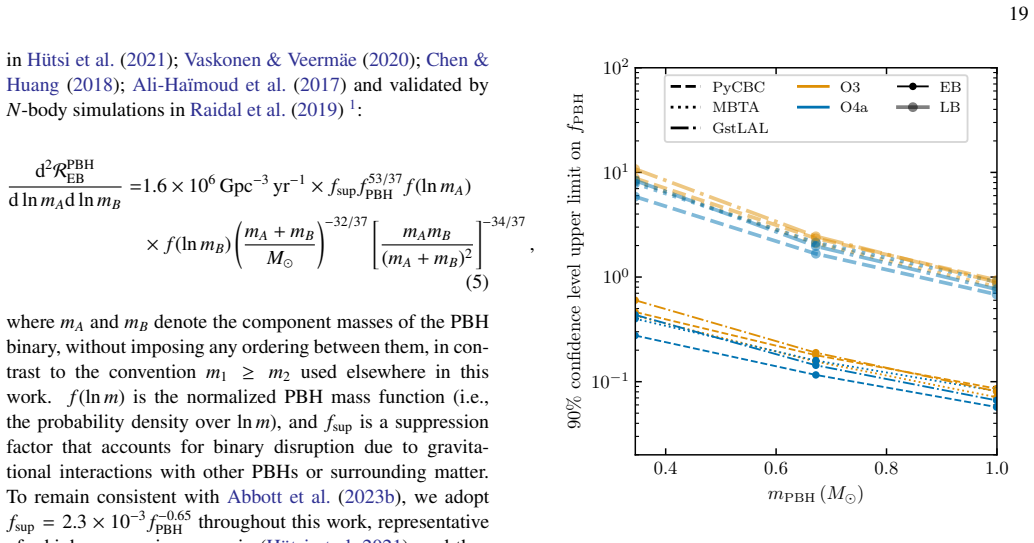
We report on a gravitational wave search for compact binary coalescences involving at least one component with mass between $0.2 M_\odot$ to $1 M_\odot$, and ratio of component masses between 0.1 and 1. The analysis uses data collected by the LIGO detectors between May 24 2023 15:00 UTC and January 16 2024 16:00 UTC. No statistically significant sub-solar mass candidates were identified by the participating search algorithms. We report the detection sensitivity of the current searches to the target sub-solar mass black hole population, while also reporting the sensitivity of the search to low-mass neutron star binaries for the first time. With the absence of detections, we place upper limits on the merger rate of sub-solar mass black holes, ranging from $110$ $\mathrm{Gpc^{-3}yr^{-1}}$ to $10000$ $\mathrm{Gpc^{-3}yr^{-1}}$ at 90% confidence. We use the merger rate limits to constrain two illustrative dark matter scenarios that can form sub-solar mass compact objects: primordial black holes, and dark black holes forming in a dissipative dark matter model. For late-forming primordial black hole binaries, our search excludes the fraction of dark matter in primordial black holes to be 1 for masses above $0.9 M_\odot$. In the early-formation scenario, we limit this fraction to be $\leq$ 7% at $1 M_\odot$, and $\leq$ 40% at $0.35 M_\odot$. For the dissipative model, the excluded region in the parameter space of dark matter fraction in dark black holes and their minimum possible mass extends down to (1.2 to 1.3) $\times10^{-5}$ when the minimum mass is $1 M_\odot$. For binary neutron stars that include sub-solar mass components, we estimate the sensitive space-time hypervolume to be $10^{-3}$ $\mathrm{Gpc^3yr}$, and report the upper limit on their merger rate for a simple, fixed population as ~86 $\mathrm{Gpc^{-3}yr^{-1}}$.
Editorial analysis
A structured set of objections, weighed in public.
Referee Report
Summary. The manuscript reports results from a gravitational wave search for compact binary coalescences with at least one sub-solar mass component (0.2–1 M_⊙, mass ratio 0.1–1) using LIGO data from May 24 2023 to January 16 2024. No statistically significant candidates were identified. The authors report the search sensitivity to sub-solar mass black hole populations and, for the first time, to low-mass neutron star binaries; with no detections they derive 90% confidence upper limits on the sub-solar black hole merger rate (110–10000 Gpc^{-3} yr^{-1}) and apply these limits to constrain two illustrative dark matter scenarios (primordial black holes and dissipative dark matter). They also quote an upper limit of ~86 Gpc^{-3} yr^{-1} on the merger rate of binary neutron stars containing sub-solar components, based on a sensitive space-time hypervolume of 10^{-3} Gpc^3 yr.
Significance. If the results hold, the work supplies timely, data-driven upper limits on the abundance of sub-solar mass compact objects, directly relevant to primordial black hole and exotic dark matter models. The analysis employs standard LVK matched-filtering pipelines and injection-based sensitivity estimation on real O4a data, which lends credibility to the null result and derived rate bounds. The extension of sensitivity estimates to low-mass neutron star binaries is a useful incremental contribution.
minor comments (3)
- [Abstract] Abstract: the quoted sensitive space-time hypervolume of 10^{-3} Gpc^3 yr for sub-solar neutron star binaries is given without reference to the exact population model (mass distribution, spin assumptions); this detail should be stated explicitly in the main text or a methods subsection.
- [Results section] The reported rate limits span more than two orders of magnitude; a table or figure that tabulates the 90% upper limit as a function of component mass (or mass bin) would make the mass dependence clearer and facilitate comparison with other searches.
- [Methods] The text refers to “participating search algorithms” without naming the specific pipelines or their configuration parameters (template bank density, SNR threshold, etc.); adding this information, even by reference to prior LVK papers, would improve reproducibility.
Simulated Author's Rebuttal
We thank the referee for their positive review of the manuscript and for recommending acceptance. No major comments were raised in the report.
Circularity Check
Standard null-result search with injection-based sensitivity; no circularity
full rationale
The paper reports a gravitational-wave search for sub-solar mass binaries using established LVK analysis pipelines on O4a data. No candidates are found, and upper limits on merger rates are derived from the non-detection combined with an independently estimated sensitive space-time volume obtained via signal injections into the data. Dark-matter model constraints are presented as direct applications of these rate limits. The derivation chain relies on standard Poisson statistics and template-based recovery efficiencies with no self-definitional steps, no fitted parameters renamed as predictions, and no load-bearing self-citations that reduce the central claims to unverified inputs. The methodology is self-contained against external benchmarks and follows field-standard practices.
Axiom & Free-Parameter Ledger
axioms (2)
- domain assumption Standard general relativity waveforms accurately model the target compact binary signals
- domain assumption Detector noise and sensitivity can be accurately characterized via injections and data quality
Reference graph
Works this paper leans on
-
[1]
Abadie, J. and others. Search for gravitational waves associated with gamma-ray bursts during LIGO science run 6 and Virgo science runs 2 and 3. Astrophys. J. 2012. doi:10.1088/0004-637X/760/1/12. arXiv:1205.2216
-
[2]
Search for gravitational waves from binary inspirals in S3 and S4 LIGO data , author =. Phys. Rev. D , volume =. 2008 , month =. doi:10.1103/PhysRevD.77.062002 , url =
-
[3]
Abbott, B. P. and others. Search for Subsolar-Mass Ultracompact Binaries in Advanced LIGO s First Observing Run. Phys. Rev. Lett. 2018. doi:10.1103/PhysRevLett.121.231103. arXiv:1808.04771
-
[4]
Abbott, R. and others. Search for gravitational waves from primordial black hole binary coalescences in the galactic halo. Phys. Rev. D. 2005. doi:10.1103/PhysRevD.72.082002. gr-qc/0505042
-
[5]
Abbott, B. P. and others. Search for Subsolar Mass Ultracompact Binaries in Advanced LIGO s Second Observing Run. Phys. Rev. Lett. 2019. doi:10.1103/PhysRevLett.123.161102. arXiv:1904.08976
-
[6]
Abbott, R. and others. Search for Subsolar-Mass Binaries in the First Half of Advanced LIGO s and Advanced Virgo s Third Observing Run. Phys. Rev. Lett. 2022. doi:10.1103/PhysRevLett.129.061104. arXiv:2109.12197
-
[7]
Abbott, R. and others. Search for subsolar-mass black hole binaries in the second part of Advanced LIGO's and Advanced Virgo's third observing run. Mon. Not. Roy. Astron. Soc. 2023. doi:10.1093/mnras/stad588. arXiv:2212.01477
-
[8]
Detecting binary neutron star systems with spin in advanced gravitational-wave detectors
Brown, Duncan and Harry, Ian and Lundgren, Andrew and Nitz, Alexander H. Detecting binary neutron star systems with spin in advanced gravitational-wave detectors. Phys. Rev. D. 2012. doi:10.1103/PhysRevD.86.084017. arXiv:1207.6406
-
[9]
Davies, Gareth S. Cabourn and Harry, Ian W. Establishing significance of gravitational-wave signals from a single observatory in the PyCBC offline search. Class. Quant. Grav. 2022. doi:10.1088/1361-6382/ac8862. arXiv:2203.08545
-
[10]
Allen, Bruce and Anderson, Warren G. and Brady, Patrick R. and Brown, Duncan A. and Creighton, Jolien D. E. FINDCHIRP: An Algorithm for detection of gravitational waves from inspiraling compact binaries. Phys. Rev. D. 2012. doi:10.1103/PhysRevD.85.122006. arXiv:gr-qc/0509116
-
[11]
^ 2 time-frequency discriminator for gravitational wave detection
Allen, Bruce. ^ 2 time-frequency discriminator for gravitational wave detection. Phys. Rev. D. 2005. doi:10.1103/PhysRevD.71.062001. arXiv:gr-qc/0405045
-
[12]
Bohé, Alejandro and Shao, Lijing and Taracchini, Andrea and Buonanno, Alessandra and Babak, Stanislav and Harry, Ian W. and Hinder, Ian and Ossokine, Serguei and Pürrer, Michael and Raymond, Vivien and Chu, Tony and Fong, Heather and Kumar, Prayush and P. Pfeiffer, Harald and Boyle, Michael and Hemberger, Daniel A. and Kidder, Lawrence E. and Lovelace, Ge...
-
[13]
Boyle, Michael and Brown, Duncan A. and Pekowsky, Larne. Comparison of high-accuracy numerical simulations of black-hole binaries with stationary phase post-Newtonian template waveforms for Initial and Advanced LIGO. Class.Quant.Grav. 2009. doi:10.1088/0264-9381/26/11/114006. arXiv:0901.1628
-
[14]
doi:10.1103/PhysRevD.80.084043 , eid =
Buonanno, Alessandra and Iyer, Bala R. and Ochsner, Evan and Pan, Yi and Sathyaprakash, B.S. Comparison of post-Newtonian templates for compact binary inspiral signals in gravitational-wave detectors. Phys. Rev. D. 2009. doi:10.1103/PhysRevD.80.084043. arXiv:0907.0700
-
[15]
Dal Canton, Tito and others. Implementing a search for aligned-spin neutron star-black hole systems with advanced ground based gravitational wave detectors. Phys. Rev. D. 2014. doi:10.1103/PhysRevD.90.082004. arXiv:1405.6731
-
[16]
Cotesta, Roberto and Marsat, Sylvain and Purrer, Michael. Frequency-domain reduced-order model of aligned-spin effective-one-body waveforms with higher-order modes. Phys. Rev. D. 2020. doi:10.1103/PhysRevD.101.124040. arXiv:2003.12079
-
[17]
Usman, Samantha A. and others. The PyCBC search for gravitational waves from compact binary coalescence. Class. Quant. Grav. 2016. doi:10.1088/0264-9381/33/21/215004. arXiv:1508.02357
-
[18]
and Dent, Thomas and Dal Canton, Tito and Fairhurst, Stephen and Brown, Duncan A
Nitz, Alexander H. and Dent, Thomas and Dal Canton, Tito and Fairhurst, Stephen and Brown, Duncan A. Detecting binary compact-object mergers with gravitational waves: Understanding and Improving the sensitivity of the PyCBC search. Astrophys. J. 2017. doi:10.3847/1538-4357/aa8f50. arXiv:1705.01513
-
[19]
and Dent, Thomas and T\'apai, M\'arton and Harry, Ian and McIsaac, Connor and Nitz, Alexander H
Davies, Gareth S. and Dent, Thomas and T\'apai, M\'arton and Harry, Ian and McIsaac, Connor and Nitz, Alexander H. Extending the PyCBC search for gravitational waves from compact binary mergers to a global network. Phys. Rev. D. 2020. doi:10.1103/PhysRevD.102.022004. arXiv:2002.08291
-
[20]
Nitz, Alex and others , title =. 2024. doi:10.5281/zenodo.10473621 , url =
-
[21]
Abbott, B. P. and others. Observation of Gravitational Waves from a Binary Black Hole Merger. Phys. Rev. Lett. 2016. doi:10.1103/PhysRevLett.116.061102. arXiv:1602.03837
-
[22]
2016, Classical and Quantum Gravity, 33, 175012, doi: 10.1088/0264-9381/33/17/175012
Adams, T. and Buskulic, D. and Germain, V. and Guidi, G. M. and Marion, F. and Montani, M. and Mours, B. and Piergiovanni, F. and Wang, G. Low-latency analysis pipeline for compact binary coalescences in the advanced gravitational wave detector era. Class. Quant. Grav. 2016. doi:10.1088/0264-9381/33/17/175012. arXiv:1512.02864
-
[23]
Gravitational wave probes of dark matter: challenges and opportunities
Bertone, Gianfranco and others. Gravitational wave probes of dark matter: challenges and opportunities. SciPost Phys. Core. 2020. doi:10.21468/SciPostPhysCore.3.2.007. arXiv:1907.10610
-
[24]
Examining The Fermi-LAT Third Source Catalog In Search Of Dark Matter Subhalos
Bertoni, Bridget and Hooper, Dan and Linden, Tim. Examining The Fermi-LAT Third Source Catalog In Search Of Dark Matter Subhalos. JCAP. 2015. doi:10.1088/1475-7516/2015/12/035. arXiv:1504.02087
-
[25]
Gamma Rays From Dark Matter Subhalos Revisited: Refining the Predictions and Constraints
Hooper, Dan and Witte, Samuel J. Gamma Rays From Dark Matter Subhalos Revisited: Refining the Predictions and Constraints. JCAP. 2017. doi:10.1088/1475-7516/2017/04/018. arXiv:1610.07587
-
[26]
Schoonenberg, Djoeke and Gaskins, Jennifer and Bertone, Gianfranco and Diemand, J\"urg , title = ". JCAP. 2016. doi:10.1088/1475-7516/2016/05/028. arXiv:1601.06781
- [27]
- [28]
-
[29]
Ewing, Becca and others. Performance of the low-latency GstLAL inspiral search towards LIGO, Virgo, and KAGRA s fourth observing run. Phys. Rev. D. 2024. doi:10.1103/PhysRevD.109.042008. arXiv:2305.05625
-
[30]
Fast evaluation of multidetector consistency for real-time gravitational wave searches
Hanna, Chad and others. Fast evaluation of multidetector consistency for real-time gravitational wave searches. Phys. Rev. D. 2020. doi:10.1103/PhysRevD.101.022003. arXiv:1901.02227
-
[31]
Hanna, Chad and others. Template bank for subsolar mass compact binary mergers in the fourth observing run of Advanced LIGO, Advanced Virgo, and KAGRA. Phys. Rev. D. 2025. doi:10.1103/c97v-bmj8. arXiv:2412.10951
-
[32]
Hanna, Chad and others. Binary tree approach to template placement for searches for gravitational waves from compact binary mergers. Phys. Rev. D. 2023. doi:10.1103/PhysRevD.108.042003. arXiv:2209.11298
-
[33]
Performance of iDQ ahead of LIGO, Virgo, and KAGRA's fourth observing run
Huxford, Rachael and George, Richard and Trevor, Max and Yarbrough, Zach and Godwin, Patrick. Performance of iDQ ahead of LIGO, Virgo, and KAGRA's fourth observing run. 2024. arXiv:2412.04638
-
[34]
Post-Newtonian templates for gravitational waves from compact binary inspirals
Isoyama, Soichiro and Sturani, Riccardo and Nakano, Hiroyuki. Post-Newtonian templates for gravitational waves from compact binary inspirals. 2020. doi:10.1007/978-981-15-4702-7_31-1. arXiv:2012.01350
-
[35]
Khan, Sebastian and Husa, Sascha and Hannam, Mark and Ohme, Frank and P\"urrer, Michael and Forteza, Xisco Jim\'enez and Boh\'e, Alejandro , title = ". Physical Review D. 2016. doi:10.1103/physrevd.93.044007
-
[36]
urrer, Michael and Ohme, Frank and Forteza, Xisco Jim\'enez and Boh\'e, Alejandro , title =
Husa, Sascha and Khan, Sebastian and Hannam, Mark and P\"urrer, Michael and Ohme, Frank and Forteza, Xisco Jim\'enez and Boh\'e, Alejandro , title = ". Physical Review D. 2016. doi:10.1103/physrevd.93.044006
-
[37]
2017, PhRvD, 95, 042001, doi: 10.1103/PhysRevD.95.042001
Messick, Cody and others. Analysis Framework for the Prompt Discovery of Compact Binary Mergers in Gravitational-wave Data. Phys. Rev. D. 2017. doi:10.1103/PhysRevD.95.042001. arXiv:1604.04324
-
[38]
Ray, Anarya and others. When to Point Your Telescopes: Gravitational Wave Trigger Classification for Real-Time Multi-Messenger Followup Observations. 2023. arXiv:2306.07190
-
[39]
Sachdev, Surabhi and others. The GstLAL Search Analysis Methods for Compact Binary Mergers in Advanced LIGO's Second and Advanced Virgo's First Observing Runs. 2019. arXiv:1901.08580
work page Pith review arXiv 2019
-
[40]
Sakon, Shio and others. Template bank for compact binary mergers in the fourth observing run of Advanced LIGO, Advanced Virgo, and KAGRA. Phys. Rev. D. 2024. doi:10.1103/PhysRevD.109.044066. arXiv:2211.16674
-
[41]
Interpolating compact binary waveforms using the singular value decomposition
Cannon, Kipp and Hanna, Chad and Keppel, Drew. Interpolating compact binary waveforms using the singular value decomposition. Phys. Rev. D. 2012. doi:10.1103/PhysRevD.85.081504. arXiv:1108.5618
-
[42]
Improved ranking statistics of the GstLAL inspiral search for compact binary coalescences
Tsukada, Leo and others. Improved ranking statistics of the GstLAL inspiral search for compact binary coalescences. Phys. Rev. D. 2023. doi:10.1103/PhysRevD.108.043004. arXiv:2305.06286
-
[43]
New Methods for Offline GstLAL Analyses
Joshi, Prathamesh and others. New Methods for Offline GstLAL Analyses. 2025. arXiv:2506.06497
work page internal anchor Pith review arXiv 2025
-
[44]
Joshi, Prathamesh and others. How Many Times Should We Matched Filter Gravitational Wave Data? A Comparison of GstLAL's Online and Offline Performance. 2025. arXiv:2505.23959
work page internal anchor Pith review arXiv 2025
-
[45]
Pan, Yi and Buonanno, Alessandra and Baker, John G. and Centrella, Joan and J. Kelly, Bernard and McWilliams, Sean T. and Pretorius, Frans. and R. van Meter, James. A data-analysis driven comparison of analytic and numerical coalescing binary waveforms: nonspinning case. Phys. Rev. D. 2008. doi:10.1103/PhysRevD.77.024014. arXiv:0704.1964
-
[46]
Aubin, F. and others. The MBTA pipeline for detecting compact binary coalescences in the third LIGO Virgo observing run. Class. Quant. Grav. 2021. doi:10.1088/1361-6382/abe913. arXiv:2012.11512
-
[47]
All \'e n \'e , Christopher and others. The MBTA pipeline for detecting compact binary coalescences in the fourth LIGO-Virgo-KAGRA observing run. Class. Quant. Grav. 2025. doi:10.1088/1361-6382/add234. arXiv:2501.04598
-
[48]
and Kumar, Prayush and Nitz, Alexander H
Brown, Duncan A. and Kumar, Prayush and Nitz, Alexander H. Template banks to search for low-mass binary black holes in advanced gravitational-wave detectors. Phys. Rev. D. 2013. doi:10.1103/PhysRevD.87.082004. arXiv:1211.6184
-
[49]
What is the nature of GW230529? An exploration of the gravitational lensing hypothesis
Janquart, Justin and others. What is the nature of GW230529? An exploration of the gravitational lensing hypothesis. 2024. arXiv:2409.07298
-
[50]
Biswas, Rahul and Brady, Patrick R. and Creighton, Jolien D. E. and Fairhurst, Stephen. The Loudest event statistic: General formulation, properties and applications. Class. Quant. Grav. 2009. doi:10.1088/0264-9381/26/17/175009. arXiv:0710.0465
-
[51]
Abbott, R. and others. GWTC-3: Compact Binary Coalescences Observed by LIGO and Virgo during the Second Part of the Third Observing Run. Phys. Rev. X. 2023. doi:10.1103/PhysRevX.13.041039. arXiv:2111.03606
-
[52]
Mozzon, S. and Nuttall, L. K. and Lundgren, A. and Dent, T. and Kumar, S. and Nitz, A. H. Dynamic Normalization for Compact Binary Coalescence Searches in Non-Stationary Noise. Class. Quant. Grav. 2020. doi:10.1088/1361-6382/abac6c. arXiv:2002.09407
-
[53]
Abbott, B. P. and others. Binary Black Hole Mergers in the first Advanced LIGO Observing Run. Phys. Rev. X. 2016. doi:10.1103/PhysRevX.6.041015. arXiv:1606.04856
-
[54]
Nitz, Alexander H. and Capano, Collin and Nielsen, Alex B. and Reyes, Steven and White, Rebecca and Brown, Duncan A. and Krishnan, Badri. 1-OGC: The first open gravitational-wave catalog of binary mergers from analysis of public Advanced LIGO data. Astrophys. J. 2019. doi:10.3847/1538-4357/ab0108. arXiv:1811.01921
-
[55]
Abbott, B. P. and others. Prospects for observing and localizing gravitational-wave transients with Advanced LIGO, Advanced Virgo and KAGRA. Living Rev. Rel. 2016. doi:10.1007/s41114-020-00026-9. arXiv:1304.0670
-
[56]
Abbott, B. P. and others. GW170817: Observation of Gravitational Waves from a Binary Neutron Star Inspiral. Phys. Rev. Lett. 2017. doi:10.1103/PhysRevLett.119.161101. arXiv:1710.05832
-
[57]
Methods for the detection of gravitational waves from subsolar mass ultracompact binaries
Magee, Ryan and Deutsch, Anne-Sylvie and McClincy, Phoebe and Hanna, Chad and Horst, Christian and Meacher, Duncan and Messick, Cody and Shandera, Sarah and Wade, Madeline. Methods for the detection of gravitational waves from subsolar mass ultracompact binaries. Phys. Rev. D. 2018. doi:10.1103/PhysRevD.98.103024. arXiv:1808.04772
-
[58]
Can LIGO Detect Nonannihilating Dark Matter?
Bhattacharya, Sulagna and Dasgupta, Basudeb and Laha, Ranjan and Ray, Anupam. Can LIGO Detect Nonannihilating Dark Matter?. Phys. Rev. Lett. 2023. doi:10.1103/PhysRevLett.131.091401. arXiv:2302.07898
-
[60]
Abbott, R. and others. Population of Merging Compact Binaries Inferred Using Gravitational Waves through GWTC-3. Phys. Rev. X. 2023. doi:10.1103/PhysRevX.13.011048. arXiv:2111.03634
-
[61]
Precision Requirements for Monte Carlo Sums within Hierarchical Bayesian Inference
Essick, Reed and Farr, Will. Precision Requirements for Monte Carlo Sums within Hierarchical Bayesian Inference. 2022. arXiv:2204.00461
-
[62]
Abac, Adrian and Dietrich, Tim and Buonanno, Alessandra and Steinhoff, Jan and Ujevic, Maximiliano. New and robust gravitational-waveform model for high-mass-ratio binary neutron star systems with dynamical tidal effects. Phys. Rev. D. 2024. doi:10.1103/PhysRevD.109.024062. arXiv:2311.07456
-
[63]
Pratten, Geraint and others. Computationally efficient models for the dominant and subdominant harmonic modes of precessing binary black holes. Phys. Rev. D. 2021. doi:10.1103/PhysRevD.103.104056. arXiv:2004.06503
-
[64]
Typel, S. and Ropke, G. and Klahn, T. and Blaschke, D. and Wolter, H. H. Composition and thermodynamics of nuclear matter with light clusters. Phys. Rev. C. 2010. doi:10.1103/PhysRevC.81.015803. arXiv:0908.2344
-
[65]
Servignat, Ga. One- and two-argument equation of state parametrizations with continuous sound speed for neutron star simulations. Phys. Rev. D. 2024. doi:10.1103/PhysRevD.109.103022. arXiv:2311.02653
-
[66]
Two populations of LIGO-Virgo black holes
H. Two populations of LIGO-Virgo black holes. JCAP. 2021. doi:10.1088/1475-7516/2021/03/068. arXiv:2012.02786
-
[67]
Merger Rate Distribution of Primordial-Black-Hole Binaries
Chen, Zu-Cheng and Huang, Qing-Guo. Merger Rate Distribution of Primordial-Black-Hole Binaries. Astrophys. J. 2018. doi:10.3847/1538-4357/aad6e2. arXiv:1801.10327
-
[68]
Ali-Ha. Merger rate of primordial black-hole binaries. Phys. Rev. D. 2017. doi:10.1103/PhysRevD.96.123523. arXiv:1709.06576
-
[69]
Raidal, Martti and Spethmann, Christian and Vaskonen, Ville and Veerm. Formation and Evolution of Primordial Black Hole Binaries in the Early Universe. JCAP. 2019. doi:10.1088/1475-7516/2019/02/018. arXiv:1812.01930
-
[70]
and Magee, Ryan and Tanasijczuk, Andres Jorge
Phukon, Khun Sang and Baltus, Gregory and Caudill, Sarah and Clesse, Sebastien and Depasse, Antoine and Fays, Maxime and Fong, Heather and Kapadia, Shasvath J. and Magee, Ryan and Tanasijczuk, Andres Jorge. The hunt for sub-solar primordial black holes in low mass ratio binaries is open. 2021. arXiv:2105.11449
-
[71]
Clesse, Sebastien and Garc \' a-Bellido, Juan. GW190425, GW190521 and GW190814: Three candidate mergers of primordial black holes from the QCD epoch. Phys. Dark Univ. 2022. doi:10.1016/j.dark.2022.101111. arXiv:2007.06481
-
[72]
Bird, Simeon and Cholis, Ilias and Mu. Did LIGO detect dark matter?. Phys. Rev. Lett. 2016. doi:10.1103/PhysRevLett.116.201301. arXiv:1603.00464
-
[73]
Lower bound on the primordial black hole merger rate
Vaskonen, Ville and Veerm. Lower bound on the primordial black hole merger rate. Phys. Rev. D. 2020. doi:10.1103/PhysRevD.101.043015. arXiv:1908.09752
-
[74]
Abac, A. G. and others. GWTC-4.0: Updating the Gravitational-Wave Transient Catalog with Observations from the First Part of the Fourth LIGO-Virgo-KAGRA Observing Run. 2025. arXiv:2508.18082
work page internal anchor Pith review arXiv 2025
-
[75]
Abac, A. G. and others. GWTC-4.0: An Introduction to Version 4.0 of the Gravitational-Wave Transient Catalog. Astrophys. J. Lett. 2025. doi:10.3847/2041-8213/ae0c06. arXiv:2508.18080
- [76]
-
[77]
Abac, A. G. and others. GWTC-4.0: Population Properties of Merging Compact Binaries. 2025. arXiv:2508.18083
work page internal anchor Pith review arXiv 2025
-
[78]
Essick, Reed and others. Compact binary coalescence sensitivity estimates with injection campaigns during the LIGO-Virgo-KAGRA Collaborations fourth observing run. Phys. Rev. D. 2025. doi:10.1103/44x3-hv3y. arXiv:2508.10638
-
[79]
2018, ApJL, 852, L29, doi: 10.3847/2041-8213/aaa402
Radice, David and Perego, Albino and Zappa, Francesco and Bernuzzi, Sebastiano. GW170817: Joint Constraint on the Neutron Star Equation of State from Multimessenger Observations. Astrophys. J. Lett. 2018. doi:10.3847/2041-8213/aaa402. arXiv:1711.03647
-
[80]
De Luca, V. and Desjacques, V. and Franciolini, G. and Malhotra, A. and Riotto, A. The initial spin probability distribution of primordial black holes. JCAP. 2019. doi:10.1088/1475-7516/2019/05/018. arXiv:1903.01179
-
[81]
De Luca, V. and Franciolini, G. and Pani, P. and Riotto, A. The evolution of primordial black holes and their final observable spins. JCAP. 2020. doi:10.1088/1475-7516/2020/04/052. arXiv:2003.02778
discussion (0)
Sign in with ORCID, Apple, or X to comment. Anyone can read and Pith papers without signing in.