From Holo Pockets to Electron Density: GPT-style Drug Design with Density
Reviewed by Pith T0 review T1 audit T2 compute T3 formal T4 reserved 2026-06-30 23:19 UTCgrok-4.3pith:IW7DCNQCrecord.jsonopen to challenge →

The pith
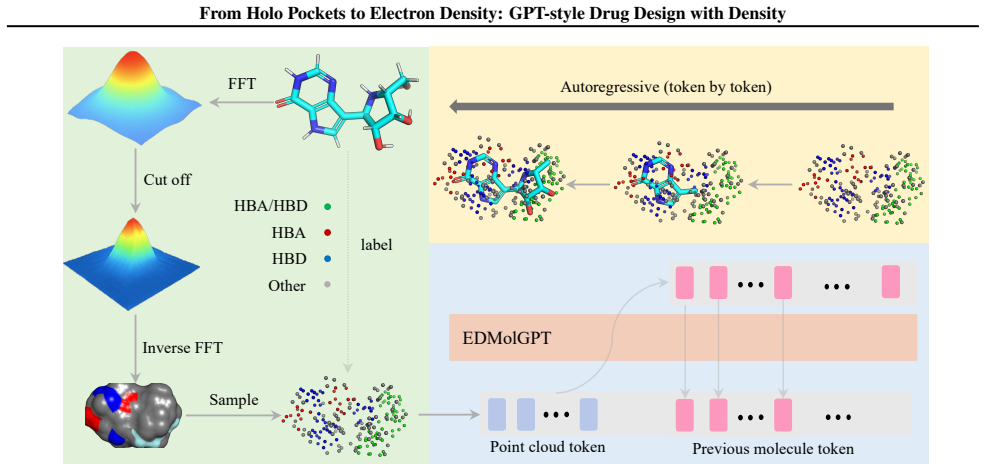
EDMolGPT generates drug molecules from low-resolution electron density point clouds instead of empty protein pockets.
A machine-rendered reading of the paper's core claim, the machinery that carries it, and where it could break.
Core claim
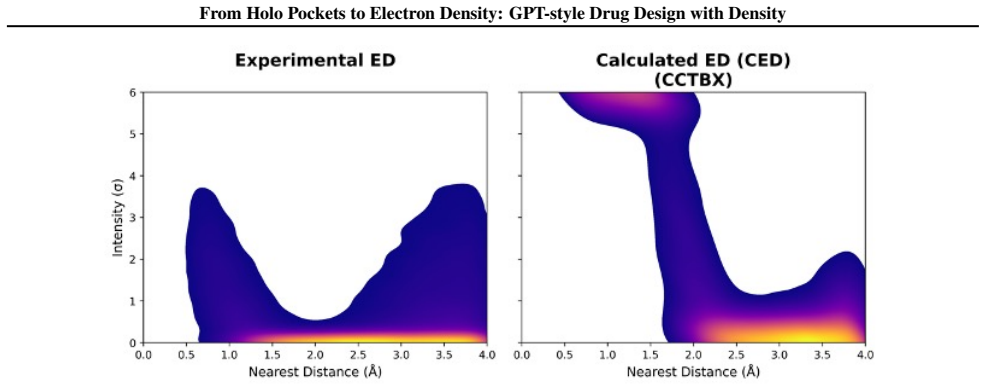
By shifting from empty holo pockets to low-resolution electron density derived from the filler components, the work establishes EDMolGPT as a decoder-only autoregressive framework capable of generating molecules from ED point clouds. This framework supports both calculated densities for pre-training and experimental densities from cryo-EM or X-ray sources, enabling a more faithful representation of the binding environment that includes conformational flexibility.
What carries the argument
EDMolGPT, a decoder-only autoregressive framework that generates molecules from low-resolution ED point clouds.
If this is right
- Molecules are produced with explicit 3D conformations aligned to the input density.
- Unified pre-training on calculated ED becomes possible alongside direct use of experimental data.
- Structural bias from rigid pocket representations is mitigated by using physically grounded signals.
- The method applies across 101 biological targets with verified generation effectiveness.
- De novo design gains access to density information that includes solvent and ligand contributions.
Where Pith is reading between the lines
- Direct use of experimental structures could reduce the need for separate ligand modeling steps in design workflows.
- The point-cloud input format may extend to handling variable-resolution or noisy experimental maps in practice.
- Iterative design cycles could incorporate real-time density updates from new experiments without pocket reconstruction.
- Similar density conditioning might apply to generating other molecular classes such as peptides or materials.
Load-bearing premise
Experimental ED naturally captures conformational flexibility and provides a more faithful description of the binding environment than rigid pocket representations.
What would settle it
A direct comparison on held-out targets showing no gain in generated molecule validity, novelty, or docking scores when conditioning on experimental ED point clouds versus standard pocket representations.
Figures





read the original abstract
Recent advances in generative modeling have enabled significant progress in structure-based drug design (SBDD). Existing methods typically condition molecule generation on empty binding pockets from holo complexes, overlooking informative components such as the filler (ligands and solvent). Here, we leverage low-resolution electron density (ED) derived from the filler as a physically grounded condition for \textit{de novo} drug design. We consider two types of ED, calculated and cryo-EM/X-ray, obtainable from computational or experimental sources, supporting unified pre-training and experimental integration. Compared with rigid pocket representations, experimental ED naturally captures conformational flexibility and provides a more faithful description of the binding environment. Based on this, we introduce EDMolGPT, a decoder-only autoregressive framework that generates molecules from low-resolution ED point clouds. By grounding generation in physically meaningful density signals, EDMolGPT mitigates structural bias and produces molecules with 3D conformations. Evaluations on 101 biological targets verify the effectiveness. Our project page: https://jiahaochen1.github.io/EDMolGPT_Page/.
Editorial analysis
A structured set of objections, weighed in public.
Referee Report
Summary. The manuscript introduces EDMolGPT, a decoder-only autoregressive framework for structure-based drug design (SBDD) that generates molecules conditioned on low-resolution electron density (ED) point clouds derived from the filler (ligands and solvent) in holo complexes. It contrasts this with conditioning on empty binding pockets, arguing that experimental ED captures conformational flexibility and provides a more faithful binding environment description. The work supports unified pre-training on calculated and cryo-EM/X-ray ED and claims evaluations on 101 biological targets verify effectiveness.
Significance. If the ED input is demonstrably independent of the target ligand and the generated molecules are novel, valid, and bind effectively, the approach could advance SBDD by replacing rigid pocket representations with physical density signals and enabling direct use of experimental data. The unified handling of calculated and experimental ED is a potential strength for broader applicability.
major comments (1)
- [Abstract] Abstract: The central claim of de novo generation from ED point clouds is load-bearing on the independence of the input ED from the output molecule. The abstract states that ED is 'derived from the filler' in holo complexes but provides no description of the computation procedure (e.g., whether ligand atoms are masked or excluded when forming the input point cloud). If ligand density contributes to the ED, the task reduces to reconstruction rather than de novo design from the binding environment, undermining the contrast with 'empty binding pockets' and the claim of mitigating structural bias.
minor comments (1)
- [Abstract] Abstract: No quantitative metrics, baselines, validity rates, or error analysis are provided, preventing assessment of the 'evaluations on 101 biological targets' claim.
Simulated Author's Rebuttal
We thank the referee for their careful review and for identifying an important point of clarity in the abstract. We address the major comment below and will revise the manuscript to resolve the ambiguity.
read point-by-point responses
-
Referee: The central claim of de novo generation from ED point clouds is load-bearing on the independence of the input ED from the output molecule. The abstract states that ED is 'derived from the filler' in holo complexes but provides no description of the computation procedure (e.g., whether ligand atoms are masked or excluded when forming the input point cloud). If ligand density contributes to the ED, the task reduces to reconstruction rather than de novo design from the binding environment, undermining the contrast with 'empty binding pockets' and the claim of mitigating structural bias.
Authors: We agree that the abstract is insufficiently precise on this point and thank the referee for highlighting it. In the method, the input ED point cloud is computed from the atomic coordinates of the protein and solvent only; ligand atoms are explicitly excluded when generating the density map from the holo complex. This produces a condition independent of the target molecule. The phrasing 'filler (ligands and solvent)' in the abstract is imprecise and will be corrected. We will revise the abstract to state: 'low-resolution electron density (ED) derived from the protein and solvent in holo complexes (ligand atoms excluded)'. This change will be incorporated in the revised version. revision: yes
Circularity Check
No circularity in derivation chain
full rationale
The provided abstract and text introduce EDMolGPT as a decoder-only autoregressive model conditioned on low-resolution ED point clouds, with claims about effectiveness on 101 targets. No equations, parameter-fitting steps, uniqueness theorems, or self-citations are presented as load-bearing for any derivation. The work is framed as an empirical architectural contribution rather than a mathematical reduction; no step reduces by construction to its inputs.
Axiom & Free-Parameter Ledger
Reference graph
Works this paper leans on
-
[1]
URL https: //doi.org/10.1021/acs.jcim.1c01406
doi: 10.1021/acs.jcim.1c01406. URL https: //doi.org/10.1021/acs.jcim.1c01406. doi: 10.1021/acs.jcim.1c01406. Ding, K., Yin, S., Li, Z., Jiang, S., Yang, Y ., Zhou, W., Zhang, Y ., and Huang, B. Observing noncovalent interac- tions in experimental electron density for macromolecular systems: a novel perspective for protein–ligand interac- tion research.Jou...
-
[2]
arXiv preprint arXiv:2303.03543 , year=
Guan, J., Qian, W. W., Peng, X., Su, Y ., Peng, J., and Ma, J. 3d equivariant diffusion for target-aware molecule generation and affinity prediction.arXiv preprint arXiv:2303.03543, 2023a. Guan, J., Qian, W. W., Peng, X., Su, Y ., Peng, J., and Ma, J. 3d equivariant diffusion for target-aware molecule gener- ation and affinity prediction. InInternational ...
-
[3]
Gaussian Error Linear Units (GELUs)
Hendrycks, D. and Gimpel, K. Gaussian error linear units (gelus).arXiv preprint arXiv:1606.08415,
work page internal anchor Pith review Pith/arXiv arXiv
-
[4]
Decoupled Weight Decay Regularization
Loshchilov, I. and Hutter, F. Decoupled weight decay regu- larization.arXiv preprint arXiv:1711.05101,
work page internal anchor Pith review Pith/arXiv arXiv
-
[5]
Qu, Y ., Qiu, K., Song, Y ., Gong, J., Han, J., Zheng, M., Zhou, H., and Ma, W.-Y . Molcraft: structure-based drug design in continuous parameter space.arXiv preprint arXiv:2404.12141,
-
[6]
Su, M., Yang, Q., Du, Y ., Feng, G., Liu, Z., Li, Y ., and Wang, R. Comparative assessment of scoring functions: the casf-2016 update.Journal of chemical information and modeling, 59(2):895–913,
work page 2016
-
[7]
doi: 10.1107/s0907444906017161
ISSN 0907-4449. doi: 10.1107/s0907444906017161. URL https:// europepmc.org/articles/PMC2745883. 10 From Holo Pockets to Electron Density: GPT-style Drug Design with Density Tong, J. and Zhao, S. Large-scale analysis of bioactive lig- and conformational strain energy by ab initio calculation. Journal of Chemical Information and Modeling, 61(3): 1180–1192,
-
[8]
Geodiff: A geometric diffusion model for molecular conformation generation
Xu, M., Yu, L., Song, Y ., Shi, C., Ermon, S., and Tang, J. Geodiff: A geometric diffusion model for molecular con- formation generation.arXiv preprint arXiv:2203.02923,
-
[9]
11 From Holo Pockets to Electron Density: GPT-style Drug Design with Density Supplementary material Overview This appendix presents comprehensive experimental details, evaluation details, and more visualization results. The content is organized into five main sections: • Sec. A discusses the practical significance of electron density–based generation and ...
work page 2021
-
[10]
to draw predictions from the model’s output distribution. However, directly sampling discretized 3D coordinatesbvi m from the entire spatial domain often results in unrealistic or geometrically distorted molecular structures. To address this issue, we exploit the predicted relative geometric features to restrict the sampling space forv i m. Specifically, ...
work page 2016
discussion (0)
Sign in with ORCID, Apple, or X to comment. Anyone can read and Pith papers without signing in.