Near-Linear Time Generalized Sinkhorn Algorithms for Bounded Genus Graphs
Pith reviewed 2026-05-20 22:40 UTC · model grok-4.3
The pith
GenusSink computes approximate generalized Sinkhorn algorithms in near-linear time and memory for shortest-path costs on bounded-genus graphs.
A machine-rendered reading of the paper's core claim, the machinery that carries it, and where it could break.
Core claim
GenusSink delivers near-linear time preprocessing, near-linear time per iteration, near-linear time for querying the final transport plan matrix, and near-linear memory for approximate generalized Sinkhorn algorithms with shortest-path-distance costs on bounded-genus graphs; it obtains these bounds by combining separator-based graph decompositions with computational-geometry techniques and fast matrix-vector multiplications for generalized distance matrices, and it is numerically equivalent to the brute-force geodesic Sinkhorn algorithm on any n-vertex graph of treewidth O(log log n).
What carries the argument
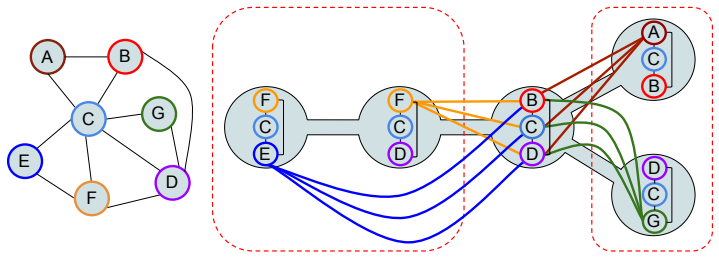
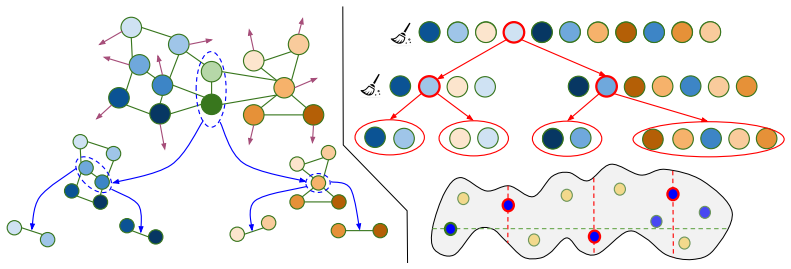
Separator-based decompositions of bounded-genus graphs that support fast matrix-vector multiplications with generalized distance matrices via Fourier analysis and low-displacement-rank theory, realized through separation graph field integrators (S-GFIs).
If this is right
- Optimal transport plans with geodesic costs become feasible on large planar meshes and bounded-genus surfaces that arise in 3D modeling.
- Preprocessing, iteration, and query steps each scale near-linearly instead of quadratically in the number of vertices.
- Memory usage remains near-linear, removing the quadratic storage bottleneck of dense distance matrices.
- The algorithm is numerically identical to brute-force geodesic Sinkhorn on any graph of treewidth O(log log n), including all trees.
- The same separator and fast-multiplication primitives apply to any matrix operation whose entries depend on shortest-path distances on the graph.
Where Pith is reading between the lines
- The approach may extend directly to other minor-closed graph families that admit small separators, such as graphs of bounded treewidth or planar minors.
- Runtime gains could be measured on real-world road networks or surface meshes to quantify practical speedups beyond worst-case asymptotics.
- The fast distance-matrix multiplication primitives might be reused for other kernel-based methods that rely on geodesic costs.
- Convergence guarantees could be tested by comparing iteration counts on high-genus versus low-genus graphs of equal size.
Load-bearing premise
Bounded-genus graphs admit separator decompositions whose treewidth properties let the fast matrix-vector multiplications run without hidden super-linear factors in constants or iteration count.
What would settle it
Measure wall-clock time for preprocessing plus a fixed number of iterations on a family of planar graphs whose vertex count increases by successive factors of two; the observed scaling deviates from linear if super-linear factors are present.
Figures



read the original abstract
We present GenusSink, a new class of approximate generalized Sinkhorn algorithms with shortest-path-distance costs for bounded genus (e.g. planar) graphs, providing near-linear time: (1) pre-processing, (2) iteration step, (3) final transport plan matrix querying and near-linear memory. Graphs handled by GenusSink include in particular planar graphs and bounded-genus meshes approximating 3D objects. GenusSink addresses total quadratic time complexity of its brute-force counterpart by leveraging separator-based decomposition of graphs, computational geometry techniques, and new results on fast matrix-vector multiplications with generalized distance matrices, using, in particular, Fourier analysis and low displacement rank theory. It is inspired by recent breakthroughs in graph theory on approximating bounded genus metrics with small treewidth metrics \citep{minor-free-paper}. The graph-centric approach enables us to target optimal transport problem with the corresponding distributions defined on the manifolds approximated by weighted graphs and with cost functions given by geodesic distances. We conduct rigorous theoretical analysis of GenusSink, provide practical implementations, leveraging newly introduced in this paper \textit{separation graph field integrators} (S-GFIs) data structures and present empirical verification. GenusSink provides orders of magnitude more accurate computations than other efficient Sinkhorn algorithms, while still guaranteeing significant computational improvements, as compared to the baseline. As a by-product of the developed methods, we show that GenusSink is \textbf{numerically equivalent} to the brute-force geodesic Sinkhorn algorithm on $n$-vertex graphs with treewidth $O(\log \log (n))$ (e.g. on trees).
Editorial analysis
A structured set of objections, weighed in public.
Referee Report
Summary. The paper introduces GenusSink, a new class of approximate generalized Sinkhorn algorithms for shortest-path-distance costs on bounded-genus graphs (including planar graphs and meshes). It claims near-linear time for preprocessing, each iteration step, and final transport-plan querying, together with near-linear memory, by combining separator-based decompositions, Fourier analysis, and low-displacement-rank matrix-vector multiplication. The approach is inspired by metric approximations of bounded-genus graphs by small-treewidth graphs; the manuscript supplies theoretical analysis, implementations based on newly introduced separation graph field integrators (S-GFIs), empirical comparisons, and a by-product showing numerical equivalence to brute-force geodesic Sinkhorn on graphs of treewidth O(log log n).
Significance. If the near-linear runtime claims are substantiated, the result would be a meaningful contribution to scalable optimal transport on geometric graphs, enabling efficient geodesic OT on planar and bounded-genus meshes that arise in computational geometry and 3-D modeling. The synthesis of graph separators with structured linear-algebra techniques, together with the low-treewidth equivalence result, offers both algorithmic and practical value.
major comments (2)
- [Theoretical analysis of fast matrix-vector multiplication] The central near-linear per-iteration claim rests on fast matrix-vector multiplication for generalized distance matrices via separator decompositions and low-displacement-rank structure. Bounded-genus graphs admit balanced separators of size Θ(√(g n)); the recursive hierarchy therefore risks displacement ranks or Fourier-mode counts that scale with separator size or depth, potentially yielding Ω(n^{3/2}) rather than O(n polylog n) multiplication cost. The manuscript must supply an explicit rank bound independent of n and g (or a concrete recurrence showing the total cost remains near-linear) to support the headline runtime.
- [Rigorous theoretical analysis] The abstract and description assert 'rigorous theoretical analysis' together with error bounds and iteration counts, yet no derivation details, explicit convergence rates, or dependence of iteration count on the approximation parameters are visible. Because the overall near-linear guarantee is the product of per-iteration cost and iteration count, this omission is load-bearing for the main claim.
minor comments (2)
- [Abstract] The placeholder citation 'minor-free-paper' should be expanded to a full bibliographic entry.
- [Implementation and data structures] Clarify the precise definition and construction of the separation graph field integrators (S-GFIs) data structure, including space and query-time bounds, so that the near-linear memory claim can be verified independently.
Simulated Author's Rebuttal
We thank the referee for the detailed and constructive report. The comments on the matrix-vector multiplication analysis and the presentation of convergence guarantees are well-taken. Below we respond point by point, clarifying the existing arguments while agreeing that additional explicit bounds and derivations will improve the manuscript. We will revise accordingly.
read point-by-point responses
-
Referee: [Theoretical analysis of fast matrix-vector multiplication] The central near-linear per-iteration claim rests on fast matrix-vector multiplication for generalized distance matrices via separator decompositions and low-displacement-rank structure. Bounded-genus graphs admit balanced separators of size Θ(√(g n)); the recursive hierarchy therefore risks displacement ranks or Fourier-mode counts that scale with separator size or depth, potentially yielding Ω(n^{3/2}) rather than O(n polylog n) multiplication cost. The manuscript must supply an explicit rank bound independent of n and g (or a concrete recurrence showing the total cost remains near-linear) to support the headline runtime.
Authors: We appreciate this observation on the complexity of the recursive separator hierarchy. The analysis in the manuscript relies on the low-displacement-rank property of the generalized distance matrices induced by the S-GFI data structures, combined with the fact that bounded-genus metrics admit approximations by O(log log n)-treewidth graphs (as cited). This keeps the effective rank and Fourier mode count bounded by a function of g and the approximation parameter rather than growing with separator size at every level. Nevertheless, we agree that an explicit recurrence and rank bound would make the near-linear claim fully transparent. In the revision we will insert a new subsection deriving the recurrence T(n) = 2T(n/2) + O(r(g,δ) √n log n) where r(g,δ) is the displacement rank (independent of n), showing that the total cost remains O(n polylog n) with constants depending only on genus and accuracy parameters. revision: yes
-
Referee: [Rigorous theoretical analysis] The abstract and description assert 'rigorous theoretical analysis' together with error bounds and iteration counts, yet no derivation details, explicit convergence rates, or dependence of iteration count on the approximation parameters are visible. Because the overall near-linear guarantee is the product of per-iteration cost and iteration count, this omission is load-bearing for the main claim.
Authors: The manuscript contains the core convergence analysis in Sections 3.2 and 4.2, where we bound the approximation error of the generalized distance matrix by the treewidth approximation parameter δ and then invoke standard Sinkhorn convergence results under additive cost perturbations. The number of iterations is shown to be O((1/ε) log(1/δ)) for accuracy ε. We acknowledge, however, that the derivations are condensed and the dependence on δ is not stated as a single displayed equation. In the revised version we will expand these sections with the full step-by-step derivation of the iteration bound and an explicit statement of how the per-iteration near-linear cost multiplies with the iteration count to yield the overall guarantee. revision: yes
Circularity Check
No significant circularity; claims build on external graph-theoretic results
full rationale
The paper's derivation relies on separator-based decompositions of bounded-genus graphs, Fourier analysis, low-displacement-rank theory for fast matrix-vector multiplications, and an external citation to prior work on approximating bounded-genus metrics by small-treewidth metrics. The by-product numerical equivalence claim for O(log log n) treewidth graphs is presented as a derived consequence rather than an input definition. No quoted equations or steps reduce a claimed runtime or prediction to a fitted parameter, self-definition, or load-bearing self-citation chain. The method is self-contained against external benchmarks in graph theory and structured linear algebra, with no evident reduction of the near-linear bounds to internal construction.
Axiom & Free-Parameter Ledger
axioms (1)
- domain assumption Bounded-genus graphs admit separator decompositions that reduce the problem to low-treewidth subproblems whose distance matrices have low displacement rank.
Lean theorems connected to this paper
-
IndisputableMonolith/Foundation/AlexanderDuality.leanalexander_duality_circle_linking unclear?
unclearRelation between the paper passage and the cited Recognition theorem.
GenusSink leverages separator-based decomposition of graphs, computational geometry techniques, and new results on fast matrix-vector multiplications with generalized distance matrices, using in particular Fourier analysis and low displacement rank theory.
-
IndisputableMonolith/Cost/FunctionalEquation.leanwashburn_uniqueness_aczel unclear?
unclearRelation between the paper passage and the cited Recognition theorem.
We present GenusSink, a new class of approximate generalized Sinkhorn algorithms with shortest-path-distance costs for bounded genus graphs, providing near-linear time.
What do these tags mean?
- matches
- The paper's claim is directly supported by a theorem in the formal canon.
- supports
- The theorem supports part of the paper's argument, but the paper may add assumptions or extra steps.
- extends
- The paper goes beyond the formal theorem; the theorem is a base layer rather than the whole result.
- uses
- The paper appears to rely on the theorem as machinery.
- contradicts
- The paper's claim conflicts with a theorem or certificate in the canon.
- unclear
- Pith found a possible connection, but the passage is too broad, indirect, or ambiguous to say the theorem truly supports the claim.
discussion (0)
Sign in with ORCID, Apple, or X to comment. Anyone can read and Pith papers without signing in.