No measurement induced phase transition in the entanglement dynamics of monitored non-interacting one-dimensional fermions in a disordered or quasiperiodic potential
Pith reviewed 2026-05-20 22:29 UTC · model grok-4.3
The pith
Monitored non-interacting one-dimensional fermions in disordered or quasiperiodic potentials remain in an area-law entanglement phase for any monitoring strength.
A machine-rendered reading of the paper's core claim, the machinery that carries it, and where it could break.
Core claim
The entanglement entropy of one-dimensional non-interacting fermions with U(1) symmetry in a disordered or quasi-periodic potential stays in an area-law phase under homodyne or projective monitoring. The critical monitoring strength is consistent with zero once finite-size effects are removed by going to lattices as large as 18000 sites. For the disordered case an exact mapping to a nonlinear sigma model confirms the absence of any transition and shows that disorder changes the symmetry class from BDI to AIII, which increases the correlation length at weak disorder and raises the effective monitoring strength linearly with disorder strength.
What carries the argument
Mapping onto a nonlinear sigma model that encodes the symmetry change from BDI to AIII and yields the correlation length for the disordered case.
If this is right
- Entanglement entropy follows an area law for every value of monitoring strength and disorder strength.
- The effective monitoring strength grows linearly with disorder but never reaches a value that produces a transition.
- Quasiperiodic potentials produce the same area-law behavior as random disorder.
- The symmetry-class change from BDI to AIII fully accounts for the enhanced correlation length at weak disorder.
Where Pith is reading between the lines
- Similar finite-size masking may hide the true phase structure in other non-interacting monitored systems that have been studied only at moderate lattice sizes.
- Adding even weak interactions could open a window for a measurement-induced transition that is absent in the strictly non-interacting limit.
- Experiments that reach thousands of sites with controlled monitoring would be needed to test the predicted area-law dominance directly.
Load-bearing premise
The correlation length extracted from systems of a few hundred sites can be extrapolated to much larger lattices without extra length scales introduced by the particular disorder or monitoring protocol.
What would settle it
A simulation or analytic calculation that finds a stable nonzero critical monitoring strength at system sizes well beyond 18000 sites would falsify the central claim.
Figures


read the original abstract
We show that the entanglement entropy (EE) of one-dimensional (1d) non-interacting fermions with $U(1)$ symmetry in the presence of a disordered or quasi-periodic potential in which the occupation number is being monitored by homodyne or projective protocols is always in an area-law phase so no measurement induced phase transition (MIPT) occurs. The reason for the previously claimed MIPT in these systems was a finite size effect related to the fact that the maximum lattice size $L \sim 500$ was of the order of the correlation length. By increasing the system size up to $L \leq 18000$, employing Graphics Processing Unit (GPU), and performing a careful finite size scaling analysis, we find that the critical monitoring strength is consistent with zero so no MIPT occurs. For the disordered case, these numerical results are fully supported by an analytical calculation based on mapping the problem onto a nonlinear sigma model (NLSM) that confirms the absence of the MIPT for any monitoring or disorder strength. The effect of disorder is captured by a change of symmetry, from BDI to AIII, which results in an enhanced correlation length in the weak disorder limit and, by an effective monitoring strength that increase linearly with disorder.
Editorial analysis
A structured set of objections, weighed in public.
Referee Report
Summary. The manuscript claims that monitored non-interacting 1D fermions with U(1) symmetry in disordered or quasiperiodic potentials exhibit area-law entanglement entropy for any monitoring strength, implying no measurement-induced phase transition (MIPT). Prior reports of an MIPT are attributed to finite-size effects at L ~ 500 comparable to the correlation length. Using GPU-enabled simulations up to L = 18000 and finite-size scaling, the critical monitoring strength is found consistent with zero. For the disordered case this is supported by an NLSM mapping that changes the symmetry class from BDI to AIII, yielding an effective monitoring strength linear in disorder and an enhanced correlation length at weak disorder.
Significance. If the central claim holds, the work resolves apparent discrepancies in the literature on MIPTs by showing that disorder and quasiperiodicity suppress the transition in this non-interacting setting. The large-scale numerics (L ≤ 18000) combined with the analytical NLSM derivation constitute a clear strength, providing both numerical evidence and a symmetry-based explanation that is independent of fitting parameters. This advances understanding of how potentials modify monitored entanglement dynamics beyond pure numerics.
major comments (2)
- [Numerical results and finite-size scaling] Finite-size scaling analysis (discussion of γ_c(L) extrapolation from L ~ 500 to L = 18000): the inference that the critical monitoring strength vanishes exactly relies on the assumption that the monitoring-dependent correlation length is the only relevant scale. For the quasiperiodic case, where the NLSM does not apply, an additional length scale from the quasiperiodic modulation period could produce a crossover that pins a small nonzero γ_c at still larger L; the scaling ansatz should be tested against this possibility with explicit checks for other diverging lengths.
- [Analytical NLSM calculation] NLSM mapping for the disordered case (section presenting the analytical support): while the symmetry change from BDI to AIII is invoked to explain the absence of an MIPT for any strength, the explicit steps deriving the linear increase of effective monitoring strength with disorder and the resulting correlation-length enhancement in the weak-disorder limit are not fully detailed in the provided text; these steps are load-bearing for the claim that the analytical result is independent of the numerics.
minor comments (2)
- [Methods] The abstract and main text refer to 'Graphics Processing Unit (GPU)' acceleration; adding a brief description of the parallelization scheme or code availability would aid reproducibility.
- [Figures] Figures displaying the entanglement scaling and collapse would benefit from explicit annotation of the extrapolated γ_c values and error bars on the L → ∞ limit.
Simulated Author's Rebuttal
We thank the referee for their careful reading of our manuscript and for the constructive comments, which help clarify the presentation of our results. We address each major comment below.
read point-by-point responses
-
Referee: Finite-size scaling analysis (discussion of γ_c(L) extrapolation from L ~ 500 to L = 18000): the inference that the critical monitoring strength vanishes exactly relies on the assumption that the monitoring-dependent correlation length is the only relevant scale. For the quasiperiodic case, where the NLSM does not apply, an additional length scale from the quasiperiodic modulation period could produce a crossover that pins a small nonzero γ_c at still larger L; the scaling ansatz should be tested against this possibility with explicit checks for other diverging lengths.
Authors: We appreciate the referee's suggestion to explicitly rule out additional length scales in the quasiperiodic case. Our finite-size scaling analysis, performed with system sizes up to L=18000, shows that the extrapolated critical monitoring strength remains consistent with zero. We have examined the dependence on the quasiperiodic modulation period and find no signatures of a crossover that would stabilize a finite γ_c at larger scales; the data collapse is consistent with the monitoring-dependent correlation length being the dominant scale. To make this explicit, we will add supplementary figures and discussion in the revised manuscript demonstrating the absence of other diverging lengths in the scaling analysis. revision: partial
-
Referee: NLSM mapping for the disordered case (section presenting the analytical support): while the symmetry change from BDI to AIII is invoked to explain the absence of an MIPT for any strength, the explicit steps deriving the linear increase of effective monitoring strength with disorder and the resulting correlation-length enhancement in the weak-disorder limit are not fully detailed in the provided text; these steps are load-bearing for the claim that the analytical result is independent of the numerics.
Authors: We agree that the explicit derivation steps of the NLSM should be presented in greater detail. The current manuscript summarizes the symmetry change from BDI to AIII induced by disorder averaging and its effect on the effective monitoring strength. In the revision we will expand the relevant section to include the full sequence: construction of the replicated action for the monitored fermions, incorporation of disorder which alters the target manifold to the AIII class, derivation of the effective monitoring coupling that grows linearly with disorder strength, and the resulting enhancement of the correlation length in the weak-disorder regime. This will render the analytical demonstration of the absence of an MIPT for any finite disorder and monitoring strength self-contained and independent of the numerical data. revision: yes
Circularity Check
No significant circularity: numerics and NLSM mapping are independent of the target claim
full rationale
The paper derives the absence of MIPT from two independent lines: (1) direct computation of entanglement entropy on systems up to L=18000 followed by standard finite-size scaling to extrapolate the apparent critical monitoring rate to zero, and (2) an analytical mapping of the disordered case onto a nonlinear sigma model that changes the symmetry class (BDI to AIII) and produces an effective monitoring strength linear in disorder strength. Neither line reduces by construction to its own inputs; the scaling ansatz is applied to externally computed data rather than defining the critical point tautologically, and the NLSM is presented as a first-principles symmetry analysis rather than a self-citation or ansatz smuggled from prior work by the same authors. The central claim therefore remains self-contained against external benchmarks.
Axiom & Free-Parameter Ledger
axioms (1)
- domain assumption Mapping the monitored fermion problem onto a nonlinear sigma model with symmetry class changed from BDI to AIII
Reference graph
Works this paper leans on
-
[1]
By contrast, in the QSD protocol, all sites are weakly measured at each time step
The probability of each of these two outcomes is given by the Born’s rule,⟨ni⟩and1− ⟨n i⟩for the filled and un- filled state at sitei, respectively, and therefore depends on the state before this measurement event. By contrast, in the QSD protocol, all sites are weakly measured at each time step. The state evolution is governed by a stochastic equa- tion ...
-
[2]
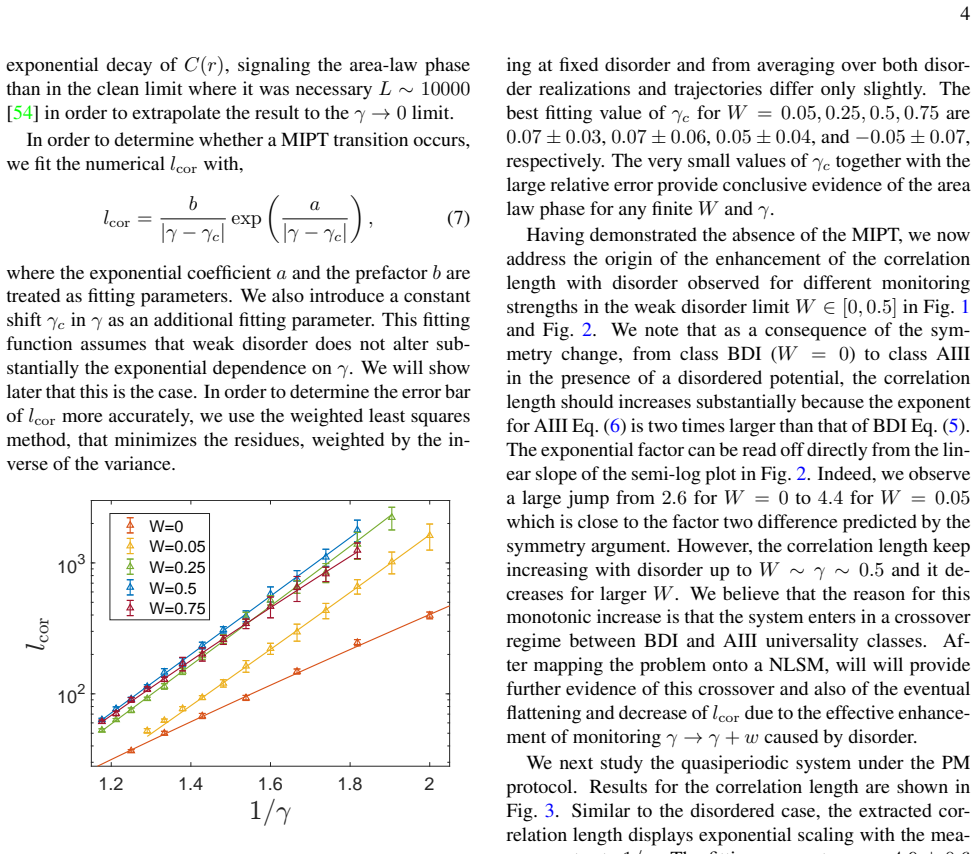
in order to extrapolate the result to theγ→0limit. In order to determine whether a MIPT transition occurs, we fit the numericall cor with, lcor = b |γ−γ c| exp a |γ−γ c| ,(7) where the exponential coefficientaand the prefactorbare treated as fitting parameters. We also introduce a constant shiftγ c inγas an additional fitting parameter. This fitting funct...
-
[3]
P. W. Anderson, Absence of diffusion in certain random lat- tices, Phys. Rev.109, 1492 (1958)
work page 1958
-
[4]
E. Abrahams, P. W. Anderson, D. C. Licciardello, and T. V . Ramakrishnan, Scaling theory of localization: Absence of quantum diffusion in two dimensions, Phys. Rev. Lett.42, 673 (1979)
work page 1979
-
[5]
M. Schreiber and H. Grussbach, Multifractal wave functions at the anderson transition, Phys. Rev. Lett.67, 607 (1991)
work page 1991
-
[7]
A. M. Garc ´ıa-Garc´ıa and E. Cuevas, Dimensional depen- dence of the metal-insulator transition, Phys. Rev. B75, 174203 (2007)
work page 2007
-
[8]
A. Rodriguez, L. J. Vasquez, K. Slevin, and R. A. R ¨omer, Multifractal finite-size scaling and universality at the ander- son transition, Phys. Rev. B84, 134209 (2011)
work page 2011
-
[9]
A. M. Garc ´ıa-Garc´ıa, Semiclassical theory of the anderson transition, Phys. Rev. Lett.100, 076404 (2008)
work page 2008
-
[10]
P. G. Harper, Single band motion of conduction electrons in a uniform magnetic field, Proceedings of the Physical Soci- ety. Section A68, 874 (1955)
work page 1955
-
[11]
S. Aubry and G. Andr ´e, Analyticity breaking and anderson localization in incommensurate lattices, Ann. Israel Phys. Soc3, 18 (1980)
work page 1980
-
[12]
M. Kohmoto, L. P. Kadanoff, and C. Tang, Localization problem in one dimension: Mapping and escape, Phys. Rev. Lett.50, 1870 (1983)
work page 1983
-
[13]
I. Burmistrov, K. Tikhonov, I. Gornyi, and A. Mirlin, En- tanglement entropy and particle number cumulants of dis- ordered fermions, Annals of Physics (NY)383, 140 (2017)
work page 2017
-
[14]
D. Gioev and I. Klich, Entanglement entropy of fermions in any dimension and the widom conjecture, Phys. Rev. Lett. 96, 100503 (2006)
work page 2006
-
[15]
W. Nagourney, J. Sandberg, and H. Dehmelt, Shelved op- tical electron amplifier: Observation of quantum jumps, Phys. Rev. Lett.56, 2797 (1986)
work page 1986
- [16]
-
[17]
S. Gleyzes, S. Kuhr, C. Guerlin, J. Bernu, S. Del ´eglise, U. Busk Hoff, M. Brune, J.-M. Raimond, and S. Haroche, Quantum jumps of light recording the birth and death of a photon in a cavity, Nature446, 297–300 (2007)
work page 2007
- [18]
-
[19]
M. B. Plenio and P. L. Knight, The quantum-jump approach to dissipative dynamics in quantum optics, Rev. Mod. Phys. 70, 101 (1998)
work page 1998
-
[20]
H. M. Wiseman and G. J. Milburn, Quantum theory of op- tical feedback via homodyne detection, Phys. Rev. Lett.70, 548 (1993)
work page 1993
-
[21]
M. Collett, R. Loudon, and C. G. and, Quantum theory of optical homodyne and heterodyne detection, Journal of Modern Optics34, 881 (1987)
work page 1987
-
[22]
H. M. Wiseman and G. J. Milburn,Quantum Measurement and Control(Cambridge University Press, 2014)
work page 2014
-
[23]
M. Fuwa, S. Takeda, M. Zwierz, H. M. Wiseman, and A. Fu- rusawa, Experimental proof of nonlocal wavefunction col- lapse for a single particle using homodyne measurements, Nature Communications6, 10.1038/ncomms7665 (2015)
-
[24]
Y . Li, X. Chen, and M. P. A. Fisher, Quantum Zeno effect and the many-body entanglement transition, Phys. Rev. B 98, 205136 (2018)
work page 2018
-
[25]
B. Skinner, J. Ruhman, and A. Nahum, Measurement- induced phase transitions in the dynamics of entanglement, Phys. Rev. X9, 031009 (2019)
work page 2019
- [26]
-
[27]
M. Ippoliti, M. J. Gullans, S. Gopalakrishnan, D. A. Huse, and V . Khemani, Entanglement phase transitions in measurement-only dynamics, Phys. Rev. X11, 011030 (2021)
work page 2021
-
[28]
Y . Li, X. Chen, and M. P. A. Fisher, Measurement-driven entanglement transition in hybrid quantum circuits, Phys. Rev. B100, 134306 (2019)
work page 2019
-
[29]
C. Carisch, A. Romito, and O. Zilberberg, Quantifying measurement-induced quantum-to-classical crossover using an open-system entanglement measure, Phys. Rev. Res.5, L042031 (2023)
work page 2023
-
[30]
M. Szyniszewski, A. Romito, and H. Schomerus, Entangle- ment transition from variable-strength weak measurements, Phys. Rev. B100, 064204 (2019)
work page 2019
-
[31]
M. Szyniszewski, A. Romito, and H. Schomerus, Universal- ity of entanglement transitions from stroboscopic to contin- uous measurements, Phys. Rev. Lett.125, 210602 (2020)
work page 2020
-
[32]
X. Turkeshi, R. Fazio, and M. Dalmonte, Measurement- induced criticality in(2 + 1)-dimensional hybrid quantum circuits, Phys. Rev. B102, 014315 (2020)
work page 2020
-
[33]
X. Turkeshi, A. Biella, R. Fazio, M. Dalmonte, and M. Schir `o, Measurement-induced entanglement transitions in the quantum Ising chain: From infinite to zero clicks, Phys. Rev. B103, 224210 (2021)
work page 2021
-
[34]
X. Turkeshi, M. Dalmonte, R. Fazio, and M. Schir `o, En- tanglement transitions from stochastic resetting of non- Hermitian quasiparticles, Phys. Rev. B105, L241114 (2022)
work page 2022
-
[35]
Y . L. Gal, X. Turkeshi, and M. Schir`o, V olume-to-area law entanglement transition in a non-Hermitian free fermionic chain, SciPost Phys.14, 138 (2023)
work page 2023
- [36]
-
[37]
C. Noel, P. Niroula, D. Zhu, A. Risinger, L. Egan, D. Biswas, M. Cetina, A. V . Gorshkov, M. J. Gullans, D. A. Huse, and C. Monroe, Measurement-induced quan- tum phases realized in a trapped-ion quantum computer, Nat. Phys.18, 760 (2022)
work page 2022
-
[38]
J. M. Koh, S.-N. Sun, M. Motta, and A. J. Minnich, Measurement-induced entanglement phase transition on a superconducting quantum processor with mid-circuit read- out, Nat. Phys.19, 1314 (2023)
work page 2023
-
[39]
Y . Li, X. Chen, A. W. W. Ludwig, and M. P. A. Fisher, Con- formal invariance and quantum nonlocality in critical hybrid circuits, Phys. Rev. B104, 104305 (2021)
work page 2021
-
[40]
C.-M. Jian, Y .-Z. You, R. Vasseur, and A. W. W. Ludwig, Measurement-induced criticality in random quantum cir- cuits, Phys. Rev. B101, 104302 (2020)
work page 2020
-
[41]
C.-M. Jian, B. Bauer, A. Keselman, and A. W. W. Ludwig, Criticality and entanglement in nonunitary quantum circuits and tensor networks of noninteracting fermions, Phys. Rev. B106, 134206 (2022)
work page 2022
- [42]
-
[43]
I. Poboiko, P. P ¨opperl, I. V . Gornyi, and A. D. Mirlin, Theory of free fermions under random projective measure- ments, Phys. Rev. X13, 041046 (2023)
work page 2023
-
[44]
I. Poboiko, I. V . Gornyi, and A. D. Mirlin, Measurement- induced phase transition for free fermions above one dimen- sion, Phys. Rev. Lett.132, 110403 (2024)
work page 2024
-
[45]
M. Buchhold, Y . Minoguchi, A. Altland, and S. Diehl, Ef- fective theory for the measurement-induced phase transition of Dirac fermions, Phys. Rev. X11, 041004 (2021)
work page 2021
-
[46]
M. Buchhold, T. M ¨uller, and S. Diehl, Revealing measurement-induced phase transitions by pre-selection (2022), arXiv:2208.10506 [cond-mat.dis-nn]
-
[47]
M. Fava, L. Piroli, T. Swann, D. Bernard, and A. Nahum, Nonlinear sigma models for monitored dynamics of free fermions, Phys. Rev. X13, 041045 (2023)
work page 2023
-
[48]
M. Fava, L. Piroli, D. Bernard, and A. Nahum, Monitored fermions with conservedu(1)charge, Phys. Rev. Res.6, 043246 (2024)
work page 2024
-
[49]
X. Cao, A. Tilloy, and A. De Luca, Entanglement in a fermion chain under continuous monitoring, SciPost Phys. 7, 024 (2019)
work page 2019
-
[50]
I. Poboiko and A. D. Mirlin, Quantum dynamics of moni- tored free fermions: Evolution of quantum correlations and scaling at measurement-induced phase transitions, Phys. Rev. B113, 144311 (2026)
work page 2026
-
[51]
I. Poboiko, M. Szyniszewski, C. J. Turner, I. V . Gornyi, A. D. Mirlin, and A. Pal, Measurement-induced l´evy flights of quantum information, Phys. Rev. Lett.135, 170403 (2025)
work page 2025
- [52]
-
[53]
F. Wegner, The mobility edge problem: continuous symme- try and a conjecture, Zeitschrift f¨ur Physik B35, 207 (1979)
work page 1979
-
[54]
Wegner, Anomalous dimesions for the nonlinear sigma- model in 2 +ϵdimensions (I), Nucl
F. Wegner, Anomalous dimesions for the nonlinear sigma- model in 2 +ϵdimensions (I), Nucl. Phys. B280, 193 (1987)
work page 1987
-
[55]
Efetov, Supersymmetry and theory of disordered metals, Advances in Physics32, 53 (1983)
K. Efetov, Supersymmetry and theory of disordered metals, Advances in Physics32, 53 (1983)
work page 1983
-
[56]
B. Fan, C. Yin, and A. M. Garc´ıa-Garc´ıa, Entanglement dy- namics of monitored noninteracting fermions on graphics processing units, Phys. Rev. B113, 094317 (2026)
work page 2026
-
[57]
K. Chahine and M. Buchhold, Entanglement phases, local- ization, and multifractality of monitored free fermions in two dimensions, Phys. Rev. B110, 054313 (2024)
work page 2024
- [58]
-
[59]
T. Muller, S. Diehl, and M. Buchhold, Measurement- induced dark state phase transitions in long-ranged fermion systems, Physical Review Letters128, 10.1103/phys- revlett.128.010605 (2022)
-
[60]
Y . Fuji and Y . Ashida, Measurement-induced quantum criti- cality under continuous monitoring, Physical Review B102, 054302 (2020)
work page 2020
-
[61]
I. Poboiko, P. P ¨opperl, I. V . Gornyi, and A. D. Mirlin, Measurement-induced transitions for interacting fermions, Phys. Rev. B111, 024204 (2025)
work page 2025
-
[62]
M. Szyniszewski, O. Lunt, and A. Pal, Disordered moni- tored free fermions, Phys. Rev. B108, 165126 (2023)
work page 2023
-
[63]
T. Matsubara, K. Yamamoto, and A. Koga, Measurement- induced phase transitions for free fermions in a quasiperi- odic potential, Phys. Rev. B112, 054309 (2025)
work page 2025
-
[64]
I. Klich and L. Levitov, Quantum noise as an entanglement meter, Phys. Rev. Lett.102, 100502 (2009)
work page 2009
-
[65]
A. MacKinnon and B. Kramer, The scaling theory of elec- trons in disordered solids: Additional numerical results, Zeitschrift fur Physik B Condensed Matter53, 1 (1983)
work page 1983
- [66]
- [67]
-
[68]
Y . Liao, M. Matheussen, and X. Zhang, Measurement- induced phase transitions in disordered fermions (2026), arXiv:2605.05306 [cond-mat.stat-mech]
work page internal anchor Pith review Pith/arXiv arXiv 2026
-
[69]
F. Evers and A. D. Mirlin, Anderson transitions, Rev. Mod. Phys.80, 1355 (2008). 9 Supplemental Materials These Supplemental Materials provides technical details and additional numerical results supporting the analysis pre- sented in the main text. We present the numerical implementation of the projective measurement (PM) and quantum state diffusion (QSD)...
work page 2008
-
[70]
project onto both on-diagonalTr(G)and off-diagonal channelsG − Tr(G) 2R I2R, since Tr ( ¯ΨΨ)2 = 1 2( ¯ΨΨ)ab( ¯ΨΨ)ba − 1 2( ¯ΨΨ)aa( ¯ΨΨ)bb =− 1 2 Tr(G2)−(Tr(G)) 2 , and choose the saddle point at the replica symmetric sectorR= 1. We believe in the current monitoring problem, the replica symmetricTr(G)andTr(σ zG)contribution can only generate diffusive dyna...
-
[71]
=−(∂ µU0)U † 0 ,(∂ µU † f)Uf =−U † f(∂µUf), the last two fast-slow correlated term merge into 2DP µ Tr h (∂µU0)U † 0 U † f(∂µUf) i . Then we try to integrate out the fastΦ f field, we first perform the expansion of Wµ ≡ −iU † f(∂µUf): Wµ =∂ µΦf − i 2 [Φf , ∂µΦf]− 1 6 [Φf ,[Φ f , ∂µΦf]] +O(Φ 4 f). and we expand the non-zero interaction vertex inS 0 of thre...
discussion (0)
Sign in with ORCID, Apple, or X to comment. Anyone can read and Pith papers without signing in.