Recognition: unknown
Measurement-induced phase transitions in disordered fermions
Pith reviewed 2026-05-08 16:00 UTC · model grok-4.3
The pith
Disorder modifies only the parameters of the nonlinear sigma model governing monitored fermions, leaving the presence or absence of measurement-induced phase transitions unchanged.
A machine-rendered reading of the paper's core claim, the machinery that carries it, and where it could break.
Core claim
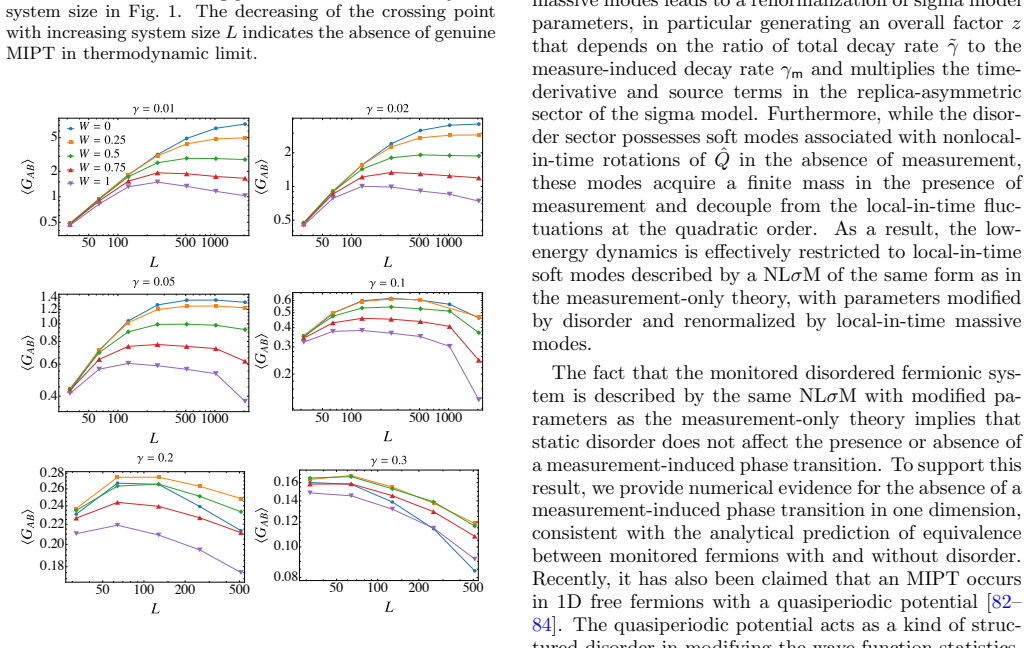
We find that the system is governed by the same nonlinear sigma model as in the case of clean monitored fermions, with disorder entering only through a modification of model parameters. This result suggests that the presence or absence of a measurement-induced phase transition is unaffected by the introduction of disorder: in spatial dimensions d>1, a transition occurs between an area x log law phase and an area law phase, whereas in d=1, the system exhibits only an area law phase and no transition. Numerical results further demonstrate that both clean and disordered one-dimensional free fermions exhibit area-law behavior when the system size is large enough.
What carries the argument
The nonlinear sigma model effective field theory for long-time entanglement scaling, whose parameters are renormalized by disorder but whose structure remains identical to the clean case.
If this is right
- In d>1 the transition between area-log and area-law entanglement phases persists when disorder is added.
- In d=1 both clean and disordered systems flow to area-law scaling with no transition once system size is large.
- Disorder shifts the numerical values of parameters in the sigma model but does not alter its functional form or the resulting phase diagram.
- The universal long-time entanglement behavior is therefore the same for clean and disordered monitored fermions.
Where Pith is reading between the lines
- The parameter shifts induced by disorder could be exploited to move the location of the critical point without changing the phases themselves.
- Similar robustness might hold for other monitoring protocols or weak interactions if the same sigma-model structure survives.
- Experimental platforms with unavoidable disorder should still display the predicted transitions in d>1 once finite-size effects are controlled.
Load-bearing premise
The derived effective field theory fully captures the universal long-time behavior and the numerical simulations for large system sizes reflect the true asymptotic entanglement scaling without finite-size artifacts.
What would settle it
A demonstration that disorder eliminates the transition in d>1 or induces a transition in large d=1 systems would falsify the claim that the phase structure is unaffected.
Figures


read the original abstract
Measurement-induced phase transitions are nonequilibrium transitions between phases characterized by distinct entanglement scaling behaviors, driven by the competition between unitary dynamics and measurements. Despite recent numerical efforts, how quenched disorder affects these transitions remains unclear. In this work, we study a $d$-dimensional noninteracting fermionic system subject to both quenched disorder and continuous monitoring of the local particle density, and derive an effective field theory describing its long-time universal behaviors. We find that the system is governed by the same nonlinear sigma model as in the case of clean monitored fermions, with disorder entering only through a modification of model parameters. This result suggests that the presence or absence of a measurement-induced phase transition is unaffected by the introduction of disorder: in spatial dimensions d>1, a transition occurs between an area x log law phase and an area law phase, whereas in d=1, the system exhibits only an area law phase and no transition. Numerical results further demonstrate that both clean and disordered one-dimensional free fermions exhibit area-law behavior when the system size is large enough.
Editorial analysis
A structured set of objections, weighed in public.
Referee Report
Summary. The paper studies d-dimensional noninteracting fermions subject to quenched disorder and continuous monitoring of local particle density. It derives an effective field theory for the long-time universal behavior, claiming that the system is governed by the same nonlinear sigma model as in the clean monitored-fermion case, with disorder entering only via shifts in model parameters (e.g., measurement rate or diffusion constant). This implies that the presence or absence of a measurement-induced phase transition is unaffected by disorder: a transition between an area-log and area-law phase occurs for d>1, while d=1 exhibits only an area-law phase with no transition. Numerical simulations in one dimension are presented to support area-law entanglement scaling for sufficiently large system sizes in both clean and disordered cases.
Significance. If the central mapping holds, the result establishes that quenched disorder does not alter the universality class or introduce new relevant operators that would change the phase diagram of measurement-induced transitions in monitored free fermions. This is a substantive contribution to the understanding of nonequilibrium entanglement transitions, as it suggests robustness of the clean-case phenomenology to disorder. The explicit derivation of the effective theory (with parameter renormalization) and the 1D numerics constitute the main strengths; the former, if parameter-free in its structural invariance, would be particularly valuable.
major comments (2)
- [effective field theory derivation] The central claim (abstract and § on effective theory) that the disordered system maps exactly onto the clean nonlinear sigma model with only parameter renormalization requires explicit verification that the disorder-averaging procedure (replicas or equivalent) generates no additional relevant operators under RG flow at the area-law or area-log fixed points. Please provide the explicit form of the replicated action after averaging and demonstrate the absence of new symmetry-breaking or higher-gradient terms that could be relevant in d=1 or d>1.
- [numerical results] § on numerical results: the statement that both clean and disordered 1D cases exhibit area-law behavior 'when the system size is large enough' is load-bearing for the no-transition claim in d=1. The finite-size scaling analysis, number of disorder realizations, and checks for possible logarithmic corrections or slow crossovers to a putative transition must be shown explicitly; current evidence appears insufficient to rule out finite-size artifacts as noted in the weakest assumption.
minor comments (2)
- [model definition] Clarify the precise definition of the monitoring protocol and the disorder distribution (e.g., random potentials vs. hoppings) in the model Hamiltonian to allow direct comparison with prior clean-case literature.
- [abstract and phase diagram discussion] The abstract states 'a transition occurs between an area x log law phase and an area law phase' for d>1; please specify whether this is area-log or volume-log scaling and cite the corresponding fixed-point analysis.
Simulated Author's Rebuttal
We thank the referee for the careful reading of our manuscript and the constructive comments. We address each major point below. The central mapping to the nonlinear sigma model is derived in the paper via disorder averaging and gradient expansion, but we will expand the presentation for clarity. The numerical evidence supports our claims but can be strengthened with additional analysis.
read point-by-point responses
-
Referee: [effective field theory derivation] The central claim (abstract and § on effective theory) that the disordered system maps exactly onto the clean nonlinear sigma model with only parameter renormalization requires explicit verification that the disorder-averaging procedure (replicas or equivalent) generates no additional relevant operators under RG flow at the area-law or area-log fixed points. Please provide the explicit form of the replicated action after averaging and demonstrate the absence of new symmetry-breaking or higher-gradient terms that could be relevant in d=1 or d>1.
Authors: In § on effective theory, we start from the replicated Keldysh action for the monitored fermions, average over Gaussian quenched disorder (which couples to local density), and integrate out massive modes to arrive at the nonlinear sigma model. The averaged replicated action takes the form of the clean model plus a term that only renormalizes the measurement rate and diffusion constant; no new symmetry-breaking or higher-gradient operators are generated because the disorder is local and preserves the replica and time-reversal symmetries. Power counting shows these potential terms are irrelevant at both the area-law and area-log fixed points in d ≥ 1. We will add an appendix with the explicit post-averaging replicated action and the RG relevance analysis. revision: yes
-
Referee: [numerical results] § on numerical results: the statement that both clean and disordered 1D cases exhibit area-law behavior 'when the system size is large enough' is load-bearing for the no-transition claim in d=1. The finite-size scaling analysis, number of disorder realizations, and checks for possible logarithmic corrections or slow crossovers to a putative transition must be shown explicitly; current evidence appears insufficient to rule out finite-size artifacts as noted in the weakest assumption.
Authors: We agree that explicit finite-size analysis is needed to support the no-transition conclusion in d=1. The manuscript presents entanglement entropy data for L up to 128 with 500–1000 disorder realizations, showing clear area-law scaling (S ~ const) for large L in both clean and disordered cases, with no visible logarithmic growth. To address potential artifacts, we will add (i) plots of S/L versus 1/L and versus log L to quantify corrections, (ii) the number of realizations used, and (iii) a discussion of crossover scales. This additional analysis will be included in the revised manuscript. revision: yes
Circularity Check
No significant circularity: derivation of effective theory from microscopic model is independent
full rationale
The paper explicitly derives the effective field theory for the monitored disordered fermions starting from the microscopic noninteracting fermionic Hamiltonian with quenched disorder and continuous density monitoring. It then shows that after disorder averaging the resulting long-wavelength theory is the same nonlinear sigma model previously obtained for the clean case, with disorder absorbed only into renormalized coefficients. This structural invariance is presented as the output of the derivation rather than an input assumption or a renaming of a prior result. No self-citation is load-bearing for the central mapping, no parameters are fitted and then relabeled as predictions, and no uniqueness theorem from the authors' own prior work is invoked to forbid alternatives. The 1D numerical evidence for area-law scaling in both clean and disordered limits is reported as an independent consistency check. The derivation chain therefore remains self-contained and does not reduce to its inputs by construction.
Axiom & Free-Parameter Ledger
axioms (1)
- domain assumption Long-time universal behavior of the monitored disordered system is captured by an effective nonlinear sigma model derived from the microscopic Hamiltonian.
Forward citations
Cited by 1 Pith paper
-
No measurement induced phase transition in the entanglement dynamics of monitored non-interacting one-dimensional fermions in a disordered or quasiperiodic potential
Large-scale numerics up to 18000 sites and nonlinear sigma model analysis demonstrate that monitored non-interacting 1D fermions in disorder or quasiperiodicity exhibit only area-law entanglement with no MIPT at any m...
Reference graph
Works this paper leans on
-
[1]
replica-symmetric sector The action for Gaussian fluctuations in the replica- symmetric sectorδ ˆ¯q(s) andδ ˆQ(s) takes the form iS(s) =−Rπνγ m Z ε Z ω,k δ¯q(s)12 ω,k δ¯q(s)21 −ω,−k −Rπνγ D Z ε,ω,k δQ(s)12 ε,ε−ω,kδQ(s)21 ε−ω,ε,−k −R πν ˜γ Z ε,ω,k [−1 +θ(ω, k)−ϕ(ω)] × h γmδ¯q(s)12 ω,k +γ DδQ(s)12 ε,ε−ω,k +iJ q(s) ω,k i × h γmδ¯q(s)21 −ω,−k +γ DδQ(s)21 ε−ω,...
-
[2]
(B4) Here we have defined, as before,X (D) andY (D) as the ˆτ1 andτ 2 components ofδ ˆQ(a): ˆX(D) = (δ ˆQ(a)12 +δ ˆQ(a)21)/2, ˆY (D) =i(δ ˆQ(a)12 −δ ˆQ(a)21)/2
Replica-asymmetric sector The action governing the Gaussian fluctuations in the replica-asymmetric sector assumes the form S(a) =SX +S Y +S XY +S XY J +S J , iSX =− πν ˜γ Z ε Z ω,k trR γ2 m ˆX(m) ω,k −1− ˜γ γm +θ(ω, k) ˆX(m) −ω,−k +γ 2 D ˆX(D) ε,ε−ω,k −1 + ˜γ γD +θ(ω, k) ˆX(D) ε−ω,ε,−k +2γmγD ˆX(m) ω,k [−1 +θ(ω, k)] ˆX(D) ε−ω,ε,−k o , iSY =− πν ˜γ Z ε Z ω...
-
[3]
Skinner, J
B. Skinner, J. Ruhman, and A. Nahum, Measurement- induced phase transitions in the dynamics of entangle- ment, Phys. Rev. X9, 031009 (2019)
2019
-
[4]
Y. Li, X. Chen, and M. P. A. Fisher, Quantum zeno effect and the many-body entanglement transition, Phys. Rev. B98, 205136 (2018)
2018
-
[5]
A. Chan, R. M. Nandkishore, M. Pretko, and G. Smith, Unitary-projective entanglement dynamics, Phys. Rev. B 99, 224307 (2019)
2019
-
[6]
Szyniszewski, A
M. Szyniszewski, A. Romito, and H. Schomerus, Entan- glement transition from variable-strength weak measure- ments, Phys. Rev. B100, 064204 (2019)
2019
-
[7]
Y. Li, X. Chen, and M. P. A. Fisher, Measurement- driven entanglement transition in hybrid quantum cir- cuits, Phys. Rev. B100, 134306 (2019)
2019
-
[8]
Y. Bao, S. Choi, and E. Altman, Theory of the phase transition in random unitary circuits with measurements, Phys. Rev. B101, 104301 (2020)
2020
-
[9]
Jian, Y.-Z
C.-M. Jian, Y.-Z. You, R. Vasseur, and A. W. W. Ludwig, Measurement-induced criticality in random quantum cir- cuits, Phys. Rev. B101, 104302 (2020)
2020
-
[10]
Zhang, J
L. Zhang, J. A. Reyes, S. Kourtis, C. Chamon, E. R. Mucciolo, and A. E. Ruckenstein, Nonuniversal entan- glement level statistics in projection-driven quantum cir- cuits, Phys. Rev. B101, 235104 (2020)
2020
-
[11]
Zabalo, M
A. Zabalo, M. J. Gullans, J. H. Wilson, S. Gopalakrish- nan, D. A. Huse, and J. H. Pixley, Critical properties of the measurement-induced transition in random quantum circuits, Phys. Rev. B101, 060301 (2020)
2020
-
[12]
M. J. Gullans and D. A. Huse, Scalable probes of measurement-induced criticality, Phys. Rev. Lett.125, 070606 (2020)
2020
-
[13]
M. J. Gullans and D. A. Huse, Dynamical purifica- tion phase transition induced by quantum measurements, Phys. Rev. X10, 041020 (2020)
2020
-
[14]
Iaconis, A
J. Iaconis, A. Lucas, and X. Chen, Measurement-induced phase transitions in quantum automaton circuits, Phys. Rev. B102, 224311 (2020)
2020
-
[15]
Turkeshi, R
X. Turkeshi, R. Fazio, and M. Dalmonte, Measurement- induced criticality in (2+1)-dimensional hybrid quantum circuits, Phys. Rev. B102, 014315 (2020)
2020
-
[16]
Szyniszewski, A
M. Szyniszewski, A. Romito, and H. Schomerus, Univer- sality of entanglement transitions from stroboscopic to continuous measurements, Phys. Rev. Lett.125, 210602 (2020)
2020
-
[17]
S. Choi, Y. Bao, X.-L. Qi, and E. Altman, Quantum er- ror correction in scrambling dynamics and measurement- induced phase transition, Phys. Rev. Lett.125, 030505 (2020)
2020
-
[18]
Y. Li, X. Chen, A. W. W. Ludwig, and M. P. A. Fisher, Conformal invariance and quantum nonlocality in critical hybrid circuits, Phys. Rev. B104, 104305 (2021)
2021
-
[19]
Sang and T
S. Sang and T. H. Hsieh, Measurement-protected quan- tum phases, Phys. Rev. Res.3, 023200 (2021)
2021
-
[20]
Nahum, S
A. Nahum, S. Roy, B. Skinner, and J. Ruhman, Mea- surement and entanglement phase transitions in all-to- all quantum circuits, on quantum trees, and in landau- ginsburg theory, PRX Quantum2, 010352 (2021)
2021
-
[21]
Ippoliti, M
M. Ippoliti, M. J. Gullans, S. Gopalakrishnan, D. A. Huse, and V. Khemani, Entanglement phase transitions in measurement-only dynamics, Phys. Rev. X11, 011030 (2021)
2021
-
[22]
Lavasani, Y
A. Lavasani, Y. Alavirad, and M. Barkeshli, Measurement-induced topological entanglement transi- tions in symmetric random quantum circuits, Nature Physics17, 342–347 (2021)
2021
-
[23]
Lavasani, Y
A. Lavasani, Y. Alavirad, and M. Barkeshli, Topologi- cal order and criticality in (2 + 1)D monitored random quantum circuits, Phys. Rev. Lett.127, 235701 (2021)
2021
-
[24]
Block, Y
M. Block, Y. Bao, S. Choi, E. Altman, and N. Y. Yao, Measurement-induced transition in long-range in- teracting quantum circuits, Phys. Rev. Lett.128, 010604 (2022)
2022
-
[25]
Agrawal, A
U. Agrawal, A. Zabalo, K. Chen, J. H. Wilson, A. C. Pot- ter, J. H. Pixley, S. Gopalakrishnan, and R. Vasseur, En- tanglement and Charge-Sharpening Transitions in U(1) Symmetric Monitored Quantum Circuits, Phys. Rev. X 12, 041002 (2022)
2022
-
[26]
Barratt, U
F. Barratt, U. Agrawal, S. Gopalakrishnan, D. A. Huse, R. Vasseur, and A. C. Potter, Field theory of charge sharpening in symmetric monitored quantum circuits, Phys. Rev. Lett.129, 120604 (2022)
2022
-
[27]
Sharma, X
S. Sharma, X. Turkeshi, R. Fazio, and M. Dalmonte, Measurement-induced criticality in extended and long- range unitary circuits, SciPost Phys. Core5, 023 (2022)
2022
-
[28]
S. P. Kelly, U. Poschinger, F. Schmidt-Kaler, M. P. A. 17 Fisher, and J. Marino, Coherence requirements for quan- tum communication from hybrid circuit dynamics, Sci- Post Phys.15, 250 (2023)
2023
-
[29]
Morral-Yepes, F
R. Morral-Yepes, F. Pollmann, and I. Lovas, Detect- ing and stabilizing measurement-induced symmetry- protected topological phases in generalized cluster mod- els, Phys. Rev. B108, 224304 (2023)
2023
-
[30]
Zabalo, J
A. Zabalo, J. H. Wilson, M. J. Gullans, R. Vasseur, S. Gopalakrishnan, D. A. Huse, and J. H. Pixley, Infinite- randomness criticality in monitored quantum dynamics with static disorder, Phys. Rev. B107, L220204 (2023)
2023
-
[31]
M. P. Fisher, V. Khemani, A. Nahum, and S. Vijay, Random quantum circuits, Annual Review of Condensed Matter Physics14, 335–379 (2023)
2023
-
[32]
H. Ha, A. Pandey, S. Gopalakrishnan, and D. A. Huse, Measurement-induced phase transitions in systems with diffusive dynamics, Phys. Rev. B110, L140301 (2024)
2024
-
[33]
Liu, M.-R
S. Liu, M.-R. Li, S.-X. Zhang, and S.-K. Jian, Entan- glement structure and information protection in noisy hybrid quantum circuits, Phys. Rev. Lett.132, 240402 (2024)
2024
-
[34]
Manna, V
S. Manna, V. Madhok, and A. Lakshminarayan, Entan- gling power, gate typicality, and measurement-induced phase transitions, Phys. Rev. A110, 062422 (2024)
2024
-
[35]
Majidy, U
S. Majidy, U. Agrawal, S. Gopalakrishnan, A. C. Pot- ter, R. Vasseur, and N. Y. Halpern, Critical phase and spin sharpening in SU(2)-symmetric monitored quantum circuits, Phys. Rev. B108, 054307 (2023)
2023
-
[36]
Agrawal, J
U. Agrawal, J. Lopez-Piqueres, R. Vasseur, S. Gopalakr- ishnan, and A. C. Potter, Observing quantum measure- ment collapse as a learnability phase transition, Phys. Rev. X14, 041012 (2024)
2024
-
[37]
Chakraborty, K
A. Chakraborty, K. Chen, A. Zabalo, J. H. Wilson, and J. H. Pixley, Charge and entanglement criticality in a U(1)-symmetric hybrid circuit of qubits, Phys. Rev. B 110, 045135 (2024)
2024
-
[38]
Yang, X.-B
F. Yang, X.-B. Wang, and T. Chen, Bridging measurement-induced phase transition and quantum er- ror correction in monitored quantum circuits with many- body measurements, Phys. Rev. B111, 064308 (2025)
2025
-
[39]
Khanna, A
K. Khanna, A. Kumar, R. Vasseur, and A. W. W. Lud- wig, Random quantum circuits with time-reversal sym- metry, Phys. Rev. Res.8, 013165 (2026)
2026
-
[40]
X. Cao, A. Tilloy, and A. D. Luca, Entanglement in a fermion chain under continuous monitoring, SciPost Phys.7, 024 (2019)
2019
-
[41]
X. Chen, Y. Li, M. P. A. Fisher, and A. Lucas, Emergent conformal symmetry in nonunitary random dynamics of free fermions, Phys. Rev. Res.2, 033017 (2020)
2020
-
[42]
Alberton, M
O. Alberton, M. Buchhold, and S. Diehl, Entanglement transition in a monitored free-fermion chain: From ex- tended criticality to area law, Phys. Rev. Lett.126, 170602 (2021)
2021
-
[43]
Buchhold, Y
M. Buchhold, Y. Minoguchi, A. Altland, and S. Diehl, Ef- fective Theory for the Measurement-Induced Phase Tran- sition of Dirac Fermions, Phys. Rev. X11, 041004 (2021)
2021
-
[44]
Turkeshi, A
X. Turkeshi, A. Biella, R. Fazio, M. Dalmonte, and M. Schir´ o, Measurement-induced entanglement transi- tions in the quantum ising chain: From infinite to zero clicks, Phys. Rev. B103, 224210 (2021)
2021
-
[45]
Q. Tang, X. Chen, and W. Zhu, Quantum criticality in the nonunitary dynamics of (2 + 1)-dimensional free fermions, Phys. Rev. B103, 174303 (2021)
2021
-
[46]
Turkeshi, L
X. Turkeshi, L. Piroli, and M. Schir´ o, Enhanced entangle- ment negativity in boundary-driven monitored fermionic chains, Phys. Rev. B106, 024304 (2022)
2022
-
[47]
Zhang, C
P. Zhang, C. Liu, S.-K. Jian, and X. Chen, Universal Entanglement Transitions of Free Fermions with Long- range Non-unitary Dynamics, Quantum6, 723 (2022)
2022
-
[48]
Carollo and V
F. Carollo and V. Alba, Entangled multiplets and spread- ing of quantum correlations in a continuously monitored tight-binding chain, Phys. Rev. B106, L220304 (2022)
2022
-
[49]
Minato, K
T. Minato, K. Sugimoto, T. Kuwahara, and K. Saito, Fate of measurement-induced phase transition in long- range interactions, Phys. Rev. Lett.128, 010603 (2022)
2022
-
[50]
Ladewig, S
B. Ladewig, S. Diehl, and M. Buchhold, Monitored open fermion dynamics: Exploring the interplay of measure- ment, decoherence, and free hamiltonian evolution, Phys. Rev. Res.4, 033001 (2022)
2022
-
[51]
Coppola, E
M. Coppola, E. Tirrito, D. Karevski, and M. Collura, Growth of entanglement entropy under local projective measurements, Phys. Rev. B105, 094303 (2022)
2022
-
[52]
Poboiko, P
I. Poboiko, P. P¨ opperl, I. V. Gornyi, and A. D. Mirlin, Theory of free fermions under random projective mea- surements, Phys. Rev. X13, 041046 (2023)
2023
-
[53]
M. Fava, L. Piroli, T. Swann, D. Bernard, and A. Nahum, Nonlinear sigma models for monitored dynamics of free fermions, Phys. Rev. X13, 041045 (2023)
2023
-
[54]
Y. L. Gal, X. Turkeshi, and M. Schir` o, Volume-to-area law entanglement transition in a non-Hermitian free fermionic chain, SciPost Phys.14, 138 (2023)
2023
-
[55]
M¨ uller, S
T. M¨ uller, S. Diehl, and M. Buchhold, Measurement- induced dark state phase transitions in long-ranged fermion systems, Phys. Rev. Lett.128, 010605 (2022)
2022
-
[56]
Kells, D
G. Kells, D. Meidan, and A. Romito, Topological tran- sitions in weakly monitored free fermions, SciPost Phys. 14, 031 (2023)
2023
-
[57]
M. Fava, L. Piroli, D. Bernard, and A. Nahum, Monitored fermions with conservedU(1) charge, Phys. Rev. Res.6, 043246 (2024)
2024
-
[58]
Piccitto, D
G. Piccitto, D. Rossini, and A. Russomanno, The im- pact of different unravelings in a monitored system of free fermions, The European Physical Journal B97, 90 (2024)
2024
-
[59]
Chahine and M
K. Chahine and M. Buchhold, Spectral transitions of the entanglement hamiltonian in monitored free fermions, Phys. Rev. B112, 214309 (2025)
2025
-
[60]
Starchl, M
E. Starchl, M. H. Fischer, and L. M. Sieberer, General- ized zeno effect and entanglement dynamics induced by fermion counting, PRX Quantum6, 030302 (2025)
2025
-
[61]
B. Fan, C. Yin, and A. M. Garc´ ıa-Garc´ ıa, Entanglement dynamics of monitored noninteracting fermions on graph- ics processing units, Phys. Rev. B113, 094317 (2026)
2026
- [62]
-
[63]
L´ oio, A
H. L´ oio, A. De Luca, J. De Nardis, and X. Turkeshi, Purification timescales in monitored fermions, Phys. Rev. B108, L020306 (2023)
2023
- [64]
-
[65]
Yokomizo and Y
K. Yokomizo and Y. Ashida, Measurement-induced phase transition in free bosons, Phys. Rev. B111, 235419 (2025)
2025
-
[66]
P¨ opperl, I
P. P¨ opperl, I. V. Gornyi, and Y. Gefen, Measurements 18 on an Anderson chain, Phys. Rev. B107, 174203 (2023)
2023
-
[67]
Szyniszewski, O
M. Szyniszewski, O. Lunt, and A. Pal, Disordered moni- tored free fermions, Phys. Rev. B108, 165126 (2023)
2023
-
[68]
Yamamoto and R
K. Yamamoto and R. Hamazaki, Localization properties in disordered quantum many-body dynamics under con- tinuous measurement, Phys. Rev. B107, L220201 (2023)
2023
-
[69]
De Tomasi and I
G. De Tomasi and I. M. Khaymovich, Stable many-body localization under random continuous measurements in the no-click limit, Phys. Rev. B109, 174205 (2024)
2024
-
[70]
Evers and A
F. Evers and A. D. Mirlin, Anderson transitions, Rev. Mod. Phys.80, 1355 (2008)
2008
-
[71]
Chahine and M
K. Chahine and M. Buchhold, Entanglement phases, lo- calization, and multifractality of monitored free fermions in two dimensions, Phys. Rev. B110, 054313 (2024)
2024
-
[72]
Poboiko, I
I. Poboiko, I. V. Gornyi, and A. D. Mirlin, Measurement- induced phase transition for free fermions above one di- mension, Phys. Rev. Lett.132, 110403 (2024)
2024
-
[73]
Jin and D
T. Jin and D. G. Martin, Measurement-induced phase transition in a single-body tight-binding model, Phys. Rev. B110, L060202 (2024)
2024
-
[74]
P. W. Anderson, Absence of diffusion in certain random lattices, Phys. Rev.109, 1492 (1958)
1958
-
[75]
Burmistrov, K
I. Burmistrov, K. Tikhonov, I. Gornyi, and A. Mirlin, Entanglement entropy and particle number cumulants of disordered fermions, Annals of Physics383, 140 (2017)
2017
-
[76]
M. A. Nielsen and I. L. Chuang,Quantum computation and quantum information(Cambridge university press, 2010)
2010
-
[77]
Klich and L
I. Klich and L. Levitov, Quantum noise as an entangle- ment meter, Phys. Rev. Lett.102, 100502 (2009)
2009
-
[78]
H. Guo, M. S. Foster, C.-M. Jian, and A. W. W. Ludwig, Field theory of monitored interacting fermion dynam- ics with charge conservation, Phys. Rev. B112, 064304 (2025)
2025
-
[79]
Y. Liao, A. Levchenko, and M. S. Foster, Response the- ory of the ergodic many-body delocalized phase: Keldysh Finkel’stein sigma models and the 10-fold way, Annals of Physics386, 97 (2017)
2017
-
[80]
Here we have employed the standard antisymmetric pre- scription for the equal time correlator [89]
discussion (0)
Sign in with ORCID, Apple, or X to comment. Anyone can read and Pith papers without signing in.