Self-similar dendrites with finite boundary and P-sprouts
Pith reviewed 2026-05-13 04:28 UTC · model grok-4.3
The pith
A finite graph called the sprout encodes the topology of self-similar dendrites with finite boundaries.
A machine-rendered reading of the paper's core claim, the machinery that carries it, and where it could break.
Core claim
Each self-similar dendrite K with a finite self-similar boundary defines a finite acyclic edge-labeled bipartite graph G, called the sprout of K, and this graph G determines the combinatorial properties of the dendrite K and its topological structure.
What carries the argument
The sprout G, a finite acyclic edge-labeled bipartite graph derived from the self-similar boundary of the dendrite.
If this is right
- The topology of any such dendrite can be reconstructed directly from its sprout graph.
- Combinatorial invariants of the dendrite become readable as graph-theoretic properties of the sprout.
- Classification of self-similar dendrites with finite boundaries reduces to enumeration of admissible sprout graphs.
- Topological equivalence between two such dendrites can be decided by comparing their sprouts.
Where Pith is reading between the lines
- Algorithms could generate all admissible dendrites by enumerating small sprout graphs and checking which ones produce valid self-similar realizations.
- The same reduction might extend to other classes of self-similar continua once a suitable notion of sprout is defined for them.
- One could test the framework by constructing explicit examples from given small graphs and verifying that the resulting sets satisfy the self-similarity and boundary conditions.
- The approach supplies a discrete skeleton that could be used to compute metric properties such as Hausdorff dimension from the graph alone.
Load-bearing premise
Every self-similar dendrite with finite self-similar boundary admits a well-defined finite sprout graph whose combinatorial data suffices to reconstruct the topology.
What would settle it
A concrete self-similar dendrite with finite boundary whose topology cannot be recovered from its associated sprout graph, or two topologically distinct dendrites that produce identical sprouts.
Figures





read the original abstract
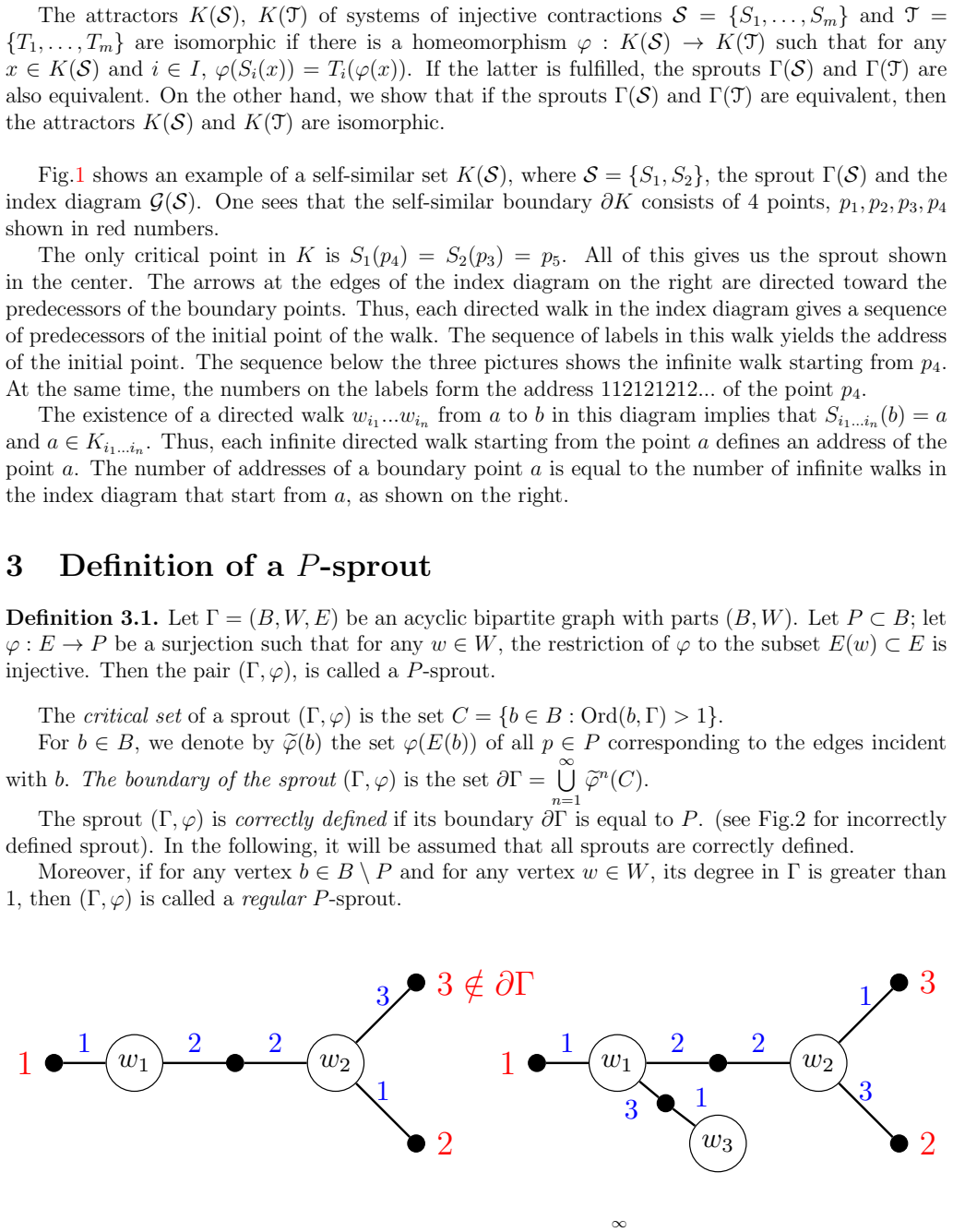
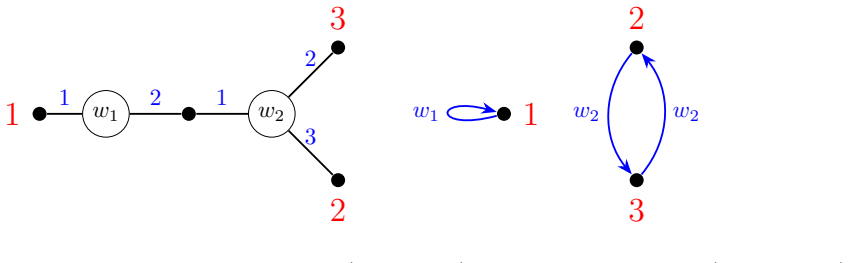
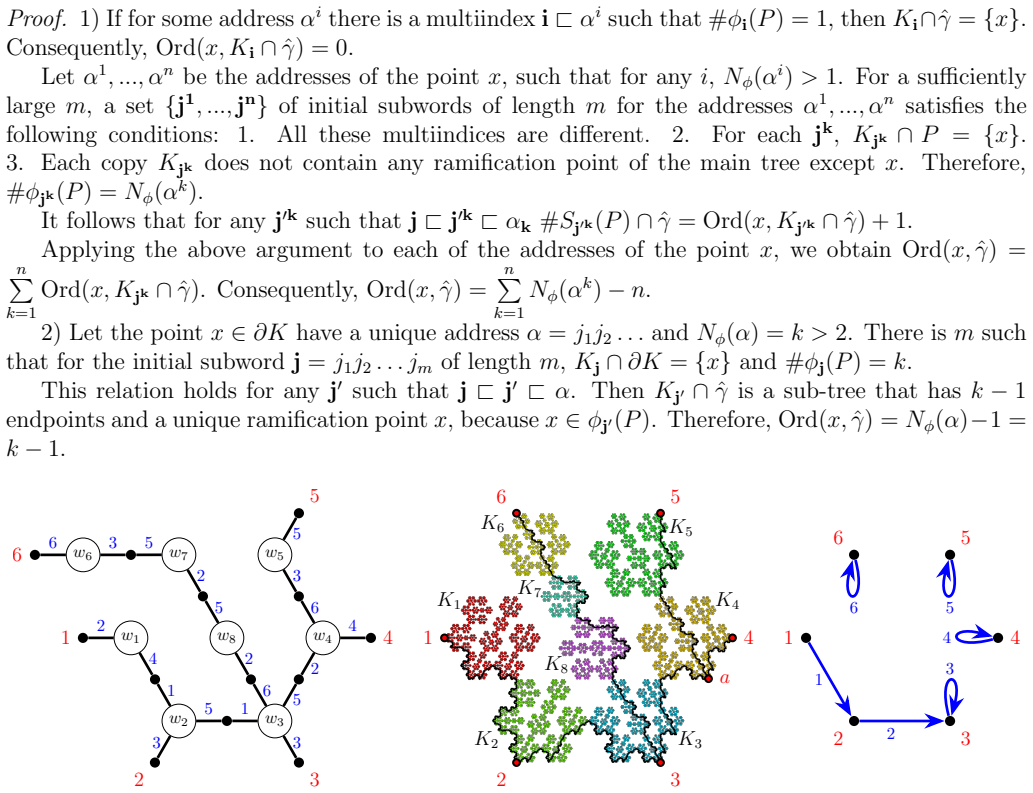
Each self-similar dendrite K with a finite self-similar boundary defines a finite acyclic edge-labeled bipartite graph G, called the sprout of K. The paper shows that the sprout G determines the combinatorial properties of the dendrite K and its topological structure.
Editorial analysis
A structured set of objections, weighed in public.
Referee Report
Summary. The manuscript defines the sprout G of each self-similar dendrite K possessing a finite self-similar boundary as a finite acyclic edge-labeled bipartite graph. It establishes that the combinatorial data of G determines the combinatorial properties of K and suffices to reconstruct its topological structure.
Significance. If the construction and reconstruction are fully rigorous, the result supplies a finite combinatorial model for an infinite topological object, which could streamline classification, computation of invariants, and comparison of self-similar dendrites in metric geometry. The explicit use of acyclicity and bipartiteness to encode branching and attachment is a clear strength.
minor comments (3)
- The definition of the sprout graph (likely in §2) should include an explicit statement of the label alphabet and the precise rule by which edges receive labels from the self-similarity data.
- An illustrative example computing G for a concrete dendrite (e.g., the Wazewski universal dendrite or a simple iterated function system) would strengthen the reconstruction claim.
- The manuscript should clarify whether the bipartition of G corresponds to a canonical partition of the dendrite's vertices or edges, and state this explicitly in the reconstruction theorem.
Simulated Author's Rebuttal
We thank the referee for the positive assessment of our manuscript and for recommending minor revision. The referee's summary correctly identifies the core contribution: the sprout G as a finite acyclic edge-labeled bipartite graph that encodes the combinatorial and topological structure of the self-similar dendrite K with finite self-similar boundary. We are pleased that the potential utility for classification and invariant computation is noted.
Circularity Check
No significant circularity; standard construction and reconstruction
full rationale
The paper constructs the sprout G directly from the self-similar dendrite K with finite boundary as a finite acyclic edge-labeled bipartite graph, then proves that the combinatorial data of G encodes and reconstructs the topological structure of K. This is a definitional invariant plus reconstruction theorem, not a reduction where a claimed prediction equals its inputs by construction, a fitted parameter is relabeled as a prediction, or a load-bearing step collapses to an unverified self-citation. The argument is self-contained against the stated assumptions of self-similarity and finite boundary, with no ansatz smuggling or renaming of known results as new derivations.
Axiom & Free-Parameter Ledger
axioms (1)
- domain assumption Self-similar dendrites with finite self-similar boundaries exist and admit a canonical finite acyclic edge-labeled bipartite graph (the sprout).
invented entities (1)
-
Sprout graph G
no independent evidence
Lean theorems connected to this paper
-
IndisputableMonolith/Foundation/AlexanderDuality.leanalexander_duality_circle_linking unclear?
unclearRelation between the paper passage and the cited Recognition theorem.
Each self-similar dendrite K with a finite self-similar boundary defines a finite acyclic edge-labeled bipartite graph Γ, called the sprout of K. The paper shows that the sprout Γ determines the combinatorial properties of the dendrite K and its topological structure.
-
IndisputableMonolith/Foundation/ArithmeticFromLogic.leanLogicNat ≃ Nat recovery unclear?
unclearRelation between the paper passage and the cited Recognition theorem.
If the systems S and ˜S have isomorphic P-sprouts Γ and ˜Γ, then their attractors K and ˜K are isomorphic (Theorem 4.5).
What do these tags mean?
- matches
- The paper's claim is directly supported by a theorem in the formal canon.
- supports
- The theorem supports part of the paper's argument, but the paper may add assumptions or extra steps.
- extends
- The paper goes beyond the formal theorem; the theorem is a base layer rather than the whole result.
- uses
- The paper appears to rely on the theorem as machinery.
- contradicts
- The paper's claim conflicts with a theorem or certificate in the canon.
- unclear
- Pith found a possible connection, but the passage is too broad, indirect, or ambiguous to say the theorem truly supports the claim.
discussion (0)
Sign in with ORCID, Apple, or X to comment. Anyone can read and Pith papers without signing in.