Binarity at LOw Metallicity (BLOeM): massive star variability revealed using a novel software tool for point-spread function fitting of TESS images
Pith reviewed 2026-05-19 19:37 UTC · model grok-4.3
The pith
A PSF-fitting method extracts clean TESS light curves for 91 massive stars in the SMC, showing their stochastic low-frequency variability follows patterns similar to those in the Milky Way.
A machine-rendered reading of the paper's core claim, the machinery that carries it, and where it could break.
Core claim
Using the Lemons PSF-based extraction on TESS data, light curves of SMC massive stars reveal stochastic low-frequency variability whose morphology probes the star's location in the Hertzsprung-Russell diagram similarly to Galactic massive stars, indicating that the underlying physical mechanism could be insensitive to metallicity.
What carries the argument
The Lemons point-spread function fitting procedure, which models the PSF to extract uncontaminated light curves from crowded TESS images of faint stars.
If this is right
- The extracted light curves show indications of binarity including eclipses and ellipsoidal modulation.
- Stellar pulsations appear in the low-metallicity SMC massive stars.
- SLF variability morphology can locate stars within the Hertzsprung-Russell diagram.
- The close match to Galactic stars implies the driving mechanism does not strongly depend on metallicity.
Where Pith is reading between the lines
- The Lemons technique could be applied to TESS observations of massive stars in other crowded or distant fields.
- If the mechanism proves metallicity-insensitive, evolution models for massive stars may require fewer environment-specific adjustments.
- Targeted follow-up photometry could test whether specific SLF features correlate with parameters beyond HR-diagram position.
Load-bearing premise
The Lemons PSF-fitting procedure removes crowding contamination without introducing systematic artifacts that could mimic or distort the reported SLF variability patterns.
What would settle it
Re-extraction of the same TESS data with an independent method or ground-based observations that yield substantially different SLF morphology for the same stars would undermine the claimed similarity to Galactic patterns.
Figures



read the original abstract
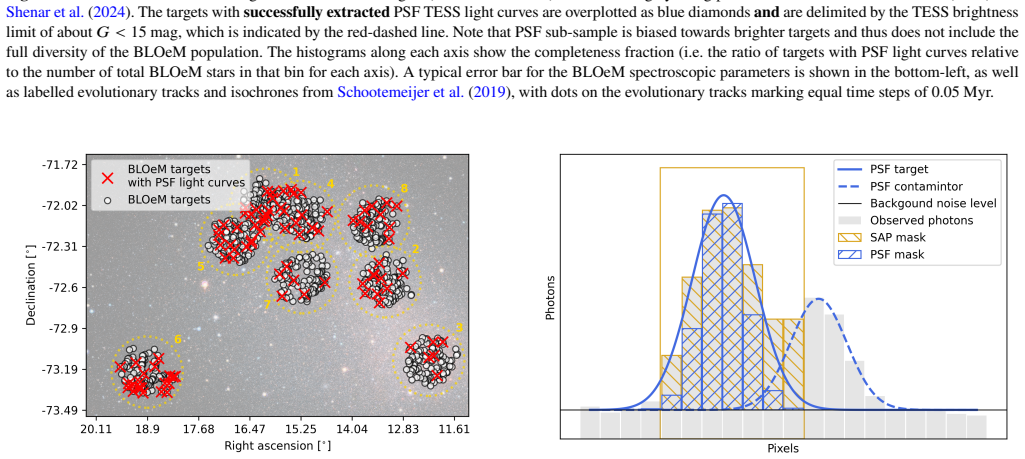
Massive stars, the progenitors of neutron stars and black holes, play a crucial role in shaping the chemical and radiative properties of entire galaxies through their winds and explosive deaths. Stellar pulsations are a common phenomenon in massive stars and asteroseismology -- the study of such pulsations -- provides crucial constraints on the physics of massive star interiors. The excitation of heat-driven pulsations in massive stars is expected to depend on a star's metallicity, but this remains largely uncalibrated in evolution models due to a lack of a sufficient observations. While TESS has dramatically improved the statistics for Galactic massive stars, obtaining TESS light curves for low-metallicity massive stars beyond the Milky Way is challenging, due to their faintness and heavy crowding. In this paper, we present a novel point-spread function (PSF) based light curve extraction method called {\sc Lemons}, which overcomes these challenges. We also demonstrate the limitations of the often-used simple aperture photometry (SAP) method that can provide heavily contaminated light curves. With this new technique, accurate light curves of 91 SMC massive stars in the BLOeM sample are extracted. They reveal a variety of variability types including indications of binarity (e.g. eclipses and ellipsoidal modulation) and stellar pulsations. They also enable us to investigate stochastic low-frequency (SLF) variability for massive stars in the SMC. Furthermore we demonstrate how the morphology of SLF variability probes a star's location in the Hertzsprung--Russell diagram, which appears similar to Galactic massive stars thus indicating that the underlying physical mechanism could be insensitive to metallicity.
Editorial analysis
A structured set of objections, weighed in public.
Referee Report
Summary. The paper introduces a novel PSF-fitting tool called Lemons for extracting TESS light curves from crowded, faint fields and applies it to 91 massive stars in the SMC BLOeM sample. It contrasts Lemons results with SAP photometry to show reduced contamination, identifies variability types including binarity and pulsations, and analyzes stochastic low-frequency (SLF) variability, reporting that its morphology correlates with position in the Hertzsprung-Russell diagram similarly to Galactic massive stars and thus suggesting the underlying mechanism is insensitive to metallicity.
Significance. If the central claims hold after validation, the work would be significant for delivering the first substantial sample of space-based light curves of low-metallicity massive stars, enabling new constraints on asteroseismology and pulsation excitation models that currently lack low-Z calibration. The Lemons method itself has potential broader utility for TESS observations of extragalactic targets, and the reported similarity in SLF morphology would provide an important observational anchor for theories of stochastic variability in massive stars.
major comments (2)
- [§3] §3 (Lemons PSF-fitting procedure): the manuscript demonstrates cleaner signals relative to SAP but provides no quantitative validation such as injection-recovery tests for SLF signals, assessment of amplitude or frequency bias as a function of local crowding or magnitude, or direct comparison with ground-based photometry. This is load-bearing for the interpretation that the reported SLF patterns and their HRD correlation reflect intrinsic physics rather than extraction systematics.
- [§5] §5 (SLF variability analysis and HRD correlation): the claim that SLF morphology probes stellar location in the HR diagram in a manner similar to Galactic stars is presented without statistical quantification of the similarity (e.g., Kolmogorov-Smirnov test on morphological parameters or error bars on the reported trends), weakening the inference that the mechanism is metallicity-insensitive.
minor comments (2)
- The acronym BLOeM should be expanded on first use in the main text; similarly, ensure SLF is defined before its extensive use in the results.
- Figure captions for the light-curve comparisons and SLF morphology plots would benefit from more detail on the exact sample selection and any applied filters.
Simulated Author's Rebuttal
We thank the referee for their constructive and detailed report. We address each major comment below and describe the revisions we will implement to strengthen the manuscript.
read point-by-point responses
-
Referee: [§3] §3 (Lemons PSF-fitting procedure): the manuscript demonstrates cleaner signals relative to SAP but provides no quantitative validation such as injection-recovery tests for SLF signals, assessment of amplitude or frequency bias as a function of local crowding or magnitude, or direct comparison with ground-based photometry. This is load-bearing for the interpretation that the reported SLF patterns and their HRD correlation reflect intrinsic physics rather than extraction systematics.
Authors: We agree that quantitative validation would strengthen the claims regarding the intrinsic nature of the extracted signals. The current manuscript relies on direct visual and qualitative comparison with SAP photometry to demonstrate reduced contamination in crowded SMC fields. In the revised manuscript we will add an injection-recovery analysis in which synthetic SLF signals are injected into the TESS images at varying amplitudes, frequencies, crowding levels and magnitudes. Recovery statistics, amplitude and frequency biases will be quantified and discussed, together with any implications for the reported HRD trends. We will also note the absence of contemporaneous ground-based photometry for the specific targets as a limitation. revision: yes
-
Referee: [§5] §5 (SLF variability analysis and HRD correlation): the claim that SLF morphology probes stellar location in the HR diagram in a manner similar to Galactic stars is presented without statistical quantification of the similarity (e.g., Kolmogorov-Smirnov test on morphological parameters or error bars on the reported trends), weakening the inference that the mechanism is metallicity-insensitive.
Authors: We acknowledge that the similarity is currently presented through qualitative description of the morphological trends. In the revised manuscript we will add error bars to the reported morphological parameters and perform a quantitative statistical comparison (including a two-sample Kolmogorov-Smirnov test) between the SMC SLF parameter distributions and the corresponding Galactic distributions from the literature. These additions will provide a more rigorous basis for the conclusion that the underlying mechanism appears insensitive to metallicity. revision: yes
Circularity Check
No circularity: observational light-curve extraction and empirical SLF morphology comparison are self-contained.
full rationale
The paper introduces the Lemons PSF-fitting algorithm as a new tool, applies it to TESS data for 91 SMC stars, contrasts results with SAP photometry, and reports an empirical similarity in SLF variability morphology to Galactic stars. No derivation chain equates the reported SLF-HRD correlation or metallicity-insensitivity conclusion to an input assumption, fitted parameter, or self-citation by construction. The central claim rests on direct observational classification rather than any self-referential equation or load-bearing prior result that reduces to the present work.
Axiom & Free-Parameter Ledger
axioms (2)
- domain assumption Standard assumptions about the stability and shape of the TESS point-spread function across the observed fields.
- domain assumption The morphological classification of SLF variability can be performed consistently across metallicities using the same visual or quantitative criteria.
Reference graph
Works this paper leans on
-
[1]
Galaxies on FIRE (Feedback In Realistic Environments): stellar feedback explains cosmologically inefficient star formation. , keywords =. doi:10.1093/mnras/stu1738 , archivePrefix =. 1311.2073 , primaryClass =
work page internal anchor Pith review Pith/arXiv arXiv doi:10.1093/mnras/stu1738 2073
-
[2]
Handbook of CCD astronomy, 2nd ed., by S.B. Howell. Cambridge observing handbooks for research astronomers, Vol. 5 Cambridge, UK: Cambridge University Press, 2006 ISBN 0521852153 , date-added =
work page 2006
-
[3]
One size does not fit all: Evidence for a range of mixing efficiencies in stellar evolution calculations. , keywords =. doi:10.1051/0004-6361/202141080 , archivePrefix =. 2107.09075 , primaryClass =
-
[4]
Numerical Simulations Confirm Wave-induced Shear Mixing in Stellar Interiors. , keywords =. doi:10.3847/2041-8213/ae09ae , archivePrefix =. 2509.18244 , primaryClass =
-
[5]
arXiv , author =:2211.08347 , journal =
doi:10.1051/0004-6361/202243545 , eid =. arXiv , author =:2211.08347 , journal =
-
[6]
arXiv , author =:2005.09658 , journal =
doi:10.1051/0004-6361/202037700 , eid =. arXiv , author =:2005.09658 , journal =
-
[7]
, keywords =. doi:10.1111/j.1745-3933.2006.00267.x , eprint =
-
[8]
arXiv , author =:2211.06432 , journal =
doi:10.3847/1538-4357/aca092 , eid =. arXiv , author =:2211.06432 , journal =
-
[9]
doi:10.1146/annurev-astro-052722-105936 , eprint =
, keywords =. doi:10.1146/annurev-astro-052722-105936 , eprint =
-
[10]
Binary interaction dominates the evolution of massive stars
Binary Interaction Dominates the Evolution of Massive Stars. Science , keywords =. doi:10.1126/science.1223344 , archivePrefix =. 1207.6397 , primaryClass =
work page internal anchor Pith review Pith/arXiv arXiv doi:10.1126/science.1223344
-
[11]
Astrophysical Implications of the Binary Black-Hole Merger GW150914
2016 , bdsk-url-1 =. doi:10.3847/2041-8205/818/2/L22 , eid =. arXiv , author =:1602.03846 , journal =
work page internal anchor Pith review Pith/arXiv arXiv doi:10.3847/2041-8205/818/2/l22 2016
-
[12]
Photometric detection of internal gravity waves in upper main-sequence stars. I. Methodology and application to CoRoT targets. , keywords =. doi:10.1051/0004-6361/201833662 , archivePrefix =. 1811.08023 , primaryClass =
work page internal anchor Pith review Pith/arXiv arXiv doi:10.1051/0004-6361/201833662
-
[13]
Stars and their Variability Observed from Space , year = 2020, editor =
What physics is missing in theoretical models of high-mass stars: new insights from asteroseismology. Stars and their Variability Observed from Space , year = 2020, editor =. doi:10.48550/arXiv.1912.12653 , archivePrefix =. 1912.12653 , primaryClass =
-
[14]
arXiv , author =:2008.11162 , journal =
doi:10.3389/fspas.2020.578584 , eid =. arXiv , author =:2008.11162 , journal =
-
[15]
Low-frequency gravity waves in blue supergiants revealed by high-precision space photometry
Low-frequency gravity waves in blue supergiants revealed by high-precision space photometry. Nature Astronomy , keywords =. doi:10.1038/s41550-019-0768-1 , archivePrefix =. 1905.02120 , primaryClass =
work page internal anchor Pith review Pith/arXiv arXiv doi:10.1038/s41550-019-0768-1 1905
-
[16]
Photometric detection of internal gravity waves in upper main-sequence stars. II. Combined TESS photometry and high-resolution spectroscopy. , keywords =. doi:10.1051/0004-6361/202038224 , archivePrefix =. 2006.03012 , primaryClass =
-
[17]
Annual Review of Astronomy and Astrophysics , year=
THE EVOLUTION OF ROTATING STARS , author=. Annual Review of Astronomy and Astrophysics , year=
- [18]
-
[19]
Angular Momentum Transport by Internal Gravity Waves across Age. , keywords =. doi:10.3847/2041-8213/adc45a , archivePrefix =. 2504.03827 , primaryClass =
-
[20]
Making waves in massive star asteroseismology. , keywords =. doi:10.1007/s10509-023-04262-7 , archivePrefix =. 2312.08319 , primaryClass =
-
[21]
Internal Gravity Waves in Massive Stars: Angular Momentum Transport
Internal Gravity Waves in Massive Stars: Angular Momentum Transport. , keywords =. doi:10.1088/0004-637X/772/1/21 , archivePrefix =. 1306.3262 , primaryClass =
work page internal anchor Pith review Pith/arXiv arXiv doi:10.1088/0004-637x/772/1/21
-
[22]
On the Chemical Mixing Induced by Internal Gravity Waves (IGW)
On the Chemical Mixing Induced by Internal Gravity Waves. , keywords =. doi:10.3847/2041-8213/aa8d13 , archivePrefix =. 1709.04920 , primaryClass =
work page internal anchor Pith review Pith/arXiv arXiv doi:10.3847/2041-8213/aa8d13 2041
-
[23]
Comparable stochastic low-frequency variability in SMC, LMC, and Galactic massive stars
Photometric detection of internal gravity waves in upper main-sequence stars: IV. Comparable stochastic low-frequency variability in SMC, LMC, and Galactic massive stars. , keywords =. doi:10.1051/0004-6361/202451419 , archivePrefix =. 2410.12726 , primaryClass =
-
[24]
New Algorithms to Extract Blended TESS Photometry of Massive Stars
Van Daele , Pieterjan. New Algorithms to Extract Blended TESS Photometry of Massive Stars. 2023
work page 2023
-
[25]
43rd COSPAR Scientific Assembly
Review of TESS's Primary Mission and Plans for Continuing Sky Surveys. 43rd COSPAR Scientific Assembly. Held 28 January - 4 February , year = 2021, volume =
work page 2021
-
[26]
X-Shooting ULLYSES: Massive stars at low metallicity - I. Project description⋆⋆⋆ , DOI= "10.1051/0004-6361/202245650", url= "https://doi.org/10.1051/0004-6361/202245650", journal =
-
[27]
Binarity at LOw Metallicity (BLOeM): A spectroscopic VLT monitoring survey of massive stars in the SMC. , keywords =. doi:10.1051/0004-6361/202451586 , archivePrefix =. 2407.14593 , primaryClass =
-
[28]
K2 photometry and HERMES spectroscopy of the blue supergiant Leo: rotational wind modulation and low-frequency waves. , keywords =. doi:10.1093/mnras/sty308 , archivePrefix =. 1802.00621 , primaryClass =
work page internal anchor Pith review Pith/arXiv arXiv doi:10.1093/mnras/sty308
-
[29]
Reviews of Modern Physics , keywords =
Probing the interior physics of stars through asteroseismology. Reviews of Modern Physics , keywords =. doi:10.1103/RevModPhys.93.015001 , archivePrefix =. 1912.12300 , primaryClass =
-
[30]
Markov Chain Monte Carlo Methods for Bayesian Data Analysis in Astronomy
Markov Chain Monte Carlo Methods for Bayesian Data Analysis in Astronomy. , keywords =. doi:10.1146/annurev-astro-082214-122339 , archivePrefix =. 1706.01629 , primaryClass =
work page internal anchor Pith review Pith/arXiv arXiv doi:10.1146/annurev-astro-082214-122339
-
[31]
TESS-Gaia Light Curve: A PSF-based TESS FFI Light-curve Product. , keywords =. doi:10.3847/1538-3881/acaaa7 , archivePrefix =. 2301.03704 , primaryClass =
-
[32]
Effect of Rotation on Wave Mixing in Intermediate-mass Stars. , keywords =. doi:10.3847/1538-4357/ad54b5 , archivePrefix =. 2406.04403 , primaryClass =
-
[33]
Pre-Supernova Evolution of Massive Single and Binary Stars
Presupernova Evolution of Massive Single and Binary Stars. , keywords =. doi:10.1146/annurev-astro-081811-125534 , archivePrefix =. 1206.5443 , primaryClass =
work page internal anchor Pith review Pith/arXiv arXiv doi:10.1146/annurev-astro-081811-125534
-
[34]
Angular Momentum Transport in Stellar Interiors. , keywords =. doi:10.1146/annurev-astro-091918-104359 , archivePrefix =. 1809.07779 , primaryClass =
-
[35]
Three-dimensional Simulations of Massive Stars. I. Wave Generation and Propagation. , keywords =. doi:10.3847/1538-4357/ab12df , archivePrefix =. 1903.09392 , primaryClass =
work page internal anchor Pith review Pith/arXiv arXiv doi:10.3847/1538-4357/ab12df 1903
-
[36]
doi:10.1007/978-1-4020-5803-5 , adsurl =
Asteroseismology. doi:10.1007/978-1-4020-5803-5 , adsurl =
-
[37]
Convective excitation and spectra of internal gravity waves
3D hydrodynamic simulations of massive main-sequence stars - II. Convective excitation and spectra of internal gravity waves. , keywords =. doi:10.1093/mnras/stae1162 , archivePrefix =. 2303.06125 , primaryClass =
-
[38]
Large-scale variability in macroturbulence driven by pulsations in the rapidly rotating massive star Oph from high-cadence ESPRESSO spectroscopy and TESS photometry. , keywords =. doi:10.1051/0004-6361/202555936 , adsurl =
-
[39]
doi:10.1051/0004-6361/200810471 , eprint =
, keywords =. doi:10.1051/0004-6361/200810471 , eprint =
-
[40]
doi:10.1093/mnras/stv868 , eprint =
, keywords =. doi:10.1093/mnras/stv868 , eprint =
-
[41]
Signatures of internal rotation discovered in the Kepler data of five slowly pulsating B stars
doi:10.1051/0004-6361/201629814 , eid =. arXiv , author =:1611.06955 , journal =
work page internal anchor Pith review Pith/arXiv arXiv doi:10.1051/0004-6361/201629814
-
[42]
arXiv , author =:2303.03989 , journal =
doi:10.1051/0004-6361/202345881 , eid =. arXiv , author =:2303.03989 , journal =
-
[43]
Catalog of Galactic Beta Cephei Stars
Catalog of Galactic Cephei Stars. , keywords =. doi:10.1086/429408 , archivePrefix =. astro-ph/0506495 , primaryClass =
work page internal anchor Pith review Pith/arXiv arXiv doi:10.1086/429408
-
[44]
2025, Experimental Astronomy, 59, 26, doi: 10.1007/s10686-025-09985-9
The PLATO mission. Experimental Astronomy , keywords =. doi:10.1007/s10686-025-09985-9 , archivePrefix =. 2406.05447 , primaryClass =
-
[45]
Classifying Be Star Variability With TESS. I. The Southern Ecliptic. , keywords =. doi:10.3847/1538-3881/ac5abd , archivePrefix =. 2010.13905 , primaryClass =
-
[46]
Pulsations in Binary Star Systems. arXiv e-prints , keywords =. doi:10.48550/arXiv.2509.08426 , archivePrefix =. 2509.08426 , primaryClass =
-
[47]
Localizing Sources of Variability in Crowded TESS Photometry. , keywords =. doi:10.3847/1538-3881/acb20c , archivePrefix =. 2204.06020 , primaryClass =
-
[48]
A calibration point for stellar evolution from massive star asteroseismology. Nature Astronomy , keywords =. doi:10.1038/s41550-023-01978-y , archivePrefix =. 2306.11798 , primaryClass =
-
[49]
The Gaia mission. , keywords =. doi:10.1051/0004-6361/201629272 , archivePrefix =. 1609.04153 , primaryClass =
work page internal anchor Pith review Pith/arXiv arXiv doi:10.1051/0004-6361/201629272
-
[50]
Summary of the content and survey properties
Gaia Data Release 3. Summary of the content and survey properties. , keywords =. doi:10.1051/0004-6361/202243940 , archivePrefix =. 2208.00211 , primaryClass =
-
[51]
Summary of the contents and survey properties
Gaia Early Data Release 3. Summary of the contents and survey properties. , keywords =. doi:10.1051/0004-6361/202039657 , archivePrefix =. 2012.01533 , primaryClass =
-
[52]
doi:10.3847/2041-8213/ab5446 , eid =
2019 , bdsk-url-1 =. doi:10.3847/2041-8213/ab5446 , eid =. arXiv , author =:1910.01643 , journal =
-
[53]
Surface manifestation of stochastically excited internal gravity waves. , keywords =. doi:10.1093/mnras/stab2524 , archivePrefix =. 2105.04558 , primaryClass =
-
[54]
doi:10.1093/mnras/stad1067 , eprint =
, keywords =. doi:10.1093/mnras/stad1067 , eprint =
-
[55]
arXiv , author =:2110.13944 , journal =
doi:10.3847/2041-8213/ac441f , eid =. arXiv , author =:2110.13944 , journal =
-
[56]
doi:10.1051/0004-6361/200911643 , eprint =
, keywords =. doi:10.1051/0004-6361/200911643 , eprint =
-
[57]
On the Origin of Stochastic, Low-Frequency Photometric Variability in Massive Stars. , keywords =. doi:10.3847/1538-4357/ac03b0 , archivePrefix =. 2102.05670 , primaryClass =
-
[58]
A Transparent Window into Early-type Stellar Variability. , keywords =. doi:10.3847/1538-4357/ac4e89 , archivePrefix =. 2201.10567 , primaryClass =
-
[59]
Light variations due to the line-driven wind instability and wind blanketing in O stars
Light variations due to the line-driven wind instability and wind blanketing in O stars. , keywords =. doi:10.1051/0004-6361/201731614 , archivePrefix =. 1807.09407 , primaryClass =
work page internal anchor Pith review Pith/arXiv arXiv doi:10.1051/0004-6361/201731614
-
[60]
arXiv , author =:2103.08755 , journal =
doi:10.1051/0004-6361/202040148 , eid =. arXiv , author =:2103.08755 , journal =
-
[61]
The photometric variability of massive stars due to gravity waves excited by core convection. Nature Astronomy , keywords =. doi:10.1038/s41550-023-02040-7 , archivePrefix =. 2306.08023 , primaryClass =
-
[62]
The Astrophysical Journal Supplement Series , author =
Modules for Experiments in Stellar Astrophysics (MESA): Convective Boundaries, Element Diffusion, and Massive Star Explosions. , keywords =. doi:10.3847/1538-4365/aaa5a8 , archivePrefix =. 1710.08424 , primaryClass =
work page internal anchor Pith review Pith/arXiv arXiv doi:10.3847/1538-4365/aaa5a8
-
[63]
Lightkurve: Kepler and TESS time series analysis in Python. ascl:1812.013 , adsurl =
-
[64]
GYRE: An open-source stellar oscillation code based on a new Magnus Multiple Shooting Scheme
GYRE: an open-source stellar oscillation code based on a new Magnus Multiple Shooting scheme. , keywords =. doi:10.1093/mnras/stt1533 , archivePrefix =. 1308.2965 , primaryClass =
work page internal anchor Pith review Pith/arXiv arXiv doi:10.1093/mnras/stt1533
-
[65]
Transport of angular momentum by stochastically excited waves as an explanation for the outburst of the rapidly rotating Be star HD49330. , keywords =. doi:10.1051/0004-6361/201935858 , archivePrefix =. 2007.08977 , primaryClass =
-
[66]
Search for exoplanets and variable stars in the field of 47 Tuc
A PSF-based Approach to TESS High quality data Of Stellar clusters (PATHOS) - I. Search for exoplanets and variable stars in the field of 47 Tuc. , keywords =. doi:10.1093/mnras/stz2878 , archivePrefix =. 1910.03592 , primaryClass =
-
[67]
eleanor: An Open-source Tool for Extracting Light Curves from the TESS Full-frame Images. , keywords =. doi:10.1088/1538-3873/ab291c , archivePrefix =. 1903.09152 , primaryClass =
-
[68]
Larry Bradley and Brigitta Sipőcz and Thomas Robitaille and Erik Tollerud and Zé Vinícius and Christoph Deil and Kyle Barbary and Tom J Wilson and Ivo Busko and Axel Donath and Hans Moritz Günther and Mihai Cara and P. L. Lim and Sebastian Meßlinger and Simon Conseil and Azalee Bostroem and Michael Droettboom and E. M. Bray and Lars Andersen Bratholm and ...
-
[69]
European Physical Journal Web of Conferences , year = 2015, series =
PLATO: PSF modelling using a micro-scanning technique. European Physical Journal Web of Conferences , year = 2015, series =. doi:10.1051/epjconf/201510106050 , archivePrefix =. 1411.7511 , primaryClass =
-
[70]
Brighter-fatter Effect in Near-infrared Detectors. I. Theory of Flat Autocorrelations. , keywords =. doi:10.1088/1538-3873/ab44f7 , archivePrefix =. 1906.01846 , primaryClass =
-
[71]
Radiative hydrodynamic simulations of red supergiant stars. III. Spectro-photocentric variability, photometric variability, and consequences on Gaia measurements. , keywords =. doi:10.1051/0004-6361/201015768 , archivePrefix =. 1012.5234 , primaryClass =
work page internal anchor Pith review Pith/arXiv arXiv doi:10.1051/0004-6361/201015768
-
[72]
Binarity at LOw Metallicity (BLOeM): Multiplicity of early B-type supergiants in the Small Magellanic Cloud. arXiv e-prints , keywords =. doi:10.48550/arXiv.2502.12239 , archivePrefix =. 2502.12239 , primaryClass =
-
[73]
The CubeSpec space mission. I. Asteroseismology of massive stars from time-series optical spectroscopy: Science requirements and target list prioritisation. , keywords =. doi:10.1051/0004-6361/202142375 , archivePrefix =. 2111.09814 , primaryClass =
-
[74]
Detection of period-spacing patterns due to the gravity modes of rotating dwarfs in the TESS southern continuous viewing zone. , keywords =. doi:10.1051/0004-6361/202141926 , archivePrefix =. 2202.10507 , primaryClass =
-
[75]
Astrocut: Tools for creating cutouts of TESS images
-
[76]
Journal of Astronomical Telescopes, Instruments, and Systems , month = jan, number = 1, pages =. doi:10.1117/1.JATIS.1.1.014003 , eid =
work page internal anchor Pith review doi:10.1117/1.jatis.1.1.014003
-
[77]
Kepler Eclipsing Binary Stars. VIII. Identification of False Positive Eclipsing Binaries and Re-extraction of New Light Curves. , keywords =. doi:10.3847/0004-6256/151/4/101 , archivePrefix =. 1602.05932 , primaryClass =
work page internal anchor Pith review Pith/arXiv arXiv doi:10.3847/0004-6256/151/4/101
-
[78]
TESS Eclipsing Binary Stars. I. Short-cadence Observations of 4584 Eclipsing Binaries in Sectors 1-26. , keywords =. doi:10.3847/1538-4365/ac324a , archivePrefix =. 2110.13382 , primaryClass =
-
[79]
Spectral classification of O and B0 supergiants in the Magellanic Clouds. , keywords =. doi:10.1086/155334 , adsurl =
-
[80]
Observational signatures of convectively driven waves in massive stars
Observational Signatures of Convectively Driven Waves in Massive Stars. , keywords =. doi:10.1088/2041-8205/806/2/L33 , archivePrefix =. 1505.06648 , primaryClass =
work page internal anchor Pith review Pith/arXiv arXiv doi:10.1088/2041-8205/806/2/l33 2041
discussion (0)
Sign in with ORCID, Apple, or X to comment. Anyone can read and Pith papers without signing in.