ANNEAL: Adapting LLM Agents via Governed Symbolic Patch Learning
Pith reviewed 2026-07-01 00:40 UTC · model grok-4.3
The pith
ANNEAL converts recurring LLM agent failures into permanent symbolic repairs of a process knowledge graph.
A machine-rendered reading of the paper's core claim, the machinery that carries it, and where it could break.
Core claim
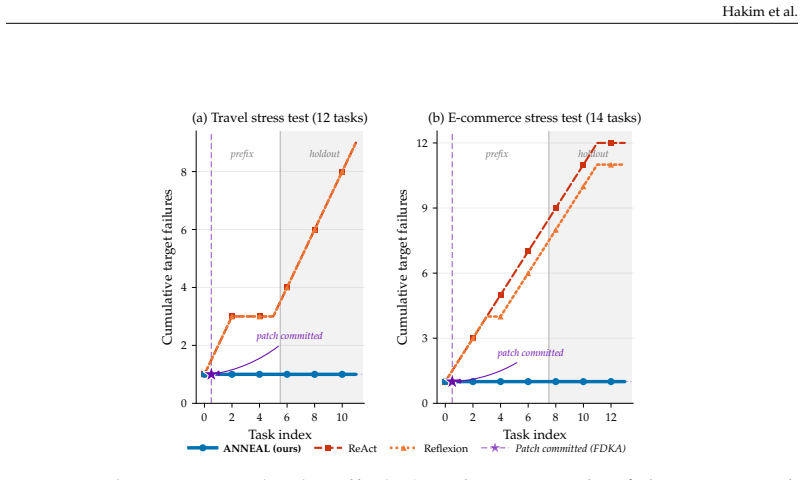
ANNEAL is a neuro-symbolic agent that converts recurring failures into governed symbolic edits of a process knowledge graph without modifying foundation model weights. Its core mechanism, Failure-Driven Knowledge Acquisition, localizes the responsible operator, synthesizes a typed patch through constrained LLM generation, and validates the proposal via multi-dimensional scoring, symbolic guardrails, and canary testing before commit. Every accepted edit carries full provenance and deterministic rollback capability. Across four domains and 27 multi-seed runs, ANNEAL is the only evaluated system that commits persistent structural repairs, reducing recurring-failure holdout rates to 0 percent wh
What carries the argument
Failure-Driven Knowledge Acquisition (FDKA), which localizes faults to specific operators in the process knowledge graph and produces validated symbolic patches that persist across episodes.
If this is right
- Agents achieve zero recurring failures on tested faults by editing symbolic operator schemas rather than relying on episodic recovery.
- Every committed patch includes provenance tracking and deterministic rollback for deployment safety.
- Ablation removing FDKA eliminates all structural repairs and lowers task success by up to 26.7 percentage points.
- The method offers a complementary path to prompt or weight updates for eliminating persistent faults across domains.
Where Pith is reading between the lines
- Agents could accumulate a growing library of verified process edits over many episodes without retraining.
- The same localization-plus-validation loop might transfer to other symbolic planning representations used in robotics or workflow systems.
- Governed patching could reduce the need for human oversight when agents operate in changing environments.
Load-bearing premise
Recurring failures can be accurately localized to individual operators and the constrained patches will prove both correct and free of new faults after validation.
What would settle it
An experiment in which a recurring failure is localized to the wrong operator or an accepted patch introduces new failures on the same holdout tasks.
Figures




read the original abstract
LLM-based agents can recover from individual execution errors, yet they repeatedly fail on the same fault when the underlying process knowledge--operator schemas, preconditions, and constraints--remains unrepaired. Existing self-evolving approaches address this gap by updating prompts, memory, or model weights, but none directly repair the symbolic structures that encode how tasks are executed, and few provide the governance guarantees required for safe deployment. We introduce ANNEAL, a neuro-symbolic agent that converts recurring failures into governed symbolic edits of a process knowledge graph without modifying foundation model weights. Its core mechanism, Failure-Driven Knowledge Acquisition (FDKA), localizes the responsible operator, synthesizes a typed patch through constrained LLM generation, and validates the proposal via multi-dimensional scoring, symbolic guardrails, and canary testing before commit. Every accepted edit carries full provenance and deterministic rollback capability. Across four domains and 27 multi-seed runs, ANNEAL is the only evaluated system that commits persistent structural repairs--strong baselines such as ReAct and Reflexion achieve high episodic recovery yet retain 72--100% holdout failure rates on recurring faults, whereas ANNEAL reduces these to 0% in the tested recurring-failure settings. Ablation confirms that removing FDKA eliminates all structural repairs and drops success rate by up to 26.7 percentage points. These results suggest that governed symbolic repair offers a complementary paradigm to weight-level and prompt-level adaptation for persistent fault elimination.
Editorial analysis
A structured set of objections, weighed in public.
Referee Report
Summary. The paper introduces ANNEAL, a neuro-symbolic LLM agent framework that uses Failure-Driven Knowledge Acquisition (FDKA) to localize faults in a process knowledge graph, generate constrained symbolic patches via LLM, and validate them with multi-dimensional scoring, guardrails, and canary testing before committing edits with provenance and rollback. It claims that across four domains and 27 multi-seed runs, ANNEAL is the only system achieving persistent structural repairs that reduce recurring-failure holdout rates to 0%, while baselines like ReAct and Reflexion retain 72-100% failure rates on the same faults; ablation removing FDKA eliminates all repairs and drops success by up to 26.7 points.
Significance. If the empirical results are substantiated with full experimental details, this offers a complementary paradigm to prompt- or weight-based adaptation by directly editing symbolic process knowledge under governance constraints. The emphasis on provenance, deterministic rollback, and guardrails addresses safety concerns in agent deployment, and the ablation provides a clear test of the core mechanism.
major comments (1)
- [Abstract] The abstract reports 0% recurring-failure holdout rates and 26.7-point ablation drops but supplies no experimental protocol, statistical tests, error bars, dataset details, or failure-mode analysis. This makes the central empirical claim impossible to evaluate from the provided text; the full methods and results sections must supply these to support the cross-domain and cross-baseline comparisons.
minor comments (1)
- [Abstract] The term 'Failure-Driven Knowledge Acquisition (FDKA)' is introduced as a core mechanism but its precise formalization (e.g., localization algorithm, patch synthesis constraints, scoring dimensions) is not defined in the abstract; this should be clarified with pseudocode or equations in the methods section.
Simulated Author's Rebuttal
We thank the referee for the constructive feedback. We address the single major comment below and commit to revisions that improve evaluability of the empirical claims.
read point-by-point responses
-
Referee: [Abstract] The abstract reports 0% recurring-failure holdout rates and 26.7-point ablation drops but supplies no experimental protocol, statistical tests, error bars, dataset details, or failure-mode analysis. This makes the central empirical claim impossible to evaluate from the provided text; the full methods and results sections must supply these to support the cross-domain and cross-baseline comparisons.
Authors: We agree that the abstract, due to strict length limits, omits the requested experimental details and therefore cannot stand alone for full evaluation. The full manuscript already supplies the protocol, dataset descriptions, multi-seed design (27 runs), statistical tests, error bars, and failure-mode analysis in the Experimental Setup, Results, and Ablation sections. To directly address the concern, we will revise the abstract to include a brief statement of the evaluation methodology and add explicit cross-references, while confirming that all supporting tables, figures, and statistical reporting remain complete in the main text. revision: yes
Circularity Check
No significant circularity
full rationale
The manuscript presents an empirical system (ANNEAL/FDKA) whose central claims are performance outcomes measured on external holdout sets across four domains and 27 runs. No equations, fitted parameters, or derivation steps are described that could reduce to self-defined quantities. The localization-plus-validation premise is stated as an implemented mechanism with provenance/rollback rather than an unexamined assumption, and results are compared against independent baselines (ReAct, Reflexion) without internal reduction. Ablation removing FDKA is likewise an external experimental control. The work is therefore self-contained against external benchmarks with no load-bearing self-citation chain or definitional loop.
Axiom & Free-Parameter Ledger
axioms (1)
- domain assumption Recurring execution failures stem from unrepaired operator schemas, preconditions, and constraints in a process knowledge graph.
invented entities (1)
-
Failure-Driven Knowledge Acquisition (FDKA)
no independent evidence
Reference graph
Works this paper leans on
-
[1]
arXiv:2506.03320, https://arxiv.org/abs/2506
doi: 10.48550/arXiv.2506.03320. arXiv:2506.03320, https://arxiv.org/abs/2506. 03320. Vaishak Belle, Michael Fisher, Alessandra Russo, Ekaterina Komendantskaya, and Alistair Nottle. Neuro-symbolic ai+ agent systems: a first reflection on trends, opportunities and challenges. InInternational Conference on Autonomous Agents and Multiagent Systems, pp. 180–20...
-
[2]
URLhttps://arxiv.org/abs/2508.02085. Minhua Lin, Hanqing Lu, Zhan Shi, Bing He, Rui Mao, Zhiwei Zhang, Zongyu Wu, Xianfeng Tang, Hui Liu, Zhenwei Dai, Xiang Zhang, Suhang Wang, Benoit Dumoulin, and Jian Pei. Position: Agentic evolution is the path to evolving LLMs, 2026. URL https://arxiv.org/ abs/2602.00359. Shuai Shao, Qihan Ren, Chen Qian, Boyi Wei, Da...
-
[3]
Name Canonicalization
-
[4]
Stage 2 uses few-shot constrained prompting to emit a patch in closed JSON schema
Normalization Rejection on any failure Typed Edit o (AST) - Ready for scoring Figure 4:Concrete PROPOSEEDITpipeline.Stage 1 serializes failure trace τ into compact JSON. Stage 2 uses few-shot constrained prompting to emit a patch in closed JSON schema. Stage 3 deterministically parses and type-checks output into typed symbolic edit ∆o. The LLM acts as a c...
-
[5]
Ledger check:CHECKANDSTAGEdetects coverage or reverse conflicts; resolves or escalates
-
[6]
5) evaluates plausibility, consistency, utility, and risk
Score:Multi-dimensional scoring (Eq. 5) evaluates plausibility, consistency, utility, and risk. 4.Guardrails:Value (Eq. 6) and causal (Eq. 7) gates veto or escalate unsafe edits
-
[7]
Human gate:High-impact or low-confidence patches queue human review immediately after guardrails; only auto-approved patches continue
-
[8]
action a must complete within t seconds of b
Canary test:CSR (Eq. 18) provides empirical safety evidence for auto-approved patches or post-review approvals. 7.Commit:On approval, commit (Eq. 21) with trust initialization and rollback set. 8.Monitor:Trust scoring (Eq. 20) tracks reliability; automatic rollback triggered ifρ<0.3. This multi-layered defense ensures no single mechanism is a single point...
2025
discussion (0)
Sign in with ORCID, Apple, or X to comment. Anyone can read and Pith papers without signing in.