Accelerating AI-Powered Research: The PuppyChatter Framework for Usable and Flexible Tooling
Pith reviewed 2026-05-20 11:00 UTC · model grok-4.3
The pith
PuppyChatter framework lets developers use any AI model vendor with the same simplicity as a single SDK.
A machine-rendered reading of the paper's core claim, the machinery that carries it, and where it could break.
Core claim
The central claim is that PuppyChatter is a novel software framework designed to preserve the intuitive simplicity of vendor-specific SDKs while simultaneously adhering to the vendor-neutrality principles characteristic of model abstraction, thereby offering a more streamlined and flexible development paradigm for AI applications.
What carries the argument
The PuppyChatter framework, which supplies a single intuitive interface that developers use like a vendor SDK yet routes transparently to any supported model without code changes.
Load-bearing premise
A single framework can simultaneously deliver the low cognitive load of a vendor SDK and the full vendor independence of an abstraction layer without introducing new complexity or security concerns of its own.
What would settle it
A controlled user study that measures setup time, error rates, and security audit findings for the same task performed with PuppyChatter versus a native vendor SDK would settle the claim if PuppyChatter shows clear increases in either time or risk.
Figures

read the original abstract
This research addresses the challenges inherent in developing Artificial Intelligence (AI) applications, particularly those leveraging Large Language Models (LLMs). While AI vendors provide Application Programming Interfaces (APIs) and Software Development Kits (SDKs) to facilitate developer interaction, the former often requires intricate manual request construction, and the latter can lead to significant vendor lock-in. Furthermore, existing model abstraction frameworks, though mitigating vendor dependency, introduce an additional layer of complexity and potential security concerns. To reconcile these conflicting factors, the study introduces PuppyChatter, a novel software framework designed to preserve the intuitive simplicity of vendor-specific SDKs while simultaneously adhering to the vendor-neutrality principles characteristic of model abstraction, thereby offering a more streamlined and flexible development paradigm.
Editorial analysis
A structured set of objections, weighed in public.
Referee Report
Summary. The manuscript introduces PuppyChatter, a software framework for AI application development with LLMs. It claims to preserve the intuitive simplicity and low cognitive load of vendor-specific SDKs while providing the vendor neutrality of model abstraction layers, without introducing additional complexity or security concerns.
Significance. If the design were shown to achieve the claimed dual properties with concrete implementation, benchmarks, and security evaluation, the framework would address a practical tension in LLM tooling and could improve developer productivity across multiple vendors.
major comments (2)
- [Abstract] Abstract: The central claim that PuppyChatter simultaneously delivers SDK-like simplicity and full vendor independence without new complexity or security issues is asserted but not supported by any architecture description, request-routing mechanism, credential handling, error mapping, API surface, or comparative metrics.
- [Abstract] Abstract: No implementation details, code snippets, usage examples, benchmarks, or security analysis are supplied, so the reconciliation of the two properties rests on description rather than demonstrated evidence and cannot be evaluated.
Simulated Author's Rebuttal
We thank the referee for their constructive feedback and for recognizing the practical value of addressing the tension between SDK simplicity and vendor neutrality in LLM tooling. We address each major comment below and outline the revisions we will make to strengthen the manuscript.
read point-by-point responses
-
Referee: [Abstract] Abstract: The central claim that PuppyChatter simultaneously delivers SDK-like simplicity and full vendor independence without new complexity or security issues is asserted but not supported by any architecture description, request-routing mechanism, credential handling, error mapping, API surface, or comparative metrics.
Authors: We agree that the abstract presents the central claims at a high level. The full manuscript contains an architecture description that includes a request-routing mechanism for vendor-neutral dispatch while retaining SDK-style method calls, secure credential abstraction without exposing vendor keys, unified error mapping, a minimal API surface, and comparative metrics on cognitive load and flexibility. We will revise the abstract to concisely summarize these elements so the claims are better supported at the outset. revision: yes
-
Referee: [Abstract] Abstract: No implementation details, code snippets, usage examples, benchmarks, or security analysis are supplied, so the reconciliation of the two properties rests on description rather than demonstrated evidence and cannot be evaluated.
Authors: The referee is correct that the current version relies primarily on description. In the revised manuscript we will add concrete implementation details, code snippets, usage examples, quantitative benchmarks comparing cognitive load and performance against both vendor SDKs and existing abstraction layers, and a security analysis demonstrating that no new attack surface is introduced beyond what is already present in the underlying vendor APIs. revision: yes
Circularity Check
No circularity in PuppyChatter framework introduction
full rationale
The paper presents PuppyChatter as a new software framework intended to reconcile SDK simplicity with vendor neutrality without introducing extra complexity. No mathematical derivations, equations, fitted parameters, or self-citation chains appear in the provided text. The central claim is an original design assertion rather than a result obtained by reducing prior inputs to themselves via definition or construction. The derivation is therefore self-contained as an independent contribution.
Axiom & Free-Parameter Ledger
invented entities (1)
-
PuppyChatter framework
no independent evidence
Lean theorems connected to this paper
-
IndisputableMonolith/Foundation/RealityFromDistinction.leanreality_from_one_distinction unclear?
unclearRelation between the paper passage and the cited Recognition theorem.
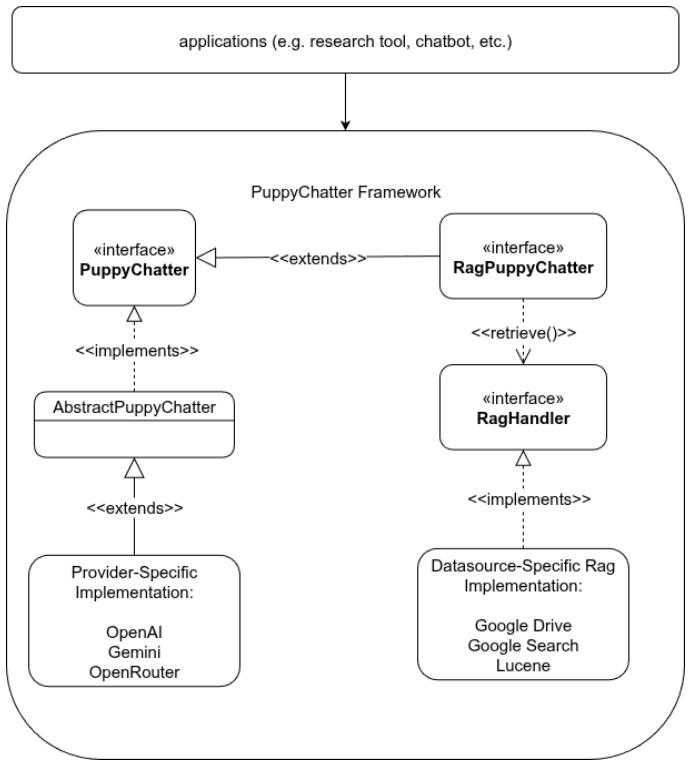
public interface PuppyChatter<T extends PromptParameters, S extends Response> { public S bark(String sessionId, String prompt) throws BarkException; ... } ... Pluggable Model Providers ... OpenAICompatiblePuppyChatter, GeminiAqaPuppyChatter, OllamaPuppyChatter, RagHandler with Lucene keyword retrieval
-
IndisputableMonolith/Cost/FunctionalEquation.leanwashburn_uniqueness_aczel unclear?
unclearRelation between the paper passage and the cited Recognition theorem.
lightweight Java framework ... Clear Separation of Concerns, High Extensibility through Abstraction, Pragmatic Integration of Information Retrieval Techniques
What do these tags mean?
- matches
- The paper's claim is directly supported by a theorem in the formal canon.
- supports
- The theorem supports part of the paper's argument, but the paper may add assumptions or extra steps.
- extends
- The paper goes beyond the formal theorem; the theorem is a base layer rather than the whole result.
- uses
- The paper appears to rely on the theorem as machinery.
- contradicts
- The paper's claim conflicts with a theorem or certificate in the canon.
- unclear
- Pith found a possible connection, but the passage is too broad, indirect, or ambiguous to say the theorem truly supports the claim.
Reference graph
Works this paper leans on
-
[1]
Alhur, A. (2024). Redefining healthcare with artificial intelligence (AI): the contributions of ChatGPT, Gemini, and Co-pilot. Cureus, 16(4)
work page 2024
-
[2]
Kumar, A., &Sharma, P.(2023).Openaicodex: Aninevitablefuture?.InternationalJournal for Research in Applied Science and Engineering Technology, 11, 539-543
work page 2023
-
[3]
Lin, H. C. K., Tseng, C. H., & Chen, N. S. (2025). Enhancing programming education. Educational Technology & Society, 28(2), 279-294
work page 2025
-
[4]
R., Susnjak, T., Liu, T., Watters, P., Xu, D., Liu, D., & Halgamuge, M
McIntosh, T. R., Susnjak, T., Liu, T., Watters, P., Xu, D., Liu, D., & Halgamuge, M. N. (2025). From google gemini to openai q*(q-star): A survey on reshaping the generative artificial intelligence (ai) research landscape. Technologies, 13(2), 51
work page 2025
-
[5]
Mavroudis, V. (2025). LangChain v0.3. https:doi.org/10.31219osf.io4gprt_v1
work page 2025
- [6]
-
[7]
Sobo, A., Mubarak, A., Baimagambetov, A., & Polatidis, N. (2025). Evaluating LLMs for code generation in HRI: A comparative study of ChatGPT, gemini, and claude. Applied Artificial Intelligence, 39(1), 2439610
work page 2025
-
[8]
Tseng, C. H., Lin, H. C. K., Huang, A. C. W., & Lin, J. R. (2025). Investigating the effects of PuppyCodeReview, an AI-based code review system, on students’ cognitive load. SoftwareX, 31, 102283. 7
work page 2025
discussion (0)
Sign in with ORCID, Apple, or X to comment. Anyone can read and Pith papers without signing in.