Generalize cross-ratios in n-dimensional Plane-Based Geometric Algebra
Pith reviewed 2026-05-19 23:27 UTC · model grok-4.3
The pith
Cross-ratios extend as a grade-agnostic projective invariant across all object types in n-dimensional PGA.
A machine-rendered reading of the paper's core claim, the machinery that carries it, and where it could break.
Core claim
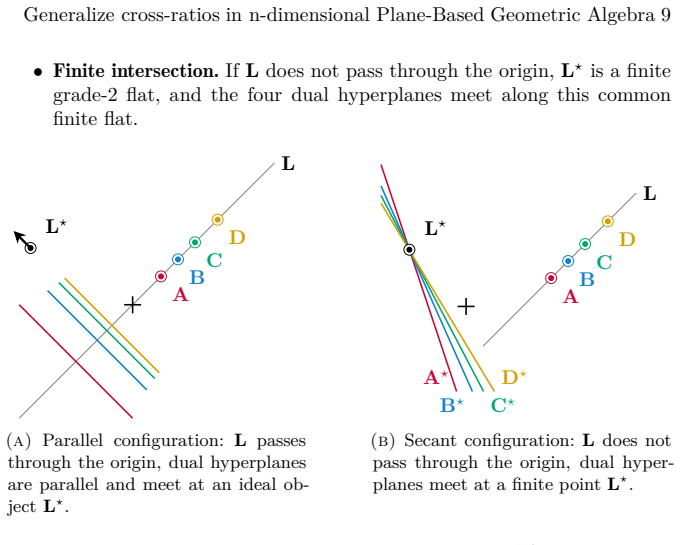
In Plane-Based Geometric Algebra R(n,0,1), the cross-ratio is defined for any pair of objects using a canonical pairwise measurement operator that reduces to the commutator or the commutator dual according to whether the objects are parallel or secant. Explicit formulas are given for each object type and configuration; each formula recovers the appropriate classical invariant. The eight configurations organize into four dual pairs under the Hodge dual, establishing the cross-ratio as a single projective invariant that does not depend on object grade.
What carries the argument
The commutator (or commutator dual) as the canonical pairwise measurement operator that supplies the cross-ratio for arbitrary object grades and the eight geometric configurations.
If this is right
- Explicit cross-ratio formulas exist for finite points, ideal points, hyperplanes, and intermediate flats in any dimension.
- Measurement operators reduce to either the commutator or the commutator dual solely according to geometric configuration.
- All eight configurations form four dual pairs under the Hodge dual.
- The formulas supply a direct algebraic route to n-dimensional homographies defined from prescribed invariants.
Where Pith is reading between the lines
- The uniform formulas could remove the need for separate handling of object types when implementing projective geometry routines in software.
- The observed duality between configurations suggests that switching between primal and dual representations preserves the invariant without additional computation.
- The same commutator-based construction might be tried in other geometric algebras to locate analogous invariants.
- Numerical checks in low dimensions against known classical values for mixed-grade objects would provide immediate verification.
Load-bearing premise
The algebraic structure of PGA together with the Hodge dual and commutator operators extends the classical projective cross-ratio to every grade and every configuration without extra constraints or exceptions.
What would settle it
Take two secant lines in 3D PGA, compute the proposed commutator-dual formula, and check whether the numerical value matches the sine cross-ratio obtained from independent classical angle measurements on the same lines.
Figures


read the original abstract
We develop a complete theory of projective cross-ratios in n-dimensional Plane-Based Geometric Algebra (PGA), R(n,0,1), covering geometric objects of every grade: finite and ideal points, hyperplanes, and intermediate flats. For each object type and configuration, we establish an explicit cross-ratio formula, prove that it recovers the appropriate classical invariant, and identify the canonical pairwise measurement operator. A systematic duality analysis further revealed that all eight configurations organize into four dual pairs under the Hodge dual, and that all measurement operators reduce to either the commutator or the commutator dual, depending solely on the geometric configuration rather than on object grade. In each case the formula recovers the appropriate classical invariant: signed distance ratios for parallel configurations and sine cross-ratios for secant ones. These results establish the cross-ratio as a grade-agnostic projective invariant within PGA, and provide a constructive foundation for defining n-dimensional homographies directly from prescribed invariants.
Editorial analysis
A structured set of objections, weighed in public.
Referee Report
Summary. The manuscript develops a complete theory of projective cross-ratios in n-dimensional Plane-Based Geometric Algebra (PGA), R(n,0,1). It covers geometric objects of every grade, including finite and ideal points, hyperplanes, and intermediate flats. For each object type and configuration, explicit cross-ratio formulas are given, with proofs that they recover the classical invariants (signed distance ratios for parallel configurations and sine cross-ratios for secant ones). All eight configurations are shown to organize into four dual pairs under the Hodge dual, and all measurement operators reduce to either the commutator or the commutator dual depending only on the geometric configuration.
Significance. If the central derivations hold, the work establishes the cross-ratio as a grade-agnostic projective invariant in PGA and supplies a constructive algebraic foundation for defining n-dimensional homographies directly from prescribed invariants. The systematic reduction of all cases to two canonical operators and the explicit recovery of classical invariants for every grade and configuration are genuine strengths that could unify projective geometry tools across dimensions in computational settings.
major comments (2)
- [§4.3, Theorem 7] §4.3, Theorem 7: the proof that the commutator dual applied to two k-flats (k>1) in R(n,0,1) for n>3 eliminates all non-scalar residuals and exactly recovers the sine cross-ratio is incomplete; the geometric-product expansion leaves potential bivector and trivector terms whose cancellation is asserted but not shown term-by-term for ideal elements.
- [§5.1, Eq. (28)] §5.1, Eq. (28): the reduction of the parallel ideal-point case to the classical signed-distance ratio assumes that the Hodge dual commutes with the commutator without introducing extra factors; this step is load-bearing for the grade-agnostic claim yet is only sketched rather than derived for general n.
minor comments (2)
- [§2.2] §2.2: the definition of the canonical measurement operator would be clearer if the commutator and commutator-dual were written out explicitly in terms of the geometric product before the duality analysis.
- [Table 1] Table 1: the column headers for the eight configurations could include a brief reminder of which operator (commutator vs. commutator dual) applies to each row.
Simulated Author's Rebuttal
We thank the referee for the careful and constructive review of our manuscript. The comments correctly identify places where the proofs would benefit from greater explicit detail. We address each point below and will incorporate the suggested expansions in the revised version.
read point-by-point responses
-
Referee: [§4.3, Theorem 7] §4.3, Theorem 7: the proof that the commutator dual applied to two k-flats (k>1) in R(n,0,1) for n>3 eliminates all non-scalar residuals and exactly recovers the sine cross-ratio is incomplete; the geometric-product expansion leaves potential bivector and trivector terms whose cancellation is asserted but not shown term-by-term for ideal elements.
Authors: We agree that the geometric-product expansion in the proof of Theorem 7 would be clearer if the cancellation of non-scalar terms were shown explicitly rather than asserted. In the revision we will add a term-by-term expansion of the commutator dual for k-flats with k>1 when n>3. Separate calculations will be supplied for finite and ideal elements, confirming that all bivector and trivector residuals cancel and that the result reduces precisely to the scalar sine cross-ratio. revision: yes
-
Referee: [§5.1, Eq. (28)] §5.1, Eq. (28): the reduction of the parallel ideal-point case to the classical signed-distance ratio assumes that the Hodge dual commutes with the commutator without introducing extra factors; this step is load-bearing for the grade-agnostic claim yet is only sketched rather than derived for general n.
Authors: The referee is right that the commutation relation between the Hodge dual and the commutator is only sketched in the parallel ideal-point case. To support the grade-agnostic claim rigorously, the revised manuscript will contain an explicit derivation of this commutation for arbitrary n. We will demonstrate that the dual introduces at most a consistent sign that is absorbed into the definition of the cross-ratio, so that the reduction to the classical signed-distance ratio holds without extraneous factors. revision: yes
Circularity Check
No significant circularity; derivations are direct algebraic constructions
full rationale
The paper constructs explicit cross-ratio formulas for each grade and configuration using PGA operations (geometric product, commutator, Hodge dual) and then proves recovery of classical invariants (signed distance ratios or sine forms). No step reduces by definition to its own output, no fitted parameter is relabeled as a prediction, and no load-bearing premise rests on self-citation chains. The duality analysis and operator reduction are presented as consequences of the algebra rather than presuppositions of the target invariant. The work is therefore self-contained against external benchmarks.
Axiom & Free-Parameter Ledger
axioms (1)
- domain assumption PGA provides a faithful algebraic model for projective geometry in n dimensions that correctly extends classical cross-ratio definitions.
Reference graph
Works this paper leans on
-
[1]
Journal of Mathe matical Imaging and Vision 16(2), 131–154 (2002)
Bayro-Corrochano, E., Banarer, V.: A geometric approac h for the theory and applications of 3d projective invariants. Journal of Mathe matical Imaging and Vision 16(2), 131–154 (2002)
work page 2002
-
[2]
URL https://bivector.net/PGA4CS.html
Dorst, L., De Keninck, S.: A guided tour to the plane-base d geometric algebra PGA (2022). URL https://bivector.net/PGA4CS.html
work page 2022
-
[3]
URL https://bivector.net/PGADYN.html
Dorst, L., De Keninck, S.: May the forque be with you, dyna mics in PGA (version 2.2)(2022) (2023). URL https://bivector.net/PGADYN.html
work page 2022
-
[4]
Dorst, L., Fontijne, D., Mann, S.: Geometric Algebra for Computer Science, An Object-Oriented Approach to Geometry. Morgan Kaufmann ( 2007)
work page 2007
-
[5]
Gunn, C.: Geometry, kinematics, and rigid body mechanic s in Cayley-Klein geometries. Ph.D. thesis (2011). DOI 10.14279/depositonc e-3058
-
[6]
In: Guide to Geometric Algebra in Practice, pp
Gunn, C.: On the homogeneous model of euclidean geometry . In: Guide to Geometric Algebra in Practice, pp. 297–327. Springer (2011 )
work page 2011
-
[7]
Cam- bridge university press (2003)
Hartley, R., Zisserman, A.: Multiple view geometry in co mputer vision. Cam- bridge university press (2003)
work page 2003
-
[8]
Interna- tional journal of pattern recognition and artificial intell igence 13(08), 1105–1121 (1999)
Lasenby, J., Bayro-Corrochano, E.: Analysis and comput ation of projective invariants from multiple views in the geometric algebra fra meworks. Interna- tional journal of pattern recognition and artificial intell igence 13(08), 1105–1121 (1999)
work page 1999
-
[9]
URL https://cs.uwaterloo.ca/~smann/PGABLE/PGAtutorial.pdf
Leger, Z., Mann, S.: A tutorial for plane-based geometri c algebra (2025). URL https://cs.uwaterloo.ca/~smann/PGABLE/PGAtutorial.pdf
work page 2025
-
[10]
Clifford algebra, geometric algebra, and applications
Lundholm, D., Svensson, L.: Clifford algebra, geometri c algebra, and applica- tions. arXiv preprint arXiv:0907.5356 (2009)
work page internal anchor Pith review Pith/arXiv arXiv 2009
-
[11]
Stillwell, J.: The Four Pillars of Geometry. Springer ( 2005) 16 E. Harquin, S. Breuils, P. Monasse, V. Biri and V. Nozick Enzo Harquin and Stéphane Breuils and Pascal Monasse and Ven ceslas Biri and Vincent Nozick Enzo Harquin, Pascal Monasse, Venceslas Biri, Vincent Nozi ck Université Gustave Eiffel, LIGM, Champs-sur-Marne, F-77420, France {enzo.harquin2...
work page 2005
discussion (0)
Sign in with ORCID, Apple, or X to comment. Anyone can read and Pith papers without signing in.