Cooling Channel Design Optimization for High Power Multi-Chip Packages
Pith reviewed 2026-05-21 04:13 UTC · model grok-4.3
The pith
A surrogate-optimized interdigitated cooling design cuts peak chip temperatures by 140.45°C in high-power multi-chip packages.
A machine-rendered reading of the paper's core claim, the machinery that carries it, and where it could break.
Core claim
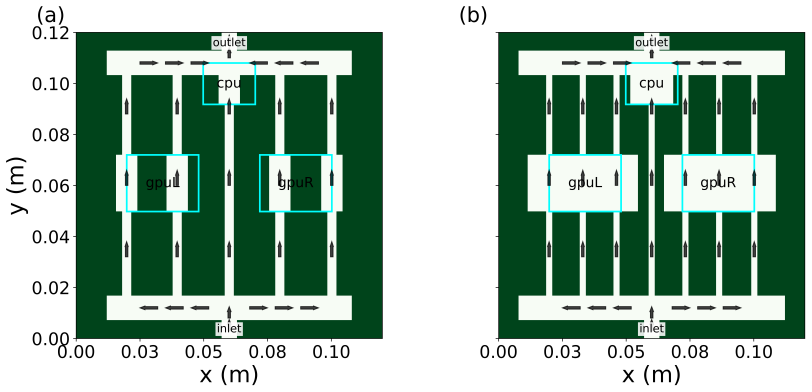
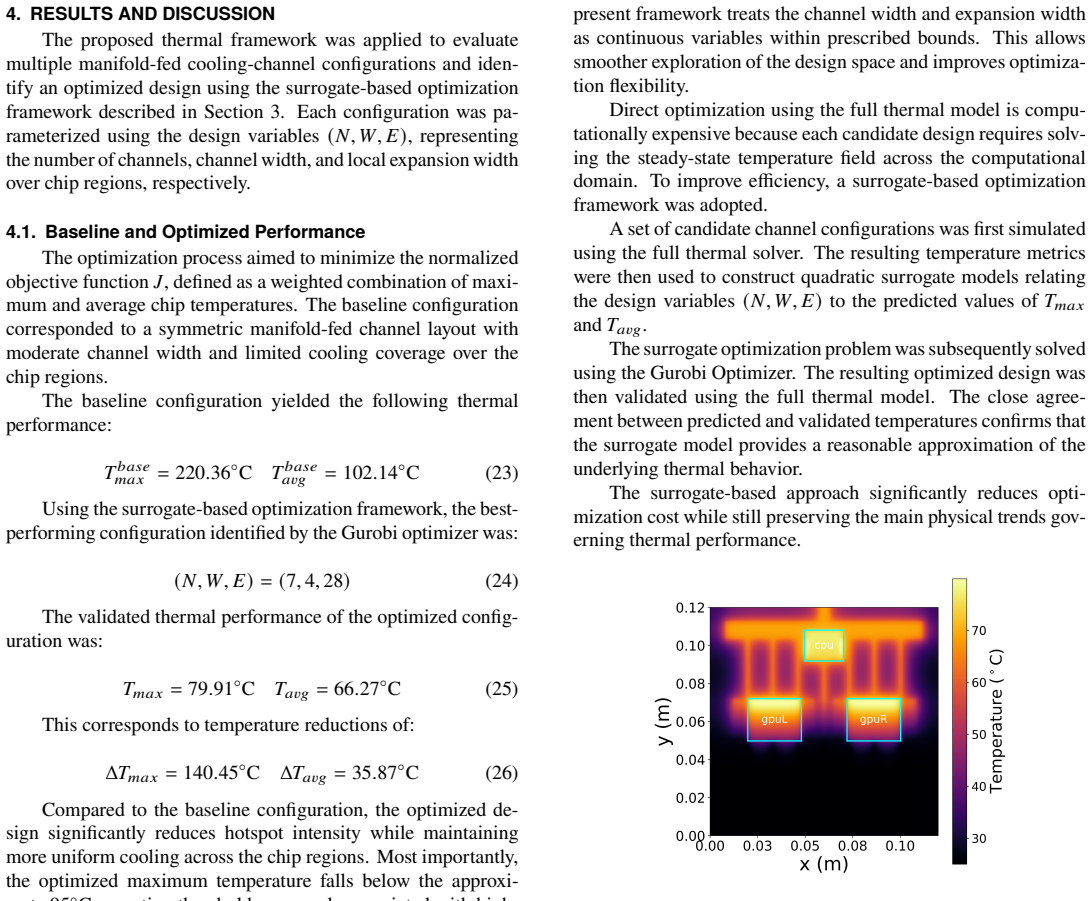
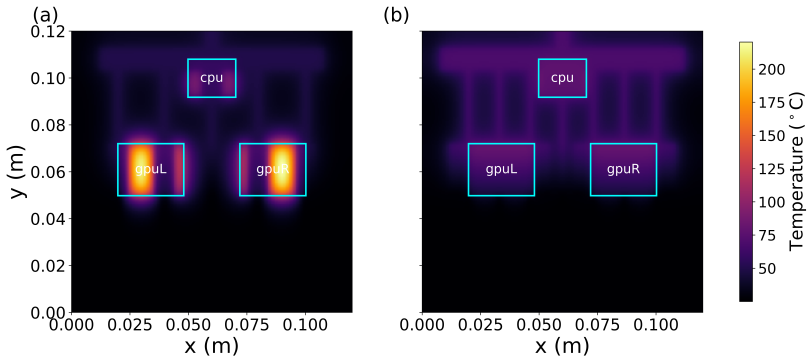
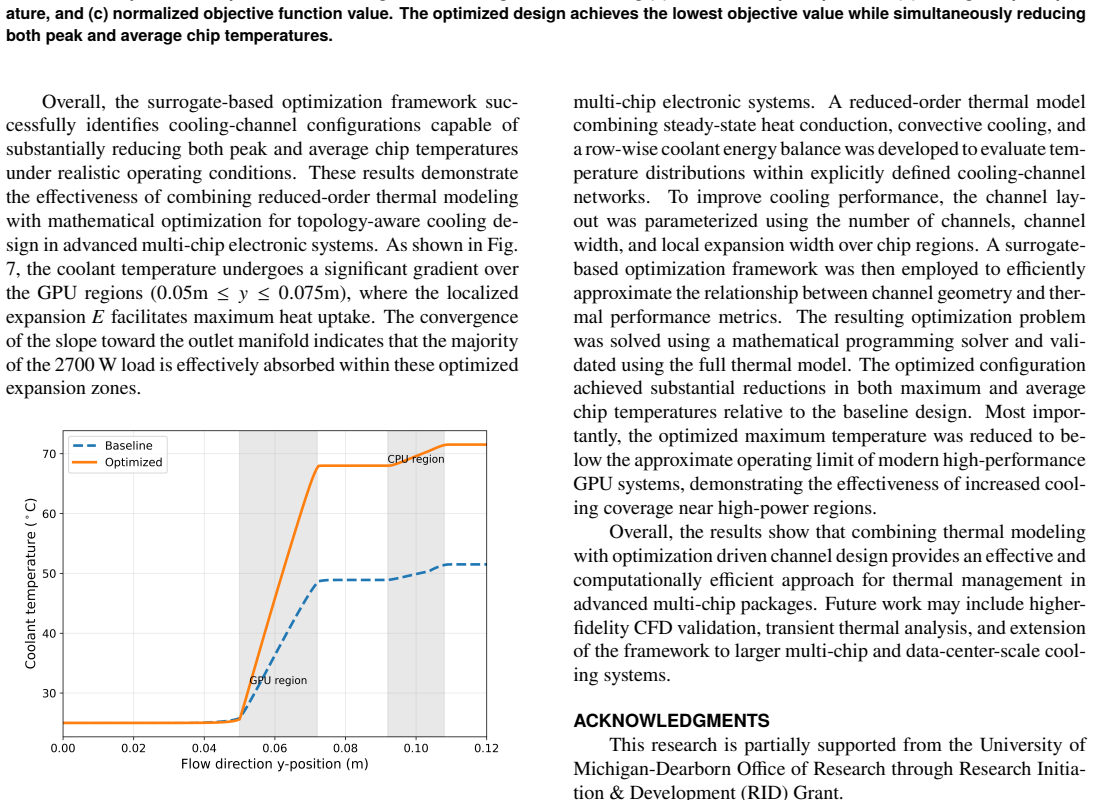
The authors parameterize an interdigitated cooling architecture with variables for channel count, width, and regional expansion, couple a porous-media flow model with row-wise energy balance to predict chip temperatures, and optimize the layout via a surrogate-assisted mixed-integer quadratic program. When applied to a representative GB200-style multi-chip package, the resulting design lowers peak chip temperature by 140.45°C and average chip temperature by 35.87°C relative to the baseline configuration.
What carries the argument
Interdigitated cooling architecture parameterized by channel count, width, and expansion over chip regions, approximated by a surrogate model and optimized with mixed-integer quadratic programming under GPU-coverage constraints.
If this is right
- The same parameterization and optimization procedure can be reused for other heterogeneous multi-chip layouts with different power distributions.
- Adding more weight to the GPU regions in the objective forces cooling channels to concentrate where thermal loads are highest.
- The surrogate-plus-MIQP approach replaces exhaustive high-fidelity simulations for each candidate geometry, making systematic layout exploration tractable.
Where Pith is reading between the lines
- If the surrogate remains accurate at higher power densities, the framework could guide cooling designs for future chips beyond the GB200 power envelope.
- The method's reliance on a porous-media approximation suggests a natural next test: comparing predicted flow resistance against full Navier-Stokes simulations or experimental pressure-drop data.
- Because the optimization is purely geometric, the same machinery could later incorporate manufacturing constraints such as minimum feature size or etch tolerances.
Load-bearing premise
The surrogate model accurately reproduces the relationship between the geometric channel parameters and the resulting chip temperature fields.
What would settle it
Build a physical prototype of the reported optimal channel geometry, apply the same power map, and measure the steady-state peak temperature; a value more than 20°C higher than the predicted optimum would falsify the optimization result.
Figures



read the original abstract
Thermal management is a major challenge in next-generation high-performance computing systems, particularly for heterogeneous multi-chip packages such as the NVIDIA GB200 Grace Blackwell Superchip. In this work, a physics-based computational framework is developed to optimize embedded cooling channel layouts for high-power multi-chip modules. The model couples steady-state heat conduction with a porous media-based representation of coolant transport, coupled with a row-wise coolant energy balance, to estimate chip temperature fields within microchannel networks. Unlike conventional designs, an interdigitated cooling architecture is parameterized using geometric variables, including channel count, width, and expansion over chip regions, enabling systematic design exploration. To enable efficient optimization, a surrogate-based approach is employed to approximate the relationship between geometric parameters and temperature metrics. The resulting model is optimized using a mixed-integer quadratic programming algorithm to minimize a weighted objective based on peak and average chip temperatures. To improve physical relevance, channel placement is further constrained to increase cooling coverage near GPU regions, where thermal loads are highest. The framework is applied to a representative multi-chip configuration based on NVIDIA GB200 architecture, consisting of two graphics processing units and one central processing unit. The results demonstrate that the optimal design reduces the peak chip temperature by 140.45{\deg}C and the average chip temperature by 35.87{\deg}C compared to the baseline configuration.
Editorial analysis
A structured set of objections, weighed in public.
Referee Report
Summary. The paper develops a physics-based computational framework coupling steady-state heat conduction with a porous-media representation of coolant flow and row-wise energy balance to model temperature fields in interdigitated microchannel networks for high-power multi-chip packages such as the NVIDIA GB200 Grace Blackwell Superchip. Geometric parameters (channel count, width, and expansion) are optimized via a surrogate model and mixed-integer quadratic programming to minimize a weighted combination of peak and average chip temperatures, subject to constraints favoring GPU cooling coverage. The central quantitative claim is that the resulting optimal design reduces peak chip temperature by 140.45 °C and average chip temperature by 35.87 °C relative to a baseline configuration.
Significance. If the surrogate accurately captures the underlying physics and the reported optima are verified by direct model re-evaluation, the work would supply a practical, parameterized design tool for embedded cooling in heterogeneous HPC modules, addressing a timely thermal-management bottleneck. The explicit incorporation of GPU-region constraints and the use of MIQP for discrete channel decisions are methodologically sound strengths that could translate to other multi-chip layouts.
major comments (3)
- [Surrogate Model] Surrogate Model section (inferred from abstract description of surrogate-based approach): no leave-one-out error, maximum residual on hold-out CFD/physics-model points, or any other quantitative fidelity metric is reported for the surrogate that maps the two geometric parameters to peak/average temperatures. Because the headline deltas (140.45 °C peak, 35.87 °C average) are produced by feeding this surrogate into MIQP, any local bias near high-flux GPU regions would be directly inherited and amplified by the optimizer.
- [Results] Results section (abstract and optimization-results paragraph): the claimed temperature reductions are not accompanied by re-evaluation of the full physics model (porous-media flow + row-wise energy balance + conduction) at the reported optimal geometry, nor by any experimental comparison or mesh-convergence study. Without this verification step, the quantitative outcomes rest on an untested approximation and cannot be considered load-bearing evidence for the central claim.
- [Model Formulation] Model Formulation section: the porous-media permeability and effective conductivity parameters are introduced without stated calibration procedure, sensitivity analysis, or comparison against detailed CFD or experimental data for the specific channel geometries. These parameters directly determine the temperature fields that enter the objective, so their justification is essential for trusting the optimization outcomes.
minor comments (2)
- [Abstract] The abstract states the number of geometric design variables but does not indicate how many discrete channel configurations were evaluated to build the surrogate; adding this detail would clarify computational cost.
- [Model Formulation] Notation for the row-wise energy balance and the weighting factors in the objective function should be introduced with explicit symbols and units in the main text for reproducibility.
Simulated Author's Rebuttal
We thank the referee for the constructive and detailed comments. We address each major comment point by point below, indicating the revisions we will make to strengthen the manuscript's rigor and transparency.
read point-by-point responses
-
Referee: [Surrogate Model] no leave-one-out error, maximum residual on hold-out CFD/physics-model points, or any other quantitative fidelity metric is reported for the surrogate that maps the two geometric parameters to peak/average temperatures. Because the headline deltas (140.45 °C peak, 35.87 °C average) are produced by feeding this surrogate into MIQP, any local bias near high-flux GPU regions would be directly inherited and amplified by the optimizer.
Authors: We agree that quantitative fidelity metrics for the surrogate are essential to support the optimization results. The surrogate was trained on evaluations from the physics-based model, but these error metrics were not reported in the original manuscript. In the revision we will add a dedicated subsection to the Surrogate Model section that reports leave-one-out cross-validation errors, maximum residuals on an independent hold-out set of physics-model points, and R-squared values, with explicit discussion of accuracy in high-flux GPU regions. revision: yes
-
Referee: [Results] the claimed temperature reductions are not accompanied by re-evaluation of the full physics model (porous-media flow + row-wise energy balance + conduction) at the reported optimal geometry, nor by any experimental comparison or mesh-convergence study. Without this verification step, the quantitative outcomes rest on an untested approximation and cannot be considered load-bearing evidence for the central claim.
Authors: We acknowledge that direct verification of the optimal geometry with the full physics model is required. We will re-evaluate the complete model (porous-media flow, row-wise energy balance, and conduction) at the reported optimum and include these results in the revised Results section to confirm the surrogate predictions. A mesh-convergence study will also be added. Experimental comparison is outside the scope of this computational framework and will be noted as future work. revision: partial
-
Referee: [Model Formulation] the porous-media permeability and effective conductivity parameters are introduced without stated calibration procedure, sensitivity analysis, or comparison against detailed CFD or experimental data for the specific channel geometries. These parameters directly determine the temperature fields that enter the objective, so their justification is essential for trusting the optimization outcomes.
Authors: The permeability and effective conductivity were selected from established literature correlations for microchannel geometries with similar hydraulic diameters and flow conditions. We agree that explicit justification is needed. In the revised Model Formulation section we will add the parameter selection rationale, a sensitivity analysis for ±10% and ±20% variations, and comparisons against a subset of detailed CFD simulations for representative channel geometries. revision: yes
Circularity Check
No circularity: physics-based model optimized via surrogate and MIQP
full rationale
The paper constructs a physics-based thermal model (steady-state conduction + porous-media coolant transport + row-wise energy balance), parameterizes an interdigitated channel layout with geometric variables, evaluates the model to train a surrogate, and applies external MIQP to minimize a weighted peak/average temperature objective under placement constraints. The reported deltas (140.45 °C peak, 35.87 °C average) are differences between the optimized design and baseline as produced by this pipeline. No equation reduces the output temperatures to a fitted parameter by construction, no self-citation is load-bearing for the central result, and the surrogate serves only as an efficiency tool rather than redefining the physics. The derivation remains self-contained against the stated physical assumptions and external optimization algorithm.
Axiom & Free-Parameter Ledger
free parameters (2)
- Objective function weights
- Geometric design variables
axioms (2)
- domain assumption Porous media representation accurately models coolant transport and heat transfer in microchannel networks
- domain assumption Steady-state conditions govern the chip temperature fields
discussion (0)
Sign in with ORCID, Apple, or X to comment. Anyone can read and Pith papers without signing in.