Formation of extremely low-mass white dwarf binaries undergoing enhanced angular momentum loss
Pith reviewed 2026-06-30 17:42 UTC · model grok-4.3
The pith
Assuming mass loss at the outer Lagrangian point reproduces the short orbital periods of extremely low-mass white dwarf binaries.
A machine-rendered reading of the paper's core claim, the machinery that carries it, and where it could break.
Core claim
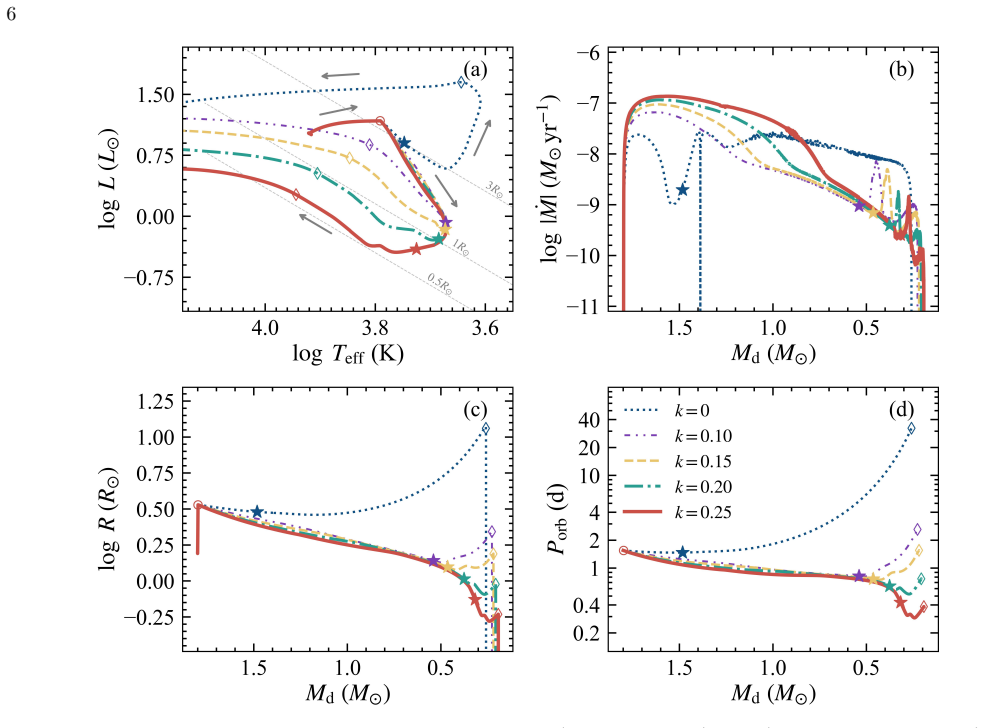
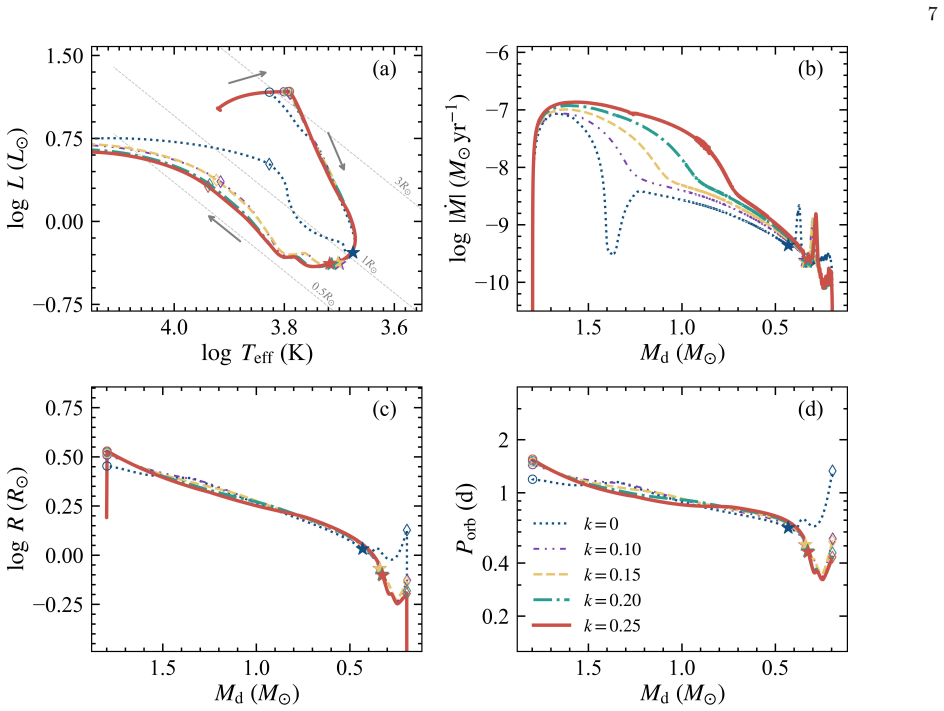
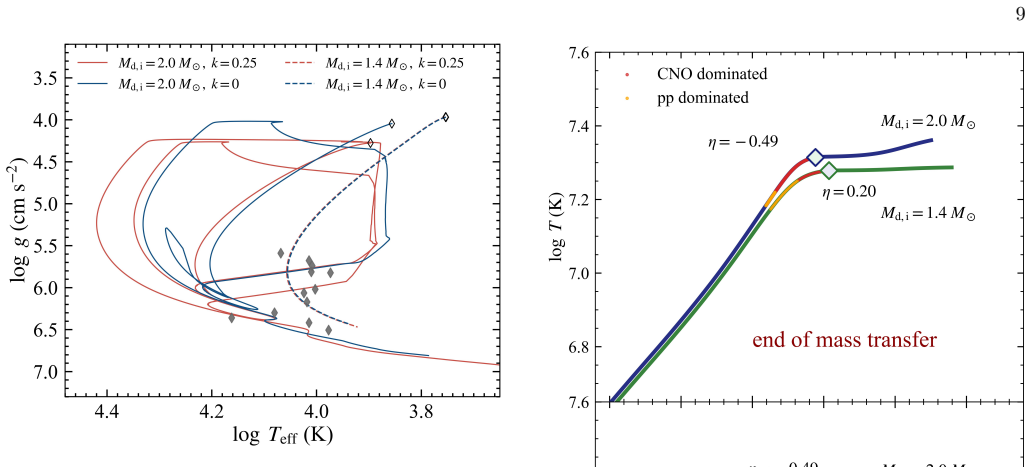
By assuming that part of the transferred mass from the donor is lost at the outer Lagrangian point and simulating the formation of ELM WD binaries, enhanced AML enables more mass to be lost during thermal-timescale mass transfer, thereby affecting nuclear burning in the transfer phase and producing ELM WDs with distinct internal structures. These structural differences alter the (pre-)He WD mass-radius relation at the end of mass transfer, which in turn shifts the WD mass-orbital period relation downward. These adjustments enable our model to successfully reproduce the majority of observed systems from the relevant survey projects.
What carries the argument
Enhanced angular momentum loss from ejecting transferred mass at the outer Lagrangian point, which changes the donor's nuclear burning and produces ELM white dwarfs with altered internal structures that shift the mass-radius relation.
If this is right
- More mass is lost during the thermal-timescale mass transfer phase.
- Nuclear burning inside the donor is affected during the transfer.
- The resulting ELM white dwarfs have distinct internal structures.
- The pre-He white dwarf mass-radius relation changes at the end of mass transfer.
- The white dwarf mass-orbital period relation shifts downward to shorter periods.
Where Pith is reading between the lines
- The same mass-loss assumption could be applied to other classes of mass-transferring binaries to test whether similar period shifts appear.
- If the fraction of mass lost at the outer point varies with donor mass or metallicity, the model predicts a spread in the observed mass-period relation that future surveys could measure.
- The mechanism reduces the need to invoke the common-envelope channel for as many short-period systems as previously required.
Load-bearing premise
The load-bearing premise is that a fraction of the mass transferred from the donor escapes at the outer Lagrangian point rather than remaining bound to the binary.
What would settle it
A direct measurement of the radius or internal structure of an observed ELM white dwarf whose mass and period lie above the downward-shifted relation would falsify the claim that this mass-loss mechanism produces the required structural change.
Figures




read the original abstract
Extremely low-mass white dwarfs (ELM WDs) are helium (He) WDs with masses below $\sim 0.3\ M_{\odot}$, mainly formed through binary interaction. ELM WD binaries typically are formed from two channels, namely the stable Roche lobe overflow (RLOF) channel and the common envelope ejection channel. For ELM WD binaries produced from RLOF channel, the ELM WD mass has a strong correlation with the orbital period, i.e., the so-called WD mass-orbital period relation. However, the observations in the ELM Survey show that the orbital periods of ELM WD binaries from the RLOF channel are typically shorter than the theoretically predicted values. Extra angular momentum loss (AML) may be needed to explain such a phenomenon. In this work, we assumed that part of the transferred mass from the donor is lost at the outer Lagrangian point and simulated the formation of ELM WD binaries. Enhanced AML enables more mass to be lost during thermal-timescale mass transfer, thereby affecting nuclear burning in the transfer phase and producing ELM WDs with distinct internal structures. These structural differences alter the (pre-)He WD mass-radius relation at the end of mass transfer, which in turn shifts the WD mass-orbital period relation downward. These adjustments enable our model to successfully reproduce the majority of observed systems from the relevant survey projects.
Editorial analysis
A structured set of objections, weighed in public.
Referee Report
Summary. The manuscript models the formation of extremely low-mass white dwarf (ELM WD) binaries through the stable Roche-lobe overflow channel. It assumes that a fraction of the transferred mass is lost at the outer Lagrangian point (L2), supplying enhanced angular momentum loss. This is claimed to drive additional mass loss during thermal-timescale transfer, alter the donor's nuclear burning and internal structure, shift the (pre-)He WD mass-radius relation, and thereby move the theoretical WD mass-orbital period relation downward so that the majority of ELM Survey systems are reproduced.
Significance. If the L2 mass-loss fraction can be independently constrained, the work would supply a concrete physical mechanism for the observed period deficit relative to standard binary-evolution calculations and would link AML, donor structure, and the mass-period relation in a testable way.
major comments (1)
- [Abstract] Abstract: the fraction of transferred mass lost at L2 is introduced solely to produce the required extra AML and the downward shift in the mass-period relation; no independent derivation from Roche geometry, hydrodynamics, or other observables is supplied, so the reproduction of the ELM Survey data is a fit rather than a prediction of the mechanism.
minor comments (1)
- The abstract refers to 'relevant survey projects' without naming them or citing the specific observational samples used for comparison.
Simulated Author's Rebuttal
We thank the referee for their constructive report. We respond to the single major comment below.
read point-by-point responses
-
Referee: [Abstract] Abstract: the fraction of transferred mass lost at L2 is introduced solely to produce the required extra AML and the downward shift in the mass-period relation; no independent derivation from Roche geometry, hydrodynamics, or other observables is supplied, so the reproduction of the ELM Survey data is a fit rather than a prediction of the mechanism.
Authors: We agree that the L2 mass-loss fraction is introduced as a free parameter chosen to supply the enhanced AML needed to explain the observed period deficit; the manuscript supplies no independent derivation of its value from hydrodynamics, Roche-lobe geometry, or additional observables. The physical motivation for allowing non-zero L2 ejection rests on the known possibility of mass loss through the outer Lagrangian point during RLOF, but we do not claim a first-principles calculation of the fraction. Once the fraction is fixed, however, the model makes a specific prediction: the extra AML alters the thermal-timescale mass-transfer phase, changes the donor’s nuclear-burning history and internal structure, and thereby shifts the (pre-)He WD mass–radius relation, moving the theoretical mass–period relation downward. This structural link is a testable consequence of the assumed mechanism rather than an additional tuning. We will revise the abstract to state explicitly that the fraction is an assumed parameter and to clarify which aspects of the mass–period match constitute predictions of the model. revision: partial
Axiom & Free-Parameter Ledger
free parameters (1)
- mass loss fraction at outer Lagrangian point
axioms (1)
- domain assumption Standard assumptions of Roche lobe overflow and binary stellar evolution hold during thermal-timescale mass transfer
Reference graph
Works this paper leans on
-
[1]
Althaus, L. G., Calcaferro, L. M., C´ orsico, A. H., & Brown, W. R. 2025, A&A, 699, A280, doi: 10.1051/0004-6361/202554891
-
[2]
Althaus, L. G., Miller Bertolami, M. M., & C´ orsico, A. H. 2013, A&A, 557, A19, doi: 10.1051/0004-6361/201321868 16
-
[3]
Laser Interferometer Space Antenna
Amaro-Seoane, P., Audley, H., Babak, S., et al. 2017, arXiv e-prints, arXiv:1702.00786, doi: 10.48550/arXiv.1702.00786
work page internal anchor Pith review Pith/arXiv arXiv doi:10.48550/arxiv.1702.00786 2017
-
[4]
Barraza-Jorquera, J. A., Schreiber, M. R., & Belloni, D. 2025, A&A, 696, A92, doi: 10.1051/0004-6361/202553757
-
[5]
2010, The Astrophysical Journal, 715, L138, doi: 10.1088/2041-8205/715/2/L138
Belczynski, K., Dominik, M., Bulik, T., et al. 2010, ApJL, 715, L138, doi: 10.1088/2041-8205/715/2/L138
-
[6]
Belloni, D., & Schreiber, M. R. 2023a, in Handbook of X-ray and Gamma-ray Astrophysics, 129, doi: 10.1007/978-981-16-4544-0 98-1
-
[7]
Belloni, D., & Schreiber, M. R. 2023b, A&A, 678, A34, doi: 10.1051/0004-6361/202347047
-
[8]
Shen, K. J. 2024, A&A, 682, A33, doi: 10.1051/0004-6361/202347931
-
[9]
2024, PASP, 136, 124201, doi: 10.1088/1538-3873/ad94a2
Blomberg, L., El-Badry, K., Breivik, K., et al. 2024, PASP, 136, 124201, doi: 10.1088/1538-3873/ad94a2
-
[10]
Carter, J. A. 2012, ApJ, 748, 115, doi: 10.1088/0004-637X/748/2/115
-
[11]
R., Gianninas, A., Kilic, M., Kenyon, S
Brown, W. R., Gianninas, A., Kilic, M., Kenyon, S. J., & Allende Prieto, C. 2016a, ApJ, 818, 155, doi: 10.3847/0004-637X/818/2/155
-
[12]
R., Kilic, M., Allende Prieto, C., Gianninas, A., & Kenyon, S
Brown, W. R., Kilic, M., Allende Prieto, C., Gianninas, A., & Kenyon, S. J. 2013, ApJ, 769, 66, doi: 10.1088/0004-637X/769/1/66
-
[13]
R., Kilic, M., Allende Prieto, C., & Kenyon, S
Brown, W. R., Kilic, M., Allende Prieto, C., & Kenyon, S. J. 2010, ApJ, 723, 1072, doi: 10.1088/0004-637X/723/2/1072
-
[14]
R., Kilic, M., Allende Prieto, C., & Kenyon, S
Brown, W. R., Kilic, M., Allende Prieto, C., & Kenyon, S. J. 2012, ApJ, 744, 142, doi: 10.1088/0004-637X/744/2/142
-
[15]
Brown, W. R., Kilic, M., Kenyon, S. J., & Gianninas, A. 2016b, ApJ, 824, 46, doi: 10.3847/0004-637X/824/1/46
-
[16]
R., Kilic, M., Kosakowski, A., & Gianninas, A
Brown, W. R., Kilic, M., Kosakowski, A., & Gianninas, A. 2022, ApJ, 933, 94, doi: 10.3847/1538-4357/ac72ac
-
[17]
R., Kilic, M., Kosakowski, A., et al
Brown, W. R., Kilic, M., Kosakowski, A., et al. 2020, ApJ, 889, 49, doi: 10.3847/1538-4357/ab63cd
-
[18]
Cadelano, M., Pallanca, C., Ferraro, F. R., et al. 2015, ApJ, 812, 63, doi: 10.1088/0004-637X/812/1/63
-
[19]
Calcaferro, L. M., Althaus, L. G., & C´ orsico, A. H. 2018, A&A, 614, A49, doi: 10.1051/0004-6361/201732551
-
[20]
A., Rappaport, S., & Fabrycky, D
Carter, J. A., Rappaport, S., & Fabrycky, D. 2011, ApJ, 728, 139, doi: 10.1088/0004-637X/728/2/139
-
[21]
2022, Accreting Binaries; Nature, formation, and evolution, doi: 10.1088/2514-3433/ac595f
Chaty, S. 2022, Accreting Binaries; Nature, formation, and evolution, doi: 10.1088/2514-3433/ac595f
-
[22]
Chen, H.-L., Tauris, T. M., Han, Z., & Chen, X. 2021, MNRAS, 503, 3540, doi: 10.1093/mnras/stab670
-
[23]
Chen, H.-L., Woods, T. E., Yungelson, L. R., et al. 2019, MNRAS, 490, 1678, doi: 10.1093/mnras/stz2644
-
[24]
2024, Progress in Particle and Nuclear Physics, 134, 104083, doi: 10.1016/j.ppnp.2023.104083
Chen, X., Liu, Z., & Han, Z. 2024, Progress in Particle and Nuclear Physics, 134, 104083, doi: 10.1016/j.ppnp.2023.104083
-
[25]
Chen, X., Maxted, P. F. L., Li, J., & Han, Z. 2017, MNRAS, 467, 1874, doi: 10.1093/mnras/stx115
-
[26]
Cromartie, H. T., Fonseca, E., Ransom, S. M., et al. 2020, Nature Astronomy, 4, 72, doi: 10.1038/s41550-019-0880-2
-
[27]
K., Singh Yadav, R., Subramaniam, A., & Shankar Singh, R
Dattatrey, A. K., Singh Yadav, R., Subramaniam, A., & Shankar Singh, R. 2024, Bulletin de la Societe Royale des Sciences de Liege, 93, 300, doi: 10.25518/0037-9565.11687
-
[28]
Dattatrey, A. K., Yadav, R. K. S., Rani, S., et al. 2023, ApJ, 943, 130, doi: 10.3847/1538-4357/acade0
-
[29]
2021, ApJ, 909, 174, doi: 10.3847/1538-4357/abe0b2
Deng, Z.-L., Li, X.-D., Gao, Z.-F., & Shao, Y. 2021, ApJ, 909, 174, doi: 10.3847/1538-4357/abe0b2
-
[30]
Dewi, J. D. M., & Tauris, T. M. 2000, A&A, 360, 1043, doi: 10.48550/arXiv.astro-ph/0007034 Di Stefano, R., Kruckow, M. U., Gao, Y., Neunteufel, P. G., & Kobayashi, C. 2023, ApJ, 944, 87, doi: 10.3847/1538-4357/acae9b
work page internal anchor Pith review Pith/arXiv arXiv doi:10.48550/arxiv.astro-ph/0007034 2000
-
[31]
Eggleton, P. P. 1983, ApJ, 268, 368, doi: 10.1086/160960 El Eid, M. F., Fricke, K. J., & Ober, W. W. 1983, A&A, 119, 54
-
[32]
2015, ApJ, 815, 26, doi: 10.1088/0004-637X/815/1/26
Faigler, S., Kull, I., Mazeh, T., et al. 2015, ApJ, 815, 26, doi: 10.1088/0004-637X/815/1/26
-
[33]
S., Lustig-Yaeger, J., Fortney, J
Freedman, R. S., Lustig-Yaeger, J., Fortney, J. J., et al. 2014, ApJS, 214, 25, doi: 10.1088/0067-0049/214/2/25
-
[34]
Freedman, R. S., Marley, M. S., & Lodders, K. 2008, ApJS, 174, 504, doi: 10.1086/521793
-
[35]
2023, MNRAS, 525, 2605, doi: 10.1093/mnras/stad2446
Gao, S.-J., & Li, X.-D. 2023, MNRAS, 525, 2605, doi: 10.1093/mnras/stad2446
-
[36]
Ge, H., Tout, C. A., Webbink, R. F., et al. 2024, ApJ, 961, 202, doi: 10.3847/1538-4357/ad158e
-
[37]
Kenyon, S. J. 2015, ApJ, 812, 167, doi: 10.1088/0004-637X/812/2/167
-
[38]
Guo, Z., Gies, D. R., & Matson, R. A. 2017, ApJ, 851, 39, doi: 10.3847/1538-4357/aa978c
-
[39]
1996, ApJL, 470, L97, doi: 10.1086/310303
Hachisu, I., Kato, M., & Nomoto, K. 1996, ApJL, 470, L97, doi: 10.1086/310303
-
[40]
Han, Z., & Podsiadlowski, P. 2004, MNRAS, 350, 1301, doi: 10.1111/j.1365-2966.2004.07713.x
-
[41]
Han, Z., Podsiadlowski, P., & Eggleton, P. P. 1995, MNRAS, 272, 800, doi: 10.1093/mnras/272.4.800
-
[42]
2020, Research in Astronomy and Astrophysics, 20, 161, doi: 10.1088/1674-4527/20/10/161
Han, Z.-W., Ge, H.-W., Chen, X.-F., & Chen, H.-L. 2020, Research in Astronomy and Astrophysics, 20, 161, doi: 10.1088/1674-4527/20/10/161
-
[43]
2016, PASP, 128, 082001, doi: 10.1088/1538-3873/128/966/082001
Heber, U. 2016, PASP, 128, 082001, doi: 10.1088/1538-3873/128/966/082001
-
[44]
The evolution of AGB stars with convective overshoot
Herwig, F. 2000, A&A, 360, 952, doi: 10.48550/arXiv.astro-ph/0007139 17
work page internal anchor Pith review Pith/arXiv arXiv doi:10.48550/arxiv.astro-ph/0007139 2000
-
[45]
Hjellming, M. S., & Webbink, R. F. 1987, ApJ, 318, 794, doi: 10.1086/165412
-
[46]
Hong, K., Lee, J. W., Koo, J.-R., et al. 2021, AJ, 161, 137, doi: 10.3847/1538-3881/abdd39
-
[47]
1990, ApJ, 353, 215, doi: 10.1086/168609
Iben, Jr., I. 1990, ApJ, 353, 215, doi: 10.1086/168609
-
[48]
Istrate, A. G., Marchant, P., Tauris, T. M., et al. 2016, A&A, 595, A35, doi: 10.1051/0004-6361/201628874
-
[49]
Istrate, A. G., Tauris, T. M., & Langer, N. 2014a, A&A, 571, A45, doi: 10.1051/0004-6361/201424680
-
[50]
Istrate, A. G., Tauris, T. M., Langer, N., & Antoniadis, J. 2014b, A&A, 571, L3, doi: 10.1051/0004-6361/201424681
-
[51]
2015, MNRAS, 447, 2181, doi: 10.1093/mnras/stu2582
Ivanova, N., Justham, S., & Podsiadlowski, P. 2015, MNRAS, 447, 2181, doi: 10.1093/mnras/stu2582
-
[52]
2013b, A&A Rv, 21, 59, doi: 10.1007/s00159-013-0059-2
Ivanova, N., Justham, S., Chen, X., et al. 2013, A&A Rv, 21, 59, doi: 10.1007/s00159-013-0059-2
-
[53]
Jermyn, A. S., Bauer, E. B., Schwab, J., et al. 2023, ApJS, 265, 15, doi: 10.3847/1538-4365/acae8d
-
[54]
2014, ApJ, 791, 127, doi: 10.1088/0004-637X/791/2/127
Jia, K., & Li, X.-D. 2014, ApJ, 791, 127, doi: 10.1088/0004-637X/791/2/127
-
[55]
2004, ApJL, 613, L129, doi: 10.1086/425249
Kato, M., & Hachisu, I. 2004, ApJL, 613, L129, doi: 10.1086/425249
-
[56]
Kilic, M., Brown, W. R., Allende Prieto, C., et al. 2011, ApJ, 727, 3, doi: 10.1088/0004-637X/727/1/3
-
[57]
Kilic, M., Brown, W. R., Allende Prieto, C., et al. 2012, ApJ, 751, 141, doi: 10.1088/0004-637X/751/2/141
-
[58]
King, A. R., Schenker, K., Kolb, U., & Davies, M. B. 2001, MNRAS, 321, 327, doi: 10.1046/j.1365-8711.2001.04002.x
-
[59]
2022, ApJ, 940, 86, doi: 10.3847/1538-4357/ac98b8
Klement, R., Baade, D., Rivinius, T., et al. 2022, ApJ, 940, 86, doi: 10.3847/1538-4357/ac98b8
-
[60]
Klencki, J., Nelemans, G., Istrate, A. G., & Chruslinska, M. 2021, A&A, 645, A54, doi: 10.1051/0004-6361/202038707
-
[61]
Klencki, J., Nelemans, G., Istrate, A. G., & Pols, O. 2020, A&A, 638, A55, doi: 10.1051/0004-6361/202037694
-
[62]
1990, A&A, 236, 385
Kolb, U., & Ritter, H. 1990, A&A, 236, 385
1990
-
[63]
Kosakowski, A., Brown, W. R., Kilic, M., et al. 2023, ApJ, 950, 141, doi: 10.3847/1538-4357/acd187
-
[64]
Kosakowski, A., Kilic, M., Brown, W. R., & Gianninas, A. 2020, ApJ, 894, 53, doi: 10.3847/1538-4357/ab8300
-
[65]
D., & Lifshitz, E
Landau, L. D., & Lifshitz, E. M. 1975, The classical theory of fields
1975
-
[66]
W., Hong, K., Jeong, M.-J., & Wolf, M
Lee, J. W., Hong, K., Jeong, M.-J., & Wolf, M. 2024, ApJ, 973, 114, doi: 10.3847/1538-4357/ad67c7
-
[67]
Lee, J. W., Hong, K., & Park, J.-H. 2022, MNRAS, 511, 654, doi: 10.1093/mnras/stac075
-
[68]
W., Koo, J.-R., Hong, K., & Park, J.-H
Lee, J. W., Koo, J.-R., Hong, K., & Park, J.-H. 2020, AJ, 160, 49, doi: 10.3847/1538-3881/ab9621
-
[69]
2025, Reports on Progress in Physics, 88, 056901, doi: 10.1088/1361-6633/adc9be
Li, E.-K., Liu, S., Torres-Orjuela, A., et al. 2025, Reports on Progress in Physics, 88, 056901, doi: 10.1088/1361-6633/adc9be
-
[70]
2024, Results in Physics, 59, 107568, doi: 10.1016/j.rinp.2024.107568
Li, Z., & Chen, X. 2024, Results in Physics, 59, 107568, doi: 10.1016/j.rinp.2024.107568
-
[71]
2019, ApJ, 871, 148, doi: 10.3847/1538-4357/aaf9a1
Li, Z., Chen, X., Chen, H.-L., & Han, Z. 2019, ApJ, 871, 148, doi: 10.3847/1538-4357/aaf9a1
-
[72]
2011, ApJ, 732, 70, doi: 10.1088/0004-637X/732/2/70
Lin, J., Rappaport, S., Podsiadlowski, P., et al. 2011, ApJ, 732, 70, doi: 10.1088/0004-637X/732/2/70
-
[73]
1988, ApJ, 329, 764, doi: 10.1086/166419
Livio, M., & Soker, N. 1988, ApJ, 329, 764, doi: 10.1086/166419
-
[74]
2023, MNRAS, 519, 1409, doi: 10.1093/mnras/stac3621
Lu, W., Fuller, J., Quataert, E., & Bonnerot, C. 2023, MNRAS, 519, 1409, doi: 10.1093/mnras/stac3621
-
[75]
2020, NewA, 78, 101363, doi: 10.1016/j.newast.2020.101363
Luo, Y. 2020, NewA, 78, 101363, doi: 10.1016/j.newast.2020.101363
-
[76]
Manchester, R. N., Hobbs, G. B., Teoh, A., & Hobbs, M. 2005, AJ, 129, 1993, doi: 10.1086/428488
work page internal anchor Pith review doi:10.1086/428488 2005
-
[77]
Marigo, P., Girardi, L., Chiosi, C., & Wood, P. R. 2001, A&A, 371, 152, doi: 10.1051/0004-6361:20010309
-
[78]
Marsh, T. R., Dhillon, V. S., & Duck, S. R. 1995, MNRAS, 275, 828, doi: 10.1093/mnras/275.3.828
-
[79]
Maxted, P. F. L., Serenelli, A. M., Marsh, T. R., et al. 2014, MNRAS, 444, 208, doi: 10.1093/mnras/stu1465
-
[80]
Maxted, P. F. L., Anderson, D. R., Burleigh, M. R., et al. 2011, MNRAS, 418, 1156, doi: 10.1111/j.1365-2966.2011.19567.x
discussion (0)
Sign in with ORCID, Apple, or X to comment. Anyone can read and Pith papers without signing in.