When Does a Neural Receiver Help? Calibration-Drift Benchmarking and Detect-and-Rollback for 5G/6G NR
Pith reviewed 2026-06-29 23:58 UTC · model grok-4.3
The pith
Neural receivers outperform conventional detectors only when signals stay inside the training distribution, and drift detection allows safe rollback.
A machine-rendered reading of the paper's core claim, the machinery that carries it, and where it could break.
Core claim
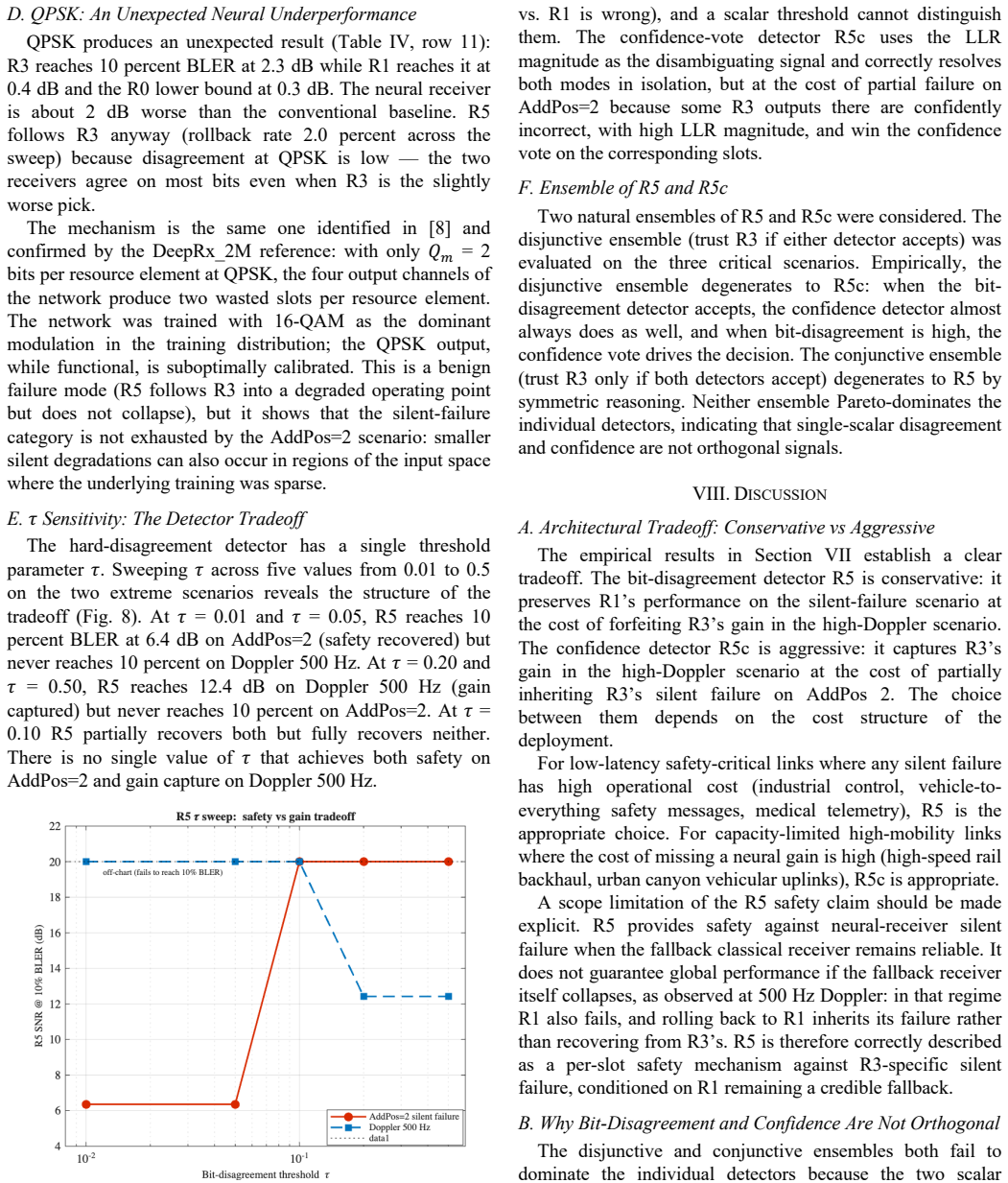
Convolutional neural receivers outperform minimum mean-square error physical uplink shared channel detection on in-distribution channel and waveform configurations, but their behavior under calibration drift when transmitter or channel parameters depart from the training envelope is poorly characterized; a detect-and-rollback mechanism is proposed to restore reliability once drift is identified.
What carries the argument
Detect-and-rollback trigger that monitors receiver performance or parameter mismatch and switches from the neural detector back to the conventional minimum mean-square error detector.
If this is right
- Neural receivers deliver their reported gains only when transmitter and channel statistics remain inside the training envelope.
- A monitoring layer that detects drift is required before neural receivers can be placed in production 5G or 6G equipment.
- Rollback to the classical minimum mean-square error detector preserves link reliability once drift is flagged.
- System designers must budget for both neural and conventional receiver paths rather than replacing the latter outright.
Where Pith is reading between the lines
- Standardized test vectors for calibration drift could be added to 3GPP conformance suites so that neural-receiver vendors demonstrate robustness before deployment.
- The same drift-monitoring idea might apply to other learned modules in the physical layer, such as channel estimators or beamformers.
- If drift detection proves cheap, operators could run multiple neural models in parallel and select the best one on the fly rather than rolling back to a single classical algorithm.
Load-bearing premise
The particular calibration-drift cases examined in the benchmarks represent the dominant real-world departures from training data, and the trigger can be implemented without creating new failure modes.
What would settle it
A live 5G base-station deployment in which the detect-and-rollback logic either misses a genuine calibration drift or triggers incorrectly on in-distribution traffic, causing measurable throughput loss or outages.
Figures



read the original abstract
Convolutional neural receivers such as DeepRx outperform minimum mean-square error physical uplink shared channel detection on in distribution channel and waveform configurations, but their behavior under calibration drift when transmitter or channel parameters depart from the training envelope is poorly characterized.
Editorial analysis
A structured set of objections, weighed in public.
Referee Report
Summary. The manuscript claims that convolutional neural receivers such as DeepRx outperform MMSE-based PUSCH detection under in-distribution channel and waveform conditions in 5G/6G NR, but that their behavior under calibration drift (transmitter or channel parameters departing from the training envelope) remains poorly characterized. It introduces a benchmarking framework to quantify this gap across drift scenarios and proposes a detect-and-rollback mechanism to revert to conventional detection when drift is identified.
Significance. If the empirical results hold, the benchmarking suite and rollback trigger would constitute a practical contribution to the safe deployment of learned receivers, addressing a recognized gap between in-distribution gains and out-of-distribution reliability in wireless systems. The work is positioned as an empirical study whose value lies in the specific test conditions and mitigation approach rather than a new theoretical derivation.
minor comments (1)
- The abstract and title frame the contribution clearly, but the absence of any visible equations, dataset descriptions, or quantitative tables in the provided source material prevents verification of the claimed outperformance margins or the reliability of the detect-and-rollback trigger.
Simulated Author's Rebuttal
We thank the referee for reviewing the manuscript and for acknowledging the potential practical value of the benchmarking framework and detect-and-rollback approach for safe deployment of neural receivers in 5G/6G NR. The recommendation is listed as uncertain, yet the report contains no enumerated major comments. We therefore provide no point-by-point responses below and stand ready to address any specific concerns the referee may wish to raise.
Circularity Check
No significant circularity identified
full rationale
The paper is positioned as an empirical benchmarking study introducing a test suite and detect-and-rollback mechanism for neural receivers under calibration drift. No derivation chains, modeling equations, or load-bearing self-citations are visible in the provided abstract or description that could reduce performance claims to fitted inputs or self-referential definitions by construction. The central claims rest on external testing rather than internal reductions, making the work self-contained against the listed circularity patterns.
Axiom & Free-Parameter Ledger
Reference graph
Works this paper leans on
-
[1]
Sionna: An Open-Source Li- brary for Next-Generation Physical Layer Research,
J. Hoydis, S. Cammerer, F. Ait Aoudia, A. Vem, N. Binder, G. Marcus, and A. Keller, “Sionna: An open-source library for next-generation physical layer research,” arXiv:2203.11854,
-
[2]
Deep residual learning for image recognition,
K. He, X. Zhang, S. Ren, and J. Sun, “Deep residual learning for image recognition,” in Proc. IEEE CVPR, 2016, pp. 770–778
2016
-
[3]
Xception: Deep learning with depthwise separable convolutions,
F. Chollet, “Xception: Deep learning with depthwise separable convolutions,” in Proc. IEEE CVPR, 2017, pp. 1251–1258
2017
-
[4]
Meta-learning to communicate: Fast end-to-end training for fading channels,
S. Park, O. Simeone, and J. Kang, “Meta-learning to communicate: Fast end-to-end training for fading channels,” IEEE Trans. Signal Process., vol. 69, pp. 1925–1940,
1925
-
[5]
degrees in Electrical Communications Engineering (1995, 1999,
AYMAN ELNASHAR received his B.Sc., M.Sc., and Ph.D. degrees in Electrical Communications Engineering (1995, 1999,
1995
discussion (0)
Sign in with ORCID, Apple, or X to comment. Anyone can read and Pith papers without signing in.