Order-disorder trade-off in dirty quantum systems
Pith reviewed 2026-06-29 09:00 UTC · model grok-4.3
The pith
In one-dimensional quantum spin systems with quenched disorder and exact Ising symmetry, any gapped ensemble exhibits exactly one Edwards-Anderson order parameter or disorder parameter of order one, but not both.
A machine-rendered reading of the paper's core claim, the machinery that carries it, and where it could break.
Core claim
For a disordered ensemble with exact Ising symmetry and average translation symmetry, any gapped ensemble must have one and only one of the following: an O(1) order parameter or an O(1) disorder parameter with even parity, both of the Edwards-Anderson type. The result extends to nearly gapped ensembles that accommodate Griffiths-type rare-region effects.
What carries the argument
Edwards-Anderson order and disorder parameters defined through quenched averaging over the disordered ensemble, which detect long-range correlations in the presence of disorder.
If this is right
- String order parameters must exist in disordered symmetry-protected topological phases.
- A Lieb-Schultz-Mattis-type constraint forces a nearly gapped disordered ensemble to break the symmetry spontaneously.
- Analogous order-disorder trade-offs apply to disordered fermion chains and constrain intrinsically disordered topological phases.
- The theorem supplies a rigorous, non-perturbative framework for disorder effects in gapped quantum systems.
Where Pith is reading between the lines
- The trade-off may restrict the possible ground states of many-body localized phases that retain an approximate Ising symmetry.
- Experimental measurement of Edwards-Anderson parameters in quantum simulators could directly test whether both order and disorder parameters remain finite in a single sample.
- Similar constraints could appear in two-dimensional disordered systems once average translation symmetry is suitably defined.
Load-bearing premise
The disordered ensemble possesses exact Ising symmetry together with average translation symmetry.
What would settle it
A concrete counter-example would be a gapped or nearly gapped disordered ensemble with Ising symmetry in which both the Edwards-Anderson order parameter and the even-parity disorder parameter remain order one in the thermodynamic limit.
Figures
read the original abstract
We prove a trade-off theorem for order and disorder parameters in one-dimensional quantum spin systems with quenched disorder. For a disordered ensemble with exact Ising symmetry and average translation symmetry, any gapped ensemble must have one and only one of the following: an $O(1)$ order parameter or an $O(1)$ disorder parameter with even parity, both of the Edwards-Anderson type. The result extends to nearly gapped ensembles that accommodate Griffiths-type rare-region effects. These results offer a powerful and rigorous framework to understand the disorder effects beyond perturbative approaches. As applications, we (1) establish the existence of string order parameters for SPT phases; (2) derive a Lieb-Schultz-Mattis-type constraint for disordered ensembles, which requires a nearly gapped ensemble to spontaneously break the symmetry; and (3) discuss similar trade-off relations for disordered fermion chains, leading to an improved understanding of certain "intrinsically disordered" topological phases.
Editorial analysis
A structured set of objections, weighed in public.
Referee Report
Summary. The manuscript proves a trade-off theorem for Edwards-Anderson-type order and disorder parameters in one-dimensional quantum spin systems with quenched disorder. For any disordered ensemble possessing exact Ising symmetry and average translation symmetry, a gapped ensemble must exhibit exactly one of an O(1) order parameter or an O(1) even-parity disorder parameter. The theorem is extended to nearly gapped ensembles that incorporate Griffiths-type rare-region effects. Applications include the existence of string order parameters in SPT phases, a Lieb-Schultz-Mattis-type constraint requiring spontaneous symmetry breaking in nearly gapped disordered ensembles, and analogous trade-offs in disordered fermion chains.
Significance. If the central derivation holds, the result supplies a non-perturbative, symmetry-based framework for classifying order versus disorder in gapped and nearly gapped dirty quantum systems. This goes beyond perturbative treatments and directly yields falsifiable constraints on SPT phases and symmetry breaking. The explicit restriction to ensembles with exact Ising symmetry plus average translation symmetry, together with the controlled extension to Griffiths singularities, constitutes a clear strength that could be used to test phase stability in future numerical or experimental work.
minor comments (2)
- The abstract refers to 'even parity' for the disorder parameter; the main text should include an explicit definition or equation showing how parity is assigned under the Ising symmetry.
- Notation for the quenched average and the Edwards-Anderson parameters should be introduced once in a dedicated subsection and used consistently thereafter.
Simulated Author's Rebuttal
We thank the referee for their positive summary, significance assessment, and recommendation to accept the manuscript. No major comments were raised.
Circularity Check
No significant circularity; theorem is a direct mathematical consequence of stated symmetries
full rationale
The central result is presented as a theorem proved from the explicit assumptions of exact Ising symmetry, average translation symmetry, and the definition of gapped (or nearly gapped) ensembles under quenched-disorder averaging. The trade-off between the two Edwards-Anderson-type parameters follows logically once those symmetry and gap conditions are granted; no step reduces a claimed prediction to a fitted parameter inside the paper, no self-citation is invoked as the sole justification for a uniqueness claim, and no ansatz is smuggled via prior work. The derivation chain is therefore self-contained against external benchmarks and does not exhibit any of the enumerated circularity patterns.
Axiom & Free-Parameter Ledger
axioms (3)
- standard math Quantum spin systems obey standard Hilbert-space axioms and unitary time evolution
- domain assumption The disordered ensemble possesses exact Ising symmetry and only average translation symmetry
- domain assumption Gapped or nearly gapped ensembles are well-defined under quenched disorder averaging
Reference graph
Works this paper leans on
-
[1]
Informally, ifA i occurs, the state has nontrivial long-range correlations betweenI i and its complementI ′ i, signaling local ordering near sitei
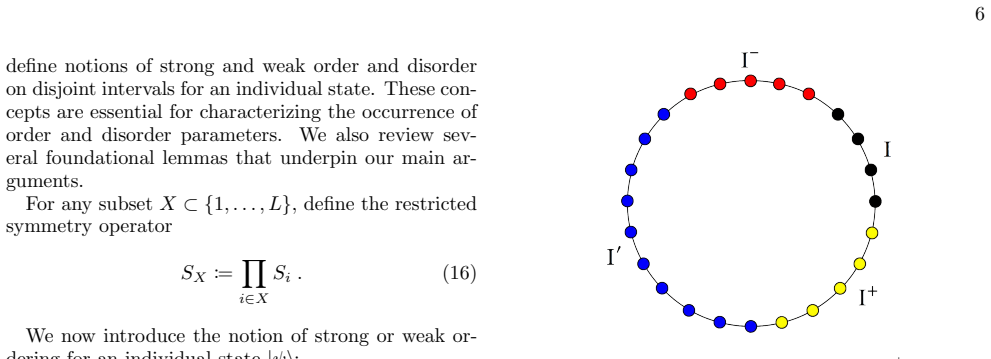
The events for ordering:{A i} We first summarize the physical content ofA i before giving the rigorous proof. Informally, ifA i occurs, the state has nontrivial long-range correlations betweenI i and its complementI ′ i, signaling local ordering near sitei. Moreover, if bothA i andA j occur for two well- separated pointsiandj, the local ordering neariand ...
-
[2]
The trace normεcan in turn be bounded by con- nected correlation functions
Combining (21) and (26), we have εℓ+ 2H 2(ε/2)> 1 32 ,(27) where ε := ΩIi ⊗Ω I ′ i −Ω IiI ′ i 1 ,(28) and we denote the solution to this inequality asε > ε ℓ. The trace normεcan in turn be bounded by con- nected correlation functions. Lemma 3(Lemma 20 of Ref. [42]).For every bounded operatorL∈B(C d ⊗C D)withd≤D, ∥L∥1 ≤d 2 max ∥X∥≤1,∥Y∥≤1 tr (X⊗Y)L .(29) A...
-
[3]
Informally, ifB i occurs, the state has a nontrivial disorder parameter onI − i andI + i , signaling that the system is disordered near sitei
The events for disordering:{B i} We first summarize the physical content ofB i be- fore giving the rigorous argument. Informally, ifB i occurs, the state has a nontrivial disorder parameter onI − i andI + i , signaling that the system is disordered near sitei. Moreover, ifB i,j,k all occur for three well- separated sitesi,j,k, the local disordering near t...
-
[4]
Suppose bothA i andA j occur for a ran- dom disorder realizationω
Estimation ofP(A i) For the estimation ofP(A i), consider two eventsA i andA j with dist(i, j)≫ℓ ′ such that they are inde- pendent. Suppose bothA i andA j occur for a ran- dom disorder realizationω. Recall that, as shown in Sec. III B 1, this implies that the state|Ω ω⟩has an order parameter betweenI i andI j. More explicitly, there exist odd operatorsO ...
-
[5]
As in theA i case, we consider three independent eventsB i,B j,B k with dist(i, j),dist(j, k),dist(i, k)≫ℓ
Estimation ofP(B i) We now estimateP(B i). As in theA i case, we consider three independent eventsB i,B j,B k with dist(i, j),dist(j, k),dist(i, k)≫ℓ. If all three occur, there existω-dependent disorder-parameter witnesses in at least two of the regionsI − i ,I − j ,I − k ; taking these to beI − i andI − j without loss of generality, there exist operators...
-
[6]
A union bound over allN ℓ′(ε′ 0)2 pairs, combined with independenceP(B i ∩B j ∩B k) = P(Bi)3, gives P(Bi)< 384η′ Nℓ′ 1 384 2 1/3 .(71)
-
[7]
Proposition 1.Letf,g,ε ℓ,N ℓ, andλ 1/4 be as de- fined below
Main trade-off result We are now ready to prove our main trade-off result. Proposition 1.Letf,g,ε ℓ,N ℓ, andλ 1/4 be as de- fined below. A gapped ensemble{|Ω ω⟩}has either an (η, ℓ)order parameter or an(η ′, ℓ′)disorder parameter, providedℓandℓ ′ satisfy 1.f(ℓ)≤ 1 128, 2.ℓ ′ ≥λ 1/4, 3.f(ℓ ′)≤ (2−2ℓ−1εℓ)2 2 , 4.(6 + √ 2) p g(ℓ′) +g(ℓ ′)≤2 −2ℓ−1εℓ. Moreover...
-
[8]
Suppose bothA i andC i occur for some disorder realizationω, we first show that|Ω ω⟩is strongly-ordered on regionI i and I ′ i
Estimation ofP(A i ∩C i) We now estimateP(A i ∩C i). Suppose bothA i andC i occur for some disorder realizationω, we first show that|Ω ω⟩is strongly-ordered on regionI i and I ′ i. The proof follows the same chain as in Sec. III B: Lemma 2 converts the mutual information lower bound IΩ(Ii :I ′ i)>1/32 into a trace-norm lower bound ∥ΩIi ⊗Ω I ′ i −Ω IiI ′ i...
-
[9]
Recall that ifB i occurs, the state|Ω ω⟩will be weakly-disordered on the regionI − i andI + i
Estimation ofP(B i ∩C i) We now move on to estimateP(B i ∩C i). Recall that ifB i occurs, the state|Ω ω⟩will be weakly-disordered on the regionI − i andI + i . Furthermore, for the case without rare region effect, we can leverage Lemma. 1 to show that|Ω ω⟩is also strongly-disordered on the regionI − i andI + i . We can then use the Markov’s inequality and...
-
[10]
intrinsically disordered
Trade-off relation We begin by generalizing the incompatibility condi- tion for the gapped case without the rare region effect. Recall that in that case, the incompatibility between the events Ai and Bi is shown by Lemma. 1. For the case with rare region effect, we can similarly show that if the event Bi ∩C i occurs, then IΩ(Ii :I ′ i)> 1 32 (116) 16 whic...
-
[11]
The former corresponds to a trivial phase while the latter corresponds to a Kitaev chain
There always exists some disorder parameter lim |i1−i2|→∞ Eω|⟨O1O2 Y i1≤k≤i2 Fk⟩Ωω |=O(1).(168) The dressing local operatorsO 1,2 are either al- ways bosonic or always fermionic. The former corresponds to a trivial phase while the latter corresponds to a Kitaev chain
-
[12]
intrinsically disordered
The fermion two-point correlator must decay: lim |i−j|→∞ Eω⟨fifj⟩Ωω = 0.(169) In Ref. [34] a simple example ofintrinsically dis- orderedtopological phase was proposed in a fermion chain. The proposed phase is essentially a disordered Kitaev chain, but with an additional averageZ 4 sym- metryc i →ic i (wherec i =γ 2i−1 +iγ 2i is the complex fermion on each...
-
[13]
This quasi-adiabatic construction extends to the case where the spectral gap is required only within the parity-even symmetry sector, rather than across the full Hilbert space
Construction For two local HamiltoniansH0 andH 1 smoothly con- nected by a pathH s along which the gap remains open, the ground-state subspaces of the two systems can be connected by a quasi-adiabatic evolution defined as fol- lows: U :=Sexp i Z 1 0 dsDs (B1) whereSdenotes ans-ordered exponential, and the quasi-adiabatic continuation operatorD s is given ...
-
[14]
This is used in Sec
Quasi-adiabatic evolution for disorder parameters We now show that the parity of the endpoint oper- ators of a disorder parameter is invariant under quasi- adiabatic evolution. This is used in Sec. III F to estab- lish that any disorder parameter must be parity-even, and underlies our applications to SPT phases and the disorder-averaged LSM theorem in Sec...
-
[15]
(Cambridge University Press, 2011)
Subir Sachdev,Quantum Phase Transitions, 2nd ed. (Cambridge University Press, 2011)
2011
-
[16]
Nonanalytic behavior above the critical point in a random ising ferromagnet,
Robert B. Griffiths, “Nonanalytic behavior above the critical point in a random ising ferromagnet,” Phys. Rev. Lett.23, 17–19 (1969)
1969
-
[17]
Rare region effects at classical, quan- tum and nonequilibrium phase transitions,
Thomas Vojta, “Rare region effects at classical, quan- tum and nonequilibrium phase transitions,” Journal of Physics A: Mathematical and General39, R143–R205 (2006)
2006
-
[18]
Critical behavior of random transverse-field ising spin chains,
Daniel S. Fisher, “Critical behavior of random transverse-field ising spin chains,” Phys. Rev. B51, 6411–6461 (1995)
1995
-
[19]
Strong disorder rg ap- proach of random systems,
F IGLOI and C MONTHUS, “Strong disorder rg ap- proach of random systems,” Physics Reports412, 23 277–431 (2005)
2005
-
[20]
Disordered weyl semimetal as an array of coupled hubbard chains,
Jinmin Yi and A. A. Burkov, “Disordered weyl semimetal as an array of coupled hubbard chains,” Phys. Rev. B111, 165114 (2025)
2025
-
[21]
Categorical symme- try and noninvertible anomaly in symmetry-breaking and topological phase transitions,
Wenjie Ji and Xiao-Gang Wen, “Categorical symme- try and noninvertible anomaly in symmetry-breaking and topological phase transitions,” Phys. Rev. Res.2, 033417 (2020)
2020
-
[22]
Symmetry as a shadow of topological order and a derivation of topological holographic principle,
Arkya Chatterjee and Xiao-Gang Wen, “Symmetry as a shadow of topological order and a derivation of topological holographic principle,” Phys. Rev. B107, 155136 (2023)
2023
-
[23]
Algebraic higher symmetry and categorical symmetry: A holographic and entan- glement view of symmetry,
Liang Kong, Tian Lan, Xiao-Gang Wen, Zhi-Hao Zhang, and Hao Zheng, “Algebraic higher symmetry and categorical symmetry: A holographic and entan- glement view of symmetry,” Phys. Rev. Res.2, 043086 (2020)
2020
-
[24]
Sheng-Jie Huang and Meng Cheng, “Topologi- cal holography, quantum criticality, and boundary states,” SciPost Physics18(2025), 10.21468/scipost- phys.18.6.213
-
[25]
Constraints on order and disorder pa- rameters in quantum spin chains,
Michael Levin, “Constraints on order and disorder pa- rameters in quantum spin chains,” Communications in Mathematical Physics378, 1081–1106 (2020)
2020
-
[26]
Theory of spin glasses,
S F Edwards and P W Anderson, “Theory of spin glasses,” Journal of Physics F: Metal Physics5, 965 (1975)
1975
-
[27]
Automorphic equiva- lence within gapped phases of quantum lattice sys- tems,
Sven Bachmann, Spyridon Michalakis, Bruno Nachter- gaele, and Robert Sims, “Automorphic equiva- lence within gapped phases of quantum lattice sys- tems,” Communications in Mathematical Physics309, 835–871 (2011)
2011
-
[28]
Local perturbations per- turb—exponentially–locally,
W. De Roeck and M. Sch¨ utz, “Local perturbations per- turb—exponentially–locally,” Journal of Mathematical Physics56(2015), 10.1063/1.4922507
-
[29]
Symmetry-protected topological orders in interacting bosonic systems,
X. Chen, Z.-C. Gu, Z.-X. Liu, and X.-G. Wen, “Symmetry-protected topological orders in interacting bosonic systems,” Science338, 1604–1606 (2012)
2012
-
[30]
Hidden z2×z2 symme- try breaking in haldane-gap antiferromagnets,
Tom Kennedy and Hal Tasaki, “Hidden z2×z2 symme- try breaking in haldane-gap antiferromagnets,” Phys. Rev. B45, 304–307 (1992)
1992
-
[31]
String order and symmetries in quantum spin lattices,
D. P´ erez-Garc´ ıa, M. M. Wolf, M. Sanz, F. Verstraete, and J. I. Cirac, “String order and symmetries in quantum spin lattices,” Physical Review Letters100 (2008), 10.1103/physrevlett.100.167202
-
[33]
Order parameter for symmetry- protected phases in one dimension,
Jutho Haegeman, David P´ erez-Garc´ ıa, Ignacio Cirac, and Norbert Schuch, “Order parameter for symmetry- protected phases in one dimension,” Physical Review Letters109(2012), 10.1103/physrevlett.109.050402
-
[34]
Two soluble models of an antiferromagnetic chain,
Elliott Lieb, Theodore Schultz, and Daniel Mattis, “Two soluble models of an antiferromagnetic chain,” Annals of Physics16, 407–466 (1961)
1961
-
[35]
Commensurability, excitation gap and topology in quantum many-particle systems on a periodic lattice
Masaki Oshikawa, “Commensurability, Excitation Gap, and Topology in Quantum Many-Particle Sys- tems on a Periodic Lattice,” Physical Review Letters 84, 1535–1538 (2000), arXiv:cond-mat/9911137 [cond- mat.str-el]
work page internal anchor Pith review Pith/arXiv arXiv 2000
-
[36]
Lieb-schultz-mattis in higher dimen- sions,
M. B. Hastings, “Lieb-schultz-mattis in higher dimen- sions,” Phys. Rev. B69, 104431 (2004)
2004
-
[37]
Trans- lational symmetry and microscopic constraints on symmetry-enriched topological phases: A view from the surface,
Meng Cheng, Michael Zaletel, Maissam Barkeshli, Ashvin Vishwanath, and Parsa Bonderson, “Trans- lational symmetry and microscopic constraints on symmetry-enriched topological phases: A view from the surface,” Phys. Rev. X6, 041068 (2016)
2016
-
[38]
Ruizhi Liu, Jinmin Yi, Shiyu Zhou, and Liu- jun Zou, “Entanglement area law and lieb-schultz- mattis theorem in long-range interacting systems, and symmetry-enforced long-range entanglement,” (2025), arXiv:2405.14929 [cond-mat.str-el]
-
[39]
Lov´ asz meets lieb- schultz-mattis: Complexity in approximate quantum error correction,
Jinmin Yi, Ruizhi Liu, and Zhi Li, “Lov´ asz meets lieb- schultz-mattis: Complexity in approximate quantum error correction,” (2025), arXiv:2510.04453 [quant- ph]
-
[40]
Nonzero momentum re- quires long-range entanglement,
Lei Gioia and Chong Wang, “Nonzero momentum re- quires long-range entanglement,” Phys. Rev. X12, 031007 (2022)
2022
-
[41]
Lieb-Schultz-Mattis Anomalies and Anomaly Matching
Liujun Zou and Meng Cheng, “Lieb-Schultz-Mattis Anomalies and Anomaly Matching,” arXiv e-prints , arXiv:2604.00347 (2026), arXiv:2604.00347 [cond- mat.str-el]
work page internal anchor Pith review Pith/arXiv arXiv 2026
-
[42]
Va- lence bonds in random quantum magnets: Theory and application to ybmggao 4,
Itamar Kimchi, Adam Nahum, and T. Senthil, “Va- lence bonds in random quantum magnets: Theory and application to ybmggao 4,” Phys. Rev. X8, 031028 (2018)
2018
-
[43]
Average symmetry- protected topological phases,
Ruochen Ma and Chong Wang, “Average symmetry- protected topological phases,” Phys. Rev. X13, 031016 (2023)
2023
-
[44]
Yizhi You and Masaki Oshikawa, “Intrinsic symmetry- protected topological mixed state from modulated symmetries and hierarchical structure of bound- ary anomaly,” Phys. Rev. B110, 165160 (2024), arXiv:2407.08786 [quant-ph]
-
[45]
Average-exact mixed anomalies and compatible phases,
Yichen Xu and Chao-Ming Jian, “Average-exact mixed anomalies and compatible phases,” Physical Review B 111(2025), 10.1103/physrevb.111.125128
-
[46]
Quantum criticality at strong randomness: a lesson from anomaly
Yasamin Panahi, Subhayan Sahu, Naren Manju- nath, and Chong Wang, “Quantum criticality at strong randomness: a lesson from anomaly,” (2026), arXiv:2602.02648 [cond-mat.dis-nn]
work page internal anchor Pith review Pith/arXiv arXiv 2026
-
[47]
Average categorical symmetries in one-dimensional disordered systems,
Yabo Li, Meng Cheng, and Ruochen Ma, “Average categorical symmetries in one-dimensional disordered systems,” (2026), arXiv:2602.09083 [cond-mat.dis-nn]
-
[48]
Ruochen Ma, Jian-Hao Zhang, Zhen Bi, Meng Cheng, and Chong Wang, “Topological phases with average symmetries: The decohered, the disordered, and the intrinsic,” Physical Review X15(2025), 10.1103/phys- revx.15.021062
-
[49]
M. B. Hastings and Xiao-Gang Wen, “Quasiadia- batic continuation of quantum states: The stabil- ity of topological ground-state degeneracy and emer- gent gauge invariance,” Physical Review B72(2005), 10.1103/physrevb.72.045141
-
[50]
Topological quantum order: Stability under local perturbations,
Sergey Bravyi, Matthew B. Hastings, and Spyri- don Michalakis, “Topological quantum order: Stability under local perturbations,” Journal of Mathematical Physics51(2010), 10.1063/1.3490195
-
[51]
Quantum algorithm for simulat- ing real time evolution of lattice hamiltonians,
Jeongwan Haah, Matthew B. Hastings, Robin Kothari, and Guang Hao Low, “Quantum algorithm for simulat- ing real time evolution of lattice hamiltonians,” SIAM Journal on Computing52, FOCS18–250–FOCS18–284 (2021)
2021
-
[52]
Jinmin Yi, Kangle Li, Chuan Liu, Zixuan Li, and Li- ujun Zou, “Universal decay of mutual information and conditional mutual information in gapped pure- and 24 mixed-state quantum matter,” Physical Review Let- ters136(2026), 10.1103/mqp8-y1m7
-
[53]
Random antiferromagnetic quantum spin chains,
Daniel S. Fisher, “Random antiferromagnetic quantum spin chains,” Phys. Rev. B50, 3799–3821 (1994)
1994
-
[54]
Continuity of quantum condi- tional information,
R Alicki and M Fannes, “Continuity of quantum condi- tional information,” Journal of Physics A: Mathemat- ical and General37, L55–L57 (2004)
2004
-
[55]
Tight uniform continuity bounds for quantum entropies: Conditional entropy, relative en- tropy distance and energy constraints,
Andreas Winter, “Tight uniform continuity bounds for quantum entropies: Conditional entropy, relative en- tropy distance and energy constraints,” Communica- tions in Mathematical Physics347, 291–313 (2016)
2016
-
[56]
Exponential decay of correlations implies area law,
Fernando G. S. L. Brand˜ ao and Micha l Horodecki, “Exponential decay of correlations implies area law,” Communications in Mathematical Physics333, 761–798 (2014)
2014
-
[57]
Cryptographic Distinguishability Measures for Quantum Mechanical States
Christopher A. Fuchs and Jeroen van de Graaf, “Cryp- tographic distinguishability measures for quantum mechanical states,” (1998), arXiv:quant-ph/9712042 [quant-ph]
work page internal anchor Pith review Pith/arXiv arXiv 1998
-
[58]
The “transition probability
A. Uhlmann, “The “transition probability” in the state space of a∗-algebra,” Reports on Mathematical Physics9, 273–279 (1976)
1976
-
[59]
Area laws in quantum systems: mutual information and correlations
Michael M. Wolf, Frank Verstraete, Matthew B. Hast- ings, and J. Ignacio Cirac, “Area Laws in Quan- tum Systems: Mutual Information and Correlations,” Phys. Rev. Lett.100, 070502 (2008), arXiv:0704.3906 [quant-ph]
work page internal anchor Pith review Pith/arXiv arXiv 2008
-
[60]
High-dimensional probabil- ity: An introduction with applications in data science,
Omiros Papaspiliopoulos, “High-dimensional probabil- ity: An introduction with applications in data science,” (2020)
2020
-
[61]
Ruizhi Liu, Jinmin Yi, and Liujun Zou, “Twisted locality-preserving automorphisms, anomaly index, and generalized Lieb-Schultz-Mattis theorems with anti-unitary symmetries,” (2025), arXiv:2510.06555 [cond-mat.str-el]
-
[62]
Local strong-to-weak spontaneous symmetry break- ing,
Francisco Divi, Leonardo A. Lessa, and Chong Wang, “Local strong-to-weak spontaneous symmetry break- ing,” To appear (2026)
2026
discussion (0)
Sign in with ORCID, Apple, or X to comment. Anyone can read and Pith papers without signing in.