Common Noise-Induced Group-Level Synchronization Between Uncoupled Groups of Oscillators
Pith reviewed 2026-06-28 23:53 UTC · model grok-4.3
The pith
Common noise synchronizes the collective oscillations of uncoupled oscillator groups.
A machine-rendered reading of the paper's core claim, the machinery that carries it, and where it could break.
Core claim
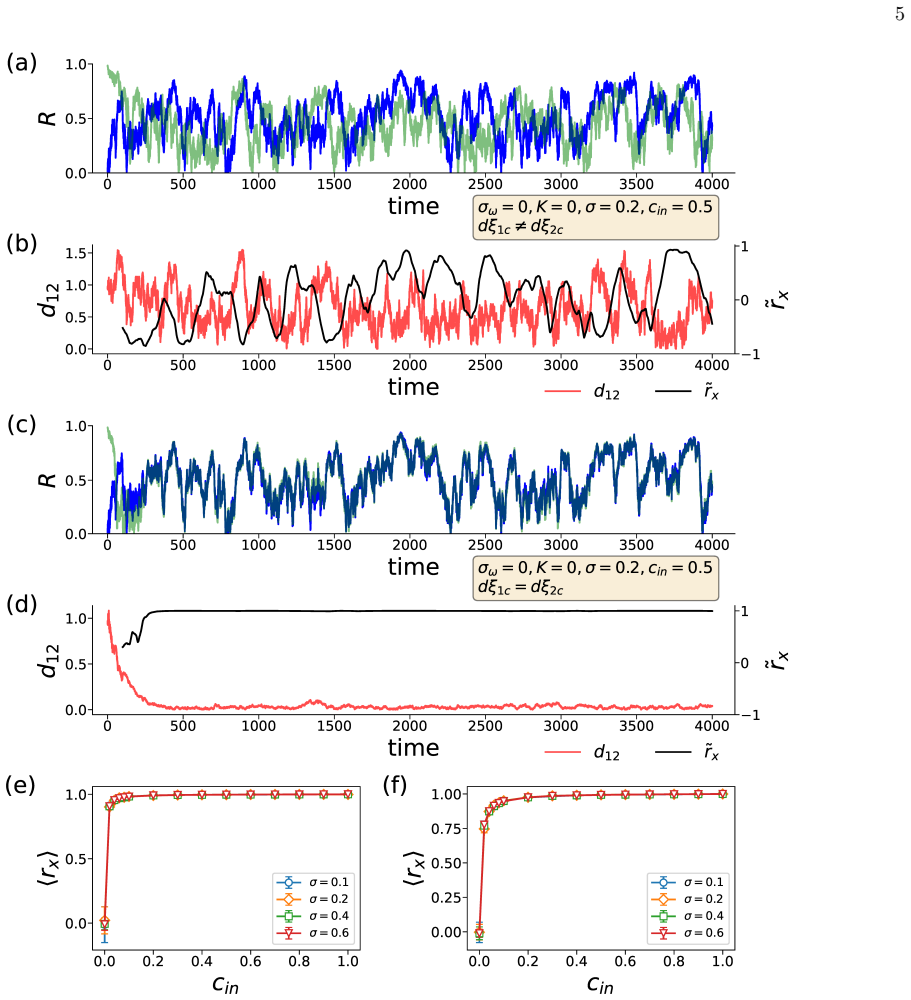
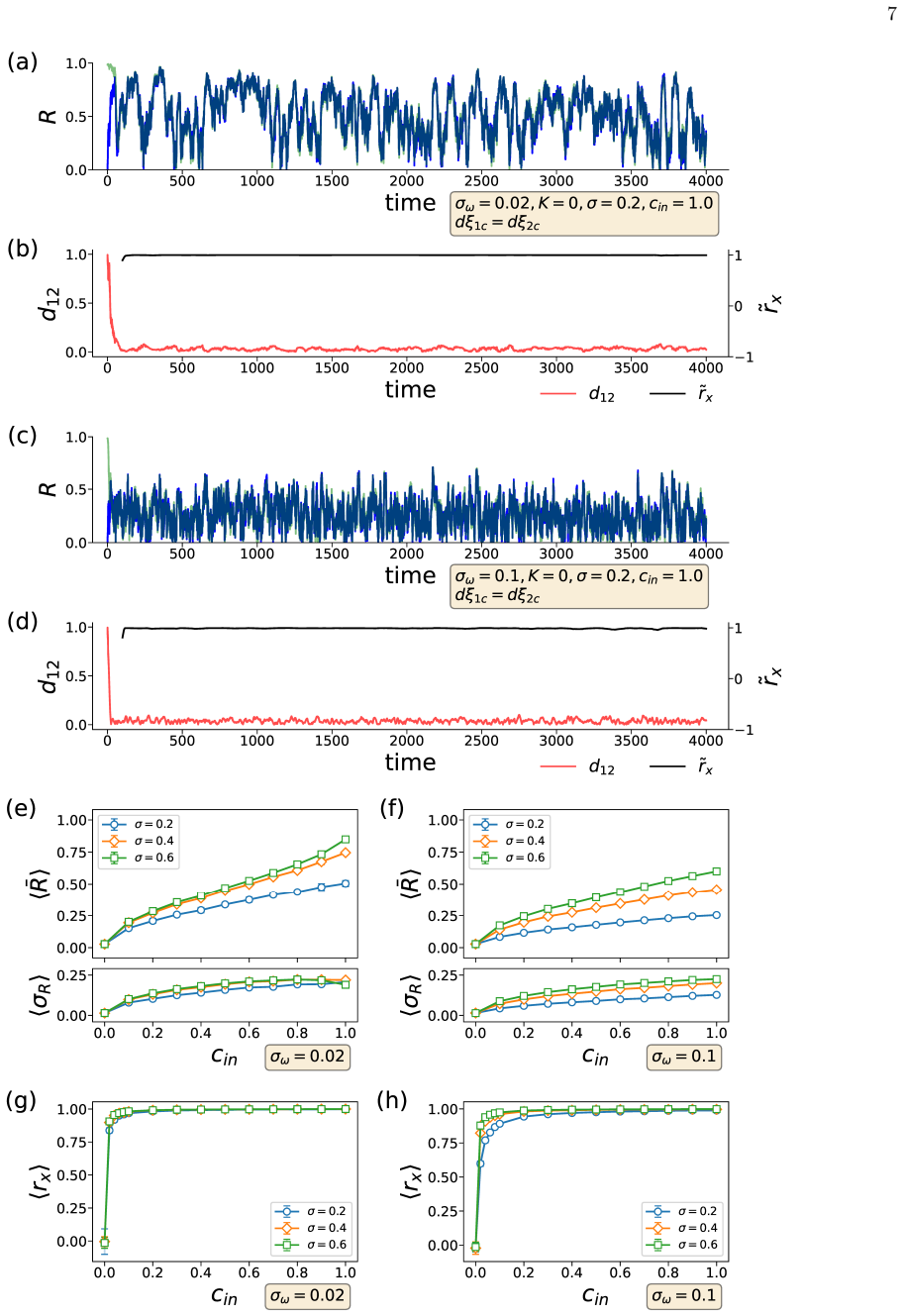
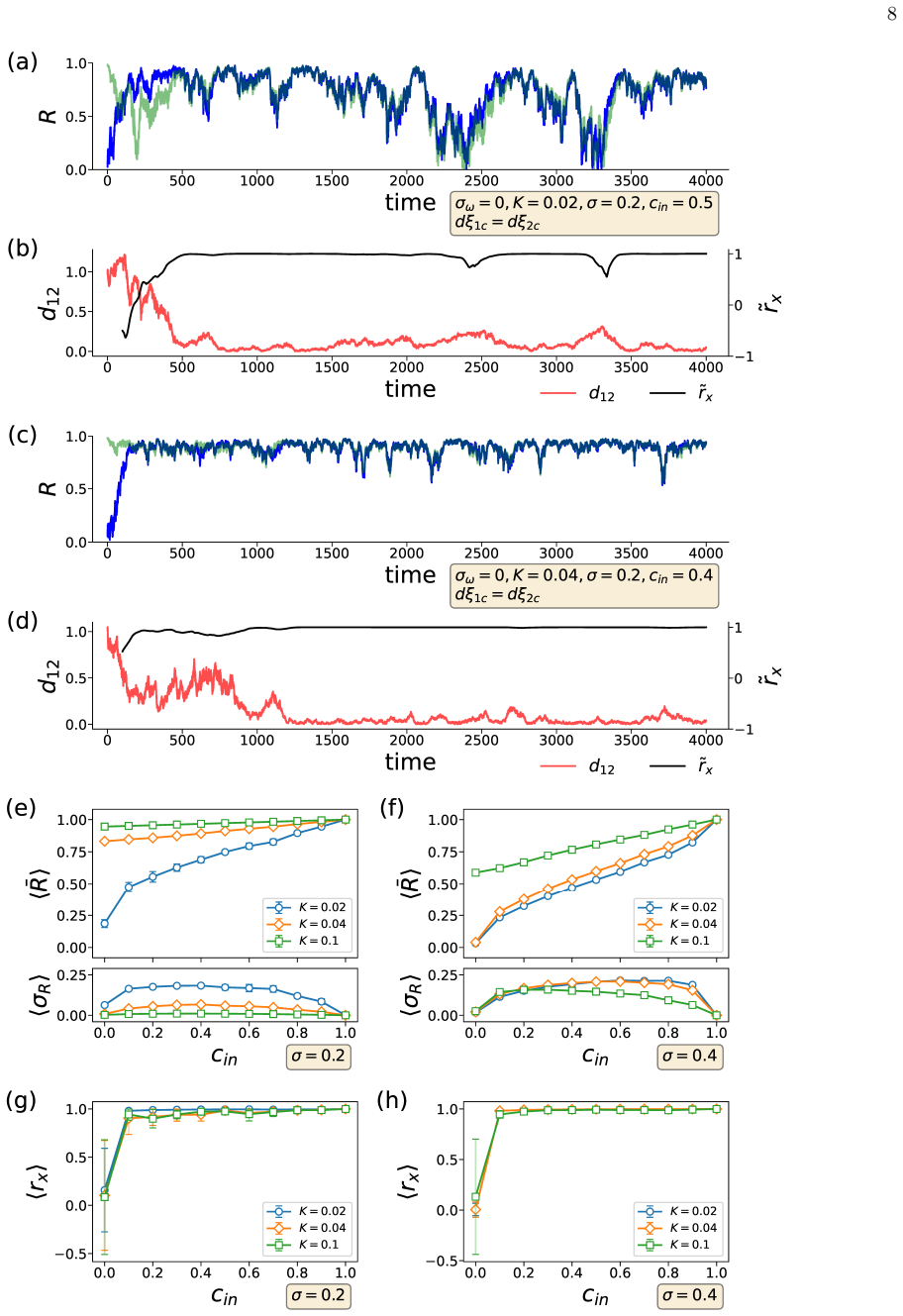
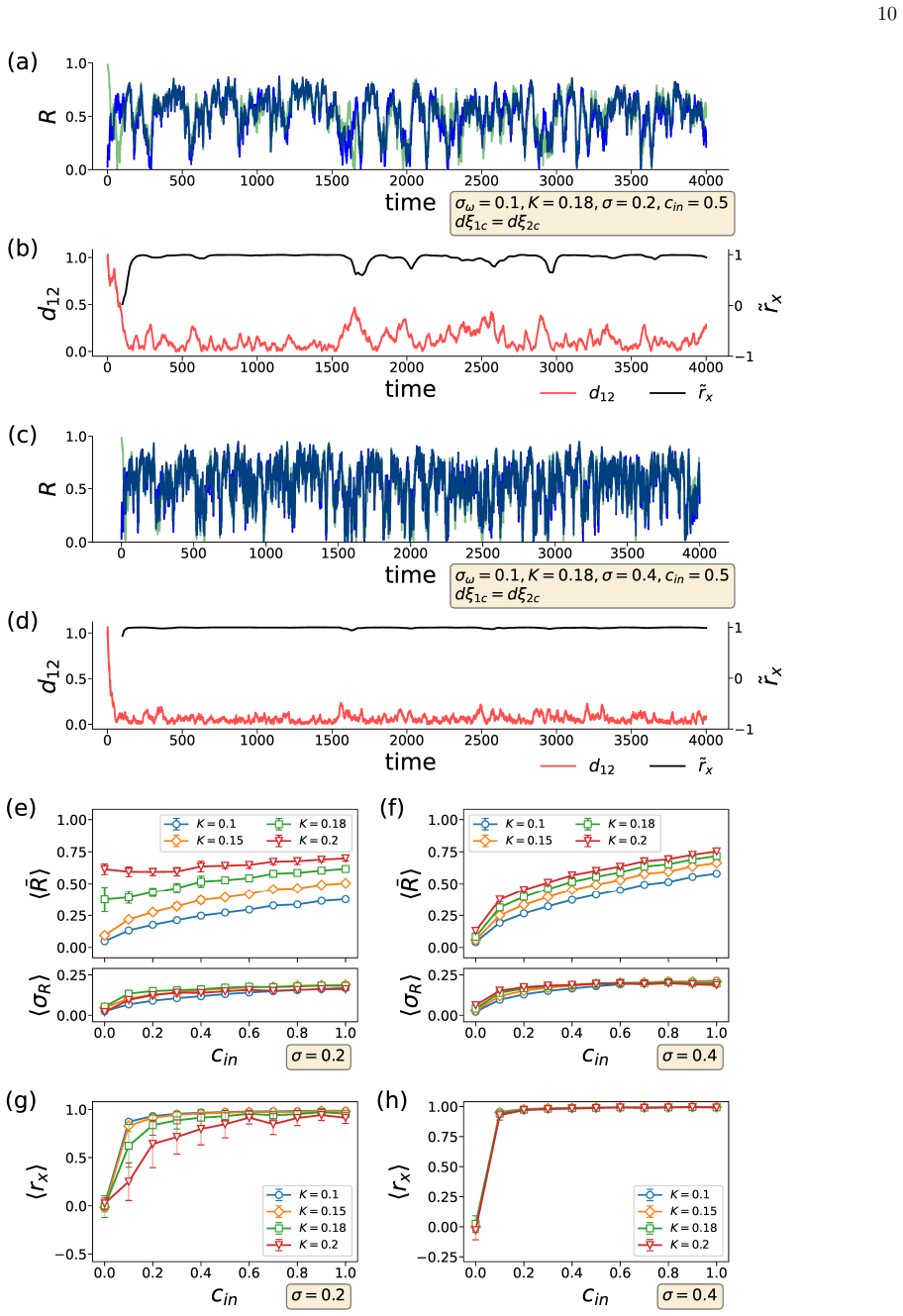
When multiple groups of oscillators are driven by the same common noise, the complex Kuramoto order parameters that represent the collective oscillations of each group synchronize, even in the complete absence of inter-group coupling. This group-level synchronization occurs for both identical oscillators and nonidentical oscillators drawn from identical frequency distributions, and persists with or without intra-group coupling.
What carries the argument
Phase density evolution mapping that tracks how the shared common noise aligns the complex order parameters of uncoupled groups.
If this is right
- The synchronization of group order parameters occurs without any direct coupling between groups.
- The effect holds for both identical oscillators and statistically equivalent nonidentical oscillators.
- Intra-group synchronization levels fluctuate temporally while the order parameters across groups remain aligned.
- The phase density evolution mapping provides an analytical account of the synchronization observed in simulations.
Where Pith is reading between the lines
- The same common-noise mechanism could coordinate activity in biological populations that share an environment but lack direct connections.
- The result suggests testing whether partial correlation in the common noise still produces measurable group-level alignment.
- Extensions to larger numbers of groups or to different oscillator models would clarify the robustness of the mapping.
Load-bearing premise
The groups receive exactly identical common noise and, when oscillators are nonidentical, their natural frequencies are drawn from the same distribution so the groups remain statistically equivalent.
What would settle it
Numerical simulations or experiments in which the complex order parameters of the groups fail to align when the groups receive identical common noise.
Figures



read the original abstract
We investigate group-level synchronization between oscillator groups induced by common noise in the absence of inter-group coupling. Each group receives a common noise shared by all its oscillators and independent local noise inputs to individual oscillators. The same common noise is applied to all groups. The system is studied with both identical and nonidentical oscillators, and with and without intra-group coupling. In the nonidentical case, natural frequencies are drawn from the same distribution for both groups, making them statistically equivalent. Through numerical simulations of this system, we find that the degree of synchronization within each group, measured by the absolute value of a complex Kuramoto order parameter, typically shows significant temporal fluctuations. Importantly, the complex order parameters representing the collective oscillations of the groups synchronize when the groups are driven by the same common noise. By deriving a phase density evolution mapping, we analytically explain how this group-level synchronization is achieved in the absence of intra-group coupling.
Editorial analysis
A structured set of objections, weighed in public.
Referee Report
Summary. The manuscript claims that common noise shared across multiple uncoupled groups of oscillators induces synchronization between the groups' collective dynamics, as quantified by the complex Kuramoto order parameters of each group. This occurs for both identical and nonidentical oscillators (with natural frequencies drawn from the same distribution) and holds with or without intra-group coupling. The result is supported by numerical simulations showing temporal fluctuations in intra-group synchronization but coincidence of inter-group order parameters under identical common noise, together with an analytical phase-density evolution mapping that explains the effect in the large-N limit by showing identical evolution of the groups' phase densities.
Significance. If the central claim holds, the work identifies a purely noise-driven mechanism for group-level synchronization without inter-group coupling or parameter tuning, which is relevant to collective phenomena in systems such as neural populations or coupled oscillators subject to environmental fluctuations. The combination of direct simulations across multiple regimes and the analytical phase-density mapping provides both empirical support and a mechanistic explanation; the setup is free of ad-hoc parameters and relies on the explicit statistical equivalence of the groups.
minor comments (3)
- The phase-density mapping is central to the analytical explanation; the manuscript should include the explicit form of the mapping (e.g., the integro-differential equation for the density) and the steps showing that the complex order parameters coincide when the common noise is identical.
- Figure captions and axis labels should explicitly state the value of N used in each panel and whether the plotted order-parameter trajectories are single realizations or ensemble averages.
- The manuscript cites the standard Kuramoto order parameter but does not reference prior work on common-noise synchronization in oscillator populations; adding 1-2 relevant citations would clarify the novelty.
Simulated Author's Rebuttal
We thank the referee for their positive summary and significance assessment of our work on common noise-induced group-level synchronization. We appreciate the recommendation for minor revision and the recognition that the combination of simulations and the phase-density mapping provides both empirical and analytical support.
Circularity Check
No significant circularity identified
full rationale
The paper's derivation begins from the standard phase equations for oscillators driven by shared common noise plus independent local noise, then obtains the phase-density evolution (a continuity/Fokker-Planck equation) under the explicit modeling assumption that both groups receive identical common noise and draw frequencies from the same distribution. The resulting identity of the two density equations directly implies coincidence of their order parameters in the large-N limit; this is a symmetry consequence of the input setup rather than a redefinition or a fitted quantity renamed as a prediction. No self-citation chain, uniqueness theorem, or ansatz imported from prior work by the same authors is invoked to close the argument. The numerical simulations serve only as confirmation of the analytically derived mapping. The derivation is therefore self-contained against the model equations themselves.
Axiom & Free-Parameter Ledger
Reference graph
Works this paper leans on
-
[1]
For the simulations, we set ω 0 = 2 π , N = 1000 and a time step of δt = 0
using the Euler-Maruyama method, a numerical approach well- suited for solving SDEs in the Itˆ o sense [36]. For the simulations, we set ω 0 = 2 π , N = 1000 and a time step of δt = 0 . 01. The specific choice of ω 0 does not change the results qualitatively. We calculate the time average of quantities of interest over a time interval [ t = T1, t = T2], ex...
-
[2]
15, and 0 . 18. With larger noise strength σ = 0 . 4 and K values of Fig. 5(h), strong group-level synchronization persists down to cin ≈ 0. 1. For coupled nonidentical oscillators, while both fre- quency heterogeneity and intra-group coupling affect intra-group synchronization and its fluctuations, the sharing of the common noise across groups still induce...
-
[3]
Here, we use Zg,n which is the complex order parameter defined in Eq
through the Euler-Maruyama method with time step δt gives the following approximate mapping: θgi,n +1 = θgi,n + [ ω gi + K ( Zg,n e− iθgi,n − Z ∗ g,n eiθgi,n ) 2i + σ 2 2 ∆( θgi,n )∆ ′(θgi,n ) ] δt + σ ∆ ( θgi,n ) ( √ cinλ gc,n + √ 1 − cinλ gi,n ) n = 0, 1, 2, ..., (4) where θgi,n stands for the phase of oscillator i of group g at time t = nδt. Here, we u...
-
[4]
( 5) for four different initial conditions (ID1, ID2, ID3, and ID4)
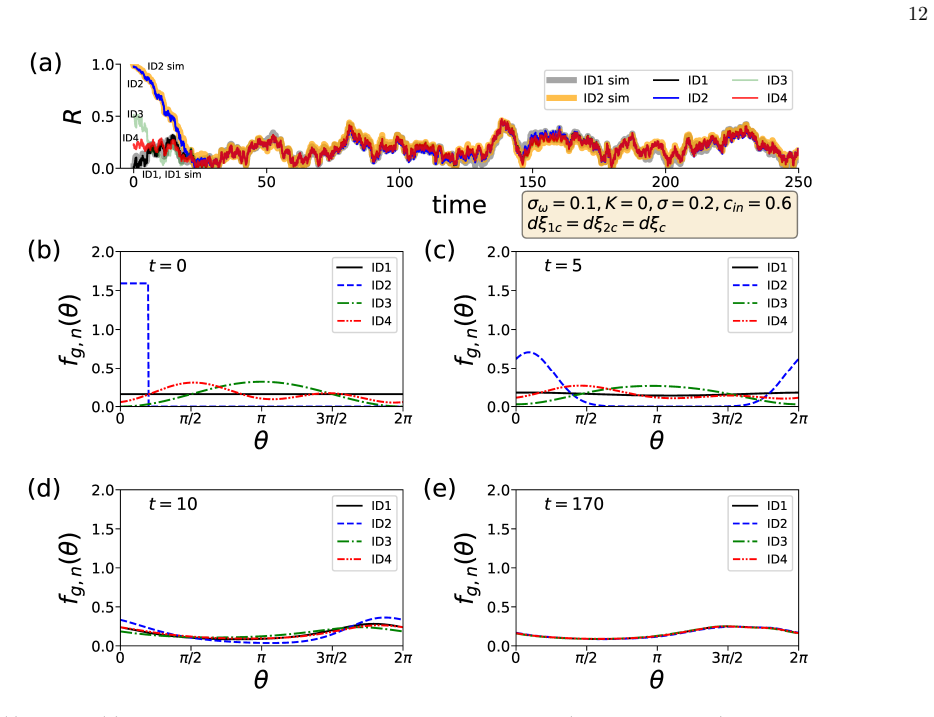
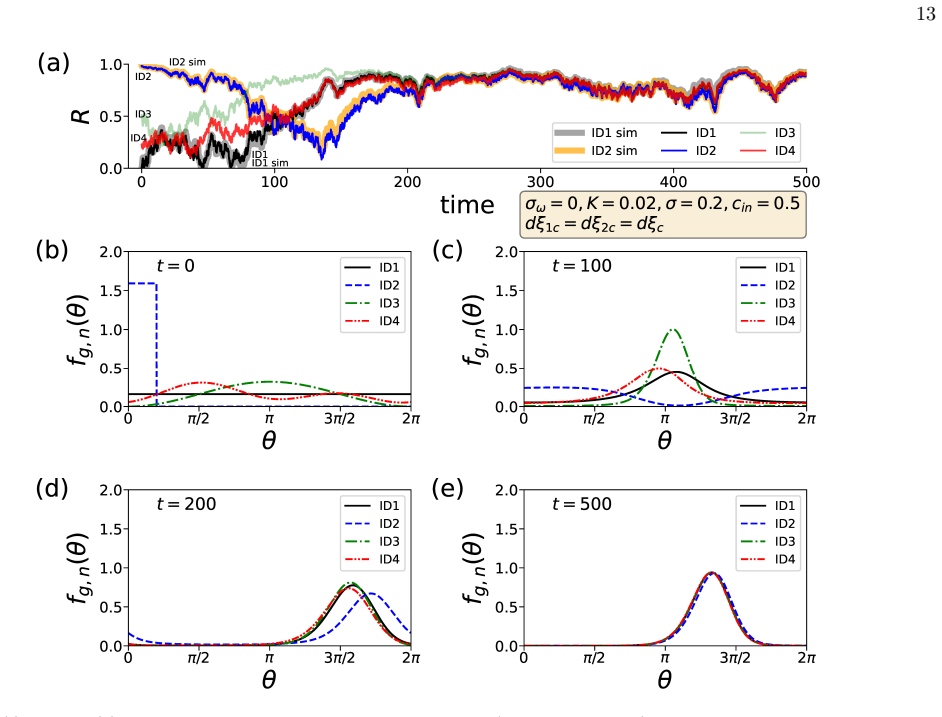
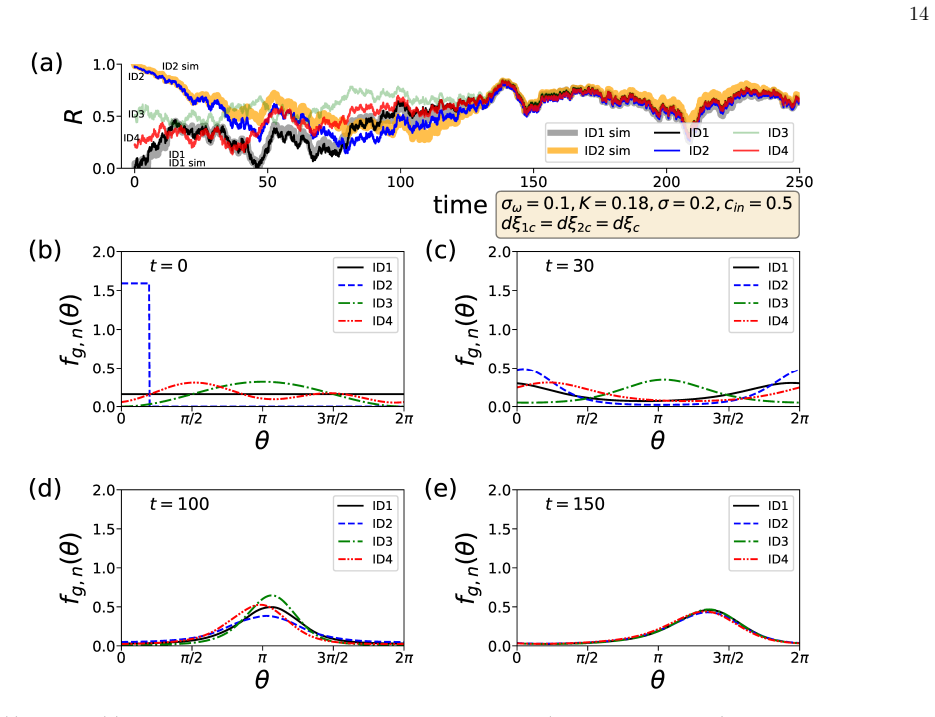
and four time series R(t) are obtained from the numerical evolutions of fg,n (θ) us- ing Eq. ( 5) for four different initial conditions (ID1, ID2, ID3, and ID4). All the time series for R eventually con- verge to the same trajectory, as in Fig. 2. The R time series obtained from simulation and numerical evolution match well when starting from the same init...
-
[5]
Conse- quently, there is no increase in the overlapping portion between f1ω,n (θ) and f2ω,n (θ) as time progresses
and thus there can- not be overlap between f d 1ω,n +(θ) and f d 2ω,n +(θ). Conse- quently, there is no increase in the overlapping portion between f1ω,n (θ) and f2ω,n (θ) as time progresses. How- ever, group-level synchronization between the two groups occurs without increase in the overlapping, because both groups come close to a fully synchronized stat...
-
[6]
in Fig. 10. Figure 10(a) displays R(t) of the two groups obtained from the evolving phase distributions at time t for cin = 0 . 6. The phase densities f1ω,n (θ) and f2ω,n (θ) shown in Fig. 10(b) are the initial densities used for the numerical evolution. Note that in the cases of identical oscillators, it is sufficient to consider fgω,n (θ) only since fg,n ...
-
[7]
A. T. Winfree, The Geometry of Biological Time , 2nd ed. (Springer-Verlag, New York, 2001)
2001
-
[8]
Pikovsky, M
A. Pikovsky, M. Rosenblum, and J. Kurths, Synchroniza- tion: A universal concept in nonlinear sciences (Cam- bridge University Press, Cambridge, 2001)
2001
-
[9]
S. H. Strogatz, Sync: The emergence science of sponta- neous order (Hyperion publisher, New York, 2003)
2003
-
[10]
Kuramoto, Chemical Oscillations, Waves, and Turbu- lence (Springer, Berlin, 1984)
Y. Kuramoto, Chemical Oscillations, Waves, and Turbu- lence (Springer, Berlin, 1984)
1984
-
[11]
S. H. Strogatz, From Kuramoto to Crawford: Exploring the onset of synchronization in populations of coupled oscillators, Physica D 143, 1 (2000)
2000
-
[12]
J. A. Acebr´ on et al. , The Kuramoto model: A sim- ple paradigm for synchronization phenomena, Rev. Mod. Phys. 77, 137 (2005)
2005
-
[13]
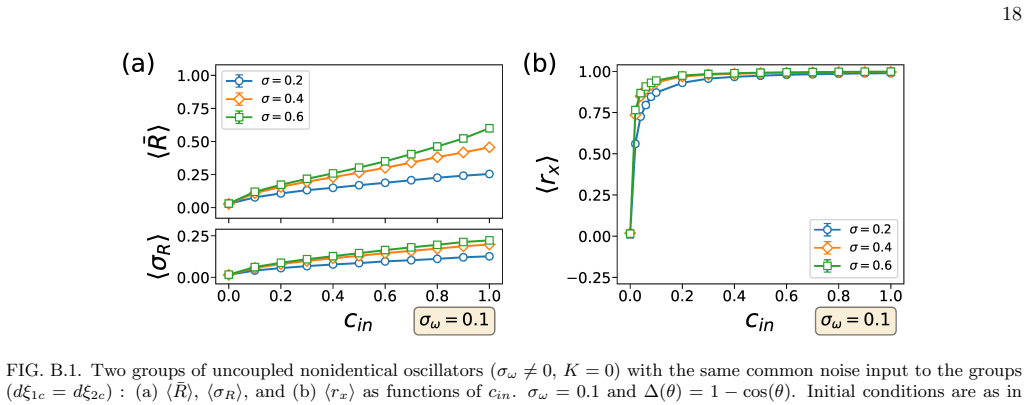
G. B. Ermentrout and D. Kleinfeld, Traveling Electrical Waves in Cortex : Insights from Phase Dynamics and Speculation on a Computational Role, Neuron 29, 33 18 FIG. B.1. Two groups of uncoupled nonidentical oscillators (σ ω ̸= 0, K = 0) with the same common noise input to the groups (dξ1c = dξ2c) : (a) ⟨ ¯R⟩, ⟨σ R⟩, and (b) ⟨rx⟩ as functions of cin. σ ω ...
2001
-
[14]
Pikovskii, Synchronization and stochastization of ar - ray of self-excited oscillators by external noise, Radio- phys
A.S. Pikovskii, Synchronization and stochastization of ar - ray of self-excited oscillators by external noise, Radio- phys. Quantum Electron. 27, 390 (1984)
1984
-
[15]
Goldobin and A
D.S. Goldobin and A. S. Pikovsky, Synchronization of periodic self-oscillations by common noise, Radiophys. Quantum Electron. 47, 910 (2004)
2004
-
[16]
J. N. Teramae and D. Tanaka, Robustness of the Noise- Induced Phase Synchronization in a General Class of Limit Cycle Oscillators, Phys. Rev. Lett. 93, 204103 (2004)
2004
-
[17]
R. F. Gal´ an, N. Fourcaud-Trocm´ e, G. B. Ermentrout, and N. N. Urban, Correlation-Induced Synchronization of Oscillations in Olfactory Bulb Neurons, J. Neurosci. 26, 3646 (2006)
2006
-
[18]
R. F. Gal´ an, G. B. Ermentrout, and N. N. Urban, Reli- ability and stochastic synchronization in type I vs. type II neural oscillators, Neurocomputing 70, 2102 (2007)
2007
-
[19]
R. F. Gal´ an, G. B. Ermentrout, and N. N. Urban, Stochastic dynamics of uncoupled neural oscillators: Fokker-Planck studies with the finite element method, Phys. Rev. E 76, 056110 (2007)
2007
-
[20]
Marella and G
S. Marella and G. B. Ermentrout, Class-II neurons dis- play a higher degree of stochastic synchronization than class-I neurons, Phys. Rev. E 77, 041918 (2008)
2008
-
[21]
Abouzeid and B
A. Abouzeid and B. Ermentrout, Type-II phase resetting curve is optimal for stochastic synchrony, Phys. Rev. E 80, 011911 (2009)
2009
-
[22]
D. S. Goldobin and A. Pikovsky, Synchronization and desynchronization of self-sustained oscillators by com- mon noise, Phys. Rev. E 71, 045201(R) (2005)
2005
-
[23]
Goldobin and A
D.S. Goldobin and A. Pikovsky, Antireliability of noise- driven neurons, Phys. Rev. E 73, 061906 (2006)
2006
-
[24]
Mainen and T
Z. Mainen and T. Sejnowski, Reliability of spike timing in neocortical neurons, Science 268, 1503 (1995)
1995
-
[25]
Nakao, K
H. Nakao, K. Arai, and Y. Kawamura, Noise-induced synchronization and clustering in ensembles of uncou- pled limit-cycle oscillators, Phys. Rev. Lett. 98, 184101 (2007)
2007
-
[26]
Abouzeid and B
A. Abouzeid and B. Ermentrout, Correlation transfer in stochastically driven neural oscillators over long and short time scales, Phys. Rev. E 84, 061914 (2011)
2011
-
[27]
K. H. Nagai and H. Kori, Noise-induced synchronization of a large population of globally coupled nonidentical os- cillators, Phys. Rev. E 81, 065202(R) (2010)
2010
-
[28]
Y. M. Lai and M. A. Porter, Noise-induced synchroniza- tion, desynchronization, and clustering in globally cou- pled nonidentical oscillators, Phys. Rev. E 88, 012905 (2013)
2013
-
[29]
P. A. P. Moran, The Statistical Analysis of the Canadian Lynx Cycle. II. Synchronization and meteorology, Aust. 19 FIG. B.3. Two groups of coupled nonidentical oscillators ( σ ω ̸= 0, K > 0) with the same common noise input to the groups (dξ1c = dξ2c) : (a) ⟨ ¯R⟩, ⟨σ R⟩, and (b) ⟨rx⟩ as functions of cin. σ = 0. 4, σ ω = 0. 1, and ∆( θ) = 1 − cos(θ). Initi...
1953
-
[30]
P. J. Hudson and I. M. Cattadori, The Moran effect: a cause of population synchrony, Trends Ecol. Evol. 14, 1 (1999)
1999
-
[31]
B. B. Hansen, V. Grøtan, I. Herfindal, and A. M. Lee, The Moran effect revisited: spatial population synchrony under global warming, Ecography 43, 1591 (2020)
2020
-
[32]
Hasson, Y
U. Hasson, Y. Nir, I. Levy, G. Fuhrmann, and R. Malach, Intersubject Synchronization of Cortical Activity During Natural Vision, Science 303, 1634 (2004)
2004
-
[33]
Hasson, R
U. Hasson, R. Malach, and D. J. Heeger, Reliability of cortical activity during natural stimulation, Trends in Cogn. Sci. 14, 40 (2009)
2009
-
[34]
Denworth, Brain Waves Synchronize when People In- teract, Sci
L. Denworth, Brain Waves Synchronize when People In- teract, Sci. Am. (July 1, 2023)
2023
-
[35]
K. K. Lin, E. Shea-Brown, and L.-S. Young, Spike-time reliability of layered neural oscillator networks, J. Com- put. Neurosci. 27, 135 (2009)
2009
-
[36]
K. K. Lin, E. Shea-Brown, and L.-S. Young, Reliability of layered neural oscillator networks, Commun. Math. Sci. 7, 239 (2009)
2009
-
[37]
Kawamura, H
Y. Kawamura, H. Nakao, K. Arai, H. Kori, and Y. Ku- ramoto, Collective Phase Sensitivity, Phys. Rev. Lett. 101, 024101 (2008)
2008
-
[38]
J. N. Teramae, H. Nakao, and G.B. Ermentrout, Stochas- tic Phase Reduction for a General Class of Noisy Limit Cycle Oscillators, Phys. Rev. Lett. 102, 194102 (2009)
2009
-
[39]
Goldobin, J
D.S. Goldobin, J. N. Teramae, H. Nakao, and G.B. Er- mentrout, Dynamics of Limit-Cycle Oscillators Subject to General Noise, Phys. Rev. Lett. 105, 154101 (2010)
2010
-
[40]
C. C. Canavier, Phase response curve, Scholarpedia 1(12), 1332 (2006)
2006
-
[41]
R. M. Smeal, G. B. Ermentrout, and J. A. White, Phase- response curves and synchronized neural networks, Phil. Trans. R. Soc. B 365, 2407 (2010)
2010
-
[42]
D. J. Higham, An Algorithmic Introduction to Numerical Simulation of Stochastic Differential Equations, SIAM Review 43, 525 (2001)
2001
-
[43]
S¨ uli and D
E. S¨ uli and D. F. Mayers, An Introduction to Numer- ical Analysis (Cambridge University Press, Cambridge, 2003)
2003
-
[44]
Ott and T
E. Ott and T. M. Antonsen, Low dimensional behavior of large systems of globally coupled oscillators, Chaos 18, 037113 (2008)
2008
-
[45]
A. V. Pimenova, D. S. Goldobin, M. Rosenblum, and A. Pikovsky, Interplay of coupling and common noise at the transition to synchrony in oscillator populations, Sci . Rep. 6, 38518 (2016)
2016
-
[46]
D. S. Goldobin and A.V. Dolmatova, Interplay of the mechanisms of synchronization by common noise and global coupling for a general class of limit-cycle oscil- lators, Commun. Nonlinear Sci. Numer. Simulat. 75, 94 (2019)
2019
-
[47]
P. C. Bressloff, Stochastic Fokker-Planck equation in ran- dom environments, Phys. Rev. E, 94, 042129 (2016)
2016
-
[48]
Pessoa, Understanding brain networks and brain or- ganization, Phys
L. Pessoa, Understanding brain networks and brain or- ganization, Phys. Life Rev. 11, 400 (2014). 20 FIG. C.1. Simulations with different group sizes N for two groups of uncoupled identical oscillators ( σ ω = 0, K = 0) receiving the same common noise input ( dξ1c = dξ2c): (a) Synchronized behaviors of R1(t) and R2(t) for N = 1000 and N = 10000 with cin = ...
2014
discussion (0)
Sign in with ORCID, Apple, or X to comment. Anyone can read and Pith papers without signing in.