Decay criteria for asymptotic freedom in plane gravitational waves
Pith reviewed 2026-06-29 06:44 UTC · model grok-4.3
The pith
Weighted decay rates on the wave profile are needed for asymptotically free outgoing geodesics in plane gravitational waves.
A machine-rendered reading of the paper's core claim, the machinery that carries it, and where it could break.
Core claim
From the integral form of the transverse geodesic equation, weighted decay criteria on the profile A(U) divide asymptotic dynamics into strongly asymptotically free motion (sufficiently rapid decay of the integrals), weakly asymptotically free motion (slower decay that produces a velocity-dependent drift correction), and non-asymptotically free motion. These classes are realized by new analytic solutions for a Scarf profile, an inverse-cubic profile, and an inverse-square profile. The drift in the weakly free case affects only trajectories with nonzero outgoing velocity and therefore leaves displacement memory intact. The same classification is recovered from the accumulated tidal matrix, sh
What carries the argument
The integral form of the transverse geodesic equation in Brinkmann coordinates, whose late-time behavior is controlled by weighted integrals of the profile A(U).
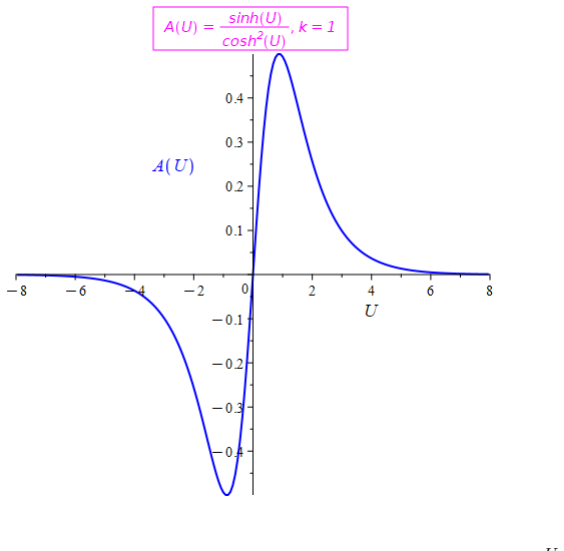
If this is right
- Strong decay of the weighted integrals produces trajectories that approach free outgoing data without residual drift.
- Weaker decay still yields asymptotically free motion except for a constant drift that appears only when outgoing velocity is nonzero.
- Displacement memory remains well-defined and unaffected in the weakly free class.
- The classification can be read directly from the accumulated tidal matrix without reference to coordinates.
- Non-decaying weighted integrals produce motions that never become free at infinity.
Where Pith is reading between the lines
- The same weighted-integral test may supply a practical diagnostic for asymptotic freedom in numerical simulations of more general gravitational-wave spacetimes.
- The velocity-selective nature of the weak-drift correction suggests that memory observables extracted from null geodesics or light signals could remain robust even when massive-particle trajectories are only weakly free.
- Explicit solutions for the three example profiles provide concrete test cases that can be used to benchmark geodesic integrators in wave spacetimes.
Load-bearing premise
The integral form of the transverse geodesic equation correctly encodes the distinction between free and non-free outgoing data solely through weighted integrals of A(U).
What would settle it
A direct numerical integration of the geodesic equation for a profile whose weighted integrals sit exactly at the boundary between the weak and non-free regimes, checking whether the trajectory approaches a linear free motion or retains a persistent deviation.
Figures


read the original abstract
We investigate when plane-wave memory admits standard outgoing free data beyond the idealized sandwich-wave approximation. For a Brinkmann plane wave with profile $A(U)$, the commonly used condition $A(U)|_{U\to\infty}=0$ is not sufficient to guarantee ordinary asymptotically free motion. From the integral form of the transverse geodesic equation, we derive weighted decay criteria which divide the asymptotic dynamics into strongly asymptotically free, weakly asymptotically free, and non-asymptotically free motions. These motions are realized explicitly by the new analytical solutions of three typical examples: a Scarf profile, an inverse-cubic profile, and an inverse-square profile. A surprising feature is that the drift correction in the weakly asymptotically free motion affects only trajectories with nonzero outgoing velocity and therefore does not obstruct displacement memory. We further express the classification in terms of the accumulated tidal matrix, showing that it is an intrinsic curvature effect rather than a coordinate artifact.
Editorial analysis
A structured set of objections, weighed in public.
Referee Report
Summary. The paper investigates asymptotic freedom for geodesics in Brinkmann plane waves with profile A(U). It argues that A(U)→0 at infinity is insufficient and derives weighted integral decay criteria (e.g., ∫U^k |A(U)|dU <∞ for suitable k) from the integral form of the transverse geodesic equation to classify motions as strongly asymptotically free, weakly asymptotically free, or non-asymptotically free. These are realized by new closed-form solutions for a Scarf profile, an inverse-cubic profile, and an inverse-square profile. The classification is re-expressed via the accumulated tidal matrix and shown to be coordinate-independent; a drift term in the weak case affects only trajectories with nonzero outgoing velocity and thus preserves displacement memory.
Significance. If the weighted criteria are rigorously justified beyond the three explicit examples, the work supplies a sharper, intrinsic characterization of outgoing free data in exact plane-wave spacetimes. The explicit solvable cases and the separation of memory from drift are concrete advances that could be used to test numerical or perturbative schemes for gravitational-wave memory.
major comments (2)
- [§3, Eq. (12)] §3, Eq. (12) (Volterra integral form X(U)=a+b(U−U0)−∫(U−s)A(s)X(s)ds): the weighted decay criteria are asserted to classify the asymptotic behavior solely from integrals of A. No Gronwall estimate, contraction-mapping argument, or a-priori bound on X is supplied to show that convergence of the weighted integrals of A controls the unknown X inside the kernel; the three solvable profiles confirm the classification only for those special A, not necessity and sufficiency in general.
- [§4.2] §4.2, statement that the criteria are necessary and sufficient: the derivation appears to treat the integral equation as if the kernel term decouples, but the abstract and the Volterra structure indicate that an iteration or fixed-point argument is required; without it the central claim that the weighted integrals alone divide the dynamics into the three classes rests on the examples rather than a general proof.
minor comments (3)
- [§5] Notation for the accumulated tidal matrix in §5 should be introduced with an explicit integral definition before it is used to re-express the classification.
- [Figure 2] Figure 2 (inverse-square profile) lacks error bars or comparison with the numerical integration of the geodesic equation; a short table of asymptotic coefficients would strengthen the claim.
- [Abstract] The phrase “parameter-free” in the abstract is not used in the body; either remove it or define the sense in which the criteria contain no free parameters.
Simulated Author's Rebuttal
We thank the referee for the careful and constructive report. The comments correctly identify a gap in the general justification of the weighted decay criteria. We address each point below and will strengthen the manuscript accordingly.
read point-by-point responses
-
Referee: [§3, Eq. (12)] §3, Eq. (12) (Volterra integral form X(U)=a+b(U−U0)−∫(U−s)A(s)X(s)ds): the weighted decay criteria are asserted to classify the asymptotic behavior solely from integrals of A. No Gronwall estimate, contraction-mapping argument, or a-priori bound on X is supplied to show that convergence of the weighted integrals of A controls the unknown X inside the kernel; the three solvable profiles confirm the classification only for those special A, not necessity and sufficiency in general.
Authors: We agree that the manuscript would benefit from an explicit general argument. The weighted criteria are motivated directly from the Volterra form by isolating the integral term and examining its convergence, with the three closed-form solutions serving as concrete realizations. To make the claim rigorous, we will add a new subsection (or appendix) that applies a contraction-mapping argument on a suitable weighted Banach space of functions to show that convergence of the weighted integrals of |A| implies X(U) ∼ a + bU at infinity (strongly free case) or the corresponding weak/non-free behaviors. This establishes sufficiency in general; necessity follows by contraposition from the integral equation. revision: yes
-
Referee: [§4.2] §4.2, statement that the criteria are necessary and sufficient: the derivation appears to treat the integral equation as if the kernel term decouples, but the abstract and the Volterra structure indicate that an iteration or fixed-point argument is required; without it the central claim that the weighted integrals alone divide the dynamics into the three classes rests on the examples rather than a general proof.
Authors: The referee is right that the necessity-and-sufficiency statement in §4.2 is currently supported primarily by the explicit solutions and the intrinsic reformulation via the accumulated tidal matrix. We will revise §4.2 to include a short fixed-point/iteration argument (building on the new material added for the first comment) that directly shows the weighted integrability conditions are necessary and sufficient for the three asymptotic classes. The explicit profiles will then be presented as illustrative examples rather than the sole justification. revision: yes
Circularity Check
No circularity; derivation self-contained from geodesic integral form
full rationale
The paper starts from the integral form of the transverse geodesic equation for Brinkmann plane waves and derives weighted decay criteria for asymptotic freedom directly from that equation, classifying motions into strong/weak/non-free categories. Explicit analytical solutions for three profiles (Scarf, inverse-cubic, inverse-square) are used to realize the classes, and the classification is re-expressed via the accumulated tidal matrix as an intrinsic effect. No self-definitional reduction, fitted parameter renamed as prediction, load-bearing self-citation, or ansatz smuggled via prior work appears; the steps remain independent of the target classification and rest on the structure of the Volterra integral equation itself rather than presupposing its asymptotic consequences.
Axiom & Free-Parameter Ledger
axioms (1)
- domain assumption The transverse geodesic equation in Brinkmann plane-wave coordinates admits an integral form that governs asymptotic particle motion
Reference graph
Works this paper leans on
-
[1]
Analytical solution of the motion of a test particle 11
-
[2]
Asymptotic behavior of the test particle 12
-
[3]
Weakly asymptotically free motion 15
Displacement memory effect in Scarf profile 14 B. Weakly asymptotically free motion 15
-
[4]
Analytical solution of the motion of a test particle in the inverse-cubic profile 16
-
[5]
Asymptotic behavior of the test particle in the inverse-cubic profile 17
-
[6]
Non-asymptotically free motion 20
Displacement memory effect in the inverse-cubic profile 19 C. Non-asymptotically free motion 20
-
[7]
Analytical solution of the motion of a test particle 22
-
[8]
+” polarization modes with constant amplitude k. Here we ignore the other “×
Asymptotic behavior of test particle with differentk22 IV. An Intrinsic Physical Perspective: the Geodesic Deviation Equation and the Tidal Matrix24 V. Summary26 Acknowledgments27 References27 A. General integral solution of geodesic equation30 B. Calculations for hypergeometric solution31 2 C. Details of the calculation for the asymptotic behavior in str...
-
[9]
The calculation details are shown in Appendix
Analytical solution of the motion of a test particle For the Scarf profile, the transverse geodesic equation can be written as d2 dU 2 X i(U) + (−1)i+1k sinhU cosh2 U X i(U) = 0.(III.2) By using t= sinhU,(III.3) 11 the above equation becomes [17] (1 +t 2) d2X i dt2 +t dX i dt + (−1)i+1k t 1 +t 2 X i = 0.(III.4) (III.4) can be solved in terms of the follow...
-
[10]
Note that t→ ∞asU→ ∞, we will first study the asymptotic behavior ofX i(t)
Asymptotic behavior of the test particle Now let us study the asymptotic behavior of the test particle whenU→ ∞. Note that t→ ∞asU→ ∞, we will first study the asymptotic behavior ofX i(t). Note that the hypergeometric function satisfies the following two identities [22] 2F(a, b;c;z) = Γ(c)Γ(b−a) Γ(b)Γ(c−a) (−z)−a 2F a,1−c+a; 1−b+a; 1 z +Γ(c)Γ(a−b) Γ(a)Γ(c...
-
[11]
ci − −a i −
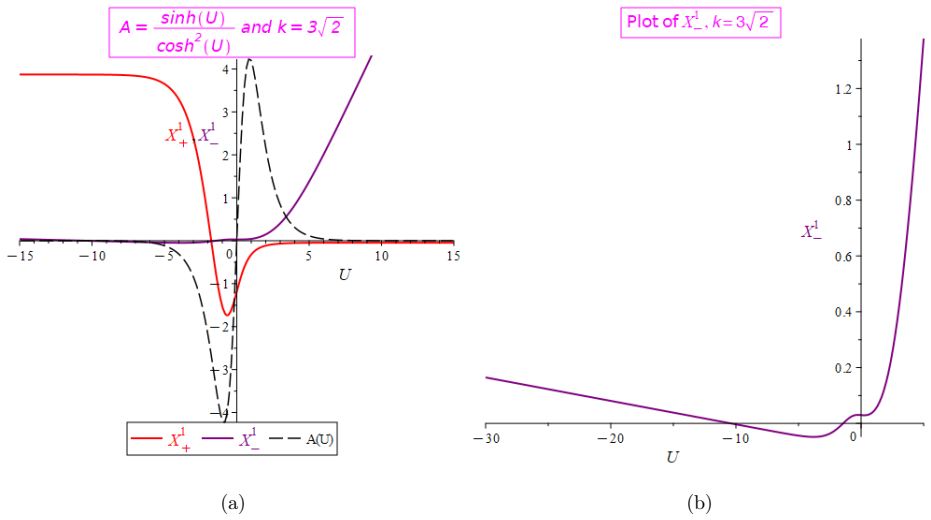
Displacement memory effect in Scarf profile We have so far demonstrated that, in the Scarf profile, the particle motion is strictly free. Nevertheless, a subtle distinction remains in the asymptotic behaviors of the two linearly independent solutions,X i + andX i −. Note that the Gamma functionΓ(x)diverges whenever its argument is a negative integer [23] ...
-
[12]
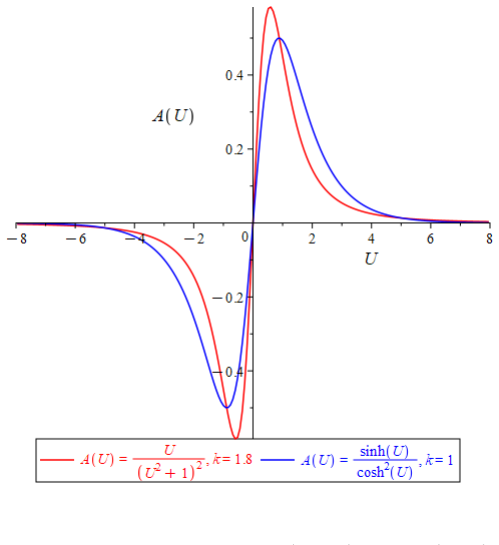
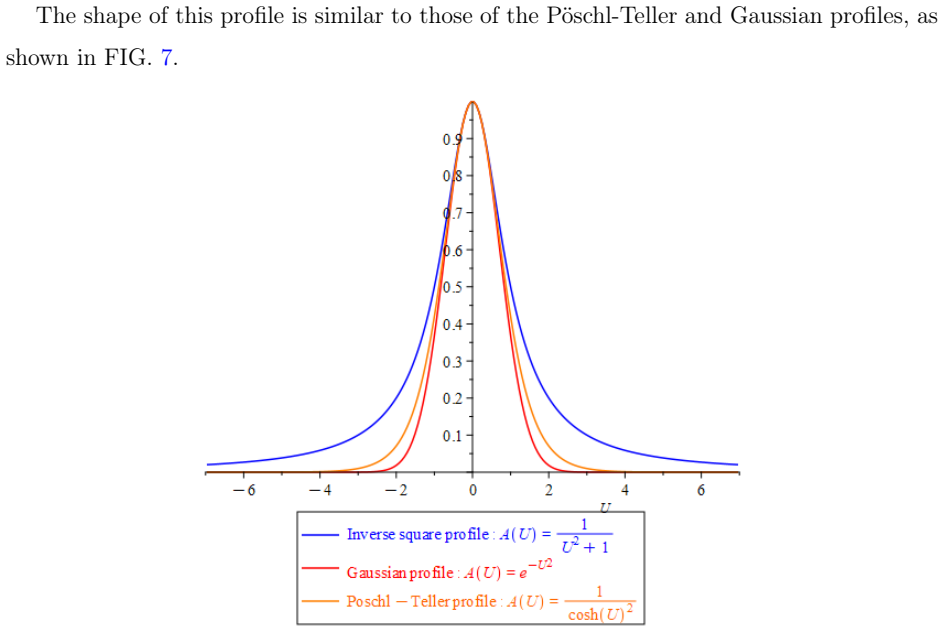
4:This plot shows the shapes of the profiles in(III.26)and in(III.1), they are very similar
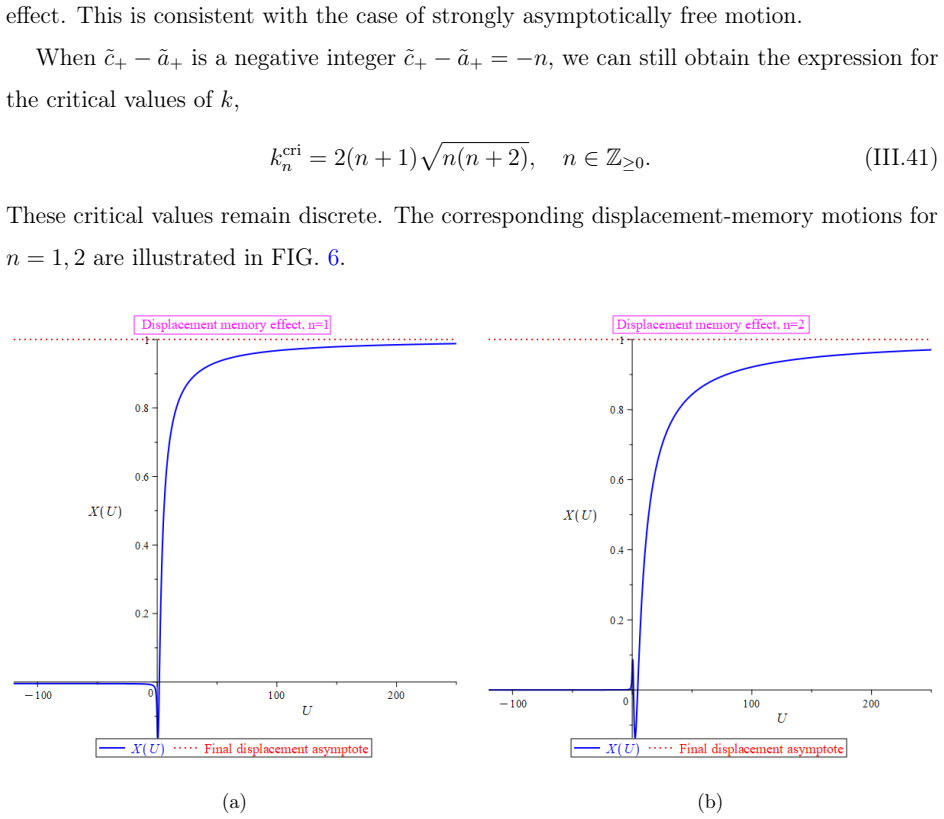
Analytical solution of the motion of a test particle in the inverse-cubic profile Under the inverse-cubic profile in (III.26), the transverse geodesic equation can be written as d2 dU 2 X i(U) + (−1)i+1k U (U 2 + 1)2 X i(U) = 0,(III.27) whose analytical solution can also be obtained by using hypergeometric function X i ± =c 1 X i + +c 2 X i −,(III.28) 16 ...
-
[13]
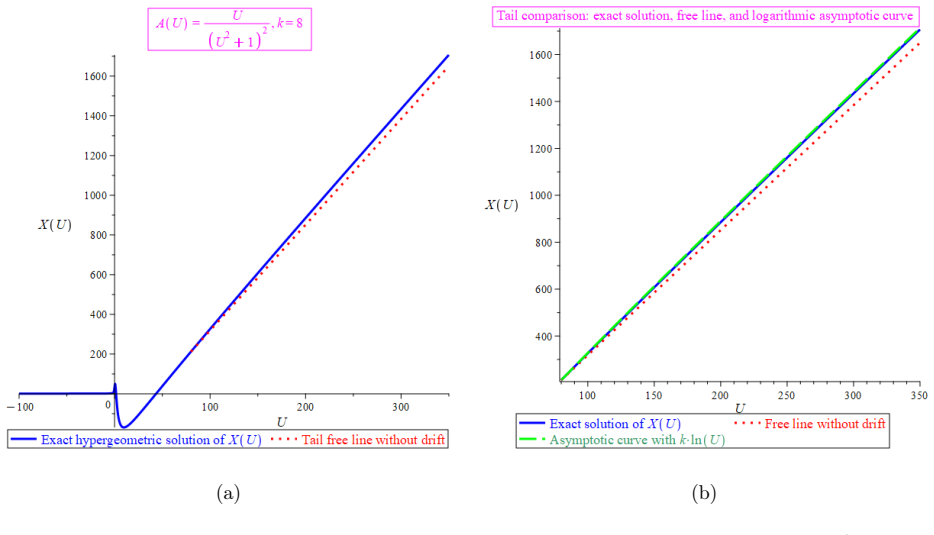
klnU”. FIG. 5 illustrates this asymptotic motion with a drift. Notice that the drift term “klnU
Asymptotic behavior of the test particle in the inverse-cubic profile Now let us study the asymptotic behavior of the test particle whenU→ ∞. For convenience we first setz= 1−IU 2 . Then, the two linearly independent solutions in (III.29) can be written as X i ±(z) = (2−2z) 1∓¯βi 2 (2z) 1+βi 2 F i ±(z).(III.32) By using again the two identities of hyperge...
-
[14]
inverse-square profile
Displacement memory effect in the inverse-cubic profile From (III.37) and (III.34) we know that the leading velocity is related to the Gamma function V i ∝ 1 Γ(˜ci ± −˜ai ±) ,(III.39) This means that we can still exploit the singularity of the Gamma function at negative integer arguments to make the outgoing velocity vanish, while the finite part˜M i ± is...
-
[15]
Analytical solution of the motion of a test particle The transverse geodesic equation under the inverse-square profile (III.42) can be written as d2 dU 2 X i(U) + (−1)i+1 k U 2 + 1X i(U) = 0.(III.43) The solutions of the above equation can also be obtained by using hypergeometric equation X i(U) =c + (U 2 + 1)F i +(U) +c − U(U 2 + 1)F i −(U),(III.44) wher...
-
[16]
free motion
Asymptotic behavior of test particle with differentk By employing (III.10)-(III.11) and using the same technique described in Appendix. C and E, we can directly obtain the final results of asymptotic behavior, as shown in following: lim U→∞ X i(U)∼ C i + U 1+ρi 2 +C i − U 1−ρi 2 ,(−1) i+1k < 1 4 U 1 2 Di + +D i − lnU ,(−1) i+1k= 1 4 U 1 2 h Ei...
-
[17]
Nonlinear nature of gravitation and gravitational wave experiments,
D. Christodoulou, “Nonlinear nature of gravitation and gravitational wave experiments,” Phys. Rev. Lett.67, 1486-1489 (1991) doi:10.1103/PhysRevLett.67.1486
-
[18]
Radiation of gravitational waves by a cluster of super- dense stars,
Y. B. Zel’dovich and A. G. Polnarev, “Radiation of gravitational waves by a cluster of super- dense stars,” Sov. Astron.18, 17 (1974)
1974
-
[19]
Gravitational Memory, BMS Supertranslations and Soft Theorems
A. Strominger and A. Zhiboedov, “Gravitational Memory, BMS Supertranslations and Soft Theorems,” JHEP01, 086 (2016) doi:10.1007/JHEP01(2016)086 [arXiv:1411.5745 [hep-th]]. 27
work page internal anchor Pith review Pith/arXiv arXiv doi:10.1007/jhep01(2016)086 2016
-
[20]
A review of gravitational memory and BMS frame fixing in numerical relativity,
K. Mitman, M. Boyle, L. C. Stein, N. Deppe, L. E. Kidder, J. Moxon, H. P. Pfeiffer, M. A. Scheel, S. A. Teukolsky and W. Throwe,et al.“A review of gravitational memory and BMS frame fixing in numerical relativity,” Class. Quant. Grav.41, no.22, 223001 (2024) doi:10.1088/1361-6382/ad83c2 [arXiv:2405.08868 [gr-qc]]
-
[21]
BMS supertranslations and Weinberg's soft graviton theorem
T. He, V. Lysov, P. Mitra and A. Strominger, “BMS supertranslations and Weinberg’s soft graviton theorem,” JHEP05, 151 (2015) doi:10.1007/JHEP05(2015)151 [arXiv:1401.7026 [hep- th]]
work page internal anchor Pith review Pith/arXiv arXiv doi:10.1007/jhep05(2015)151 2015
-
[22]
Conformal Carroll groups and BMS symmetry
C. Duval, G. W. Gibbons and P. A. Horvathy, “Conformal Carroll groups and BMS symmetry,” Class. Quant. Grav.31, 092001 (2014) doi:10.1088/0264-9381/31/9/092001 [arXiv:1402.5894 [gr-qc]]
work page internal anchor Pith review Pith/arXiv arXiv doi:10.1088/0264-9381/31/9/092001 2014
-
[23]
Carrollian-Holographic Derivation of Gravitational Flux-Balance Laws,
A. Fiorucci, S. Pekar, P. Marios Petropoulos and M. Vilatte, “Carrollian-Holographic Derivation of Gravitational Flux-Balance Laws,” Phys. Rev. Lett.135, no.26, 26 (2025) doi:10.1103/qv17-ks32 [arXiv:2505.00077 [hep-th]]
-
[24]
Memory and supertranslations on plane wave spacetimes: an on-shell perspective,
A. Cristofoli and S. Klisch, “Memory and supertranslations on plane wave spacetimes: an on-shell perspective,” JHEP02, 230 (2026) doi:10.1007/JHEP02(2026)230 [arXiv:2501.14480 [hep-th]]
-
[25]
The Memory Effect for Plane Gravitational Waves
P. M. Zhang, C. Duval, G. W. Gibbons and P. A. Horvathy, “The Memory Effect for Plane Gravitational Waves,” Phys. Lett. B772, 743-746 (2017) doi:10.1016/j.physletb.2017.07.050 [arXiv:1704.05997 [gr-qc]]
work page internal anchor Pith review Pith/arXiv arXiv doi:10.1016/j.physletb.2017.07.050 2017
-
[26]
Soft Gravitons & the Memory Effect for Plane Gravitational Waves
P. M. Zhang, C. Duval, G. W. Gibbons and P. A. Horvathy, “Soft gravitons and the memory effect for plane gravitational waves,” Phys. Rev. D96, no.6, 064013 (2017) doi:10.1103/PhysRevD.96.064013 [arXiv:1705.01378 [gr-qc]]
work page internal anchor Pith review Pith/arXiv arXiv doi:10.1103/physrevd.96.064013 2017
-
[27]
M. Rosselló-Sastre, S. Husa and S. Bera, “Waveform model for the missing quadrupole mode from black hole coalescence: Memory effect and ringdown of the (ℓ=2,m=0) spher- ical harmonic,” Phys. Rev. D110, no.8, 084074 (2024) doi:10.1103/PhysRevD.110.084074 [arXiv:2405.17302 [gr-qc]]
-
[28]
M. Favata, “Post-Newtonian corrections to the gravitational-wave memory for quasi-circular, inspiralling compact binaries,” Phys. Rev. D80, 024002 (2009) doi:10.1103/PhysRevD.80.024002 [arXiv:0812.0069 [gr-qc]]
work page internal anchor Pith review Pith/arXiv arXiv doi:10.1103/physrevd.80.024002 2009
-
[29]
P. M. Zhang, C. Duval, G. W. Gibbons and P. A. Horvathy, JCAP05, 030 (2018) doi:10.1088/1475-7516/2018/05/030 [arXiv:1802.09061 [gr-qc]]. 28
work page internal anchor Pith review Pith/arXiv arXiv doi:10.1088/1475-7516/2018/05/030 2018
-
[30]
Memory effect for generalized modes in pp-waves spacetime,
F. L. Carneiro, H. P. de Carvalho, M. P. Lobo and L. A. Cabral, “Memory effect for generalized modes in pp-waves spacetime,” [arXiv:2603.27042 [gr-qc]]
-
[31]
Displacement within velocity effect in gravitational wave memory,
P. M. Zhang and P. A. Horvathy, “Displacement within velocity effect in gravitational wave memory,” Annals Phys.470, 169784 (2024) doi:10.1016/j.aop.2024.169784 [arXiv:2405.12928 [gr-qc]]
-
[32]
Displacement memory for flyby,
P. M. Zhang, Q. L. Zhao, J. Balog and P. A. Horvathy, “Displacement memory for flyby,” Annals Phys.473, 169890 (2025) doi:10.1016/j.aop.2024.169890 [arXiv:2407.10787 [gr-qc]]
-
[33]
Flyby-induced displacement effect: An analytic solution,
P. M. Zhang, Z. K. Silagadze and P. A. Horvathy, “Flyby-induced displacement effect: An analytic solution,” Phys. Lett. B868(2025), 139687 doi:10.1016/j.physletb.2025.139687 [arXiv:2502.01326 [gr-qc]]
-
[34]
All Order Gravitational Wave- forms from Scattering Amplitudes,
T. Adamo, A. Cristofoli, A. Ilderton and S. Klisch, “All Order Gravitational Wave- forms from Scattering Amplitudes,” Phys. Rev. Lett.131, no.1, 011601 (2023) doi:10.1103/PhysRevLett.131.011601 [arXiv:2210.04696 [hep-th]]
-
[35]
Approximate Models for Gravitational Memory
Q. L. Zhao, P. M. Zhang, M. Elbistan and P. A. Horvathy, “Approximate Models for Gravita- tional Memory,” [arXiv:2603.15442 [gr-qc]]
work page internal anchor Pith review Pith/arXiv arXiv
-
[36]
Globally defined Carroll symmetry of grav- itational waves,
M. Elbistan, P. M. Zhang and P. Horvathy, “Globally defined Carroll symmetry of grav- itational waves,” Nucl. Phys. B1024, 117354 (2026) doi:10.1016/j.nuclphysb.2026.117354 [arXiv:2510.16762 [gr-qc]]
-
[37]
An Introduction to Hypergeometric Functions,
D. Duverney, “An Introduction to Hypergeometric Functions,” Springer, 2024, ISBN 978-3- 031-65143-4, 978-3-031-65146-5, 978-3-031-65144-1 doi:10.1007/978-3-031-65144-1
-
[38]
N. Michel, M. V. Stoitsov, “Fast computation of the Gauss hypergeometric function with all its parameters complex with application to the P"oschl–Teller–Ginocchio potential wave functions,” Comput. Phys. Commun.178(2008), 535–551 doi:10.1016/j.cpc.2007.11.007 [arXiv:0708.0116 [math-ph]]
work page internal anchor Pith review Pith/arXiv arXiv doi:10.1016/j.cpc.2007.11.007 2008
-
[39]
NIST Digital Library of Mathematical Functions,https://dlmf.nist.gov/, Release 1.2.6 of 2026-03-15. F. W. J. Olver, A. B. Olde Daalhuis, D. W. Lozier, B. I. Schneider, R. F. Boisvert, C. W. Clark, B. R. Miller, B. V. Saunders, H. S. Cohl, and M. A. McClain, eds
2026
-
[40]
Persistent gravitational wave observables: Nonlinear plane wave spacetimes,
É. É. Flanagan, A. M. Grant, A. I. Harte and D. A. Nichols, “Persistent gravitational wave observables: Nonlinear plane wave spacetimes,” Phys. Rev. D101, no.10, 104033 (2020) doi:10.1103/PhysRevD.101.104033 [arXiv:1912.13449 [gr-qc]]
-
[41]
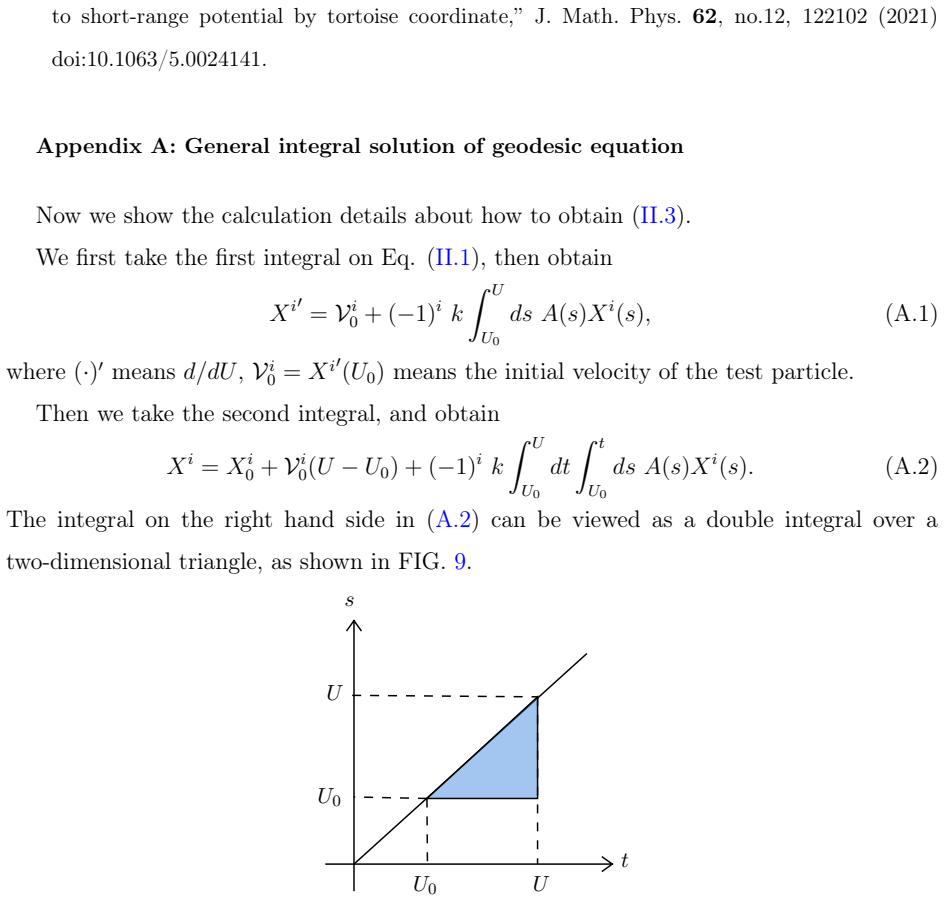
W. D. Li and W. S. Dai, “Long-range potential scattering: Converting long-range potential 29 to short-range potential by tortoise coordinate,” J. Math. Phys.62, no.12, 122102 (2021) doi:10.1063/5.0024141. Appendix A: General integral solution of geodesic equation Now we show the calculation details about how to obtain (II.3). We first take the first integ...
discussion (0)
Sign in with ORCID, Apple, or X to comment. Anyone can read and Pith papers without signing in.