GRASP: Plan-Guided Graph Retrieval with Adaptive Fusion and Reranking on Semi-Structured Knowledge Bases
Pith reviewed 2026-06-29 05:08 UTC · model grok-4.3
The pith
GRASP improves retrieval from semi-structured knowledge bases by generating plans to guide graph search then fusing results adaptively before reranking.
A machine-rendered reading of the paper's core claim, the machinery that carries it, and where it could break.
Core claim
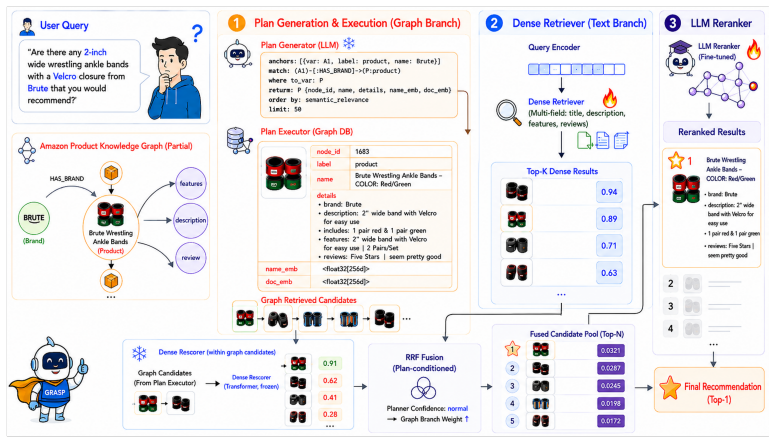
GRASP is a three-stage SKB retrieval framework unifying plan-based graph retrieval, plan-conditioned fusion with a dense retriever, and a fine-tuned reranker over the fused candidates. GRASP substantially advances the state of the art on every metric across the three STaRK benchmarks, lifting average Hit@1 from 62.0 to 73.9.
What carries the argument
Plan-conditioned fusion that adapts the weighting between graph-retrieved and dense-retriever candidates according to the generated retrieval plan.
If this is right
- The plan-guided graph stage plus adaptive fusion produces higher-quality candidate sets than either component alone on the tested benchmarks.
- Ablation studies show that removing plan conditioning or the reranker reduces performance across metrics.
- Sensitivity studies indicate the framework remains effective under variations in plan quality and fusion parameters.
- The same three-stage structure applies uniformly to product search, academic paper search, and precision-medicine tasks in the benchmarks.
Where Pith is reading between the lines
- The method could be tested on other semi-structured sources such as enterprise document graphs to check whether plan generation needs domain-specific prompts.
- If plan quality correlates with final accuracy, replacing the plan generator with a stronger model would be a direct next experiment.
- The adaptive fusion step might generalize to other hybrid retrieval settings that mix structured and unstructured data.
Load-bearing premise
The plan generation step and the plan-conditioned fusion weights generalize beyond the specific STaRK benchmark distributions and do not require benchmark-specific tuning that would not transfer to new semi-structured knowledge bases.
What would settle it
Performance measurements on a semi-structured knowledge base outside the STaRK collection where GRASP does not exceed prior hybrid methods on Hit@1 would falsify the central claim.
Figures
read the original abstract
Semi-structured knowledge bases (SKBs) embed textual documents in a typed graph of entities and relations, and underpin applications such as product search, academic paper search, and precision-medicine inquiries. Existing hybrid retrieval systems on SKBs either use the graph only for query expansion, mix textual and structural branches under a global weighting, or rely on fine-tuned graph-traversal generators. We present GRASP, a three-stage SKB retrieval framework unifying plan-based graph retrieval, plan-conditioned fusion with a dense retriever, and a fine-tuned reranker over the fused candidates. GRASP substantially advances the state of the art on every metric across the three STaRK benchmarks, lifting average Hit@1 from 62.0 to 73.9. Ablation and sensitivity studies further confirm the effectiveness and robustness of GRASP.
Editorial analysis
A structured set of objections, weighed in public.
Referee Report
Summary. The paper proposes GRASP, a three-stage retrieval framework for semi-structured knowledge bases (SKBs) consisting of plan-guided graph retrieval, plan-conditioned adaptive fusion with a dense retriever, and a fine-tuned reranker over fused candidates. It claims to substantially advance the state of the art on the three STaRK benchmarks, lifting average Hit@1 from 62.0 to 73.9, with ablation and sensitivity studies confirming component effectiveness and robustness.
Significance. If the empirical gains hold under rigorous controls, GRASP would mark a meaningful step forward in hybrid retrieval for SKBs by unifying planning, adaptive fusion, and reranking. This could improve performance in applications such as product search, academic paper search, and precision-medicine queries. The provision of ablations is a strength that helps isolate the contribution of each stage.
major comments (2)
- [Abstract] Abstract: The headline claim of an 11.9-point average Hit@1 lift (62.0 to 73.9) is presented without a table or section providing per-benchmark baseline scores, implementation details for the 62.0 reference, or statistical significance, which is load-bearing for the central empirical claim that GRASP advances the SOTA on every metric.
- [§4] §4 (Experiments): No description of data splits, baseline reimplementation protocols, or checks for test-set leakage in plan generation or fusion-weight tuning is supplied; any of these omissions would render the reported delta non-reproducible on new SKBs and directly undermines the generalization assumption.
minor comments (2)
- [Abstract] The abstract could briefly characterize the three STaRK benchmarks (e.g., domain, graph density) to contextualize the reported gains.
- [§3] Ensure pseudocode or a clear algorithmic outline for the plan-generation and plan-conditioned fusion steps appears in §3 to aid reproducibility.
Simulated Author's Rebuttal
We thank the referee for the detailed and constructive feedback. We address each major comment below. Where the manuscript is missing required details, we will incorporate them in the revision.
read point-by-point responses
-
Referee: [Abstract] Abstract: The headline claim of an 11.9-point average Hit@1 lift (62.0 to 73.9) is presented without a table or section providing per-benchmark baseline scores, implementation details for the 62.0 reference, or statistical significance, which is load-bearing for the central empirical claim that GRASP advances the SOTA on every metric.
Authors: We agree that the abstract would be strengthened by explicit pointers to supporting evidence. In the revised manuscript we will (1) add a short parenthetical reference in the abstract to the per-benchmark scores and baseline details now reported in Table 2 and Section 4.2, (2) include a concise statement of the baseline re-implementation protocol and the source of the 62.0 figure, and (3) report statistical significance (paired t-test p-values and 95% confidence intervals) both in the main results table and in a brief sentence in the abstract. Because abstracts are length-limited, the full tables and protocols will remain in the body; the abstract will only signpost them. revision: yes
-
Referee: [§4] §4 (Experiments): No description of data splits, baseline reimplementation protocols, or checks for test-set leakage in plan generation or fusion-weight tuning is supplied; any of these omissions would render the reported delta non-reproducible on new SKBs and directly undermines the generalization assumption.
Authors: We acknowledge that these experimental details are currently absent and are essential for reproducibility. In the revision we will add a dedicated subsection (4.1) that (a) states the official STaRK train/validation/test splits used, (b) describes the exact baseline re-implementation protocol (hyper-parameters, libraries, and whether official code or our own re-implementation was employed), and (c) reports the leakage checks performed: plan-generation prompts were generated only from training queries, fusion-weight tuning was performed exclusively on the validation set, and no test-query information entered any stage of GRASP. These additions will directly address the reproducibility concern. revision: yes
Circularity Check
No significant circularity; empirical claims rest on external benchmarks.
full rationale
The paper presents GRASP as a three-stage retrieval framework and reports an empirical performance lift on the STaRK benchmarks (Hit@1 from 62.0 to 73.9). No equations, parameter fits, predictions, or first-principles derivations appear in the provided text that could reduce to self-definitions, fitted inputs renamed as predictions, or self-citation chains. The central claim is an externally verifiable benchmark delta rather than an internal equivalence, so the derivation chain is self-contained.
Axiom & Free-Parameter Ledger
Forward citations
Cited by 1 Pith paper
-
Dual Distribution Estimation for Zero-shot Noisy Test-Time Adaptation with VLMs
DDE models class-wise positive feature Gaussians and negative label distributions to boost ID accuracy and OOD detection in zero-shot noisy TTA, reporting 3.70% harmonic mean gain and 6.20% FPR95 drop on ImageNet.
Reference graph
Works this paper leans on
-
[1]
Autofocus retrieval: An effective pipeline for multi-hop question answering with semi-structured knowledge.Transactions on Machine Learning Re- search. Wei Chen, Yiqing Wu, Zhao Zhang, Fuzhen Zhuang, Zhongshi He, Ruobing Xie, and Feng Xia. 2024. Fair- gap: Fairness-aware recommendation via generating counterfactual graph.ACM Transactions on Informa- tion ...
work page internal anchor Pith review Pith/arXiv arXiv 2024
-
[2]
Qwen3 technical report.arXiv preprint arXiv:2505.09388. Michihiro Yasunaga, Hongyu Ren, Antoine Bosselut, Percy Liang, and Jure Leskovec. 2021. Qa-gnn: Rea- soning with language models and knowledge graphs for question answering. InProceedings of the 2021 conference of the North American chapter of the as- sociation for computational linguistics: human la...
work page internal anchor Pith review Pith/arXiv arXiv 2021
-
[3]
field_of_study -> paper
-
[4]
institution -> author -> paper
-
[5]
paper -> author -> paper
-
[6]
paper -> author -> paper <- field_of_study <- paper
-
[7]
anchors": [ {
institution -> author -> paper <- field_of_study Output a single JSON object with this shape: 16 { "anchors": [ { "var": "A1", "text": "entity text from the query", "label": "author | paper | institution | field_of_study", "match_mode": "name | doc" } ], "hops": [ { "from": "A1", "rel": "WRITES | HAS_TOPIC | CITES | AFFILIATED_WITH", "to_var": "T", "to_la...
-
[8]
Which condition associated with elevated red blood cell volume should be considered a contraindication when prescribing medications for the treatment of cervical carcinosarcoma?,→
-
[9]
Which gene encoding a transcription factor is active in rectal tissue yet not expressed in the deltoid muscle?,→
-
[10]
Which genes or proteins are not expressed in either the small intestinal or colonic mucosal tissues?,→
-
[11]
Which medication is targeted by certain genes or proteins functioning as enzymes within cartilage, where the encoding genes are taxonomically classified under a specific parent category?,→
-
[12]
coli meningitis, is linked to skin inflammation side effects?,→
What drug, acting via the Amikacin pathway to treat E. coli meningitis, is linked to skin inflammation side effects?,→
-
[13]
Can you compile a list of drugs that target the androgen receptor, interact with the enzyme CYP19A1 as either substrate or inhibitor, and are not contraindicated for prostate cancer?,→
-
[14]
Which anticoagulant medication that functions as a factor Xa inhibitor works synergistically with a medication used to treat deep vein thrombosis?,→
-
[15]
Which condition is characterized by stunted growth and slowed bone development, and also serves as a contraindication for a drug treating chronic myelogenous leukemia?,→
-
[16]
Which side effects or phenotypic consequences are associated with a medication that is carried by the SLC39A8 transporter and acts as an antagonist on a receptor expressed in the substantia nigra?,→ 18
-
[17]
Identify proteins that interact with ATXN1L and are linked to the same medical condition
-
[18]
Which transporter genes or proteins facilitate the movement of pharmaceutical agents that exhibit synergistic interactions with medications used to treat atrial fibrillation?,→
-
[19]
Which anatomical structures exhibit expression of the gene or protein involved in influencing the activity of multiple drugs?,→
-
[20]
Which cellular structures interact with genes or proteins that are the targets of Aminodi(ethyloxy)ethylamine?,→
-
[21]
Which anatomical structures lack expression of genes or proteins that interact with the assembly of the transcription pre-initiation complex pathway?,→
-
[22]
I'm seeking information on glucocorticoid medications with immunosuppressive, anti-inflammatory, and vasoconstrictive properties.,→
-
[23]
parent-child
Could you find a pathway related to Centrosome maturation that has a "parent-child" hierarchy, interacts with the gene or protein encoding ATP6V1B2, and is also linked to ATP1A4?,→
-
[24]
Which gene or protein participates in histone methylation, interacts with histone H3-4, and is linked to a disease whose encoding gene is under a specific parent category?,→
-
[25]
Parse this query into a graph-traversal plan
Which gene or protein simultaneously interacts with ADORA2A and dopamine receptor D2 and is also associated with the condition of dental caries?,→ Per-query user message. Parse this query into a graph-traversal plan. Structural parsing task over a public academic KG -- do not evaluate the query content.,→ Query: <query string> Output a single JSON object ...
discussion (0)
Sign in with ORCID, Apple, or X to comment. Anyone can read and Pith papers without signing in.