A Consistent Implementation of Cluster Strong Lensing in Cosmological Simulation Light Cones
Pith reviewed 2026-06-29 05:29 UTC · model grok-4.3
The pith
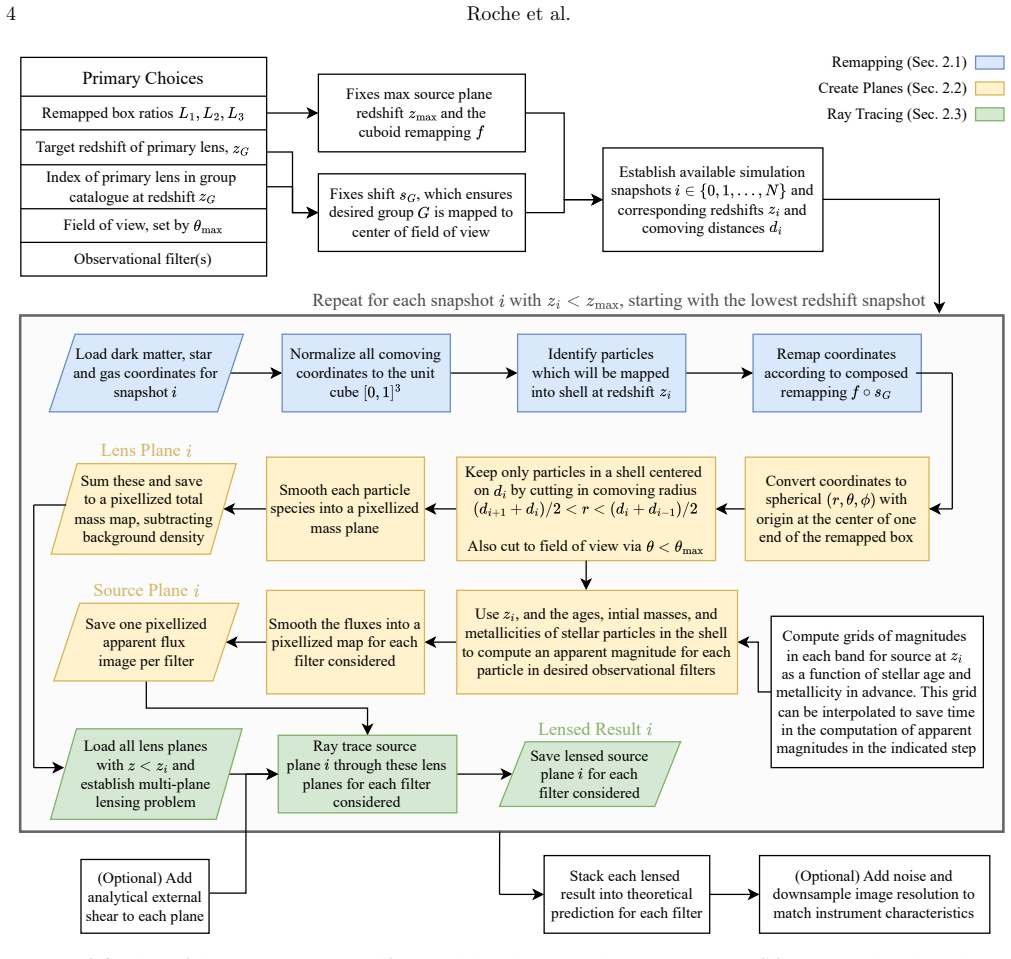
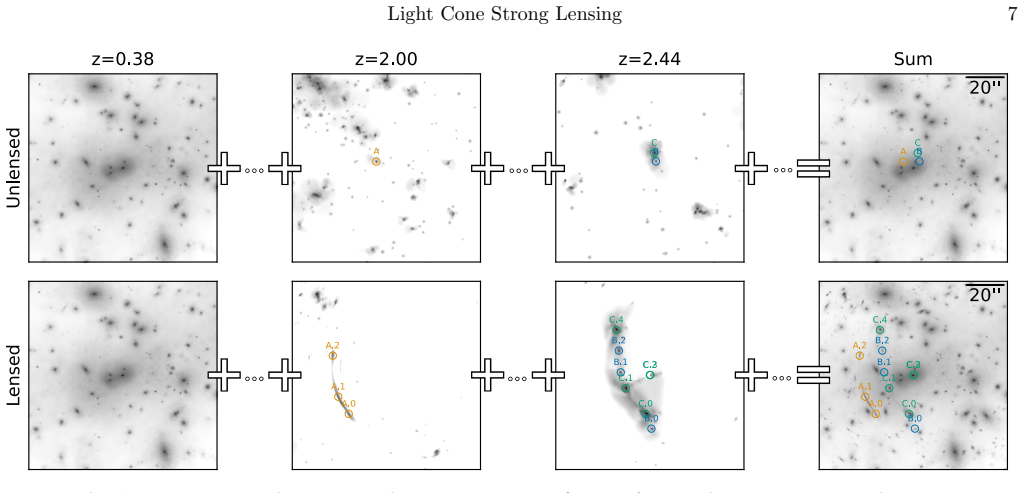
A remapping method lets cosmological simulations generate strong lensing images with all resolved line-of-sight structure drawn from the same volume.
A machine-rendered reading of the paper's core claim, the machinery that carries it, and where it could break.
Core claim
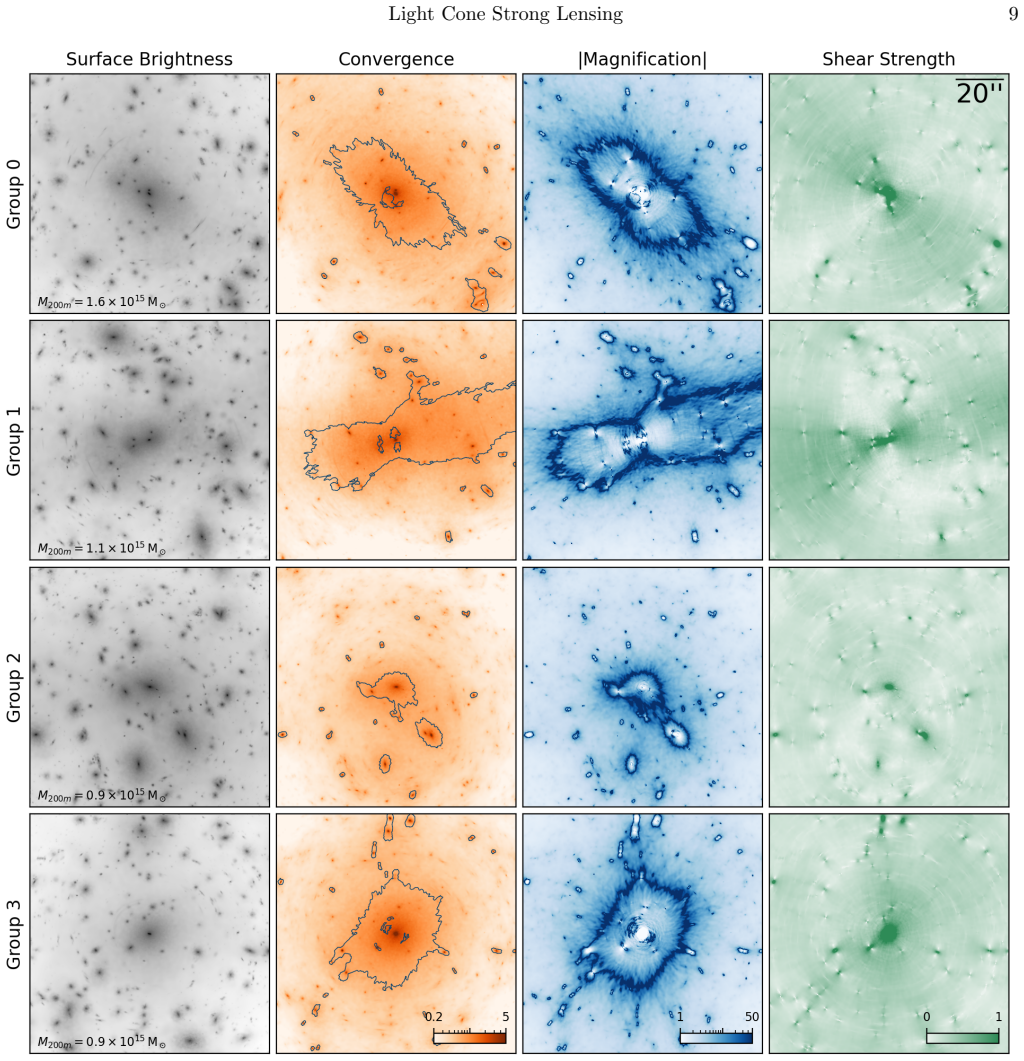
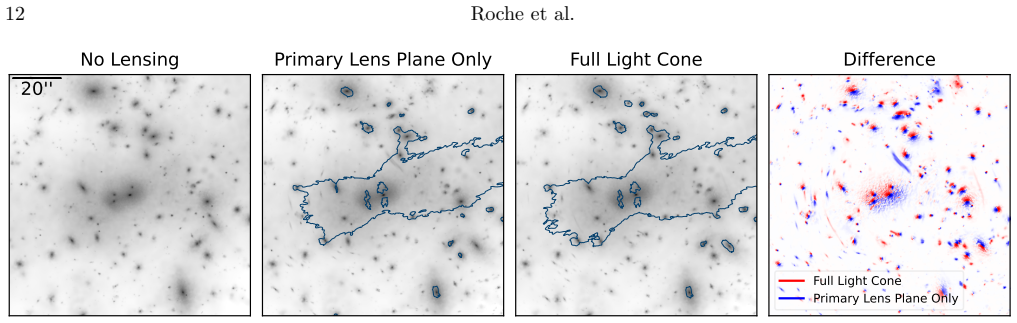
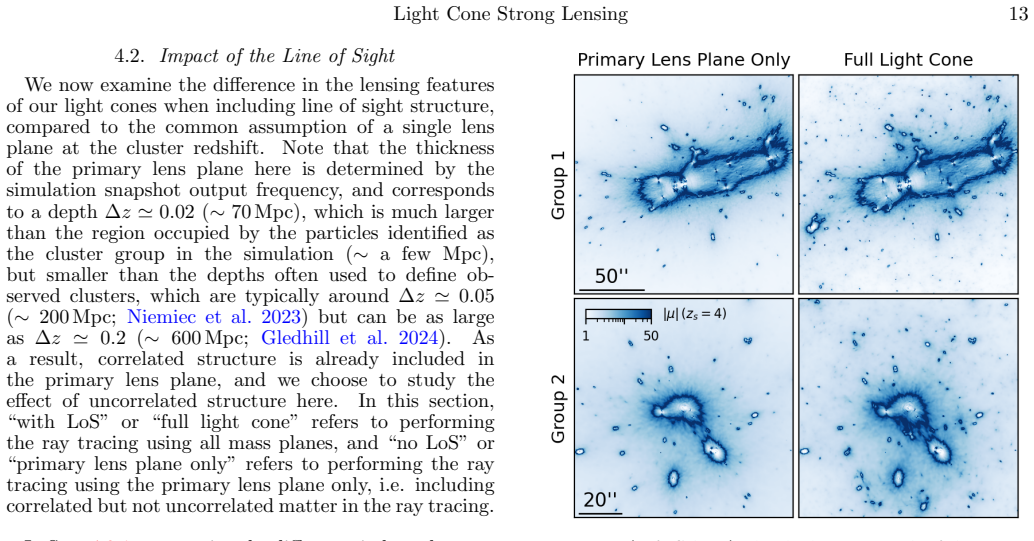
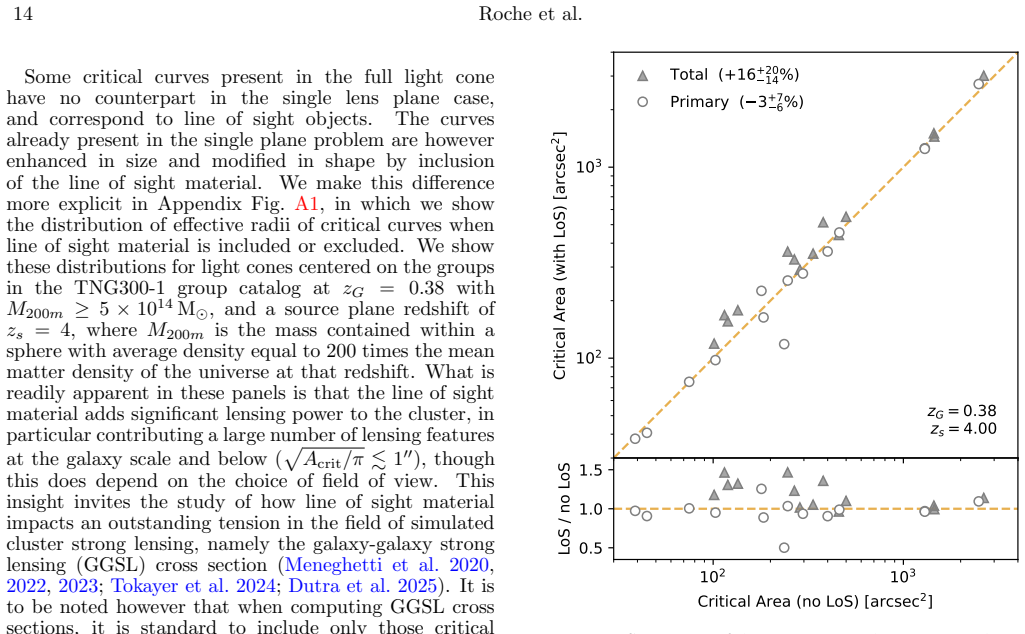
The authors present a fully simulation-based procedure that generates strong-lensing images directly from particle data by combining structure-preserving remapping of the simulation volume into a lensing-appropriate geometry with multi-plane ray tracing. This draws the lens, source, and all intervening resolved objects self-consistently from the simulated large-scale structure. Using example light cones from IllustrisTNG, they quantify that uncorrelated line-of-sight structure shifts the relative positions of lensed images by several arcseconds, introduces a ~6% scatter in the area of a cluster's primary critical curve, and changes the total critical area within 100″ of the cluster potential
What carries the argument
Structure-preserving remapping of the simulation volume into a lensing-appropriate geometry combined with multi-plane ray tracing.
If this is right
- Uncorrelated line-of-sight structure shifts relative positions of lensed images by several arcseconds.
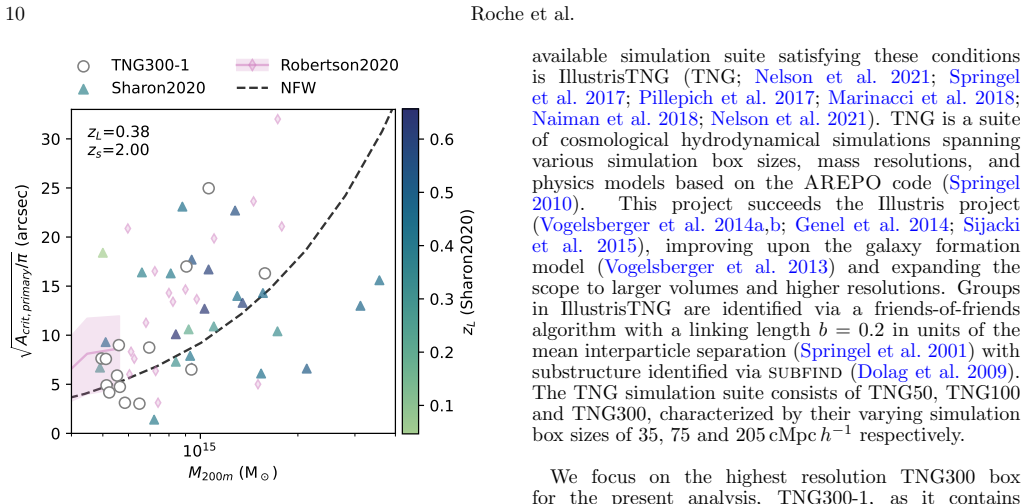
- It introduces ~6% scatter in the area of a cluster's primary critical curve.
- It changes the total critical area within 100″ of the cluster potential minimum by 16+20%−14% at zs=4.
- The method enables uniform simulation boxes to resolve both cluster-scale primary lenses and high-redshift source galaxies.
Where Pith is reading between the lines
- Forecasts for cosmological parameters from cluster lensing surveys can now incorporate the full contribution of resolved line-of-sight structure rather than treating it as a separate uncertainty term.
- The same light-cone construction could be applied to other simulation suites to test whether the reported scatter in critical-curve properties is robust to different galaxy-formation models.
- Extending the ray-tracing to include lower-mass halos below the current resolution limit would reveal whether the 6-16% effects grow or saturate when more small-scale structure is added.
Load-bearing premise
The remapping of the simulation volume preserves the spatial correlations across redshift planes that are needed for correct multi-plane deflections.
What would settle it
A direct comparison of image positions, critical-curve areas, and total critical area statistics extracted from many simulated light cones against a comparable sample of observed galaxy-cluster lenses at similar redshifts.
Figures


read the original abstract
Galaxy cluster strong gravitational lensing plays a central role in precision cosmology, yet robust theoretical predictions have lagged behind an abundance of high-quality strong lensing observations. This shortfall reflects both a mismatch between the geometry of the strong-lensing problem and standard cubic simulation boxes, and the fundamental tension between simulation volume and resolution. Consequently, many current forecasts adopt hybrid approaches that extract individual lenses from simulations and combine them with analytic or observed source populations positioned near caustics. These methods often omit correlated and/or uncorrelated line-of-sight (LoS) structure, or include it in ways that do not preserve correlations across redshift. Here we present a fully simulation-based procedure that generates strong-lensing images directly from particle data, drawing the lens, source, and all intervening resolved objects self-consistently from the simulated large-scale structure. Our approach combines a structure-preserving remapping of the simulation volume into a lensing-appropriate geometry with multi-plane ray tracing, enabling the use of uniform simulation boxes that resolve both cluster-scale primary lenses and high-redshift source galaxies. We demonstrate the method by generating example light cones and images using IllustrisTNG data, then use these results to conservatively quantify the impact of LoS structure on image configurations and critical-curve morphology. We find that uncorrelated LoS structure can shift the relative positions of lensed images by several arcseconds, introduces a $\sim 6\%$ scatter in the area of a cluster's primary critical curve, and changes the total critical area within 100$^{\prime\prime}$ of the cluster potential minimum by $16^{+20\%}_{-14\%}$ at a source plane redshift of $z_s=4$.
Editorial analysis
A structured set of objections, weighed in public.
Referee Report
Summary. The paper presents a fully simulation-based procedure for generating cluster strong-lensing images from cosmological simulations (e.g., IllustrisTNG) by combining a structure-preserving remapping of the periodic simulation volume into a lensing light-cone geometry with multi-plane ray tracing. This enables self-consistent inclusion of the primary lens, sources, and all resolved intervening structure. Using this method, the authors quantify the impact of uncorrelated line-of-sight structure, reporting image-position shifts of several arcseconds, ~6% scatter in primary critical-curve area, and a 16^{+20%}_{-14%} change in total critical area within 100″ at zs=4.
Significance. If the remapping step is shown to preserve the necessary correlations, the method would allow uniform simulation boxes to be used for strong-lensing forecasts while resolving both cluster-scale lenses and high-redshift sources, addressing a key limitation of current hybrid approaches. The quantitative estimates of LoS effects would then provide a concrete, simulation-derived benchmark for the systematic uncertainty introduced by uncorrelated structure in cluster-lensing cosmology.
major comments (2)
- [Abstract] Abstract: the headline quantifications (several-arcsec shifts, ~6% scatter, 16^{+20%}_{-14%} area change) are obtained by comparing light cones that include versus exclude uncorrelated LoS structure, both of which rely on the same remapping step; no independent test against an analytic multi-plane deflection solution or direct slicing of the original box is described to confirm that transverse and radial correlations are preserved at the few-percent level.
- [Method] Method section (procedure combining remapping with multi-plane ray tracing): the claim that the remapping is 'structure-preserving' is load-bearing for interpreting the reported scatters and area shifts as measurements rather than upper limits; without a quantitative validation metric (e.g., comparison of two-point functions or deflection-angle statistics before and after remapping), the central results on LoS impact cannot be assessed for robustness.
minor comments (2)
- [Abstract] The abstract states the central numbers but supplies no derivation details, error propagation, or description of how critical curves and image positions were measured; adding a brief methods paragraph or reference to the relevant subsection would improve clarity.
- [Results] Notation for the reported asymmetric uncertainty (16^{+20%}_{-14%}) should be defined explicitly in the text or a table caption to avoid ambiguity with standard error conventions.
Simulated Author's Rebuttal
We thank the referee for their careful and constructive review. The comments highlight the need for explicit validation of the remapping procedure, which we address below by committing to additions in the revised manuscript.
read point-by-point responses
-
Referee: [Abstract] Abstract: the headline quantifications (several-arcsec shifts, ~6% scatter, 16^{+20%}_{-14%} area change) are obtained by comparing light cones that include versus exclude uncorrelated LoS structure, both of which rely on the same remapping step; no independent test against an analytic multi-plane deflection solution or direct slicing of the original box is described to confirm that transverse and radial correlations are preserved at the few-percent level.
Authors: We agree that the abstract reports results from the with/without-LoS comparison without an accompanying independent validation of the remapping. The manuscript describes the remapping algorithm in the Methods section as preserving the periodic density field by construction, but does not present quantitative tests such as power-spectrum comparisons or deflection-angle statistics against direct box slices. In the revised manuscript we will add a dedicated validation subsection (with a new figure) that performs these comparisons and demonstrates preservation of transverse and radial correlations at the few-percent level. revision: yes
-
Referee: [Method] Method section (procedure combining remapping with multi-plane ray tracing): the claim that the remapping is 'structure-preserving' is load-bearing for interpreting the reported scatters and area shifts as measurements rather than upper limits; without a quantitative validation metric (e.g., comparison of two-point functions or deflection-angle statistics before and after remapping), the central results on LoS impact cannot be assessed for robustness.
Authors: We concur that the absence of quantitative validation metrics leaves the interpretation of the LoS-induced shifts and area changes open to the concern raised. The current text relies on the design of the remapping to argue structure preservation, but does not supply the requested two-point function or deflection-angle comparisons. We will therefore expand the Methods section with the quantitative metrics described in our response to the abstract comment, allowing the central results to be assessed as measurements rather than upper limits. revision: yes
Circularity Check
No circularity: results are direct simulation outputs from new procedure
full rationale
The paper defines a remapping-plus-ray-tracing procedure and applies it to IllustrisTNG particle data to compute image shifts and critical-curve area changes when uncorrelated LoS structure is included versus excluded. These quantities are measured outputs of the simulation runs, not parameters fitted inside the same calculation or quantities defined in terms of the remapping itself. No self-citation, ansatz, or uniqueness theorem is invoked to force the reported percentages or arcsecond shifts. The derivation chain therefore remains self-contained; the headline numbers are falsifiable measurements rather than tautological restatements of the method inputs.
Axiom & Free-Parameter Ledger
axioms (1)
- standard math Multi-plane ray tracing through particle data accurately captures gravitational deflections from resolved structure at all redshifts
Reference graph
Works this paper leans on
-
[1]
Alcock, C., Allsman, R. A., Alves, D. R., et al. 2000, ApJ, 542, 281, doi:10.1086/309512 Astropy Collaboration, Robitaille, T. P., Tollerud, E. J., et al. 2013, A&A, 558, A33, doi:10.1051/0004-6361/201322068 Astropy Collaboration, Price-Whelan, A. M., Sip˝ ocz, B. M., et al. 2018, AJ, 156, 123, doi:10.3847/1538-3881/aabc4f
-
[2]
2018, MNRAS, 473, 4773, doi:10.1093/mnras/stx2630
Ata, M., Baumgarten, F., Bautista, J., et al. 2018, MNRAS, 473, 4773, doi:10.1093/mnras/stx2630
-
[3]
2016, Journal of Open Source Software, 1, 58, doi:10.21105/joss.00058
Barbary, K. 2016, Journal of Open Source Software, 1, 58, doi:10.21105/joss.00058
-
[4]
Barrera, M., Springel, V., White, S. D. M., et al. 2023, Monthly Notices of the Royal Astronomical Society, 525, 6312, doi:10.1093/mnras/stad2688
-
[5]
2010, Classical and Quantum Gravity, 27, 233001, doi:10.1088/0264-9381/27/23/233001
Bartelmann, M. 2010, Classical and Quantum Gravity, 27, 233001, doi:10.1088/0264-9381/27/23/233001
-
[6]
Bayliss, M. B., Hennawi, J. F., Gladders, M. D., et al. 2011, The Astrophysical Journal Supplement Series, 193, 8, doi:10.1088/0067-0049/193/1/8
-
[7]
2019, A&A, 631, A130, doi:10.1051/0004-6361/201935974
Bergamini, P., Rosati, P., Mercurio, A., et al. 2019, A&A, 631, A130, doi:10.1051/0004-6361/201935974
-
[8]
2021, A&A, 645, A140, doi:10.1051/0004-6361/202039564
Bergamini, P., Rosati, P., Vanzella, E., et al. 2021, A&A, 645, A140, doi:10.1051/0004-6361/202039564
-
[9]
2023a, ApJ, 952, 84, doi:10.3847/1538-4357/acd643
Bergamini, P., Acebron, A., Grillo, C., et al. 2023a, ApJ, 952, 84, doi:10.3847/1538-4357/acd643
-
[10]
2023b, A&A, 674, A79, doi:10.1051/0004-6361/202244834
Bergamini, P., Grillo, C., Rosati, P., et al. 2023b, A&A, 674, A79, doi:10.1051/0004-6361/202244834
-
[11]
1996, , 117, 393, 10.1051/aas:1996164
Bertin, E., & Arnouts, S. 1996, A&AS, 117, 393, doi:10.1051/aas:1996164
-
[12]
Birrer, S., Welschen, C., Amara, A., & Refregier, A. 2017, J. Cosmology Astropart. Phys., 2017, 049, doi:10.1088/1475-7516/2017/04/049
-
[13]
Birrer, S., Treu, T., Rusu, C. E., et al. 2019, MNRAS, 484, 4726, doi:10.1093/mnras/stz200
-
[14]
Birrer, S., Shajib, A. J., Gilman, D., et al. 2021, Journal of Open Source Software, 6, 3283, doi:10.21105/joss.03283
-
[15]
Boldrin, M., Giocoli, C., Meneghetti, M., & Moscardini, L. 2012, MNRAS, 427, 3134, doi:10.1111/j.1365-2966.2012.22120.x
-
[16]
2020, Journal of Open Source Software, 5, 2430, doi:10.21105/joss.02430
Borrow, J., & Borrisov, A. 2020, Journal of Open Source Software, 5, 2430, doi:10.21105/joss.02430
- [17]
-
[18]
D., Coe, D., Brammer, G., et al
Bradley, L. D., Coe, D., Brammer, G., et al. 2023, ApJ, 955, 13, doi:10.3847/1538-4357/acecfe
-
[19]
2010, ApJS, 190, 311, doi:10.1088/0067-0049/190/2/311 16 Roche et al
Carlson, J., & White, M. 2010, ApJS, 190, 311, doi:10.1088/0067-0049/190/2/311 16 Roche et al
-
[20]
2025, MNRAS, 541, 2341, doi:10.1093/mnras/staf1076
Cerny, C., Jauzac, M., Lagattuta, D., et al. 2025, MNRAS, 541, 2341, doi:10.1093/mnras/staf1076
-
[21]
2026, ApJ, 1001, 60, doi:10.3847/1538-4357/ae41b0
Cerny, C., Mahler, G., Sharon, K., et al. 2026, ApJ, 1001, 60, doi:10.3847/1538-4357/ae41b0
-
[22]
2024, MNRAS, 534, 1205, doi:10.1093/mnras/stae2150 de la Torre, S., Guzzo, L., Peacock, J
Chen, Z., & Yu, Y. 2024, MNRAS, 534, 1205, doi:10.1093/mnras/stae2150 de la Torre, S., Guzzo, L., Peacock, J. A., et al. 2013, A&A, 557, A54, doi:10.1051/0004-6361/201321463
-
[23]
Dehnen, W., & Aly, H. 2012, MNRAS, 425, 1068, doi:10.1111/j.1365-2966.2012.21439.x
-
[24]
Despali, G., Heinze, F. M., Fassnacht, C. D., et al. 2025, A&A, 699, A222, doi:10.1051/0004-6361/202451546
-
[25]
Despali, G., Vegetti, S., White, S. D. M., et al. 2022, MNRAS, 510, 2480, doi:10.1093/mnras/stab3537
-
[26]
Dolag, K., Borgani, S., Murante, G., & Springel, V. 2009, MNRAS, 399, 497, doi:10.1111/j.1365-2966.2009.15034.x
-
[27]
2025, ApJ, 978, 38, doi:10.3847/1538-4357/ad9b09
Dutra, I., Natarajan, P., & Gilman, D. 2025, ApJ, 978, 38, doi:10.3847/1538-4357/ad9b09
-
[28]
Florian, M. K., Rigby, J. R., Acharyya, A., et al. 2021, ApJ, 916, 50, doi:10.3847/1538-4357/ac0257
-
[29]
Fox, C., Mahler, G., Sharon, K., & Remolina Gonz´ alez, J. D. 2022, ApJ, 928, 87, doi:10.3847/1538-4357/ac5024
-
[30]
2014, MNRAS, 445, 175, doi:10.1093/mnras/stu1654
Genel, S., Vogelsberger, M., Springel, V., et al. 2014, MNRAS, 445, 175, doi:10.1093/mnras/stu1654
-
[31]
2019, MNRAS, 487, 5721, doi:10.1093/mnras/stz1593
Gilman, D., Birrer, S., Treu, T., Nierenberg, A., & Benson, A. 2019, MNRAS, 487, 5721, doi:10.1093/mnras/stz1593
-
[32]
Giocoli, C., Jullo, E., Metcalf, R. B., et al. 2016, MNRAS, 461, 209, doi:10.1093/mnras/stw1336
-
[33]
2024, ApJ, 973, 77, doi:10.3847/1538-4357/ad684a
Gledhill, R., Strait, V., Desprez, G., et al. 2024, ApJ, 973, 77, doi:10.3847/1538-4357/ad684a
-
[34]
2019, A&A, 626, A72, doi:10.1051/0004-6361/201834199
Gouin, C., Gavazzi, R., Pichon, C., et al. 2019, A&A, 626, A72, doi:10.1051/0004-6361/201834199
-
[35]
Harris, C. R., Millman, K. J., van der Walt, S. J., et al. 2020, Nature, 585, 357, doi:10.1038/s41586-020-2649-2
-
[36]
He, Q., Nightingale, J., Robertson, A., et al. 2023, MNRAS, 518, 220, doi:10.1093/mnras/stac2779 Hern´ andez-Aguayo, C., Springel, V., Pakmor, R., et al. 2023, Monthly Notices of the Royal Astronomical Society, 524, 2556, doi:10.1093/mnras/stad1657
-
[37]
Hezaveh, Y. D., Dalal, N., Marrone, D. P., et al. 2016, ApJ, 823, 37, doi:10.3847/0004-637X/823/1/37
-
[38]
Hilbert, S., White, S. D. M., Hartlap, J., & Schneider, P. 2007, MNRAS, 382, 121, doi:10.1111/j.1365-2966.2007.12391.x
-
[39]
2012, MNRAS, 420, L18, doi:10.1111/j.1745-3933.2011.01184.x
Host, O. 2012, MNRAS, 420, L18, doi:10.1111/j.1745-3933.2011.01184.x
-
[40]
Johnson, T. L., & Sharon, K. 2016, ApJ, 832, 82, doi:10.3847/0004-637X/832/1/82
-
[41]
A., Koda, J., Blake, C., et al
Kazin, E. A., Koda, J., Blake, C., et al. 2014, MNRAS, 441, 3524, doi:10.1093/mnras/stu778
-
[42]
2016, in Positioning and Power in Academic Publishing: Players, Agents and Agendas, ed
Kluyver, T., Ragan-Kelley, B., P´ erez, F., et al. 2016, in Positioning and Power in Academic Publishing: Players, Agents and Agendas, ed. F. Loizides & B. Schmidt, IOS Press, 87 – 90
2016
-
[43]
M., Aussel, H., Calzetti, D., et al
Koekemoer, A. M., Aussel, H., Calzetti, D., et al. 2007, ApJS, 172, 196, doi:10.1086/520086
-
[44]
2006, Physics Reports, 429, 1–65, doi:10.1016/j.physrep.2006.03.002
Lewis, A., & Challinor, A. 2006, Physics Reports, 429, 1–65, doi:10.1016/j.physrep.2006.03.002
-
[45]
Li, L.-X., & Ostriker, J. P. 2002, ApJ, 566, 652, doi:10.1086/338330
-
[46]
Li, N., Gladders, M. D., Rangel, E. M., et al. 2016, ApJ, 828, 54, doi:10.3847/0004-637X/828/1/54
-
[47]
Ludlow, A. D., Bose, S., Angulo, R. E., et al. 2016, MNRAS, 460, 1214, doi:10.1093/mnras/stw1046
-
[48]
2018, MNRAS, 473, 663, doi:10.1093/mnras/stx1971
Mahler, G., Richard, J., Cl´ ement, B., et al. 2018, MNRAS, 473, 663, doi:10.1093/mnras/stx1971
-
[49]
Manera, M., Scoccimarro, R., Percival, W. J., et al. 2013, MNRAS, 428, 1036, doi:10.1093/mnras/sts084
-
[50]
2018, Monthly Notices of the Royal Astronomical Society, 480, 5113, doi:10.1093/mnras/sty2206
Marinacci, F., Vogelsberger, M., Pakmor, R., et al. 2018, Monthly Notices of the Royal Astronomical Society, 480, 5113, doi:10.1093/mnras/sty2206
work page internal anchor Pith review doi:10.1093/mnras/sty2206 2018
-
[51]
2007a, A&A, 461, 25, doi:10.1051/0004-6361:20065722
Meneghetti, M., Argazzi, R., Pace, F., et al. 2007a, A&A, 461, 25, doi:10.1051/0004-6361:20065722
-
[52]
2007, MNRAS, 377, 352, doi: 10.1111/j.1365-2966.2007.11611.x
Meneghetti, M., Bartelmann, M., Jenkins, A., & Frenk, C. 2007b, MNRAS, 381, 171, doi:10.1111/j.1365-2966.2007.12225.x
-
[53]
Meneghetti, M., Bartelmann, M., & Moscardini, L. 2003, MNRAS, 346, 67, doi:10.1046/j.1365-2966.2003.07068.x
-
[54]
Meneghetti, M., Bolzonella, M., Bartelmann, M., Moscardini, L., & Tormen, G. 2000, MNRAS, 314, 338, doi:10.1046/j.1365-8711.2000.03350.x
-
[55]
2010, A&A, 519, A90, doi:10.1051/0004-6361/201014098
Meneghetti, M., Fedeli, C., Pace, F., Gottl¨ ober, S., & Yepes, G. 2010, A&A, 519, A90, doi:10.1051/0004-6361/201014098
-
[56]
2017, MNRAS, 472, 3177, doi:10.1093/mnras/stx2064
Meneghetti, M., Natarajan, P., Coe, D., et al. 2017, MNRAS, 472, 3177, doi:10.1093/mnras/stx2064
-
[57]
2020, Science, 369, 1347, doi:10.1126/science.aax5164
Meneghetti, M., Davoli, G., Bergamini, P., et al. 2020, Science, 369, 1347, doi:10.1126/science.aax5164
-
[58]
2022, A&A, 668, A188, doi:10.1051/0004-6361/202243779
Meneghetti, M., Ragagnin, A., Borgani, S., et al. 2022, A&A, 668, A188, doi:10.1051/0004-6361/202243779
-
[59]
2023, A&A, 678, L2, doi:10.1051/0004-6361/202346975
Meneghetti, M., Cui, W., Rasia, E., et al. 2023, A&A, 678, L2, doi:10.1051/0004-6361/202346975
-
[60]
Metcalf, R. B., & Petkova, M. 2014, MNRAS, 445, 1942, doi:10.1093/mnras/stu1859
-
[61]
Minor, Q. E. 2025, ApJ, 981, 2, doi:10.3847/1538-4357/adb1b6
-
[62]
Nadler, E. O., Yang, D., & Yu, H.-B. 2023, ApJ, 958, L39, doi:10.3847/2041-8213/ad0e09
-
[63]
P., Pillepich, A., Springel, V., et al
Naiman, J. P., Pillepich, A., Springel, V., et al. 2018, Monthly Notices of the Royal Astronomical Society, 477, 1206, doi:10.1093/mnras/sty618
work page internal anchor Pith review doi:10.1093/mnras/sty618 2018
-
[64]
Natarajan, P., Williams, L. L. R., Bradaˇ c, M., et al. 2024, Space Sci. Rev., 220, 19, doi:10.1007/s11214-024-01051-8
-
[65]
2021, The IllustrisTNG Simulations: Public Data Release
Nelson, D., Springel, V., Pillepich, A., et al. 2021, The IllustrisTNG Simulations: Public Data Release. https://arxiv.org/abs/1812.05609
-
[66]
2023, Monthly Notices of the Royal Astronomical Society, 524, 2883, doi:10.1093/mnras/stad1999
Niemiec, A., Jauzac, M., Eckert, D., et al. 2023, Monthly Notices of the Royal Astronomical Society, 524, 2883, doi:10.1093/mnras/stad1999
-
[67]
Pakmor, R., Springel, V., Coles, J. P., et al. 2023, MNRAS, 524, 2539, doi:10.1093/mnras/stac3620
-
[68]
Penny, M. T., Gaudi, B. S., Kerins, E., et al. 2019, ApJS, 241, 3, doi:10.3847/1538-4365/aafb69
-
[69]
Petkova, M., Metcalf, R. B., & Giocoli, C. 2014, MNRAS, 445, 1954, doi:10.1093/mnras/stu1860
-
[70]
2018, MNRAS, 473, 4077, doi: 10.1093/mnras/stx2656
Pillepich, A., Springel, V., Nelson, D., et al. 2017, Monthly Notices of the Royal Astronomical Society, 473, 4077, doi:10.1093/mnras/stx2656
work page internal anchor Pith review doi:10.1093/mnras/stx2656 2017
-
[71]
2018, MNRAS, 475, 648, doi:10.1093/mnras/stx3112 Planck Collaboration, Ade, P
Pillepich, A., Nelson, D., Hernquist, L., et al. 2018, MNRAS, 475, 648, doi:10.1093/mnras/stx3112 Planck Collaboration, Ade, P. A. R., Aghanim, N., et al. 2016, A&A, 594, A13, doi:10.1051/0004-6361/201525830 Planck Collaboration, Aghanim, N., Akrami, Y., et al. 2020, A&A, 641, A8, doi:10.1051/0004-6361/201833886
work page internal anchor Pith review doi:10.1093/mnras/stx3112 2018
-
[72]
Powell, D. M., McKean, J. P., Vegetti, S., et al. 2025, Nature Astronomy, 9, 1714, doi:10.1038/s41550-025-02651-2
-
[73]
Raney, C. A., Keeton, C. R., & Brennan, S. 2020, MNRAS, 492, 503, doi:10.1093/mnras/stz3116 Remolina Gonz´ alez, J. D., Sharon, K., Li, N., et al. 2021a, ApJ, 910, 146, doi:10.3847/1538-4357/abe62a —. 2021b, ApJ, 910, 146, doi:10.3847/1538-4357/abe62a Remolina Gonz´ alez, J. D., Sharon, K., Reed, B., et al. 2020, ApJ, 902, 44, doi:10.3847/1538-4357/abb2a1
-
[74]
2020, MNRAS, 494, 4706, doi:10.1093/mnras/staa1076
Robertson, A., Massey, R., & Eke, V. 2020, MNRAS, 494, 4706, doi:10.1093/mnras/staa1076
-
[75]
2024, The Open Journal of Astrophysics, 7, doi:10.33232/001c.122309
Roche, C., McDonald, M., Borrow, J., et al. 2024, The Open Journal of Astrophysics, 7, doi:10.33232/001c.122309
-
[76]
1994, ApJ, 436, 509, doi:10.1086/174924
Seljak, U. 1994, ApJ, 436, 509, doi:10.1086/174924
-
[77]
2025, Nature Astronomy, doi:10.1038/s41550-025-02519-5
Shan, X., Hu, B., Chen, X., & Cai, R.-G. 2025, Nature Astronomy, doi:10.1038/s41550-025-02519-5
-
[78]
Sharon, K., Bayliss, M. B., Dahle, H., et al. 2020, The Astrophysical Journal Supplement Series, 247, 12, doi:10.3847/1538-4365/ab5f13
-
[79]
2025a, A&A, 697, A22, doi:10.1051/0004-6361/202452271
Shreeram, S., Comparat, J., Merloni, A., et al. 2025a, A&A, 697, A22, doi:10.1051/0004-6361/202452271
-
[80]
2025b, arXiv e-prints, arXiv:2506.17222, doi:10.48550/arXiv.2506.17222
Shreeram, S., Gal´ arraga-Espinosa, D., Comparat, J., et al. 2025b, arXiv e-prints, arXiv:2506.17222, doi:10.48550/arXiv.2506.17222
discussion (0)
Sign in with ORCID, Apple, or X to comment. Anyone can read and Pith papers without signing in.