FASR: Automated Identification of Unsafe Control Actions in STPA
Pith reviewed 2026-06-28 22:23 UTC · model grok-4.3
The pith
FASR automates complete identification of unsafe control actions in STPA by detecting them as robustness deviations in controller actions.
A machine-rendered reading of the paper's core claim, the machinery that carries it, and where it could break.
Core claim
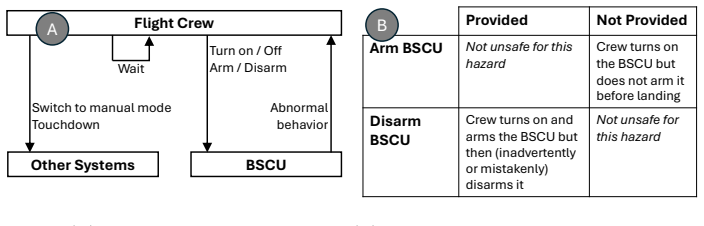
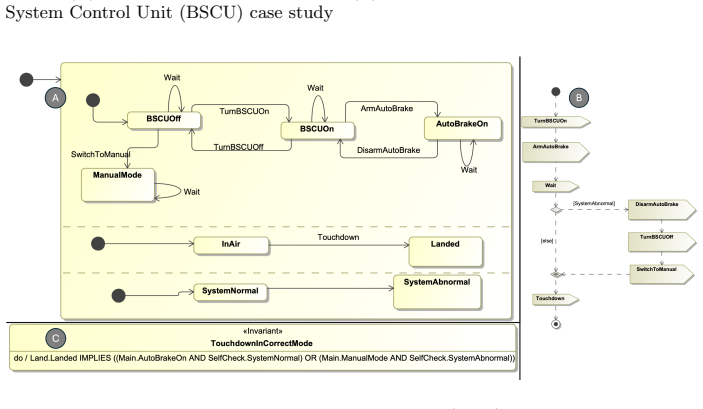
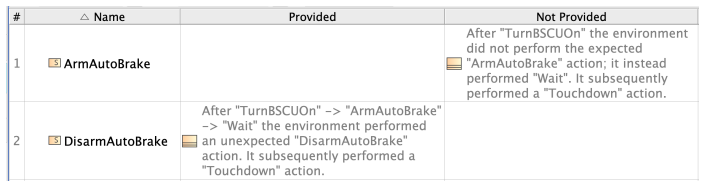
FASR enables automated, complete identification of unsafe control actions by leveraging recent advances in robustness analysis to identify UCAs as undesirable deviations in the controller's actions, demonstrated through a case study on a Braking System Control Unit in an avionics system.
What carries the argument
FASR tool, which combines formal models of controller and plant with robustness analysis to detect unsafe control actions as action deviations.
If this is right
- STPA analysis becomes faster and less error-prone when UCA identification is automated.
- The tool produces complete results for systems that admit formal controller-plant models, such as the avionics BSCU example.
- Analysts with mixed backgrounds in STPA and formal methods can use the output as a reliable starting point.
- Further tool refinements are required before the method applies to a wider range of systems and analyst skill levels.
Where Pith is reading between the lines
- The same robustness-based deviation detection could be adapted to other hazard analysis methods that rely on identifying unsafe behaviors.
- Early-stage design might still require manual STPA because formal models are often unavailable until later phases.
- Combining FASR output with existing model-based engineering environments could reduce the barrier to adoption.
Load-bearing premise
A formal model of the controller and plant, together with robustness analysis, can capture all the context and intent that a human STPA analyst would use to decide whether a control action is unsafe.
What would settle it
An unsafe control action present in the Braking System Control Unit case study that FASR fails to report, or a participant in the user study who cannot complete UCA identification with the tool.
Figures

read the original abstract
The System-Theoretic Process Analysis (STPA) is a well-established hazard analysis technique that has been applied to a wide range of safety-critical systems. Despite its popularity, there is relatively little automation support for STPA, and most of its steps are carried out manually by a human analyst, which can be time consuming and error prone. This paper investigates the potential use of model-based engineering and formal methods to assist human analysts in efficiently and accurately carrying out STPA. The proposed tool, called FASR (Formalizing and Automating STPA with Robustness), enables automated, complete identification of unsafe control actions (UCAs), leveraging recent advances in robustness analysis to identify UCAs as undesirable deviations in the controller's actions. The use of the tool is demonstrated on a case study involving a Braking System Control Unit (BSCU) in an avionics system. As a preliminary exploration of the potential benefits and limitations of the tool, the paper reports on a user study involving nine participants with varying backgrounds in STPA, model-based engineering, and formal methods; the study found that most participants considered the tool a useful aid in identifying UCAs, while suggesting improvements that would make a tool such as FASR usable and applicable to a wider range of systems and analysts.
Editorial analysis
A structured set of objections, weighed in public.
Referee Report
Summary. The manuscript proposes the FASR tool to automate identification of unsafe control actions (UCAs) in STPA. It models the controller and plant formally and applies robustness analysis to detect undesirable deviations from nominal controller behavior as UCAs. The approach is demonstrated via a Braking System Control Unit (BSCU) case study in avionics; a user study with nine participants of varying STPA and formal-methods backgrounds reports that most found the tool useful, while noting needed improvements for broader applicability.
Significance. If the completeness claim is substantiated, the work offers a concrete direction for reducing manual effort and inconsistency in STPA, a widely used hazard-analysis method. The combination of model-based engineering with robustness analysis is a promising technical step. The user study provides initial qualitative evidence of usability. However, the absence of any quantitative validation (recall, precision, or direct comparison to manual UCA tables) substantially limits the demonstrated significance of the central automation claim.
major comments (3)
- [Abstract] Abstract: the claim of 'automated, complete identification of unsafe control actions' is load-bearing for the paper's contribution, yet no quantitative metrics (recall against a ground-truth manual STPA analysis, false-positive rate, or coverage of context-sensitive hazards) are reported for the BSCU example.
- [§4] §4 (BSCU case study): the demonstration does not include a side-by-side enumeration or table comparing the UCAs returned by the robustness procedure against those that would be identified by a conventional manual STPA analyst considering the same hazards, environmental context, and system intent.
- [§5] §5 (user study): the study measures only perceived usefulness and suggested improvements; it supplies no data on whether FASR recovers every manually identified UCA or introduces spurious ones, leaving the weakest assumption (that robustness deviations capture all analyst context and intent) untested.
minor comments (2)
- [Abstract] Abstract: the expansion of the FASR acronym ('Formalizing and Automating STPA with Robustness') is given only in the abstract; repeating it once in the introduction would aid readers.
- The manuscript would benefit from an explicit statement of the modeling assumptions required for the controller/plant formalization (e.g., discrete vs. continuous time, scope of environmental disturbances) so that readers can assess applicability to other systems.
Simulated Author's Rebuttal
We thank the referee for the constructive and detailed comments, which help clarify the scope and limitations of our preliminary work on FASR. We address each major comment below, indicating planned revisions where appropriate. The manuscript presents an initial exploration combining formal robustness analysis with STPA; we agree that stronger quantitative evidence would strengthen the automation claims.
read point-by-point responses
-
Referee: [Abstract] Abstract: the claim of 'automated, complete identification of unsafe control actions' is load-bearing for the paper's contribution, yet no quantitative metrics (recall against a ground-truth manual STPA analysis, false-positive rate, or coverage of context-sensitive hazards) are reported for the BSCU example.
Authors: We acknowledge that the abstract's phrasing of 'automated, complete identification' is strong and that the BSCU demonstration provides only an illustrative application rather than quantitative validation metrics such as recall or precision. The completeness claim rests on the formal coverage of robustness violations within the modeled controller-plant interface, but we agree this does not substitute for empirical comparison against manual analysis. We will revise the abstract to qualify the claim (e.g., 'automated identification of UCAs as robustness violations') and add an explicit limitations paragraph discussing the absence of such metrics. revision: yes
-
Referee: [§4] §4 (BSCU case study): the demonstration does not include a side-by-side enumeration or table comparing the UCAs returned by the robustness procedure against those that would be identified by a conventional manual STPA analyst considering the same hazards, environmental context, and system intent.
Authors: The BSCU case study serves to demonstrate tool usage on a realistic avionics example rather than to perform exhaustive validation. A direct side-by-side table would require an independent, fully documented manual STPA by domain experts on the identical hazard set and context, which exceeds the scope of this initial study. We will add a new subsection in §4 that enumerates the UCAs produced by FASR, discusses how they relate to the modeled hazards, and explicitly notes the lack of a manual baseline comparison as a limitation. revision: partial
-
Referee: [§5] §5 (user study): the study measures only perceived usefulness and suggested improvements; it supplies no data on whether FASR recovers every manually identified UCA or introduces spurious ones, leaving the weakest assumption (that robustness deviations capture all analyst context and intent) untested.
Authors: The user study was intentionally scoped as a preliminary qualitative assessment of perceived usefulness across participants with mixed STPA and formal-methods backgrounds; it was not designed as a controlled accuracy evaluation. We agree that this leaves the assumption that robustness deviations fully capture analyst intent untested in quantitative terms. In revision we will expand §5 and the conclusions to state this limitation clearly and to outline the design of a future controlled study that would measure recall/precision against manual UCA tables. revision: yes
Circularity Check
No circularity: tool description and case study lack any derivation chain or fitted predictions
full rationale
The paper describes a software tool (FASR) that applies existing robustness analysis techniques to formal controller/plant models in order to flag unsafe control actions. No equations, parameter fits, uniqueness theorems, or predictive claims appear in the provided text. The completeness argument is presented as an empirical claim evaluated via case study and user study rather than derived from prior self-citations or by construction. The mapping from robustness deviations to STPA UCAs is treated as an engineering assumption, not a mathematical reduction that collapses to the inputs. This is the normal non-circular outcome for a tool-building paper without a formal derivation.
Axiom & Free-Parameter Ledger
Reference graph
Works this paper leans on
-
[1]
Risk Analysis and Assessment Modeling Language (RAAML) Libraries and Pro- files Version 1.1 Beta 2. Tech. Rep. ptc/24-03-02, OMG Standards Development Organization (March 2024)
2024
-
[2]
Procedia Engineering128, 2–11 (2015), proceedings of the 3rd European STAMP Workshop
Abdulkhaleq, A., Wagner, S., Leveson, N.: A comprehensive safety engineering approach for software-intensive systems based on stpa. Procedia Engineering128, 2–11 (2015), proceedings of the 3rd European STAMP Workshop
2015
-
[3]
In: 2022 IEEE International Symposium on Systems Engineering (ISSE)
Ahlbrecht, A., Zaeske, W., Durak, U.: Model-Based STPA: Towards Agile Safety- Guided Design with Formalization. In: 2022 IEEE International Symposium on Systems Engineering (ISSE). pp. 1–8 (Oct 2022), iSSN: 2687-8828
2022
-
[4]
In: 2013 ACM/IEEE International Conference on Cyber-Physical Systems (ICCPS)
Asare, P., Lach, J., Stankovic, J.A.: Fstpa-i: A formal approach to hazard identi- fication via system theoretic process analysis. In: 2013 ACM/IEEE International Conference on Cyber-Physical Systems (ICCPS). pp. 150–159 (2013)
2013
-
[5]
In: Formal Methods for the Design of Real-Time Systems
Behrmann, G., David, A., Larsen, K.G.: A tutorial on Uppaal. In: Formal Methods for the Design of Real-Time Systems. LNCS, vol. 3185, pp. 200–236. Springer, Berlin, Heidelberg (2004)
2004
-
[6]
In: Proceedings of the 21st Safety-Critical Systems Symposium
Colley, J., Butler, M.: A formal, systematic approach to stpa using event-b refine- ment and proof. In: Proceedings of the 21st Safety-Critical Systems Symposium. Safety-Critical Systems Club, Bristol, UK (February 2013)
2013
-
[7]
Safety Science109, 130–143 (2018)
Dakwat, A.L., Villani, E.: System safety assessment based on stpa and model checking. Safety Science109, 130–143 (2018)
2018
-
[8]
Damerau, F.J.: A technique for computer detection and correction of spelling er- rors. Commun. ACM7(3), 171–176 (Mar 1964)
1964
-
[9]
3ds.com/products/catia/no-magic/cameo-enterprise-architecture, 2024x
Dassault Syst` emes: Cameo Enterprise Architecture (January 2026),https://www. 3ds.com/products/catia/no-magic/cameo-enterprise-architecture, 2024x
2026
-
[10]
IEEE Access10, 120936– 120950 (2022)
De Saqui-Sannes, P., Vingerhoeds, R.A., Garion, C., Thirioux, X.: A Taxonomy of MBSE Approaches by Languages, Tools and Methods. IEEE Access10, 120936– 120950 (2022)
2022
-
[11]
John Wiley & Sons, Inc., Fredericksburg, Virginia, United States of America, second edn
Ericson II, C.A.: Hazard Analysis Techniques for System Safety. John Wiley & Sons, Inc., Fredericksburg, Virginia, United States of America, second edn. (2016)
2016
-
[12]
Galois, Inc: Camet tools (2025),https://tools.galois.com/camet/overview/ camet-tools, Last accessed on 2026-03-03
2025
-
[13]
In: ERTS 2022
Hetherington, D., Roques, P.: STPA Analysis of Automotive Safety Using Arcadia and Capella. In: ERTS 2022. pp. 191–200. HAL Open Science, Toulouse, France (Jun 2022)
2022
-
[14]
Nuclear Engineering and Technology54(5), 1635–1643 (May 2022)
Jung, S., Heo, Y., Yoo, J.: A formal approach to support the identification of unsafe control actions of STPA for nuclear protection systems. Nuclear Engineering and Technology54(5), 1635–1643 (May 2022)
2022
-
[15]
Addison-Wesley (6 2002)
Lamport, L.: Specifying Systems: The TLA+ Language and Tools for Hardware and Software Engineers. Addison-Wesley (6 2002)
2002
-
[16]
Leveson, N., Thomas, J.: STPA Handbook. Tech. rep. (2018)
2018
-
[17]
OMG ® Systems Modeling: OMG Systems Modeling Language™(SysML ®) ver- sion 1.7. Tech. Rep. formal/24-01-07, OMG Standards Development Organization (January 2024)
2024
-
[18]
In: Gallina, B., T¨ orngren, M., Bitsch, F
Petzold, J., von Hanxleden, R.: Hot PASTA: Improved Pragmatics for System- Theoretic Process Analysis. In: Gallina, B., T¨ orngren, M., Bitsch, F. (eds.) Com- puter Safety, Reliability, and Security. pp. 160–174. Springer Nature Switzerland, Cham (2026)
2026
-
[19]
In: 18th Annual Symposium on Foun- dations of Computer Science (sfcs 1977)
Pnueli, A.: The temporal logic of programs. In: 18th Annual Symposium on Foun- dations of Computer Science (sfcs 1977). pp. 46–57 (1977)
1977
-
[20]
In: 12th ACM/IEEE International Conference on Methods and Models for System Design, MEMOCODE 2014 (2014)
Procter, S., Hatcliff, J.: An architecturally-integrated, systems-based hazard anal- ysis for medical applications. In: 12th ACM/IEEE International Conference on Methods and Models for System Design, MEMOCODE 2014 (2014)
2014
-
[21]
In: Gl¨ asser, U., Creissac Campos, J., M´ ery, D., Palanque, P
Salehi Fathabadi, A., Snook, C., Dghaym, D., Hoang, T.S., Alotaibi, F., Butler, M.: Designing critical systems using hierarchical stpa and event-b. In: Gl¨ asser, U., Creissac Campos, J., M´ ery, D., Palanque, P. (eds.) Rigorous State-Based Methods. pp. 220–237. Springer Nature Switzerland, Cham (2023)
2023
-
[22]
In: 2020 IEEE International Systems Conference (SysCon)
de Souza, F.G.R., de Melo Bezerra, J., Hirata, C.M., de Saqui-Sannes, P., Apvrille, L.: Combining stpa with sysml modeling. In: 2020 IEEE International Systems Conference (SysCon). pp. 1–8 (2020)
2020
-
[23]
In: Proceedings of the Twenty- first Safety-Critical Systems Symposium
Thomas, J., Leveson, N.: Generating formal model-based safety requirements for complex, software- and human-intensive systems. In: Proceedings of the Twenty- first Safety-Critical Systems Symposium. Safety-Critical Systems Club, Bristol, United Kingdom (2013)
2013
-
[24]
In: Formal Methods in Computer- Aided Design (FMCAD)
Zhang, C., Dardik, I., Meira-G´ oes, R., Garlan, D., Kang, E.: Fortis: A tool for analysis and repair of robust software systems. In: Formal Methods in Computer- Aided Design (FMCAD). pp. 1–9. IEEE (2023)
2023
-
[25]
In: Proceedings of ESEC/FSE
Zhang, C., Garlan, D., Kang, E.: A behavioral notion of robustness for software systems. In: Proceedings of ESEC/FSE. p. 1–12 (2020)
2020
discussion (0)
Sign in with ORCID, Apple, or X to comment. Anyone can read and Pith papers without signing in.