GSAM: A Generalizable and Safe Robotic Framework for Articulated Object Manipulation
Pith reviewed 2026-06-28 22:38 UTC · model grok-4.3
The pith
GSAM corrects vision-based kinematic estimates with a VLM refiner and uses LLM-generated constraints to plan safer trajectories for articulated objects.
A machine-rendered reading of the paper's core claim, the machinery that carries it, and where it could break.
Core claim
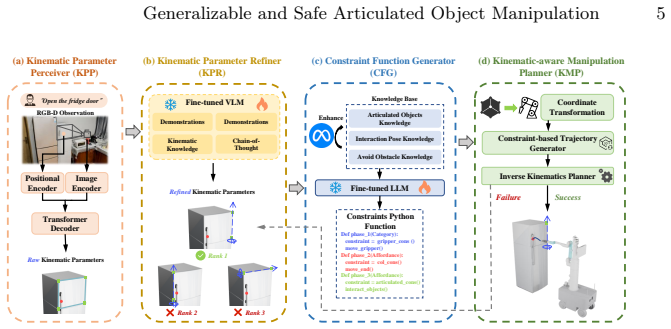
GSAM generates kinematic parameters via a vision-based perceiver, refines raw estimates that deviate from commonsense using a fine-tuned VLM with chain-of-thought reasoning, builds an interaction constraint function generator that encodes object, pose, and obstacle knowledge, lets an LLM functionalize those constraints for trajectory and posture planning, and applies a kinematic-aware manipulation planner; this combination yields a 36.0 percent higher success rate and 3.1 percent lower standard deviation on 50 hinge tasks across five object categories and 50 random end-effector-handle configurations.
What carries the argument
The interaction constraint function generator that folds articulated object geometry, interaction pose, and obstacle avoidance into constraints later functionalized by an LLM.
If this is right
- Manipulation succeeds on a wider range of articulated objects from multiple categories.
- Random initial end-effector positions lead to fewer failed attempts.
- Destructive collisions are reduced through explicit constraint enforcement during planning.
- Performance variability across repeated trials drops measurably.
- The same pipeline supports both trajectory and posture planning under reachability checks.
Where Pith is reading between the lines
- The correction step could apply to other perception-heavy robotic tasks where commonsense priors improve raw sensor data.
- Extending the constraint generator beyond hinges would require only new object geometry inputs if the refiner generalizes.
- Real-time versions might reduce planning latency if the LLM functionalizer is distilled into faster models.
Load-bearing premise
The vision-based perceiver produces raw kinematic estimates that deviate from commonsense and require reliable correction by the fine-tuned VLM refiner using chain-of-thought reasoning.
What would settle it
An ablation experiment that removes the VLM refiner and shows that uncorrected kinematic estimates produce no gain in success rate or reduction in standard deviation compared with the best baseline.
Figures

read the original abstract
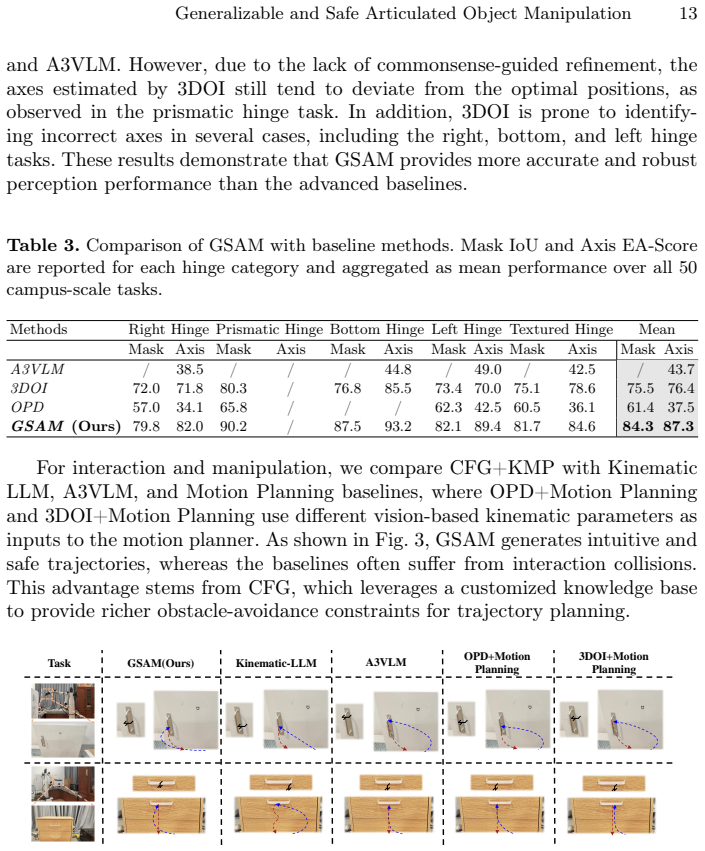
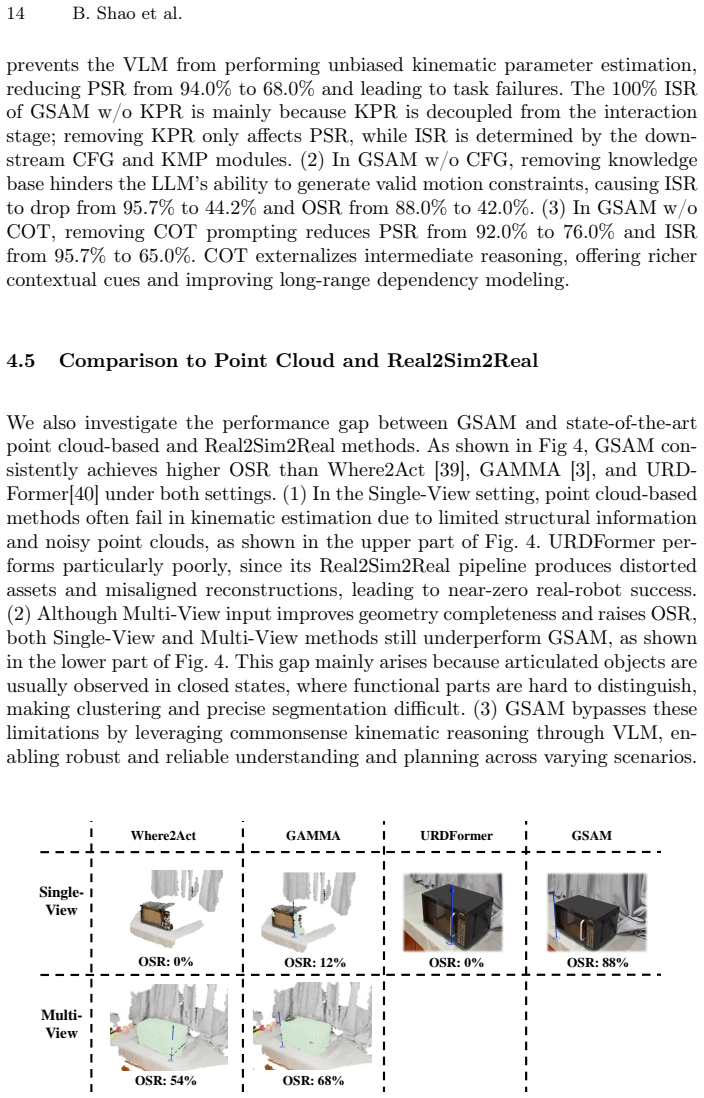
Articulated object manipulation is a unique challenge for service robots. Existing methods employ end-to-end policy learning, visionmotion planning, and large-language/visual-language model (LLM/VLM), but often overlook the diversity of articulated objects and the complexity of interactions between end-effector and handle, leading to limited generalization and destructive collisions. To address this, we propose GSAM, a generalizable and safe robotic framework for articulated object manipulation. Specifically, a vision-based perceiver generates the kinematic parameters. Considering that pre-trained markers in perceiver yield raw estimations that may deviate from commonsense, we present a f ine-tuned VLM-based refiner, using chain-of-thought (COT) commonsense reasoning to refine perception. To prevent destructive collisions, we design an interaction constraint function generator, integrating articulated object, interaction pose, and obstacle avoidance knowledge into a base. LLM then functionalize these constraints and apply them to trajectory and posture planning. A kinematic-aware manipulation planner verifies reachability for trajectory and posture. Experiments on 50 hinge tasks across 5 object categories and 50 randomly initialized end-effectorhandle configurations show that GSAM reduces standard deviation by 3.1% and improves manipulation success rate by 36.0% compared to the best baseline, respectively demonstrating the superior object generalization and interaction safety of GSAM in practical scenarios.
Editorial analysis
A structured set of objections, weighed in public.
Referee Report
Summary. The paper claims to introduce GSAM, a framework for articulated object manipulation consisting of a vision-based perceiver for kinematic parameters, a fine-tuned VLM refiner using chain-of-thought commonsense reasoning to correct raw estimations, an interaction constraint function generator, an LLM to functionalize constraints for trajectory and posture planning, and a kinematic-aware manipulation planner. On 50 hinge tasks across 5 object categories with 50 random end-effector-handle configurations, it reports a 36.0% improvement in manipulation success rate and 3.1% reduction in standard deviation over the best baseline.
Significance. If validated, the approach could contribute to more generalizable and safer robotic manipulation of articulated objects by mitigating perception errors and collision risks through hybrid vision-VLM-constraint methods. The emphasis on commonsense reasoning in perception refinement is a notable aspect for real-world service robot applications.
major comments (2)
- [Abstract] The headline experimental result (36.0% success-rate lift, 3.1% std reduction on 50 tasks) is presented without details on baseline implementations, statistical significance, error bars, data splits, or random seeds, preventing verification of the central performance claim.
- [Abstract / Experiments] The framework's claimed gains rest on the unablated assumption that the VLM refiner meaningfully corrects the perceiver's kinematic estimates; no perception-error metrics (e.g., joint-angle RMSE with vs. without refiner) or ablation isolating the refiner are provided, leaving the attribution of improvements to this component unsupported.
minor comments (2)
- [Abstract] Typographical error: 'f ine-tuned' appears with a space; should be 'fine-tuned'.
- [Abstract] Missing hyphen/space: 'end-effectorhandle' should read 'end-effector-handle'.
Simulated Author's Rebuttal
We thank the referee for the constructive feedback on experimental clarity and component validation. We address each major comment below and commit to revisions that strengthen the presentation without altering the core claims.
read point-by-point responses
-
Referee: [Abstract] The headline experimental result (36.0% success-rate lift, 3.1% std reduction on 50 tasks) is presented without details on baseline implementations, statistical significance, error bars, data splits, or random seeds, preventing verification of the central performance claim.
Authors: We agree that the abstract would benefit from additional context. The full manuscript details baseline implementations, statistical significance testing (including p-values), error bars from repeated trials, data splits across the 5 object categories, and random seeds in Section 4 (Experiments). In the revision we will expand the abstract with a brief clause referencing these elements and the experimental protocol to improve verifiability while respecting length constraints. revision: yes
-
Referee: [Abstract / Experiments] The framework's claimed gains rest on the unablated assumption that the VLM refiner meaningfully corrects the perceiver's kinematic estimates; no perception-error metrics (e.g., joint-angle RMSE with vs. without refiner) or ablation isolating the refiner are provided, leaving the attribution of improvements to this component unsupported.
Authors: We acknowledge the value of isolating the VLM refiner's contribution. The current manuscript reports end-to-end success rates but does not include perception-specific metrics or a dedicated ablation. We will add these to the revised Experiments section, including joint-angle RMSE comparisons with and without the refiner, plus an ablation table attributing performance gains to individual components. revision: yes
Circularity Check
No significant circularity; framework claims rest on modular components and external experiments
full rationale
The paper describes a pipeline (vision perceiver → VLM refiner with CoT → constraint generator → kinematic planner) whose performance is evaluated via comparative experiments on 50 tasks. No equations, fitted parameters, or self-citations are shown that reduce any claimed prediction or result to an input by construction. The reported gains (36% success-rate lift, 3.1% std reduction) are presented as empirical outcomes of the integrated system rather than tautological re-statements of fitted quantities or prior self-citations. The derivation chain is therefore self-contained against the supplied experimental benchmarks.
Axiom & Free-Parameter Ledger
Reference graph
Works this paper leans on
-
[1]
In: Proceedings of Robotics: Science and Systems (2024)
Chi, C., Xu, Z., Pan, C., Cousineau, E., Burchfiel, B., Feng, S., Tedrake, R., Song, S.: Universal Manipulation Interface: In-The-Wild Robot Teaching Without In-The- Wild Robots. In: Proceedings of Robotics: Science and Systems (2024)
2024
-
[2]
In: Conference on Robot Learning (2024)
Huang, W., Wang, C., Li, Y., Zhang, R., Fei-Fei, L.: ReKep: Spatio-Temporal Rea- soning of Relational Keypoint Constraints for Robotic Manipulation. In: Conference on Robot Learning (2024)
2024
-
[3]
In: 2024 IEEE International Conference on Robotics and Automation, pp
Yu, Q., Wang, J., Liu, W., Hao, C., Liu, L., Shao, L., Lu, C.: Gamma: Generalizable Articulation Modeling and Manipulation for Articulated Objects. In: 2024 IEEE International Conference on Robotics and Automation, pp. 5419–5426 (2024)
2024
-
[4]
In: Proceedings of the IEEE/CVF Conference on Computer Vision and Pattern Recognition, pp
Ehsani, K., Han, W., Herrasti, A., VanderBilt, E., Weihs, L., Kolve, E., Kembhavi, A., Mottaghi, R.: ManipulaTHOR: A Framework for Visual Object Manipulation. In: Proceedings of the IEEE/CVF Conference on Computer Vision and Pattern Recognition, pp. 4497–4506 (2021)
2021
-
[5]
In: Proceedings of the IEEE/CVF Interna- tional Conference on Computer Vision, pp
Liu, J., Mahdavi-Amiri, A., Savva, M.: PARIS: Part-level Reconstruction and Mo- tion Analysis for Articulated Objects. In: Proceedings of the IEEE/CVF Interna- tional Conference on Computer Vision, pp. 352–363 (2023)
2023
-
[6]
In: European Conference on Computer Vision, pp
Jiang, H., Mao, Y., Savva, M., Chang, A.X.: OPD: Single-View 3D Openable Part Detection. In: European Conference on Computer Vision, pp. 410–426 (2022)
2022
-
[7]
In: Proceedings of the IEEE/CVF International Conference on Computer Vision, pp
Qian, S., Fouhey, D.F.: Understanding 3D Object Interaction from a Single Image. In: Proceedings of the IEEE/CVF International Conference on Computer Vision, pp. 21753–21763 (2023)
2023
-
[8]
arXiv preprint arXiv:2303.14087 (2023)
Sun, X., Jiang, H., Savva, M., Chang, A.X.: OPDMulti: Openable Part Detection for Multiple Objects. arXiv preprint arXiv:2303.14087 (2023)
-
[9]
In: 2024 IEEE International Conference on Robotics and Automation, pp
Xia, W., Wang, D., Pang, X., Wang, Z., Zhao, B., Hu, D., Li, X.: Kinematic-Aware Prompting for Generalizable Articulated Object Manipulation with LLMs. In: 2024 IEEE International Conference on Robotics and Automation, pp. 2073–2080 (2024) 16 B. Shao et al
2024
-
[10]
In: Proceedings of the IEEE/CVF International Conference on Computer Vision (2023)
Kirillov, A., Mintun, E., Ravi, N., Mao, H., Rolland, C., Gustafson, L., Xiao, T., Whitehead, S., Berg, A.C., Lo, W.-Y., Dollár, P., Girshick, R.: Segment Anything. In: Proceedings of the IEEE/CVF International Conference on Computer Vision (2023)
2023
-
[11]
In: Proceedings of the IEEE/CVF Conference on Computer Vision and Pattern Recognition (2022)
He, K., Chen, X., Xie, S., Li, Y., Dollár, P., Girshick, R.: Masked Autoencoders Are Scalable Vision Learners. In: Proceedings of the IEEE/CVF Conference on Computer Vision and Pattern Recognition (2022)
2022
-
[12]
In: Advances in Neural Information Processing Systems (2020)
Tancik, M., Srinivasan, P., Mildenhall, B., Fridovich-Keil, S., Raghavan, N., Sing- hal, U., Ramamoorthi, R., Barron, J., Ng, R.: Fourier Features Let Networks Learn High Frequency Functions in Low Dimensional Domains. In: Advances in Neural Information Processing Systems (2020)
2020
-
[13]
In: AdvancesinNeuralInformationProcessingSystems,vol.35,pp.24824–24837(2022)
Wei, J., Wang, X., Schuurmans, D., Bosma, M., Xia, F., Chi, E., Zhou, D., et al.: Chain-of-Thought Prompting Elicits Reasoning in Large Language Models. In: AdvancesinNeuralInformationProcessingSystems,vol.35,pp.24824–24837(2022)
2022
-
[14]
Frontiers of Computer Science (2024)
Yang, K., Cao, N., Ding, Y., Chen, C.: BestMan: A Modular Mobile Manipulator Platform for Embodied AI with Unified Simulation-Hardware APIs. Frontiers of Computer Science (2024). https://doi.org/10.1007/s11704-025-41109-6
-
[15]
In: Proceedings of the IEEE/CVF Conference on Computer Vision and Pattern Recognition, pp
Mo, K., Zhu, S., Chang, A.X., Yi, L., Tripathi, S., Guibas, L.J., Su, H.: PartNet: A Large-scale Benchmark for Fine-grained and Hierarchical Part-level 3D Object Understanding. In: Proceedings of the IEEE/CVF Conference on Computer Vision and Pattern Recognition, pp. 909–918 (2019)
2019
-
[16]
In: Proceedings of the IEEE/CVF International Conference on Computer Vision (ICCV), pp
Su, H., Xie, M., Cao, N., Ding, Y., Shao, B., Long, X., Gu, F., Chen, C.: OVA- Fields: Weakly Supervised Open-Vocabulary Affordance Fields for Robot Opera- tional Part Detection. In: Proceedings of the IEEE/CVF International Conference on Computer Vision (ICCV), pp. 6385–6395 (2025)
2025
-
[17]
In: Proceedings of the IEEE/CVF Conference on Computer Vision and Pattern Recognition (CVPR), pp
Wang,J.,Cao,N.,Ding,Y.,Xie,M.,Gu,F.,Chen,C.:SKE-Layout:SpatialKnowl- edge Enhanced Layout Generation with LLMs. In: Proceedings of the IEEE/CVF Conference on Computer Vision and Pattern Recognition (CVPR), pp. 19414–19423 (2025)
2025
-
[18]
The International Journal of Robotics Research37(4-5), 421–436 (2018)
Levine, S., Pastor, P., Krizhevsky, A., Ibarz, J., Quillen, D.: Learning Hand-Eye Coordination for Robotic Grasping with Deep Learning and Large-Scale Data Col- lection. The International Journal of Robotics Research37(4-5), 421–436 (2018)
2018
-
[19]
In: Algorithms and Architectures for Parallel Processing, vol
Shao, B., Cao, N., Ding, Y., Wang, X., Gu, F., Chen, C.: MoMa-Pos: An Efficient Object-Kinematic-Aware Base Placement Determination Framework for Mobile Ma- nipulation. In: Algorithms and Architectures for Parallel Processing, vol. 16383, pp. 254–270. Springer, Singapore (2026). https://doi.org/10.1007/978-981-95-8405- 5_14
-
[20]
IEEE Robotics and Automation Letters8(12), 8494–8501 (2023)
Fan, W., Guo, X., Feng, E., Lin, J., Wang, Y., Liang, J., Garrad, M., Rossiter, J., Zhang, Z., Lepora, N., Wei, L., Zhang, D.: Digital Twin- Driven Mixed Reality Framework for Immersive Teleoperation with Haptic Rendering. IEEE Robotics and Automation Letters8(12), 8494–8501 (2023). https://doi.org/10.1109/LRA.2023.3325784
-
[21]
In: 2024 IEEE/RSJ InternationalConferenceonIntelligentRobotsandSystems,pp.12156–12163(2024)
Wu, P., Shentu, Y., Yi, Z., Lin, X., Abbeel, P.: GELLO: A General, Low-Cost, and Intuitive Teleoperation Framework for Robot Manipulators. In: 2024 IEEE/RSJ InternationalConferenceonIntelligentRobotsandSystems,pp.12156–12163(2024)
2024
-
[22]
In: Robotics: Science and Systems (2025)
Gupta, A., Zhang, M., Sathua, R., Gupta, S.: Opening Articulated Objects in the Real World. In: Robotics: Science and Systems (2025)
2025
-
[23]
IEEE Transactions on Robotics32(1), 161–175 (2016) Generalizable and Safe Articulated Object Manipulation 17
Karayiannidis, Y., Smith, C., Barrientos, F.E.V., Ögren, P., Kragic, D.: An Adap- tive Control Approach for Opening Doors and Drawers under Uncertainties. IEEE Transactions on Robotics32(1), 161–175 (2016) Generalizable and Safe Articulated Object Manipulation 17
2016
-
[24]
651–673 (2018)
Kalashnikov, D., Irpan, A., Pastor, P., Ibarz, J., Herzog, A., Jang, E., Quillen, D., Holly,E.,Kalakrishnan,M.,Vanhoucke,V.,Levine,S.:ScalableDeepReinforcement LearningforVision-BasedRoboticManipulation.In:ConferenceonRobotLearning, pp. 651–673 (2018)
2018
-
[25]
In: Pro- ceedings of Robotics: Science and Systems (2022)
Bahl, S., Gupta, A., Pathak, D.: Human-to-Robot Imitation in the Wild. In: Pro- ceedings of Robotics: Science and Systems (2022)
2022
-
[26]
In: Proceedings of the Eleventh International Conference on Learning Representa- tions (2023)
Ma, Y.J., Sodhani, S., Jayaraman, D., Bastani, O., Kumar, V., Zhang, A.: VIP: To- wards Universal Visual Reward and Representation via Value-Implicit Pre-training. In: Proceedings of the Eleventh International Conference on Learning Representa- tions (2023)
2023
-
[27]
In: Proceedings of the 7th Conference on Robot Learning, vol
Wang, C., Fan, L., Sun, J., Zhang, R., Fei-Fei, L., Xu, D., Zhu, Y., Anandkumar, A.: MimicPlay: Long-Horizon Imitation Learning by Watching Human Play. In: Proceedings of the 7th Conference on Robot Learning, vol. 229, pp. 201–221 (2023)
2023
-
[28]
In: Proceedings of the 5th Conference on Robot Learning, vol
Wong, J., Tung, A., Kurenkov, A., Mandlekar, A., Fei-Fei, L., Savarese, S., Martín- Martín, R.: Error-Aware Imitation Learning from Teleoperation Data for Mobile Manipulation. In: Proceedings of the 5th Conference on Robot Learning, vol. 164, pp. 1367–1378 (2022)
2022
-
[29]
In: Proceedings of the 2023 IEEE-RAS 22nd International Conference on Humanoid Robots, pp
Seo, M., Han, S., Sim, K., Bang, S.H., Gonzalez, C., Sentis, L., Zhu, Y.: Deep Im- itation Learning for Humanoid Loco-Manipulation through Human Teleoperation. In: Proceedings of the 2023 IEEE-RAS 22nd International Conference on Humanoid Robots, pp. 1–8 (2023)
2023
-
[30]
In: Proceedings of Robotics: Science and Systems (2023)
Zhao, T.Z., Kumar, V., Levine, S., Finn, C.: Learning Fine-Grained Bimanual Manipulation with Low-Cost Hardware. In: Proceedings of Robotics: Science and Systems (2023)
2023
-
[31]
In: Proceedings of the 8th Annual Conference on Robot Learning (2024)
Fu, Z., Zhao, T.Z., Finn, C.: Mobile ALOHA: Learning Bimanual Mobile Ma- nipulation Using Low-Cost Whole-Body Teleoperation. In: Proceedings of the 8th Annual Conference on Robot Learning (2024)
2024
-
[32]
Chi, C., Xu, Z., Feng, S., Cousineau, E., Du, Y., Burchfiel, B., Tedrake, R., Song, S.: Diffusion Policy: Visuomotor Policy Learning via Ac- tion Diffusion. The International Journal of Robotics Research (2024). https://doi.org/10.1177/02783649241273668
-
[33]
Intelligent Service Robotics17(5), 1091–1107 (2024)
Kim, Y., Kim, D., Choi, J., Park, J., Oh, N., Park, D.: A Survey on Integration of Large Language Models with Intelligent Robots. Intelligent Service Robotics17(5), 1091–1107 (2024). https://doi.org/10.1007/s11370-024-00495-6
-
[34]
IEEE Transactions on Automation Sci- ence and Engineering (2025)
Yao, T., Wang, H., Lu, B., Ge, J., Pei, Z., Kowarschik, M., Qi, P., et al.: Sim2Real Learning with Domain Randomization for Autonomous Guidewire Navigation in Robotic-Assisted Endovascular Procedures. IEEE Transactions on Automation Sci- ence and Engineering (2025)
2025
-
[35]
In: Robotics: Science and Systems (2025)
Wang, Y., Wang, Z., Nakura, M., Bhowal, P., Kuo, C.-L., Chen, Y.-T., Erickson, Z., Held, D.: ArticuBot: Learning Universal Articulated Object Manipulation Policy via Large Scale Simulation. In: Robotics: Science and Systems (2025)
2025
-
[36]
The International Journal of Robotics Research30(7), 846–894 (2011)
Karaman, S., Frazzoli, E.: Sampling-Based Algorithms for Optimal Motion Plan- ning. The International Journal of Robotics Research30(7), 846–894 (2011)
2011
-
[37]
IEEE Transactions on Robotics and Automation12(4), 566–580 (1996)
Kavraki, L.E., Svestka, P., Latombe, J.-C., Overmars, M.H.: Probabilistic Roadmaps for Path Planning in High-Dimensional Configuration Spaces. IEEE Transactions on Robotics and Automation12(4), 566–580 (1996)
1996
-
[38]
In: Proceedings of the Conference on Robot Learning (2023) 18 B
Wu, P., Shentu, F., Lin, X., Abbeel, P.: GELLO: A General, Low-Cost, and In- tuitive Teleoperation Framework for Robot Manipulators. In: Proceedings of the Conference on Robot Learning (2023) 18 B. Shao et al
2023
-
[39]
In: Proceedings of the IEEE/CVF International Conference on Computer Vision, pp
Mo, K., Guibas, L.J., Mukadam, M., Gupta, A., Tulsiani, S.: Where2Act: From Pixels to Actions for Articulated 3D Objects. In: Proceedings of the IEEE/CVF International Conference on Computer Vision, pp. 6813–6823 (2021)
2021
-
[40]
In: Robotics: Science and Systems (2024)
Chen, Q., Walsman, A., Memmel, M., Mo, K., Fang, A., Fox, D., Gupta, A.: URD- Former: A Pipeline for Constructing Articulated Simulation Environments from Real-World Images. In: Robotics: Science and Systems (2024)
2024
-
[41]
In: Conference on Robot Learning (2024)
Huang, S., Chang, H., Liu, Y., Zhu, Y., Dong, H., Gao, P., Boularias, A., Li, H.: A3VLM: Actionable Articulation-Aware Vision Language Model. In: Conference on Robot Learning (2024)
2024
-
[42]
In: IEEE International Conference on Robotics and Automation (2024)
Chen, F., Zheng, Y., Wang, Z., Chi, W., Liu, S.: RBI-RRT*: Efficient Sampling- Based Path Planning for High-Dimensional State Space. In: IEEE International Conference on Robotics and Automation (2024)
2024
discussion (0)
Sign in with ORCID, Apple, or X to comment. Anyone can read and Pith papers without signing in.