Can dents and gouges compromise the structural integrity of hydrogen transport pipelines?
Pith reviewed 2026-06-28 20:05 UTC · model grok-4.3
The pith
Hydrogen does not significantly increase damage from dents and gouges in pipelines except when egress is fully blocked at the outer surface during internal pressurization of a passive dent with gouge.
A machine-rendered reading of the paper's core claim, the machinery that carries it, and where it could break.
Core claim
The central claim is that hydrogen exposure does not significantly increase the damage severity of dents and gouges unless hydrogen egress is completely precluded at the outer surface of a pipeline that is being pressurised internally and contains a pre-existing passive dent with a gouge.
What carries the argument
An integrated model that couples multi-trap hydrogen transport, finite-strain plasticity, and a hydrogen- and triaxiality-dependent damage law.
If this is right
- Most dents and gouges in hydrogen pipelines do not require extra mitigation beyond standard mechanical assessment.
- Damage predictions for typical operating conditions can treat hydrogen effects as secondary.
- The critical case is limited to sealed outer surfaces on pre-existing passive defects under internal pressure.
- Model predictions rest on X65 steel behavior and can guide defect acceptance criteria for hydrogen service.
Where Pith is reading between the lines
- Operators might focus inspection on surface sealing rather than assuming broad hydrogen embrittlement risk at dents.
- The model framework could be applied to assess whether coatings that permit egress reduce the exceptional case.
- If the blocked-egress scenario proves common in the field, standards for pipeline repurposing could add surface-permeability requirements.
- Extension to cyclic loading or different steel grades would test whether the limited hydrogen effect holds more broadly.
Load-bearing premise
The integrated model accurately reproduces the experimental response of X65 steel under the combined conditions of large plastic strain and hydrogen exposure that occur at dents and gouges.
What would settle it
A test in which a passive dent with gouge under internal pressure and blocked outer-surface egress shows no increase in damage, or in which the same defect shows large damage increase even when egress remains possible.
Figures






read the original abstract
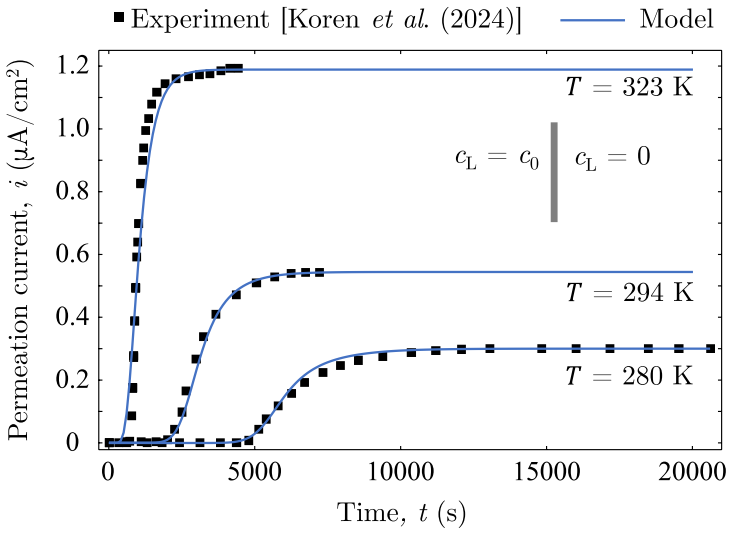
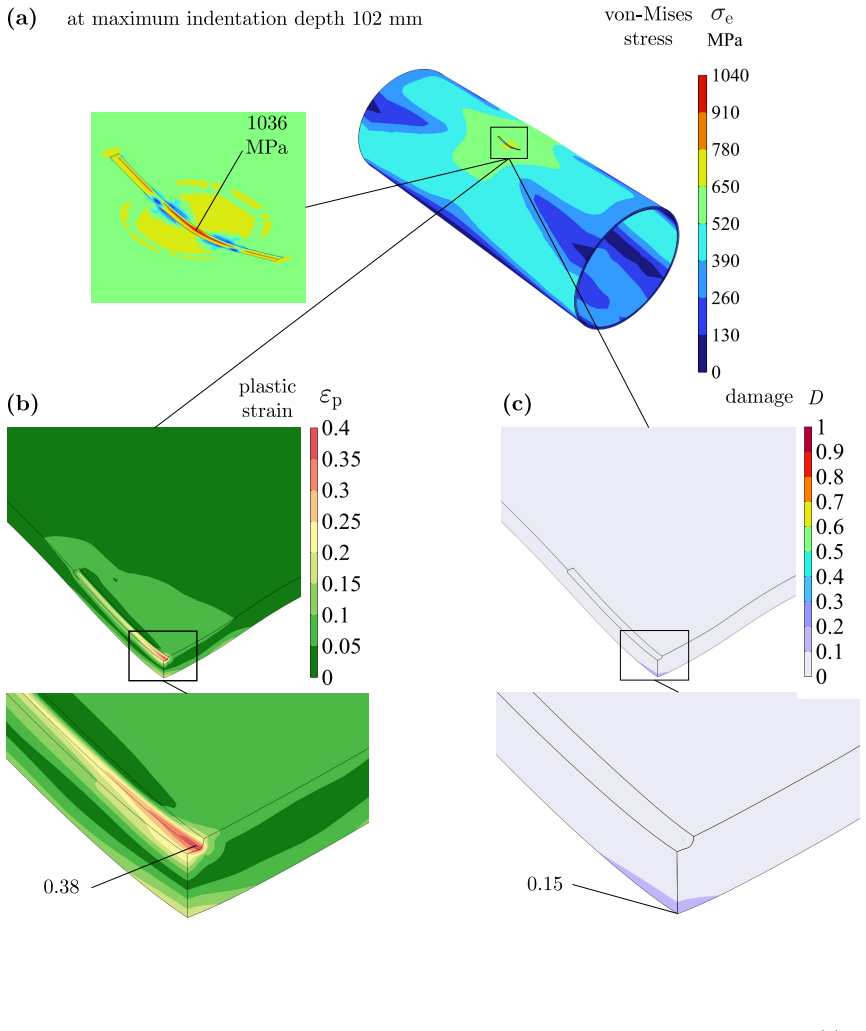
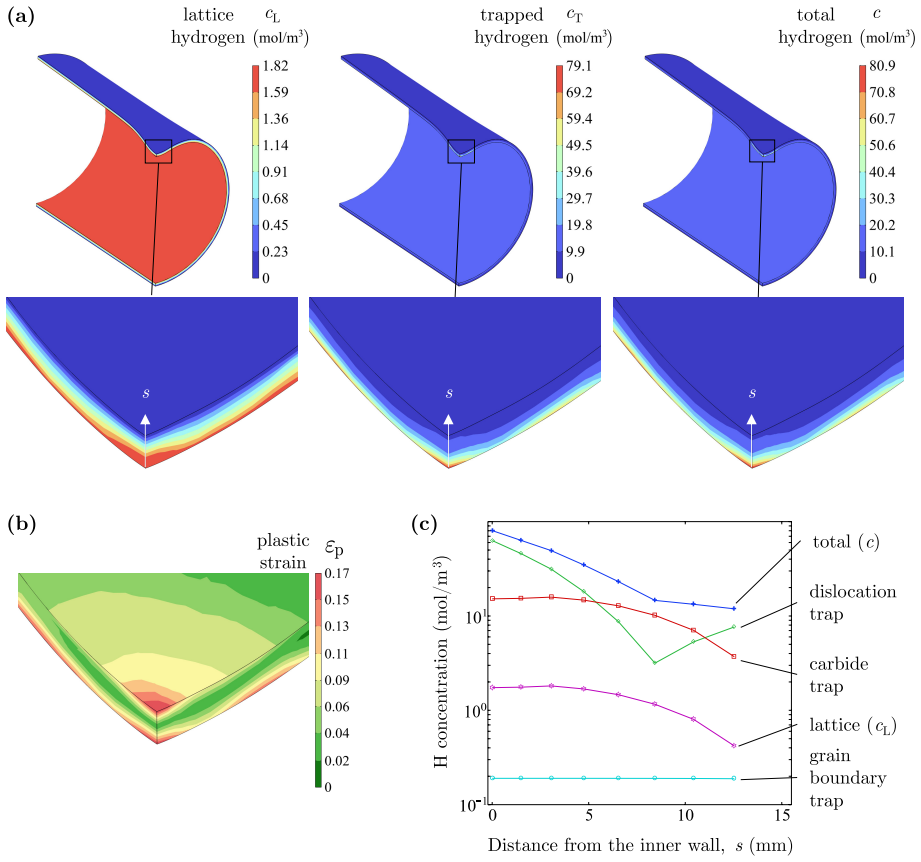
Repurposing natural gas pipelines for hydrogen transport requires understanding how external defects, like dents and gouges, affect structural integrity under H$_2$ exposure. To address this, we combine experiments with a new hydrogen embrittlement model aimed at large plastic straining scenarios, which integrates: (i) multi-trap hydrogen transport, (ii) finite-strain plasticity, and (iii) a hydrogen- and triaxiality-dependent damage law. Each constituent of the model is validated with experiments on X65 pipeline steel: (i) hydrogen permeation, (ii) full-scale pipe-indentation, and (iii) mechanical testing at different hydrogen and triaxiality levels. The validated model is used to study \textit{passive} (indent before H$_2$ exposure) and \textit{active} (indent with H$_2$) dents and gouges. Results reveal that hydrogen does not significantly increase the damage severity of those defects, unless hydrogen egress is completely precluded at the outer surface of a pipeline that is being pressurised internally and contains a pre-existing \textit{passive} dent with a gouge.
Editorial analysis
A structured set of objections, weighed in public.
Referee Report
Summary. The paper investigates the structural integrity impact of dents and gouges on pipelines repurposed for hydrogen transport in X65 steel. It introduces an integrated model combining (i) multi-trap hydrogen transport, (ii) finite-strain plasticity, and (iii) a hydrogen- and triaxiality-dependent damage law. Each constituent is validated separately via hydrogen permeation tests, full-scale pipe indentation experiments, and mechanical tests at varying hydrogen levels and triaxiality. The model is applied to passive (indent before H2) and active (indent with H2) defects, yielding the result that hydrogen does not significantly increase damage severity except when egress is completely blocked at the outer surface of an internally pressurized pipeline with a pre-existing passive dent containing a gouge.
Significance. If the result holds, the findings have substantial practical significance for hydrogen pipeline safety assessments, suggesting limited additional risk from hydrogen embrittlement for most dents and gouges and identifying one narrow critical scenario. The work is credited for its component-wise experimental validations across transport, plasticity, and damage, and for the clear distinction between passive and active defects. These elements strengthen the contribution if the coupled predictions can be further supported.
major comments (1)
- [Validation sections and results/discussion] The headline quantitative claim (abstract and final results section) that hydrogen 'does not significantly increase the damage severity' except under complete egress blockage rests on the coupled multi-trap transport + finite-strain plasticity + H/triaxiality damage model. However, validation remains component-wise only: permeation tests for transport, full-scale indentation for plasticity, and separate mechanical tests for the damage law. No experiment combines all three under the simultaneous high plastic strain, hydrogen exposure, and evolving triaxiality conditions at actual dents/gouges. This is load-bearing for the 'not significantly' assessment and requires either a combined benchmark or explicit uncertainty quantification on the coupling.
minor comments (1)
- [Model formulation] Clarify in the model description whether any parameters in the damage law or transport model are fitted to the same datasets used for the dent/gouge predictions, to address potential circularity concerns.
Simulated Author's Rebuttal
We thank the referee for their constructive review and for recognizing the practical significance of the work. The major comment concerns the strength of the headline claim given the component-wise nature of the validation. We address this below and outline revisions that will be incorporated.
read point-by-point responses
-
Referee: [Validation sections and results/discussion] The headline quantitative claim (abstract and final results section) that hydrogen 'does not significantly increase the damage severity' except under complete egress blockage rests on the coupled multi-trap transport + finite-strain plasticity + H/triaxiality damage model. However, validation remains component-wise only: permeation tests for transport, full-scale indentation for plasticity, and separate mechanical tests for the damage law. No experiment combines all three under the simultaneous high plastic strain, hydrogen exposure, and evolving triaxiality conditions at actual dents/gouges. This is load-bearing for the 'not significantly' assessment and requires either a combined benchmark or explicit uncertainty quantification on the coupling.
Authors: We agree that a single experiment simultaneously exercising multi-trap transport, finite-strain plasticity, and the triaxiality-dependent damage law under dent/gouge conditions would constitute the strongest possible validation. Such a combined benchmark is not available in the literature and would be technically demanding to execute safely at full scale with controlled hydrogen environments. Our approach follows the standard practice of validating each physics module against dedicated experiments before coupling, using constitutive relations whose forms are already established in the hydrogen-embrittlement literature. To directly address the referee’s concern, the revised manuscript will add an explicit uncertainty-quantification section. This will propagate parameter uncertainties obtained from the three separate validation campaigns through the coupled model and report confidence intervals on the predicted damage severity for the passive and active defect cases. The added analysis will quantify how robust the conclusion remains that hydrogen does not significantly worsen damage except under complete outer-surface egress blockage. revision: yes
Circularity Check
No circularity; component validations are independent of target predictions
full rationale
The paper calibrates and validates the three model constituents against distinct experimental datasets (permeation tests, full-scale indentation, and separate mechanical tests at varying H/triaxiality) that do not include the dents/gouges scenarios. The headline result is an extrapolation from the integrated model to passive/active dents and gouges, which are not part of the fitting data. No self-citations, self-definitional equations, or fitted parameters renamed as predictions appear in the provided text. The derivation chain therefore remains self-contained against external benchmarks.
Axiom & Free-Parameter Ledger
Reference graph
Works this paper leans on
-
[1]
M. M. Hossain Bhuiyan, Z. Siddique, Hydrogen as an alternative fuel: A comprehensive review of challenges and opportunities in production, storage, and transportation, International Journal of Hydrogen Energy 102 (2025) 1026–1044
2025
-
[2]
M. M. Aba, I. L. Sauer, N. B. Amado, Comparative review of hydrogen and electricity as energy carriers for the energy transition, International Journal of Hydrogen Energy 57 (2024) 660–678
2024
-
[3]
P. P. Edwards, V. L. Kuznetsov, W. I. David, Hydrogen energy, Philosophical Transactions of the Royal Society A: Mathematical, Physical and Engineering Sciences 365 (2007) 1043–1056
2007
-
[4]
Lipiäinen, K
S. Lipiäinen, K. Lipiäinen, A. Ahola, E. Vakkilainen, Use of existing gas infrastructure in european hydrogen economy, International Journal of Hydrogen Energy 48 (2023) 31317–31329
2023
-
[5]
J. R. Vreeburg, J. C. Garcia-Navarro, The potential of repurposing offshore natural gas infrastructure on the dutch continental shelf for hydrogen production and transport, International Journal of Hydrogen Energy 115 (2025) 37–48
2025
-
[6]
Mielich, R
T. Mielich, R. Dobler, J. Hollnagel, O. Akca, J. Müller-Kirchenbauer, Europe’s way from natural gas to green hydrogen: Modeling and simulation of the transforming european gas transport infrastructure, International Journal of Hydrogen Energy 135 (2025) 156–171
2025
-
[7]
Laureys, R
A. Laureys, R. Depraetere, M. Cauwels, T. Depover, S. Hertelé, K. Verbeken, Use of existing steel pipeline infrastructure for gaseous hydrogen storage and transport: A review of factors affecting hydrogen induced degradation, Journal of Natural Gas Science and Engineering 101 (2022) 104534
2022
-
[8]
D. R. Chalfoun, J. Parker, M. Gagliano, E. Martínez-Pañeda, Tailored heat treatments to characterise the fracture resistance of critical weld regions in hydrogen transmission pipelines, International Journal of Hydrogen Energy 192 (2025) 152347. 33
2025
-
[9]
W. H. Johnson, II. On some remarkable changes produced in iron and steel by the action of hydrogen and acids, Proceedings of the Royal Society of London 23 (1875) 168–179
-
[10]
M. B. Djukic, G. M. Bakic, V. S. Zeravcic, A. Sedmak, B. Rajicic, The synergistic action and interplay of hydrogen embrittlement mechanisms in steels and iron: Localized plasticity and decohesion, Engineering Fracture Mechanics 216 (2019) 106528
2019
-
[11]
H. Yu, A. Díaz, X. Lu, B. Sun, Y. Ding, M. Koyama, J. He, X. Zhou, A. Oudriss, X. Feaugas, Z. Zhang, Hydrogen embrittlement as a conspicuous material challenge - Comprehensive review and future directions, Chemical Reviews 124 (2024) 6271–6392
2024
-
[12]
Y.-S. Chen, C. Huang, P.-Y. Liu, H.-W. Yen, R. Niu, P. Burr, K. L. Moore, E. Martínez-Pañeda, A. Atrens, J. M. Cairney, Hydrogen trapping and embrittlement in metals - A review, International Journal of Hydrogen Energy 136 (2025) 789–821
2025
-
[13]
D. Wang, A. Hagen, P. Fathi, M. Lin, R. Johnsen, X. Lu, Investigation of hydrogen embrittlement behavior in X65 pipeline steel under different hydrogen charging conditions, Materials Science and Engineering: A 860 (2022) 144262
2022
-
[14]
Y.-H. Lee, H. M. Lee, Y.-i. Kim, S.-H. Nahm, Mechanical degradation of API X65 pipeline steel by exposure to hydrogen gas, Metals and Materials International 17 (2011) 389–395
2011
-
[15]
Bae, C.-E
D.-S. Bae, C.-E. Sung, H.-J. Bang, S.-P. Lee, J.-K. Lee, I.-S. Son, Y.-R. Cho, U.-B. Baek, S.-H. Nahm, Effect of highly pressurized hydrogen gas charging on the hydrogen embrittlement of API X70 steel, Metals and Materials International 20 (2014) 653–658
2014
-
[16]
Entezari, J
E. Entezari, J. L. Velázquez González, D. Rivas López, M. A. Beltrán Zúñiga, T. A. Jack, J. Szpunar, Experimental study on hydrogen embrittlement behavior of X80 and X70 pipeline steels evaluated by hydrogen permeation and slow strain rate tensile tests, Journal of Failure Analysis and Prevention 24 (2024) 2900–2911
2024
-
[17]
Hoschke, M
J. Hoschke, M. F. W. Chowdhury, J. Venezuela, A. Atrens, A review of hydrogen embrittlement in gas transmission pipeline steels, Corrosion Reviews 41 (2023) 277–317
2023
-
[18]
C. W. San Marchi, B. P. Somerday, Technical reference for hydrogen compatibility of materials, Technical Report, Sandia National Laboratories (SNL), Albuquerque, NM, and Livermore, CA, 2012
2012
-
[19]
Briottet, H
L. Briottet, H. Ez-Zaki, Influence of hydrogen and oxygen impurity content in a natural gas / hydrogen blend on the toughness of an API X70 steel, Pressure Vessels and Piping Conference 6B: Materials and Fabrication (2018) V06BT06A036
2018
-
[20]
Boukortt, M
H. Boukortt, M. Amara, M. Hadj Meliani, O. Bouledroua, B. Muthanna, R. Suleiman, A. Sorour, G. Pluvinage, Hydrogen embrittlement effect on the structural integrity of API 5L X52 steel pipeline, International Journal of Hydrogen Energy 43 (2018) 19615–19624
2018
-
[21]
T. K. Mandal, J. Parker, M. Gagliano, E. Martínez-Pañeda, Computational predictions of weld structural integrity in hydrogen transport pipelines, International Journal of Hydrogen Energy 136 (2025) 923–937. 34
2025
-
[22]
P. K. Kristensen, C. F. Niordson, E. Martínez-Pañeda, Applications of phase field fracture in modelling hydrogen assisted failures, Theoretical and Applied Fracture Mechanics 110 (2020) 102837
2020
-
[23]
L. Xu, S. Finneran, Engineering assessment of hydrogen embrittlement susceptibility at defects in hydrogen pipelines by numerical modeling, International Pipeline Conference 88582 (2024) V005T09A026
2024
-
[24]
G. Qin, C. Zhang, B. Wang, Y. Wang, Y. F. Cheng, Investigation by finite element modeling of hydrogen-assisted failure mechanisms in pipelines containing a crack-in-dent defect, International Journal of Hydrogen Energy 143 (2025) 769–779
2025
-
[25]
Zhang, Z
H. Zhang, Z. Tian, Failure analysis of corroded high-strength pipeline subject to hydrogen damage based on FEM and GA-BP neural network, International Journal of Hydrogen Energy 47 (2022) 4741–4758
2022
-
[26]
Wijnen, J
J. Wijnen, J. Parker, M. Gagliano, E. Martínez-Pañeda, A computational framework to predict weld integrity and microstructural heterogeneity: Application to hydrogen transmission, Materials & Design 249 (2025) 113533
2025
-
[27]
Wijnen, J
J. Wijnen, J. Parker, M. Gagliano, E. Martínez-Pañeda, Virtual failure assessment diagrams for hydrogen transmission pipelines, International Journal of Hydrogen Energy 149 (2025) 149984
2025
-
[28]
T.-l. Xu, F. Xiong, H.-y. Han, H. Rong, J.-l. Tang, H.-y. Jiang, Y.-l. Li, Y. Liao, Research on hydrogen-induced crack propagation behavior in the girth weld zone of X80 hydrogen-enriched pipelines based on the phase field method, Engineering Failure Analysis 174 (2025) 109528
2025
-
[29]
Y. Ning, P. Yang, Y. Wang, Y. Li, C. Liu, C. Wang, Finite element modeling of hydrogen atom diffusion and distribution at pore defects in circumferential welds of pipelines, Engineering Failure Analysis (2025) 110106
2025
-
[30]
Nazar, E
S. Nazar, E. Proverbio, Modeling of hydrogen-assisted fatigue crack growth in carbon steel pipelines, International Journal of Hydrogen Energy 138 (2025) 548–558
2025
-
[31]
J. A. Ronevich, C. San Marchi, Materials compatibility concerns for hydrogen blended into natural gas, Pressure Vessels and Piping Conference 4: Materials and Fabrication (2021) V004T06A052
2021
-
[32]
San Marchi, B
C. San Marchi, B. P. Somerday, K. A. Nibur, D. G. Stalheim, T. Boggess, S. Jansto, Fracture resistance and fatigue crack growth of X80 pipeline steel in gaseous hydrogen, Pressure Vessels and Piping Conference 6: Materials and Fabrication, Parts A and B (2011) 841–849
2011
-
[33]
San Marchi, B
C. San Marchi, B. P. Somerday, K. A. Nibur, D. G. Stalheim, T. Boggess, S. Jansto, Fracture and fatigue of commercial grade API pipeline steels in gaseous hydrogen, Pressure Vessels and Piping Conference 6: Parts A and B (2010) 939–948
2010
-
[34]
San Marchi, J
C. San Marchi, J. Ronevich, K. Simmons, Materials Evaluation for Hydrogen Service, Technical Report, Sandia National Laboratories, Albuquerque, New Mexico; Sandia National Laboratories, Livermore, California; United States, 2021. 35
2021
-
[35]
J. Zhao, Y. F. Cheng, A phase field method for predicting hydrogen-induced cracking on pipelines, International Journal of Mechanical Sciences 283 (2024) 109651
2024
-
[36]
H. H. Johnson, J. G. Morlet, A. R. Troiano, Hydrogen, crack initiation, and delayed failure in steel, Transactions of the Metallurgical Society of AIME 212 (1958) 528–536
1958
-
[37]
E. A. Steigerwald, F. W. Schaller, A. R. Troiano, The role of stress in hydrogen induced delayed failure, Transactions of the Metallurgical Society of AIME 218 (1960) 832–841
1960
-
[38]
Sofronis, R
P. Sofronis, R. McMeeking, Numerical analysis of hydrogen transport near a blunting crack tip, Journal of the Mechanics and Physics of Solids 37 (1989) 317–350
1989
-
[39]
Dadfarnia, P
M. Dadfarnia, P. Sofronis, T. Neeraj, Hydrogen interaction with multiple traps: Can it be used to mitigate embrittlement?, International Journal of Hydrogen Energy 36 (2011) 10141–10148
2011
-
[40]
Kumnick, H
A. Kumnick, H. Johnson, Deep trapping states for hydrogen in deformed iron, Acta Metallurgica 28 (1980) 33–39
1980
-
[41]
M. Lin, H. Yu, D. Wang, A. Díaz, A. Alvaro, V. Olden, E. Koren, Y. Ding, J. He, Z. Zhang, Experimental and numerical study on hydrogen-induced failure of X65 pipeline steel, Materials Science and Engineering: A 894 (2024) 146175
2024
-
[42]
Sofronis, Y
P. Sofronis, Y. Liang, N. Aravas, Hydrogen induced shear localization of the plastic flow in metals and alloys, European Journal of Mechanics - A/Solids 20 (2001) 857–872
2001
-
[43]
Fernández-Sousa, C
R. Fernández-Sousa, C. Betegón, E. Martínez-Pañeda, Analysis of the influence of microstructural traps on hydrogen assisted fatigue, Acta Materialia 199 (2020) 253–263
2020
-
[44]
A. Díaz, J. M. Alegre, I. I. Cuesta, E. Martínez-Pañeda, A COMSOL framework for predicting hydrogen embrittlement, Part I: Coupled hydrogen transport, Engineering Fracture Mechanics 319 (2025) 111007
2025
-
[45]
A. Krom, R. Koers, A. Bakker, Hydrogen transport near a blunting crack tip, Journal of the Mechanics and Physics of Solids 47 (1999) 971–992
1999
-
[46]
García-Macías, Z
E. García-Macías, Z. D. Harris, E. Martínez-Pañeda, TDS simulator: A MATLAB app to model temperature-programmed hydrogen desorption, International Journal of Hydrogen Energy 94 (2024) 510–524
2024
-
[47]
Oriani, The diffusion and trapping of hydrogen in steel, Acta Metallurgica 18 (1970) 147–157
R. Oriani, The diffusion and trapping of hydrogen in steel, Acta Metallurgica 18 (1970) 147–157
1970
-
[48]
Cupertino-Malheiros, A
L. Cupertino-Malheiros, A. Oudriss, F. Thébault, M. Piette, X. Feaugas, Hydrogen diffusion and trapping in low-alloy tempered martensitic steels, Metallurgical and Materials Transactions A 54 (2023) 1159–1173
2023
-
[49]
J. Simo, M. Ortiz, A unified approach to finite deformation elastoplastic analysis based on the use of hyperelastic constitutive equations, Computer Methods in Applied Mechanics and Engineering 49 (1985) 221–245. 36
1985
-
[50]
Oh, Y.-J
C.-K. Oh, Y.-J. Kim, J.-H. Baek, W.-S. Kim, Development of stress-modified fracture strain for ductile failure of API X65 steel, International Journal of Fracture 143 (2007) 119–133
2007
-
[51]
Seo, J.-H
K.-W. Seo, J.-H. Hwang, Y.-J. Kim, K.-S. Kim, P.-S. Lam, Fracture toughness prediction of hydrogen-embrittled materials using small punch test data in hydrogen, International Journal of Mechanical Sciences 225 (2022) 107371
2022
-
[52]
Guedes, L
D. Guedes, L. C. Malheiros, A. Oudriss, S. Cohendoz, J. Bouhattate, J. Creus, F. Thébault, M. Piette, X. Feaugas, The role of plasticity and hydrogen flux in the fracture of a tempered martensitic steel: A new design of mechanical test until fracture to separate the influence of mobile from deeply trapped hydrogen, Acta Materialia 186 (2020) 133–148
2020
-
[53]
Z. D. Harris, S. K. Lawrence, D. L. Medlin, G. Guetard, J. T. Burns, B. P. Somerday, Elucidating the contribution of mobile hydrogen-deformation interactions to hydrogen-induced intergranular cracking in polycrystalline nickel, Acta Materialia 158 (2018) 180–192
2018
-
[54]
Serebrinsky, E
S. Serebrinsky, E. Carter, M. Ortiz, A quantum-mechanically informed continuum model of hydrogen embrittlement, Journal of the Mechanics and Physics of Solids 52 (2004) 2403–2430
2004
-
[55]
Martínez-Pañeda, C
E. Martínez-Pañeda, C. F. Niordson, R. P. Gangloff, Strain gradient plasticity-based modeling of hydrogen environment assisted cracking, Acta Materialia 117 (2016) 321–332
2016
-
[56]
quasi-cleavage
A. Nagao, M. Dadfarnia, B. P. Somerday, P. Sofronis, R. O. Ritchie, Hydrogen-enhanced-plasticity mediated decohesion for hydrogen-induced intergranular and “quasi-cleavage” fracture of lath martensitic steels, Journal of the Mechanics and Physics of Solids 112 (2018) 403–430
2018
-
[57]
S. S. Shishvan, G. Csányi, V. S. Deshpande, Hydrogen induced fast-fracture, Journal of the Mechanics and Physics of Solids 134 (2020) 103740
2020
-
[58]
Cupertino-Malheiros, T
L. Cupertino-Malheiros, T. K. Mandal, F. Thébault, E. Martínez-Pañeda, On the suitability of single-edge notch tension (sent) testing for assessing hydrogen-assisted cracking susceptibility, Engineering Failure Analysis 162 (2024) 108360
2024
-
[59]
Koren, J
E. Koren, J. Yamabe, X. Lu, C. M. Hagen, D. Wang, R. Johnsen, Hydrogen diffusivity in X65 pipeline steel: Desorption and permeation studies, International Journal of Hydrogen Energy 61 (2024) 1157–1169
2024
-
[60]
Kiuchi, R
K. Kiuchi, R. McLellan, The solubility and diffusivity of hydrogen in well-annealed and deformed iron, Perspectives in Hydrogen in Metals (1986) 29–52
1986
-
[61]
Zhang, H
L. Zhang, H. Shen, K. Lu, W. Cao, Y. Sun, Y. Fang, Y. Xing, Y. Du, M. Lu, Investigation of hydrogen concentration and hydrogen damage on API X80 steel surface under cathodic overprotection, International Journal of Hydrogen Energy 42 (2017) 29888–29896
2017
-
[62]
C. Zhou, B. Ye, Y. Song, T. Cui, P. Xu, L. Zhang, Effects of internal hydrogen and surface-absorbed hydrogen on the hydrogen embrittlement of X80 pipeline steel, International Journal of Hydrogen Energy 44 (2019) 22547–22558. 37
2019
-
[63]
Y. Han, R. Wang, H. Wang, L. Xu, Hydrogen embrittlement sensitivity of X100 pipeline steel under different pre-strain, International Journal of Hydrogen Energy 44 (2019) 22380–22393
2019
-
[64]
C. Dong, Z. Liu, X. Li, Y. Cheng, Effects of hydrogen-charging on the susceptibility of X100 pipeline steel to hydrogen-induced cracking, International Journal of Hydrogen Energy 34 (2009) 9879–9884
2009
-
[65]
M. L. Martin, M. J. Connolly, F. W. DelRio, A. J. Slifka, Hydrogen embrittlement in ferritic steels, Applied Physics Reviews 7 (2020) 041301
2020
-
[66]
Martínez-Pañeda, I
E. Martínez-Pañeda, I. I. Cuesta, I. Peñuelas, A. Díaz, J. M. Alegre, Damage modeling in small punch test specimens, Theoretical and Applied Fracture Mechanics 86 (2016) 51–60
2016
-
[67]
P. Barlow, On the force excited by hydraulic pressure in a bramah press; the resisting power of the cylinder, and rules for computing the thickness of metal for presses of various powers and dimensions, Transactions of the Institution of Civil Engineers 1 (1836) 133–139. 38
discussion (0)
Sign in with ORCID, Apple, or X to comment. Anyone can read and Pith papers without signing in.