Far-infrared synchrotron properties of the inner lobes of the radio galaxy Centaurus A revealed with the Herschel observatory
Pith reviewed 2026-06-28 21:09 UTC · model grok-4.3
The pith
Far-infrared observations of Centaurus A's northern inner lobe reveal a magnetic field of at least 100 microgauss.
A machine-rendered reading of the paper's core claim, the machinery that carries it, and where it could break.
Core claim
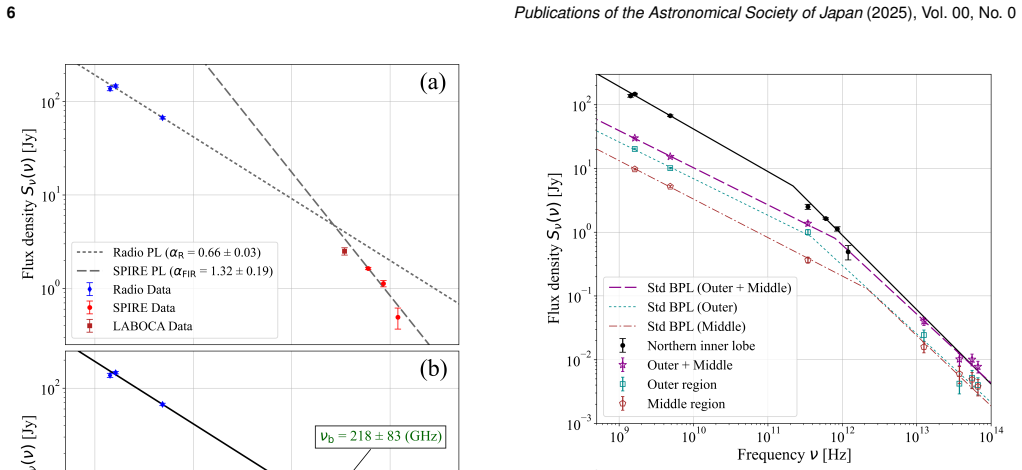
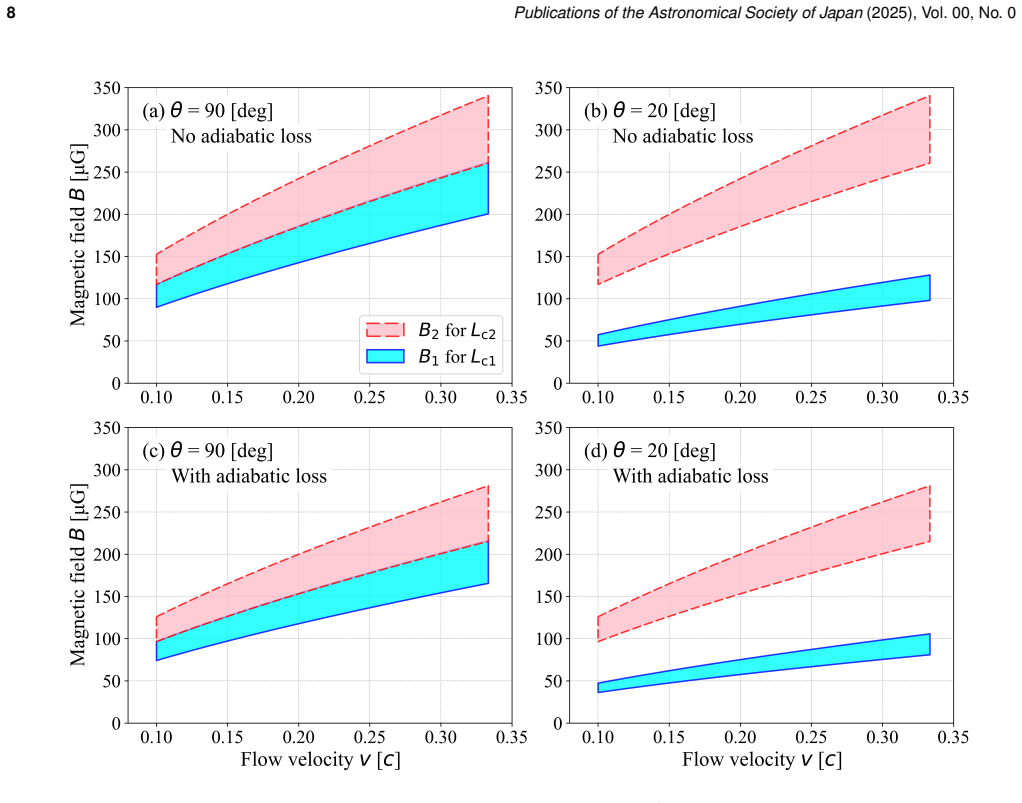
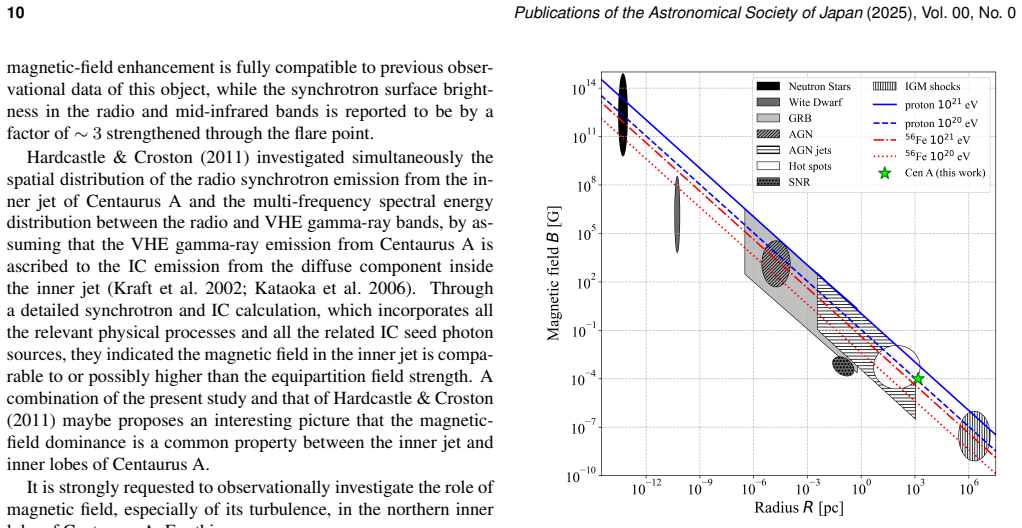
The integrated far-infrared flux density of the northern inner lobe is 1.63 Jy at 500 microns. The spectral index changes from 0.66 at radio frequencies to 1.32 at far-infrared frequencies, consistent with the expected shift for a synchrotron cooling break under continuous injection. The break frequency of 218 GHz implies a magnetic field B ≳ 100 μG, which is more than five times higher than the minimum-energy value and at least four times stronger than the inner-jet region, with only minor effects from adiabatic cooling or line-of-sight orientation.
What carries the argument
The cooling break frequency identified from the difference in spectral indices between radio and far-infrared data, which determines the magnetic field through the relation between synchrotron loss timescale and field strength.
Load-bearing premise
The change in spectral index is due solely to the standard synchrotron cooling break of 0.5 under continuous injection, without dominant contributions from other processes.
What would settle it
Multi-frequency observations that find either a spectral index change different from 0.5 or a break frequency much lower than 218 GHz would invalidate the magnetic field strength estimate.
Figures
read the original abstract
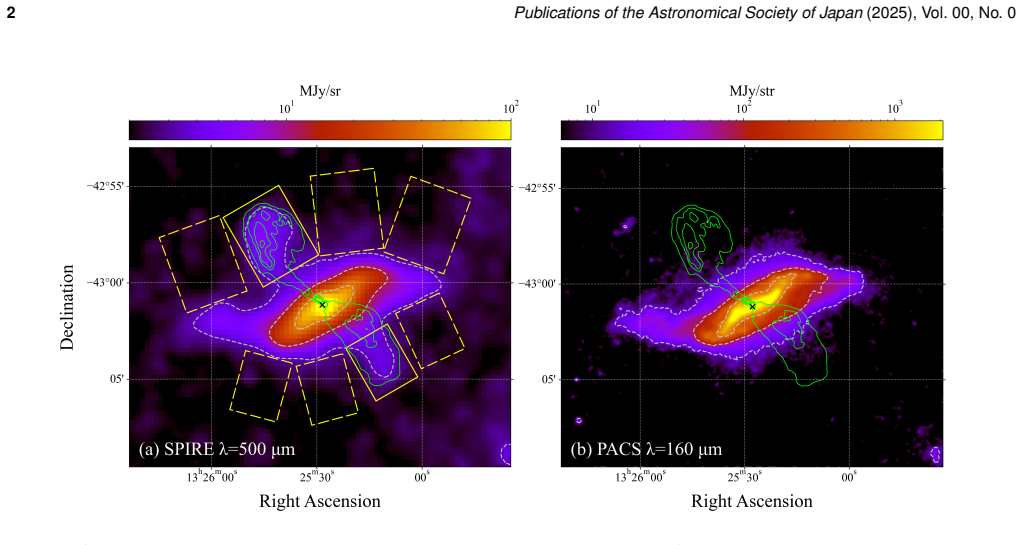
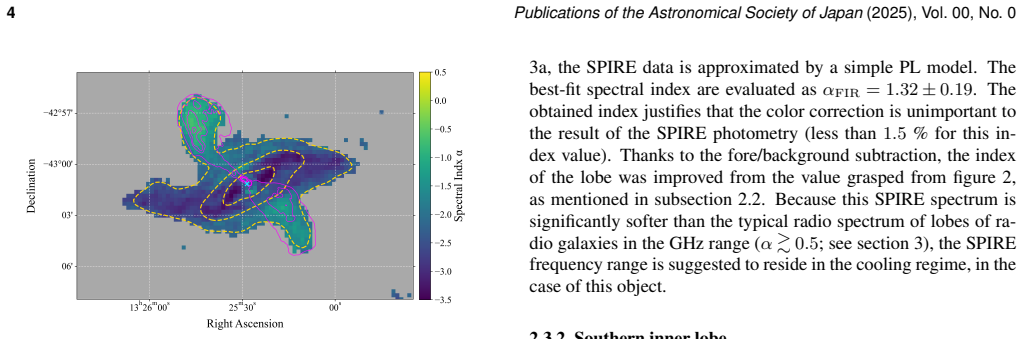
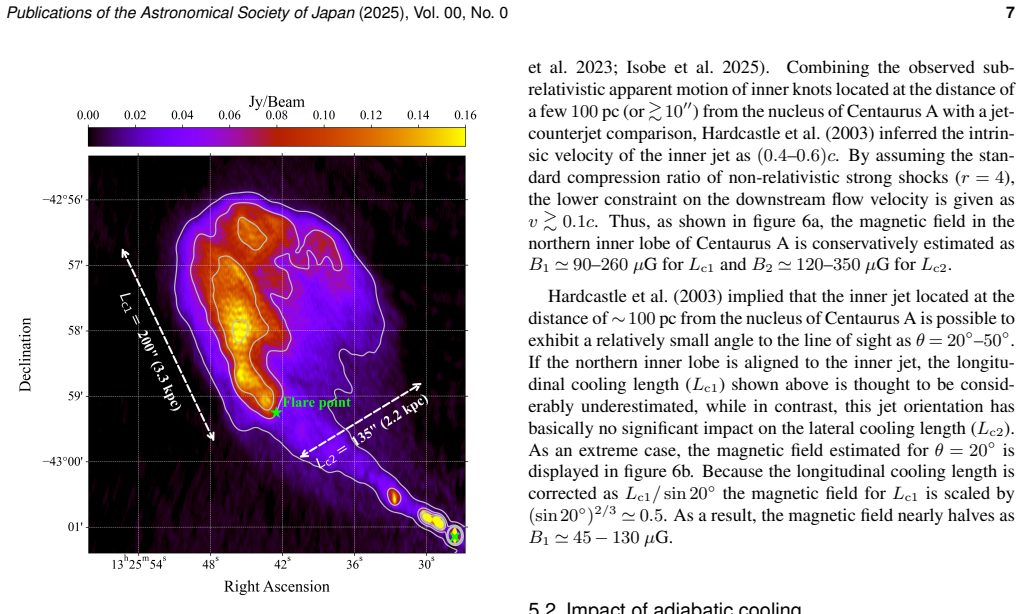
Diffuse far-infrared synchrotron emission filling the northern inner lobe of the radio galaxy Centaurus A is investigated with the Spectral and Photometric Imaging Receiver onboard the Herschel observatory at its three photometric bands. The far-infrared flux density spatially integrated over the lobe is measured as $S_{\rm \nu} = 1.63 \pm 0.05$ Jy at the wavelength of $500$ $\mu$m (the frequency of $600$ GHz). A comparison between the far-infrared spectral index derived with Herschel ($\alpha = 1.32 \pm 0.19$) and the radio index ($\alpha = 0.66 \pm 0.04$) suggests a spectral break between these frequency ranges. The change of the spectral index through the break is indicated to be consistent with that of the standard cooling break ($\Delta \alpha = 0.5$) predicted for particle acceleration under the continuous energy injection condition. A broken power-law model incorporating the standard cooling break yields the break frequency as $\nu_{\rm b} = 218 \pm 83$ GHz. From the measured cooling break frequency, the magnetic field of the northern inner lobe is evaluated as $B \gtrsim 100$ $\mu$G. It is quantitatively estimated that the adiabatic cooling puts only a minor impact on the derived magnetic field. This magnetic field is higher than that under the minimum-energy condition by more than a factor of $5$. In addition, the derived magnetic field of the lobe is suggested to be at least by a factor of $4$ stronger than that of the inner-jet region implied in the previous very-high-energy gamma-ray study. Even if the line-of-sight orientation of the lobe is considered in its possible extreme case, the magnetic field is found to be reduced only by a factor of 2, and the above arguments about the strong magnetic field basically holds. The science impact of this result is discussed from the viewpoints of jet energetics, and of ultra-high energy cosmic rays.
Editorial analysis
A structured set of objections, weighed in public.
Referee Report
Summary. The manuscript presents Herschel SPIRE far-infrared observations of the northern inner lobe of Centaurus A, reporting an integrated flux density of 1.63 ± 0.05 Jy at 500 μm (600 GHz) and a FIR spectral index α = 1.32 ± 0.19. Comparing this to the radio spectral index α = 0.66 ± 0.04, the authors identify a spectral break at ν_b = 218 ± 83 GHz that is consistent with the standard synchrotron cooling break (Δα = 0.5) under continuous energy injection. From this break frequency they derive a magnetic field B ≳ 100 μG in the lobe (more than 5× the minimum-energy value and at least 4× stronger than the inner-jet region), with quantitative estimates that adiabatic losses are minor and that extreme line-of-sight geometry reduces B by at most a factor of 2. Implications for jet energetics and UHECR acceleration are discussed.
Significance. If the cooling-break interpretation holds and the standard B(ν_b, t_age) relation applies without dominant adiabatic, inhomogeneous, or projection effects, the result would indicate magnetic fields in the lobe substantially exceeding equipartition, with direct consequences for the energy budget of the Centaurus A jet and the viability of lobe-based UHECR acceleration. The multi-wavelength constraint on the break frequency itself is a clear observational strength.
major comments (3)
- [Abstract] Abstract: the measured Δα = 0.66 is stated to be 'consistent with' the continuous-injection cooling increment of 0.5, yet the quoted uncertainties permit a range ~0.47–0.85. Because the central claim that the break is the standard synchrotron cooling break (rather than a composite of synchrotron plus adiabatic or inhomogeneous losses) rests on this consistency, the manuscript must show the statistical preference for Δα = 0.5 in the broken-power-law fit (e.g., via Δχ² or posterior odds) rather than relying on overlap alone.
- [Abstract] Abstract: derivation of B ≳ 100 μG from ν_b = 218 ± 83 GHz requires an independent lobe age t_age via the standard relation B ∝ (ν_b t_age²)^{-1/3}. The manuscript must state the adopted t_age (and its uncertainty) explicitly; a factor-of-two uncertainty in t_age propagates to a ~0.6 factor in B and directly affects whether the factor-of-5 excess over minimum-energy is secure.
- [Abstract] Abstract: the claim that 'adiabatic cooling puts only a minor impact on the derived magnetic field' is load-bearing for the interpretation that the observed break is purely synchrotron. The quantitative estimation (including the assumed expansion history and the resulting correction to ν_b) must be shown in the relevant methods or discussion section so that readers can assess its magnitude relative to the quoted ±83 GHz uncertainty on ν_b.
minor comments (2)
- The abstract states that the science impact is discussed from the viewpoints of jet energetics and UHECRs but provides no summary of the quantitative conclusions reached; a one-sentence outline would improve accessibility.
- Ensure that the broken-power-law fit parameters (normalization, low- and high-frequency indices, break frequency) and their covariance are tabulated or plotted with the data points so that the reader can reproduce the ν_b = 218 ± 83 GHz value.
Simulated Author's Rebuttal
We thank the referee for the constructive and detailed comments, which help clarify the presentation of our results. We respond to each major comment below and will revise the manuscript to address the points raised.
read point-by-point responses
-
Referee: [Abstract] Abstract: the measured Δα = 0.66 is stated to be 'consistent with' the continuous-injection cooling increment of 0.5, yet the quoted uncertainties permit a range ~0.47–0.85. Because the central claim that the break is the standard synchrotron cooling break (rather than a composite of synchrotron plus adiabatic or inhomogeneous losses) rests on this consistency, the manuscript must show the statistical preference for Δα = 0.5 in the broken-power-law fit (e.g., via Δχ² or posterior odds) rather than relying on overlap alone.
Authors: We agree that demonstrating a statistical preference strengthens the interpretation. In the revised manuscript we will report the χ² for the broken-power-law fit both with Δα fixed at the canonical value of 0.5 and with Δα allowed to vary freely, together with the resulting Δχ² (or equivalent posterior odds if a Bayesian fit is used). This will quantify the data's preference for the standard cooling-break model. revision: yes
-
Referee: [Abstract] Abstract: derivation of B ≳ 100 μG from ν_b = 218 ± 83 GHz requires an independent lobe age t_age via the standard relation B ∝ (ν_b t_age²)^{-1/3}. The manuscript must state the adopted t_age (and its uncertainty) explicitly; a factor-of-two uncertainty in t_age propagates to a ~0.6 factor in B and directly affects whether the factor-of-5 excess over minimum-energy is secure.
Authors: The magnetic-field estimate does rely on an adopted lobe age. We will explicitly quote the value of t_age (and its uncertainty) used in the calculation, together with the literature reference, both in the abstract and in the methods/discussion section of the revised manuscript. We will also note the propagated uncertainty on B and confirm that the factor-of-5 excess over the minimum-energy field remains secure within the stated range. revision: yes
-
Referee: [Abstract] Abstract: the claim that 'adiabatic cooling puts only a minor impact on the derived magnetic field' is load-bearing for the interpretation that the observed break is purely synchrotron. The quantitative estimation (including the assumed expansion history and the resulting correction to ν_b) must be shown in the relevant methods or discussion section so that readers can assess its magnitude relative to the quoted ±83 GHz uncertainty on ν_b.
Authors: We will expand the relevant discussion section to present the quantitative adiabatic-loss calculation in full, including the assumed expansion history, the derived correction to ν_b, and a direct comparison of that correction against the ±83 GHz measurement uncertainty. This will allow readers to evaluate the magnitude of the effect independently. revision: yes
Circularity Check
No significant circularity in derivation of B from cooling break
full rationale
The paper measures integrated FIR flux and spectral indices directly from Herschel and radio data, fits an external broken-power-law model (with fixed Δα=0.5) to extract ν_b, then inserts ν_b into the standard synchrotron cooling formula B∝(ν_b t_age²)^(-1/3) taken from the literature. None of these steps reduces the final B≳100 μG claim to a fitted parameter or self-citation by the paper's own equations; the result remains an application of independent physics to new observations.
Axiom & Free-Parameter Ledger
axioms (2)
- domain assumption Synchrotron cooling under continuous energy injection produces a spectral-index change of exactly Δα = 0.5
- domain assumption The standard relation between synchrotron break frequency, magnetic field, and electron lifetime applies without significant modification by adiabatic losses or source inhomogeneity
Reference graph
Works this paper leans on
-
[1]
2018, ApJL, 853, L29,
Aab, A., Abreu, P., Aglietta, M., et al. 2018, ApJL, 853, L29,
2018
-
[2]
2025, Phys
Abbasi, R., Ackermann, M., Adams, J., et al. 2025, Phys. Rev. Lett., 135, 031001,
2025
-
[3]
U., Abe, Y ., Abu-Zayyad, T., et al
Abbasi, R. U., Abe, Y ., Abu-Zayyad, T., et al. 2024, Phys. Rev. Lett., 133, 041001, Abdul Halim, A., Abreu, P., Aglietta, M., et al. 2024, Journal of Cosmology and Astroparticle Physics, 2024, 022,
2024
-
[4]
G., Anton, G., et al
Aharonian, F., Akhperjanian, A. G., Anton, G., et al. 2009, ApJL, 695, L40,
2009
-
[5]
W., Dunn, R
Allen, S. W., Dunn, R. J. H., Fabian, A. C., Taylor, G. B., & Reynolds, C. S. 2006, MNRAS, 372, 21,
2006
-
[6]
Auld, R., Smith, M. W. L., Bendo, G., et al. 2012, MNRAS, 420, 1882,
2012
-
[7]
2003, ApJ, 589, 827,
Bamba, A., Yamazaki, R., Ueno, M., & Koyama, K. 2003, ApJ, 589, 827,
2003
-
[8]
L., & Grindlay, J
Band, D. L., & Grindlay, J. E. 1985, ApJ, 298, 128,
1985
-
[9]
C., Blandford, R
Begelman, M. C., Blandford, R. D., & Rees, M. J. 1984, Reviews of Modern Physics, 56, 255,
1984
-
[10]
Bell, A. R. 1978, Monthly Notices of the Royal Astronomical Society, 182, 147,
1978
-
[11]
M., Mushotzky, R., et al
Bogensberger, D., Miller, J. M., Mushotzky, R., et al. 2024, ApJ, 974, 307,
2024
-
[12]
H., Lawrence, C
Brookes, M. H., Lawrence, C. R., Keene, J., et al. 2006, ApJL, 646, L41,
2006
-
[13]
Brunetti, G., Cappi, M., Setti, G., Feretti, L., & Harris, D. E. 2001, A&A, 372, 755,
2001
-
[14]
O., Feigelson, E
Burns, J. O., Feigelson, E. D., & Schreier, E. J. 1983, ApJ, 273, 128,
1983
-
[15]
L., Perley, R
Carilli, C. L., Perley, R. A., Dreher, J. W., & Leahy, J. P. 1991, Astrophysical Journal, 383, 554,
1991
-
[16]
A., Burns, J
Clarke, D. A., Burns, J. O., & Norman, M. L. 1992, ApJ, 395, 444,
1992
-
[17]
J., Helou, G., Sanders, D
Condon, J. J., Helou, G., Sanders, D. B., & Soifer, B. T. 1996, ApJS, 103, 81,
1996
-
[18]
H., Kraft, R
Croston, J. H., Kraft, R. P., Hardcastle, M. J., et al. 2009, MNRAS, 395, 1999, de Oliveira, C., Matthews, J. H., & de Souza, V . 2025, MNRAS, 539, 3697,
2009
-
[19]
Draine, B. T. 2003, ARA&A, 41, 241,
2003
-
[20]
L., & Riley, J
Fanaroff, B. L., & Riley, J. M. 1974, MNRAS, 167, 31P,
1974
-
[21]
2013, ApJ, 770, 84,
Fraschetti, F. 2013, ApJ, 770, 84,
2013
-
[22]
M., et al
Glenn, J., Meixner, M., Bradford, C. M., et al. 2025, Journal of Astronomical
2025
-
[23]
1966, Phys
Greisen, K. 1966, Phys. Rev. Lett., 16, 748,
1966
-
[24]
J., Abergel, A., Abreu, A., et al
Griffin, M. J., Abergel, A., Abreu, A., et al. 2010, A&A, 518, L3,
2010
-
[25]
J., North, C
Griffin, M. J., North, C. E., Schulz, B., et al. 2013, MNRAS, 434, 992, H. E. S. S. Collaboration, Abdalla, H., Adam, R., et al. 2020, Nature, 582, 356,
2013
-
[26]
2006, Journal of Cosmology and Astroparticle Physics, 2006, 012,
Harari, D., Mollerach, S., & Roulet, E. 2006, Journal of Cosmology and Astroparticle Physics, 2006, 012,
2006
-
[27]
J., & Croston, J
Hardcastle, M. J., & Croston, J. H. 2011, MNRAS, 415, 133,
2011
-
[28]
J., Harris, D
Hardcastle, M. J., Harris, D. E., Worrall, D. M., & Birkinshaw, M. 2004, ApJ, 612, 729,
2004
-
[29]
J., Kraft, R
Hardcastle, M. J., Kraft, R. P., & Worrall, D. M. 2006, MNRAS, 368, L15,
2006
-
[30]
J., Worrall, D
Hardcastle, M. J., Worrall, D. M., Kraft, R. P., et al. 2003, ApJ, 593, 169,
2003
-
[31]
E., & Grindlay, J
Harris, D. E., & Grindlay, J. E. 1979, MNRAS, 188, 25,
1979
-
[32]
J., Hardcastle, M
Harwood, J. J., Hardcastle, M. J., Croston, J. H., & Goodger, J. L. 2013, MNRAS, 435, 3353,
2013
-
[33]
Hillas, A. M. 1984, ARA&A, 22, 425,
1984
-
[34]
R., Johnson, M
Hunt, L. R., Johnson, M. C., Cigan, P. J., Gordon, D., & Spitzak, J. 2021, AJ, 162, 121,
2021
-
[35]
1996, ApJ, 463, 555, 1 https://archives.esac.esa.int/hsa/whsa/ 2 https://ned.ipac.caltech.edu/
Inoue, S., & Takahara, F. 1996, ApJ, 463, 555, 1 https://archives.esac.esa.int/hsa/whsa/ 2 https://ned.ipac.caltech.edu/
1996
-
[36]
2011, ApJ, 734, 77,
Inoue, T., Asano, K., & Ioka, K. 2011, ApJ, 734, 77,
2011
-
[37]
2009, ApJ, 695, 825,
Inoue, T., Yamazaki, R., & Inutsuka, S.-i. 2009, ApJ, 695, 825,
2009
-
[38]
2017, ApJ, 850, 193,
Isobe, N., Koyama, S., Kino, M., et al. 2017, ApJ, 850, 193,
2017
-
[39]
2005, ApJ, 632, 781,
Isobe, N., Makishima, K., Tashiro, M., & Hong, S. 2005, ApJ, 632, 781,
2005
-
[40]
2023, ApJ, 953, 76,
Isobe, N., Nagai, H., Kino, M., et al. 2023, ApJ, 953, 76,
2023
-
[41]
2025, Journal of Astronomical
Isobe, N., Nakagawa, T., Kino, M., et al. 2025, Journal of Astronomical
2025
-
[42]
2020, ApJ, 899, 17,
Isobe, N., Sunada, Y ., Kino, M., et al. 2020, ApJ, 899, 17,
2020
-
[43]
2002, ApJL, 580, L111,
Isobe, N., Tashiro, M., Makishima, K., et al. 2002, ApJL, 580, L111,
2002
-
[44]
Israel, F. P. 1998, A&AR, 8, 237,
1998
-
[45]
2008, ApJ, 685, 828,
Ito, H., Kino, M., Kawakatu, N., Isobe, N., & Yamada, S. 2008, ApJ, 685, 828,
2008
-
[46]
Jamrozy, M., Konar, C., Machalski, J., & Saikia, D. J. 2008, MNRAS, 385, 1286,
2008
-
[47]
2021, Nature Astronomy, 5, 1017,
Janssen, M., Falcke, H., Kadler, M., et al. 2021, Nature Astronomy, 5, 1017,
2021
-
[48]
P., Ruszkowski, M., & Markevitch, M
Ji, S., Oh, S. P., Ruszkowski, M., & Markevitch, M. 2016, MNRAS, 463, 3989,
2016
-
[49]
2005, ApJ, 622, 797,
Kataoka, J., & Stawarz, Ł. 2005, ApJ, 622, 797,
2005
-
[50]
2006, ApJ, 641, 158,
Kataoka, J., Stawarz, Ł., Aharonian, F., et al. 2006, ApJ, 641, 158,
2006
-
[51]
2016, MNRAS, 457, 1124,
Kawakatu, N., Kino, M., & Takahara, F. 2016, MNRAS, 457, 1124,
2016
-
[52]
Kim, H. B. 2013, ApJ, 764, 121,
2013
-
[53]
2012, ApJ, 751, 101,
Kino, M., Kawakatu, N., & Takahara, F. 2012, ApJ, 751, 101,
2012
-
[54]
2004, Monthly Notices of the Royal Astronomical Society, 349, 336,
Kino, M., & Takahara, F. 2004, Monthly Notices of the Royal Astronomical Society, 349, 336,
2004
-
[55]
G., & Duffy, P
Kirk, J. G., & Duffy, P. 1999, Journal of Physics G Nuclear Physics, 25, R163,
1999
-
[56]
Kotera, K., & Olinto, A. V . 2011, ARA&A, 49, 119,
2011
-
[57]
P., Forman, W
Kraft, R. P., Forman, W. R., Jones, C., et al. 2002, ApJ, 569, 54,
2002
-
[58]
P., Vázquez, S
Kraft, R. P., Vázquez, S. E., Forman, W. R., et al. 2003, ApJ, 592, 129,
2003
-
[59]
P., Nulsen, P
Kraft, R. P., Nulsen, P. E. J., Birkinshaw, M., et al. 2007, ApJ, 665, 1129,
2007
-
[60]
H., Bell, A
Matthews, J. H., Bell, A. R., Blundell, K. M., & Araudo, A. T. 2018, MNRAS, 479, L76,
2018
-
[61]
G., & Roeser, H
Meisenheimer, K., Yates, M. G., & Roeser, H. J. 1997, Astronomy and Astrophysics, 325, 57
1997
-
[62]
1980, ARA&A, 18, 165,
Miley, G. 1980, ARA&A, 18, 165,
1980
-
[63]
2011, ApJ, 726, 62,
Mizuno, Y ., Pohl, M., Niemiec, J., et al. 2011, ApJ, 726, 62,
2011
-
[64]
2022, Phys
Mollerach, S., & Roulet, E. 2022, Phys. Rev. D, 105, 063001, —. 2024, Phys. Rev. D, 110, 063030,
2022
-
[65]
V ., Stawarz, L., Porter, T
Moskalenko, I. V ., Stawarz, L., Porter, T. A., & Cheung, C. C. 2009, ApJ, 693, 1261,
2009
-
[66]
Pacholczyk, A. G. 1970, Radio astrophysics. Nonthermal processes in galactic and extragalactic sources
1970
-
[67]
J., Wilson, C
Parkin, T. J., Wilson, C. D., Foyle, K., et al. 2012, MNRAS, 422, 2291,
2012
-
[68]
A., & Butler, B
Perley, R. A., & Butler, B. J. 2017, ApJS, 230, 7, Pierre Auger Collaboration, Abraham, J., Abreu, P., et al. 2007, Science, 318, 938,
2017
-
[69]
2010, A&A, 518, L2,
Poglitsch, A., Waelkens, C., Geis, N., et al. 2010, A&A, 518, L2,
2010
-
[70]
E., Combi, J
Romero, G. E., Combi, J. A., Perez Bergliaffa, S. E., & Anchordoqui, L. A. 1996, Astroparticle Physics, 5, 279,
1996
-
[71]
2012, ApJ, 758, 126,
Sano, T., Nishihara, K., Matsuoka, C., & Inoue, T. 2012, ApJ, 758, 126,
2012
-
[72]
S., et al
Sunada, Y ., Isobe, N., Tashiro, M. S., et al. 2022, MNRAS, 512, 5995,
2022
-
[73]
J., & Lenc, E
Tingay, S. J., & Lenc, E. 2009, AJ, 138, 808,
2009
-
[74]
2021, PoS, ICRC2021, 392,
Tkachev, I., et al. 2021, PoS, ICRC2021, 392,
2021
-
[75]
A., Tanaka, T., Takahashi, T., & Maeda, Y
Uchiyama, Y ., Aharonian, F. A., Tanaka, T., Takahashi, T., & Maeda, Y . 2007, Nature, 449, 576,
2007
-
[76]
M., Cheung, C
Uchiyama, Y ., Urry, C. M., Cheung, C. C., et al. 2006, ApJ, 648, 910,
2006
-
[77]
Vink, J., & Laming, J. M. 2003, ApJ, 584, 758, Weiß, A., Kovács, A., Güsten, R., et al. 2008, A&A, 490, 77,
2003
-
[78]
T., & Kuz’min, V
Zatsepin, G. T., & Kuz’min, V . A. 1966, Soviet Journal of Experimental and Theoretical Physics Letters, 4, 78
1966
discussion (0)
Sign in with ORCID, Apple, or X to comment. Anyone can read and Pith papers without signing in.