KG-FairDiff: Knowledge Graph-Guided Prompt Refinement for Demographically Fair Text-to-Image Generation
Pith reviewed 2026-06-28 17:34 UTC · model grok-4.3
The pith
KG-FairDiff refines user prompts at inference time with a knowledge graph to cut gender, race, age, and intersectional biases in text-to-image outputs.
A machine-rendered reading of the paper's core claim, the machinery that carries it, and where it could break.
Core claim
KG-FairDiff formalises fairness-aware prompt refinement as a constrained optimisation problem and solves it via a closed-loop pipeline in which a knowledge graph of approximately 1,200 triples retrieves structured context, an LLM proposes candidate refinements, and a validator retains only those prompts that reduce a divergence-based fairness loss while preserving semantic fidelity to the original user intent. The framework proves a finite-termination bound, contributes an evaluation suite that links Bias-P and Bias-W to divergence from target distributions and ENS to KL divergence, and demonstrates substantial reductions in gender, race, age, and intersectional disparities across eight wide
What carries the argument
The closed-loop pipeline that retrieves context from a knowledge graph of culture- and bias-related triples, uses an LLM rewriter, and validates refinements against a divergence-based fairness loss.
If this is right
- Refined prompts yield images that reduce under-representation of women, people of colour, older adults, and non-Western cultures.
- The method operates at inference time and requires no changes to the underlying generator weights.
- Semantic fidelity is preserved by the validator, so user intent remains intact.
- The finite-termination bound guarantees the refinement loop ends after a bounded number of iterations.
- The supplied evaluation suite gives a uniform way to compare fairness across different text-to-image backbones.
Where Pith is reading between the lines
- The same graph-guided loop could be adapted to other generative modalities such as text-to-video if equivalent bias triples are assembled.
- Periodic updates to the knowledge graph from new cultural data would allow the system to track shifting notions of fairness over time.
- Defining the target demographic distributions inside the loss function requires external choices that may themselves become points of contention.
- The validator could be extended to additional constraints such as style or composition consistency without altering the core pipeline.
Load-bearing premise
The knowledge graph supplies accurate and sufficient context for the LLM rewriter and the divergence-based fairness loss correctly quantifies demographic fairness without introducing new distortions.
What would settle it
Apply KG-FairDiff to a fixed test set of prompts, generate images from the refined and original prompts with the same backbone, and observe no measurable drop in the reported demographic disparity metrics or a clear drop in semantic similarity scores.
Figures

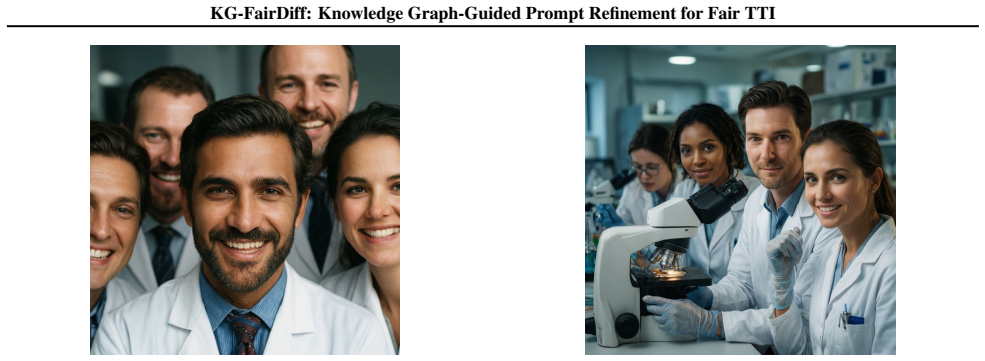
read the original abstract
Text-to-Image (TTI) systems are now everyday infrastructure for journalism, education, advertising, and public communication, and the demographic and cultural stereotypes they inherit from training data (rendering women, people of colour, older adults, and non-Western cultures as under-represented or caricatured) become a population-level harm at deployment scale. Existing mitigations either require costly retraining, infeasible for the closed-source backbones that dominate consumer products, or rely on fixed demographic templates that ignore cultural context. We present KG-FairDiff, a model-agnostic, inference-time framework that formalises fairness-aware prompt refinement as a constrained optimisation problem and operationalises it as a closed-loop pipeline: a knowledge graph of ~1,200 culture- and bias-related triples retrieves structured context, an LLM rewriter proposes refinements, and a validator accepts only prompts that reduce a divergence-based fairness loss while preserving semantic fidelity to the user's original intent. We prove a finite-termination bound for the refinement loop, contribute a mathematically consistent evaluation suite linking Bias-P/Bias-W to divergence from target distributions and ENS to KL divergence, and audit eight widely-deployed backbone generators. KG-FairDiff substantially reduces gender, race, age, and intersectional disparities while preserving prompt semantics, offering a practical, deployment-ready route to more equitable generative AI.
Editorial analysis
A structured set of objections, weighed in public.
Referee Report
Summary. The manuscript presents KG-FairDiff, a model-agnostic inference-time framework for demographically fair text-to-image generation. It models fairness-aware prompt refinement as a constrained optimization problem implemented via a closed-loop pipeline consisting of a knowledge graph with approximately 1,200 culture- and bias-related triples, an LLM-based rewriter, and a validator that accepts refinements only if they reduce a divergence-based fairness loss while preserving semantic fidelity. The authors prove a finite-termination bound for the refinement loop, introduce an evaluation suite linking existing bias metrics (Bias-P/Bias-W) to divergence from target distributions and ENS to KL divergence, and report audits on eight backbone generators claiming substantial reductions in gender, race, age, and intersectional disparities.
Significance. If the empirical results hold and the fairness loss is shown to correlate with actual demographic fairness in generated images, this work would be significant for providing a practical, deployment-ready method to mitigate biases in widely used TTI systems without requiring retraining of closed-source models. The finite-termination proof and the mathematically consistent evaluation suite are notable strengths that support the framework's reliability if validated.
major comments (2)
- [Abstract] Abstract: The abstract claims substantial reductions on eight backbones and a finite-termination proof, but provides no experimental details, data, error bars, or validation that the divergence-based fairness loss (Bias-P/Bias-W matched to targets, ENS via KL) correlates with measured demographic disparities in the generated images (e.g., via classifiers or human audit). This is load-bearing for the central deployment claim.
- [Evaluation suite] Evaluation suite: The contribution of linking Bias-P/Bias-W to divergence from target distributions and ENS to KL divergence is presented as mathematically consistent, but without explicit verification that minimizing this loss leads to reduced disparities as measured by standard demographic classifiers on the output images, the reductions may not reflect real fairness improvements.
minor comments (1)
- The description of the knowledge graph size (~1,200 triples) could benefit from more detail on its construction and coverage to allow reproducibility.
Simulated Author's Rebuttal
We thank the referee for the constructive feedback on our manuscript. The comments correctly identify areas where additional clarity and validation would strengthen the presentation of our results and the reliability of the evaluation suite. We address each major comment below and outline revisions that will be incorporated in the next version.
read point-by-point responses
-
Referee: [Abstract] Abstract: The abstract claims substantial reductions on eight backbones and a finite-termination proof, but provides no experimental details, data, error bars, or validation that the divergence-based fairness loss (Bias-P/Bias-W matched to targets, ENS via KL) correlates with measured demographic disparities in the generated images (e.g., via classifiers or human audit). This is load-bearing for the central deployment claim.
Authors: The abstract is a concise summary and therefore omits detailed experimental parameters, data tables, and error bars, which appear in Section 4 (audits on eight backbones) and Section 3 (finite-termination proof). We agree that the correlation between the proposed divergence-based loss and actual demographic disparities measured by independent classifiers or human audits is central to the deployment claim. The current version relies on established metrics without providing this explicit cross-validation; we will add a new subsection with classifier-based verification experiments and a brief discussion of this point in the revised manuscript. revision: yes
-
Referee: [Evaluation suite] Evaluation suite: The contribution of linking Bias-P/Bias-W to divergence from target distributions and ENS to KL divergence is presented as mathematically consistent, but without explicit verification that minimizing this loss leads to reduced disparities as measured by standard demographic classifiers on the output images, the reductions may not reflect real fairness improvements.
Authors: The evaluation suite formalizes the use of established bias metrics through divergence measures to enable consistent, model-agnostic assessment. While the manuscript demonstrates consistent metric reductions across backbones, we acknowledge that direct verification—showing that loss minimization produces corresponding improvements when images are scored by standard demographic classifiers—would provide stronger evidence that the reductions reflect real fairness gains. We will include such verification experiments in the revised version. revision: yes
Circularity Check
No significant circularity in derivation chain
full rationale
The paper describes a self-contained framework that takes an external knowledge graph of ~1,200 triples as input, applies an LLM rewriter, and enforces a divergence-based fairness loss (linking Bias-P/Bias-W to target distributions and ENS to KL divergence) plus a finite-termination bound. The evaluation suite is presented as a new linking of existing metrics rather than a redefinition of fitted parameters. No quoted equations or steps reduce the central claims (prompt refinement optimisation, fairness quantification, or termination proof) to self-defined inputs, fitted subsets renamed as predictions, or load-bearing self-citations. The derivation therefore remains independent of the patterns that would indicate circularity.
Axiom & Free-Parameter Ledger
axioms (1)
- standard math The refinement loop terminates after finite steps under the constrained optimisation formulation.
invented entities (1)
-
KG-FairDiff closed-loop pipeline
no independent evidence
Reference graph
Works this paper leans on
-
[1]
PreciseDebias: An Automatic Prompt Engineering Approach for Generative AI to Mitigate Image Demographic Biases , year=
Clemmer, Colton and Ding, Junhua and Feng, Yunhe , booktitle=. PreciseDebias: An Automatic Prompt Engineering Approach for Generative AI to Mitigate Image Demographic Biases , year=
-
[2]
2025 , url=
FairCoT: Enhancing Fairness in Diffusion Models via Chain of Thought Reasoning of Multimodal Language Models , author=. 2025 , url=
2025
-
[3]
2024 , url=
MinorityPrompt: Text to Minority Image Generation via Prompt Optimization , author=. 2024 , url=
2024
-
[4]
2025 , eprint=
FairImagen: Post-Processing for Bias Mitigation in Text-to-Image Models , author=. 2025 , eprint=
2025
-
[5]
Dominguez-Catena, Iris and Paternain, Daniel and Galar, Mikel , title =. 2024 , issue_date =. doi:10.1109/TPAMI.2024.3361979 , journal =
-
[6]
Proceedings of the IEEE/CVF Winter Conference on Applications of Computer Vision , year=
FairFace: Face Attribute Dataset for Balanced Race, Gender, and Age for Bias Measurement and Mitigation , author=. Proceedings of the IEEE/CVF Winter Conference on Applications of Computer Vision , year=
-
[7]
CDE val: A Benchmark for Measuring the Cultural Dimensions of Large Language Models
Wang, Yuhang and et al. CDE val: A Benchmark for Measuring the Cultural Dimensions of Large Language Models. Proceedings of the 2nd Workshop on Cross-Cultural Considerations in NLP. 2024. doi:10.18653/v1/2024.c3nlp-1.1
-
[8]
2025 , url=
Rethinking Training for De-biasing Text-to-Image Generation: Unlocking the Potential of Stable Diffusion , author=. 2025 , url=
2025
-
[9]
Thirty-seventh Conference on Neural Information Processing Systems Datasets and Benchmarks Track , year=
Stable Bias: Evaluating Societal Representations in Diffusion Models , author=. Thirty-seventh Conference on Neural Information Processing Systems Datasets and Benchmarks Track , year=
-
[10]
2025 , url=
Images Speak Louder than Words: Understanding and Mitigating Bias in Vision-Language Model from a Causal Mediation Perspective , author=. 2025 , url=
2025
-
[11]
Vasilev, V. A. and et al. , year=. CRAFT: Cultural Russian-Oriented Dataset Adaptation for Focused Text-to-Image Generation , url=. doi:10.1134/s1064562424602324 , journal=
-
[12]
2024 , url=
CIVICS: Building a Dataset for Examining Culturally-Informed Values in Large Language Models , author=. 2024 , url=
2024
-
[13]
Data Augmentation Techniques Using Text-to-Image Diffusion Models for Enhanced Data Diversity , year=
Shin, Jeongmin and Jang, Hyeryung , booktitle=. Data Augmentation Techniques Using Text-to-Image Diffusion Models for Enhanced Data Diversity , year=
-
[14]
Submitted to Transactions on Machine Learning Research , year=
Diverse Diffusion: Enhancing Image Diversity in Text-to-Image Generation , author=. Submitted to Transactions on Machine Learning Research , year=
-
[15]
T 2 IAT : Measuring Valence and Stereotypical Biases in Text-to-Image Generation
Wang, Jialu and et al. T 2 IAT : Measuring Valence and Stereotypical Biases in Text-to-Image Generation. Findings of the Association for Computational Linguistics: ACL 2023. 2023. doi:10.18653/v1/2023.findings-acl.160
-
[16]
2023 , url=
Mitigating stereotypical biases in text to image generative systems , author=. 2023 , url=
2023
-
[17]
2024 , url=
15M Multimodal Facial Image-Text Dataset , author=. 2024 , url=
2024
-
[18]
2024 , url=
Fair Text-to-Image Diffusion via Fair Mapping , author=. 2024 , url=
2024
-
[19]
Addressing Bias in Text-to-Image Generation: A Review of Mitigation Methods , year=
Prerak, Shah , booktitle=. Addressing Bias in Text-to-Image Generation: A Review of Mitigation Methods , year=
-
[20]
2024 , url=
Survey of Bias In Text-to-Image Generation: Definition, Evaluation, and Mitigation , author=. 2024 , url=
2024
-
[21]
Quantifying Bias in Text-to-Image Generative Models , year=
Vice, Jordan and Akhtar, Naveed and Hartley, Richard and Mian, Ajmal , journal=. Quantifying Bias in Text-to-Image Generative Models , year=
-
[22]
2025 , url=
Exploring Bias in over 100 Text-to-Image Generative Models , author=. 2025 , url=
2025
-
[23]
2025 , url=
A Survey of Automatic Prompt Optimization with Instruction-focused Heuristic-based Search Algorithm , author=. 2025 , url=
2025
-
[24]
Prompt Optimization via Adversarial In-Context Learning
Do, Xuan Long and et al. Prompt Optimization via Adversarial In-Context Learning. Proceedings of the 62nd Annual Meeting of the Association for Computational Linguistics (Volume 1: Long Papers). 2024. doi:10.18653/v1/2024.acl-long.395
-
[25]
Proceedings of the IEEE/CVF Conference on Computer Vision and Pattern Recognition (CVPR) , year =
Miao, Zichen and Wang, Jiang and Wang, Ze and Yang, Zhengyuan and Wang, Lijuan and Qiu, Qiang and Liu, Zicheng , title =. Proceedings of the IEEE/CVF Conference on Computer Vision and Pattern Recognition (CVPR) , year =
-
[26]
Shi, Weiyan and et al. C ulture B ank: An Online Community-Driven Knowledge Base Towards Culturally Aware Language Technologies. Findings of the Association for Computational Linguistics: EMNLP 2024. 2024. doi:10.18653/v1/2024.findings-emnlp.288
-
[27]
The Thirty-eighth Annual Conference on Neural Information Processing Systems , year=
Efficient Prompt Optimization Through the Lens of Best Arm Identification , author=. The Thirty-eighth Annual Conference on Neural Information Processing Systems , year=
-
[28]
2025 , url=
Meta-Prompt Optimization for LLM-Based Sequential Decision Making , author=. 2025 , url=
2025
-
[29]
2025 , url=
Culture-TRIP: Culturally-Aware Text-to-Image Generation with Iterative Prompt Refinement , author=. 2025 , url=
2025
-
[30]
2025 , url=
CultureVLM: Characterizing and Improving Cultural Understanding of Vision-Language Models for over 100 Countries , author=. 2025 , url=
2025
-
[31]
2024 , url=
DRAGIN: Dynamic Retrieval Augmented Generation based on the Information Needs of Large Language Models , author=. 2024 , url=
2024
-
[32]
2024 , url=
SCoFT: Self-Contrastive Fine-Tuning for Equitable Image Generation , author=. 2024 , url=
2024
-
[33]
2024 , url=
Analyzing Quality, Bias, and Performance in Text-to-Image Generative Models , author=. 2024 , url=
2024
-
[34]
2024 , url=
Measuring Political Bias in Large Language Models: What Is Said and How It Is Said , author=. 2024 , url=
2024
-
[35]
Gallegos, Isabel O. and et al. , title =. Computational Linguistics , year =. doi:10.1162/coli_a_00524 , url =
-
[36]
2025 , url=
BiasGuard: A Reasoning-enhanced Bias Detection Tool For Large Language Models , author=. 2025 , url=
2025
-
[37]
2024 , url=
Investigating Bias in LLM-Based Bias Detection: Disparities between LLMs and Human Perception , author=. 2024 , url=
2024
-
[38]
2025 , url=
FACTER: Fairness-Aware Conformal Thresholding and Prompt Engineering for Enabling Fair LLM-Based Recommender Systems , author=. 2025 , url=
2025
-
[39]
2025 , url=
Mitigating Social Bias in Large Language Models: A Multi-Objective Approach within a Multi-Agent Framework , author=. 2025 , url=
2025
-
[40]
ACM Multimedia 2024 , year=
Mitigating Social Biases in Text-to-Image Diffusion Models via Linguistic-Aligned Attention Guidance , author=. ACM Multimedia 2024 , year=
2024
-
[41]
2025 , url=
Understanding and Mitigating Gender Bias in LLMs via Interpretable Neuron Editing , author=. 2025 , url=
2025
-
[42]
and Ritter, Alan and Xu, Wei , title =
Naous, Tarek and et al. Having Beer after Prayer? Measuring Cultural Bias in Large Language Models. Proceedings of the 62nd Annual Meeting of the Association for Computational Linguistics (Volume 1: Long Papers). 2024. doi:10.18653/v1/2024.acl-long.862
-
[43]
2025 , url=
BiasConnect: Investigating Bias Interactions in Text-to-Image Models , author=. 2025 , url=
2025
-
[44]
Proceedings of the IEEE/CVF Conference on Computer Vision and Pattern Recognition (CVPR) , month =
D'Inc\`. Proceedings of the IEEE/CVF Conference on Computer Vision and Pattern Recognition (CVPR) , month =. 2024 , pages =
2024
-
[45]
Advances in Neural Information Processing Systems , volume =
Holistic Evaluation of Text-to-Image Models , author =. Advances in Neural Information Processing Systems , volume =. 2024 , url =
2024
-
[46]
Proceedings of the IEEE/CVF International Conference on Computer Vision (ICCV) , month =
Zhang, Cheng and Chen, Xuanbai and Chai, Siqi and Wu, Chen Henry and Lagun, Dmitry and Beeler, Thabo and De la Torre, Fernando , title =. Proceedings of the IEEE/CVF International Conference on Computer Vision (ICCV) , month =. 2023 , pages =
2023
-
[47]
2025 , doi =
Bonna, Sarah and Huang, Yu-Cheng and Novozhilova, Ekaterina and Paik, Sejin and Shan, Zhengyang and Feng, Michelle Yilin and Gao, Ge and Tayal, Yonish and Kulkarni, Rushil and Yu, Jialin and Divekar, Nupur and Ghadiyaram, Deepti and Wijaya, Derry and Betke, Margrit , booktitle =. 2025 , doi =
2025
-
[48]
AI and Ethics , volume =
Auditing and Instructing Text-to-Image Generation Models on Fairness , author =. AI and Ethics , volume =. 2025 , doi =
2025
discussion (0)
Sign in with ORCID, Apple, or X to comment. Anyone can read and Pith papers without signing in.