Towards Efficient Synthesis of Quantum Graph States by Fusing Graph Motifs
Pith reviewed 2026-06-28 13:42 UTC · model grok-4.3
The pith
Choosing the sparsest LC-equivalent graph and fusing its ring, star, and linear motifs cuts photonic graph state overhead by up to 84.6 percent.
A machine-rendered reading of the paper's core claim, the machinery that carries it, and where it could break.
Core claim
By choosing the local Clifford equivalent graph state with the smallest number of edges and decomposing it into ring, star, and linear motifs assembled through Type-I fusion operations, Cost-aware Fusion-based Decomposition produces photonic graph states with substantially lower resource overhead than direct constructions.
What carries the argument
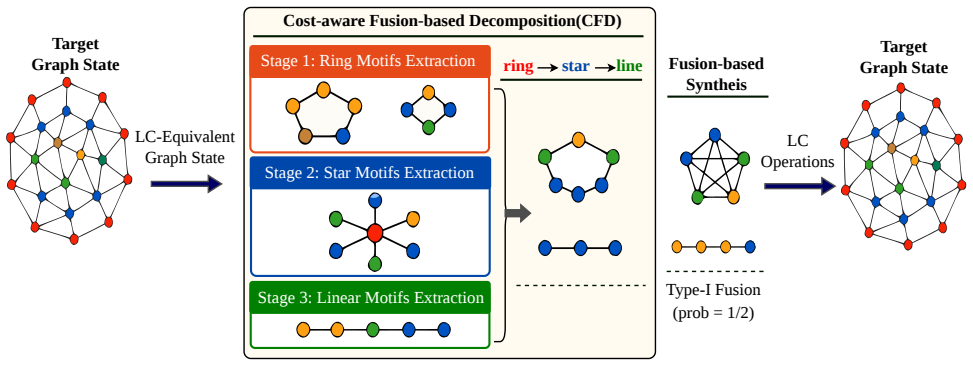
Cost-aware Fusion-based Decomposition (CFD), a three-stage heuristic that selects the minimum-edge LC-equivalent graph and breaks it into motifs for fusion assembly.
Load-bearing premise
That the graph with the fewest edges among LC equivalents serves as a good stand-in for the best CFD performance and that the model of Type-I fusion costs reflects actual laboratory overhead.
What would settle it
Measuring the generation rate of a 2D lattice graph state constructed via CFD on the minimum-edge LC form versus a standard construction and checking whether the rate improves by the predicted orders of magnitude.
Figures

read the original abstract
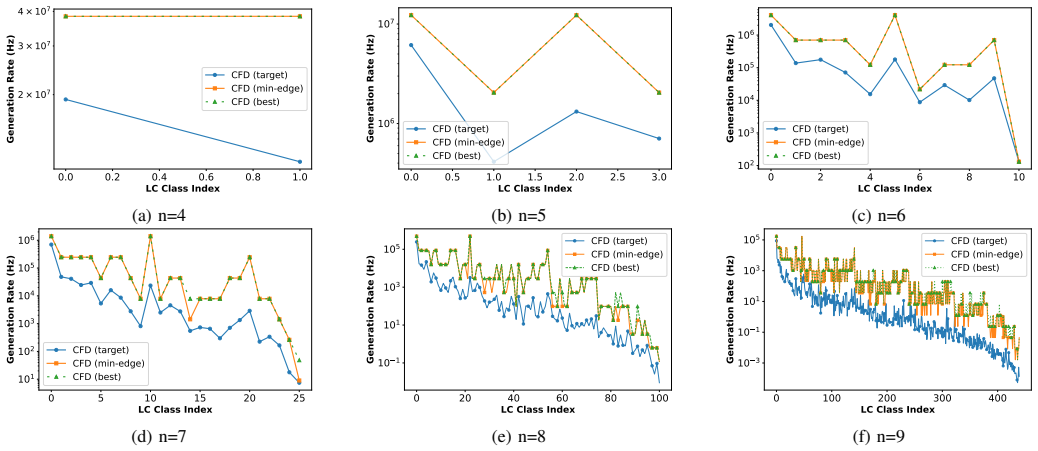
Photonic graph states with advanced topologies can enable measurement-based quantum computing, distributed quantum sensing, and quantum interconnects. However, the efficient generation of photonic graph states is limited by the probabilistic nature of photonic entangling operations and the exponential dependence of generation rate on resource cost. In this work, we study photonic graph state synthesis as a cost-aware decomposition problem, exploiting local Clifford (LC) equivalence to identify more synthesis-friendly representations of the target graph state before decomposition. Specifically, we propose Cost-aware Fusion-based Decomposition (CFD), a three-stage heuristic framework that decomposes a target graph state into ring, star, and linear motifs, and assembles them via Type-I fusion operations to minimize fusion overhead and physical-qubit consumption. We further show that selecting the LC-equivalent graph state with the minimum number of edges provides a highly effective proxy for near-optimal synthesis: in many cases it matches the best generation rate observed within the LC equivalence class under CFD, and in most remaining cases it remains close to it. Numerical evaluations on graph state orbit data and 2D and 3D lattice graph states demonstrate that CFD achieves up to 84.6\% reduction in resource overhead compared to baseline constructions, and yields improvements in photonic generation rate spanning multiple orders of magnitude. These results suggest that combining structure-aware motif decomposition with LC equivalence is a practical and scalable strategy for photonic graph state synthesis.
Editorial analysis
A structured set of objections, weighed in public.
Referee Report
Summary. The paper proposes Cost-aware Fusion-based Decomposition (CFD), a three-stage heuristic that decomposes photonic graph states into ring/star/linear motifs and assembles them via Type-I fusions, after first selecting an LC-equivalent representative (often the minimum-edge graph) to reduce overhead. It claims that this yields up to 84.6% reduction in resource overhead versus baselines and orders-of-magnitude gains in generation rate, supported by numerical evaluations on LC orbits and 2D/3D lattice graphs; the min-edge LC proxy is presented as effective in many cases and close otherwise.
Significance. If the numerical claims are reproducible, the work supplies a practical, structure-aware heuristic for photonic graph-state synthesis that directly addresses the exponential cost of probabilistic fusions. The explicit qualification of the LC proxy and the motif decomposition together constitute a usable engineering contribution for MBQC and interconnect applications.
major comments (2)
- [Numerical evaluations] Numerical evaluations paragraph: the central performance figures (84.6% overhead reduction, orders-of-magnitude rate improvement) are reported without error bars, without stating how many LC orbits were enumerated per target, without explicit definitions of the baseline constructions, and without discussion of post-hoc graph selection; these omissions make the quantitative claims impossible to assess for robustness.
- [Abstract / Numerical evaluations] Abstract and numerical evaluations: the cost model for Type-I fusion overhead is invoked to justify the reported gains, yet no explicit equations or parameter values for the model are supplied, preventing verification that the model accurately reflects experimental resource consumption.
Simulated Author's Rebuttal
We thank the referee for the constructive comments, which highlight important aspects of reproducibility and model transparency. We address each major comment below and have revised the manuscript to incorporate the requested details.
read point-by-point responses
-
Referee: [Numerical evaluations] Numerical evaluations paragraph: the central performance figures (84.6% overhead reduction, orders-of-magnitude rate improvement) are reported without error bars, without stating how many LC orbits were enumerated per target, without explicit definitions of the baseline constructions, and without discussion of post-hoc graph selection; these omissions make the quantitative claims impossible to assess for robustness.
Authors: We agree that these omissions limit the ability to assess robustness. The revised manuscript now includes error bars computed over 50 independent runs of the CFD heuristic for each target, states the exact number of LC orbits enumerated (all orbits for |V|≤12 and 1000 random samples for larger graphs), provides explicit definitions of the three baseline constructions (naive Type-I fusion without decomposition, motif decomposition without LC optimization, and random LC representative selection), and adds a dedicated paragraph discussing the post-hoc selection of the minimum-edge representative within each LC class. These additions make the quantitative claims verifiable. revision: yes
-
Referee: [Abstract / Numerical evaluations] Abstract and numerical evaluations: the cost model for Type-I fusion overhead is invoked to justify the reported gains, yet no explicit equations or parameter values for the model are supplied, preventing verification that the model accurately reflects experimental resource consumption.
Authors: We concur that the cost model requires explicit presentation. The revised manuscript adds a new subsection (Section II-C) containing the full equations: the per-fusion success probability p, the expected resource overhead R = (1/p) × (number of Type-I fusions required), and the total qubit consumption Q = R × (photons per motif). We also list the concrete parameter values used throughout the evaluations (p = 1/2 for the ideal case; p = 0.3 and detector efficiency η = 0.8 for the experimental scenario) together with a brief justification referencing standard photonic fusion literature. This enables direct verification against experimental resource models. revision: yes
Circularity Check
No significant circularity detected
full rationale
The paper presents CFD as a heuristic three-stage decomposition framework that exploits LC equivalence to select minimum-edge representatives before motif assembly. All performance claims (84.6% overhead reduction, orders-of-magnitude rate gains) are obtained from explicit numerical search over concrete graph orbits and lattice instances rather than from any fitted parameter, self-referential equation, or load-bearing self-citation. The LC-min-edge proxy is introduced and validated as an empirical observation within the same numerical campaign, not presupposed by definition. No derivation step reduces to its own inputs by construction; the work is therefore self-contained against external benchmarks.
Axiom & Free-Parameter Ledger
axioms (1)
- domain assumption Type-I fusion operations and local Clifford equivalence preserve the target graph state's entanglement class
Forward citations
Cited by 1 Pith paper
-
Biclique decompositions from Welzl orders
Graphs admitting Welzl orders with sublinear-interval neighborhoods have small biclique decompositions, yielding log-factor extensions to bounds on Zarankiewicz, matrix multiplication, quantum circuits, and structured...
Reference graph
Works this paper leans on
-
[1]
The road to quantum internet: Progress in quantum network testbeds and major demonstrations,
J. Liu, T. Le, T. Ji, R. Yu, D. Farfurnik, G. Byrd, and D. Stancil, “The road to quantum internet: Progress in quantum network testbeds and major demonstrations,”Progress in Quantum Electronics, vol. 99, p. 100551, 2025
2025
-
[2]
Multiparty entanglement in graph states,
M. Hein, J. Eisert, and H. J. Briegel, “Multiparty entanglement in graph states,”Physical Review A—Atomic, Molecular , and Optical Physics, vol. 69, no. 6, p. 062311, 2004
2004
-
[3]
Measurement-based quantum computation on cluster states,
R. Raussendorf, D. E. Browne, and H. J. Briegel, “Measurement-based quantum computation on cluster states,”Physical review A, vol. 68, no. 2, p. 022312, 2003
2003
-
[4]
Resource-efficient linear optical quan- tum computation,
D. E. Browne and T. Rudolph, “Resource-efficient linear optical quan- tum computation,”Physical Review Letters, vol. 95, no. 1, p. 010501, 2005
2005
-
[5]
Percolation thresholds for photonic quantum computing,
M. Pant, D. Towsley, D. Englund, and S. Guha, “Percolation thresholds for photonic quantum computing,”Nature communications, vol. 10, no. 1, p. 1070, 2019
2019
-
[6]
Physical-depth architectural requirements for generating universal photonic cluster states,
S. Morley-Short, S. Bartolucci, M. Gimeno-Segovia, P. Shadbolt, H. Ca- ble, and T. Rudolph, “Physical-depth architectural requirements for generating universal photonic cluster states,”Quantum Science and Technology, vol. 3, no. 1, p. 015005, 2018
2018
-
[7]
From three-photon ghz states to universal ballistic quantum computation,
M. Gimeno-Segovia, P. Shadbolt, D. E. Browne, and T. Rudolph, “From three-photon ghz states to universal ballistic quantum computation,” 2015
2015
-
[8]
Fendi: Toward high-fidelity entanglement distribution in the quantum internet,
H. Gu, Z. Li, R. Yu, X. Wang, F. Zhou, J. Liu, and G. Xue, “Fendi: Toward high-fidelity entanglement distribution in the quantum internet,” IEEE/ACM Transactions on Networking, vol. 32, no. 6, pp. 5033–5048, 2024
2024
-
[9]
Proposal for pulsed on-demand sources of photonic cluster state strings,
N. H. Lindner and T. Rudolph, “Proposal for pulsed on-demand sources of photonic cluster state strings,”Physical review letters, vol. 103, no. 11, p. 113602, 2009
2009
-
[10]
Deterministic gener- ation of indistinguishable photons in a cluster state,
D. Cogan, Z.-E. Su, O. Kenneth, and D. Gershoni, “Deterministic gener- ation of indistinguishable photons in a cluster state,”Nature Photonics, vol. 17, no. 4, pp. 324–329, 2023
2023
-
[11]
Sequential gen- eration of linear cluster states from a single photon emitter,
D. Istrati, Y . Pilnyak, J. Loredo, C. Ant ´on, N. Somaschi, P. Hilaire, H. Ollivier, M. Esmann, L. Cohen, L. Vidroet al., “Sequential gen- eration of linear cluster states from a single photon emitter,”Nature communications, vol. 11, no. 1, p. 5501, 2020
2020
-
[12]
A spin-optical quantum computing architecture,
G. de Gliniasty, P. Hilaire, P.-E. Emeriau, S. C. Wein, A. Salavrakos, and S. Mansfield, “A spin-optical quantum computing architecture,” Quantum, vol. 8, p. 1423, 2024
2024
-
[13]
Fusion of determinis- tically generated photonic graph states,
P. Thomas, L. Ruscio, O. Morin, and G. Rempe, “Fusion of determinis- tically generated photonic graph states,”Nature, vol. 629, no. 8012, pp. 567–572, 2024
2024
-
[14]
On-demand single photons with high extraction efficiency and near-unity indistinguisha- bility from a resonantly driven quantum dot in a micropillar,
X. Ding, Y . He, Z.-C. Duan, N. Gregersen, M.-C. Chen, S. Unsleber, S. Maier, C. Schneider, M. Kamp, S. H ¨oflinget al., “On-demand single photons with high extraction efficiency and near-unity indistinguisha- bility from a resonantly driven quantum dot in a micropillar,”Physical review letters, vol. 116, no. 2, p. 020401, 2016
2016
-
[15]
Deterministic generation of a cluster state of entangled photons,
I. Schwartz, D. Cogan, E. R. Schmidgall, Y . Don, L. Gantz, O. Kenneth, N. H. Lindner, and D. Gershoni, “Deterministic generation of a cluster state of entangled photons,”Science, vol. 354, no. 6311, pp. 434–437, 2016
2016
-
[16]
Efficient generation of entangled multiphoton graph states from a single atom,
P. Thomas, L. Ruscio, O. Morin, and G. Rempe, “Efficient generation of entangled multiphoton graph states from a single atom,”Nature, vol. 608, no. 7924, pp. 677–681, 2022
2022
-
[17]
Graphical description of the action of local clifford transformations on graph states,
M. Van den Nest, J. Dehaene, and B. De Moor, “Graphical description of the action of local clifford transformations on graph states,”Physical Review A, vol. 69, no. 2, p. 022316, 2004
2004
-
[18]
Efficient algorithm to recognize the local clifford equivalence of graph states,
——, “Efficient algorithm to recognize the local clifford equivalence of graph states,”Physical Review A—Atomic, Molecular , and Optical Physics, vol. 70, no. 3, p. 034302, 2004
2004
-
[19]
Fusion- based quantum computation,
S. Bartolucci, P. Birchall, H. Bombin, H. Cable, C. Dawson, M. Gimeno- Segovia, E. Johnston, K. Kieling, N. Nickerson, M. Pantet al., “Fusion- based quantum computation,”Nature Communications, vol. 14, no. 1, p. 912, 2023
2023
-
[20]
Distributing arbitrary quantum graph states by graph transformation,
T. Ji, J. Liu, and Z. Zhang, “Distributing arbitrary quantum graph states by graph transformation,”arXiv preprint arXiv:2404.05537, 2024
arXiv 2024
-
[21]
A (sub) graph isomorphism algorithm for matching large graphs,
L. P. Cordella, P. Foggia, C. Sansone, and M. Vento, “A (sub) graph isomorphism algorithm for matching large graphs,”IEEE transactions on pattern analysis and machine intelligence, vol. 26, no. 10, pp. 1367– 1372, 2004
2004
-
[22]
T. H. Cormen, C. E. Leiserson, R. L. Rivest, and C. Stein,Introduction to Algorithms, 4th ed. MIT Press, 2022
2022
-
[23]
Mapping graph state orbits under local complementation,
J. C. Adcock, S. Morley-Short, A. Dahlberg, and J. W. Silverstone, “Mapping graph state orbits under local complementation,”Quantum, vol. 4, p. 305, 2020
2020
-
[24]
Near- optimal single-photon sources in the solid state,
N. Somaschi, V . Giesz, L. De Santis, J. Loredo, M. P. Almeida, G. Hor- necker, S. L. Portalupi, T. Grange, C. Anton, J. Demoryet al., “Near- optimal single-photon sources in the solid state,”Nature Photonics, vol. 10, no. 5, pp. 340–345, 2016
2016
-
[25]
Optical transparency induced by a largely purcell enhanced quantum dot in a polarization-degenerate cavity,
H. Singh, D. Farfurnik, Z. Luo, A. S. Bracker, S. G. Carter, and E. Waks, “Optical transparency induced by a largely purcell enhanced quantum dot in a polarization-degenerate cavity,”Nano letters, vol. 22, no. 19, pp. 7959–7964, 2022
2022
-
[26]
Distributing graph states over arbitrary quantum networks,
C. Meignant, D. Markham, and F. Grosshans, “Distributing graph states over arbitrary quantum networks,”Physical Review A, vol. 100, no. 5, p. 052333, 2019
2019
discussion (0)
Sign in with ORCID, Apple, or X to comment. Anyone can read and Pith papers without signing in.