Amplituhedra and origami, II: loop level
Pith reviewed 2026-06-28 09:14 UTC · model grok-4.3
The pith
BCFW cells triangulate the m=4 amplituhedron at all loop orders in both momentum and momentum-twistor space.
A machine-rendered reading of the paper's core claim, the machinery that carries it, and where it could break.
Core claim
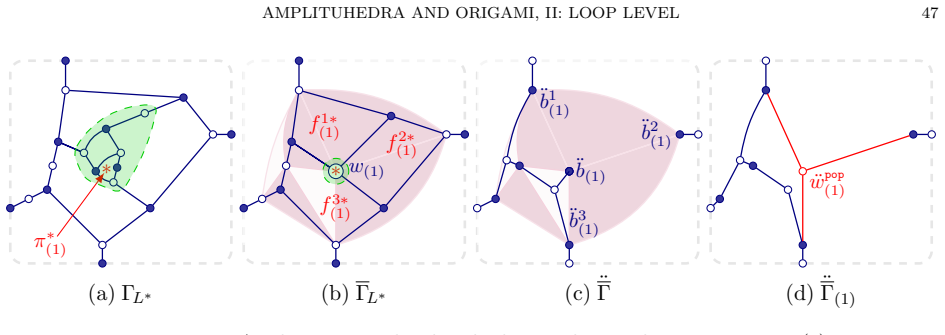
The BCFW cells triangulate the m=4 amplituhedron in full generality at all loop orders, both in momentum and momentum-twistor space, by extending the origami-amplituhedron correspondence to loop level and developing two natural L-punctured extensions of the positive Grassmannian that are related by T-duality.
What carries the argument
The origami-amplituhedron correspondence, which identifies positive cells in the amplituhedron with origami foldings, extended to loops; it is used to establish that BCFW cells form a triangulation.
If this is right
- The triangulation supplies an explicit simplicial decomposition of the amplituhedron that works at arbitrary loop order.
- The same BCFW cells triangulate both the momentum-space and momentum-twistor versions of the geometry.
- The two L-punctured positive Grassmannians organize loop-level data and are interchanged by T-duality.
- The decomposition applies uniformly to all loop orders without additional case-by-case checks.
Where Pith is reading between the lines
- If the triangulation is valid, loop amplitudes could be computed by summing contributions from BCFW cells while automatically respecting the positivity constraints.
- The L-punctured Grassmannians may connect to other positive geometries that appear in cluster algebra studies of scattering amplitudes.
- The result suggests that similar origami-style correspondences could be tested for amplituhedra with m greater than four.
- A low-loop numerical check using known BCFW recursions could serve as an independent verification of the general proof.
Load-bearing premise
The origami-amplituhedron correspondence found at tree level continues to hold when loops are included.
What would settle it
A concrete two-loop calculation that exhibits either an uncovered region inside the amplituhedron or a BCFW cell that violates the required positivity conditions would disprove the claimed triangulation.
Figures
read the original abstract
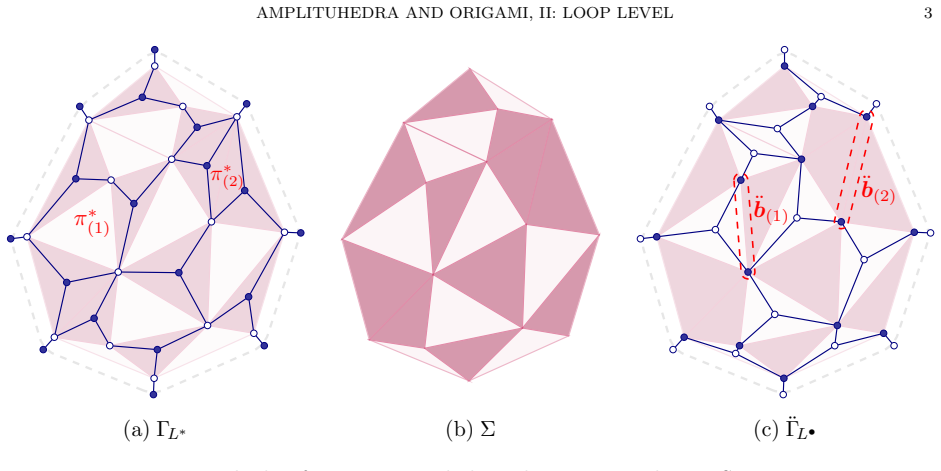
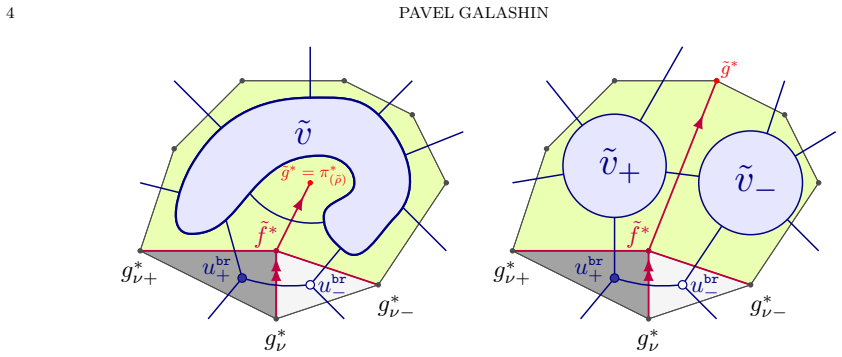
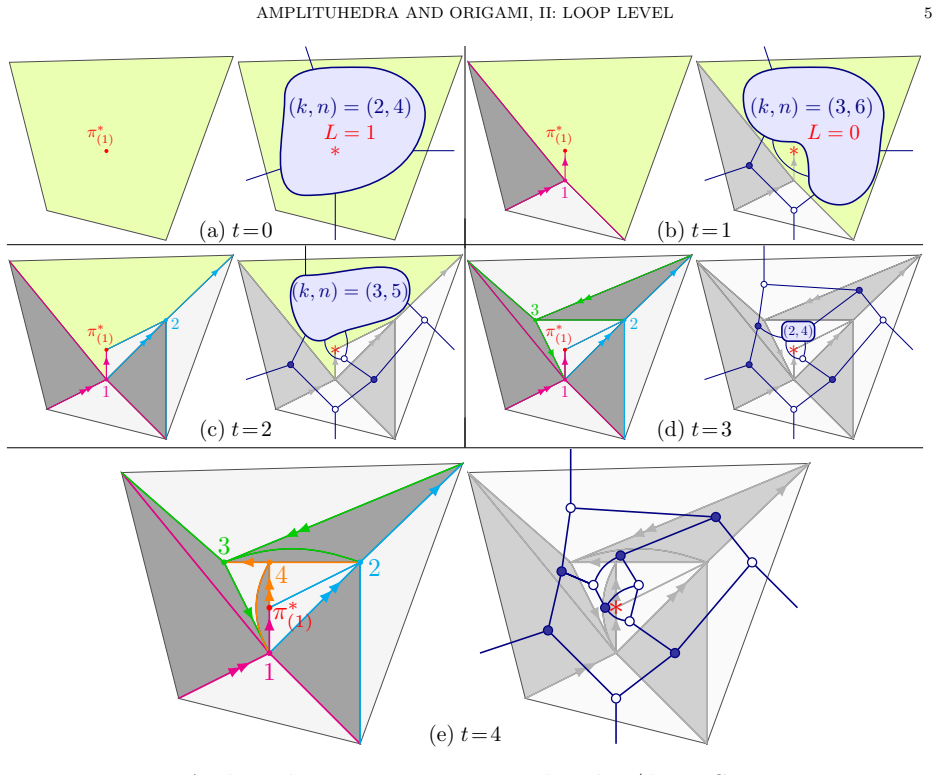
Building on the recently discovered origami-amplituhedron correspondence, we prove that the BCFW (Britto-Cachazo-Feng-Witten) cells triangulate the $m=4$ amplituhedron in full generality at all loop orders, both in momentum and momentum-twistor space. Along the way, we develop two natural "$L$-punctured" extensions of the positive Grassmannian and relate them via T-duality.
Editorial analysis
A structured set of objections, weighed in public.
Referee Report
Summary. The paper claims to prove that BCFW cells triangulate the m=4 amplituhedron in full generality at all loop orders, both in momentum and momentum-twistor space. It builds directly on the recently discovered origami-amplituhedron correspondence and develops two natural L-punctured extensions of the positive Grassmannian, relating them via T-duality.
Significance. If the central claim holds, the result would establish a complete triangulation of the m=4 amplituhedron at arbitrary loop order, a significant advance for positive geometries and loop-level scattering amplitudes in N=4 SYM. The explicit construction of the L-punctured positive Grassmannians and their T-duality relation constitutes a concrete technical contribution that could be useful independently of the triangulation statement.
major comments (1)
- [Abstract] Abstract and introduction: the triangulation statement at all loop orders is presented as following directly from the origami-amplituhedron correspondence; the manuscript does not re-derive or supply an independent check that this correspondence extends without additional assumptions or gaps to arbitrary loop order in both momentum and momentum-twistor formulations. Because the triangulation claim is conditional on this extension, the load-bearing step requires either an explicit verification or a precise citation to where the loop-level correspondence is established.
Simulated Author's Rebuttal
We thank the referee for their careful reading and for highlighting the need to clarify the dependence on the loop-level origami-amplituhedron correspondence. We address the comment below and will revise the manuscript accordingly.
read point-by-point responses
-
Referee: [Abstract] Abstract and introduction: the triangulation statement at all loop orders is presented as following directly from the origami-amplituhedron correspondence; the manuscript does not re-derive or supply an independent check that this correspondence extends without additional assumptions or gaps to arbitrary loop order in both momentum and momentum-twistor formulations. Because the triangulation claim is conditional on this extension, the load-bearing step requires either an explicit verification or a precise citation to where the loop-level correspondence is established.
Authors: We agree that the triangulation result is conditional on the loop-level origami-amplituhedron correspondence. This correspondence, including its validity in both momentum and momentum-twistor formulations at arbitrary loop order, was established in the companion paper 'Amplituhedra and origami, I'. The present manuscript (part II) takes that result as given and proves the BCFW triangulation from it. We will revise the abstract and introduction to include an explicit citation to the loop-level correspondence, together with a brief statement of the assumptions under which it holds. revision: yes
Circularity Check
Central triangulation proof is conditional on the origami-amplituhedron correspondence
specific steps
-
self citation load bearing
[Abstract]
"Building on the recently discovered origami-amplituhedron correspondence, we prove that the BCFW (Britto-Cachazo-Feng-Witten) cells triangulate the $m=4$ amplituhedron in full generality at all loop orders, both in momentum and momentum-twistor space."
The triangulation statement is explicitly derived from the prior correspondence rather than re-derived or independently verified within this manuscript; the result therefore stands or falls with the validity and loop-level extension of that earlier result.
full rationale
The manuscript's abstract and skeptic summary state that the proof of BCFW triangulation at all loop orders builds directly on the recently discovered origami-amplituhedron correspondence (likely from prior work by overlapping authors given the 'II' title). This makes the load-bearing step a self-citation whose independence is not re-established inside the paper. No equations or definitions inside the provided text reduce the result to a tautology by construction, and no other patterns (fitted predictions, ansatz smuggling, renaming) are exhibited. The derivation therefore has independent content once the correspondence is granted, but the central claim is not self-contained.
Axiom & Free-Parameter Ledger
axioms (1)
- domain assumption The origami-amplituhedron correspondence holds at loop level
Reference graph
Works this paper leans on
-
[1]
Discrete Differential Geometry and Cluster Algebras via TCD maps
[Aff23] Niklas Christoph Affolter. Discrete Differential Geometry and Cluster Algebras via TCD maps. arXiv:2305.02212v1,
-
[2]
Arkani-Hamed, J
[AHBC+11] N. Arkani-Hamed, J. Bourjaily, F. Cachazo, S. Caron-Huot, and J. Trnka. The all-loop integrand for scattering amplitudes in planarN=4 SYM.Journal of High Energy Physics, 2011(1):41, Jan
2011
-
[3]
The Grassmannian origin of dual superconformal invariance.J
[AHCC10] Nima Arkani-Hamed, Freddy Cachazo, and Clifford Cheung. The Grassmannian origin of dual superconformal invariance.J. High Energy Phys., 2010(3):36, Mar
2010
-
[4]
Unwinding the amplituhedron in binary.J
[AHTT18] Nima Arkani-Hamed, Hugh Thomas, and Jaroslav Trnka. Unwinding the amplituhedron in binary.J. High Energy Phys., 2018(1):16, Jan
2018
-
[5]
The amplituhedron from momentum twistor diagrams.Journal of High Energy Physics, 2015(2):65, Feb
[BH15] Yuntao Bai and Song He. The amplituhedron from momentum twistor diagrams.Journal of High Energy Physics, 2015(2):65, Feb
2015
-
[6]
The amplituhedron and the one-loop grassmannian measure
[BHL16] Yuntao Bai, Song He, and Thomas Lam. The amplituhedron and the one-loop grassmannian measure. Journal of High Energy Physics, 2016(1):112, Jan
2016
-
[7]
[CLSBW23] Roger Casals, Ian Le, Melissa Sherman-Bennett, and Daping Weng. Demazure weaves for reduced plabic graphs (with a proof that Muller-Speyer twist is Donaldson-Thomas).arXiv:2308.06184v2,
-
[8]
Cluster algebras and tilings for the m=4 amplituhedron.arXiv:2310.17727v2,
[EZLP+23] Chaim Even-Zohar, Tsviqa Lakrec, Matteo Parisi, Ran Tessler, Melissa Sherman-Bennett, and Lauren Williams. Cluster algebras and tilings for the m=4 amplituhedron.arXiv:2310.17727v2,
-
[9]
Amplituhedra and origami, I: tree level.arXiv:2410.09574v2,
[Gal24] Pavel Galashin. Amplituhedra and origami, I: tree level.arXiv:2410.09574v2,
-
[10]
Totally nonnegative Grassmannian and Grassmann polytopes
[Lam16] Thomas Lam. Totally nonnegative Grassmannian and Grassmann polytopes. InCurrent developments in mathematics 2014, pages 51–152. Int. Press, Somerville, MA,
2014
-
[11]
Total positivity, Grassmannians, and networks.arXiv:math/0609764v1,
[Pos06] Alexander Postnikov. Total positivity, Grassmannians, and networks.arXiv:math/0609764v1,
-
[12]
Pseudo-Triangulations — a Survey
[RSS06] Guenter Rote, Francisco Santos, and Ileana Streinu. Pseudo-Triangulations — a Survey. arXiv:math/0612672v2,
-
[13]
A combinatorial approach to planar non-colliding robot arm motion planning
[Str00] Ileana Streinu. A combinatorial approach to planar non-colliding robot arm motion planning. In41st Annual Symposium on Foundations of Computer Science (Redondo Beach, CA, 2000), pages 443–453. IEEE Comput. Soc. Press, Los Alamitos, CA,
2000
-
[14]
[Tes25] Ran J. Tessler. Notes on the one-loop amplituhedron and its BCFW tiling.arXiv:2506.22238v1,
discussion (0)
Sign in with ORCID, Apple, or X to comment. Anyone can read and Pith papers without signing in.