A comprehensive Rossiter-Mclaughlin Modelling Framework in TLCM: Application to HD 2685 = TOI-135 system
Pith reviewed 2026-06-28 08:26 UTC · model grok-4.3
The pith
Updated Rossiter-McLaughlin framework in TLCM measures 55.6-degree sky-projected obliquity for TOI-135.
A machine-rendered reading of the paper's core claim, the machinery that carries it, and where it could break.
Core claim
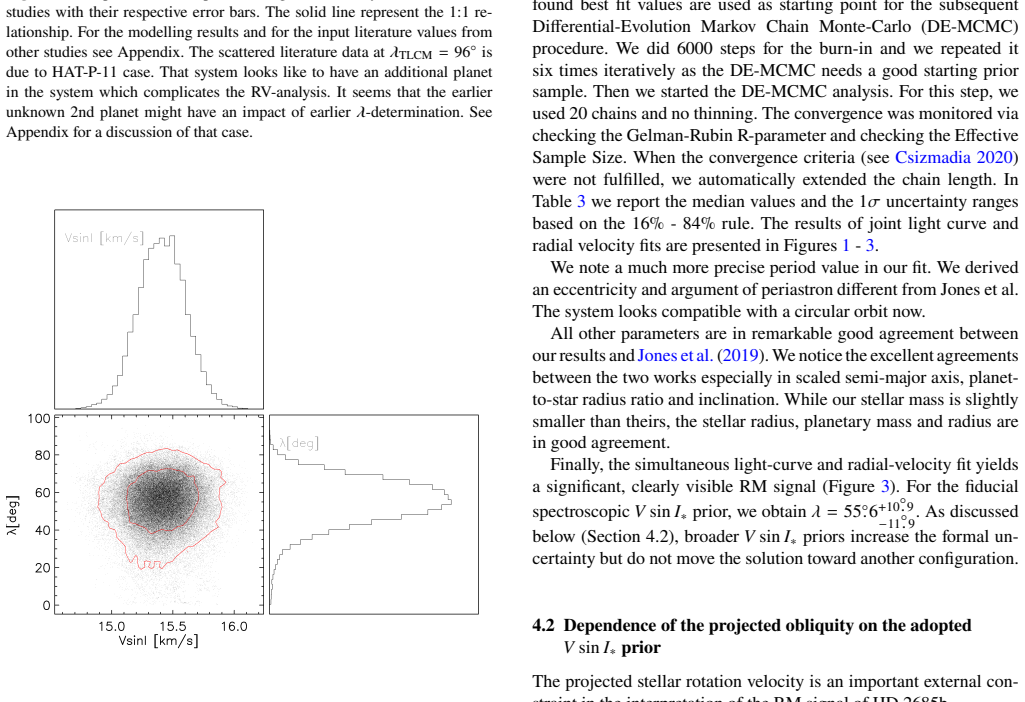
We present an updated Rossiter-McLaughlin modelling framework in TLCM. After validating on nine systems with TESS photometry and archive RV data, we apply it to new HARPS and TESS data for TOI-135, an evolved hot star with a transiting hot Jupiter. We find λ = 55.6 +10.9/-11.9 degrees for the fiducial V sin I prior, with the value stable under broader priors.
What carries the argument
The Rossiter-McLaughlin effect modeling framework in TLCM, which accounts for the radial velocity anomaly during transit caused by a planet crossing a rotating star.
If this is right
- The updated model reproduces the RV anomaly without bias in the nine validation systems and can be applied directly to other targets.
- TOI-135 exhibits an intermediate obliquity indicating a misalignment between the stellar spin axis and the orbital plane.
- Additional TESS sectors refine the planetary mass, radius, and orbital parameters for the system.
- The measured obliquity central value holds steady when the V sin I prior is broadened, though uncertainties grow.
- New HARPS in-transit and out-of-transit RVs combined with TESS photometry enable the RM detection.
Where Pith is reading between the lines
- The measured misalignment may trace to past dynamical events such as scattering or Kozai-Lidov cycles in the system's formation history.
- The framework could be tested on additional evolved-star hosts to check whether obliquity statistics differ from main-sequence cases.
- Refined parameters open the possibility of searching for additional planets or transit timing variations in the TOI-135 system.
Load-bearing premise
The updated RM model inside TLCM reproduces the observed radial-velocity anomaly without significant systematic bias once the nine validation systems are fitted.
What would settle it
New in-transit radial velocity observations of TOI-135 that produce a sky-projected obliquity significantly different from 55.6 degrees with smaller error bars would falsify the central result.
Figures

read the original abstract
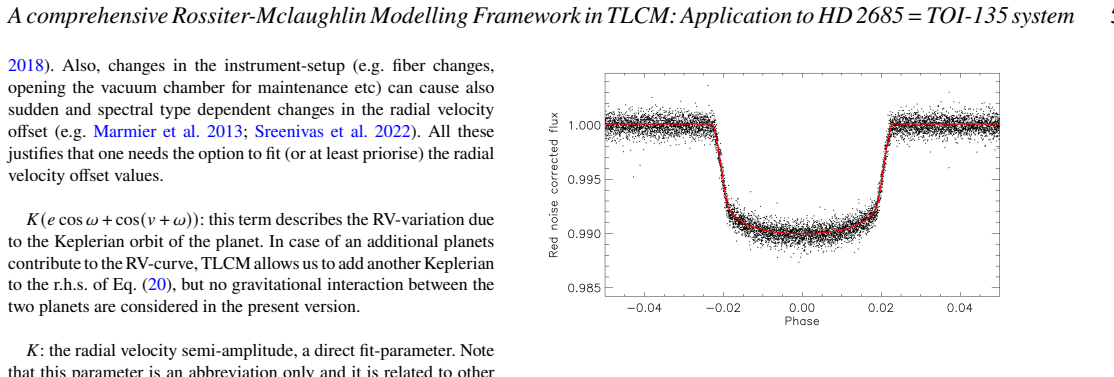
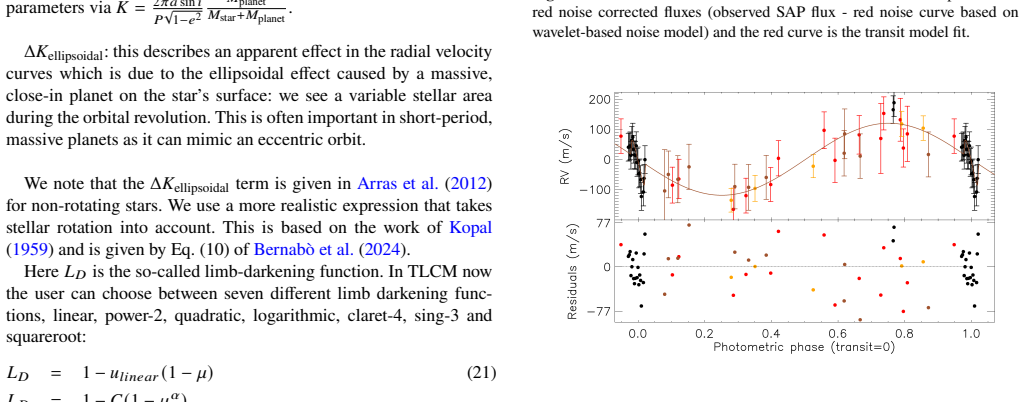
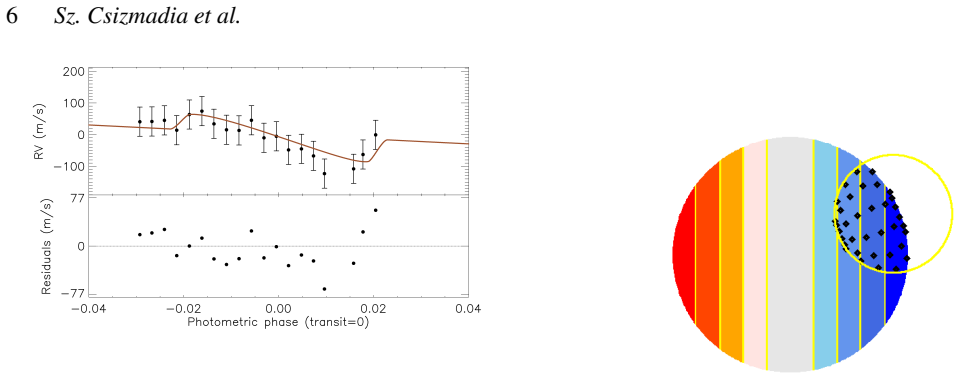
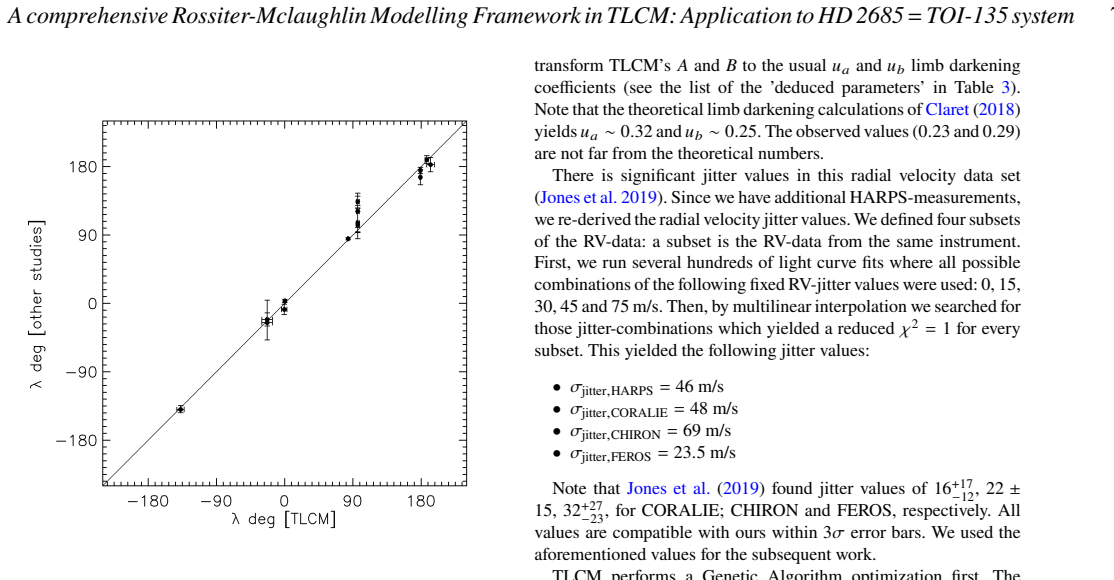
We present an updated Rossiter-McLaughlin modelling framework in the exoplanet analysis code \textsc{TLCM}. We describe our model in detail. The model and the code were validated by nine systems where we use TESS photometric measurements and archive radial velocity data (WASP-15, HAT-P-1, HAT-P-3, HAT-P-6, HAT-P-7, HAT-P-11, HAT-P-14, HAT-P-20, HAT-P-32). In addition, new observations were obtained from HD 2685 = TOI-135 which is an evolved, hot ($T_\mathrm{eff}=6801$ K), single star hosting a $\sim 1.15$ Jupiter-mass transiting hot Jupiter in a $\sim 4.1$ days orbit. We obtained new HARPS radial velocity measurements in-transit and out-of-transit. Also, there are new photometric observations from six additional, yet not-analyzed TESS-sectors since the time of the discovery of its transits. This allowed us to refine the planetary, orbital and system parameters and to detect Rossiter-Mclaughlin effect in it. We find an intermediate sky-projected obliquity, $\lambda = \ang{55.6}^{+\ang{10.9}}_{-\ang{11.9}}$, for our fiducial spectroscopic \(V\sin I_\star\) prior. Tests with broader \(V\sin I_\star\) priors show that the central value of \(\lambda\) remains stable, although the uncertainty increases.
Editorial analysis
A structured set of objections, weighed in public.
Referee Report
Summary. The manuscript presents an updated Rossiter-McLaughlin (RM) modeling framework implemented in the TLCM exoplanet analysis code. The framework is validated on nine literature systems (WASP-15, HAT-P-1, HAT-P-3, HAT-P-6, HAT-P-7, HAT-P-11, HAT-P-14, HAT-P-20, HAT-P-32) using TESS photometry and archival radial-velocity data. New HARPS in-transit and out-of-transit RV observations, together with additional TESS photometry, are used to refine the parameters of the evolved hot-Jupiter host HD 2685 = TOI-135 and to measure its sky-projected obliquity, yielding λ = 55.6 +10.9/-11.9° for the fiducial spectroscopic Vsin I_star prior; tests with broader priors show the central value remains stable while the uncertainty increases.
Significance. If the validation step confirms that the updated RM model reproduces literature obliquities without detectable systematic bias, the work supplies a documented, publicly usable RM tool and adds an obliquity measurement for an evolved hot-Jupiter system. The explicit prior-sensitivity tests and the multi-system validation constitute concrete strengths that support the robustness of the quoted λ value.
major comments (2)
- [Validation section] Validation section: the central claim that the updated model can be applied directly to TOI-135 rests on the nine-system validation. A table (or figure) comparing the recovered λ (and other RM parameters) to the published literature values for each of the nine systems, together with the rms residuals of the fits, is required to demonstrate the absence of systematic bias at the level claimed.
- [TOI-135 analysis] TOI-135 RM fit (fiducial prior): the reported λ uncertainty (+10.9/-11.9°) is derived from the new HARPS data; the manuscript must state the number of in-transit RV points, their typical S/N, and the adopted limb-darkening coefficients to allow assessment of whether the quoted precision is realistic.
minor comments (2)
- The abstract notation “ang{55.6}” should be replaced by a consistent degree symbol throughout the text and tables.
- The list of validation systems is given only in the abstract; a dedicated table in the main text that also reports the adopted priors and the resulting χ² values would improve traceability.
Simulated Author's Rebuttal
We thank the referee for the constructive review and the recommendation for minor revision. We address the major comments below.
read point-by-point responses
-
Referee: Validation section: the central claim that the updated model can be applied directly to TOI-135 rests on the nine-system validation. A table (or figure) comparing the recovered λ (and other RM parameters) to the published literature values for each of the nine systems, together with the rms residuals of the fits, is required to demonstrate the absence of systematic bias at the level claimed.
Authors: We agree that an explicit comparison table would strengthen the validation section and better demonstrate the absence of systematic bias. In the revised manuscript we will add a table that lists, for each of the nine systems, the recovered λ and other RM parameters together with the corresponding literature values and the rms residuals of the fits. revision: yes
-
Referee: TOI-135 RM fit (fiducial prior): the reported λ uncertainty (+10.9/-11.9°) is derived from the new HARPS data; the manuscript must state the number of in-transit RV points, their typical S/N, and the adopted limb-darkening coefficients to allow assessment of whether the quoted precision is realistic.
Authors: We will revise the TOI-135 analysis section to explicitly report the number of in-transit HARPS RV points, their typical signal-to-noise ratios, and the adopted limb-darkening coefficients. revision: yes
Circularity Check
No significant circularity in the reported obliquity measurement
full rationale
The paper updates and validates an RM model on nine independent literature systems using TESS and archive RV data, then applies it to new HARPS observations of TOI-135. The reported λ value is obtained by fitting to the new data, with stability tested under different priors. No self-definitional steps, fitted inputs called predictions, or load-bearing self-citations that reduce the central claim to its inputs are present in the described chain. The measurement is externally falsifiable via the new observations.
Axiom & Free-Parameter Ledger
free parameters (1)
- Vsin I_star prior
axioms (1)
- domain assumption The TLCM RM model produces unbiased obliquity measurements once validated on the nine reference systems
Reference graph
Works this paper leans on
-
[1]
Obliquities of Hot Jupiter host stars: Evidence for tidal interactions and primordial misalignments
Obliquities of Hot Jupiter Host Stars: Evidence for Tidal Interactions and Primordial Misalignments. , keywords =. doi:10.1088/0004-637X/757/1/18 , archivePrefix =. 1206.6105 , primaryClass =
work page internal anchor Pith review Pith/arXiv arXiv doi:10.1088/0004-637x/757/1/18
-
[2]
A High Stellar Obliquity in the WASP-7 Exoplanetary System
A High Stellar Obliquity in the WASP-7 Exoplanetary System. , keywords =. doi:10.1088/0004-637X/744/2/189 , archivePrefix =. 1111.5016 , primaryClass =
work page internal anchor Pith review Pith/arXiv arXiv doi:10.1088/0004-637x/744/2/189
-
[3]
A Preponderance of Perpendicular Planets. , keywords =. doi:10.3847/2041-8213/ac0f03 , archivePrefix =. 2105.09327 , primaryClass =
-
[4]
The radial velocity signature of tides raised in stars hosting exoplanets. , keywords =. doi:10.1111/j.1365-2966.2012.20756.x , archivePrefix =. 1107.6005 , primaryClass =
-
[5]
Aligned, Misaligned and Polar Orbits of Hot Jupiters: Measuring Spin-Orbit Angles via Doppler Tomography with HARPS-N. arXiv e-prints , keywords =. doi:10.48550/arXiv.2601.11313 , archivePrefix =. 2601.11313 , primaryClass =
-
[6]
, year = 2012, month = nov, volume =
A primordial origin for misalignments between stellar spin axes and planetary orbits. , year = 2012, month = nov, volume =. doi:10.1038/nature11560 , adsurl =
-
[7]
Chaotic star formation and the alignment of stellar rotation with disc and planetary orbital axes. , keywords =. doi:10.1111/j.1365-2966.2009.15773.x , archivePrefix =. 0909.4255 , primaryClass =
-
[8]
Evidence of apsidal motion and a possible co-moving companion star detected in the WASP-19 system. , keywords =. doi:10.1051/0004-6361/202346852 , archivePrefix =. 2402.12896 , primaryClass =
-
[9]
The SOPHIE search for northern extrasolar planets. V. Follow-up of ELODIE candidates: Jupiter-analogs around Sun-like stars. , keywords =. doi:10.1051/0004-6361/201118419 , archivePrefix =. 1205.5835 , primaryClass =
work page internal anchor Pith review Pith/arXiv arXiv doi:10.1051/0004-6361/201118419
-
[10]
Monthly Notices of the Royal Astronomical Society , volume =
Borkovits, T and Rappaport, S and Kaye, T and Isaacson, H and Vanderburg, A and Howard, A W and Kristiansen, M H and Omohundro, M R and Schwengeler, H M and Terentev, I A and Shporer, A and Relles, H and Villanueva Jr, S and Tan, T G and Colón, K D and Blex, J and Haas, M and Cochran, W and Endl, M , title =. Monthly Notices of the Royal Astronomical Soci...
-
[11]
Version 2 (Bourges+, 2017)
VizieR Online Data Catalog: JMMC Stellar Diameters Catalogue - JSDC. Version 2 (Bourges+, 2017)
2017
-
[12]
The Rossiter-McLaughlin effect revolutions: an ultra-short period planet and a warm mini-Neptune on perpendicular orbits. , keywords =. doi:10.1051/0004-6361/202141527 , archivePrefix =. 2110.14214 , primaryClass =
-
[13]
Rossiter-McLaughlin models and their effect on estimates of stellar rotation, illustrated using six WASP systems. , keywords =. doi:10.1093/mnras/stw2316 , archivePrefix =. 1610.00600 , primaryClass =
work page internal anchor Pith review Pith/arXiv arXiv doi:10.1093/mnras/stw2316
-
[14]
Modeling the Rossiter-McLaughlin Effect: Impact of the Convective Center-to-limb Variations in the Stellar Photosphere. , keywords =. doi:10.3847/0004-637X/819/1/67 , archivePrefix =. 1601.02054 , primaryClass =
work page internal anchor Pith review Pith/arXiv arXiv doi:10.3847/0004-637x/819/1/67
-
[15]
A new method to compute limb-darkening coefficients for stellar atmosphere models with spherical symmetry: the space missions TESS, Kepler, CoRoT, and MOST. , keywords =. doi:10.1051/0004-6361/201833060 , archivePrefix =. 1804.10135 , primaryClass =
work page internal anchor Pith review Pith/arXiv arXiv doi:10.1051/0004-6361/201833060
-
[16]
Line-profile tomography of exoplanet transits - I. The Doppler shadow of HD 189733b. , keywords =. doi:10.1111/j.1365-2966.2009.16131.x , archivePrefix =. 0911.5361 , primaryClass =
-
[17]
A catalogue of stellar diameters and fluxes for mid-infrared interferometry. , keywords =. doi:10.1093/mnras/stz2803 , archivePrefix =. 1910.00542 , primaryClass =
-
[18]
Transiting exoplanets from the CoRoT space mission . XXVIII. CoRoT-33b, an object in the brown dwarf desert with 2:3 commensurability with its host star. , keywords =. doi:10.1051/0004-6361/201526763 , archivePrefix =. 1508.05763 , primaryClass =
work page internal anchor Pith review Pith/arXiv arXiv doi:10.1051/0004-6361/201526763
-
[19]
The Great Planetary Heist: theft and capture in star-forming regions. , keywords =. doi:10.1093/mnras/stac1392 , archivePrefix =. 2205.07895 , primaryClass =
-
[20]
Tidal dissipation and spin─orbit alignment due to the precessional instability in convection zones in rotating giant planets and stars. , keywords =. doi:10.1093/mnras/staf1882 , archivePrefix =. 2510.25624 , primaryClass =
-
[21]
EXOFASTv2: Generalized publication-quality exoplanet modeling code
-
[22]
juliet: a versatile modelling tool for transiting and non-transiting exoplanetary systems. , keywords =. doi:10.1093/mnras/stz2688 , archivePrefix =. 1812.08549 , primaryClass =
-
[23]
Allesfitter: Flexible Star and Exoplanet Inference from Photometry and Radial Velocity. , keywords =. doi:10.3847/1538-4365/abe70e , archivePrefix =. 2003.14371 , primaryClass =
-
[24]
Shrinking binary and planetary orbits by Kozai cycles with tidal friction
Shrinking Binary and Planetary Orbits by Kozai Cycles with Tidal Friction. , keywords =. doi:10.1086/521702 , archivePrefix =. 0705.4285 , primaryClass =
work page internal anchor Pith review Pith/arXiv arXiv doi:10.1086/521702
-
[25]
A New Method for the Analysis of Apsidal Motions in Eclipsing Binaries. , keywords =. doi:10.1007/BF00653602 , adsurl =
-
[26]
Equations for the Analysis of the Rossiter-MCLaughlin Effect in Extrasolar Planetary Transits. , keywords =. doi:10.1086/507021 , adsurl =
-
[27]
Hot Jupiters in Old Wide-Binary Systems. arXiv e-prints , keywords =. doi:10.48550/arXiv.2512.13773 , archivePrefix =. 2512.13773 , primaryClass =
-
[28]
The Orbit of Warm Jupiter WASP-106 b is Aligned with its Star. , keywords =. doi:10.3847/1538-3881/acf46d , archivePrefix =. 2308.07165 , primaryClass =
-
[29]
Power of wavelets in analyses of transit and phase curves in the presence of stellar variability and instrumental noise. II. Accuracy of the transit parameters. , keywords =. doi:10.1051/0004-6361/202143017 , archivePrefix =. 2208.01716 , primaryClass =
-
[30]
Modelling the light curves of transiting exomoons: a zero-order photodynamic agent added to the Transit and Light Curve Modeller. , keywords =. doi:10.1093/mnrasl/slad169 , archivePrefix =. 2311.04647 , primaryClass =
-
[31]
The CHEOPS view of HD 95338b: Refined transit parameters, and a search for exomoons. , keywords =. doi:10.1051/0004-6361/202554040 , archivePrefix =. 2507.15318 , primaryClass =
-
[32]
Spitzer Secondary Eclipse Depths with Multiple Intrapixel Sensitivity Correction Methods Observations of WASP-13b, WASP-15b, WASP-16b, WASP-62b, and HAT-P-22b. , keywords =. doi:10.3847/1538-3881/153/1/22 , archivePrefix =. 1611.08708 , primaryClass =
work page internal anchor Pith review Pith/arXiv arXiv doi:10.3847/1538-3881/153/1/22
-
[33]
Close binary systems
-
[34]
Studies of Stellar Rotation. V. The Dependence of Rotation on Age among Solar-Type Stars. , year = 1967, month = nov, volume =. doi:10.1086/149359 , adsurl =
-
[35]
Additional planets and stellar models
Evolution of spin direction of accreting magnetic protostars and spin-orbit misalignment in exoplanetary systems. , keywords =. doi:10.1111/j.1365-2966.2010.18127.x , archivePrefix =. 1008.3148 , primaryClass =
-
[36]
Convective blueshift strengths of 810 F to M solar-type stars. , keywords =. doi:10.1051/0004-6361/202039607 , archivePrefix =. 2108.03859 , primaryClass =
-
[37]
HD2685 b: A Hot-Jupiter orbiting an early F-type star detected by TESS
HD 2685 b: a hot Jupiter orbiting an early F-type star detected by TESS. , keywords =. doi:10.1051/0004-6361/201834640 , archivePrefix =. 1811.05518 , primaryClass =
work page internal anchor Pith review Pith/arXiv arXiv doi:10.1051/0004-6361/201834640
-
[38]
A new MPS-ATLAS library for Kepler, TESS, CHEOPS, and PLATO passbands
Stellar limb darkening. A new MPS-ATLAS library for Kepler, TESS, CHEOPS, and PLATO passbands. , keywords =. doi:10.1051/0004-6361/202243722 , archivePrefix =. 2206.06641 , primaryClass =
-
[39]
AAS/Division for Extreme Solar Systems Abstracts , year = 2015, series =
Are Tidal Effects Responsible for Exoplanetary Spin-Orbit Alignment?. AAS/Division for Extreme Solar Systems Abstracts , year = 2015, series =
2015
-
[40]
Double Hot Jupiter Formation through Mirrored ZLK Migration in Binary Star Systems: The Case of WASP-94. , keywords =. doi:10.3847/2041-8213/ae2fd8 , archivePrefix =. 2512.18108 , primaryClass =
-
[41]
The CORALIE survey for southern extrasolar planets. XVII. New and updated long period and massive planets. , keywords =. doi:10.1051/0004-6361/201219639 , archivePrefix =. 1211.6444 , primaryClass =
work page internal anchor Pith review Pith/arXiv arXiv doi:10.1051/0004-6361/201219639
-
[42]
Martynov , Y. Da. Eclisping Variable Stars
-
[43]
Comparison of the power-2 limb-darkening law from the STAGGER-grid to Kepler light curves of transiting exoplanets. , keywords =. doi:10.1051/0004-6361/201832944 , archivePrefix =. 1804.07943 , primaryClass =
work page internal anchor Pith review Pith/arXiv arXiv doi:10.1051/0004-6361/201832944
-
[44]
Journal of Astronomical Telescopes, Instruments, and Systems , year = 2015, month = jan, volume =
Transiting Exoplanet Survey Satellite (TESS). Journal of Astronomical Telescopes, Instruments, and Systems , year = 2015, month = jan, volume =. doi:10.1117/1.JATIS.1.1.014003 , adsurl =
work page internal anchor Pith review doi:10.1117/1.jatis.1.1.014003 2015
-
[45]
Formation of Hot Planets by a Combination of Planet Scattering, Tidal Circularization, and the Kozai Mechanism. , keywords =. doi:10.1086/529369 , archivePrefix =. 0801.1368 , primaryClass =
work page internal anchor Pith review Pith/arXiv arXiv doi:10.1086/529369
-
[46]
Evidence of Possible Spin-Orbit Misalignment Along the Line of Sight in Transiting Exoplanet Systems
Evidence of Possible Spin-orbit Misalignment Along the Line of Sight in Transiting Exoplanet Systems. , keywords =. doi:10.1088/0004-637X/719/1/602 , archivePrefix =. 1006.2851 , primaryClass =
work page internal anchor Pith review Pith/arXiv arXiv doi:10.1088/0004-637x/719/1/602
-
[47]
Transiting exoplanets from the CoRoT space mission. VII. The ``hot-Jupiter''-type planet CoRoT-5b. , keywords =. doi:10.1051/0004-6361/200911902 , archivePrefix =. 0909.3397 , primaryClass =
work page internal anchor Pith review Pith/arXiv arXiv doi:10.1051/0004-6361/200911902
-
[48]
Homogeneous studies of transiting extrasolar planets - IV. Thirty systems with space-based light curves. , keywords =. doi:10.1111/j.1365-2966.2011.19399.x , archivePrefix =. 1107.1235 , primaryClass =
-
[49]
The Impact of the Convective Blueshift Effect on Spectroscopic Planetary Transits
The Impact of the Convective Blueshift Effect on Spectroscopic Planetary Transits. , keywords =. doi:10.1088/0004-637X/733/1/30 , archivePrefix =. 1103.0775 , primaryClass =
work page internal anchor Pith review Pith/arXiv arXiv doi:10.1088/0004-637x/733/1/30
-
[50]
The catalogue of radial velocity standard stars for Gaia. I. Pre-launch release. , keywords =. doi:10.1051/0004-6361/201220927 , archivePrefix =. 1302.1905 , primaryClass =
work page internal anchor Pith review Pith/arXiv arXiv doi:10.1051/0004-6361/201220927 1905
-
[51]
Gaia Data Release 2: The catalogue of radial velocity standard stars
Gaia Data Release 2. The catalogue of radial velocity standard stars. , keywords =. doi:10.1051/0004-6361/201832795 , archivePrefix =. 1804.09370 , primaryClass =
work page internal anchor Pith review Pith/arXiv arXiv doi:10.1051/0004-6361/201832795
-
[52]
A Comprehensive Analysis of Acknowledgement Texts in Web of Science: a case study on four scientific domains. arXiv e-prints , keywords =. doi:10.48550/arXiv.2210.09716 , archivePrefix =. 2210.09716 , primaryClass =
-
[53]
Jupiter-like planets around HD103891 and HD105779
Analysis of the public HARPS/ESO spectroscopic archive. Jupiter-like planets around HD103891 and HD105779. , keywords =. doi:10.1051/0004-6361/202142612 , archivePrefix =. 2112.09029 , primaryClass =
-
[54]
, year = 2016, month = apr, volume =
MARVELS 1D Pipeline Development, Optimization, and Performance. , year = 2016, month = apr, volume =. doi:10.1088/1538-3873/128/962/045003 , adsurl =
-
[55]
Engulfment of a hot Jupiter as a possible origin of the rapid spin and internal spin misalignment of the planet-hosting red giant Kepler-56. , keywords =. doi:10.1093/mnras/staf1891 , archivePrefix =. 2510.25680 , primaryClass =
-
[56]
The Spin orbit alignment of two short period eclipsing binary systems. , keywords =. doi:10.1093/mnras/staf1355 , archivePrefix =. 2509.03826 , primaryClass =
-
[57]
Ten Aligned Orbits: Planet Migration in the Era of JWST and Ariel. arXiv e-prints , keywords =. doi:10.48550/arXiv.2505.20516 , archivePrefix =. 2505.20516 , primaryClass =
-
[58]
Stable satellites around extrasolar giant planets. , keywords =. doi:10.1111/j.1365-2966.2006.11104.x , adsurl =
-
[59]
Enhanced thermal radiation from a tidally heated exomoon with a single hotspot. , keywords =. doi:10.1093/mnras/stab2955 , archivePrefix =. 2110.05353 , primaryClass =
-
[60]
The Astropy Project: Building an inclusive, open-science project and status of the v2.0 core package
The Astropy Project: Building an Open-science Project and Status of the v2.0 Core Package. , keywords =. doi:10.3847/1538-3881/aabc4f , archivePrefix =. 1801.02634 , primaryClass =
work page internal anchor Pith review Pith/arXiv arXiv doi:10.3847/1538-3881/aabc4f
-
[61]
The Transit and Light Curve Modeller. , keywords =. doi:10.1093/mnras/staa349 , adsurl =
-
[62]
Parameter Estimation from Time-series Data with Correlated Errors: A Wavelet-based Method and its Application to Transit Light Curves. , keywords =. doi:10.1088/0004-637X/704/1/51 , archivePrefix =. 0909.0747 , primaryClass =
work page internal anchor Pith review Pith/arXiv arXiv doi:10.1088/0004-637x/704/1/51
-
[63]
Power of wavelets in analyses of transit and phase curves in the presence of stellar variability and instrumental noise. I. Method and validation. , keywords =. doi:10.1051/0004-6361/202141302 , archivePrefix =. 2108.11822 , primaryClass =
-
[64]
Evidence for a Large Exomoon Orbiting Kepler-1625b
Evidence for a large exomoon orbiting Kepler-1625b. Science Advances , keywords =. doi:10.1126/sciadv.aav1784 , archivePrefix =. 1810.02362 , primaryClass =
work page internal anchor Pith review Pith/arXiv arXiv doi:10.1126/sciadv.aav1784
-
[65]
An alternative interpretation of the exomoon candidate signal in the combined Kepler and Hubble data of Kepler-1625. , keywords =. doi:10.1051/0004-6361/201834913 , archivePrefix =. 1902.06018 , primaryClass =
work page internal anchor Pith review Pith/arXiv arXiv doi:10.1051/0004-6361/201834913 1902
-
[66]
An exomoon survey of 70 cool giant exoplanets and the new candidate Kepler-1708 b-i. Nature Astronomy , keywords =. doi:10.1038/s41550-021-01539-1 , archivePrefix =. 2201.04643 , primaryClass =
-
[67]
A full transit of v ^ 2 Lupi d and the search for an exomoon in its Hill sphere with CHEOPS. , keywords =. doi:10.1051/0004-6361/202244790 , archivePrefix =. 2302.01853 , primaryClass =
-
[68]
The PLATO 2.0 mission. Experimental Astronomy , keywords =. doi:10.1007/s10686-014-9383-4 , archivePrefix =. 1310.0696 , primaryClass =
work page internal anchor Pith review Pith/arXiv arXiv doi:10.1007/s10686-014-9383-4
-
[69]
Ariel: Enabling planetary science across light-years. arXiv e-prints , keywords =. doi:10.48550/arXiv.2104.04824 , archivePrefix =. 2104.04824 , primaryClass =
-
[70]
Cronomoons: origin, dynamics, and light-curve features of ringed exomoons. , keywords =. doi:10.1093/mnras/stab3531 , archivePrefix =. 2112.02687 , primaryClass =
-
[71]
The LUVOIR Mission Concept Study Final Report. arXiv e-prints , keywords =. doi:10.48550/arXiv.1912.06219 , archivePrefix =. 1912.06219 , primaryClass =
-
[72]
Astronomische Nachrichten , keywords =
Digital color codes of stars. Astronomische Nachrichten , keywords =. doi:10.1002/asna.202113868 , archivePrefix =. 2101.06254 , primaryClass =
-
[73]
Experimental Astronomy , keywords =
High-precision photometry with Ariel. Experimental Astronomy , keywords =. doi:10.1007/s10686-021-09777-x , adsurl =
-
[74]
Pandora: A fast open-source exomoon transit detection algorithm. , keywords =. doi:10.1051/0004-6361/202243129 , archivePrefix =. 2205.09410 , primaryClass =
-
[75]
Experimental Astronomy , keywords =
The CHEOPS mission. Experimental Astronomy , keywords =. doi:10.1007/s10686-020-09679-4 , archivePrefix =. 2009.11633 , primaryClass =
-
[76]
Astropy: A Community Python Package for Astronomy
Astropy: A community Python package for astronomy. , keywords =. 2013. doi:10.1051/0004-6361/201322068 , archivePrefix =. 1307.6212 , primaryClass =
work page internal anchor Pith review Pith/arXiv arXiv doi:10.1051/0004-6361/201322068 2013
-
[77]
1996, A&AS, 117, 393, doi: 10.1051/aas:1996164
SExtractor: Software for source extraction. , keywords =. 1996. doi:10.1051/aas:1996164 , adsurl =
-
[78]
Quantifying the Observational Effort Required for the Radial Velocity Characterization of TESS Planets. , keywords =. 2018. doi:10.3847/1538-3881/aacea9 , archivePrefix =. 1807.01263 , primaryClass =
work page internal anchor Pith review Pith/arXiv arXiv doi:10.3847/1538-3881/aacea9 2018
-
[79]
X-Ray Scattering Echoes and Ghost Halos from the Intergalactic Medium: Relation to the Nature of AGN Variability. , keywords =. 2015. doi:10.1088/0004-637X/805/1/23 , archivePrefix =. 1503.01475 , primaryClass =
work page internal anchor Pith review Pith/arXiv arXiv doi:10.1088/0004-637x/805/1/23 2015
-
[80]
, keywords =
The 2013 Release of Cloudy. , keywords =. 2013
2013
discussion (0)
Sign in with ORCID, Apple, or X to comment. Anyone can read and Pith papers without signing in.