Prospective Dynamic 3D MRI Reconstruction via Latent-Space Motion Tracking from Single Measurement
Pith reviewed 2026-06-28 10:27 UTC · model grok-4.3
The pith
Parameterizing motion fields on an offline-learned low-dimensional manifold enables prospective 3D MRI reconstruction from single ultra-sparse measurements.
A machine-rendered reading of the paper's core claim, the machinery that carries it, and where it could break.
Core claim
By learning an efficient latent manifold of motion fields offline and parameterizing deformation vector fields on this manifold with tri-plane encoding, PDMR performs rapid prospective reconstruction of dynamic 3D MRI from single ultra-sparse measurements while maintaining high fidelity and temporal consistency across multiple scenarios.
What carries the argument
low-dimensional latent manifold of deformation vector fields encoded via tri-plane representation, learned offline for online adaptation
If this is right
- High-fidelity 3D volumes can be obtained immediately or after a 2-minute delay from single measurements.
- Temporal consistency is preserved across frames without requiring full k-space data at each time point.
- The method outperforms both retrospective and online baselines on XCAT phantoms and in-house abdominal datasets.
- Motion estimation occurs concurrently with reconstruction, supporting latency-sensitive applications.
Where Pith is reading between the lines
- If the manifold generalizes across scanners or patient populations, the same offline training could support multiple sites without retraining.
- Extending the tri-plane encoding to other motion-sensitive modalities such as CT or ultrasound could follow the same offline-online split.
- Reducing the required measurements per frame might allow higher temporal resolution in dynamic studies without increasing total scan time.
Load-bearing premise
Deformation vector fields from new measurements can be accurately recovered by projecting onto a low-dimensional manifold that was learned from separate offline data.
What would settle it
Reconstruction error or temporal inconsistency would increase sharply on held-out patient scans whose motion patterns lie outside the learned manifold.
Figures

read the original abstract
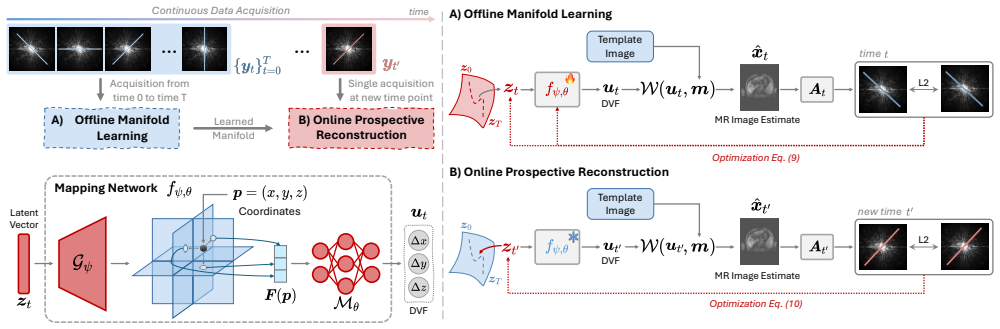
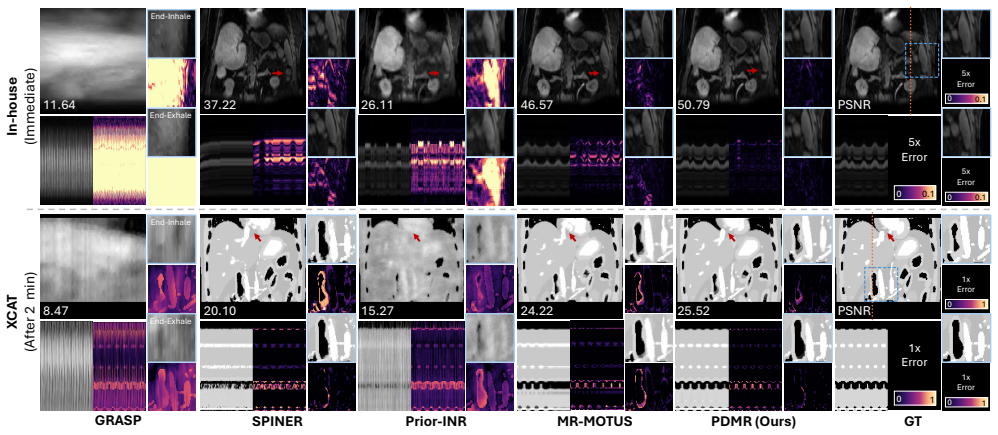
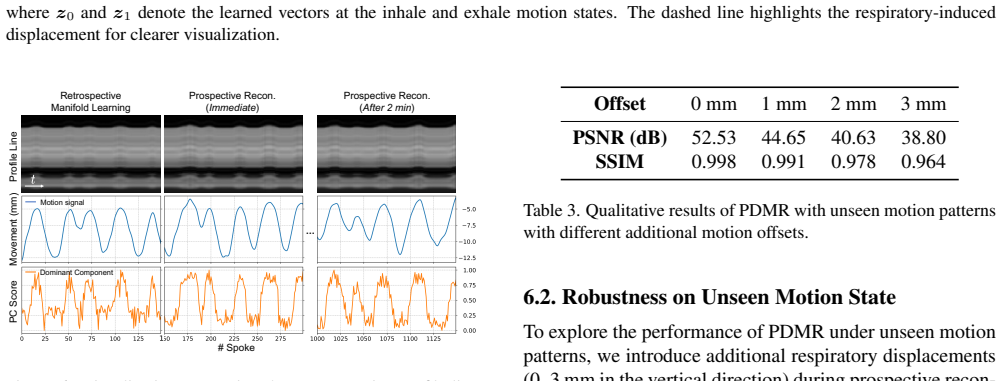
Prospective reconstruction is crucial in many clinical applications such as MRI-guided radiotherapy, which demands accurate image reconstruction and fast motion estimation from currently acquired measurements. However, prospective reconstruction remains challenging due to ultra-sparse sampling and stringent latency requirements. In this work, we propose PDMR, a Prospective Dynamic 3D MRI Reconstruction framework with latent-space motion tracking. Our core idea is to learn an efficient and generalizable latent manifold of motion fields offline, enabling rapid online adaptation for prospective reconstruction. Specifically, we parameterize the deformation vector fields (DVFs) on a low-dimensional manifold, effectively reducing the search space for fast online adaptation, and employ a tri-plane representation to achieve geometry-aware and memory-efficient encoding of 3D motion. Experiments on both XCAT digital phantoms and in-house abdominal MRI datasets demonstrate that PDMR achieves high-fidelity and temporally consistent reconstruction across multiple prospective scenarios (Immediate and After-2min), outperforming state-of-the-art retrospective and online methods. Our results suggest a promising pathway toward ultra-fast, motion-aware prospective MRI reconstruction in clinical practice.
Editorial analysis
A structured set of objections, weighed in public.
Referee Report
Summary. The manuscript proposes PDMR, a Prospective Dynamic 3D MRI Reconstruction framework that learns a low-dimensional latent manifold of deformation vector fields (DVFs) offline via tri-plane encoding. This enables rapid online adaptation for prospective reconstruction from ultra-sparse single measurements, targeting applications such as MRI-guided radiotherapy. The approach is evaluated on XCAT digital phantoms and in-house abdominal MRI datasets across Immediate and After-2min prospective scenarios, with claims of high-fidelity, temporally consistent results that outperform state-of-the-art retrospective and online methods.
Significance. If the experimental claims are substantiated with detailed metrics and controls, the work offers a promising route to ultra-fast motion-aware prospective 3D MRI by constraining the motion search space through an offline-learned latent manifold. The tri-plane representation for geometry-aware DVF encoding is a practical efficiency choice. This could meaningfully advance clinical workflows requiring low-latency reconstruction under extreme undersampling, provided the offline-to-online transfer generalizes robustly.
major comments (1)
- [Experiments (abstract and §4)] The central experimental claim (outperformance on XCAT and in-house data for Immediate/After-2min scenarios) is stated without reference to specific quantitative metrics, statistical significance tests, number of runs, or exact baseline implementations. This makes it impossible to evaluate whether the reported gains are load-bearing for the prospective-adaptation thesis.
minor comments (2)
- [Method (§3)] Clarify the precise dimensionality of the learned latent manifold and any regularization terms used during offline training; these details are needed to reproduce the claimed reduction in online search space.
- [Method (§3.2)] The tri-plane encoding is described as 'memory-efficient,' but no memory or parameter counts are provided relative to voxel-grid or implicit alternatives.
Simulated Author's Rebuttal
We thank the referee for the constructive feedback and positive recommendation for minor revision. We address the single major comment below by committing to expanded experimental reporting.
read point-by-point responses
-
Referee: [Experiments (abstract and §4)] The central experimental claim (outperformance on XCAT and in-house data for Immediate/After-2min scenarios) is stated without reference to specific quantitative metrics, statistical significance tests, number of runs, or exact baseline implementations. This makes it impossible to evaluate whether the reported gains are load-bearing for the prospective-adaptation thesis.
Authors: We agree that the current presentation of results would benefit from greater specificity. In the revised manuscript we will augment both the abstract and §4 with the requested details: concrete quantitative metrics (PSNR/SSIM/Dice) for all methods and scenarios, standard deviations across repeated runs, statistical significance testing (paired t-tests with p-values), and explicit descriptions of baseline implementations (including hyper-parameter settings and code references where applicable). These additions will directly substantiate the performance claims. revision: yes
Circularity Check
No significant circularity detected
full rationale
The provided abstract and description outline a standard machine-learning pipeline for MRI reconstruction: offline learning of a low-dimensional DVF manifold via tri-plane encoding, followed by online adaptation from sparse measurements. No equations, derivations, or self-citations are shown that reduce any claimed prediction or result to a fitted input by construction. The experimental claims concern outperformance on XCAT and in-house data, which are external benchmarks rather than internal tautologies. The derivation chain is self-contained against the stated assumptions and does not exhibit any of the enumerated circularity patterns.
Axiom & Free-Parameter Ledger
Reference graph
Works this paper leans on
-
[1]
Inter- pretable cardiac anatomy modeling using variational mesh autoencoders.Frontiers in Cardiovascular Medicine, 9: 983868, 2022
Marcel Beetz, Jorge Corral Acero, Abhirup Banerjee, Ingo Eitel, Ernesto Zacur, Torben Lange, Thomas Stiermaier, Ruben Evertz, S¨oren J Backhaus, Holger Thiele, et al. Inter- pretable cardiac anatomy modeling using variational mesh autoencoders.Frontiers in Cardiovascular Medicine, 9: 983868, 2022. 2
2022
-
[2]
Laplacian eigenmaps for dimensionality reduction and data representation.Neural computation, 15(6):1373–1396, 2003
Mikhail Belkin and Partha Niyogi. Laplacian eigenmaps for dimensionality reduction and data representation.Neural computation, 15(6):1373–1396, 2003. 2
2003
-
[3]
Manifold learning of brain mris by deep learning
Tom Brosch, Roger Tam, and Alzheimer’s Disease Neu- roimaging Initiative. Manifold learning of brain mris by deep learning. InInternational Conference on Medical Im- age Computing and Computer-Assisted Intervention, pages 633–640. Springer, 2013. 2
2013
-
[4]
Efficient geometry-aware 3d generative adversarial networks
Eric R Chan, Connor Z Lin, Matthew A Chan, Koki Nagano, Boxiao Pan, Shalini De Mello, Orazio Gallo, Leonidas J Guibas, Jonathan Tremblay, Sameh Khamis, et al. Efficient geometry-aware 3d generative adversarial networks. InPro- ceedings of the IEEE/CVF Conference on Computer Vision and Pattern Recognition, pages 16123–16133, 2022. 2, 4
2022
-
[5]
Single-spoke motion-compensated dynamic 3d mri reconstruction via neural representation
Lixuan Chen, James M Balter, Liyue Shen, and Jeong Joon Park. Single-spoke motion-compensated dynamic 3d mri reconstruction via neural representation. InInternational Conference on Medical Image Computing and Computer- Assisted Intervention, pages 513–522. Springer, 2025. 1, 5, 6, 7
2025
-
[6]
Mr fingerprinting for rapid quantitative abdominal imaging.Radiology, 279(1): 278–286, 2016
Yong Chen, Yun Jiang, Shivani Pahwa, Dan Ma, Lan Lu, Michael D Twieg, Katherine L Wright, Nicole Seiberlich, Mark A Griswold, and Vikas Gulani. Mr fingerprinting for rapid quantitative abdominal imaging.Radiology, 279(1): 278–286, 2016. 5
2016
-
[7]
Diffusion maps
Ronald R Coifman and St ´ephane Lafon. Diffusion maps. Applied and Computational Harmonic Analysis, 21(1):5–30,
-
[8]
Spatiotemporal implicit neural representation for unsu- pervised dynamic mri reconstruction.IEEE Transactions on Medical Imaging, 40(5):2143–2156, 2025
Jie Feng, Ruimin Feng, Qing Wu, Xin Shen, Lixuan Chen, Xin Li, Li Feng, Jingjia Chen, Zhiyong Zhang, Chunlei Liu, et al. Spatiotemporal implicit neural representation for unsu- pervised dynamic mri reconstruction.IEEE Transactions on Medical Imaging, 40(5):2143–2156, 2025. 3
2025
-
[9]
Compressed sensing for body mri.Journal of Magnetic Resonance Imag- ing, 45(4):966–987, 2017
Li Feng, Thomas Benkert, Kai Tobias Block, Daniel K Sod- ickson, Ricardo Otazo, and Hersh Chandarana. Compressed sensing for body mri.Journal of Magnetic Resonance Imag- ing, 45(4):966–987, 2017. 3
2017
-
[10]
Grasp-pro: improving grasp dce-mri through self-calibrating subspace-modeling and contrast phase automation.Magnetic Resonance in Medicine, 83(1):94–108, 2020
Li Feng, Qiuting Wen, Chenchan Huang, Angela Tong, Fang Liu, and Hersh Chandarana. Grasp-pro: improving grasp dce-mri through self-calibrating subspace-modeling and contrast phase automation.Magnetic Resonance in Medicine, 83(1):94–108, 2020. 1, 5, 7
2020
-
[11]
Model-based image reconstruction for mri
Jeffrey A Fessler. Model-based image reconstruction for mri. IEEE Signal Processing Magazine, 27(4):81–89, 2010. 3
2010
-
[12]
Nonuniform fast fourier transforms using min-max interpolation.IEEE Trans- actions on Signal Processing, 51(2):560–574, 2003
Jeffrey A Fessler and Bradley P Sutton. Nonuniform fast fourier transforms using min-max interpolation.IEEE Trans- actions on Signal Processing, 51(2):560–574, 2003. 5, 7
2003
-
[13]
Real-time non-rigid 3d respiratory motion estimation for mr-guided radiotherapy us- ing mr-motus.IEEE Transactions on Medical Imaging, 41 (2):332–346, 2021
Niek RF Huttinga, Tom Bruijnen, Cornelis AT Van Den Berg, and Alessandro Sbrizzi. Real-time non-rigid 3d respiratory motion estimation for mr-guided radiotherapy us- ing mr-motus.IEEE Transactions on Medical Imaging, 41 (2):332–346, 2021. 2, 3, 5, 7
2021
-
[14]
Integrated mri- guided radiotherapy—opportunities and challenges.Nature Reviews Clinical Oncology, 19(7):458–470, 2022
Paul J Keall, Caterina Brighi, Carri Glide-Hurst, Gary Liney, Paul ZY Liu, Suzanne Lydiard, Chiara Paganelli, Trang Pham, Shanshan Shan, Alison C Tree, et al. Integrated mri- guided radiotherapy—opportunities and challenges.Nature Reviews Clinical Oncology, 19(7):458–470, 2022. 1
2022
-
[15]
Auto-encoding varia- tional bayes
Diederik P Kingma and Max Welling. Auto-encoding varia- tional bayes. InInternational Conference on Learning Rep- resentations, 2014. 2
2014
-
[16]
V olumetric mri with sparse sampling for mr-guided 3d motion tracking via sparse prior-augmented implicit neural representation learn- ing.Medical Physics, 51(4):2526–2537, 2024
Lianli Liu, Liyue Shen, Adam Johansson, James M Balter, Yue Cao, Lucas Vitzthum, and Lei Xing. V olumetric mri with sparse sampling for mr-guided 3d motion tracking via sparse prior-augmented implicit neural representation learn- ing.Medical Physics, 51(4):2526–2537, 2024. 2, 3, 5, 6, 7
2024
-
[17]
Nerf: Representing scenes as neural radiance fields for view syn- thesis.Communications of the ACM, 65(1):99–106, 2021
Ben Mildenhall, Pratul P Srinivasan, Matthew Tancik, Jonathan T Barron, Ravi Ramamoorthi, and Ren Ng. Nerf: Representing scenes as neural radiance fields for view syn- thesis.Communications of the ACM, 65(1):99–106, 2021. 3
2021
-
[18]
Morales, David Izquierdo-Garcia, Iman Aganj, Jayashree Kalpathy-Cramer, Bruce R
Manuel A. Morales, David Izquierdo-Garcia, Iman Aganj, Jayashree Kalpathy-Cramer, Bruce R. Rosen, and Ciprian Catana. Implementation and validation of a three- dimensional cardiac motion estimation network.Radiology: Artificial Intelligence, 1(4):e180080, 2019. 2
2019
-
[19]
Real-time magnetic res- onance imaging.Journal of Magnetic Resonance Imaging, 55(1):81–99, 2022
Krishna S Nayak, Yongwan Lim, Adrienne E Campbell- Washburn, and Jennifer Steeden. Real-time magnetic res- onance imaging.Journal of Magnetic Resonance Imaging, 55(1):81–99, 2022. 1
2022
-
[20]
Learning-based and unrolled motion- compensated reconstruction for cardiac mr cine imaging
Jiazhen Pan, Daniel Rueckert, Thomas K ¨ustner, and Ker- stin Hammernik. Learning-based and unrolled motion- compensated reconstruction for cardiac mr cine imaging. In International Conference on Medical Image Computing and Computer-Assisted Intervention, pages 686–696. Springer,
-
[21]
Motion-compensated mr cine reconstruction with reconstruction-driven motion esti- mation.IEEE Transactions on Medical Imaging, 43(7): 2420–2433, 2024
Jiazhen Pan, Wenqi Huang, Daniel Rueckert, Thomas K¨ustner, and Kerstin Hammernik. Motion-compensated mr cine reconstruction with reconstruction-driven motion esti- mation.IEEE Transactions on Medical Imaging, 43(7): 2420–2433, 2024. 2
2024
-
[22]
Deepsdf: Learning con- tinuous signed distance functions for shape representation
Jeong Joon Park, Peter Florence, Julian Straub, Richard Newcombe, and Steven Lovegrove. Deepsdf: Learning con- tinuous signed distance functions for shape representation. InProceedings of the IEEE/CVF Conference on Computer Vision and Pattern Recognition, pages 165–174, 2019. 3, 4
2019
-
[23]
Nonlinear dimension- ality reduction by locally linear embedding.Science, 290 (5500):2323–2326, 2000
Sam T Roweis and Lawrence K Saul. Nonlinear dimension- ality reduction by locally linear embedding.Science, 290 (5500):2323–2326, 2000. 2
2000
-
[24]
4d xcat phantom for multimodality imaging research.Medical Physics, 37(9):4902–4915, 2010
W Paul Segars, G Sturgeon, S Mendonca, Jason Grimes, and Benjamin MW Tsui. 4d xcat phantom for multimodality imaging research.Medical Physics, 37(9):4902–4915, 2010. 2, 5
2010
-
[25]
Hua-Chieh Shao, Xiaoxue Qian, Guoping Xu, Can Wu, Ri- cardo Otazo, Jie Deng, and You Zhang. A dynamic recon- struction and motion estimation framework for cardiores- piratory motion-resolved real-time volumetric mr imaging (dreme-mr).Physics in Medicine and Biology, 70(17): 175013, 2025. 2, 3
2025
-
[26]
Liyue Shen, John Pauly, and Lei Xing. Nerp: implicit neu- ral representation learning with prior embedding for sparsely sampled image reconstruction.IEEE Transactions on Neural Networks and Learning Systems, 35(1):770–782, 2022. 3
2022
-
[27]
Implicit neural representa- tions with periodic activation functions.Advances in Neural Information Processing Systems, 33:7462–7473, 2020
Vincent Sitzmann, Julien Martel, Alexander Bergman, David Lindell, and Gordon Wetzstein. Implicit neural representa- tions with periodic activation functions.Advances in Neural Information Processing Systems, 33:7462–7473, 2020. 3
2020
-
[28]
Unsupervised motion- compensated decomposition for cardiac mri reconstruction via neural representation
Xuanyu Tian, Lixuan Chen, Qing Wu, Xiao Wang, Jie Feng, Yuyao Zhang, and Hongjiang Wei. Unsupervised motion- compensated decomposition for cardiac mri reconstruction via neural representation. InProceedings of the AAAI Con- ference on Artificial Intelligence, pages 9529–9537, 2026. 2
2026
-
[29]
Deep image prior
Dmitry Ulyanov, Andrea Vedaldi, and Victor Lempitsky. Deep image prior. InProceedings of the IEEE Conference on Computer Vision and Pattern Recognition, pages 9446– 9454, 2018. 5
2018
-
[30]
Time-dependent deep image prior for dynamic mri.IEEE Transactions on Medical Imaging, 40(12):3337–3348, 2021
Jaejun Yoo, Kyong Hwan Jin, Harshit Gupta, Jerome Yerly, Matthias Stuber, and Michael Unser. Time-dependent deep image prior for dynamic mri.IEEE Transactions on Medical Imaging, 40(12):3337–3348, 2021. 1, 5, 7
2021
-
[31]
A hi- erarchical model of abdominal configuration changes ex- tracted from golden angle radial magnetic resonance imag- ing.Physics in Medicine and Biology, 66(4):045018, 2021
Yuhang Zhang, Rojano Kashani, Yue Cao, Theodore S Lawrence, Adam Johansson, and James M Balter. A hi- erarchical model of abdominal configuration changes ex- tracted from golden angle radial magnetic resonance imag- ing.Physics in Medicine and Biology, 66(4):045018, 2021. 5
2021
discussion (0)
Sign in with ORCID, Apple, or X to comment. Anyone can read and Pith papers without signing in.