Speculating the Impacts of Mediated Social Touch Technology
Pith reviewed 2026-06-28 04:45 UTC · model grok-4.3
The pith
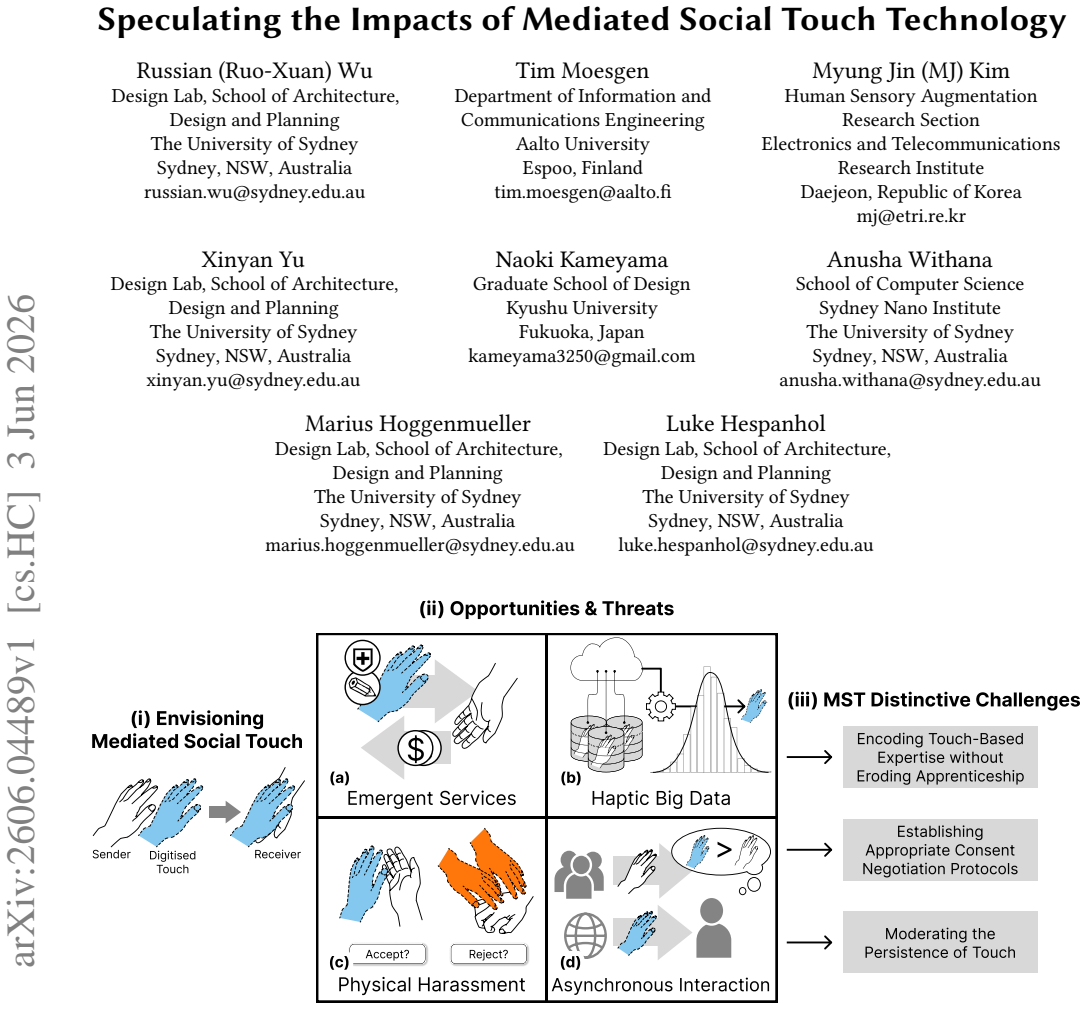
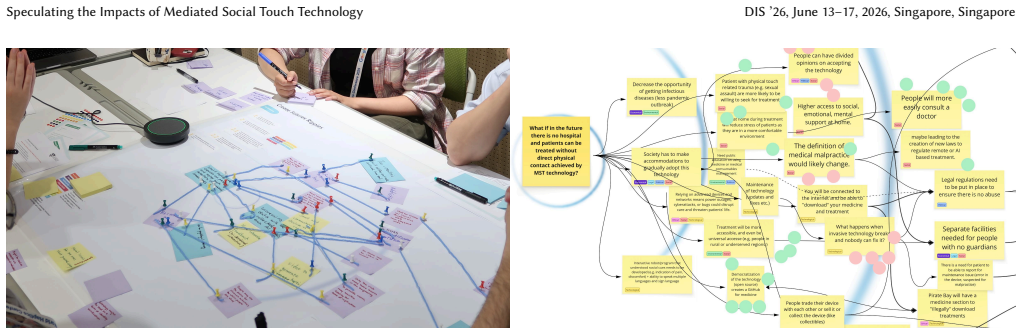
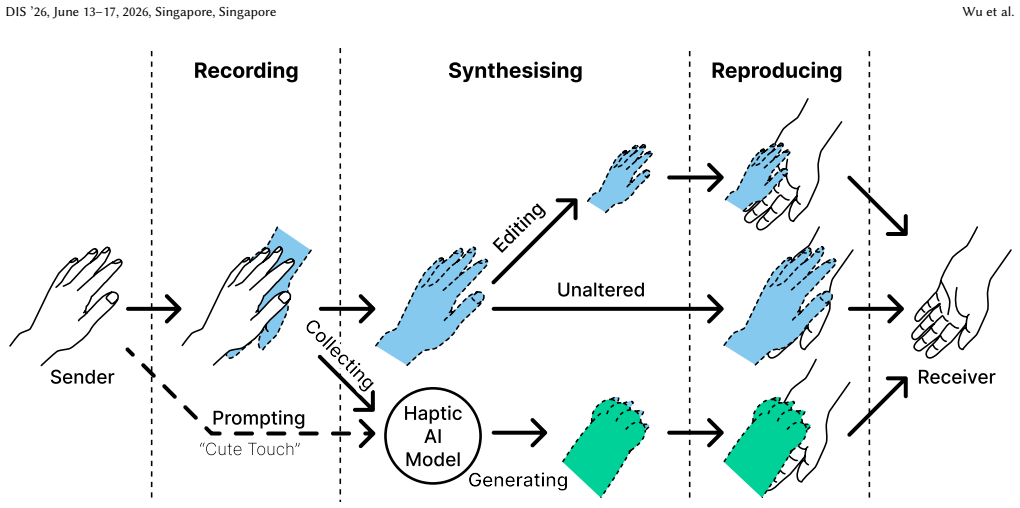
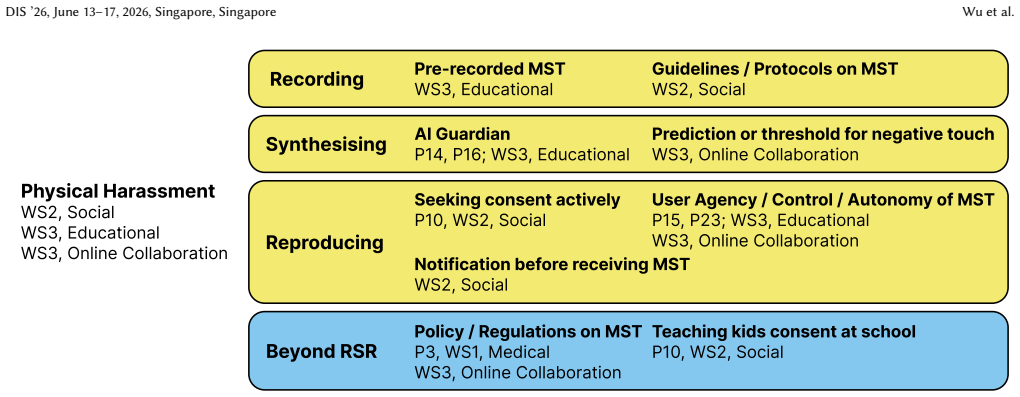
Workshops using Future Ripples identify intervention points across the record-synthesize-reproduce pipeline for mediated social touch technologies.
A machine-rendered reading of the paper's core claim, the machinery that carries it, and where it could break.
Core claim
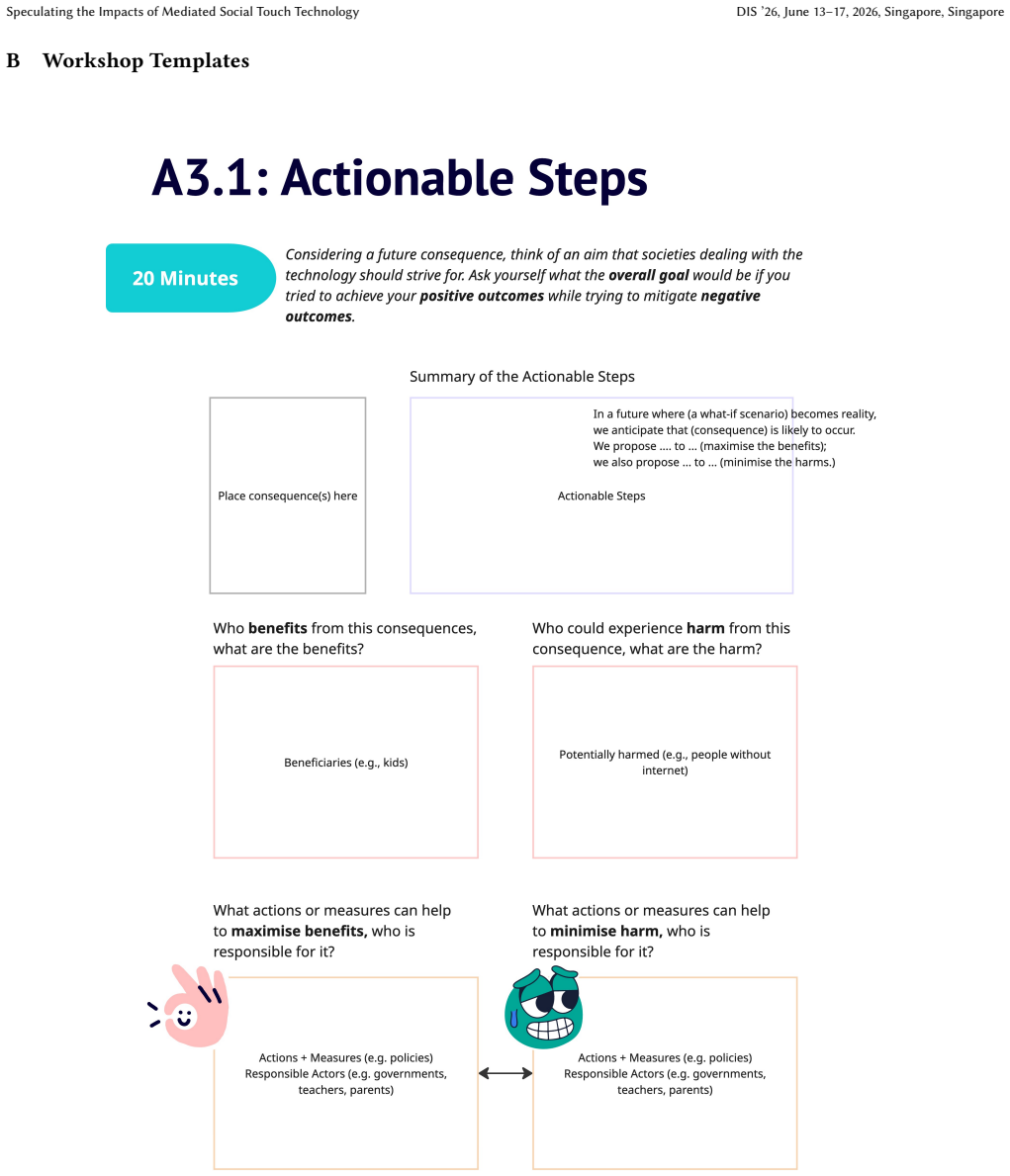
Through workshops applying the Future Ripples method, participants envisioned future scenarios for MST technologies and identified opportunities, threats, and actionable responses. Qualitative analysis organized these into four themes and three distinctive challenges, offering haptics researchers intervention points across the RSR pipeline to inform MST design alongside methodological insights from the method's application.
What carries the argument
The Future Ripples method applied in participatory workshops to speculate on MST impacts by generating scenarios, opportunities, threats, and responses that map to the record-synthesize-reproduce pipeline.
If this is right
- Haptics researchers gain specific intervention points in the record, synthesize, and reproduce stages to shape MST design.
- Four themes and three challenges provide a structured way to anticipate and respond to sociotechnical effects.
- Methodological insights support adapting Future Ripples for other haptic technology explorations.
- Designers can move beyond individual benefits to address collective opportunities and threats in future scenarios.
Where Pith is reading between the lines
- The identified challenges could be used to develop ethical checklists for haptic interface teams before deployment.
- Similar speculation workshops might be run for related technologies such as remote VR touch or wearable social signals.
- Policy discussions around digital communication tools could incorporate the themes to weigh mediated touch regulations.
- Prototype testing could validate whether incorporating workshop responses reduces the predicted negative impacts.
Load-bearing premise
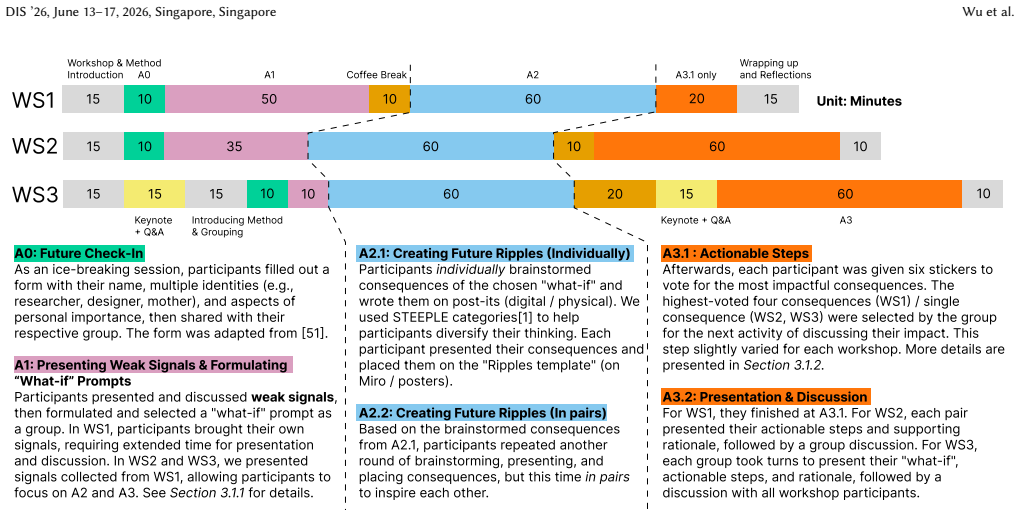
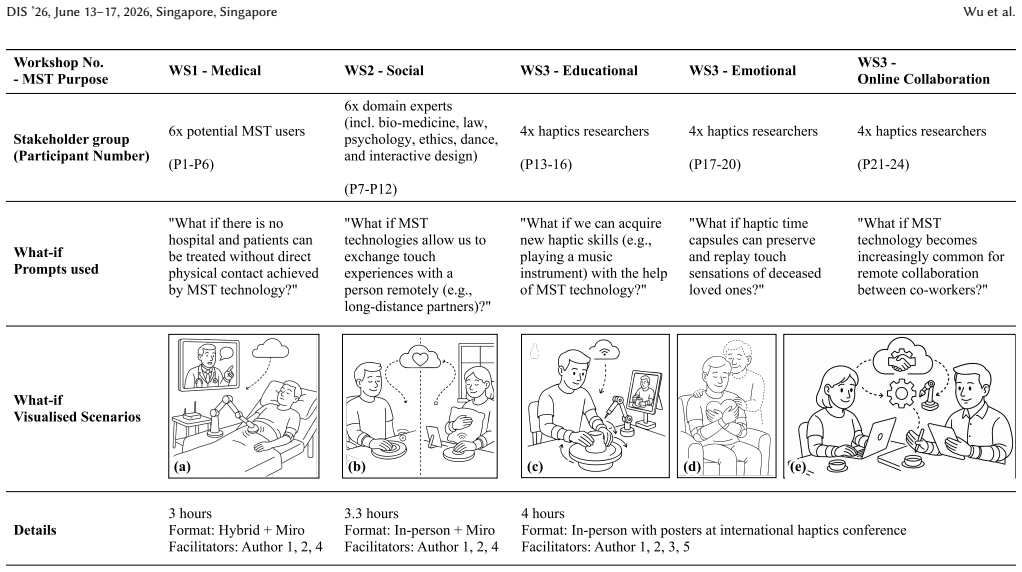
The Future Ripples method applied in workshops with 24 participants can generate reliable insights into the broader sociotechnical impacts of MST that go beyond the direct benefits highlighted in existing research.
What would settle it
A follow-up study of deployed MST systems that finds no evidence of the speculated opportunities, threats, or challenges across the RSR pipeline would falsify the workshop-derived insights.
Figures
read the original abstract
With growing research on haptic interfaces, Mediated Social Touch (MST) technologies offer the potential to record, synthesise, and reproduce (RSR) touch experiences across space and time, enabling, for instance, a hug from afar and from the past. Although much of the existing research highlights the direct benefits of these systems, such as reducing loneliness and providing emotional support, little attention has been paid to their broader sociotechnical impacts. To address this gap, we used the Future Ripples method to speculate on possible effects of MST. We conducted three workshops with 24 participants, including potential users, domain experts, and haptics researchers. Throughout these sessions, participants collectively envisioned possible future scenarios, alongside opportunities and threats, and proposed actionable responses. Our qualitative analysis organised these insights into four themes and three distinctive challenges. These findings offer haptics researchers intervention points across the RSR pipeline to inform MST design, alongside methodological insights from applying Future Ripples to MST technology.
Editorial analysis
A structured set of objections, weighed in public.
Referee Report
Summary. The paper applies the Future Ripples speculative method in three workshops with 24 participants (potential users, domain experts, and haptics researchers) to explore broader sociotechnical impacts of Mediated Social Touch (MST) technologies, which support recording, synthesising, and reproducing (RSR) touch across space and time. Qualitative analysis of participant-generated scenarios, opportunities, threats, and responses yields four themes and three distinctive challenges, positioned as intervention points across the RSR pipeline plus methodological notes on the Future Ripples approach.
Significance. If the themes and challenges are robustly grounded, the work supplies concrete, participant-derived considerations for haptics researchers that extend beyond the direct benefits (e.g., loneliness reduction) already emphasised in the literature, potentially supporting more responsible MST design. The methodological reflections on adapting Future Ripples to MST also offer a reusable template for speculative inquiry in HCI.
major comments (1)
- [Abstract / Methods] Abstract and Methods section: the qualitative analysis is described only at the level of outcome (four themes, three challenges) with no account of the procedure used to derive themes from workshop transcripts or artefacts, no mention of coding approach, inter-coder agreement, member checking, or other validation steps. Because the central claim rests on these participant-generated insights as reliable intervention points, the absence of this detail is load-bearing.
Simulated Author's Rebuttal
We thank the referee for their constructive feedback highlighting the need for greater transparency in our qualitative analysis. We agree this is a substantive point and will revise the manuscript accordingly to provide the requested procedural details.
read point-by-point responses
-
Referee: [Abstract / Methods] Abstract and Methods section: the qualitative analysis is described only at the level of outcome (four themes, three challenges) with no account of the procedure used to derive themes from workshop transcripts or artefacts, no mention of coding approach, inter-coder agreement, member checking, or other validation steps. Because the central claim rests on these participant-generated insights as reliable intervention points, the absence of this detail is load-bearing.
Authors: We agree that the Methods section requires additional detail on the analysis procedure to support the reliability of the derived themes and challenges. In the revision we will expand this section to describe the full process: how workshop transcripts and artefacts were prepared, the specific coding approach (thematic analysis following an inductive approach), steps taken for theme development and refinement, any measures of inter-coder agreement, and validation procedures such as discussion among the research team. The abstract will remain at a high level as is conventional, but we will ensure the Methods section now provides the load-bearing procedural account. revision: yes
Circularity Check
No significant circularity
full rationale
The paper is an exploratory qualitative study that applies the Future Ripples method in workshops with external participants to generate speculative scenarios on MST impacts. No derivation chain, equations, fitted parameters, or first-principles results exist that could reduce to inputs by construction. Claims rest on participant-generated themes and challenges rather than self-definitions, self-citations, or renamed known results. The work explicitly scopes its contribution to methodological notes and intervention points derived from external input, with no load-bearing internal reductions.
Axiom & Free-Parameter Ledger
axioms (1)
- domain assumption The Future Ripples method is suitable for identifying opportunities, threats, and responses in emerging technologies such as MST.
Reference graph
Works this paper leans on
-
[1]
Csaba Antonya and Silviu Butnariu. 2022. Preservation of Cultural Heritage Using Virtual Reality Technologies and Haptic Feedback: A Prototype and Case Study on Antique Carpentry Tools.Applied Sciences12, 16 (2022), 8002. doi:10. 3390/app12168002
2022
-
[2]
Giulia Barbareschi, Ximing Shen, Yulan Ju, Diego Compagna, Frank O. Flemisch, Kenta Hashiura, Hsin-Ni Ho, Arata Horie, Keigo Inukai, Jieun Kim, Nicole Krämer, Takumi Kuhara, Sven Martin, Stephanie M. Mueller, Aiko Murata, Gernot Oberfell, Mark Paterson, Mina Shibasaki, Anna Spiegel, Celia Spooden, Heiko Stoff, Rikako Sumida, Yoshihiro Tanaka, Sohei Wakisa...
-
[3]
Julian Bleecker. 2022. Design Fiction: A Short Essay on Design, Science, Fact, and Fiction. InMachine Learning and the City(1 ed.), Silvio Carta (Ed.). Wiley, Hoboken, NJ, United States, 561–578. doi:10.1002/9781119815075.ch47
-
[4]
Leonardo Bonanni, Cati Vaucelle, Jeff Lieberman, and Orit Zuckerman. 2006. TapTap: a haptic wearable for asynchronous distributed touch therapy. InCHI’06 extended abstracts on Human factors in computing systems. 580–585
2006
-
[5]
Leonardo Bonanni, Cati Vaucelle, Jeff Lieberman, and Orit Zuckerman. 2006. TapTap: a haptic wearable for asynchronous distributed touch therapy. InCHI ’06 Extended Abstracts on Human Factors in Computing Systems (CHI EA ’06). Association for Computing Machinery, New York, NY, USA, 580–585. doi:10. 1145/1125451.1125573
arXiv 2006
-
[6]
Hadley, and Leah Zaidi
Stuart Candy, Cher Potter, Danah Abdulla, Ahmed Ansari, Paola Antonelli, Tina Auer, James Auger, Nik Baerten, Ralph Borland, Tim Boykett, Anne Burdick, Ece Canli, Kuo-Hua Chen, David Delgado, Alida Draudt, Jake Dunagan, Tony Fry, Nik Gaffney, J.J. Hadley, and Leah Zaidi. 2019.Design and Futures. Tamkang University Press, Taipei
2019
-
[7]
Asta Cekaite and Lorenza Mondada. 2020. Towards an Interactional Approach to Touch in Social Encounters. InTouch in Social Interaction(1 ed.), Asta Cekaite and Lorenza Mondada (Eds.). Routledge, 1–26. doi:10.4324/9781003026631-1
-
[8]
Victoria Clarke and Virginia Braun. 2014. Thematic Analysis. InEncyclopedia of Critical Psychology. Springer, New York, NY, USA, 1947–1952. doi:10.1007/978-1- 4614-5583-7_311
-
[9]
Patricia Cornelio, Stephen Hughes, Orestis Georgiou, William Frier, Martin Maunsbach, Madhan Kumar Vasudevan, and Marianna Obrist. 2023. Responsible Innovation of Touchless Haptics: A Prospective Design Exploration in Social Interaction. InProceedings of the 2023 CHI Conference on Human Factors in Com- puting Systems (CHI ’23). Association for Computing M...
-
[10]
Kimberly Do, Rock Yuren Pang, Jiachen Jiang, and Katharina Reinecke. 2023. “That’s important, but... ”: How Computer Science Researchers Anticipate Unin- tended Consequences of Their Research Innovations. InProceedings of the 2023 CHI Conference on Human Factors in Computing Systems (CHI ’23). Association for Computing Machinery, New York, NY, USA, 1–16. ...
-
[11]
Felix Anand Epp, Tim Moesgen, Antti Salovaara, Emmi Pouta, and İdil Gaziu- lusoy. 2022. Reinventing the Wheel: The Future Ripples Method for Activating Anticipatory Capacities in Innovation Teams. InDesigning Interactive Systems Conference. ACM, Virtual Event Australia, 387–399. doi:10.1145/3532106.3534570
-
[12]
Stefanie M Erk, Alexander Toet, and Jan BF Van Erp. 2015. Effects of mediated social touch on affective experiences and trust.PeerJ3 (2015), e1297
2015
-
[13]
Merle Fairhurst and Irene Valori. 2023. A functional framework for multisensory and interactive mediated social touch experiences. InProceedings of the 2023 ACM International Conference on Interactive Media Experiences Workshops. ACM, Nantes France, 46–51. doi:10.1145/3604321.3604349
-
[14]
Batya Friedman, Peter H. Kahn Jr., and Alan Borning. 2008. Value Sensitive Design and Information Systems. InThe Handbook of In- formation and Computer Ethics. John Wiley & Sons, Ltd, Hoboken, NJ, USA, 69–101. doi:10.1002/9780470281819.ch4 Section: 4 _eprint: https://onlinelibrary.wiley.com/doi/pdf/10.1002/9780470281819.ch4
-
[15]
Alberto Gallace and Charles Spence. 2010. The science of interpersonal touch: an overview.Neuroscience & Biobehavioral Reviews34, 2 (2010), 246–259
2010
-
[16]
Anne Galloway and Catherine Caudwell. 2018. Speculative design as research method. InUndesign(1 ed.), Gretchen Coombs, Andrew McNamara, and Gavin Sade (Eds.). Routledge, London, 85–96. doi:10.4324/9781315526379-8
-
[17]
Daniel Gooch and Leon Watts. 2012. YourGloves, hothands and hotmits: devices to hold hands at a distance. InProceedings of the 25th annual ACM symposium on User interface software and technology (UIST ’12). Association for Computing Machinery, New York, NY, USA, 157–166. doi:10.1145/2380116.2380138
-
[18]
Antal Haans and Wijnand IJsselsteijn. 2006. Mediated social touch: a review of current research and future directions.Virtual Reality9, 2-3 (Jan. 2006), 149–159. doi:10.1007/s10055-005-0014-2
-
[19]
Brent Hecht, Lauren Wilcox, Jeffrey P. Bigham, Johannes Schöning, Ehsan Hoque, Jason Ernst, Yonatan Bisk, Luigi De Russis, Lana Yarosh, Bushra Anjum, Danish Contractor, and Cathy Wu. 2021. It’s Time to Do Something: Mitigating the Negative Impacts of Computing Through a Change to the Peer Review Process. doi:10.48550/arXiv.2112.09544 arXiv:2112.09544 [cs]
-
[20]
Michel Hohendanner, Chiara Ullstein, Dohjin Miyamoto, Emma F Huffman, Gudrun Socher, Jens Grossklags, and Hirotaka Osawa. 2024. Metaverse Per- spectives from Japan: A Participatory Speculative Design Case Study.Proceed- ings of the ACM on Human-Computer Interaction8, CSCW2 (Nov. 2024), 1–51. doi:10.1145/3686939
-
[21]
Michel Hohendanner, Chiara Ullstein, Bukola Abimbola Onyekwelu, Amelia Katirai, Jun Kuribayashi, Olusola Babalola, Arisa Ema, and Jens Grossklags. 2025. Initiating the Global AI Dialogues: Laypeople Perspectives on the Future Role of genAI in Society from Nigeria, Germany and Japan. InProceedings of the 2025 CHI Conference on Human Factors in Computing Sy...
-
[22]
Jussi Holopainen, Yuxuan Huang, Joongi Shin, Erkka Nissinen, and Andrés Lucero
-
[23]
InProceedings of the 2025 ACM Designing Interactive Systems Conference
Infinity Book: Speculating Literary Expressions in the Age of Generative AI. InProceedings of the 2025 ACM Designing Interactive Systems Conference. ACM, Madeira Portugal, 1430–1454. doi:10.1145/3715336.3735735
-
[24]
Gijs Huisman. 2017. Social touch technology: A survey of haptic technology for social touch.IEEE transactions on haptics10, 3 (2017), 391–408
2017
-
[25]
Gijs Huisman. 2022. An interaction theory account of (mediated) social touch. Frontiers in Psychology13 (2022), 830193
2022
-
[26]
Carey Jewitt, Sara Price, Kerstin Leder Mackley, Nikoleta Yiannoutsou, and Dou- glas Atkinson. 2019. Digital Touch Ethics and Values. InInterdisciplinary Insights for Digital Touch Communication, Carey Jewitt, Sara Price, Kerstin Leder Mack- ley, Nikoleta Yiannoutsou, and Douglas Atkinson (Eds.). Springer International Publishing, 107–122. doi:10.1007/978...
-
[27]
Carey Jewitt, Sara Price, Jürgen Steimle, Gijs Huisman, Lili Golmohammadi, Narges Pourjafarian, William Frier, Thomas Howard, Sima Ipakchian Askari, Michela Ornati, et al. 2021. Manifesto for digital social touch in crisis.Frontiers in Computer Science3 (2021), 754050
2021
-
[28]
Merel Jung, Anouk Keizer, Gijs Huisman, Laura Dima, Karen Lancel, Hermen Maat, and Jan van Erp. 2024. Digital Social Touch Toolkit: a research tool for studying attitudes towards digital touch.Eurohaptics 20241, 1 (June 2024), 3. doi:10.5281/ZENODO.12601161 Publisher: Zenodo
-
[29]
1991.Legitimate Peripheral Participation in Communities of Practice
Jean Lave and Etienne Wenger. 1991.Legitimate Peripheral Participation in Communities of Practice. Cambridge University Press, 89–118. doi:10.1017/ CBO9780511815355
1991
-
[30]
Madelaine Ley and Nathan Rambukkana. 2021. Touching at a distance: digital intimacies, haptic platforms, and the ethics of consent.Science and Engineering Ethics27, 5 (2021), 63
2021
-
[31]
Q. Vera Liao and Michael Muller. 2019. Enabling Value Sensitive AI Sys- tems through Participatory Design Fictions. doi:10.48550/arXiv.1912.07381 arXiv:1912.07381 [cs]
-
[32]
Yiyue Luo, Chao Liu, Young Joong Lee, Joseph DelPreto, Kui Wu, Michael Foshey, Daniela Rus, Tomás Palacios, Yunzhu Li, Antonio Torralba, and Wojciech Matusik
-
[33]
Nature Communications15, 1 (Jan
Adaptive tactile interaction transfer via digitally embroidered smart gloves. Nature Communications15, 1 (Jan. 2024), 868. doi:10.1038/s41467-024-45059-8
-
[34]
Kouta Minamizawa, Yasuaki Kakehi, Masashi Nakatani, Soichiro Mihara, and Susumu Tachi. 2012. TECHTILE toolkit: a prototyping tool for design and education of haptic media. InProceedings of the 2012 Virtual Reality International Conference (VRIC ’12). Association for Computing Machinery, New York, NY, USA, 1–2. doi:10.1145/2331714.2331745
-
[35]
Frederik Ølgaard Jensen, Sigurd Dalsgaard Pedersen, and Minna Pakanen. 2024. SuspenderMender - Designing for a Shared Management of Anxiety in Higher Education Context Through a Pair of Wearables Simulating Physical Touch. In Proceedings of the Eighteenth International Conference on Tangible, Embedded, and Embodied Interaction(Cork, Ireland)(TEI ’24). Ass...
-
[36]
Nassim Parvin and Anne Pollock. 2020. Unintended by Design: On the Political Uses of “Unintended Consequences”.Engaging Science, Technology, and Society6 (Aug. 2020), 320–327. doi:10.17351/ests2020.497
-
[37]
Michael Polanyi. 1997. The Tacit Dimension. InKnowledge in Organizations (1 ed.), Laurence Prusak (Ed.). Routledge, New York, NY, USA, 135–146. doi:10. 4324/9780080509822
1997
-
[38]
Stefano Puntoni, Rebecca Walker Reczek, Markus Giesler, and Simona Botti. 2021. Consumers and Artificial Intelligence: An Experiential Perspective.Journal of Marketing85, 1 (2021), 131–151. doi:10.1177/0022242920953847
-
[39]
James A. Roberts, Phil D. Young, and Meredith E. David. 2025. The Epidemic of Loneliness: A 9-Year Longitudinal Study of the Impact of Passive and Active Social Media Use on Loneliness.Personality and Social Psychology Bulletin(2025), 01461672241295870. doi:10.1177/01461672241295870
-
[40]
Anton Poikolainen Rosén, Chiara Rossitto, Fatemeh Bakhshoudeh, Rob Comber, and Stanley J Greenstein. 2025. Yarn as a Means to Give Form to Entanglements of Regulation, Design and Sustainability Practices. InProceedings of the 2025 ACM Designing Interactive Systems Conference. ACM, Madeira Portugal, 2534–2548. doi:10.1145/3715336.3735410
-
[41]
Camilo Sanchez, Anton Poikolainen Rosén, Antti Salovaara, Felix A. Epp, and Tim Moesgen. 2024. Peering through Time. InMore-Than-Human Design in Practice(1 ed.). Routledge, London, 209–222. doi:10.4324/9781003467731-18
-
[42]
Camilo Sanchez, Sui Wang, Kaisa Savolainen, Felix Anand Epp, and Antti Salo- vaara. 2025. Let’s Talk Futures: A Literature Review of HCI’s Future Orientation. InProceedings of the 2025 CHI Conference on Human Factors in Computing Sys- tems (CHI ’25). Association for Computing Machinery, New York, NY, USA, 1–36. doi:10.1145/3706598.3713759
-
[43]
Vivian Shen, Tucker Rae-Grant, Joe Mullenbach, Chris Harrison, and Craig Shultz. 2023. Fluid Reality: High-Resolution, Untethered Haptic Gloves using Electroosmotic Pump Arrays. InProceedings of the 36th Annual ACM Symposium on User Interface Software and Technology. ACM, San Francisco CA USA, 1–20. doi:10.1145/3586183.3606771
-
[44]
Mohit Singhal, Chen Ling, Pujan Paudel, Poojitha Thota, Nihal Kumarswamy, Gianluca Stringhini, and Shirin Nilizadeh. 2023. SoK: Content Moderation in Social Media, from Guidelines to Enforcement, and Research to Practice. In 2023 IEEE 8th European Symposium on Security and Privacy (EuroS&P). 868–895. doi:10.1109/EuroSP57164.2023.00056
-
[45]
Jack Stilgoe, Richard Owen, and Phil Macnaghten. 2017. Developing a framework for responsible innovation*. InThe Ethics of Nanotechnology, Geoengineering, and Clean Energy. Routledge, London. Num Pages: 13
2017
-
[46]
Miriam Sturdee, Joseph Lindley, Conor Linehan, Chris Elsden, Neha Kumar, Tawanna Dillahunt, Regan Mandryk, and John Vines. 2021. Consequences, Schmonsequences! Considering the Future as Part of Publication and Peer Review in Computing Research. InExtended Abstracts of the 2021 CHI Conference on Human Factors in Computing Systems (CHI EA ’21). Association ...
-
[47]
Juulia T Suvilehto, Enrico Glerean, Robin IM Dunbar, Riitta Hari, and Lauri Nummenmaa. 2015. Topography of social touching depends on emotional bonds between humans.Proceedings of the National Academy of Sciences112, 45 (2015), 13811–13816
2015
-
[48]
Harunobu Taguchi, Youichi Kamiyama, Kenta Kan, Yulan Ju, Arata Horie, Yoshi- hiro Tanaka, Hironori Ishikawa, and Kouta Minamizawa. 2023. Multichannel Haptic Communication Platform with Wearable Sensing and Display. InSIG- GRAPH Asia 2023 Emerging Technologies(Sydney, NSW, Australia)(SA ’23). As- sociation for Computing Machinery, New York, NY, USA, Articl...
-
[49]
Peiris, Yongsoon Choi, Vuong Thuong, and Sha Lai
James Keng Soon Teh, Adrian David Cheok, Roshan L. Peiris, Yongsoon Choi, Vuong Thuong, and Sha Lai. 2008. Huggy Pajama: a mobile parent and child hugging communication system. InProceedings of the 7th international conference on Interaction design and children (IDC ’08). Association for Computing Machinery, New York, NY, USA, 250–257. doi:10.1145/1463689.1463763
-
[50]
Jan B. F. Van Erp, Karon E. MacLean, Gregory J. Gerling, Carey Jewitt, and Alexander Toet. 2023. Editorial: Social touch.Frontiers in Computer Science5 (July 2023), 1255784. doi:10.3389/fcomp.2023.1255784
-
[51]
Jan B. F. Van Erp and Alexander Toet. 2015. Social Touch in Human-Computer Interaction. 2 (2015). doi:10.3389/fdigh.2015.00002
-
[52]
Lorenzo Vianello, Emek Barış Küçüktabak, Matthew Short, Clément Lhoste, Lorenzo Amato, Kevin Lynch, and Jose Pons. 2024. Exoskeleton-Mediated Phys- ical Human-Human Interaction for a Sit-to-Stand Rehabilitation Task. In2024 IEEE International Conference on Robotics and Automation (ICRA). 4521–4527. doi:10.1109/ICRA57147.2024.10610796
-
[53]
Kristin Werner and Antje Nestler. 2025.Co-Creating Futures: A Practical Guide to Speculation Workshops Connecting Research, Design, and Society. Technical Report. Humboldt-Universität zu Berlin. doi:10.18452/31342
-
[54]
David Wicks. 2017. The Coding Manual for Qualitative Researchers (3rd edition). Qualitative Research in Organizations and Management: An International Journal 12, 2 (June 2017), 169–170. doi:10.1108/QROM-08-2016-1408
-
[55]
Danielle Wilde. 2010. Swing that thing: Moving to move. InProceedings of the fourth international conference on Tangible, embedded, and embodied interaction. 303–304
2010
-
[56]
Russian (Ruo-Xuan) Wu, Luke Hespanhol, Marius Hoggenmüller, Hannes Wald- schütz, and Eva Hornecker. 2025. Hugging Suit: Designing and Evaluating a Pneu- matic System for Remote Haptic Experiences. InProceedings of the 37th Australian Conference on Human-Computer Interaction (OzCHI ’25). Association for Comput- ing Machinery, New York, NY, USA, 136–149. do...
-
[57]
Heng Xu, Robert E. Crossler, and France Bélanger. 2012. A Value Sensitive Design Investigation of Privacy Enhancing Tools in Web Browsers.Decision Support Systems54, 1 (Dec. 2012), 424–433. doi:10.1016/j.dss.2012.06.003
-
[58]
Zhang, Grayden Zaleski, Jaya N
Cindy C. Zhang, Grayden Zaleski, Jaya N. Kailley, Katelyn A. Teng, Mahala English, Anna Riminchan, and Julie M. Robillard. 2024. Debate: Social media content moderation may do more harm than good for youth mental health.Child and Adolescent Mental Health29, 1 (2024), 104–106. doi:10.1111/camh.12689 A Participants’ Background DIS ’26, June 13–17, 2026, Sin...
discussion (0)
Sign in with ORCID, Apple, or X to comment. Anyone can read and Pith papers without signing in.