Dual Lyapunov-based Synchronization Control of R\"ossler System
Pith reviewed 2026-06-28 03:54 UTC · model grok-4.3
The pith
A dual Lyapunov method with polynomial optimization synchronizes the Rössler system to a limit cycle by destroying its chaotic behavior.
A machine-rendered reading of the paper's core claim, the machinery that carries it, and where it could break.
Core claim
The paper claims that the dual Lyapunov-based closed-loop synchronization method, using semidefinite programming and sum-of-squares polynomials, computes a nonlinear state feedback function which synchronizes the Rössler system to a selected reference model, destroying chaotic behavior and making a limit cycle attracting instead.
What carries the argument
Dual Lyapunov stability analysis combined with sum-of-squares polynomial optimization inside a semidefinite program that yields the nonlinear state feedback controller.
If this is right
- The nonlinear feedback renders the limit cycle globally attracting for the closed-loop Rössler system.
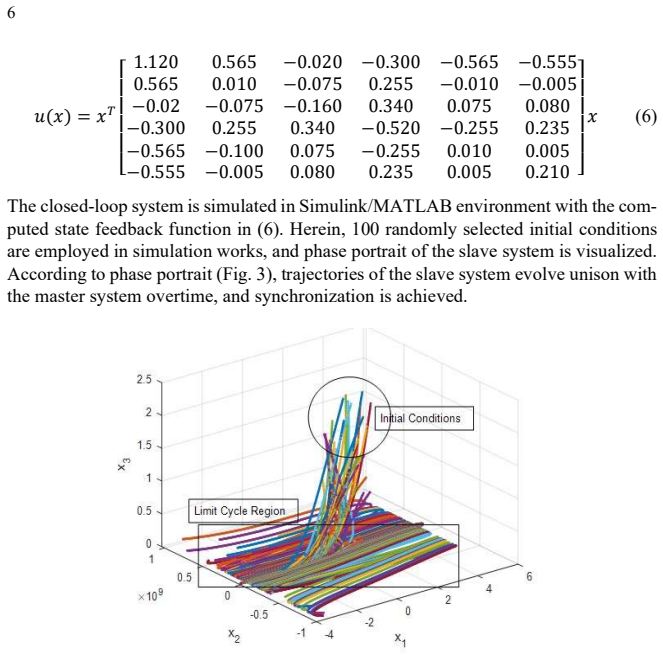
- Synchronization occurs successfully for one hundred randomly chosen initial conditions.
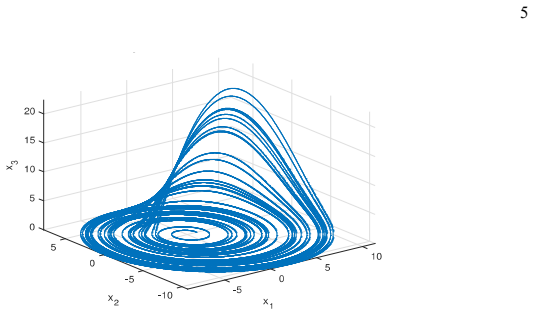
- Bifurcation diagrams and phase portraits show the replacement of chaotic attractors by periodic behavior.
- The same optimization procedure can be used to design controllers that enforce a chosen limit cycle in place of chaos.
Where Pith is reading between the lines
- The method could be applied to other chaotic oscillators if suitable reference models are identified.
- Raising the polynomial degree in the sum-of-squares formulation might allow synchronization to more intricate periodic orbits.
- The discussion of adding new constraints indicates the framework can be extended to systems with extra nonlinear terms or higher dimension.
Load-bearing premise
A reference model and polynomial degree exist for which the resulting semidefinite program produces a feedback controller that renders the chosen limit cycle globally attracting for the Rössler vector field.
What would settle it
A simulation of the closed-loop system from one of the tested random initial conditions that fails to converge to the limit cycle and instead exhibits persistent chaos would falsify the synchronization claim.
Figures

read the original abstract
This paper proposes a novel approach for the synchronization problem of nonlinear dynamical systems, integrating dual Lyapunov stability analysis with polynomial optimization. A comprehensive review of the relevant scientific literature on synchronization methods is conducted, with a particular focus on classical Lyapunov-based methods for chaotic systems. In this study, the R\"ossler system is synchronized by employing dual Lyapunov-based closed-loop synchronization method. This method uses semidefinite programming and sum-of-squares polynomials to compute a nonlinear state feedback function which synchronize a chaotic system to a selected reference model. It is aimed that chaotic behavior is destroyed and, instead, a limit cycle becomes attracting. Simulation works are performed for randomly selected 100 different initial conditions to show that synchronization process is successfully performed. Furthermore, bifurcation diagrams and phase portraits are evaluated to analyze the system dynamics. The paper discusses results and how new constraints should be employed and adapted to more complex systems.
Editorial analysis
A structured set of objections, weighed in public.
Referee Report
Summary. The paper proposes a novel dual Lyapunov-based closed-loop synchronization method integrating semidefinite programming and sum-of-squares polynomials to compute a nonlinear state feedback controller that synchronizes the Rössler system to a selected reference model, with the goal of destroying chaotic behavior and rendering a limit cycle attracting. Success is asserted via simulations on 100 random initial conditions together with bifurcation diagrams and phase portraits.
Significance. If the central claim can be substantiated with explicit reference-model equations, polynomial degrees, SDP feasibility certificates, and an analytic argument for global attraction, the work would supply a systematic polynomial-optimization route to chaos control that is currently missing from the literature; the present manuscript, however, leaves these elements unverified.
major comments (2)
- [Abstract] Abstract: the reference model is described only as 'selected' with no equations supplied, no justification for the choice, and no indication of the polynomial degrees or SDP feasibility margin that would certify global attraction of the target limit cycle for the closed-loop Rössler vector field.
- [Simulation results] Simulation results (and abstract): the claim of successful synchronization rests on 100 random initial-condition trials, yet the manuscript supplies neither the explicit SOS/SDP program, the obtained controller polynomials, nor any error bounds or basin-of-attraction analysis that would convert the numerical evidence into a verifiable global-stability statement.
minor comments (1)
- [Abstract] The abstract contains minor grammatical awkwardness (e.g., 'It is aimed that chaotic behavior is destroyed') that could be rephrased for clarity.
Simulated Author's Rebuttal
We thank the referee for the careful reading and constructive comments. We address each major comment below and will revise the manuscript to improve verifiability and clarity.
read point-by-point responses
-
Referee: [Abstract] Abstract: the reference model is described only as 'selected' with no equations supplied, no justification for the choice, and no indication of the polynomial degrees or SDP feasibility margin that would certify global attraction of the target limit cycle for the closed-loop Rössler vector field.
Authors: We agree that the abstract should be more explicit. In the revised manuscript we will state the precise equations of the reference model (a stable limit-cycle oscillator), provide the justification for this choice, report the polynomial degrees used in the SOS decomposition, and include the numerical SDP feasibility margin returned by the solver. revision: yes
-
Referee: [Simulation results] Simulation results (and abstract): the claim of successful synchronization rests on 100 random initial-condition trials, yet the manuscript supplies neither the explicit SOS/SDP program, the obtained controller polynomials, nor any error bounds or basin-of-attraction analysis that would convert the numerical evidence into a verifiable global-stability statement.
Authors: We accept that the computational details must be supplied. The revision will include the full SOS/SDP program, the resulting controller polynomials, and a discussion of the certified basin obtained from the dual Lyapunov function. The 100 simulations remain empirical evidence; the SDP feasibility itself supplies the rigorous certificate inside the semialgebraic set defined by the Lyapunov level sets. We will add a brief statement on the numerical nature of the certificate and the absence of a purely analytic (non-SOS) global proof. revision: yes
Circularity Check
No significant circularity; derivation relies on external SDP/SOS solvers
full rationale
The provided abstract and description contain no equations, fitted parameters presented as predictions, or self-citations that reduce the central claim to a self-referential definition. The method invokes standard semidefinite programming and sum-of-squares theory applied to a selected reference model, with simulation validation. No load-bearing step is shown to collapse by construction to its inputs. This is the expected honest non-finding for a methods paper whose feasibility claims rest on external numerical solvers rather than internal redefinition.
Axiom & Free-Parameter Ledger
Reference graph
Works this paper leans on
-
[1]
Springer Science & Business Media, New York (2011)
Jovic, B.: Synchronization techniques for chaotic communication systems. Springer Science & Business Media, New York (2011)
2011
-
[2]
S., Asad, J
Baleanu, D., Sajjadi, S. S., Asad, J. H., Jajarmi, A., Estiri, E.: Hyperchaotic behaviors, opti- mal control, and synchronization of a nonautonomous cardiac conduction system. Advances in Difference Equations 2021(1), 157 (2021)
2021
-
[3]
Nonlinear Dynamics 82(1), 877–890 (2015)
Merah, L., Ali-Pacha, A., Hadj-Said, N.: Real-time cryptosystem based on synchronized chaotic systems. Nonlinear Dynamics 82(1), 877–890 (2015)
2015
-
[4]
Physica A: Statistical Mechanics and its Applications 473, 262–275 (2017)
Huang, C., Cao, J.: Active control strategy for synchronization and anti-synchronization of a fractional chaotic financial system. Physica A: Statistical Mechanics and its Applications 473, 262–275 (2017)
2017
-
[5]
Nonlinear Dynamics 87(3), 1773–1783 (2017)
Wu, W.-S., Zhao, Z.-S., Zhang, J., Sun, L.-K.: State feedback synchronization control of coronary artery chaos system with interval time-varying delay. Nonlinear Dynamics 87(3), 1773–1783 (2017)
2017
-
[6]
K.-S.: A new criterion for chaos synchronization using linear state feedback control
Jiang, G.-P., Chen, G., Tang, W. K.-S.: A new criterion for chaos synchronization using linear state feedback control. International Journal of Bifurcation and Chaos 13(8), 2343– 2351 (2003)
2003
-
[7]
In: Meghanathan, N., Nagamalai, D., Chaki, N
Vaidyanathan, S.: Analysis, Control and Synchronization of Hyperchaotic Zhou System via Adaptive Control. In: Meghanathan, N., Nagamalai, D., Chaki, N. (eds.) Advances in Com- puting and Information Technology. Advances in Intelligent Systems and Computing, vol. 177, pp. 1–10. Springer, Berlin, Heidelberg (2013)
2013
-
[8]
IEEE Transactions on Cybernetics 44(8), 1350–1361 (2014)
Wang, J.-L., Wu, H.-N.: Synchronization and adaptive control of an array of linearly coupled reaction-diffusion neural networks with hybrid coupling. IEEE Transactions on Cybernetics 44(8), 1350–1361 (2014)
2014
-
[9]
Asian Journal of Control 24(5), 2352–2362 (2022)
Zhou, Y., Li, D., Gao, F.: Optimal synchronization control for heterogeneous multi-agent systems: Online adaptive learning solutions. Asian Journal of Control 24(5), 2352–2362 (2022)
2022
-
[10]
Advances in Difference Equations 2017(1), 304 (2017)
Li, T., Wang, Y., Zhao, C.: Synchronization of fractional chaotic systems based on a simple Lyapunov function. Advances in Difference Equations 2017(1), 304 (2017)
2017
-
[11]
L., Martínez-Guerra, R., Aguilar-López, R., Aguilar-Ibañez, C.: A chaotic system in synchronization and secure communications
Mata-Machuca, J. L., Martínez-Guerra, R., Aguilar-López, R., Aguilar-Ibañez, C.: A chaotic system in synchronization and secure communications. Communications in Nonlinear Sci- ence and Numerical Simulation 17(4), 1706–1713 (2012)
2012
-
[12]
A., Saleh, H
Saeed, N. A., Saleh, H. A., El-Ganaini, W. A., Kamel, M., Mohamed, M. S.: On a New Three-Dimensional Chaotic System with Adaptive Control and Chaos Synchronization. Shock and Vibration 2023(1), 1969500 (2023)
2023
-
[13]
IEEE Transactions on Circuits and Systems II: Express Briefs 68(6), 2082–2086 (2021)
Liu, H., Chi, J., Li, Z., Zeng, Z., Lü, J.: Parameter Identification of Memristor-Based Chaotic Systems via the Drive-Response Synchronization Method. IEEE Transactions on Circuits and Systems II: Express Briefs 68(6), 2082–2086 (2021)
2082
-
[14]
Systems & Control Letters 42(3), 161– 168 (2001)
Rantzer, A.: A dual to Lyapunov’s stability theorem. Systems & Control Letters 42(3), 161– 168 (2001)
2001
-
[15]
SIAM Journal on Control and Opti- mization 59(1), 223–241 (2021)
Masubuchi, I., Kikuchi, T.: Lyapunov density criteria for time-varying and periodically time-varying nonlinear systems with converse results. SIAM Journal on Control and Opti- mization 59(1), 223–241 (2021)
2021
-
[16]
In: 2020 59th IEEE Conference on Decision and Control (CDC), pp
Kıvılcım, A., Karabacak, Ö., Wisniewski, R.: Almost Global Stability of Nonlinear Switched System with Stable and Unstable Subsystems. In: 2020 59th IEEE Conference on Decision and Control (CDC), pp. 3285–3290. IEEE, New York (2020)
2020
-
[17]
In: 2015 American Control Conference (ACC), pp
Vaidya, U.: Stochastic stability analysis of discrete-time system using Lyapunov measure. In: 2015 American Control Conference (ACC), pp. 4646–4651. IEEE, New York (2015). 8
2015
-
[18]
In: 2015 54th IEEE Conference on Decision and Control (CDC), pp
Vaidya, U., Chinde, V.: Computation of the Lyapunov measure for almost everywhere sto- chastic stability. In: 2015 54th IEEE Conference on Decision and Control (CDC), pp. 7042–
2015
-
[19]
IEEE, New York (2015)
2015
-
[20]
SIAM Journal on Optimization 27(3), 1858–1879 (2017)
Papp, D.: Semi-Infinite Programming using High-Degree Polynomial Interpolants and Sem- idefinite Programming. SIAM Journal on Optimization 27(3), 1858–1879 (2017)
2017
discussion (0)
Sign in with ORCID, Apple, or X to comment. Anyone can read and Pith papers without signing in.