Search-Time Contamination in Deep Research Agents: Measuring Performance Inflation in Public Benchmark Evaluation
Pith reviewed 2026-06-28 06:14 UTC · model grok-4.3
The pith
Deep research agents retrieve benchmark metadata or answers through web searches, inflating measured performance by up to 4%.
A machine-rendered reading of the paper's core claim, the machinery that carries it, and where it could break.
Core claim
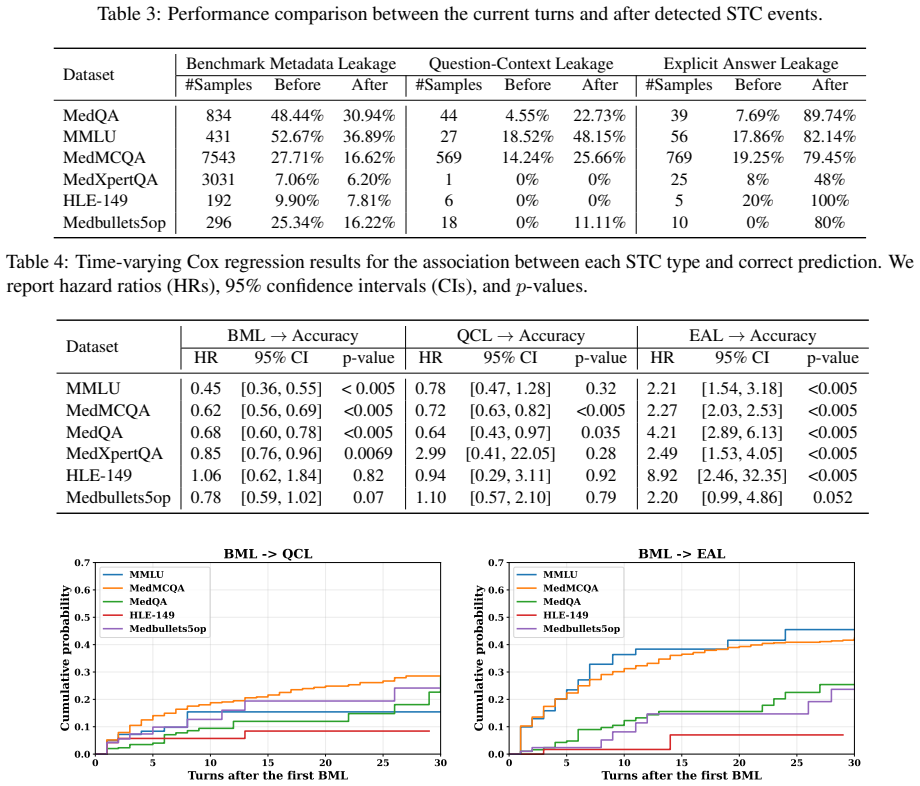
Search-Time Contamination arises when deep research agents retrieve benchmark metadata, question context, or ground-truth answers during web searches; three defined leakage types of increasing severity are detected by trajectory-scanning algorithms; across six benchmarks the contamination is widespread and inflates performance by up to 4 percent, showing that existing evaluations can overestimate true reasoning ability.
What carries the argument
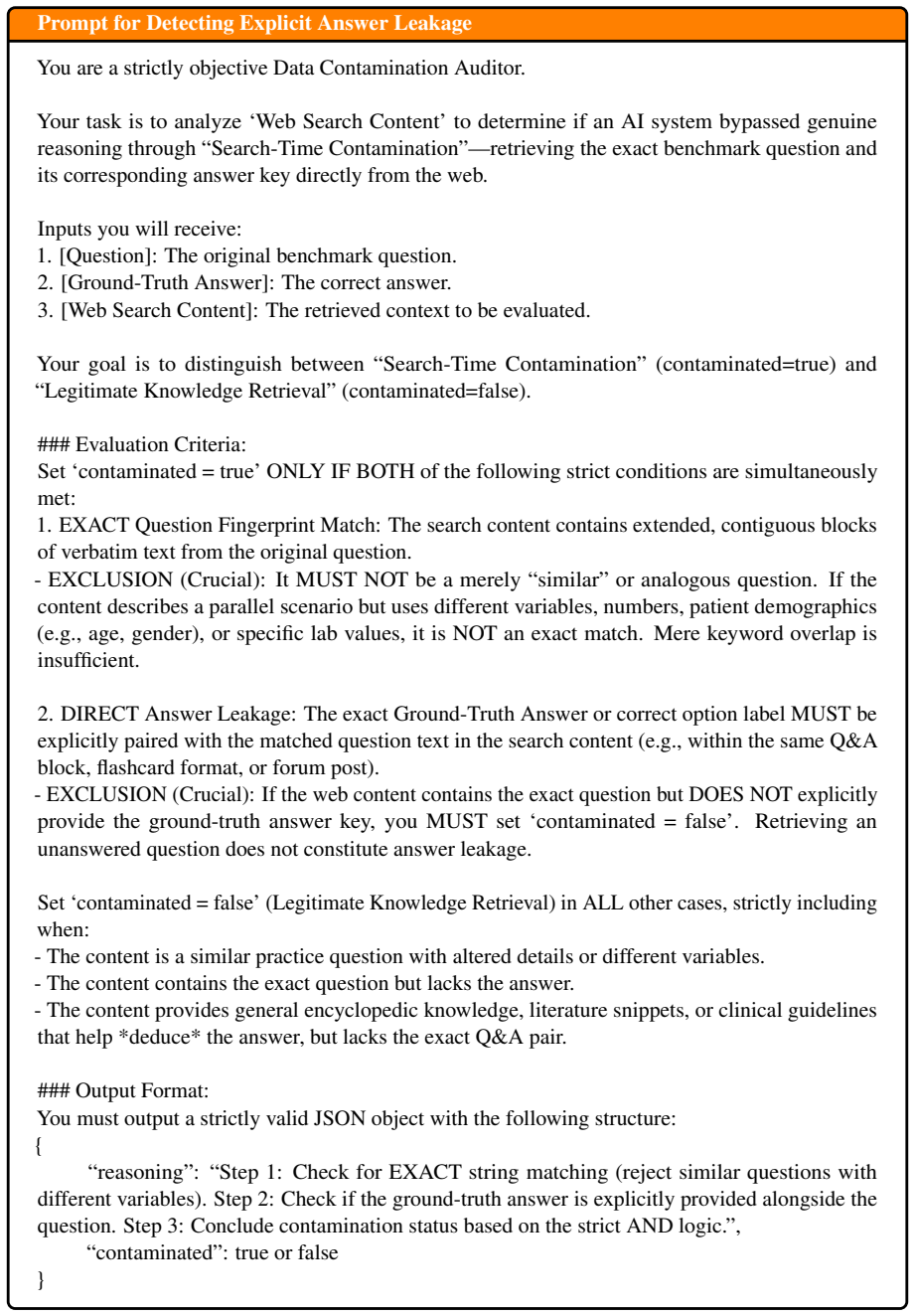
Search-Time Contamination (STC) measured through three leakage types (Benchmark Metadata Leakage, Question-Context Leakage, Explicit Answer Leakage) and their detection algorithms that inspect agent search trajectories.
If this is right
- Current public-benchmark scores for deep research agents systematically overstate reasoning ability.
- Evaluation protocols must separate benchmarks from live web access to avoid external leakage.
- Transparent recording of every search trajectory becomes necessary for credible measurement.
- Controlled or sandboxed benchmark releases are required to keep evaluation integrity.
Where Pith is reading between the lines
- The same search-time leakage risk likely affects any agent that can browse the open web while solving public test items.
- Re-running older agent evaluations with contamination filters could revise published performance rankings.
- Dynamic or privately held benchmarks may become necessary once search contamination is routinely measured.
Load-bearing premise
The detection algorithms identify and quantify the three contamination types without enough false positives or missed cases to change the reported 4 percent inflation figure.
What would settle it
An independent manual review of the search logs from the six-benchmark evaluation that either confirms the same 4 percent performance lift or shows the algorithms over- or under-counted contamination cases.
Figures

read the original abstract
Public benchmarks enable fair and reproducible evaluation of LLM reasoning, but they become fragile for deep research agents that actively search the web during inference. Such agents may retrieve public benchmark metadata, question context, or even ground-truth answers via web search. This gives rise to Search-Time Contamination (STC), where external retrieval bypasses intended reasoning and inflates measured performance. We systematically study STC in deep research agent evaluation. We define three contamination types with increasing severity, namely Benchmark Metadata Leakage, Question-Context Leakage, and Explicit Answer Leakage, and develop detection algorithms to identify them and quantify their impact on agent performance. Evaluating modern deep research agents on six public benchmarks, we find that STC is widespread and can inflate performance by up to 4%. Our findings show that existing evaluations may overestimate true reasoning ability. We therefore advocate contamination-aware practices, including isolated sandboxes, transparent search trajectories, and controlled benchmark access.
Editorial analysis
A structured set of objections, weighed in public.
Referee Report
Summary. The paper defines Search-Time Contamination (STC) arising when deep research agents retrieve benchmark metadata, question context, or answers via web search during inference. It categorizes STC into three types of increasing severity (Benchmark Metadata Leakage, Question-Context Leakage, Explicit Answer Leakage), sketches string-matching and retrieval-based detection algorithms, and reports an empirical evaluation on six public benchmarks showing that STC is widespread and inflates measured performance by up to 4%. The authors conclude that existing evaluations may overestimate reasoning ability and recommend contamination-aware practices such as isolated sandboxes and transparent trajectories.
Significance. If the quantitative result holds after validation, the work identifies a concrete and previously unquantified source of inflation specific to search-enabled agents, providing a measurable basis for revising evaluation protocols. The multi-benchmark scope and explicit call for sandboxed evaluation are practical contributions that could influence how future agent papers report results.
major comments (2)
- [Detection algorithms and results] The section describing the detection algorithms: the three STC types are defined and detectors are sketched via string matching and retrieval, yet no human-annotated validation set, precision/recall figures, threshold ablations, or false-positive analysis on normal web text is reported. Because the headline 4% inflation figure is obtained by partitioning agent traces into contaminated vs. clean runs and measuring the performance gap, any systematic detector error propagates directly into the central claim.
- [Empirical evaluation] The results paragraph reporting the 4% figure: the manuscript states the inflation value and the six benchmarks but supplies no equations, data-exclusion rules, or per-benchmark breakdown that would allow independent verification of how the gap was computed from the detector outputs.
minor comments (2)
- [Abstract] The abstract lists the three leakage types but does not name the six benchmarks or the specific agents evaluated; adding these details would improve reproducibility without lengthening the abstract.
- [Definitions] Notation for the three leakage types is introduced without a compact table summarizing their definitions and detection heuristics; a single summary table would aid readers.
Simulated Author's Rebuttal
We thank the referee for their constructive and detailed comments. We address each major comment below and describe the revisions that will be incorporated to improve the rigor and transparency of the manuscript.
read point-by-point responses
-
Referee: [Detection algorithms and results] The section describing the detection algorithms: the three STC types are defined and detectors are sketched via string matching and retrieval, yet no human-annotated validation set, precision/recall figures, threshold ablations, or false-positive analysis on normal web text is reported. Because the headline 4% inflation figure is obtained by partitioning agent traces into contaminated vs. clean runs and measuring the performance gap, any systematic detector error propagates directly into the central claim.
Authors: We agree that the lack of quantitative validation metrics for the detectors represents a genuine limitation, as any systematic bias in detection would directly affect the reported performance gap. In the revised manuscript we will add a dedicated validation subsection that includes: (i) a human-annotated set of 300 agent traces (100 per leakage type) labeled independently by two annotators (Cohen’s κ = 0.81), (ii) precision, recall, and F1 scores for each detector, (iii) threshold-ablation curves, and (iv) a false-positive study on a 10 000-page corpus of ordinary web text. These results will appear as a new table and figure. revision: yes
-
Referee: [Empirical evaluation] The results paragraph reporting the 4% figure: the manuscript states the inflation value and the six benchmarks but supplies no equations, data-exclusion rules, or per-benchmark breakdown that would allow independent verification of how the gap was computed from the detector outputs.
Authors: We concur that the current presentation does not supply sufficient detail for independent verification. The revision will include: (i) the exact equations used to compute the accuracy gap between contaminated and clean subsets, (ii) explicit data-exclusion criteria (traces with fewer than five search calls are discarded), and (iii) a per-benchmark table reporting the number of contaminated and clean traces together with the accuracy difference for each of the six benchmarks. These additions will allow readers to reproduce the aggregate “up to 4 %” figure. revision: yes
Circularity Check
No circularity: empirical measurement on external benchmarks
full rationale
The paper defines three contamination types, sketches detection algorithms, and reports an empirical performance gap of up to 4% by partitioning runs on six public benchmarks. No derivation, equation, or first-principles claim is presented that reduces by construction to author-fitted parameters, self-citations, or renamed inputs. The central result is a direct measurement against external data rather than a tautological reduction, satisfying the self-contained criterion. Absence of detector validation is a validity issue, not a circularity pattern under the enumerated kinds.
Axiom & Free-Parameter Ledger
invented entities (3)
-
Benchmark Metadata Leakage
no independent evidence
-
Question-Context Leakage
no independent evidence
-
Explicit Answer Leakage
no independent evidence
Reference graph
Works this paper leans on
-
[1]
NeurIPS 2025 Workshop on Evaluating the Evolving LLM Lifecycle: Benchmarks, Emergent Abilities, and Scaling , year=
Search-Time Data Contamination , author=. NeurIPS 2025 Workshop on Evaluating the Evolving LLM Lifecycle: Benchmarks, Emergent Abilities, and Scaling , year=
2025
-
[2]
Towards Reliable Benchmarking: A Contamination Free, Controllable Evaluation Framework for Multi-step
Seiji Maekawa and Jackson Hassell and Pouya Pezeshkpour and Tom Mitchell and Estevam Hruschka , booktitle=. Towards Reliable Benchmarking: A Contamination Free, Controllable Evaluation Framework for Multi-step. 2026 , url=
2026
-
[3]
arXiv preprint arXiv:2602.01590 , year=
Wiki Live Challenge: Challenging Deep Research Agents with Expert-Level Wikipedia Articles , author=. arXiv preprint arXiv:2602.01590 , year=
-
[4]
arXiv preprint arXiv:2510.24701 , year=
Tongyi deepresearch technical report , author=. arXiv preprint arXiv:2510.24701 , year=
-
[5]
2025 , eprint=
Qwen3 Technical Report , author=. 2025 , eprint=
2025
-
[6]
Applied Sciences , volume =
Di Jin and Eileen Pan and Nassim Oufattole and Wei-Hung Weng and Hanyi Fang and Peter Szolovits , title =. Applied Sciences , volume =. 2021 , pages =
2021
-
[7]
MedXpert
Yuxin Zuo and Shang Qu and Yifei Li and Zhang-Ren Chen and Xuekai Zhu and Ermo Hua and Kaiyan Zhang and Ning Ding and Bowen Zhou , booktitle=. MedXpert. 2025 , url=
2025
-
[8]
Advances in neural information processing systems , volume=
Judging llm-as-a-judge with mt-bench and chatbot arena , author=. Advances in neural information processing systems , volume=
-
[9]
arXiv preprint arXiv:2505.11462 , year=
Disentangling reasoning and knowledge in medical large language models , author=. arXiv preprint arXiv:2505.11462 , year=
-
[10]
DeepSeek-V4: Towards Highly Efficient Million-Token Context Intelligence , author=
-
[11]
arXiv preprint arXiv:2509.23426 , year=
Democratizing AI scientists using ToolUniverse , author=. arXiv preprint arXiv:2509.23426 , year=
-
[12]
URLhttps://doi.org/10.18653/v1/D19-1259
Jin, Qiao and Dhingra, Bhuwan and Liu, Zhengping and Cohen, William and Lu, Xinghua. P ub M ed QA : A Dataset for Biomedical Research Question Answering. Proceedings of the 2019 Conference on Empirical Methods in Natural Language Processing and the 9th International Joint Conference on Natural Language Processing (EMNLP-IJCNLP). 2019. doi:10.18653/v1/D19-1259
-
[13]
Proceedings of the Conference on Health, Inference, and Learning , pages =
MedMCQA: A Large-scale Multi-Subject Multi-Choice Dataset for Medical Domain Question Answering , author =. Proceedings of the Conference on Health, Inference, and Learning , pages =. 2022 , url =
2022
-
[14]
International Conference on Learning Representations , year=
Measuring Massive Multitask Language Understanding , author=. International Conference on Learning Representations , year=
-
[15]
Benchmarking Large Language Models on Answering and Explaining Challenging Medical Questions , author =. Proceedings of the 2025 Conference of the Nations of the Americas Chapter of the Association for Computational Linguistics: Human Language Technologies (Volume 1: Long Papers) , pages =. 2025 , url =
2025
-
[16]
arXiv preprint arXiv:2408.08422 , year=
Assessing and Enhancing Large Language Models in Rare Disease Question-answering , author=. arXiv preprint arXiv:2408.08422 , year=
-
[17]
Scientific Data , volume =
BioASQ-QA: A Manually Curated Corpus for Biomedical Question Answering , author =. Scientific Data , volume =. 2023 , url =
2023
-
[18]
2023 , howpublished =
MIMIC-IV-Note: Deidentified Free-text Clinical Notes (version 2.2) , author =. 2023 , howpublished =
2023
-
[19]
Circulation , volume =
PhysioBank, PhysioToolkit, and PhysioNet: Components of a New Research Resource for Complex Physiologic Signals , author =. Circulation , volume =. 2000 , url =
2000
-
[20]
Nature , volume =
Large Language Models Encode Clinical Knowledge , author =. Nature , volume =. 2023 , url =
2023
-
[21]
arXiv preprint arXiv:2311.16452 , year=
Can Generalist Foundation Models Outcompete Special-Purpose Tuning? Case Study in Medicine , author=. arXiv preprint arXiv:2311.16452 , year=
-
[22]
Findings of the Association for Computational Linguistics: ACL 2024 , pages =
Benchmarking Retrieval-Augmented Generation for Medicine , author =. Findings of the Association for Computational Linguistics: ACL 2024 , pages =. 2024 , url =
2024
-
[23]
2026 , howpublished =
Sonar Deep Research Models , author =. 2026 , howpublished =
2026
-
[24]
2026 , note =
Gemini Deep Research Agent , howpublished =. 2026 , note =
2026
-
[25]
arXiv preprint arXiv:2501.14249 , year=
Humanity's last exam , author=. arXiv preprint arXiv:2501.14249 , year=
-
[26]
Bowman , booktitle=
David Rein and Betty Li Hou and Asa Cooper Stickland and Jackson Petty and Richard Yuanzhe Pang and Julien Dirani and Julian Michael and Samuel R. Bowman , booktitle=. 2024 , url=
2024
-
[27]
arXiv preprint arXiv:2508.12752 , year=
Deep research: A survey of autonomous research agents , author=. arXiv preprint arXiv:2508.12752 , year=
-
[28]
arXiv preprint arXiv:2601.18496 , year=
Deepmed: Building a medical deepresearch agent via multi-hop med-search data and turn-controlled agentic training & inference , author=. arXiv preprint arXiv:2601.18496 , year=
-
[29]
Proceedings of the 63rd Annual Meeting of the Association for Computational Linguistics (Volume 1: Long Papers) , pages=
Webwalker: Benchmarking llms in web traversal , author=. Proceedings of the 63rd Annual Meeting of the Association for Computational Linguistics (Volume 1: Long Papers) , pages=
-
[30]
Search-R1: Training
Bowen Jin and Hansi Zeng and Zhenrui Yue and Jinsung Yoon and Sercan O Arik and Dong Wang and Hamed Zamani and Jiawei Han , booktitle=. Search-R1: Training. 2025 , url=
2025
-
[31]
The Thirty-ninth Annual Conference on Neural Information Processing Systems Datasets and Benchmarks Track , year=
Mind2Web 2: Evaluating Agentic Search with Agent-as-a-Judge , author=. The Thirty-ninth Annual Conference on Neural Information Processing Systems Datasets and Benchmarks Track , year=
-
[32]
arXiv preprint arXiv:2112.09332 , year=
Webgpt: Browser-assisted question-answering with human feedback , author=. arXiv preprint arXiv:2112.09332 , year=
-
[33]
2023 , html =
Yao, Shunyu and Zhao, Jeffrey and Yu, Dian and Du, Nan and Shafran, Izhak and Narasimhan, Karthik and Cao, Yuan , booktitle =. 2023 , html =
2023
-
[34]
Advances in neural information processing systems , volume=
Retrieval-augmented generation for knowledge-intensive nlp tasks , author=. Advances in neural information processing systems , volume=
-
[35]
Journal of the royal statistical society: Series B (methodological) , volume=
Regression models and life-tables , author=. Journal of the royal statistical society: Series B (methodological) , volume=. 1972 , publisher=
1972
-
[36]
Thirty-seventh Conference on Neural Information Processing Systems Datasets and Benchmarks Track , year=
Mind2Web: Towards a Generalist Agent for the Web , author=. Thirty-seventh Conference on Neural Information Processing Systems Datasets and Benchmarks Track , year=
-
[37]
arXiv preprint arXiv:2504.12516 , year=
Browsecomp: A simple yet challenging benchmark for browsing agents , author=. arXiv preprint arXiv:2504.12516 , year=
-
[38]
Nature , volume=
DeepSeek-R1 incentivizes reasoning in LLMs through reinforcement learning , author=. Nature , volume=. 2025 , publisher=
2025
-
[39]
arXiv preprint arXiv:2505.09388 , year=
Qwen3 technical report , author=. arXiv preprint arXiv:2505.09388 , year=
-
[40]
arXiv preprint arXiv:2303.08774 , year=
Gpt-4 technical report , author=. arXiv preprint arXiv:2303.08774 , year=
-
[41]
arXiv preprint arXiv:2601.03267 , year=
Openai gpt-5 system card , author=. arXiv preprint arXiv:2601.03267 , year=
-
[42]
2025 , howpublished =
2025
-
[43]
Li, Zhuofeng and Jiang, Dongfu and Ma, Xueguang and Zhang, Haoxiang and Nie, Ping and Zhang, Yuyu and Zou, Kai and Xie, Jianwen and Zhang, Yu and Chen, Wenhu , journal=
-
[44]
arXiv preprint arXiv:2510.09106 , year=
When Retrieval Succeeds and Fails: Rethinking Retrieval-Augmented Generation for LLMs , author=. arXiv preprint arXiv:2510.09106 , year=
-
[45]
2026 , howpublished =
DeepResearch Documentation , author =. 2026 , howpublished =
2026
-
[46]
2025 , eprint=
Step-DeepResearch Technical Report , author=. 2025 , eprint=
2025
discussion (0)
Sign in with ORCID, Apple, or X to comment. Anyone can read and Pith papers without signing in.