Multimarginal flow matching with optimal transport potentials
Pith reviewed 2026-06-28 07:26 UTC · model grok-4.3
The pith
Optimal transport potentials extend flow matching to multiple observed marginals while keeping training simulation-free.
A machine-rendered reading of the paper's core claim, the machinery that carries it, and where it could break.
Core claim
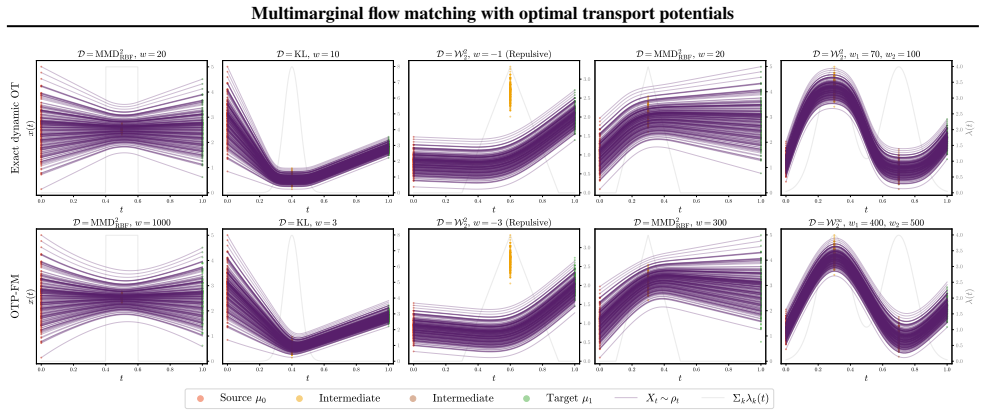
By extending the conditional flow matching loss with potential terms drawn from the dynamic optimal transport action, the authors obtain a simulation-free objective whose minimizers are flows that match both the endpoint distributions and any supplied intermediate marginals.
What carries the argument
Optimal transport potentials, which are added to the dynamic OT action to softly penalize deviation from intermediate marginals and are then folded directly into the conditional flow matching training target.
If this is right
- Flows can be trained to respect any number of observed time-point distributions without extra simulation cost.
- The learned vector fields remain flexible in their spatiotemporal evolution between the fixed points.
- Training scales to the same regime as ordinary conditional flow matching because the extra loss terms are evaluated from samples.
- The same construction applies to any conditional flow matching variant that already admits a simulation-free objective.
Where Pith is reading between the lines
- The potential construction could be reused inside other transport-based generative models that currently handle only two marginals.
- One could test whether the same potentials improve performance when the intermediate marginals are noisy or partially observed.
- The method opens a route to continuous-time interpolation tasks where the data supply more than start and end snapshots.
Load-bearing premise
The potentials can be inserted into the flow matching loss without destroying its closed-form, simulation-free character or its ability to match the endpoints exactly.
What would settle it
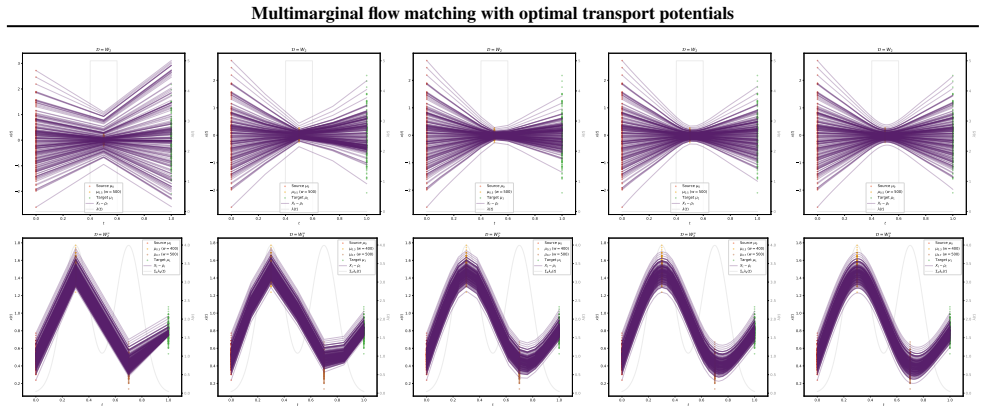
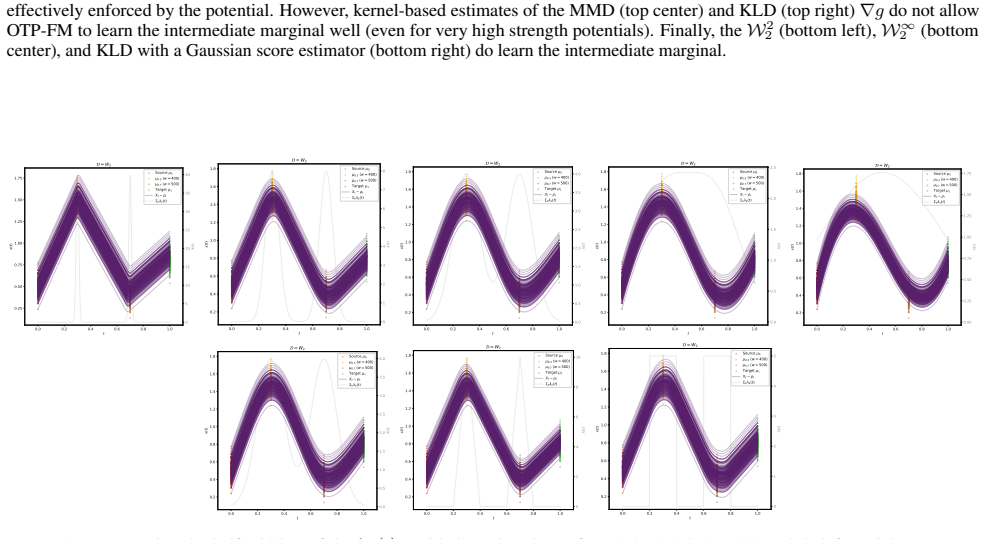
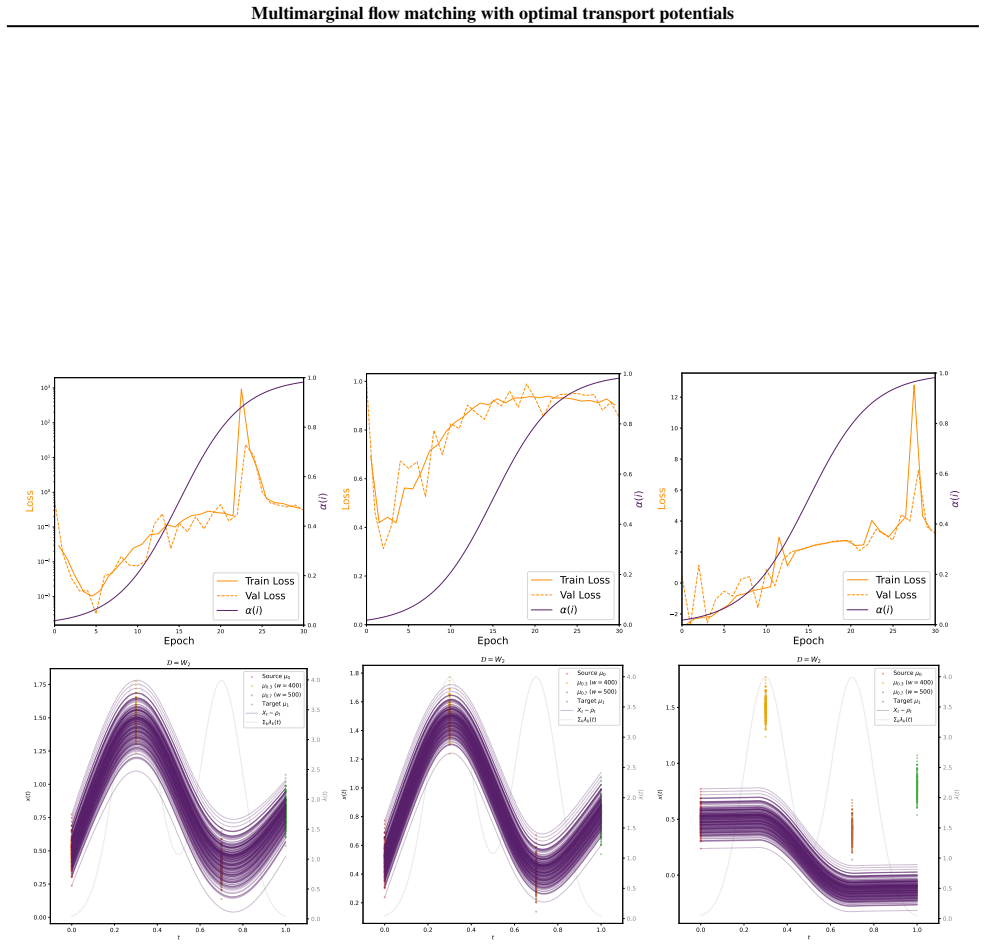
A controlled synthetic experiment in which OTP-FM is trained on three known marginals and then checked to see whether the generated paths actually pass near the middle marginal at the prescribed time; failure would falsify the steering claim.
Figures





read the original abstract
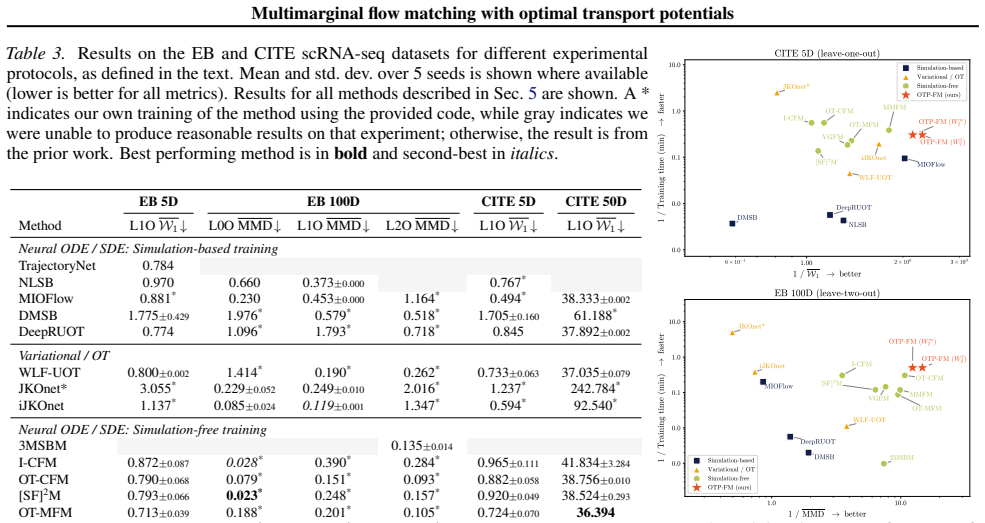
Flow matching (FM) has emerged as a powerful framework for learning dynamic transport maps between two empirical distributions. However, less explored is the setting with intermediate observed marginals that can help constrain the flows between the endpoints. This "multimarginal" regime is central to modeling temporal evolution in dynamical systems in many scientific domains that can sample sequential distributions. We tackle this problem with a novel approach that leverages the connection between FM and dynamic optimal transport (OT), softly steering the flow towards the intermediate marginals through potential terms in the dynamic OT action. By extending the conditional FM learning target to incorporate these potentials, we derive an efficient, simulation-free algorithm for multimarginal FM that offers considerable flexibility in the spatiotemporal dynamics of the learned flows. We demonstrate state-of-the-art performance and training efficiency of OT-potential FM (OTP-FM) on diverse single-cell RNA sequencing, oceanographic, and meteorological datasets. Our code is available at https://github.com/Bexorg-Inc/OTP-FM.
Editorial analysis
A structured set of objections, weighed in public.
Referee Report
Summary. The paper proposes OT-potential Flow Matching (OTP-FM), which extends conditional flow matching by incorporating potential terms derived from the dynamic optimal transport action. This modification is claimed to softly steer learned flows toward observed intermediate marginals while preserving endpoint matching, yielding an efficient simulation-free training objective for multimarginal problems. The method is demonstrated on single-cell RNA sequencing, oceanographic, and meteorological datasets with reported state-of-the-art performance and training efficiency.
Significance. If the central derivation holds and the simulation-free property is preserved, the approach would supply a flexible, computationally attractive framework for learning flows constrained by multiple observed marginals, addressing a practically relevant gap in scientific applications involving sequential distributions.
major comments (1)
- [Abstract] Abstract: the claim that extending the conditional FM target with OT potentials yields a simulation-free algorithm is load-bearing for the central contribution, yet the abstract supplies no indication that the potentials are restricted to a form (e.g., quadratic or separable) that restores closed-form conditional path velocities; without such restriction the target velocity generally requires solving the continuity equation or per-sample optimization of the augmented action.
Simulated Author's Rebuttal
We thank the referee for the detailed reading and the focus on the simulation-free claim. The comment correctly identifies that the abstract does not explicitly flag the restrictions on the OT potentials needed to retain closed-form conditional velocities. We address this below and will revise the abstract accordingly.
read point-by-point responses
-
Referee: [Abstract] Abstract: the claim that extending the conditional FM target with OT potentials yields a simulation-free algorithm is load-bearing for the central contribution, yet the abstract supplies no indication that the potentials are restricted to a form (e.g., quadratic or separable) that restores closed-form conditional path velocities; without such restriction the target velocity generally requires solving the continuity equation or per-sample optimization of the augmented action.
Authors: We agree that the abstract should make the restriction on the potentials explicit, as this is necessary to preserve the simulation-free property. In the full derivation (Section 3), the dynamic OT potentials are restricted to quadratic forms in the position variable (or separable in time and space) so that the augmented conditional vector field admits an analytic expression; the resulting training objective therefore remains a simple regression against the modified target velocity without requiring numerical integration or per-sample optimization. We will revise the abstract to state: “By extending the conditional FM learning target to incorporate quadratic OT potentials, we derive an efficient, simulation-free algorithm...” This change clarifies the load-bearing assumption without altering the technical contribution. revision: yes
Circularity Check
No circularity; derivation extends FM target independently
full rationale
The abstract and description present an extension of conditional flow matching by adding OT potential terms to the learning target, yielding a claimed simulation-free multimarginal objective. No equations, self-citations, or fitted quantities are shown that reduce the central result to a redefinition of the input data or a parameter fit by construction. The connection to dynamic OT is invoked as an external link, and the simulation-free property is asserted via the extension rather than tautologically assumed. This matches the default case of a self-contained methodological proposal with no load-bearing circular steps.
Axiom & Free-Parameter Ledger
Reference graph
Works this paper leans on
-
[1]
The Eleventh International Conference on Learning Representations , year=
Flow Matching for Generative Modeling , author=. The Eleventh International Conference on Learning Representations , year=
-
[2]
2025 , eprint=
Stochastic Interpolants: A Unifying Framework for Flows and Diffusions , author=. 2025 , eprint=
2025
-
[3]
Transactions on Machine Learning Research , issn=
Improving and generalizing flow-based generative models with minibatch optimal transport , author=. Transactions on Machine Learning Research , issn=. 2024 , url=
2024
-
[4]
The Eleventh International Conference on Learning Representations , year=
Flow Straight and Fast: Learning to Generate and Transfer Data with Rectified Flow , author=. The Eleventh International Conference on Learning Representations , year=
-
[5]
Proceedings of the 40th International Conference on Machine Learning (ICML) , pages =
Multisample Flow Matching: Straightening Flows with Minibatch Couplings , author =. Proceedings of the 40th International Conference on Machine Learning (ICML) , pages =. 2023 , volume =
2023
-
[6]
Numerische Mathematik , year =
Jean-David Benamou and Yann Brenier , title =. Numerische Mathematik , year =. doi:10.1007/s002110050002 , url =
-
[7]
Springer Science & Business Media, 2008
Cédric Villani , title =. 2009 , series =. doi:10.1007/978-3-540-71050-9 , url =
-
[8]
Integral Probability Metrics and Their Generating Classes of Functions , journal =
M. Integral Probability Metrics and Their Generating Classes of Functions , journal =. 1997 , publisher =. doi:10.2307/1428011 , url =
-
[9]
Advances in Neural Information Processing Systems , year =
Neural Ordinary Differential Equations , author =. Advances in Neural Information Processing Systems , year =
-
[10]
Journal of Machine Learning Research , volume =
A Kernel Two-Sample Test , author =. Journal of Machine Learning Research , volume =. 2012 , url =
2012
-
[11]
International Conference on Learning Representations (ICLR) , year =
Progressive Distillation for Fast Sampling of Diffusion Models , author =. International Conference on Learning Representations (ICLR) , year =. 2202.00512 , archivePrefix=
-
[12]
Advances in Neural Information Processing Systems (NeurIPS) , year =
Elucidating the Design Space of Diffusion-Based Generative Models , author =. Advances in Neural Information Processing Systems (NeurIPS) , year =. 2206.00364 , archivePrefix=
-
[13]
2023 , eprint =
Latent Consistency Models: Synthesizing High-Resolution Images with Few-Step Inference , author =. 2023 , eprint =
2023
-
[14]
Proceedings of the 40th International Conference on Machine Learning (ICML) , year =
Consistency Models , author =. Proceedings of the 40th International Conference on Machine Learning (ICML) , year =. 2303.01469 , archivePrefix=
-
[15]
arXiv preprint arXiv:2310.14189 , year =
Improved Techniques for Training Consistency Models , author =. arXiv preprint arXiv:2310.14189 , year =. 2310.14189 , archivePrefix=
-
[16]
Transactions on Machine Learning Research , year =
Flow map matching with stochastic interpolants: A mathematical framework for consistency models , author =. Transactions on Machine Learning Research , year =
-
[17]
The Thirty-ninth Annual Conference on Neural Information Processing Systems , year=
How to build a consistency model: Learning flow maps via self-distillation , author=. The Thirty-ninth Annual Conference on Neural Information Processing Systems , year=
-
[18]
The Thirty-ninth Annual Conference on Neural Information Processing Systems , year=
Mean Flows for One-step Generative Modeling , author=. The Thirty-ninth Annual Conference on Neural Information Processing Systems , year=
-
[19]
International Conference on Learning Representations , year =
Consistency Trajectory Models: Learning Probability Flow ODE Trajectory of Diffusion , author =. International Conference on Learning Representations , year =. 2310.02279 , url =
-
[20]
arXiv preprint arXiv:2402.19159 , year =
Trajectory Consistency Distillation: Improved Latent Consistency Distillation by Semi-Linear Consistency Function with Trajectory Mapping , author =. arXiv preprint arXiv:2402.19159 , year =. 2402.19159 , archivePrefix=
-
[21]
International Conference on Learning Representations , year =
One Step Diffusion via Shortcut Models , author =. International Conference on Learning Representations , year =. 2410.12557 , url =
-
[22]
The Thirty-ninth Annual Conference on Neural Information Processing Systems , year =
Align Your Flow: Scaling Continuous-Time Flow Map Distillation , author =. The Thirty-ninth Annual Conference on Neural Information Processing Systems , year =
-
[23]
Advances in Neural Information Processing Systems , volume=
Attention is All You Need , author=. Advances in Neural Information Processing Systems , volume=. 2017 , eprint=
2017
-
[24]
and Georg, Kurt , title =
Allgower, Eugene L. and Georg, Kurt , title =. 2003 , doi =
2003
-
[25]
Journal of the
Iterative Procedures for Nonlinear Integral Equations , author =. Journal of the. 1965 , doi =
1965
-
[26]
Soviet Physics Uspekhi , volume =
The Vibrational Properties of an Electron Gas , author =. Soviet Physics Uspekhi , volume =. 1968 , doi =
1968
-
[27]
1983 , isbn =
Introduction to Plasma Theory , author =. 1983 , isbn =
1983
-
[28]
Proceedings of the National Academy of Sciences , volume =
A Class of Markov Processes Associated with Nonlinear Parabolic Equations , author =. Proceedings of the National Academy of Sciences , volume =. 1966 , doi =
1966
-
[29]
The Annals of Applied Probability , volume =
Propagation of Chaos in Neural Fields , author =. The Annals of Applied Probability , volume =. 2014 , doi =
2014
-
[30]
Advances in Neural Information Processing Systems , editor =
On the Properties of Kullback-Leibler Divergence Between Multivariate Gaussian Distributions , author =. Advances in Neural Information Processing Systems , editor =
-
[31]
Statistical Inference Based on Divergence Measures , author =. 2006 , isbn =. doi:10.1201/9781420034813 , url =
-
[32]
Introduction to Numerical Analysis , author =. 1980 , series =. doi:10.1007/978-1-4757-5592-3 , url =
-
[33]
, school =
van de Rotten, Bastiaan A. , school =. A Limited Memory. 2003 , address =
2003
-
[34]
Solving Ordinary Differential Equations
Hairer, Ernst and Wanner, Gerhard , publisher =. Solving Ordinary Differential Equations. 1996 , edition =. doi:10.1007/978-3-642-05221-7 , url =
-
[35]
and others , journal =
Virtanen, Pauli and Gommers, Ralf and Oliphant, Travis E. and others , journal =. 2020 , doi =
2020
-
[36]
Advances in Neural Information Processing Systems , volume =
Sinkhorn Distances: Lightspeed Computation of Optimal Transport , author =. Advances in Neural Information Processing Systems , volume =. 2013 , url =
2013
-
[37]
Proceedings of the Twenty Third International Conference on Artificial Intelligence and Statistics , pages =
Learning with minibatch Wasserstein: asymptotic and gradient properties , author =. Proceedings of the Twenty Third International Conference on Artificial Intelligence and Statistics , pages =. 2020 , volume =
2020
-
[38]
2019 , doi =
Computational Optimal Transport , author =. 2019 , doi =
2019
-
[39]
Advances in Neural Information Processing Systems , year =
Near-linear time approximation algorithms for optimal transport via Sinkhorn iteration , author =. Advances in Neural Information Processing Systems , year =. 1705.09634 , archivePrefix=
-
[40]
Karras, Tero and Aittala, Miika and Lehtinen, Jaakko and Hellsten, Janne and Aila, Timo and Laine, Samuli , booktitle =. 2024 , volume =. doi:10.1109/CVPR52733.2024.02282 , url =
-
[41]
Mapping cells through time and space with moscot , author=. Nature , year=. doi:10.1038/s41586-024-08453-2 , url=
-
[42]
Nature Methods , volume=
Learning single-cell perturbation responses using neural optimal transport , author=. Nature Methods , volume=. 2023 , doi=
2023
-
[43]
Nature Reviews Methods Primers , volume=
Optimal transport for single-cell and spatial omics , author=. Nature Reviews Methods Primers , volume=. 2024 , doi=
2024
-
[44]
Nature Biotechnology , volume=
Visualizing structure and transitions in high-dimensional biological data , author=. Nature Biotechnology , volume=. 2019 , doi=
2019
-
[45]
Advances in Neural Information Processing Systems , year=
Manifold Interpolating Optimal-Transport Flows for Trajectory Inference , author=. Advances in Neural Information Processing Systems , year=
-
[46]
Proceedings of the 37th International Conference on Machine Learning , pages=
TrajectoryNet: A Dynamic Optimal Transport Network for Modeling Cellular Dynamics , author=. Proceedings of the 37th International Conference on Machine Learning , pages=. 2020 , volume=
2020
-
[47]
, booktitle=
Chen, Tianrong and Liu, Guan-Horng and Theodorou, Evangelos A. , booktitle=. Likelihood Training of Schr. 2022 , url=
2022
-
[48]
2023 , url=
Tianrong Chen and Guan-Horng Liu and Molei Tao and Evangelos Theodorou , booktitle=. 2023 , url=
2023
-
[49]
2023 , url=
Takeshi Koshizuka and Issei Sato , booktitle=. 2023 , url=
2023
-
[50]
Diffusion Schr
Shi, Yuyang and De Bortoli, Valentin and Campbell, Andrew and Doucet, Arnaud , booktitle=. Diffusion Schr. 2023 , url=
2023
-
[51]
Trajectory Inference with Smooth Schr
Hong, Wanli and Shi, Yuliang and Niles-Weed, Jonathan , journal=. Trajectory Inference with Smooth Schr. 2025 , url=
2025
-
[52]
International Conference on Learning Representations , year=
Multi-Modal and Multi-Attribute Generation of Single Cells with CFGen , author=. International Conference on Learning Representations , year=. 2407.11734 , url=
-
[53]
CellFlow enables generative single-cell phenotype modeling with flow matching , author=. bioRxiv , year=. doi:10.1101/2025.04.11.648220 , url=
-
[54]
International Conference on Learning Representations , year=
Modeling Complex System Dynamics with Flow Matching Across Time and Conditions , author=. International Conference on Learning Representations , year=
-
[55]
The Thirty-ninth Annual Conference on Neural Information Processing Systems , year=
Momentum Multi-Marginal Schr\"odinger Bridge Matching , author=. The Thirty-ninth Annual Conference on Neural Information Processing Systems , year=
-
[56]
Proceedings of The 24th International Conference on Artificial Intelligence and Statistics , pages=
Fast and Smooth Interpolation on Wasserstein Space , author=. Proceedings of The 24th International Conference on Artificial Intelligence and Statistics , pages=. 2021 , volume=
2021
-
[57]
Evaluating generative models in high energy physics , author=. Physical Review D , volume=. 2023 , doi=. 2211.10295 , url=
arXiv 2023
-
[58]
Advances in Neural Information Processing Systems , volume=
GANs Trained by a Two Time-Scale Update Rule Converge to a Local Nash Equilibrium , author=. Advances in Neural Information Processing Systems , volume=. 2017 , eprint=
2017
-
[59]
Multi-marginal Schr
Shen, Yunyi and Berlinghieri, Renato and Broderick, Tamara , booktitle=. Multi-marginal Schr. 2025 , eprint=
2025
-
[60]
2024 , howpublished=
HYCOM-TSIS 1/100 ^ Gulf of Mexico Reanalysis (GOMb0.01) , author=. 2024 , howpublished=
2024
-
[61]
Chen, Song , title =. 2017 , howpublished =. doi:10.24432/C5RK5G , url=
-
[62]
Preuer, Kristina and Renz, Philipp and Unterthiner, Thomas and Hochreiter, Sepp and Klambauer, G. Fr. Journal of Chemical Information and Modeling , year =. doi:10.1021/acs.jcim.8b00234 , url =
-
[63]
Particle Cloud Generation with Message Passing Generative Adversarial Networks , url =
Kansal, Raghav and Duarte, Javier and Su, Hao and Orzari, Breno and Tomei, Thiago and Pierini, Maurizio and Touranakou, Mary and vlimant, jean-roch and Gunopulos, Dimitrios , booktitle =. Particle Cloud Generation with Message Passing Generative Adversarial Networks , url =. 2021 , eprint =
2021
-
[64]
Hyun, Sangwon and Mishra, Aditya and Follett, Christopher L. and Jonsson, Bror and Kulk, Gemma and Forget, Gael and Racault, Marie-Fanny and Jackson, Thomas and Dutkiewicz, Stephanie and Müller, Christian L. and Bien, Jacob , title =. Proceedings of the Royal Society A: Mathematical, Physical and Engineering Sciences , volume =. 2022 , month =. doi:10.109...
-
[65]
The Thirty-eighth Annual Conference on Neural Information Processing Systems , year=
Metric Flow Matching for Smooth Interpolations on the Data Manifold , author=. The Thirty-eighth Annual Conference on Neural Information Processing Systems , year=
-
[66]
A Computational Framework for Solving
Neklyudov, Kirill and Brekelmans, Rob and Tong, Alexander and Atanackovic, Lazar and Liu, Qiang and Makhzani, Alireza , booktitle =. A Computational Framework for Solving. 2024 , editor =
2024
-
[67]
Learning of Population Dynamics: Inverse Optimization Meets
Mikhail Persiianov and Jiawei Chen and Petr Mokrov and Alexander Tyurin and Evgeny Burnaev and Alexander Korotin , booktitle=. Learning of Population Dynamics: Inverse Optimization Meets. 2026 , url=
2026
-
[68]
The Thirty-ninth Annual Conference on Neural Information Processing Systems , year=
Joint Velocity-Growth Flow Matching for Single-Cell Dynamics Modeling , author=. The Thirty-ninth Annual Conference on Neural Information Processing Systems , year=
-
[69]
Simulation-Free Schr\ "odinger Bridges via Score and Flow Matching , urldate =
Tong, Alexander and Malkin, Nikolay and Fatras, Kilian and Atanackovic, Lazar and Zhang, Yanlei and Huguet, Guillaume and Wolf, Guy and Bengio, Yoshua , eprint =. Simulation-Free Schr\ "odinger Bridges via Score and Flow Matching , urldate =. 2023 , booktitle =
2023
-
[70]
The Thirteenth International Conference on Learning Representations , year=
Learning stochastic dynamics from snapshots through regularized unbalanced optimal transport , author=. The Thirteenth International Conference on Learning Representations , year=
-
[71]
Gradient Flows in Metric Spaces and in the Space of Probability Measures , publisher =
Luigi Ambrosio and Nicola Gigli and Giuseppe Savar. Gradient Flows in Metric Spaces and in the Space of Probability Measures , publisher =. 2008 , doi =
2008
-
[72]
An Introduction to -Convergence , publisher =
Gianni. An Introduction to -Convergence , publisher =. 1993 , doi =
1993
-
[73]
Proceedings of The 25th International Conference on Artificial Intelligence and Statistics , year=
Proximal Optimal Transport Modeling of Population Dynamics , author=. Proceedings of The 25th International Conference on Artificial Intelligence and Statistics , year=. 2106.06345 , archivePrefix=
-
[74]
2006 , URL =
Braides, Andrea , title =. 2006 , URL =
2006
-
[75]
2015 , doi =
Filippo Santambrogio , title =. 2015 , doi =
2015
-
[76]
2026 , eprint=
Improved Mean Flows: On the Challenges of Fastforward Generative Models , author=. 2026 , eprint=
2026
-
[77]
The Thirty-eighth Annual Conference on Neural Information Processing Systems , year=
Learning diffusion at lightspeed , author=. The Thirty-eighth Annual Conference on Neural Information Processing Systems , year=
-
[78]
2022 , howpublished =
Daniel Burkhardt and Malte Luecken and Andrew Benz and Peter Holderrieth and Jonathan Bloom and Christopher Lance and Ashley Chow and Ryan Holbrook , title =. 2022 , howpublished =
2022
-
[79]
Peter Holderrieth and Ezra Erives , title =. 2026 , url =. 2506.02070 , archivePrefix =
arXiv 2026
-
[80]
2026 , eprint=
One-step Latent-free Image Generation with Pixel Mean Flows , author=. 2026 , eprint=
2026
discussion (0)
Sign in with ORCID, Apple, or X to comment. Anyone can read and Pith papers without signing in.