Conformal Risk-Averse Decision Making with Action Conditional Guarantee
Pith reviewed 2026-06-27 23:50 UTC · model grok-4.3
The pith
Action-conditional conformal prediction provides per-action safety guarantees for risk-averse optimization of conditional value-at-risk.
A machine-rendered reading of the paper's core claim, the machinery that carries it, and where it could break.
Core claim
Action-conditional prediction sets serve as a proxy for the feasible decision space for risk-averse decision makers aiming to optimize action-conditional value-at-risk, achieved through a pinball-loss minimization algorithm that delivers finite-sample guarantees.
What carries the argument
Action-conditional conformal prediction, which constructs prediction sets with coverage guarantees conditioned explicitly on each action.
If this is right
- Decision makers can optimize risk-averse policies with explicit per-action safety guarantees rather than marginal ones.
- The sets directly proxy the feasible space for conditional value-at-risk optimization.
- A finite-sample algorithm based on pinball loss connects the method to prior conformal work.
- Performance gains appear in action-conditional metrics on real datasets.
Where Pith is reading between the lines
- This framework may extend naturally to settings with continuous action spaces by appropriate discretization.
- It could be combined with online learning to update guarantees as new data arrives per action.
- Similar conditional guarantees might apply to other risk measures like conditional expected shortfall.
Load-bearing premise
The data distribution satisfies exchangeability or i.i.d. assumptions within each action stratum, allowing conditional conformal coverage to hold.
What would settle it
An experiment on held-out data showing that the empirical coverage probability for at least one action falls below the target level.
Figures


read the original abstract
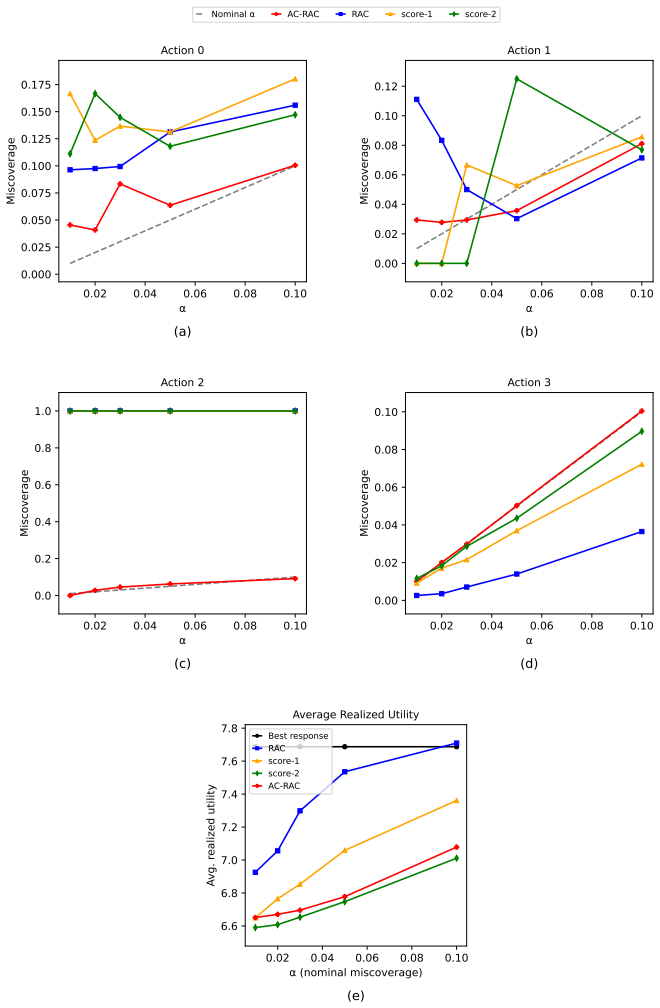
Reliable decision making pipelines powered by machine learning models require uncertainty quantification (UQ) methods that come with explicit safety guarantees. Conformal prediction provides such UQ by wrapping ML predictions into prediction sets, and recent work by Kiyani et al. (2025b) established that these sets can be translated into optimal risk-averse decision policies -- yet only inheriting marginal safety guarantees. We generalize and strengthen their results by (i) introducing action-conditional conformal prediction, which yields safety guarantees conditioned explicitly on each action taken by the decision maker, (ii) showing that action-conditional prediction sets serve as a proxy for the feasible decision space for risk-averse decision makers aiming to optimize action-conditional value-at-risk, and (iii) proposing a principled finite-sample algorithm based on pinball-loss minimization, connecting the framework of Gibbs et al. (2025) to action-conditional guarantees. Experiments on two real-world datasets confirm that our approach significantly improves action-conditional performance over conformal baselines.
Editorial analysis
A structured set of objections, weighed in public.
Referee Report
Summary. The manuscript introduces action-conditional conformal prediction sets C(X,a) that aim to deliver coverage guarantees conditioned on the chosen action a. It claims these sets act as proxies for the feasible region when optimizing action-conditional value-at-risk, proposes a pinball-loss minimization procedure per action (linking to Gibbs et al.), and reports improved action-conditional performance on two real-world datasets relative to standard conformal baselines. The work extends Kiyani et al. (2025b) from marginal to action-conditional safety.
Significance. If the action-conditional coverage holds, the framework would strengthen safety guarantees for risk-averse policies by making them explicitly action-dependent rather than marginal, offering a tighter connection between conformal methods and conditional risk measures.
major comments (2)
- [Methodology / finite-sample argument (pinball-loss procedure)] The central finite-sample guarantee P(Y ∈ C(X,a) | A=a) ≥ 1-α (stated in the abstract and derived via per-action pinball loss) treats the observed pairs within each action stratum as exchangeable. When the policy selects A as a (possibly data-dependent) function of X or model outputs, the stratum {i : A_i = a} is formed by endogenous selection that can correlate with Y, violating the exchangeability needed for the conformal argument. No correction or robustness analysis for this selection effect appears in the derivation.
- [Experiments] The experimental section reports improved action-conditional performance but does not include diagnostics that would test whether the conditional coverage actually holds under the learned policy (e.g., empirical coverage stratified by the policy-chosen actions or sensitivity to policy dependence). Without such checks, the empirical results cannot confirm that the theoretical concern is mitigated.
minor comments (2)
- [Introduction / Preliminaries] Notation for the action-conditional sets C(X,a) and the pinball loss should be introduced with explicit definitions before the main claims; the current presentation assumes familiarity with the Gibbs et al. connection.
- [Experiments] The two real-world datasets are mentioned only by name; adding a brief description of their action spaces and outcome distributions would help readers assess the relevance of the conditional guarantees.
Simulated Author's Rebuttal
We thank the referee for the thoughtful and detailed comments, which help clarify the scope and limitations of our results. We address each major comment below.
read point-by-point responses
-
Referee: [Methodology / finite-sample argument (pinball-loss procedure)] The central finite-sample guarantee P(Y ∈ C(X,a) | A=a) ≥ 1-α (stated in the abstract and derived via per-action pinball loss) treats the observed pairs within each action stratum as exchangeable. When the policy selects A as a (possibly data-dependent) function of X or model outputs, the stratum {i : A_i = a} is formed by endogenous selection that can correlate with Y, violating the exchangeability needed for the conformal argument. No correction or robustness analysis for this selection effect appears in the derivation.
Authors: We agree that the exchangeability assumption within each action stratum is central to the finite-sample guarantee and that endogenous selection induced by a data-dependent policy can violate it. The derivation applies the per-action pinball-loss procedure of Gibbs et al. to the observed pairs with A = a, which formally requires those pairs to be exchangeable. In the current manuscript we implicitly rely on this holding (e.g., when actions are assigned exogenously or the policy is fixed before calibration). We will revise the methodology section to state the exchangeability assumption explicitly, add a paragraph discussing the limitation when the policy is learned jointly from the same data, and suggest practical mitigations such as using a separate held-out calibration set. This clarifies the conditions under which the stated guarantee applies. revision: yes
-
Referee: [Experiments] The experimental section reports improved action-conditional performance but does not include diagnostics that would test whether the conditional coverage actually holds under the learned policy (e.g., empirical coverage stratified by the policy-chosen actions or sensitivity to policy dependence). Without such checks, the empirical results cannot confirm that the theoretical concern is mitigated.
Authors: We concur that the experiments would be strengthened by direct checks of action-conditional coverage under the learned policy. We will add to the experimental section (i) empirical coverage rates computed on test points grouped by the actions selected by the optimized policy and (ii) a sensitivity analysis that varies the degree of policy dependence on the calibration data (e.g., by comparing results with a fixed exogenous policy). These additions will provide empirical evidence on whether the coverage holds in the reported settings. revision: yes
Circularity Check
Central claim extends self-cited prior result by overlapping authors
specific steps
-
self citation load bearing
[Abstract]
"recent work by Kiyani et al. (2025b) established that these sets can be translated into optimal risk-averse decision policies -- yet only inheriting marginal safety guarantees. We generalize and strengthen their results by (i) introducing action-conditional conformal prediction, which yields safety guarantees conditioned explicitly on each action taken by the decision maker, (ii) showing that action-conditional prediction sets serve as a proxy for the feasible decision space for risk-averse decision makers aiming to optimize action-conditional value-at-risk"
The load-bearing premise that conformal prediction sets translate into optimal risk-averse policies (and can be strengthened to action-conditional versions) is justified solely by citation to Kiyani et al. (2025b). Because the cited paper shares an author with the present work, the central claim reduces to an extension of an unverified (within this manuscript) self-cited result rather than an independent derivation.
full rationale
The paper's derivation explicitly builds the action-conditional guarantee and its use as a proxy for action-conditional VaR optimization on the translation result from Kiyani et al. (2025b). This prior work shares the first author with the present paper, and the abstract frames the contribution as a direct generalization without citing independent external verification, machine-checked proofs, or parameter-free external benchmarks for the base mapping. Experiments are mentioned but do not substitute for independent support of the load-bearing premise. This matches the self_citation_load_bearing pattern at moderate severity; no self-definitional equations, fitted-input predictions, or ansatz smuggling are visible in the provided text.
Axiom & Free-Parameter Ledger
axioms (1)
- domain assumption Data satisfy exchangeability (or i.i.d.) conditions sufficient for conformal coverage to hold conditionally on actions.
Reference graph
Works this paper leans on
-
[1]
Angelopoulos, A. N., Bates, S., Candès, E. J., Jordan, M. I., and Lei, L. Learn then test: Calibrating predictive algorithms to achieve risk control.arXiv preprint arXiv:2110.01052,
-
[2]
N., Bates, S., Fisch, A., Lei, L., and Schuster, T
Angelopoulos, A. N., Bates, S., Fisch, A., Lei, L., and Schuster, T. Conformal risk control.arXiv preprint arXiv:2208.02814,
-
[3]
ISBN 978-0-691-14368-2. doi: 10.1515/9781400831050. Bertsimas, D. and Sim, M. The price of robustness.Operations Research, 52(1):35–53,
-
[4]
Bertsimas, D., Gupta, V., and Kallus, N
doi: 10.1287/opre.1030.0065. Bertsimas, D., Gupta, V., and Kallus, N. Data-driven robust optimization.Mathematical Program- ming, 167(2):235–292,
-
[5]
doi: 10.1007/s10107-017-1125-8. Blot, V., Angelopoulos, A. N., Jordan, M. I., and Brunel, N. J. Automatically adaptive conformal risk control.arXiv preprint arXiv:2406.17819,
-
[6]
Cakmak, S., Astudillo, R., Frazier, P
doi: 10.1016/j.ejor.2020.02.004. Cakmak, S., Astudillo, R., Frazier, P. I., and Zhou, E. Bayesian Optimization of Risk Measures. In Advances in Neural Information Processing Systems, volume 33, pp. 20130–20141,
-
[7]
URL https://ssrn.com/abstract=4970102
doi: 10.2139/ssrn.4970102. URL https://ssrn.com/abstract=4970102. 14 Chenreddy, A. R. and Delage, E. End-to-end conditional robust optimization. In Kiyavash, N. and Mooij, J. M. (eds.),Proceedings of the Fortieth Conference on Uncertainty in Artificial Intelligence, volume 244 ofProceedings of Machine Learning Research, pp. 736–748. PMLR,
-
[8]
doi: 10.1287/opre.1090.0741. Demirel, I., Celik, A. A., and Tekin, C. ESCADA: Efficient safety and context aware dose allocation for precision medicine. InAdvances in Neural Information Processing Systems, volume 35, pp. 27441–27454,
-
[9]
Ding, T., Angelopoulos, A., Bates, S., Jordan, M., and Tibshirani, R
doi: 10.1111/mafi.12394. Ding, T., Angelopoulos, A., Bates, S., Jordan, M., and Tibshirani, R. J. Class-conditional conformal prediction with many classes.Advances in neural information processing systems, 36:64555–64576,
-
[11]
Fisch, A., Jaakkola, T., and Barzilay, R
URLhttps://arxiv.org/abs/2304.06833. Fisch, A., Jaakkola, T., and Barzilay, R. Calibrated selective classification.arXiv preprint arXiv:2208.12084,
-
[12]
Garg, S., Jung, C., Reingold, O., and Roth, A
doi: 10.1093/biomet/85.2.379. Garg, S., Jung, C., Reingold, O., and Roth, A. Oracle efficient online multicalibration and om- niprediction. InProceedings of the 2024 Annual ACM-SIAM Symposium on Discrete Algorithms (SODA), pp. 2725–2792. SIAM,
-
[13]
Multicalibrated regression for downstream fairness
Globus-Harris, I., Gupta, V., Jung, C., Kearns, M., Morgenstern, J., and Roth, A. Multicalibrated regression for downstream fairness. InProceedings of the 2023 AAAI/ACM Conference on AI, Ethics, and Society, pp. 259–286,
2023
-
[14]
doi: 10.1287/opre.1090.0795. Guan, L. Localized conformal prediction: A generalized inference framework for conformal prediction. Biometrika, 110(1):33–50,
-
[15]
Hore, R. and Barber, R. F. Conformal prediction with local weights: randomization enables local guarantees.arXiv preprint arXiv:2310.07850,
-
[16]
Jia, Z., Ben-Michael, E., and Imai, K. Bayesian Safe Policy Learning with Chance Constrained Optimization: Application to Military Security Assessment during the Vietnam War.arXiv preprint arXiv:2307.08840,
-
[17]
Batch multivalid conformal prediction.arXiv preprint arXiv:2209.15145,
Jung, C., Noarov, G., Ramalingam, R., and Roth, A. Batch multivalid conformal prediction.arXiv preprint arXiv:2209.15145,
-
[18]
Robust decision making with partially calibrated forecasts.arXiv preprint arXiv:2510.23471, 2025a
16 Kiyani, S., Hassani, H., Pappas, G., and Roth, A. Robust decision making with partially calibrated forecasts.arXiv preprint arXiv:2510.23471, 2025a. Kiyani, S., Pappas, G., Roth, A., and Hassani, H. Decision theoretic foundations for conformal predic- tion: Optimal uncertainty quantification for risk-averse agents.arXiv preprint arXiv:2502.02561, 2025b...
-
[19]
Lin, B., Delage, E., andChan, T.C
URLhttps://silvioravaioli.github.io/website-documents/ Research/Avoidable%20Risk/LimRavaioli2021AvoidableRisk.pdf. Lin, B., Delage, E., andChan, T.C. Conformalinverseoptimization.arXiv preprint arXiv:2402.01489,
-
[20]
Lindemann, L., Zhao, Y., Yu, X., Pappas, G. J., and Deshmukh, J. V. Formal verification and control with conformal prediction.arXiv preprint arXiv:2409.00536,
-
[21]
URL https://ssrn.com/abstract=4890089
doi: 10.2139/ssrn.4890089. URL https://ssrn.com/abstract=4890089. Meyer, J. Second degree stochastic dominance with respect to a function.International Economic Review, 18(2):477–487,
-
[22]
High-dimensional prediction for sequential decision making.arXiv preprint arXiv:2310.17651,
Noarov, G., Ramalingam, R., Roth, A., and Xie, S. High-dimensional prediction for sequential decision making.arXiv preprint arXiv:2310.17651,
-
[23]
D., Hassani, H., and Pappas, G
17 Noorani, S., Romero, O., Fabbro, N. D., Hassani, H., and Pappas, G. J. Conformal risk minimization with variance reduction.arXiv preprint arXiv:2411.01696,
-
[24]
Human-ai collaborative uncertainty quantifica- tion.arXiv preprint arXiv:2510.23476,
Noorani, S., Kiyani, S., Pappas, G., and Hassani, H. Human-ai collaborative uncertainty quantifica- tion.arXiv preprint arXiv:2510.23476,
-
[25]
Noorani, S., Kiyani, S., Hassani, H., and Pappas, G. Multi-round human-ai collaboration with user-specified requirements.arXiv preprint arXiv:2602.17646, 2026a. Noorani, S., Kiyani, S., Pappas, G. J., and Hassani, H. Conformal prediction beyond the seen: A missing mass perspective for uncertainty quantification in generative models.Advances in Neural Info...
-
[26]
Patel, Y., Cao, G., and Tewari, A
doi: 10.3390/math9020119. Patel, Y., Cao, G., and Tewari, A. Non-parameteric conformal distributionally robust optimization. In2nd Workshop on Structured Probabilistic Inference and Generative Modeling, ICML, 2024a. URLhttps://openreview.net/forum?id=WavglEUVTR. Patel, Y. P., Rayan, S., and Tewari, A. Conformal contextual robust optimization. InInternatio...
-
[27]
Quach, V., Fisch, A., Schuster, T., Yala, A., Sohn, J
doi: 10.1142/9789814417358_0019. Quach, V., Fisch, A., Schuster, T., Yala, A., Sohn, J. H., Jaakkola, T., and Barzilay, R. Conformal language modeling. InInternational Conference on Learning Representations, volume 2024, pp. 11654–11681,
-
[29]
Rahman, T., Khandakar, A., Qiblawey, Y., Tahir, A., Kiranyaz, S., Kashem, S
URLhttps://arxiv.org/abs/1908.05659. Rahman, T., Khandakar, A., Qiblawey, Y., Tahir, A., Kiranyaz, S., Kashem, S. B. A., Islam, M. T., Al Maadeed, S., Zughaier, S. M., Khan, M. S., et al. Exploring the effect of image enhancement techniques on covid-19 detection using chest x-ray images.Computers in biology and medicine, 132:104319,
arXiv 1908
-
[30]
Ramalingam, R., Park, S., and Bastani, O. Uncertainty quantification for neurosymbolic programs via compositional conformal prediction.arXiv preprint arXiv:2405.15912,
-
[31]
Renkema, Y., Brinkel, N., and Alskaif, T. Conformal prediction for stochastic decision-making of pv power in electricity markets.arXiv preprint arXiv:2403.20149,
-
[32]
Straitouri, E., Wang, L., Okati, N., and Rodriguez, M
doi: 10.1017/asb.2022.25. Straitouri, E., Wang, L., Okati, N., and Rodriguez, M. G. Improving expert predictions with conformal prediction. InInternational Conference on Machine Learning, pp. 32633–32653. PMLR,
-
[33]
Tao, Y., Delage, E., and Xu, H. Risk-averse decision making with contextual information: Model, sample average approximation, and kernelization.arXiv preprint arXiv:2502.16607,
-
[35]
URLhttps://arxiv.org/abs/1407.1097. van der Laan, L. and Alaa, A. M. Self-calibrating conformal prediction.arXiv preprint arXiv:2402.07307,
-
[36]
Improving decision-making in open-world agents with conformal prediction and monty hall
Vishwakarma, H., Mishler, A., Cook, T., Dalmasso, N., Raman, N., and Ganesh, S. Improving decision-making in open-world agents with conformal prediction and monty hall. InNeurIPS 2024 Workshop on Open-World Agents,
2024
-
[38]
Yeh, C., Christianson, N., Wu, A., Wierman, A., and Yue, Y
URLhttps://arxiv.org/abs/2305.19225. Yeh, C., Christianson, N., Wu, A., Wierman, A., and Yue, Y. End-to-end conformal calibration for optimization under uncertainty.arXiv preprint arXiv:2409.20534,
-
[39]
Zecchin, M. and Simeone, O. Localized adaptive risk control.arXiv preprint arXiv:2405.07976,
-
[40]
Zecchin, M., Park, S., and Simeone, O. Adaptive learn-then-test: Statistically valid and efficient hyperparameter selection.arXiv preprint arXiv:2409.15844,
-
[41]
Zhao, Y., Yu, X., Deshmukh, J. V., and Lindemann, L. Conformal predictive programming for chance constrained optimization.arXiv preprint arXiv:2402.07407,
-
[42]
Zhu, Q., Yu, X., and Bayraksan, G. Residuals-based contextual distributionally robust optimization with decision-dependent uncertainty.arXiv preprint arXiv:2406.20004,
-
[43]
20 A Further Related Work Economic Literature on Risk Aversion.Decision-making under risk aversion is a classical topic in economics, with foundational concepts introduced by Arrow (1965), Pratt (2013), and studies on stochastic dominance (Hadar & Russell, 1969; Meyer, 1977). Recent economic research has increasingly focused on conditional guarantees in d...
1965
-
[44]
Alternatively, even when Bayesian assumptions’ precision is uncertain, one can still start from Bayesian posteriors and further calibrate prediction sets using our approach, ensuring robust safety guarantees. 21 Conditional robust optimization (CRO).Robust optimization (RO) and distributionally robust optimization (DRO) are classical paradigms for decisio...
2009
discussion (0)
Sign in with ORCID, Apple, or X to comment. Anyone can read and Pith papers without signing in.