Benchmarking Sequential Feedback Optimization for Wind Farm Power Maximization
Pith reviewed 2026-06-27 19:07 UTC · model grok-4.3
The pith
Sequential feedback optimization reaches higher steady-state power in wind farms than AMPC or ESC while remaining real-time feasible.
A machine-rendered reading of the paper's core claim, the machinery that carries it, and where it could break.
Core claim
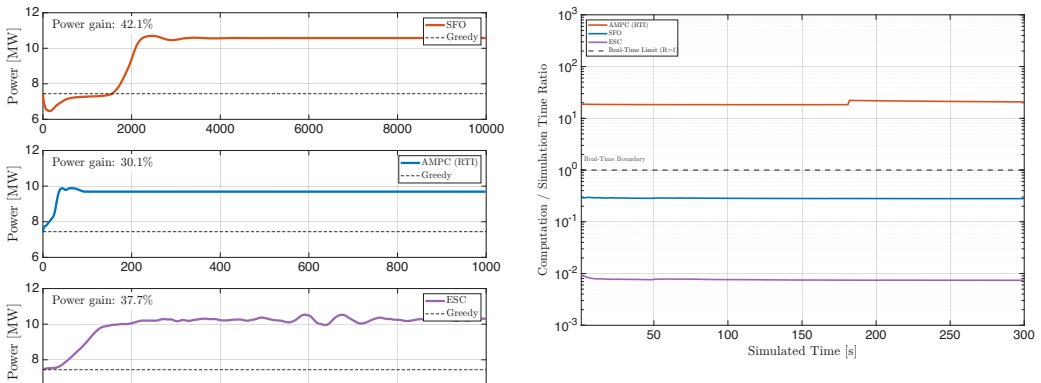
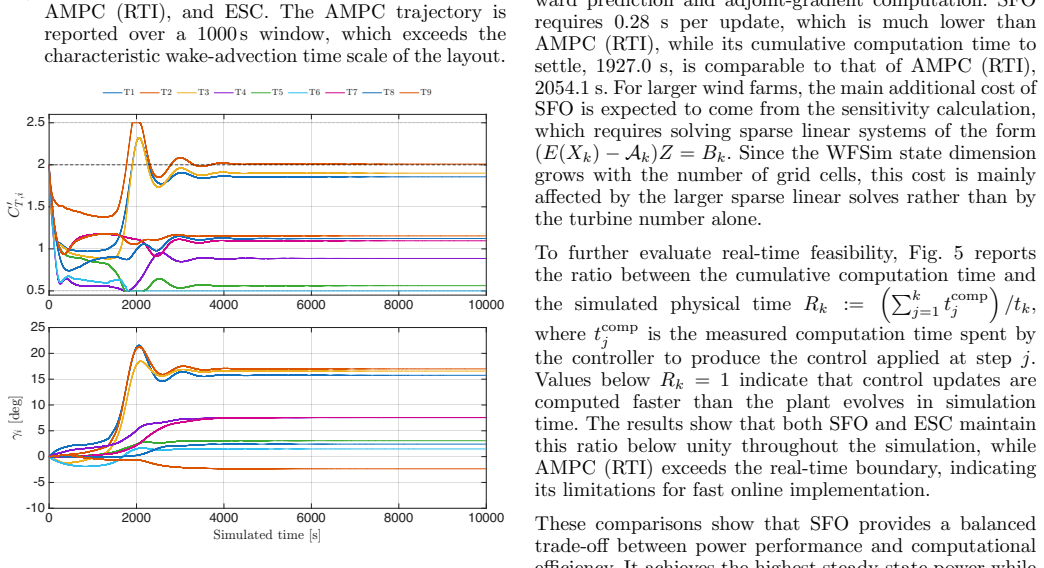
The simulation results illustrate that SFO achieves higher steady-state power while preserving real-time feasibility, AMPC provides a better transient performance at a higher online computational cost and without guarantees of convergence to the steady-state optimum, and ESC offers a computationally inexpensive model-free baseline that may converge to locally optimal solutions.
What carries the argument
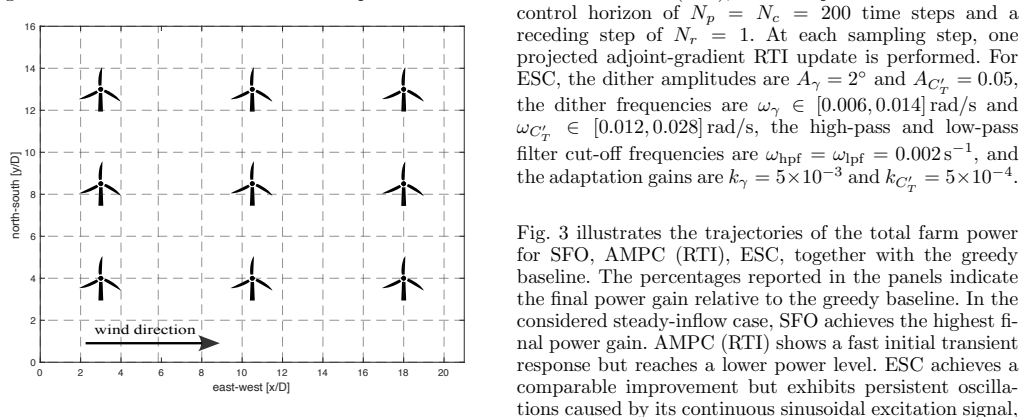
Benchmarking comparison of sequential feedback optimization, adjoint-based economic model predictive control, and extremum seeking control under a common nine-turbine layout and identical operating constraints with a medium-fidelity dynamic flow model.
If this is right
- SFO can be chosen when steady-state power maximization and real-time feasibility are the dominant requirements.
- AMPC becomes relevant if faster transient response outweighs its higher computational load and lack of steady-state convergence guarantees.
- ESC remains viable as a low-cost model-free option when local optimality is acceptable.
- The reported performance ordering supplies a concrete reference for selecting among these strategies in similar distributed energy systems.
Where Pith is reading between the lines
- Repeating the benchmark on farms with twenty or more turbines would show whether SFO's steady-state advantage scales with problem size.
- Substituting the medium-fidelity flow model with measured wind data from an operating site would test whether the same ordering holds under real atmospheric variability.
- The same three-way comparison framework could be applied to real-time optimization of other renewable assets such as solar arrays or battery fleets.
Load-bearing premise
The medium-fidelity dynamic flow model together with the fixed nine-turbine layout and identical operating constraints produces results representative enough to guide real-time control selection in actual wind farms.
What would settle it
A high-fidelity simulation or field test on an operational wind farm in which SFO no longer delivers higher steady-state power than AMPC or ESC under the same constraints.
Figures

read the original abstract
This paper benchmarks sequential feedback optimization (SFO) for wind farm power maximization using a medium-fidelity dynamic flow model. We compare SFO with two well-established approaches, adjoint-based economic model predictive control (AMPC) and extremum seeking control (ESC), under a common nine-turbine layout and identical operating constraints. The comparison focuses on steady-state power production and computational efficiency, both relevant for real-time implementation. The simulation results illustrate that SFO achieves higher steady-state power while preserving real-time feasibility, AMPC provides a better transient performance at a higher online computational cost and without guarantees of convergence to the steady-state optimum, and ESC offers a computationally inexpensive model-free baseline that may converge to locally optimal solutions. These results provide a practical reference for selecting wind farm control strategies and for designing scalable, real-time optimization methods.
Editorial analysis
A structured set of objections, weighed in public.
Referee Report
Summary. The paper benchmarks sequential feedback optimization (SFO) for wind farm power maximization against adjoint-based economic model predictive control (AMPC) and extremum seeking control (ESC). Using simulations on a medium-fidelity dynamic flow model with a fixed nine-turbine layout and identical operating constraints, it claims SFO achieves higher steady-state power while remaining real-time feasible, AMPC yields better transient performance at higher online computational cost without steady-state optimality guarantees, and ESC provides a low-cost model-free baseline that may reach only local optima. The work positions these results as a practical reference for control strategy selection.
Significance. If the reported performance ordering holds under broader conditions, the direct empirical comparison under matched constraints supplies a useful reference for real-time wind-farm control design, clarifying trade-offs among steady-state power, transients, and computational load. The absence of circularity or fitted parameters in the comparison is a positive feature.
major comments (2)
- [Abstract] Abstract and simulation results: the headline performance ordering (SFO superior in steady-state power and feasibility, AMPC better transients, ESC local) rests on a single medium-fidelity model and one fixed nine-turbine layout; no sensitivity to layout geometry, turbulence intensity, or model fidelity is reported, so the conclusions for real-time method selection can reverse under different wake dynamics or actuator constraints.
- [Abstract] Abstract: the stated performance differences are presented without any mention of model validation against higher-fidelity data, error bars on power outputs, data exclusion criteria, or statistical significance tests, leaving the quantitative support for the claimed differences unclear.
minor comments (1)
- Notation for the three controllers and the dynamic flow model should be introduced with explicit equation references in the methods section for clarity.
Simulated Author's Rebuttal
We thank the referee for the detailed review and constructive comments on our benchmarking study. We address each major comment below, clarifying the scope of our claims and noting where revisions can strengthen the manuscript without altering its core contribution as a controlled comparison under matched conditions.
read point-by-point responses
-
Referee: [Abstract] Abstract and simulation results: the headline performance ordering (SFO superior in steady-state power and feasibility, AMPC better transients, ESC local) rests on a single medium-fidelity model and one fixed nine-turbine layout; no sensitivity to layout geometry, turbulence intensity, or model fidelity is reported, so the conclusions for real-time method selection can reverse under different wake dynamics or actuator constraints.
Authors: We agree that the reported ordering is specific to the nine-turbine layout and medium-fidelity dynamic flow model employed. The manuscript presents these results as a practical reference for control strategy selection under identical operating constraints and a common simulation environment, rather than claiming universality across all wake conditions. The absence of sensitivity studies is a limitation of the current scope. In revision we will add explicit language in the abstract and conclusions stating that the performance ordering is demonstrated for this fixed layout and model fidelity, and that broader validation would be needed before generalizing to other geometries or turbulence levels. No new simulations are added, as the contribution centers on the fair, matched-constraint comparison rather than exhaustive parametric sweeps. revision: partial
-
Referee: [Abstract] Abstract: the stated performance differences are presented without any mention of model validation against higher-fidelity data, error bars on power outputs, data exclusion criteria, or statistical significance tests, leaving the quantitative support for the claimed differences unclear.
Authors: The simulations are fully deterministic runs of the same medium-fidelity model with fixed initial conditions and no stochastic elements, so error bars, data exclusion criteria, and statistical significance tests do not apply. Model validation against higher-fidelity CFD or field data is outside the paper's stated scope, which focuses on relative controller performance under identical modeling assumptions. We will revise the abstract and methods section to explicitly note that all comparisons use the same deterministic model without external validation, and that absolute power values should be interpreted relative to this benchmark setup rather than as validated predictions. revision: partial
Circularity Check
No circularity: empirical benchmarking with no derivations or fitted predictions
full rationale
The paper is a direct simulation-based comparison of SFO, AMPC, and ESC on one fixed medium-fidelity dynamic flow model and nine-turbine layout. No derivation chain, parameter fitting, self-citation load-bearing premises, or predictions that reduce to inputs by construction are present. All claims rest on reported simulation outputs under stated conditions, which are externally falsifiable and not tautological.
Axiom & Free-Parameter Ledger
Reference graph
Works this paper leans on
-
[1]
Amrit, R., Rawlings, J.B., and Angeli, D. (2011). Economic optimization using model predictive control with a terminal cost. Annual Reviews in Control, 35(2), 178--186
2011
-
[2]
Angeli, D., Amrit, R., and Rawlings, J.B. (2011). On average performance and stability of economic model predictive control. IEEE transactions on automatic control, 57(7), 1615--1626
2011
-
[3]
Annoni, J., Dall'Anese, E., Hong, M., and Bay, C.J. (2019). Efficient distributed optimization of wind farms using proximal primal-dual algorithms. In 2019 American Control Conference (ACC), 4173--4178. IEEE
2019
-
[4]
Boersma, S., Doekemeijer, B., Vali, M., Meyers, J., and van Wingerden, J.W. (2018). A control-oriented dynamic wind farm model: Wfsim. Wind Energy Science, 3(1), 75--95
2018
-
[5]
Boersma, S., Doekemeijer, B.M., Gebraad, P.M., Fleming, P.A., Annoni, J., Scholbrock, A.K., Frederik, J.A., and van Wingerden, J.W. (2017). A tutorial on control-oriented modeling and control of wind farms. In 2017 American control conference (ACC), 1--18. IEEE
2017
-
[6]
Ciri, U., Rotea, M.A., and Leonardi, S. (2017). Model-free control of wind farms: A comparative study between individual and coordinated extremum seeking. Renewable energy, 113, 1033--1045
2017
-
[7]
Colombino, M., Dall’Anese, E., and Bernstein, A. (2019). Online optimization as a feedback controller: Stability and tracking. IEEE Transactions on Control of Network Systems, 7(1), 422--432
2019
-
[8]
Cossu, C. (2021). Wake redirection at higher axial induction. Wind Energy Science, 6(2), 377--388
2021
-
[9]
Diehl, M., Bock, H.G., and Schl \"o der, J.P. (2005). A real-time iteration scheme for nonlinear optimization in optimal feedback control. SIAM Journal on control and optimization, 43(5), 1714--1736
2005
-
[10]
Doekemeijer, B.M., van der Hoek, D., and van Wingerden, J.W. (2020). Closed-loop model-based wind farm control using floris under time-varying inflow conditions. Renewable Energy, 156, 719--730
2020
-
[11]
Fleming, P.A., Ning, A., Gebraad, P.M., and Dykes, K. (2016). Wind plant system engineering through optimization of layout and yaw control. Wind Energy, 19(2), 329--344
2016
-
[12]
Gebraad, P.M., Teeuwisse, F.W., Van Wingerden, J., Fleming, P.A., Ruben, S.D., Marden, J.R., and Pao, L.Y. (2016). Wind plant power optimization through yaw control using a parametric model for wake effects—a cfd simulation study. Wind Energy, 19(1), 95--114
2016
-
[13]
Gros, S., Zanon, M., Quirynen, R., Bemporad, A., and Diehl, M. (2020). From linear to nonlinear mpc: bridging the gap via the real-time iteration. International Journal of Control, 93(1), 62--80
2020
-
[14]
Hauswirth, A., He, Z., Bolognani, S., Hug, G., and D \"o rfler, F. (2024). Optimization algorithms as robust feedback controllers. Annual Reviews in Control, 57, 100941
2024
-
[15]
Huang, S. and Grammatico, S. (2025). Sequential feedback optimization with application to wind farm control. arXiv preprint arXiv:2507.15127
arXiv 2025
-
[16]
Jensen, N.O. (1983). A note on wind generator interaction. Ris National Laboratory
1983
-
[17]
and Fritsch, G
Johnson, K.E. and Fritsch, G. (2012). Assessment of extremum seeking control for wind farm energy production. Wind Engineering, 36(6), 701--715
2012
-
[18]
Katic, I., H jstrup, J., and Jensen, N.O. (1987). A simple model for cluster efficiency. In European wind energy association conference and exhibition, 407--410. A. Raguzzi
1987
-
[19]
and Nagamune, R
Kheirabadi, A.C. and Nagamune, R. (2019). A quantitative review of wind farm control with the objective of wind farm power maximization. Journal of Wind Engineering and Industrial Aerodynamics, 192, 45--73
2019
-
[20]
Kumar, D., Rotea, M.A., Aju, E.J., and Jin, Y. (2023). Wind plant power maximization via extremum seeking yaw control: A wind tunnel experiment. Wind Energy, 26(3), 283--309
2023
-
[21]
Marden, J.R., Ruben, S.D., and Pao, L.Y. (2013). A model-free approach to wind farm control using game theoretic methods. IEEE Transactions on Control Systems Technology, 21(4), 1207--1214
2013
-
[22]
Meyers, J., Bottasso, C., Dykes, K., Fleming, P., Gebraad, P., Giebel, G., G \"o c men, T., and Van Wingerden, J.W. (2022). Wind farm flow control: prospects and challenges. Wind Energy Science Discussions, 2022, 1--56
2022
-
[23]
and Meyers, J
Munters, W. and Meyers, J. (2016). Effect of wind turbine response time on optimal dynamic induction control of wind farms. In Journal of Physics: Conference Series, volume 753, 052007. IOP Publishing
2016
-
[24]
Ne s i \'c , D. (2009). Extremum seeking control: Convergence analysis. European Journal of Control, 15(3-4), 331--347
2009
-
[25]
and Law, K.H
Park, J. and Law, K.H. (2015). Cooperative wind turbine control for maximizing wind farm power using sequential convex programming. Energy Conversion and Management, 101, 295--316
2015
-
[26]
Vali, M., Petrovi \'c , V., Boersma, S., van Wingerden, J.W., Pao, L.Y., and K \"u hn, M. (2019). Adjoint-based model predictive control for optimal energy extraction in waked wind farms. Control Engineering Practice, 84, 48--62
2019
-
[27]
van den Broek, M.J., De Tavernier, D., Sanderse, B., and van Wingerden, J.W. (2022). Adjoint optimisation for wind farm flow control with a free-vortex wake model. Renewable Energy, 201, 752--765
2022
discussion (0)
Sign in with ORCID, Apple, or X to comment. Anyone can read and Pith papers without signing in.