On Brezis Open Problem 3.1
Pith reviewed 2026-06-27 17:58 UTC · model grok-4.3
The pith
The two explicit Brezis-Coron maps are the only weak harmonic maps from the disk to the sphere with boundary trace g_R.
A machine-rendered reading of the paper's core claim, the machinery that carries it, and where it could break.
Core claim
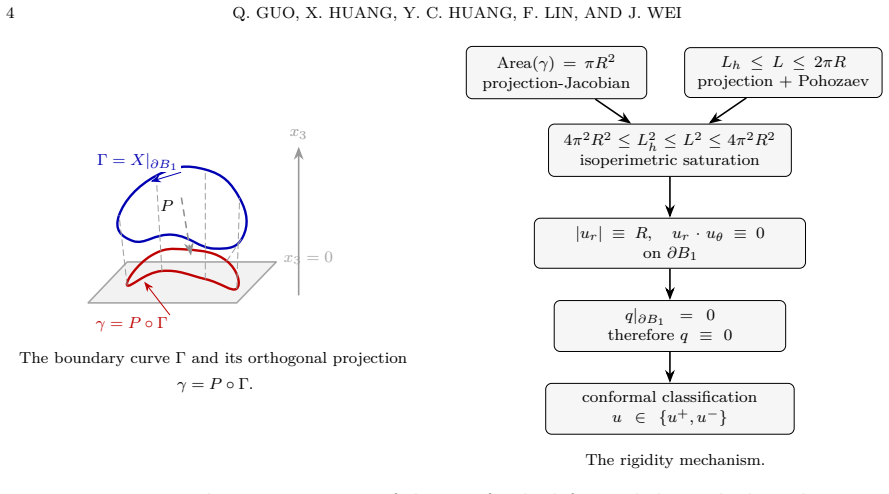
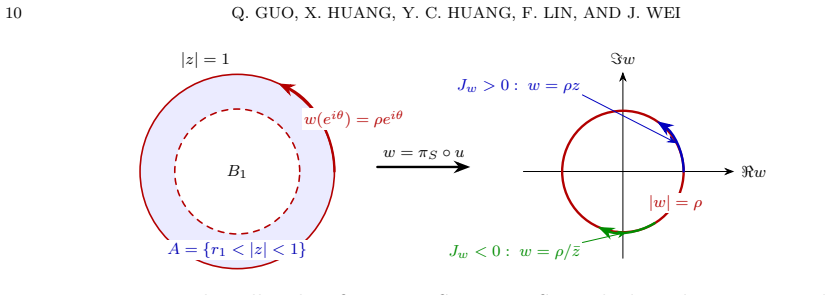
We prove that these two explicit maps are the only weak harmonic maps with boundary trace g_R. An auxiliary potential X, the Pohozaev identity for the Hopf differential, and the planar isoperimetric inequality together imply |u_r| ≡ R and u_r · u_θ ≡ 0 on the boundary. The Hopf differential therefore vanishes on the boundary and, being holomorphic, vanishes everywhere in the disk. The problem reduces to the conformal case, where stereographic-coordinate classification produces precisely the two Brezis-Coron maps.
What carries the argument
The boundary-rigidity step that uses an auxiliary potential X, the Pohozaev identity, and the isoperimetric inequality to force |u_r| ≡ R and u_r · u_θ ≡ 0 on the boundary.
If this is right
- The Hopf differential vanishes identically throughout the disk.
- Every weak solution must be conformal.
- Classification in stereographic coordinates yields exactly the two known maps.
- No other weak solutions exist in any homotopy class.
Where Pith is reading between the lines
- The same boundary-rigidity technique could be tested on harmonic maps into other rotationally symmetric targets.
- The result implies that the energy-minimizing property in each homotopy class is shared by no other maps.
- Numerical schemes searching for harmonic maps with this boundary data can safely stop after locating the two explicit examples.
Load-bearing premise
The auxiliary potential, Pohozaev identity, and isoperimetric inequality together force the two boundary conditions |u_r| ≡ R and u_r · u_θ ≡ 0.
What would settle it
Existence of one additional weak harmonic map from the disk to the sphere that satisfies the same boundary condition g_R would disprove the uniqueness statement.
Figures

read the original abstract
Let $B_1$ be the unit disk in ${\mathbb R}^2$. We consider the harmonic map equation $$ -\Delta u=|\nabla u|^2u,$$ subject to the Dirichlet boundary condition $ u(e^{i\theta})=(R\cos\theta,R\sin\theta,\sqrt{1-R^2}):=g_R$, where $0<R<1$ and $u: B_1\to {\mathbb S}^2$ is understood in the weak harmonic-map sense. In 1983, Brezis and Coron proved the existence of two explicit solutions of this nonlinear Dirichlet problem and showed that they are the unique minimizers in their respective relative homotopy classes. In this paper, we resolve a long-standing open question originally posed in their work, later posed as Open Problem 3.1 in Brezis Favorite Open Problems List. Specifically, we prove that these two explicit maps are the only weak harmonic maps with boundary trace $g_{R}$, thereby providing a definitive affirmative answer to Brezis open problem. The proof is based on a boundary rigidity argument. An auxiliary potential $X$ associated with $u$, the Pohozaev identity for the Hopf differential, and the planar isoperimetric inequality imply $$|u_r|\equiv R, \qquad u_r\cdot u_\theta\equiv0 \qquad\text{on }\partial B_1. $$ Thus the Hopf differential vanishes on the boundary and hence, by holomorphicity, on the whole disk. The problem is then reduced to the conformal case, where a stereographic-coordinate classification gives exactly the two Brezis--Coron maps.
Editorial analysis
A structured set of objections, weighed in public.
Referee Report
Summary. The manuscript claims to resolve Brezis Open Problem 3.1 by proving that the two explicit maps constructed by Brezis and Coron in 1983 are the only weak harmonic maps u : B_1 → S^2 satisfying -Δu = |∇u|^2 u with boundary trace g_R for 0 < R < 1. The argument proceeds via a boundary-rigidity step: an auxiliary potential X, the Pohozaev identity applied to the Hopf differential, and the planar isoperimetric inequality are asserted to force |u_r| ≡ R and u_r · u_θ ≡ 0 on ∂B_1 for any weak solution u ∈ W^{1,2}(B_1, S^2). This implies the Hopf differential vanishes on the boundary and hence everywhere by holomorphy, reducing the problem to the conformal case, which is then classified via stereographic coordinates to recover exactly the two known maps.
Significance. If the boundary-rigidity step holds rigorously in the weak setting, the result would provide a definitive affirmative answer to a longstanding open question on uniqueness of weak harmonic maps with this boundary data, extending the 1983 minimizer uniqueness to all weak solutions. The combination of the auxiliary potential, Pohozaev identity, and isoperimetric inequality to obtain boundary rigidity is a potentially useful technique if the details check out.
major comments (2)
- [Abstract (boundary-rigidity argument)] Abstract (boundary-rigidity paragraph): the assertion that the auxiliary potential X together with the Pohozaev identity for the Hopf differential and the planar isoperimetric inequality imply |u_r| ≡ R and u_r · u_θ ≡ 0 on ∂B_1 for every weak solution u ∈ W^{1,2}(B_1, S^2) is load-bearing for the uniqueness claim. The manuscript must supply a self-contained justification that the Pohozaev identity holds with the required boundary traces, that X possesses sufficient regularity for its boundary values to be well-defined, and that the isoperimetric inequality applies to the projected curve or quantity under consideration (typically requiring rectifiability or BV control).
- [Reduction to conformal case (post-boundary-rigidity)] The reduction step after boundary rigidity (Hopf differential vanishes on ∂B_1 and hence everywhere by holomorphy) assumes the Hopf differential is holomorphic in the weak setting without additional regularity; a precise statement of the regularity obtained for the Hopf differential from the weak harmonic-map equation is needed to confirm this step.
Simulated Author's Rebuttal
We thank the referee for the careful reading and for identifying the points where additional technical details are needed to make the boundary-rigidity argument fully self-contained. We address each major comment below and will revise the manuscript to incorporate the requested justifications and precise statements.
read point-by-point responses
-
Referee: [Abstract (boundary-rigidity argument)] Abstract (boundary-rigidity paragraph): the assertion that the auxiliary potential X together with the Pohozaev identity for the Hopf differential and the planar isoperimetric inequality imply |u_r| ≡ R and u_r · u_θ ≡ 0 on ∂B_1 for every weak solution u ∈ W^{1,2}(B_1, S^2) is load-bearing for the uniqueness claim. The manuscript must supply a self-contained justification that the Pohozaev identity holds with the required boundary traces, that X possesses sufficient regularity for its boundary values to be well-defined, and that the isoperimetric inequality applies to the projected curve or quantity under consideration (typically requiring rectifiability or BV control).
Authors: We agree that the boundary-rigidity step requires a fully self-contained justification in the weak setting. In the revised manuscript we will add a dedicated subsection that: (i) derives the Pohozaev identity for the Hopf differential directly from the weak form of the harmonic-map equation by mollification, confirming the boundary traces are attained in the required sense; (ii) establishes that the auxiliary potential X belongs to a Sobolev space (W^{1,p} for p>1) sufficient for continuous boundary values via the trace theorem and the structure of the equation; (iii) shows that the relevant projected curve is rectifiable (hence the planar isoperimetric inequality applies) by obtaining BV control from the W^{1,2} regularity of u and the Lipschitz character of the boundary data g_R. These additions will render the argument rigorous without external appeals. revision: yes
-
Referee: [Reduction to conformal case (post-boundary-rigidity)] The reduction step after boundary rigidity (Hopf differential vanishes on ∂B_1 and hence everywhere by holomorphy) assumes the Hopf differential is holomorphic in the weak setting without additional regularity; a precise statement of the regularity obtained for the Hopf differential from the weak harmonic-map equation is needed to confirm this step.
Authors: The referee is correct that the holomorphy of the Hopf differential must be stated precisely for weak solutions. For any u ∈ W^{1,2}(B_1,S^2) satisfying the weak harmonic-map equation, the Hopf differential Φ satisfies the Cauchy-Riemann equations in the distributional sense. By the Weyl lemma, Φ is therefore holomorphic. In the revision we will insert an explicit lemma: 'Let u be a weak solution of the harmonic map equation into S^2. Then the associated Hopf differential is holomorphic in B_1.' This justifies that vanishing on the boundary implies vanishing everywhere, permitting the reduction to the conformal case. revision: yes
Circularity Check
No circularity: boundary rigidity derived from external Pohozaev identity and isoperimetric inequality
full rationale
The paper's central step derives |u_r|≡R and u_r·u_θ≡0 on ∂B_1 from an auxiliary potential X, the Pohozaev identity applied to the Hopf differential, and the planar isoperimetric inequality. These are standard external tools, not defined in terms of the target conclusion or fitted to the data. The subsequent reduction to the conformal case via holomorphy of the Hopf differential and stereographic classification is a standard argument, not a self-citation chain or renaming. No self-definitional loops, fitted predictions, or load-bearing self-citations appear in the derivation chain. The paper is self-contained against external benchmarks.
Axiom & Free-Parameter Ledger
axioms (2)
- standard math Harmonic maps from planar domains to S^2 have holomorphic Hopf differential
- domain assumption The planar isoperimetric inequality applies to the boundary curves arising from the auxiliary potential
Reference graph
Works this paper leans on
-
[1]
Brézis,Some of my favorite open problems, Rend
H. Brézis,Some of my favorite open problems, Rend. Lincei Mat. Appl.34(2023), 307–335
2023
-
[2]
Brézis and J.-M
H. Brézis and J.-M. Coron,Large solutions for harmonic maps in two dimensions, Comm. Math. Phys.92 (1983), no. 2, 203–215
1983
-
[3]
Bialy,Convex billiards and a theorem by E
M. Bialy,Convex billiards and a theorem by E. Hopf, Math. Z.214(1993), no. 1, 147–154
1993
-
[4]
Bialy,Hopf rigidity for convex billiards on the hemisphere and hyperbolic plane, Discrete Contin
M. Bialy,Hopf rigidity for convex billiards on the hemisphere and hyperbolic plane, Discrete Contin. Dyn. Syst.33(2013), no. 9, 3903–3913
2013
-
[5]
Bialy,Effective bounds in E
M. Bialy,Effective bounds in E. Hopf rigidity for billiards and geodesic flows, Comment. Math. Helv.90 (2015), no. 1, 139–153
2015
-
[6]
S. S. Chern,On surfaces of constant mean curvature in a three-dimensional space of constant curvature, in Geometric Dynamics, Lecture Notes in Math. 1007, Springer, Berlin, 1983, 104–108
1983
-
[7]
Eells, Jr
J. Eells, Jr. and J. H. Sampson,Harmonic mappings of Riemannian manifolds, Amer. J. Math.86(1964), 109–160
1964
-
[8]
Eells and J
J. Eells and J. C. Wood,Harmonic maps from surfaces to complex projective spaces, Adv. Math.49(1983), no. 3, 217–263. 20 Q. GUO, X. HUANG, Y. C. HUANG, F. LIN, AND J. WEI
1983
-
[9]
Grüter, Regularity of weakH-surfaces,Journal für die reine und angewandte Mathematik, 329, 1–15, 1981
M. Grüter, Regularity of weakH-surfaces,Journal für die reine und angewandte Mathematik, 329, 1–15, 1981
1981
-
[10]
Heinz, Ein Regularitätssatz für schwache Lösungen nichtlinearer elliptischer Systeme,Nachrichten der Akademie der Wissenschaften in Göttingen
E. Heinz, Ein Regularitätssatz für schwache Lösungen nichtlinearer elliptischer Systeme,Nachrichten der Akademie der Wissenschaften in Göttingen. Mathematisch-Physikalische Klasse, II, no. 1, 1–13, 1975
1975
-
[11]
Hélein,Harmonic Maps, Conservation Laws and Moving Frames, 2nd ed., Cambridge Tracts in Mathe- matics 150, Cambridge University Press, Cambridge, 2002
F. Hélein,Harmonic Maps, Conservation Laws and Moving Frames, 2nd ed., Cambridge Tracts in Mathe- matics 150, Cambridge University Press, Cambridge, 2002
2002
-
[12]
Hildebrandt, H
S. Hildebrandt, H. Kaul, and K.-O. Widman,An existence theorem for harmonic mappings of Riemannian manifolds, Acta Math.138(1977), no. 1–2, 1–16
1977
-
[13]
Hopf,Über Flächen mit einer Relation zwischen den Hauptkrümmungen, Math
H. Hopf,Über Flächen mit einer Relation zwischen den Hauptkrümmungen, Math. Nachr.4(1951), 232–249
1951
-
[14]
Jäger and H
W. Jäger and H. Kaul,Uniqueness and stability of harmonic maps and their Jacobi fields, Manuscripta Math. 28(1979), no. 1–3, 269–291
1979
-
[15]
Kenmotsu,Weierstrass formula for surfaces of prescribed mean curvature, Math
K. Kenmotsu,Weierstrass formula for surfaces of prescribed mean curvature, Math. Ann.245(1979), no. 2, 89–100
1979
-
[16]
Kuwert,Minimizing the energy of maps from a surface into a2-sphere with prescribed degree and boundary values, Manuscripta Math.83(1994), 31–38
E. Kuwert,Minimizing the energy of maps from a surface into a2-sphere with prescribed degree and boundary values, Manuscripta Math.83(1994), 31–38
1994
-
[17]
C. B. Morrey, Jr.,On the analyticity of the solutions of analytic non-linear elliptic systems of partial differential equations, Comm. Pure Appl. Math.11(1958), 1–23
1958
-
[18]
Osserman,The isoperimetric inequality, Bull
R. Osserman,The isoperimetric inequality, Bull. Amer. Math. Soc.84(1978), no. 6, 1182–1238
1978
-
[19]
Pierre,Symmetric boundary values for the Dirichlet problem for harmonic maps from the disc into the 2-sphere, Calc
M. Pierre,Symmetric boundary values for the Dirichlet problem for harmonic maps from the disc into the 2-sphere, Calc. Var. Partial Differential Equations31(2008), no. 2, 147–166
2008
-
[20]
Qing,Multiple solutions of the Dirichlet problem for harmonic maps from discs into2-spheres, Manuscripta Math.77(1992), no
J. Qing,Multiple solutions of the Dirichlet problem for harmonic maps from discs into2-spheres, Manuscripta Math.77(1992), no. 4, 435–446
1992
-
[21]
Qing,Remark on the Dirichlet problem for harmonic maps from the disc into the2-sphere, Proc
J. Qing,Remark on the Dirichlet problem for harmonic maps from the disc into the2-sphere, Proc. Roy. Soc. Edinburgh Sect. A122(1992), no. 1–2, 63–67
1992
-
[22]
Qing,Boundary regularity of weakly harmonic maps from surfaces, J
J. Qing,Boundary regularity of weakly harmonic maps from surfaces, J. Funct. Anal.114(1993), no. 2, 458–466
1993
-
[23]
T. Rivière, Conservation laws for conformally invariant variational problems,Inventiones Mathematicae168 (2007), no. 1, 1–22, doi:10.1007/s00222-006-0023-0
-
[24]
E. A. Ruh and J. Vilms,The tension field of the Gauss map, Trans. Amer. Math. Soc.149(1970), 569–573
1970
-
[25]
J. H. Sampson,Some properties and applications of harmonic mappings, Ann. Sci. École Norm. Sup. (4)11 (1978), no. 2, 211–228
1978
-
[26]
Schoen and K
R. Schoen and K. Uhlenbeck,Boundary regularity and the Dirichlet problem for harmonic maps, J. Differential Geom.18(1983), no. 2, 253–268
1983
-
[27]
Soyeur,The Dirichlet problem for harmonic maps from the disc into the2-sphere, Proc
A. Soyeur,The Dirichlet problem for harmonic maps from the disc into the2-sphere, Proc. Roy. Soc. Edinburgh Sect. A113(1989), no. 3–4, 229–234
1989
-
[28]
I. A. Taimanov,The Weierstrass representation of closed surfaces inR3, Funct. Anal. Appl.32(1998), no. 4, 258–267
1998
-
[29]
I. A. Taimanov,Two-dimensional Dirac operator and surface theory, Russian Math. Surveys61(2006), no. 1, 79–159
2006
-
[30]
I. A. Taimanov,Topological obstructions to integrability of geodesic flows on non-simply-connected manifolds, Math. USSR-Izv.30(1988), no. 2, 403–409
1988
-
[31]
I. A. Taimanov,Closed extremals on two-dimensional manifolds, Russian Math. Surveys47(1992), no. 2, 163–211. School of Mathematics, Renmin University of China, Beijing, 100872, P.R. China Email address:qguo@ruc.edu.cn School of Mathematics and Statistics, Nanjing University of Information Science and Technol- ogy, Nanjing 210044, P.R. China Email address:...
1992
discussion (0)
Sign in with ORCID, Apple, or X to comment. Anyone can read and Pith papers without signing in.