Pressure-regulated feedback-modulated star formation as a subgrid model for galaxy formation simulations
Pith reviewed 2026-06-27 15:48 UTC · model grok-4.3
The pith
PRFM subgrid model ties star formation rate to the local balance between gravity and stellar feedback in galaxy disks.
A machine-rendered reading of the paper's core claim, the machinery that carries it, and where it could break.
Core claim
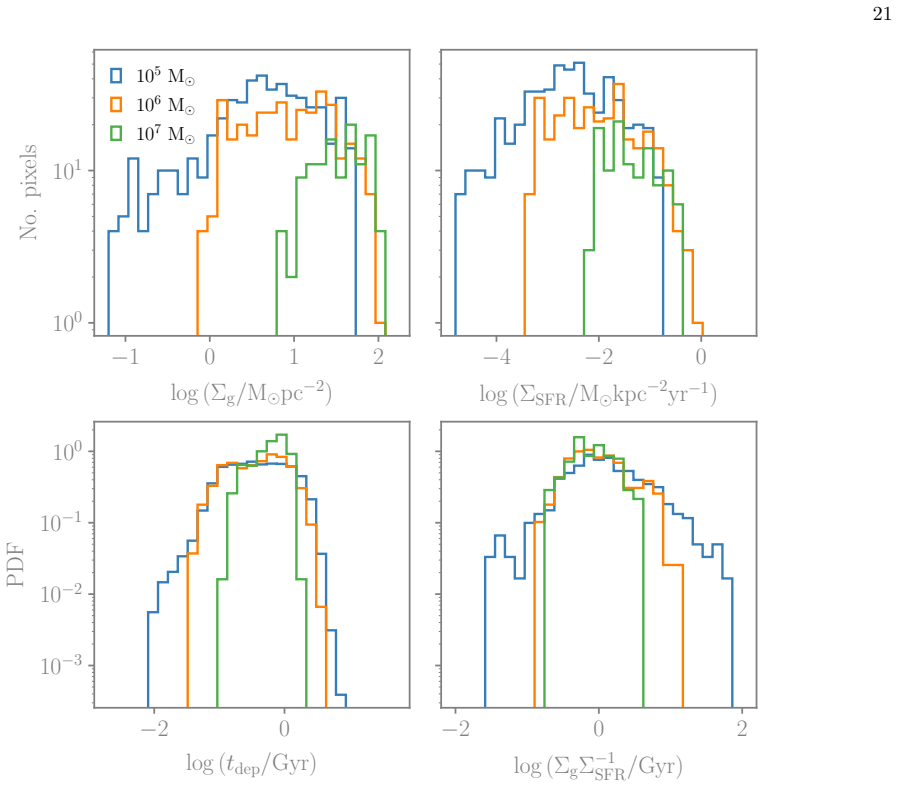
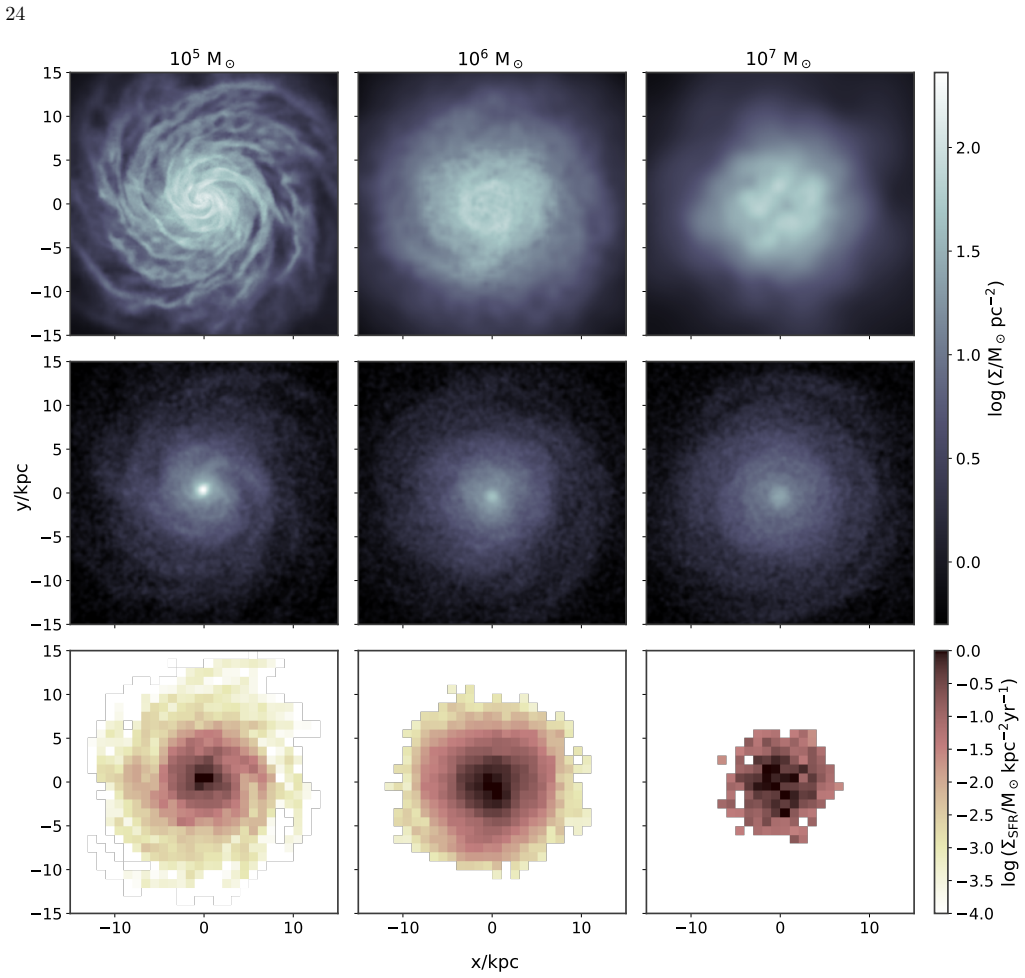
The PRFM theory supplies a subgrid star formation model in which the local star formation rate is determined by the dynamic balance between gravity and the momentum supplied by stellar feedback; the two numerical implementations (volumetric when scale height is resolved, integrated when it is not) reproduce the star formation rates of resolved TIGRESS simulations more closely than empirical prescriptions and remain consistent across a wide range of mass resolutions.
What carries the argument
Pressure-regulated, feedback-modulated (PRFM) theory, which equates the star formation rate to the rate needed to maintain vertical equilibrium between gravitational weight and feedback momentum injection.
If this is right
- Gas depletion times become shorter than in current empirical models, particularly inside dense, high-pressure regions.
- At the highest tested resolution the two PRFM implementations agree with each other and with the underlying TIGRESS simulation for the global star formation rate.
- The integrated formulation remains numerically stable and produces consistent results even when the gas disk scale height is not resolved.
- Both versions supply a physically motivated effective equation of state that can be used directly in larger-volume cosmological simulations.
Where Pith is reading between the lines
- Adoption of PRFM would likely reduce the need for separate tunable parameters that currently control star formation efficiency in cosmological codes.
- Because the model predicts an explicit dependence of star formation on local pressure, it could alter the predicted distribution of star-forming gas across different galactic environments.
- The robustness of the integrated version at low resolution suggests it could be applied immediately to existing large-volume runs without requiring changes to the numerical resolution.
Load-bearing premise
The calibration of PRFM on parsec-scale simulations can be applied unchanged as a subgrid rule at the much coarser resolutions used in cosmological galaxy formation runs.
What would settle it
A direct comparison, at the same mass resolution, of the star formation rate surface density versus mid-plane pressure relation in a full cosmological run using the PRFM subgrid model versus one using the IllustrisTNG prescription, checked against observed Kennicutt-Schmidt relations in nearby galaxies.
Figures









read the original abstract
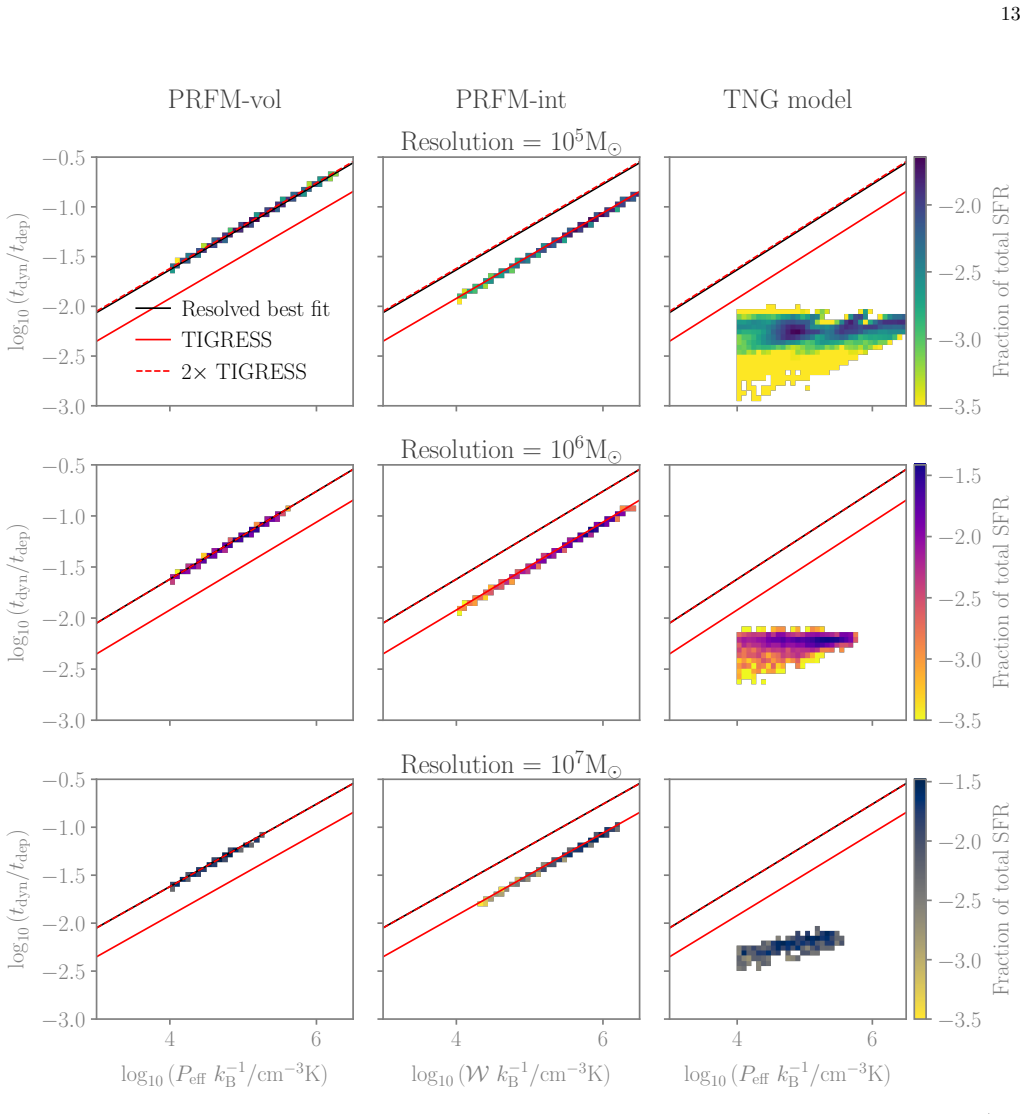
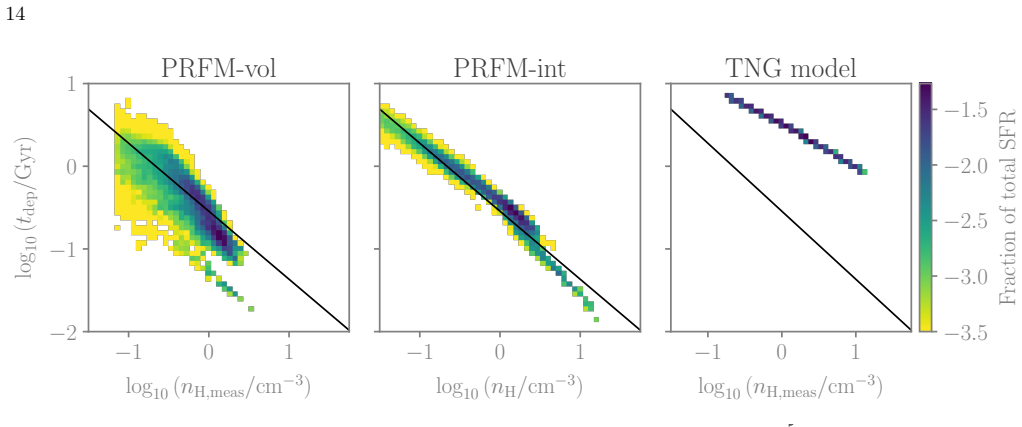
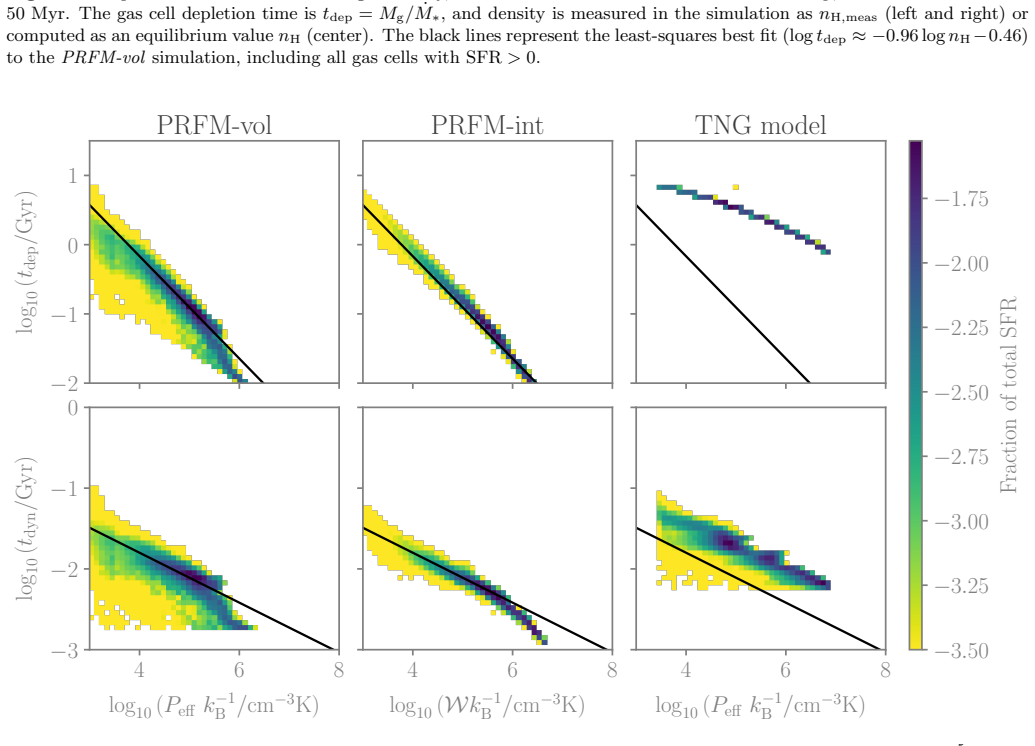
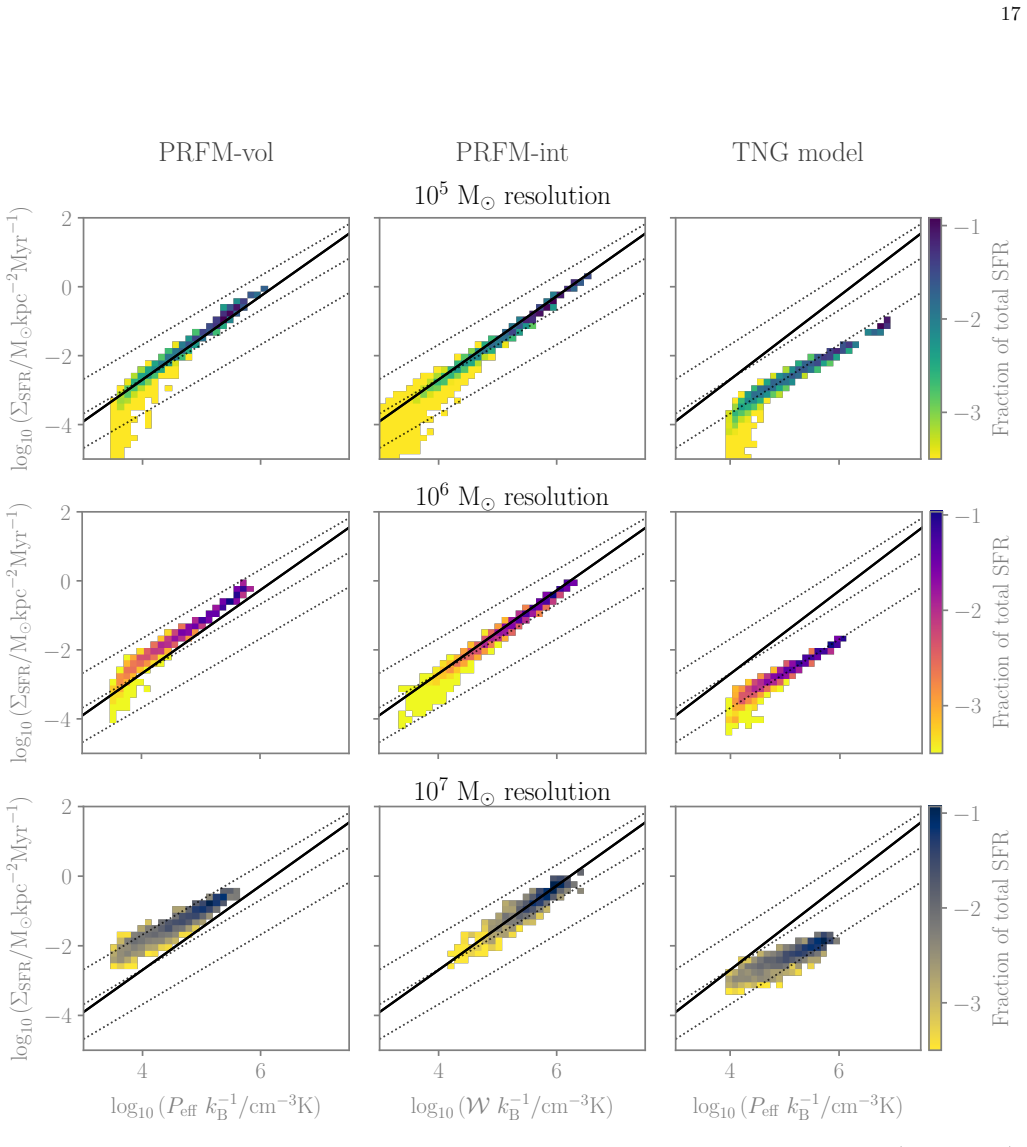
We present a new subgrid model for interstellar gas evolution in cosmological simulations of galaxy formation, based on the pressure-regulated, feedback-modulated (PRFM) theory of star formation. In contrast to the empirically pegged star formation prescriptions employed in current cosmological simulations, the PRFM model links the local star formation rate to the dynamic balance achieved in galactic interstellar gas between gravity and stellar feedback effects. With this formulation, both the star formation efficiency and the effective equation of state may be directly calibrated using numerical simulations, such as TIGRESS, which resolve physics of the interstellar medium and star formation at parsec scales. We develop, and implement in the Arepo moving-mesh code, two complementary classes of the subgrid model: a volumetric version (PRFM-vol) applicable when the gas disk scale height of a galaxy is numerically resolved in a simulation, and an integrated version (PRFM-int) that reconstructs the mid-plane density and pressure from vertical equilibrium considerations when the true gas scale height cannot be numerically resolved. Using isolated Milky-Way-like disk simulations across mass resolutions $10^5$-$10^7~{\rm M}_\odot$, we show that both implementations yield shorter gas depletion times than the IllustrisTNG prescription, especially in regions where pressure and density are large. At high resolution, PRFM-vol and PRFM-int agree closely with each other and with TIGRESS for the star formation rate; PRFM-int remains robust at all resolutions tested. These results demonstrate that PRFM-derived subgrid prescriptions provide a physically grounded and numerically stable framework for star formation across the dynamic range of galaxy formation simulations, paving the way for future cosmological applications.
Editorial analysis
A structured set of objections, weighed in public.
Referee Report
Summary. The paper presents a pressure-regulated, feedback-modulated (PRFM) subgrid model for interstellar gas and star formation in galaxy simulations. It develops two implementations in Arepo (PRFM-vol for resolved scale heights and PRFM-int for unresolved cases), calibrates star formation efficiency and effective EOS directly from TIGRESS parsec-scale simulations, and tests both on isolated Milky Way-like disk runs at mass resolutions 10^5–10^7 M_⊙. Results show shorter gas depletion times than the IllustrisTNG prescription (especially at high pressure/density), close agreement with TIGRESS at high resolution, and robustness of PRFM-int across resolutions. The work frames these as a physically grounded framework paving the way for cosmological applications.
Significance. If the direct transfer of the TIGRESS calibration holds without additional scale-dependent corrections, the model supplies a physically motivated alternative to empirical prescriptions, with explicit strengths in the TIGRESS-based calibration of both efficiency and EOS plus the dual volumetric/integrated implementations that address numerical resolution limits. The isolated-disk tests credibly demonstrate shorter depletion times and resolution robustness relative to TNG. However, because all quantitative results (depletion times, SFR agreement, convergence) are confined to isolated disks, the significance for cosmological runs with accretion and mergers remains prospective rather than demonstrated.
major comments (2)
- [Abstract] Abstract: The claim that PRFM-int 'remains robust at all resolutions tested' and that the prescriptions 'provide a physically grounded and numerically stable framework for star formation across the dynamic range of galaxy formation simulations' is load-bearing for the central contribution, yet rests exclusively on isolated MW-like disk simulations; no cosmological runs incorporating accretion, mergers, or varying environments are shown, leaving the assumption of direct transfer without scale-dependent corrections untested.
- [Abstract] Abstract: The statement that 'both the star formation efficiency and the effective equation of state may be directly calibrated using numerical simulations, such as TIGRESS' provides no quantitative error bars, exact fitting procedure, or data exclusion criteria for the TIGRESS-derived constants; this directly affects assessment of the reported agreement with TIGRESS SFRs and the shorter depletion times versus TNG.
minor comments (1)
- [Abstract] Abstract: Quantitative metrics for 'shorter gas depletion times' and 'agree closely' (e.g., specific depletion time ratios or SFR values with uncertainties) are not supplied, limiting evaluation of the strength of the comparison to TIGRESS and TNG.
Simulated Author's Rebuttal
We thank the referee for their careful review and constructive comments. We address each major comment below, agreeing where revisions are warranted to better reflect the scope of our tests and the calibration details.
read point-by-point responses
-
Referee: [Abstract] Abstract: The claim that PRFM-int 'remains robust at all resolutions tested' and that the prescriptions 'provide a physically grounded and numerically stable framework for star formation across the dynamic range of galaxy formation simulations' is load-bearing for the central contribution, yet rests exclusively on isolated MW-like disk simulations; no cosmological runs incorporating accretion, mergers, or varying environments are shown, leaving the assumption of direct transfer without scale-dependent corrections untested.
Authors: We agree that all quantitative results, including resolution robustness and depletion times, are demonstrated exclusively in isolated Milky Way-like disk simulations. The manuscript presents the PRFM model as a framework that paves the way for cosmological applications rather than claiming validation in those regimes. We will revise the abstract to explicitly state that the current tests are limited to isolated disks, that robustness is shown with respect to numerical resolution in these setups, and that cosmological runs with accretion and mergers are left for future work. This removes any implication that direct transfer without scale-dependent corrections has been tested in complex environments. revision: yes
-
Referee: [Abstract] Abstract: The statement that 'both the star formation efficiency and the effective equation of state may be directly calibrated using numerical simulations, such as TIGRESS' provides no quantitative error bars, exact fitting procedure, or data exclusion criteria for the TIGRESS-derived constants; this directly affects assessment of the reported agreement with TIGRESS SFRs and the shorter depletion times versus TNG.
Authors: The calibration of the star formation efficiency and effective equation of state from TIGRESS, including the fitting procedure and associated constants, is described in detail in Section 3 of the manuscript. To improve clarity in the abstract, we will add a concise reference to the calibration method and note that quantitative uncertainties and fitting details are provided in the main text. This will allow readers to assess the agreement with TIGRESS and comparisons to TNG more directly from the abstract. revision: yes
Circularity Check
PRFM calibration from TIGRESS makes reported agreement with TIGRESS a fitted result by construction
specific steps
-
fitted input called prediction
[Abstract]
"With this formulation, both the star formation efficiency and the effective equation of state may be directly calibrated using numerical simulations, such as TIGRESS, which resolve physics of the interstellar medium and star formation at parsec scales. [...] At high resolution, PRFM-vol and PRFM-int agree closely with each other and with TIGRESS for the star formation rate"
The efficiency and EOS parameters are fitted/calibrated from TIGRESS; therefore the reported close agreement with TIGRESS SFRs at high resolution in the Arepo runs is a direct consequence of that calibration rather than an independent prediction.
full rationale
The paper explicitly states that star formation efficiency and effective EOS are calibrated directly from TIGRESS simulations. It then presents close agreement between the Arepo implementations and TIGRESS SFRs at high resolution as a validation result. This agreement is forced by the calibration step rather than an independent test. The comparison to IllustrisTNG and resolution robustness tests retain independent content, and no load-bearing self-citation chain or definitional reduction appears in the derivation of the PRFM framework itself. The assumption of direct transfer to cosmological runs without scale corrections is noted as future work rather than a derived claim.
Axiom & Free-Parameter Ledger
free parameters (1)
- PRFM calibration constants from TIGRESS
axioms (1)
- domain assumption Vertical hydrostatic equilibrium allows reconstruction of mid-plane density and pressure when scale height is unresolved
Reference graph
Works this paper leans on
-
[1]
Andalman, Z. L., Teyssier, R., & Dekel, A. 2025, MNRAS, 540, 3350, doi: 10.1093/mnras/staf930
-
[2]
Barrera-Ballesteros, J. K., S´ anchez, S. F., Heckman, T., et al. 2021, MNRAS, 503, 3643, doi: 10.1093/mnras/stab755
-
[3]
Burger, J. D., Springel, V., Ostriker, E. C., et al. 2025, MNRAS, 544, 1390, doi: 10.1093/mnras/staf1720
-
[4]
Casey, C. M., Akins, H. B., Shuntov, M., et al. 2024, ApJ, 965, 98, doi: 10.3847/1538-4357/ad2075
-
[5]
Cen, R., & Ostriker, J. P. 1992, ApJL, 399, L113, doi: 10.1086/186620 Dav´ e, R., Angl´ es-Alc´ azar, D., Narayanan, D., et al. 2019, MNRAS, 486, 2827, doi: 10.1093/mnras/stz937
-
[6]
Li, Z. 2023, MNRAS, 523, 3201, doi: 10.1093/mnras/stad1557
-
[7]
Ellison, S. L., Pan, H.-A., Bluck, A. F. L., et al. 2024, MNRAS, 527, 10201, doi: 10.1093/mnras/stad3778
-
[8]
Elmegreen, B. G. 1989, ApJ, 338, 178, doi: 10.1086/167192
-
[9]
Genel, S., Fall, S. M., Hernquist, L., et al. 2015, ApJL, 804, L40, doi: 10.1088/2041-8205/804/2/L40
-
[10]
2018, MNRAS, 479, 3042, doi: 10.1093/mnras/sty1653
Girichidis, P., Naab, T., Hanasz, M., & Walch, S. 2018, MNRAS, 479, 3042, doi: 10.1093/mnras/sty1653
-
[11]
Gurvich, A. B., Faucher-Gigu` ere, C.-A., Richings, A. J., et al. 2020, MNRAS, 498, 3664, doi: 10.1093/mnras/staa2578
-
[12]
Hassan, S., Ostriker, E. C., Kim, C.-G., et al. 2023, MNRAS to be submitted —. 2024, ApJ, 975, 151, doi: 10.3847/1538-4357/ad73a4
-
[13]
2019, MNRAS, 483, 3363, doi: 10.1093/mnras/sty3252
Hu, C.-Y. 2019, MNRAS, 483, 3363, doi: 10.1093/mnras/sty3252
-
[14]
Jeffreson, S. M. R., Ostriker, E. C., Kim, C.-G., et al. 2024, ApJ, 975, 113, doi: 10.3847/1538-4357/ad793f
-
[15]
Jeffreson, S. M. R., Sun, J., & Wilson, C. D. 2022, MNRAS, 515, 1663, doi: 10.1093/mnras/stac1874
-
[16]
1992, ApJ, 391, 502, doi: 10.1086/171366
Katz, N. 1992, ApJ, 391, 502, doi: 10.1086/171366
-
[17]
Kennicutt, R. C., & Evans, N. J. 2012, ARA&A, 50, 531, doi: 10.1146/annurev-astro-081811-125610
work page internal anchor Pith review doi:10.1146/annurev-astro-081811-125610 2012
-
[18]
Kennicutt, Jr., R. C. 1998, ApJ, 498, 541, doi: 10.1086/305588
work page internal anchor Pith review doi:10.1086/305588 1998
-
[19]
Kim, C.-G., Kim, J.-G., Gong, M., & Ostriker, E. C. 2023a, ApJ, 946, 3, doi: 10.3847/1538-4357/acbd3a
-
[20]
Kim, C.-G., & Ostriker, E. C. 2015, ApJ, 802, 99, doi: 10.1088/0004-637X/802/2/99 —. 2017, ApJ, 846, 133, doi: 10.3847/1538-4357/aa8599 —. 2018, ApJ, 853, 173, doi: 10.3847/1538-4357/aaa5ff
-
[21]
Kim, C.-G., Ostriker, E. C., & Kim, W.-T. 2013, ApJ, 776, 1, doi: 10.1088/0004-637X/776/1/1
-
[22]
Kim, C.-G., Ostriker, E. C., Somerville, R. S., et al. 2020a, ApJ, 900, 61, doi: 10.3847/1538-4357/aba962
-
[23]
Kim, C.-G., Ostriker, E. C., Fielding, D. B., et al. 2020b, ApJL, 903, L34, doi: 10.3847/2041-8213/abc252
-
[24]
Kim, C.-G., Ostriker, E. C., Kim, J.-G., et al. 2024, ApJ, 972, 67, doi: 10.3847/1538-4357/ad59ab
-
[25]
Kim, J.-G., Gong, M., Kim, C.-G., & Ostriker, E. C. 2023b, ApJS, 264, 10, doi: 10.3847/1538-4365/ac9b1d
-
[26]
2014, ApJS, 210, 14, doi: 10.1088/0067-0049/210/1/14
Kim, J.-h., Abel, T., Agertz, O., et al. 2014, ApJS, 210, 14, doi: 10.1088/0067-0049/210/1/14
-
[27]
Kim, W.-T., Kim, C.-G., & Ostriker, E. C. 2020c, ApJ, 898, 35, doi: 10.3847/1538-4357/ab9b87 Labb´ e, I., van Dokkum, P., Nelson, E., et al. 2023, Nature, 616, 266, doi: 10.1038/s41586-023-05786-2
-
[28]
B., Kim, J.-G., Kim, C.-G., & Ostriker, E
Linzer, N. B., Kim, J.-G., Kim, C.-G., & Ostriker, E. C. 2024, ApJ, 975, 173, doi: 10.3847/1538-4357/ad7733
-
[29]
1994, ApJ, 433, 687, doi: 10.1086/174677 —
Malhotra, S. 1994, ApJ, 433, 687, doi: 10.1086/174677 —. 1995, ApJ, 448, 138, doi: 10.1086/175946
-
[30]
Mason, C. A., Trenti, M., & Treu, T. 2023, MNRAS, 521, 497, doi: 10.1093/mnras/stad035
-
[31]
M., Stanimirovi´ c, S., & Rybarczyk, D
McClure-Griffiths, N. M., Stanimirovi´ c, S., & Rybarczyk, D. R. 2023, ARA&A, 61, 19, doi: 10.1146/annurev-astro-052920-104851
-
[32]
2020, A&A, 643, A78, doi: 10.1051/0004-6361/202039008
Molina, J., Ibar, E., Godoy, N., et al. 2020, A&A, 643, A78, doi: 10.1051/0004-6361/202039008
-
[33]
Naab, T., & Ostriker, J. P. 2017, ARA&A, 55, 59, doi: 10.1146/annurev-astro-081913-040019
-
[34]
Monthly Notices of the Royal Astronomical Society , author =
Hernquist, L. 2012, MNRAS, 421, 3127, doi: 10.1111/j.1365-2966.2012.20536.x
-
[35]
2018 MNRAS, 475, 624, doi:10.1093/mnras/stx3040
Nelson, D., Pillepich, A., Springel, V., et al. 2018, MNRAS, 475, 624, doi: 10.1093/mnras/stx3040
work page internal anchor Pith review doi:10.1093/mnras/stx3040 2018
-
[36]
Ostriker, E. C., & Kim, C.-G. 2022, ApJ, 936, 137, doi: 10.3847/1538-4357/ac7de2
-
[37]
Ostriker, E. C., McKee, C. F., & Leroy, A. K. 2010, ApJ, 721, 975, doi: 10.1088/0004-637X/721/2/975
-
[38]
Ostriker, E. C., & Shetty, R. 2011, ApJ, 731, 41, doi: 10.1088/0004-637X/731/1/41
-
[39]
Pandya, V., Fielding, D. B., Angl´ es-Alc´ azar, D., et al. 2021, MNRAS, 508, 2979, doi: 10.1093/mnras/stab2714
-
[40]
Pillepich, A., Nelson, D., Hernquist, L., et al. 2018, MNRAS, 475, 648, doi: 10.1093/mnras/stx3112
work page internal anchor Pith review doi:10.1093/mnras/stx3112 2018
-
[41]
Pillepich, A., Nelson, D., Springel, V., et al. 2019, MNRAS, 490, 3196, doi: 10.1093/mnras/stz2338
-
[42]
MNRAS , archivePrefix = "arXiv", eprint =
Schaye, J., & Dalla Vecchia, C. 2008, MNRAS, 383, 1210, doi: 10.1111/j.1365-2966.2007.12639.x
-
[43]
, archivePrefix = "arXiv", eprint =
Schaye, J., Crain, R. A., Bower, R. G., et al. 2015, MNRAS, 446, 521, doi: 10.1093/mnras/stu2058 31
-
[44]
2026, MNRAS, 545, staf2119, doi: 10.1093/mnras/staf2119
Shen, X., Kannan, R., Puchwein, E., et al. 2026, MNRAS, 545, staf2119, doi: 10.1093/mnras/staf2119
-
[45]
2025, ApJ, 987, 204, doi: 10.3847/1538-4357/adda3d
Weber, M. 2025, ApJ, 987, 204, doi: 10.3847/1538-4357/adda3d
-
[46]
A model for unresolved cool clouds entrained in galactic winds in cosmological simulations
Smith, M. C., Fielding, D. B., Bryan, G. L., et al. 2024a, MNRAS, 535, 3550, doi: 10.1093/mnras/stae2589 —. 2024b, MNRAS, 527, 1216, doi: 10.1093/mnras/stad3168
-
[47]
Physical Models of Galaxy Formation in a Cosmological Framework
Somerville, R. S., & Dav´ e, R. 2015, ARA&A, 53, 51, doi: 10.1146/annurev-astro-082812-140951
work page internal anchor Pith review doi:10.1146/annurev-astro-082812-140951 2015
-
[48]
2009, MNRAS, 400, 1181, doi: 10.1111/j.1365-2966.2009.15528.x
Springel, V. 2010, MNRAS, 401, 791, doi: 10.1111/j.1365-2966.2009.15715.x
-
[49]
Springel, V., & Hernquist, L. 2003, MNRAS, 339, 289, doi: 10.1046/j.1365-8711.2003.06206.x
-
[50]
Springel, V., Pakmor, R., Pillepich, A., et al. 2018, MNRAS, 475, 676, doi: 10.1093/mnras/stx3304
-
[51]
Steinwandel, U. P., Kim, C.-G., Bryan, G. L., et al. 2024, ApJ, 960, 100, doi: 10.3847/1538-4357/ad09e1
-
[52]
2021, ApJ, 910, 131, doi: 10.3847/1538-4357/abe5ab
Su, Y., Yang, J., Yan, Q.-Z., et al. 2021, ApJ, 910, 131, doi: 10.3847/1538-4357/abe5ab
-
[53]
Sun, J., Leroy, A. K., Ostriker, E. C., et al. 2020, ApJ, 892, 148, doi: 10.3847/1538-4357/ab781c —. 2023, ApJL, 945, L19, doi: 10.3847/2041-8213/acbd9c
-
[54]
Tacconi, L. J., Genzel, R., & Sternberg, A. 2020, ARA&A, 58, 157, doi: 10.1146/annurev-astro-082812-141034
-
[55]
Teng, Y.-H., Chiang, I.-D., Sandstrom, K. M., et al. 2024, ApJ, 961, 42, doi: 10.3847/1538-4357/ad10ae
-
[56]
Vijayakumar, V., Sun, J., Ostriker, E. C., et al. 2025, ApJ, 989, 66, doi: 10.3847/1538-4357/ade800
-
[57]
Vogelsberger, M., Genel, S., Sijacki, D., et al. 2013, MNRAS, 436, 3031, doi: 10.1093/mnras/stt1789
work page internal anchor Pith review doi:10.1093/mnras/stt1789 2013
-
[58]
doi:10.1038/s42254-019-0127-2 , eprint =
Vogelsberger, M., Marinacci, F., Torrey, P., & Puchwein, E. 2020, Nature Reviews Physics, 2, 42, doi: 10.1038/s42254-019-0127-2
-
[59]
Vogelsberger, M., Genel, S., Springel, V., et al. 2014, MNRAS, 444, 1518, doi: 10.1093/mnras/stu1536
-
[60]
Xiao, M., Oesch, P. A., Elbaz, D., et al. 2024, Nature, 635, 311, doi: 10.1038/s41586-024-08094-5
-
[61]
2026, ApJ, 999, 41, doi: 10.3847/1538-4357/ae3c08
Zhou, Y., Di Matteo, T., Bird, S., et al. 2026, ApJ, 999, 41, doi: 10.3847/1538-4357/ae3c08
discussion (0)
Sign in with ORCID, Apple, or X to comment. Anyone can read and Pith papers without signing in.