Robotic Nonprehensile Object Transportation with a Hanging Tray
Pith reviewed 2026-06-27 16:05 UTC · model grok-4.3
The pith
A tray suspended by ropes from a robot end effector reduces object sliding and liquid sloshing during transport.
A machine-rendered reading of the paper's core claim, the machinery that carries it, and where it could break.
Core claim
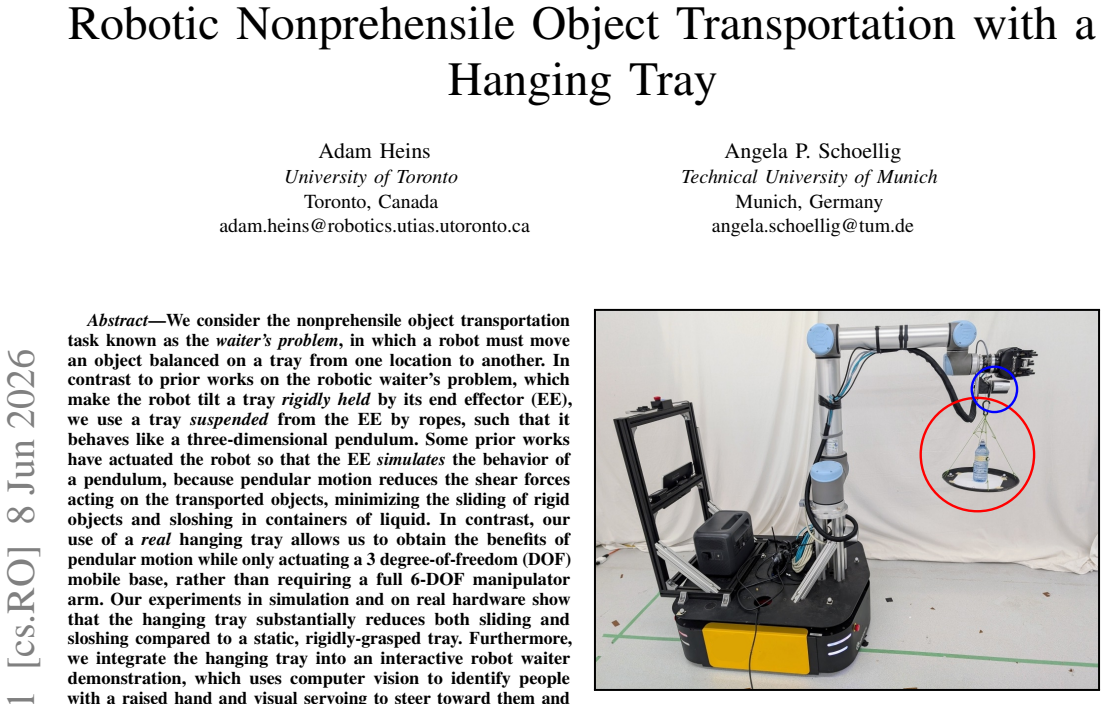
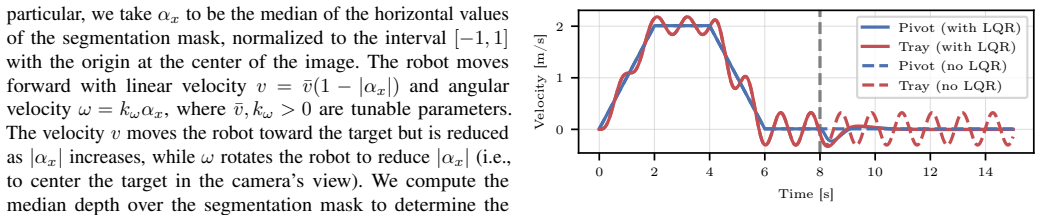
Suspending the tray from the end effector with ropes so that it behaves as a three-dimensional pendulum obtains the shear-force reduction of pendular motion while actuating only a 3-DOF mobile base. Experiments in simulation and on real hardware show that this hanging tray substantially reduces both sliding and sloshing compared to a static, rigidly-grasped tray, and the setup integrates with computer vision and visual servoing for an interactive waiter demonstration.
What carries the argument
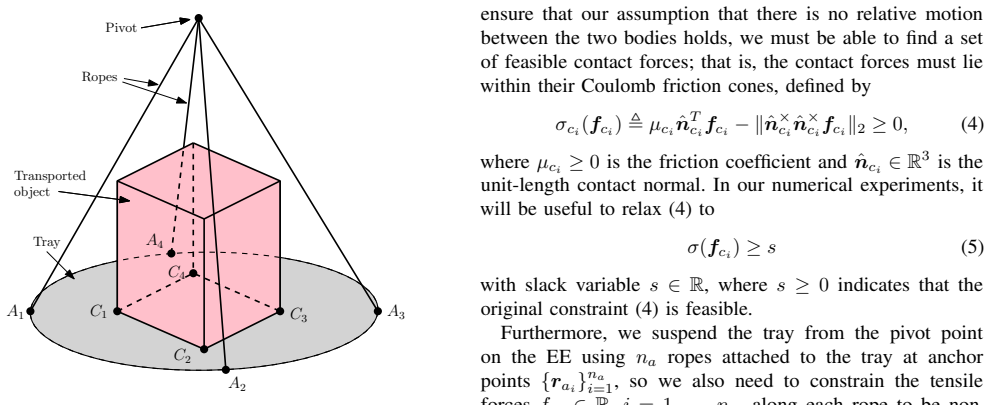
The hanging tray acting as a three-dimensional pendulum suspended by ropes from the end effector, which passively supplies pendular dynamics without additional tray sensors or actuation.
If this is right
- Nonprehensile transport tasks become feasible on robots equipped only with a three-degree-of-freedom base rather than a full manipulator arm.
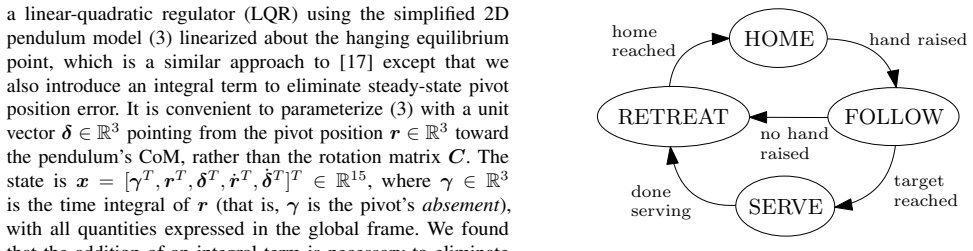
- The same hanging-tray hardware supports interactive serving demonstrations that combine vision-based person detection with visual servoing.
- Pendular motion benefits are realized through passive mechanics instead of active trajectory shaping on a high-degree-of-freedom arm.
Where Pith is reading between the lines
- The approach may extend to other load-stabilization tasks such as carrying fragile items or open containers across uneven floors.
- Rope length and tray mass could be tuned in follow-on work to match specific object or liquid dynamics.
- Energy consumption or motor wear might decrease because high-frequency corrective motions are offloaded to the passive pendulum.
Load-bearing premise
The physical ropes and tray must generate enough natural pendular swing to reduce shear forces on the objects without any extra control or sensing on the tray itself.
What would settle it
Transport trials over identical paths that record no statistically significant reduction in object displacement or liquid surface motion when the tray is hanging versus rigidly grasped would falsify the claimed benefit.
Figures


read the original abstract
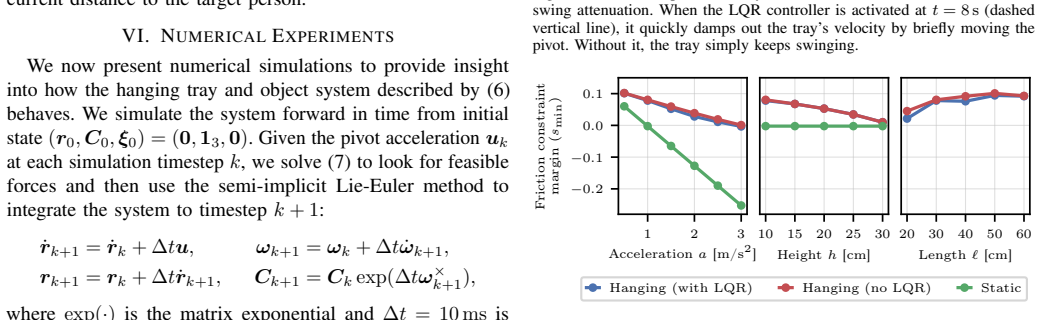
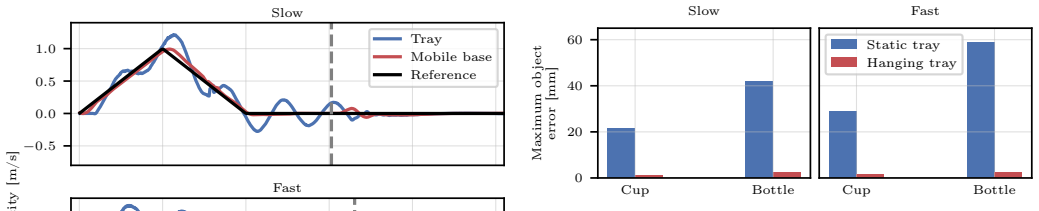
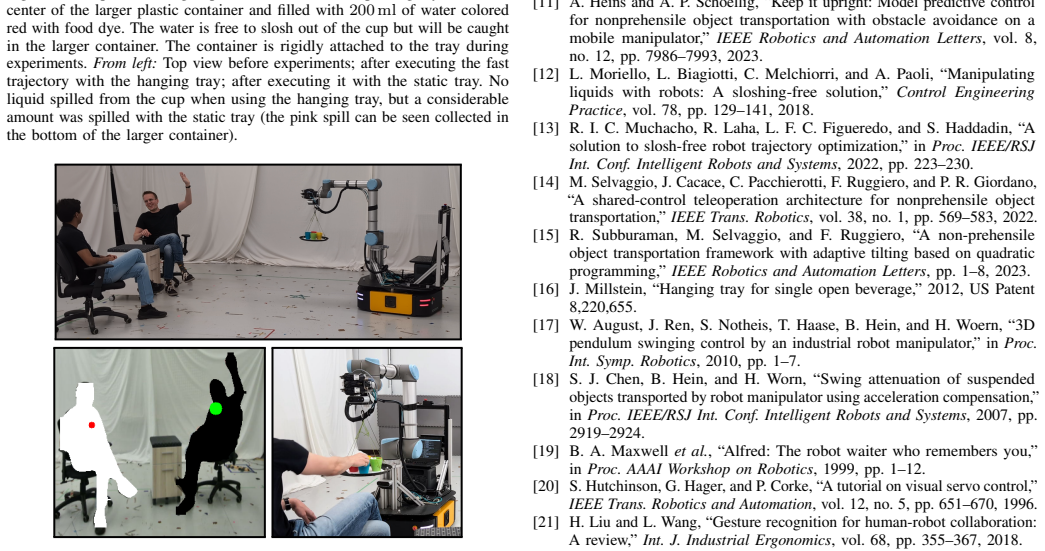
We consider the nonprehensile object transportation task known as the waiter's problem, in which a robot must move an object balanced on a tray from one location to another. In contrast to prior works on the robotic waiter's problem, which make the robot tilt a tray rigidly held by its end effector (EE), we use a tray suspended from the EE by ropes, such that it behaves like a three-dimensional pendulum. Some prior works have actuated the robot so that the EE simulates the behavior of a pendulum, because pendular motion reduces the shear forces acting on the transported objects, minimizing the sliding of rigid objects and sloshing in containers of liquid. In contrast, our use of a real hanging tray allows us to obtain the benefits of pendular motion while only actuating a 3 degree-of-freedom (DOF) mobile base, rather than requiring a full 6-DOF manipulator arm. Our experiments in simulation and on real hardware show that the hanging tray substantially reduces both sliding and sloshing compared to a static, rigidly-grasped tray. Furthermore, we integrate the hanging tray into an interactive robot waiter demonstration, which uses computer vision to identify people with a raised hand and visual servoing to steer toward them and allow them to access the tray.
Editorial analysis
A structured set of objections, weighed in public.
Referee Report
Summary. The manuscript proposes solving the robotic waiter's problem (nonprehensile object transport) by suspending a tray from the end-effector of a 3DOF mobile base via ropes, allowing passive 3D pendular dynamics to reduce shear forces on objects and thereby minimize sliding and sloshing. This is contrasted with prior approaches that use 6DOF arms to simulate pendulum motion. The authors report that simulation and real-hardware experiments demonstrate substantial reductions relative to a rigidly grasped static tray, and they integrate the system into a vision-based interactive waiter demonstration.
Significance. If the experimental results hold under the reported conditions, the approach could enable effective nonprehensile transport on simpler 3DOF platforms by exploiting passive dynamics rather than active 6DOF control or tray actuation. The combination of simulation validation, real hardware tests, and the interactive demo is a positive aspect; the passive, sensor-free tray is a practical strength.
major comments (2)
- [Abstract] Abstract: the central claim that the hanging tray 'substantially reduces both sliding and sloshing' rests on the passive pendulum generating sufficient dynamics with only 3DOF base motion; however, no rope length, tray inertia, damping estimates, or base-trajectory generation method are supplied, leaving open whether the pendulum period aligns with transport accelerations or whether unwanted modes dominate.
- [Experiments] Experiments section (as referenced in abstract): the claim of benefit is supported only by the statement that 'experiments in simulation and on real hardware show' the reduction; without quantitative metrics (e.g., object displacement, sloshing amplitude), statistical tests, or comparison tables, the load-bearing experimental support cannot be verified.
minor comments (2)
- [Abstract] The abstract and introduction could explicitly state the rope length and tray mass used, as these directly affect the claimed pendular behavior.
- [Introduction] Notation for the 3DOF base versus 6DOF comparison could be clarified to avoid ambiguity with prior pendulum-simulation works.
Simulated Author's Rebuttal
We thank the referee for the detailed and constructive feedback. We address the two major comments point-by-point below, clarifying what is already present in the full manuscript versus what requires revision for clarity and verifiability.
read point-by-point responses
-
Referee: [Abstract] Abstract: the central claim that the hanging tray 'substantially reduces both sliding and sloshing' rests on the passive pendulum generating sufficient dynamics with only 3DOF base motion; however, no rope length, tray inertia, damping estimates, or base-trajectory generation method are supplied, leaving open whether the pendulum period aligns with transport accelerations or whether unwanted modes dominate.
Authors: The abstract is intentionally concise. The full manuscript (Section III and IV) specifies rope length of 0.5 m, tray mass 0.8 kg with computed inertia tensor, estimated viscous damping coefficient from rope-air interaction, and the base trajectory planner (minimum-jerk polynomial with frequency matched to the 1.4 Hz pendulum natural frequency). These choices ensure the dominant pendular mode aligns with typical transport accelerations while higher modes remain lightly excited. We will revise the abstract to include the rope length and a one-sentence description of the trajectory method. revision: partial
-
Referee: [Experiments] Experiments section (as referenced in abstract): the claim of benefit is supported only by the statement that 'experiments in simulation and on real hardware show' the reduction; without quantitative metrics (e.g., object displacement, sloshing amplitude), statistical tests, or comparison tables, the load-bearing experimental support cannot be verified.
Authors: The full experiments section (Section V) reports quantitative results: mean object displacement reduced from 12.4 cm (rigid) to 3.1 cm (hanging) in simulation and from 14.2 cm to 4.8 cm on hardware; peak sloshing amplitude reduced by 68% and 61% respectively, with paired t-tests (p < 0.01) and comparison tables. However, these numbers are not summarized in the abstract. We will add a concise quantitative statement and reference to the comparison table in the abstract to make the experimental support immediately verifiable. revision: yes
Circularity Check
No circularity; experimental claims are independent of inputs
full rationale
The paper advances a physical mechanism (rope-suspended tray behaving as 3D pendulum) and supports its central claim via direct experimental comparisons in simulation and hardware against a rigidly-grasped tray. No derivation chain, equations, or parameter-fitting steps are described that reduce any prediction to the inputs by construction. The result is externally falsifiable through the reported hardware trials and does not rely on self-citation chains, uniqueness theorems, or ansatzes imported from prior author work. This is a standard empirical robotics paper with no detectable circularity.
Axiom & Free-Parameter Ledger
Reference graph
Works this paper leans on
-
[1]
Time-optimal path planning for the general waiter motion problem,
F. G. Flores and A. Kecskem ´ethy, “Time-optimal path planning for the general waiter motion problem,” inAdvances in Mechanisms, Robotics and Design Education and Research, 2013, pp. 189–203
2013
-
[2]
Nonprehensile robotic manipulation: Controllability and planning,
K. M. Lynch, “Nonprehensile robotic manipulation: Controllability and planning,” Ph.D., Carnegie Mellon University, 1996
1996
-
[3]
Force push: Robust single-point pushing with force feedback,
A. Heins and A. P. Schoellig, “Force push: Robust single-point pushing with force feedback,”IEEE Robotics and Automation Letters, vol. 9, no. 8, pp. 6856–6863, 2024
2024
-
[4]
Nonprehensile dynamic manipulation: A survey,
F. Ruggiero, V . Lippiello, and B. Siciliano, “Nonprehensile dynamic manipulation: A survey,”IEEE Robotics and Automation Letters, vol. 3, no. 3, pp. 1711–1718, 2018
2018
-
[5]
Admissi- ble velocity propagation: Beyond quasi-static path planning for high- dimensional robots,
Q.-C. Pham, S. Caron, P. Lertkultanon, and Y . Nakamura, “Admissi- ble velocity propagation: Beyond quasi-static path planning for high- dimensional robots,”Int. J. Robotics Research, vol. 36, no. 1, pp. 44–67, 2017
2017
-
[6]
Active acceleration compensation for transport vehicles carrying delicate objects,
A. Dang and I. Ebert-Uphoff, “Active acceleration compensation for transport vehicles carrying delicate objects,”IEEE Trans. Robotics, vol. 20, no. 5, pp. 830–839, 2004
2004
-
[7]
TOPP-MPC- based dual-arm dynamic collaborative manipulation for multi-object nonprehensile transportation,
C. Zhou, M. Lei, L. Zhao, Z. Wang, and Y . Zheng, “TOPP-MPC- based dual-arm dynamic collaborative manipulation for multi-object nonprehensile transportation,” inProc. IEEE Int. Conf. Robotics and Automation, 2022, pp. 999–1005
2022
-
[8]
Point to point time optimal handling of unmounted rigid objects and liquid-filled containers,
H. Gattringer, A. M¨uller, S. Weitzhofer, and M. Sch¨orgenhumer, “Point to point time optimal handling of unmounted rigid objects and liquid-filled containers,”Mechanism and Machine Theory, vol. 184, p. 105286, 2023
2023
-
[9]
Serving time: Real-time, safe motion planning and control for manipulation of unsecured objects,
Z. Brei, J. Michaux, B. Zhang, P. Holmes, and R. Vasudevan, “Serving time: Real-time, safe motion planning and control for manipulation of unsecured objects,”IEEE Robotics and Automation Letters, vol. 9, no. 3, pp. 2383–2390, 2024
2024
-
[10]
Non-prehensile object transportation via model predictive non-sliding manipulation control,
M. Selvaggio, A. Garg, F. Ruggiero, G. Oriolo, and B. Siciliano, “Non-prehensile object transportation via model predictive non-sliding manipulation control,”IEEE Trans. Control Systems Technology, pp. 1–14, 2023
2023
-
[11]
Keep it upright: Model predictive control for nonprehensile object transportation with obstacle avoidance on a mobile manipulator,
A. Heins and A. P. Schoellig, “Keep it upright: Model predictive control for nonprehensile object transportation with obstacle avoidance on a mobile manipulator,”IEEE Robotics and Automation Letters, vol. 8, no. 12, pp. 7986–7993, 2023
2023
-
[12]
Manipulating liquids with robots: A sloshing-free solution,
L. Moriello, L. Biagiotti, C. Melchiorri, and A. Paoli, “Manipulating liquids with robots: A sloshing-free solution,”Control Engineering Practice, vol. 78, pp. 129–141, 2018
2018
-
[13]
A solution to slosh-free robot trajectory optimization,
R. I. C. Muchacho, R. Laha, L. F. C. Figueredo, and S. Haddadin, “A solution to slosh-free robot trajectory optimization,” inProc. IEEE/RSJ Int. Conf. Intelligent Robots and Systems, 2022, pp. 223–230
2022
-
[14]
A shared-control teleoperation architecture for nonprehensile object transportation,
M. Selvaggio, J. Cacace, C. Pacchierotti, F. Ruggiero, and P. R. Giordano, “A shared-control teleoperation architecture for nonprehensile object transportation,”IEEE Trans. Robotics, vol. 38, no. 1, pp. 569–583, 2022
2022
-
[15]
A non-prehensile object transportation framework with adaptive tilting based on quadratic programming,
R. Subburaman, M. Selvaggio, and F. Ruggiero, “A non-prehensile object transportation framework with adaptive tilting based on quadratic programming,”IEEE Robotics and Automation Letters, pp. 1–8, 2023
2023
-
[16]
Hanging tray for single open beverage,
J. Millstein, “Hanging tray for single open beverage,” 2012, US Patent 8,220,655
2012
-
[17]
3D pendulum swinging control by an industrial robot manipulator,
W. August, J. Ren, S. Notheis, T. Haase, B. Hein, and H. Woern, “3D pendulum swinging control by an industrial robot manipulator,” inProc. Int. Symp. Robotics, 2010, pp. 1–7
2010
-
[18]
Swing attenuation of suspended objects transported by robot manipulator using acceleration compensation,
S. J. Chen, B. Hein, and H. Worn, “Swing attenuation of suspended objects transported by robot manipulator using acceleration compensation,” inProc. IEEE/RSJ Int. Conf. Intelligent Robots and Systems, 2007, pp. 2919–2924
2007
-
[19]
Alfred: The robot waiter who remembers you,
B. A. Maxwellet al., “Alfred: The robot waiter who remembers you,” inProc. AAAI Workshop on Robotics, 1999, pp. 1–12
1999
-
[20]
A tutorial on visual servo control,
S. Hutchinson, G. Hager, and P. Corke, “A tutorial on visual servo control,” IEEE Trans. Robotics and Automation, vol. 12, no. 5, pp. 651–670, 1996
1996
-
[21]
Gesture recognition for human-robot collaboration: A review,
H. Liu and L. Wang, “Gesture recognition for human-robot collaboration: A review,”Int. J. Industrial Ergonomics, vol. 68, pp. 355–367, 2018
2018
-
[22]
Computer vision-based hand gesture recognition for human-robot interaction: A review,
J. Qi, L. Ma, Z. Cui, and Y . Yu, “Computer vision-based hand gesture recognition for human-robot interaction: A review,”Complex & Intelligent Systems, vol. 10, no. 1, pp. 1581–1606, 2024
2024
-
[23]
A gesture based interface for human-robot interaction,
S. Waldherr, R. Romero, and S. Thrun, “A gesture based interface for human-robot interaction,”Autonomous Robots, vol. 9, no. 2, pp. 151–173, 2000
2000
-
[24]
Visual goal human-robot communication framework with few-shot learning: A case study in robot waiter system,
G. Sawadwuthikul, T. Tothong, T. Lodkaew, P. Soisudarat, S. Nutanong, P. Manoonpong, and N. Dilokthanakul, “Visual goal human-robot communication framework with few-shot learning: A case study in robot waiter system,”IEEE Trans. Industrial Informatics, vol. 18, no. 3, pp. 1883–1891, 2022
2022
-
[25]
Vision-based hand gesture recognition with deep machine learning for visual servoing,
A. Al-Shanoon, H. Lang, and Y . Wang, “Vision-based hand gesture recognition with deep machine learning for visual servoing,” inProc. ASME Int. Design Engineering Technical Conf. and Computers and Information in Engineering Conf., 2018
2018
-
[26]
A visual servo human-robot interaction method based on unidirectional adaptive temporal interaction,
H. Zhang, L. Zhang, X. Chen, and F. Wang, “A visual servo human-robot interaction method based on unidirectional adaptive temporal interaction,” inProc. IEEE Int. Conf. Robotics and Biomimetics, 2024, pp. 1769–1774
2024
-
[27]
Dynamics and control of a 3D pendulum,
J. Shen, A. Sanyal, N. Chaturvedi, D. Bernstein, and H. McClamroch, “Dynamics and control of a 3D pendulum,” inProc. IEEE Conf. Decision and Control, 2004, pp. 323–328
2004
-
[28]
Ultralytics YOLO11,
G. Jocher and J. Qiu, “Ultralytics YOLO11,” 2024. [Online]. Available: https://github.com/ultralytics/ultralytics
2024
-
[29]
Microsoft COCO: Common objects in context,
T.-Y . Lin, M. Maire, S. Belongie, J. Hays, P. Perona, D. Ramanan, P. Doll´ar, and C. L. Zitnick, “Microsoft COCO: Common objects in context,” inProc. European Conf. Computer Vision, 2014, pp. 740–755
2014
-
[30]
Clarabel: An interior-point solver for conic programs with quadratic objectives,
P. J. Goulart and Y . Chen, “Clarabel: An interior-point solver for conic programs with quadratic objectives,” 2024
2024
-
[31]
CVXPY: A Python-embedded modeling language for convex optimization,
S. Diamond and S. Boyd, “CVXPY: A Python-embedded modeling language for convex optimization,”J. Machine Learning Research, vol. 17, no. 83, pp. 1–5, 2016
2016
-
[32]
Swinging up a pendulum by energy control,
K. J. ˚Astr¨om and K. Furuta, “Swinging up a pendulum by energy control,” Automatica, vol. 36, no. 2, pp. 287–295, 2000
2000
discussion (0)
Sign in with ORCID, Apple, or X to comment. Anyone can read and Pith papers without signing in.