Emotion Profiling in LLM-Based Literary Translation: Systematic Shifts Across MT and Post-Editing
Pith reviewed 2026-06-27 16:07 UTC · model grok-4.3
The pith
Machine translation systems imprint distinct emotional profiles on literary texts that differ from human translations.
A machine-rendered reading of the paper's core claim, the machinery that carries it, and where it could break.
Core claim
LLM translations of literary fiction carry model-specific and statistically significant emotional fingerprints that deviate from both human translations and the norms of the target-language genre; post-editing narrows but does not remove these systematic shifts, so the author's voice is only partly preserved.
What carries the argument
Lexicon-based and multilingual modeling applied to measure emotional variation across MT outputs, post-edits, and human reference texts.
If this is right
- Each MT model leaves a detectable emotional signature on the translated novel.
- Post-editing reduces the distance to human emotional norms but leaves residual model-specific effects.
- Authorial voice preservation is limited when literary translation relies on current LLM systems.
- Emotional profiling can distinguish translation methods even when surface fluency appears similar.
Where Pith is reading between the lines
- Workflows for literary post-editing could add explicit checks for emotional drift.
- The finding raises the question of whether similar fingerprints appear in other genres or language pairs.
- If the effect is general, human-only translation may be required for projects where emotional fidelity is central.
- Extending the method to track specific emotion categories could isolate which aspects of voice are most altered.
Load-bearing premise
Lexicon-based and multilingual modeling methods capture emotional profiles in literary text in a way that matches human reader perception.
What would settle it
A replication study on the same texts that finds no statistically significant emotional differences between any MT system and the human translation.
Figures
read the original abstract
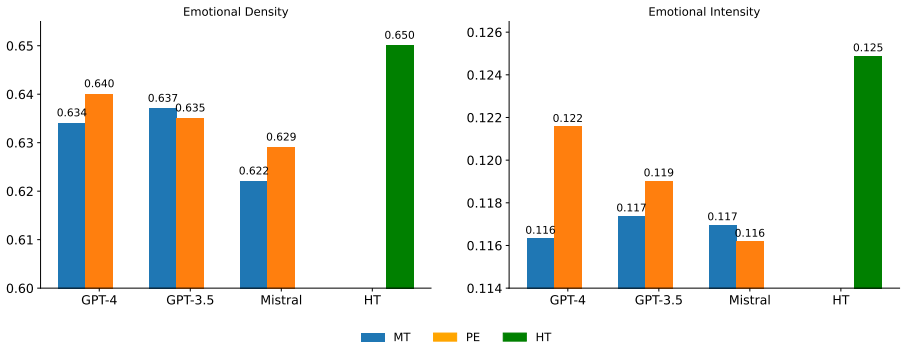
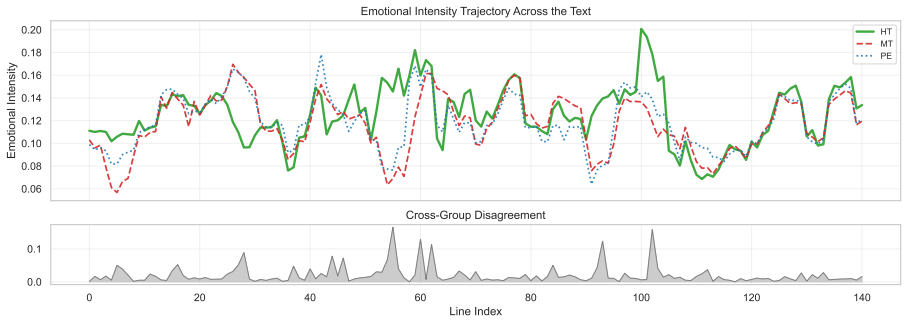
This paper investigates whether LLM translations exhibit identifiable emotional profiles and how post-editing reshapes them toward human-like norms. We compare LLM translations of Margaret Atwood's Oryx and Crake with their post-edited versions and a human translation, using a large-scale corpus of contemporary Italian science-fiction as a baseline. We examine emotion through lexicon-based and multilingual modeling, conducting a fine-grained analysis of emotional variation across systems. We find that MT systems introduce model-specific and statistically significant emotional fingerprints across translations, leading to a limited preservation of an author's voice.
Editorial analysis
A structured set of objections, weighed in public.
Referee Report
Summary. The paper examines emotional profiles in translations of Margaret Atwood's Oryx and Crake from English to Italian, comparing outputs from multiple LLM-based MT systems, their post-edited versions, a human translation, and a large baseline corpus of contemporary Italian science fiction. Using lexicon-based and multilingual emotion modeling, it reports model-specific and statistically significant emotional fingerprints in MT outputs that result in limited preservation of the author's voice, with post-editing partially aligning profiles toward human-like norms.
Significance. If the emotion metrics were validated against human judgments on literary text, the work would offer a useful empirical contribution to understanding systematic affective biases in MT for creative writing and the mitigating role of post-editing. The inclusion of a sizable external baseline corpus strengthens the ability to contextualize deviations, and the fine-grained cross-system comparison is a constructive design choice.
major comments (2)
- [Abstract] Abstract and Methods: The claim that MT systems produce 'statistically significant emotional fingerprints' is presented without any reported details on sample sizes, statistical tests performed, p-values, effect sizes, or controls for text length, genre, or lexical density differences between the dystopian novel excerpts and the baseline sci-fi corpus.
- [Methods] Methods and Results: The central interpretation that observed score differences constitute 'model-specific emotional fingerprints' limiting authorial voice preservation rests on the untested assumption that lexicon-based and multilingual emotion models accurately proxy human-perceptible emotional content in literary prose; no correlation analysis or human validation study (e.g., reader ratings of valence, arousal, or specific emotions) on the actual translated material is described.
minor comments (2)
- Clarify the exact emotion categories and lexicons/models employed, including any language-specific adaptations for Italian.
- Add explicit discussion of potential domain mismatch between the emotion detection tools (often trained on general or social media text) and dystopian literary prose.
Simulated Author's Rebuttal
We thank the referee for the detailed and constructive feedback. We address each major comment below and outline revisions to improve clarity and transparency.
read point-by-point responses
-
Referee: [Abstract] Abstract and Methods: The claim that MT systems produce 'statistically significant emotional fingerprints' is presented without any reported details on sample sizes, statistical tests performed, p-values, effect sizes, or controls for text length, genre, or lexical density differences between the dystopian novel excerpts and the baseline sci-fi corpus.
Authors: We agree that the abstract and Methods section should report these details explicitly for reproducibility. The full manuscript contains the underlying statistical comparisons in the Results, but we will revise the abstract to reference the tests performed and expand Methods with sample sizes (number of aligned text segments), the specific tests (e.g., Welch t-tests with multiple-comparison correction), exact p-values, effect sizes, and the controls used for text length (fixed-length segmentation) and lexical density (normalization against the baseline corpus). revision: yes
-
Referee: [Methods] Methods and Results: The central interpretation that observed score differences constitute 'model-specific emotional fingerprints' limiting authorial voice preservation rests on the untested assumption that lexicon-based and multilingual emotion models accurately proxy human-perceptible emotional content in literary prose; no correlation analysis or human validation study (e.g., reader ratings of valence, arousal, or specific emotions) on the actual translated material is described.
Authors: We acknowledge that the models are applied without a new human validation study on these specific literary translations. The analysis uses established, previously validated resources for multilingual emotion detection. We will add an explicit Limitations paragraph discussing the assumption, citing the models' reported correlations in prior work while noting the absence of direct reader validation here. The comparative design (multiple systems vs. human translation vs. baseline) still demonstrates systematic, model-specific deviations; we will adjust phrasing to present the 'fingerprints' as model-induced shifts rather than direct claims about authorial voice preservation. revision: partial
Circularity Check
No circularity: empirical comparisons rely on external lexicons, models, and baseline corpus
full rationale
The paper applies established lexicon-based and multilingual emotion detection methods to MT outputs, post-edits, human translation, and an external contemporary Italian SF corpus. No equations, fitted parameters, or self-referential definitions appear. Statistical differences are reported as observations rather than predictions forced by construction. No self-citation chains or uniqueness theorems are invoked to justify core claims. The derivation chain consists of standard tool application followed by comparative analysis and remains self-contained against external benchmarks.
Axiom & Free-Parameter Ledger
axioms (1)
- domain assumption Lexicon-based and multilingual modeling reliably measure emotional content in literary translations
Reference graph
Works this paper leans on
-
[1]
Öhman, Emily , editor =. The. Proceedings of the. 2021 , pages =
2021
-
[2]
Teodorescu, Daniela and Mohammad, Saif , editor =. Evaluating. Findings of the. 2023 , pages =. doi:10.18653/v1/2023.findings-emnlp.271 , abstract =
-
[3]
Jiang, Zhaokun and Lv, Qianxi and Zhang, Ziyin and Lei, Lei , year =. Distinguishing. doi:10.1111/ijal.70160 , abstract =
-
[4]
Jiang, Zeyuan , month = jun, year =. Does. PLOS ONE , publisher =. doi:10.1371/journal.pone.0324830 , abstract =
-
[5]
Vanmassenhove, Eva and Shterionov, Dimitar and Gwilliam, Matthew , editor =. Machine. Proceedings of the 16th. 2021 , pages =. doi:10.18653/v1/2021.eacl-main.188 , abstract =
-
[6]
Bizzoni, Yuri and Juzek, Tom S and España-Bonet, Cristina and Dutta Chowdhury, Koel and van Genabith, Josef and Teich, Elke , editor =. How. Proceedings of the 17th. 2020 , pages =. doi:10.18653/v1/2020.iwslt-1.34 , abstract =
-
[7]
Translationese and
Koppel, Moshe and Ordan, Noam , editor =. Translationese and. Proceedings of the 49th. 2011 , pages =
2011
-
[8]
Digital Scholarship in the Humanities , author =
On the features of translationese , volume =. Digital Scholarship in the Humanities , author =. 2015 , pages =. doi:10.1093/llc/fqt031 , abstract =
-
[9]
Translation
Mauranen, Anna and Kujamäki, Pekka , month = jan, year =. Translation
-
[10]
Zhang, Ran and Zhao, Wei and Eger, Steffen , editor =. How. Proceedings of the 2025. 2025 , pages =. doi:10.18653/v1/2025.naacl-long.548 , abstract =
-
[11]
Baker, Mona , month = jun, year =. Corpus. Text and
-
[12]
Bojar, Ondřej and Chatterjee, Rajen and Federmann, Christian and Graham, Yvette and Haddow, Barry and Huang, Shujian and Huck, Matthias and Koehn, Philipp and Liu, Qun and Logacheva, Varvara and Monz, Christof and Negri, Matteo and Post, Matt and Rubino, Raphael and Specia, Lucia and Turchi, Marco , year =. Findings of the 2017. Proceedings of the. doi:10...
-
[13]
Castilho, Sheila and Resende, Natália , month = jan, year =. Post-. Information , publisher =. doi:10.3390/info13020066 , abstract =
-
[14]
and Ramisch, Carlos and Walsh, Abigail and Wójtowicz, Beata and Wróblewska, Alina , editor =
Savary, Agata and Zeman, Daniel and Barbu Mititelu, Verginica and Barreiro, Anabela and Caftanatov, Olesea and de Marneffe, Marie-Catherine and Dobrovoljc, Kaja and Eryiğit, Gülşen and Giouli, Voula and Guillaume, Bruno and Markantonatou, Stella and Melnik, Nurit and Nivre, Joakim and Ojha, Atul Kr. and Ramisch, Carlos and Walsh, Abigail and Wójtowicz, Be...
2024
-
[15]
Proceedings of the
Castilho, Sheila and Cavalheiro Camargo, João Lucas and Menezes, Miguel and Way, Andy , editor =. Proceedings of the. 2021 , pages =
2021
-
[16]
Actionability in a
Coche, Julien and Kropczynski, Jess and Montarnal, Aurélie and Tapia, Andrea and Benaben, Frederick , year =. Actionability in a
-
[17]
Barbu, Paul-Gerhard and Lipska-Dieck, Adrianna and Lindner, Lena , editor =. Proceedings of the. 2025 , pages =. doi:10.18653/v1/2025.tsar-1.14 , abstract =
-
[18]
Actionability in a
Coche, Julien and Kropczynski, Jess and Montarnal, Aurélie and Tapia, Andrea and Benaben, Frederick , month = may, year =. Actionability in a
-
[19]
Automating
Sen, Tan Min and Chun, Zachary Choy Kit and Saikia, Swaagat Bikash and Alsagoff, Syed Ali Redha and Mohor, Banerjee and Wangsajaya, Nadya Yuki and Chan, Alvin , month = mar, year =. Automating
-
[20]
Krennmayr, Tina and Steen, Gerard , editor =. Handbook of. 2017 , pages =. doi:10.1007/978-94-024-0881-2_39 , abstract =
-
[21]
Tong, Xiaoyu and Choenni, Rochelle and Lewis, Martha and Shutova, Ekaterina , month = mar, year =. Metaphor. doi:10.48550/arXiv.2403.11810 , abstract =
-
[22]
Procesamiento del lenguaje natural , author =
Construcción del. Procesamiento del lenguaje natural , author =. 2023 , pages =
2023
-
[23]
Procesamiento del Lenguaje Natural , author =
Construcción del. Procesamiento del Lenguaje Natural , author =. 2023 , pages =
2023
-
[24]
Fine-tuning and evaluation of
Mikelenić, Bojana and Oliver, Antoni and Vidal, Sergi Àlvarez , editor =. Fine-tuning and evaluation of. Proceedings of the. 2025 , pages =
2025
-
[25]
Thai, Katherine and Karpinska, Marzena and Krishna, Kalpesh and Ray, Bill and Inghilleri, Moira and Wieting, John and Iyyer, Mohit , editor =. Exploring. Proceedings of the 2022. 2022 , pages =. doi:10.18653/v1/2022.emnlp-main.672 , abstract =
-
[26]
Par3 , copyright =
Karpinska, Marzena and Thai, Katherine and Krishna, Kalpesh and Wieting, John and Inghilleri, Moira and Iyyer, Mohit , month = may, year =. Par3 , copyright =
-
[27]
Gerrits, Kyo and Arenas, Ana Guerberof , editor =. To. Proceedings of. 2025 , pages =
2025
-
[28]
To be or not to be:. Target. International Journal of Translation Studies , author =. 2024 , pages =. doi:10.1075/target.22134.gue , abstract =
-
[29]
Information Technology and Management , author =
Generating creativity through. Information Technology and Management , author =. 2025 , keywords =. doi:10.1007/s10799-025-00454-5 , abstract =
-
[30]
arXiv preprint arXiv:2505.17241 , year=
Holzner, Niklas and Maier, Sebastian and Feuerriegel, Stefan , month = may, year =. Generative. doi:10.48550/arXiv.2505.17241 , abstract =
-
[31]
Ashkinaze, Joshua and Mendelsohn, Julia and Qiwei, Li and Budak, Ceren and Gilbert, Eric , year =. How. Proceedings of the. doi:10.1145/3715928.3737481 , abstract =
-
[32]
Hou, Zhaoyi Joey and Kovashka, Adriana and Li, Xiang Lorraine , month = sep, year =. Leveraging. doi:10.48550/arXiv.2503.00046 , abstract =
-
[33]
Artificial. PsyCh Journal , author =. doi:10.1002/pchj.70042 , abstract =
-
[34]
DiStefano, Paul V and Zeitlen, Daniel and Rafner, Janet and De Chantal, Pier Luc and Peng, Aoran and Miller, Scarlett and Beaty, Roger , month = mar, year =. Evaluating. doi:10.31234/osf.io/k2u87_v1 , abstract =
-
[35]
Journal of Learning Analytics , author =
Assessing. Journal of Learning Analytics , author =. 2025 , keywords =. doi:10.18608/jla.2025.8571 , abstract =
-
[36]
Creativity
Abdoelrazak, Saif , year =. Creativity
-
[37]
doi:10.48550/arXiv.2410.04265 , abstract =
Lu, Ximing and Sclar, Melanie and Hallinan, Skyler and Mireshghallah, Niloofar and Liu, Jiacheng and Han, Seungju and Ettinger, Allyson and Jiang, Liwei and Chandu, Khyathi and Dziri, Nouha and Choi, Yejin , month = jan, year =. doi:10.48550/arXiv.2410.04265 , abstract =
-
[38]
Building
Fukuda, So and Ogawa, Hayato and Horio, Kaito and Kawahara, Daisuke and Shibata, Tomohide , month = jun, year =. Building
-
[39]
Creative. IEEE Access , author =. 2025 , keywords =. doi:10.1109/ACCESS.2025.3606498 , abstract =
-
[40]
Kumar, Harsh and Vincentius, Jonathan and Jordan, Ewan and Anderson, Ashton , month = apr, year =. Human. Proceedings of the 2025. doi:10.1145/3706598.3714198 , abstract =
-
[41]
Sun, Luning and Gu, Hongyi and Myers, Rebecca and Yuan, Zheng , editor =. A. Intelligent. 2024 , keywords =. doi:10.1007/978-981-97-0065-3_9 , abstract =
-
[42]
Mora-Merchan, Javier M. and Larios, Diego F. and Personal, Enrique and León, Carlos , editor =. Autonomous. A. 2025 , keywords =. doi:10.1007/978-3-031-99987-1_24 , abstract =
-
[43]
Artificial Intelligence and Applications , author =
The. Artificial Intelligence and Applications , author =. 2022 , keywords =. doi:10.47852/bonviewAIA52024650 , abstract =
-
[44]
Suh, Sangho and Chen, Meng and Min, Bryan and Li, Toby Jia-Jun and Xia, Haijun , year =. Luminate:. Proceedings of the 2024. doi:10.1145/3613904.3642400 , abstract =
-
[45]
Jung, Donghoon and Choi, Jiwoo and Chae, Songeun and Jung, Seohyon , month = oct, year =. Style. doi:10.48550/arXiv.2510.02025 , abstract =
work page internal anchor Pith review Pith/arXiv arXiv doi:10.48550/arxiv.2510.02025
-
[46]
Journal of Creativity , author =
Artificial intelligence as a tool for creativity , volume =. Journal of Creativity , author =. 2024 , keywords =. doi:10.1016/j.yjoc.2024.100079 , abstract =
-
[47]
Educational Psychology Review , author =
Evaluation is. Educational Psychology Review , author =. 2024 , keywords =. doi:10.1007/s10648-024-09947-1 , abstract =
-
[48]
op ‘t Hof, Martin and Hu, Ke and Tong, Song and Bai, Honghong , month = jul, year =. The. Journal of Intelligence , publisher =. doi:10.3390/jintelligence13070080 , abstract =
-
[49]
Proceedings of the AAAI Conference on Artificial Intelligence , author =
Assessing the. Proceedings of the AAAI Conference on Artificial Intelligence , author =. 2025 , pages =. doi:10.1609/aaai.v39i24.34760 , abstract =
-
[50]
A. ACM Trans. Intell. Syst. Technol. , author =. 2024 , pages =. doi:10.1145/3641289 , abstract =
-
[51]
The creative agency of large language models: a philosophical inquiry , volume =. AI and Ethics , author =. 2025 , keywords =. doi:10.1007/s43681-024-00557-9 , abstract =
-
[52]
Exploring
Liu, Zifeng and Xing, Wanli and Li, Chenglu and Zhang, Fan and Li, Hai and Minces, Victor , year =. Exploring. Journal of Learning Analytics , publisher =
-
[53]
Mohammadi, Behnam , month = jun, year =. Creativity. doi:10.48550/arXiv.2406.05587 , abstract =
-
[54]
doi:10.48550/arXiv.2505.08744 , abstract =
Chen, Xiaoyang and Dai, Xinan and Du, Yu and Feng, Qian and Guo, Naixu and Gu, Tingshuo and Gao, Yuting and Gao, Yingyi and Han, Xudong and Jiang, Xiang and Jin, Yilin and Lin, Hongyi and Lin, Shisheng and Li, Xiangnan and Li, Yuante and Li, Yixing and Lai, Zhentao and Ma, Zilu and Peng, Yingrong and Qian, Jiacheng and Sun, Hao-Yu and Sun, Jianbo and Wang...
-
[55]
Falk, Jeanette and Chen, Yiyi and Rafner, Janet and Zhang, Mike and Bjerva, Johannes and Nolte, Alexander , month = apr, year =. How. Proceedings of the 2025. doi:10.1145/3706598.3713447 , abstract =
-
[56]
Marrone, Rebecca and Cropley, David H. and Wang, Z. , month = oct, year =. Automatic. Creativity Research Journal , publisher =. doi:10.1080/10400419.2022.2131209 , abstract =
-
[57]
Falk, Jeanette and Chen, Yiyi and Rafner, Janet and Zhang, Mike and Bjerva, Johannes and Nolte, Alexander , month = mar, year =. How. doi:10.48550/arXiv.2503.04290 , abstract =
-
[58]
Mirowski, Piotr and Love, Juliette and Mathewson, Kory and Mohamed, Shakir , year =. A. Proceedings of the 2024. doi:10.1145/3630106.3658993 , abstract =
-
[59]
The Journal of Creative Behavior , author =
Automated. The Journal of Creative Behavior , author =. 2024 , pages =. doi:10.1002/jocb.658 , abstract =
-
[60]
Weatherby, Scarlet and Ashbourne, Noel and Palmerston, Jacob , month = aug, year =. Exploring. doi:10.36227/techrxiv.172349511.19939559/v1 , urldate =
-
[61]
Bhat, Ninad and Browne, Kieran and Bingemann, Pip , year =. Creativity. doi:10.48550/ARXIV.2509.09702 , abstract =
-
[62]
Automated assessment of creativity in multilingual narratives. , issn =. Psychology of Aesthetics, Creativity, and the Arts , author =. doi:10.1037/aca0000725 , language =
-
[63]
Psychology of Aesthetics, Creativity, and the Arts , author =
Multilingual semantic distance:. Psychology of Aesthetics, Creativity, and the Arts , author =. 2023 , pages =. doi:10.1037/aca0000618 , language =
-
[64]
Proceedings of the ACM on Human-Computer Interaction , author =
". Proceedings of the ACM on Human-Computer Interaction , author =. 2024 , pages =. doi:10.1145/3637361 , abstract =
-
[65]
Biochemical and Biophysical Research Communications , author =
Atomic models for the polypeptide backbones of myohemerythrin and hemerythrin , volume =. Biochemical and Biophysical Research Communications , author =. 1975 , keywords =. doi:10.1016/0006-291x(75)90508-2 , language =
-
[66]
Investigating
Poncelas, Alberto and Shterionov, Dimitar and Way, Andy and Maillette de Buy Wenniger, Gideon and Passban, Peyman , editor =. Investigating. Proceedings of the 21st. 2018 , pages =
2018
-
[67]
Alemohammad, Sina and Casco-Rodriguez, Josue and Luzi, Lorenzo and Humayun, Ahmed Imtiaz and Babaei, Hossein and LeJeune, Daniel and Siahkoohi, Ali and Baraniuk, Richard G. , year =. Self-. doi:10.48550/ARXIV.2307.01850 , abstract =
-
[68]
Creative
Liang, Chen , year =. Creative. Computer
-
[69]
Sustainable and
Ayalp, Enes , year =. Sustainable and. cs
-
[70]
Computer
Chen, Junyi , year =. Computer
-
[71]
Computer
Tran, Quoc-Duy , year =. Computer
-
[72]
Computer
Cha, Junuk , year =. Computer
-
[73]
Computer
Guo, Michelle , year =. Computer
-
[74]
Spiess, Florian , year =. The. Computer
-
[75]
Computer
Yang, Yaqing , year =. Computer
-
[76]
Creative
Holberton, Tom , year =. Creative. cs
-
[77]
Computer
Ng, Kam Woh , year =. Computer
-
[78]
Wang, Tiannan , year =. Weaver:. Computer
-
[79]
Creative divergent synthesis with generative models , url =
Chemla--Romeu-Santos, Axel , year =. Creative divergent synthesis with generative models , url =. Computer
-
[80]
Hertzmann, Aaron , year =. Toward. Computer
discussion (0)
Sign in with ORCID, Apple, or X to comment. Anyone can read and Pith papers without signing in.