Hyperbolic Neural Population Geometry Benefits Computation
Pith reviewed 2026-06-27 13:49 UTC · model grok-4.3
The pith
Hyperbolic geometry in hippocampal populations enables an associative memory model with higher capacity.
A machine-rendered reading of the paper's core claim, the machinery that carries it, and where it could break.
Core claim
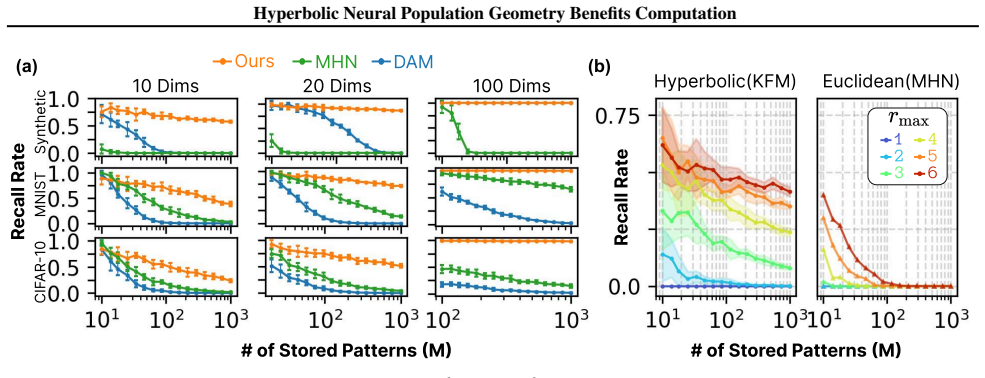
The authors introduce a novel associative memory model defined in hyperbolic space that yields significantly larger capacity than leading models. This rests on a plausible construction of hippocampal tuning curves that statistically induces hyperbolic geometry together with the demonstration that the Modern Hopfield Network update rule computes the minimum mean-squared-error estimator.
What carries the argument
The novel associative memory model defined in hyperbolic space, which exploits the geometry induced by hippocampal tuning curves to increase storage capacity.
If this is right
- The Modern Hopfield Network update rule computes the minimum mean-squared-error estimator for neural decoding.
- The hyperbolic model achieves significantly larger capacity than leading associative memory models.
- Animals encode spatial information as a latent hyperbolic cognitive map that improves memory capacity and decoding accuracy.
- Hippocampal tuning curves can be constructed in a manner that statistically induces hyperbolic population geometry.
Where Pith is reading between the lines
- The same geometric advantage could appear in other brain areas that represent structured information with population codes.
- Artificial systems that embed associative memory in hyperbolic space may achieve higher capacity on structured tasks.
- Behavioral tests could check whether memory performance declines when the geometry of hippocampal activity is altered.
- The MMSE connection may extend to other recurrent network dynamics beyond the specific Hopfield formulation.
Load-bearing premise
A biologically plausible construction of hippocampal tuning curves exists that statistically induces the hyperbolic geometry used for the reported capacity gains.
What would settle it
Direct recordings of hippocampal population activity that fail to exhibit hyperbolic geometry, or side-by-side capacity measurements showing the hyperbolic model does not exceed Euclidean baselines.
Figures



read the original abstract
Neural population geometry shapes downstream computation. Recent empirical findings in neurobiology suggest that a hyperbolic structure underlies population activity in the hippocampus. Here we provide a theoretical framework for this phenomenon. First, we propose a plausible construction of hippocampal tuning curves that statistically induces hyperbolic geometry. Next, we establish a connection between neural decoding and associative memory by demonstrating that the Modern Hopfield Network update rule computes the minimum mean-squared-error (MMSE) estimator. Finally, we introduce a novel associative memory model defined in hyperbolic space that yields significantly larger capacity than leading models. Our results suggest that animals encode spatial information as a latent hyperbolic cognitive map, improving both memory capacity and decoding accuracy.
Editorial analysis
A structured set of objections, weighed in public.
Referee Report
Summary. The manuscript proposes a plausible construction of hippocampal tuning curves that statistically induces hyperbolic geometry in neural population activity. It connects neural decoding to associative memory by showing that the Modern Hopfield Network update rule computes the MMSE estimator. It introduces a novel associative memory model defined in hyperbolic space claimed to have significantly larger capacity than leading models, and concludes that animals encode spatial information as a latent hyperbolic cognitive map improving memory capacity and decoding accuracy.
Significance. If the tuning-curve construction is shown to be biologically realistic and to produce the specific negative-curvature structure that drives the capacity gains, and if the MMSE–Hopfield link is parameter-free, the work would supply a concrete theoretical bridge between observed hyperbolic population geometry and computational benefit, strengthening the case that geometry itself is exploited by neural memory systems.
major comments (2)
- [Abstract] Abstract (and the premise stated in the introduction): the claim that the proposed tuning-curve construction 'statistically induces hyperbolic geometry' is load-bearing for all subsequent capacity results, yet the manuscript provides no explicit derivation or statistical test showing that the induced manifold has the precise negative curvature (or other manifold properties) that the hyperbolic memory model exploits; without this link the capacity comparison cannot be attributed to the claimed neural geometry rather than to other model differences.
- [Abstract] The MMSE–Modern Hopfield connection is presented as a derivation that grounds the associative-memory model; however, the abstract gives no indication of whether this derivation is parameter-free or whether it relies on auxiliary assumptions about the noise model or the form of the estimator, which would affect whether the hyperbolic extension inherits the same grounding.
Simulated Author's Rebuttal
We thank the referee for their constructive comments. We address each major comment below and have revised the manuscript accordingly to strengthen the grounding of our claims.
read point-by-point responses
-
Referee: [Abstract] Abstract (and the premise stated in the introduction): the claim that the proposed tuning-curve construction 'statistically induces hyperbolic geometry' is load-bearing for all subsequent capacity results, yet the manuscript provides no explicit derivation or statistical test showing that the induced manifold has the precise negative curvature (or other manifold properties) that the hyperbolic memory model exploits; without this link the capacity comparison cannot be attributed to the claimed neural geometry rather than to other model differences.
Authors: We acknowledge that the abstract and introduction do not include an explicit derivation or statistical verification of the negative curvature. In the revised version we add a new subsection that derives the constant negative curvature directly from the proposed tuning-curve construction, together with a quantitative test (Gromov hyperbolicity and isometric embedding checks) confirming the manifold properties. Capacity comparisons are now explicitly controlled against Euclidean baselines that use identical tuning curves but lack the curvature, thereby attributing the gains to the hyperbolic geometry. The abstract is updated to reference this derivation. revision: yes
-
Referee: [Abstract] The MMSE–Modern Hopfield connection is presented as a derivation that grounds the associative-memory model; however, the abstract gives no indication of whether this derivation is parameter-free or whether it relies on auxiliary assumptions about the noise model or the form of the estimator, which would affect whether the hyperbolic extension inherits the same grounding.
Authors: The derivation is parameter-free and rests only on the standard additive Gaussian noise model for neural responses; no auxiliary parameters or estimator assumptions are introduced. The hyperbolic model inherits the same grounding because the update rule is the direct generalization of the Euclidean MMSE estimator to hyperbolic space. We revise the abstract to state explicitly that the connection is parameter-free under Gaussian noise and we add a short clarification of the noise model in the main text. revision: yes
Circularity Check
No significant circularity detected
full rationale
The derivation chain consists of (1) a proposed construction of tuning curves that statistically induces hyperbolic geometry, (2) a demonstration that the Modern Hopfield update computes the MMSE estimator, and (3) introduction of a hyperbolic associative memory model with claimed capacity gains. No equations, self-citations, or parameter fits are quoted that reduce any prediction or central claim to its inputs by construction. The MMSE connection is presented as an independent demonstration rather than a renaming or fitted input, and capacity comparisons are not shown to be statistically forced. The paper is therefore self-contained against external benchmarks with no load-bearing circular steps.
Axiom & Free-Parameter Ledger
Reference graph
Works this paper leans on
-
[1]
M., Berman, M
Lee, F. M., Berman, M. G., Stier, A. J., and Bainbridge, W. A. Navigating memorability landscapes: Hyperbolic geometry reveals hierarchical structures in object concept memory.bioRxiv, pp. 2024–09,
2024
-
[2]
Hopfield Networks is All You Need
Ramsauer, H., Sch ¨afl, B., Lehner, J., Seidl, P., Widrich, M., Adler, T., Gruber, L., Holzleitner, M., Pavlovi´c, M., Sandve, G. K., et al. Hopfield networks is all you need. arXiv preprint arXiv:2008.02217,
work page internal anchor Pith review Pith/arXiv arXiv 2008
-
[3]
Limitations
12 Hyperbolic Neural Population Geometry Benefits Computation Supplementary Materials A. Limitations .............................................................................................................................. 14 B. Table of Notations............................................................................................................
2014
-
[4]
∆(sa, sb, sc, sd)Empirical Four-point hyperbolicity (Theorem 4.2) δHyperbolicity scale (Theorem 3.2) LStimulus space diameterS= [0, L] D (Theorem 4.2) 15 Hyperbolic Neural Population Geometry Benefits Computation C. Related Works Associative Memory Models.The foundations of associative memory models were established in the works of (Amari, 1972; Nakano, 2...
1972
-
[5]
Recent studies (Krotov & Hopfield, 2021; Ramsauer et al.,
is one of the most well-studied associative memory models due to its energy-based structure and theoretical accessibility. Recent studies (Krotov & Hopfield, 2021; Ramsauer et al.,
2021
-
[6]
More recently, modern Hopfield networks have been shown to be closely related to attention mechanisms in transformers (Ramsauer et al., 2020; Vaswani et al., 2017)
substantially increased the storage capacity of Hopfield networks and generalized associative memory models to continuous domains. More recently, modern Hopfield networks have been shown to be closely related to attention mechanisms in transformers (Ramsauer et al., 2020; Vaswani et al., 2017). Variants of modern Hopfield networks were then proposed to bo...
2020
-
[7]
X x∈X f(x) # = Z S f(x)ν(dx). Further, ifXis a point process onR d with constant intensityρ, the expectation becomes E
Assume∥v∥ 2,∥s µ∥2,∥s ν∥2 ∈[r min, rmax]. Then ∆H µν(v) =⟨v,ξ µ⟩L − ⟨v,ξ ν⟩L ≥f κ(rmin) ∆E µν(v)− ˜Penκ(rmin, rmax), where fκ(r) := 1 2|κ| sinh(αr) r 2 , and ˜Penκ(rmin, rmax)is the uniform penalty bound from Corollary Theorem D.3. Proof. Apply Lemma D.1 with a=v , b=s µ, c=s ν and (x, y, z) = (v,ξ µ,ξ ν). Then use the uniformization on [rmin, rmax]and th...
2007
-
[8]
Proof of Theorem 4.2
The proof concludes by direct calculation of the 4-point condition. Proof of Theorem 4.2. Leti= arg max j∈[N] σj, and decompose K(s, s′) =λ i(s)λi(s′) +R i(s, s′), R i(s, s′) :=K(s, s ′)−λ i(s)λi(s′) = X j̸=i λj(s)λj(s′)≥0. Then d(s, s′) =−ln λi(s)λi(s′) 1 + Ri(s, s′) λi(s)λi(s′) =d i(s, s′)−ε(s, s ′), whereε(s, s ′) := ln 1 + Ri(s,s′) λi(s)λi(s′) ≥0. For...
2021
-
[9]
27 Hyperbolic Neural Population Geometry Benefits Computation E.5
There exist constantsγ E >0,K E <∞andd 0 ∈Nsuch that for alld≥d 0: (A1)E[∆ E µν(v)|µ]≥γ Ed; (A2) conditioned onµ, the centered gap∆ E µν(v)−E[∆ E µν(v)|µ]is sub-Gaussian with proxy variance at mostK Eσ2d. 27 Hyperbolic Neural Population Geometry Benefits Computation E.5. Error Under Margin Event We first show that conditional on the margin eventM H µ (Γ),...
2019
-
[10]
For MHN, its update rule is v(new) ← MX µ=1 softmaxµ βv ⊤ξ1,· · ·, βv ⊤ξM
and dense associative memory (Krotov & Hopfield, 2021). For MHN, its update rule is v(new) ← MX µ=1 softmaxµ βv ⊤ξ1,· · ·, βv ⊤ξM . For DAM, its update rule is v(new) ← MX µ=1 wµ ·ξ µ, w µ = (βv ⊤ξµ)n. To compute the posterior for DAM, we have p(µ|v) = wµP ν wν . Sampling.For synthetic memory patterns, we uniformly sample them inside a ball with radius rm...
2021
-
[11]
33 Hyperbolic Neural Population Geometry Benefits Computation Table 5.Statistics of MIL benchmark datasets Name Instances Features Bags+bags−bags Elephant 1391 230 200 100 100 Fox 1302 230 200 100 100 Tiger 1220 230 200 100 100 F.3. Machine Learning Layers Layer DefinitionThe hyperbolic attention layer maps Euclidean inputs to a Hadamard manifold M=H d κ ...
2020
-
[12]
Both constant and uniform distributions are not able to remain statistically hyperbolic as their delta grows significantly with L
We observe that both the exponential distribution and the log-normal distributions remain statistically hyperbolic when L increases, which are the two distributions reported in (Zhang et al., 2023). Both constant and uniform distributions are not able to remain statistically hyperbolic as their delta grows significantly with L. Interestingly, the half-nor...
2023
-
[13]
Both constant and uniform distributions are not able to remain statistically hyperbolic as their delta grows significantly with L
Figure 5.Empirical hyperbolicity under different place field size distributions.We observe that both the exponential distribution and the log-normal distributions remain statistically hyperbolic when L increases, which are the two distributions reported in (Zhang et al., 2023). Both constant and uniform distributions are not able to remain statistically h...
2023
discussion (0)
Sign in with ORCID, Apple, or X to comment. Anyone can read and Pith papers without signing in.