Comparison and verification methods to trace interaction-driven disturbances in galaxies
Pith reviewed 2026-06-27 12:29 UTC · model grok-4.3
The pith
Self-supervised learning model detects galaxy disturbances with 0.86 recall and low contamination using only a small labeled dataset.
A machine-rendered reading of the paper's core claim, the machinery that carries it, and where it could break.
Core claim
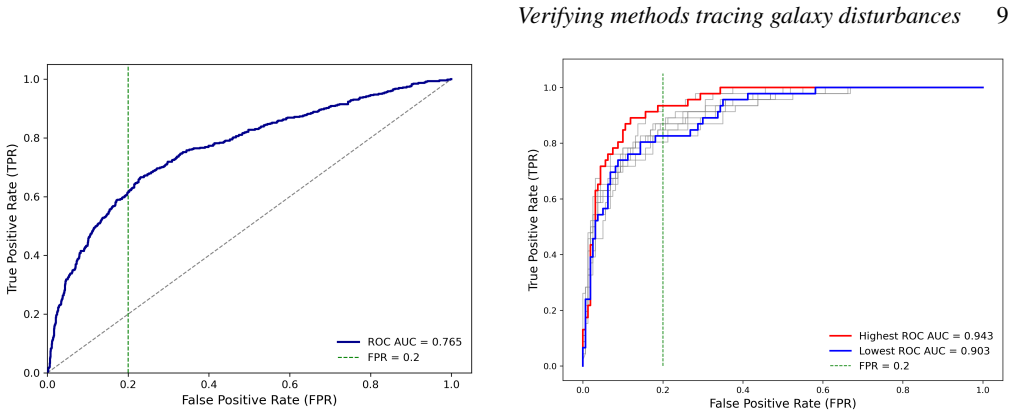
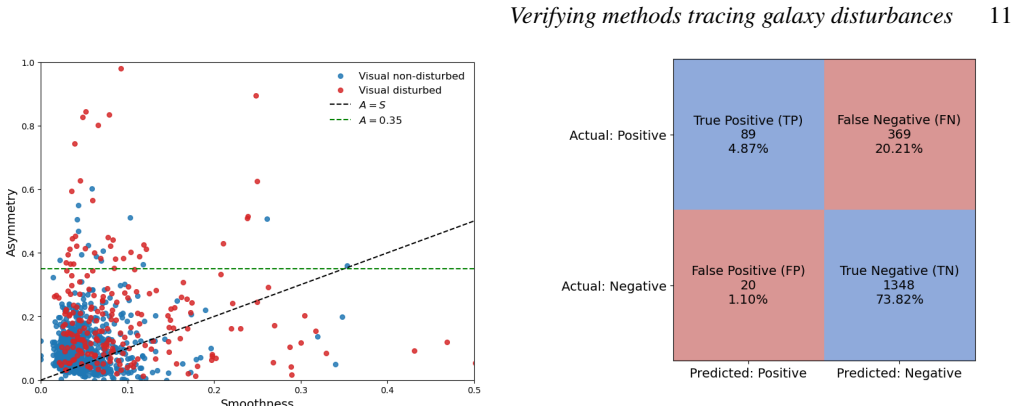
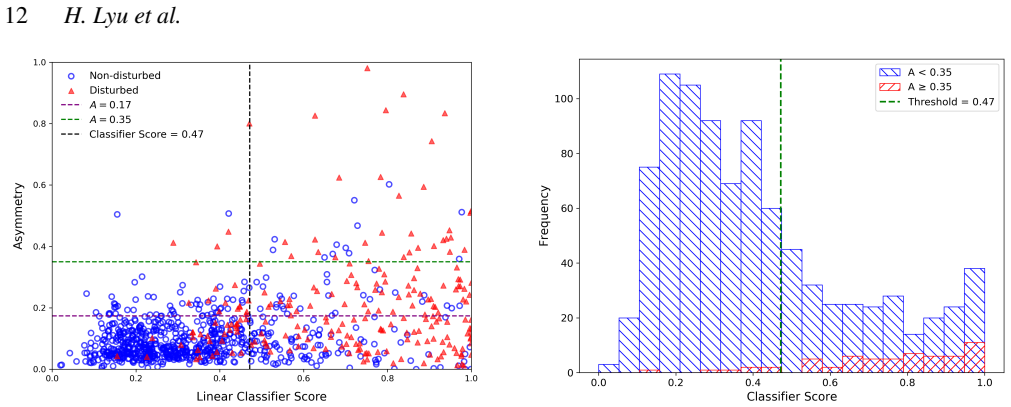
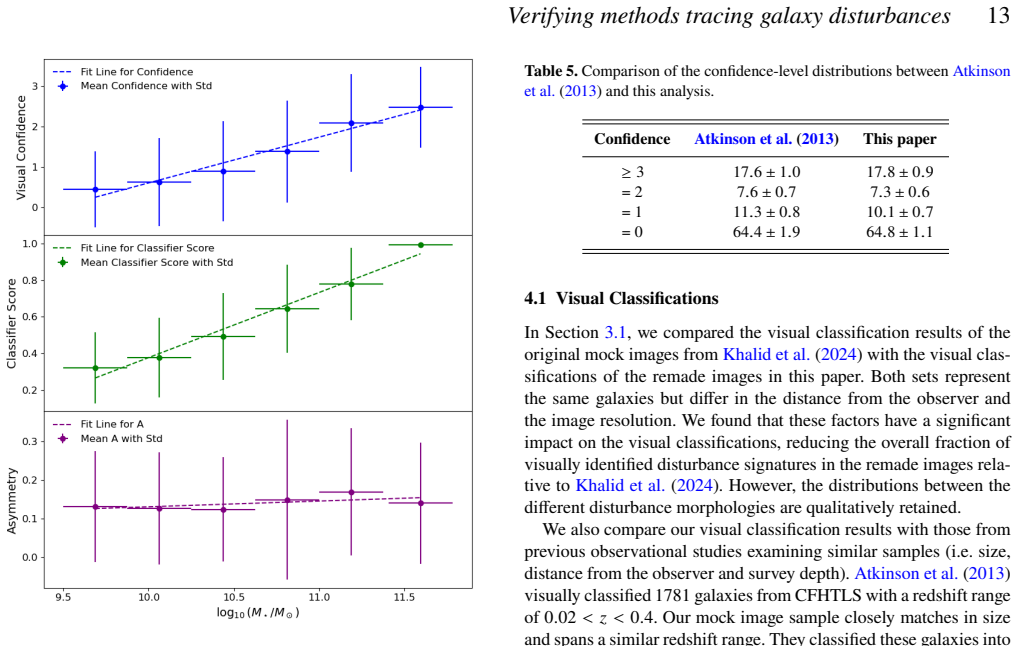
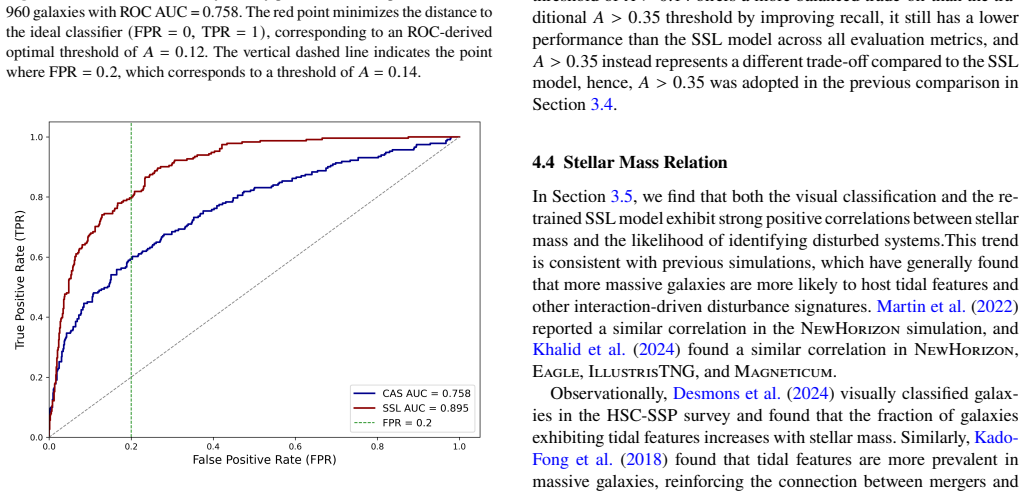
The SSL model achieves high recall (0.86 +/- 0.04) and low contamination (0.2) by retraining only its linear classifier on a small labelled dataset, making it suitable for identifying a broad set of disturbed systems, including faint tidal debris and other interaction-driven morphological disturbances, thereby providing a more complete census of merger-related features. The CAS method, using the traditional threshold A > 0.35, shows higher precision (0.77) but lower recall (0.20). Visual classification and the SSL model show a significant positive correlation between stellar mass and disturbance fraction, while the CAS method exhibits a much weaker trend.
What carries the argument
Self-supervised learning model with retrained linear classifier on small labelled dataset, benchmarked against visual classification and compared to CAS parameters with A > 0.35 threshold.
Load-bearing premise
Visual classification provides an accurate reference standard for the true disturbance fraction despite being limited by galaxy distance and image resolution in detecting faint low surface brightness structures.
What would settle it
Deeper higher-resolution imaging of the same sample revealing that the SSL model misses a substantial fraction of newly visible disturbances or produces many unconfirmed positives.
Figures
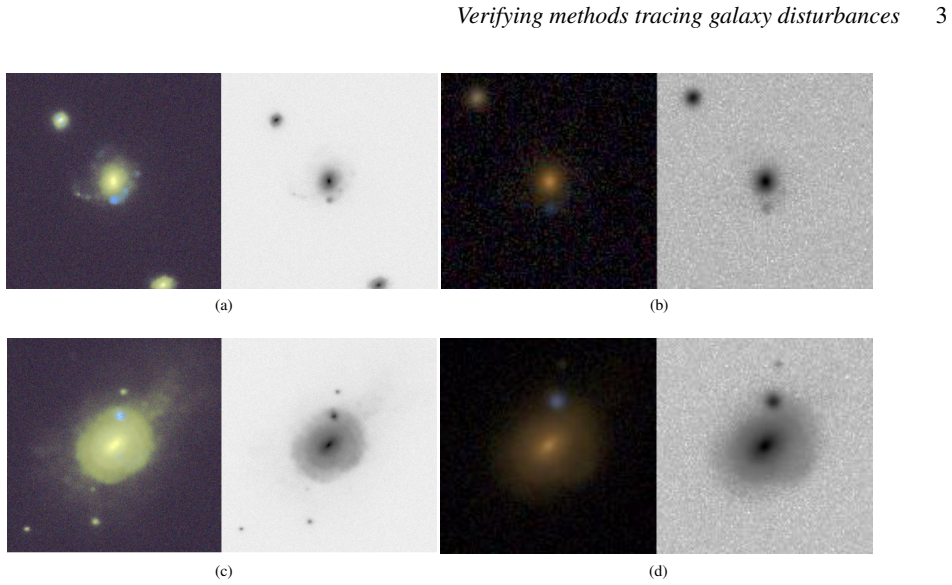
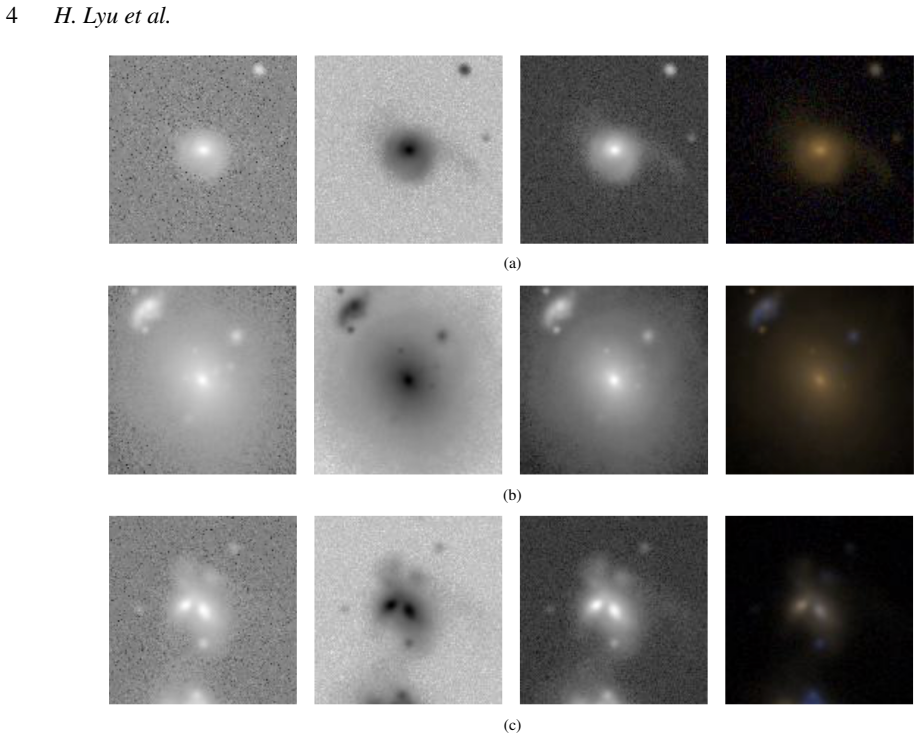
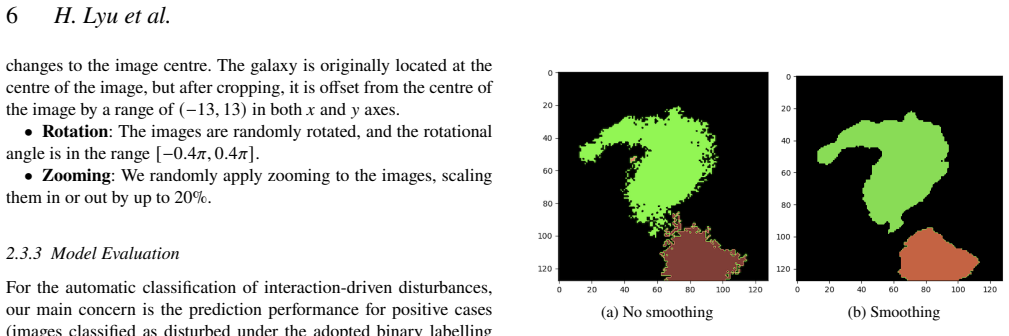
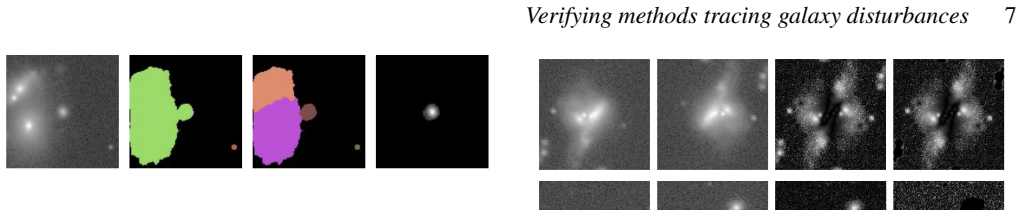
read the original abstract
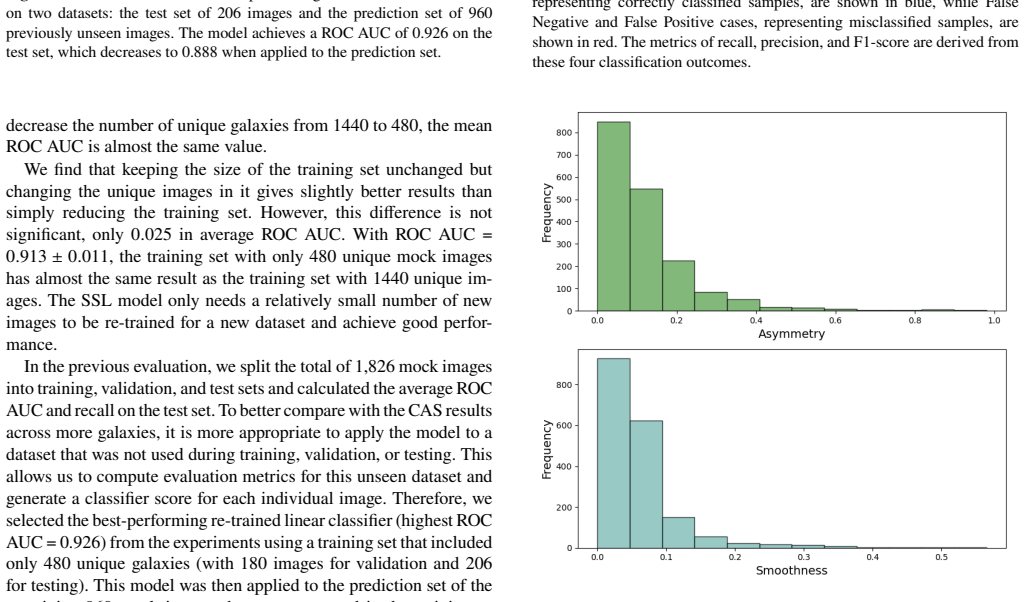
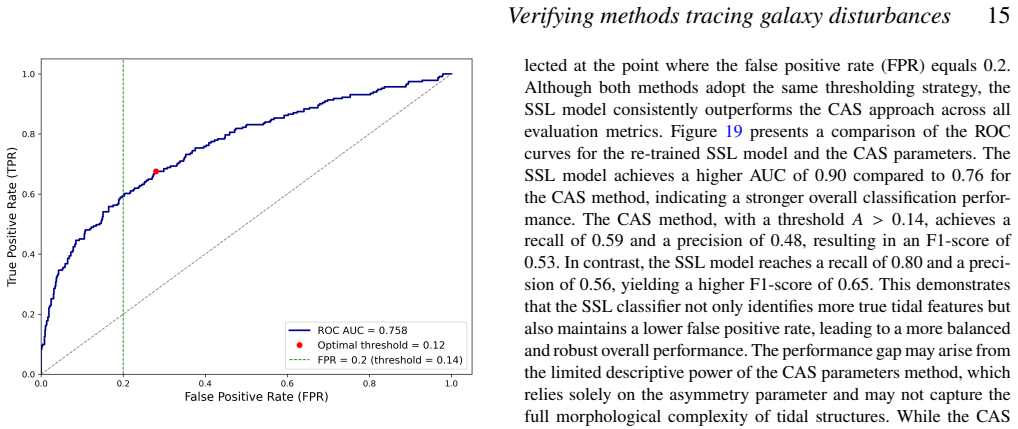
Low surface brightness tidal debris around galaxies, such as tails, streams, and shells, together with other interaction-driven morphological disturbances, serve as valuable indicators of past or ongoing galaxy mergers. With the growing data volume from surveys like the Vera C. Rubin Observatory's Legacy Survey of Space and Time (LSST), automated detection methods are essential. This paper evaluates the performance of two automated methods, a Self-Supervised Learning (SSL) model and the Concentration-Asymmetry-Smoothness (CAS) parameter method, in tracing interaction-driven disturbances and merger signatures, with visual classification used as the benchmark. Visual classification yields a high-confidence disturbance fraction of 25.1 +/- 1.5% in our sample and serves as the reference standard for assessing the completeness and precision of the automated approaches. Visual classification is affected by galaxy distance and image resolution, which limit the detectability of faint low surface brightness structures. The SSL model achieves high recall (0.86 +/- 0.04) and low contamination (0.2) by retraining only its linear classifier on a small labelled dataset, making it suitable for identifying a broad set of disturbed systems, including faint tidal debris and other interaction-driven morphological disturbances, thereby providing a more complete census of merger-related features. The CAS method, using the traditional threshold A > 0.35, shows higher precision (0.77) but lower recall (0.20), indicating a conservative approach that captures cleaner but less complete samples. Visual classification and the SSL model show a significant positive correlation between stellar mass and disturbance fraction, while the CAS method exhibits a much weaker trend.
Editorial analysis
A structured set of objections, weighed in public.
Referee Report
Summary. The paper evaluates two automated methods—a Self-Supervised Learning (SSL) model and the Concentration-Asymmetry-Smoothness (CAS) parameters—for detecting interaction-driven morphological disturbances and merger signatures in galaxies. Visual classification serves as the benchmark, yielding a disturbance fraction of 25.1 ± 1.5%. The SSL model, after retraining only its linear classifier on a small labeled set, achieves recall 0.86 ± 0.04 and contamination 0.2, while CAS with A > 0.35 yields precision 0.77 but recall 0.20. The authors conclude that SSL is suitable for identifying a broad set of disturbed systems including faint tidal debris, providing a more complete census than CAS, and report a positive stellar-mass correlation for both visual and SSL results but a weaker trend for CAS.
Significance. If validated, the work offers a practical, data-efficient approach (SSL with minimal retraining) for scaling disturbance detection to LSST volumes, addressing the need for automated merger tracers. The reporting of concrete metrics with uncertainties is a positive feature of the empirical comparison.
major comments (1)
- [Abstract] Abstract: The claim that the SSL model is suitable for identifying a broad set of disturbed systems including faint tidal debris (and thereby provides a more complete census) is not supported by the reported metrics. The abstract states that visual classification (the reference standard) is affected by galaxy distance and image resolution, limiting detectability of faint low surface brightness structures. Because the reference labels systematically under-count the very class of features asserted to be better recovered by SSL, the recall of 0.86 ± 0.04 measures agreement with an incomplete benchmark rather than true completeness; the positive stellar-mass correlation and superiority claim over CAS inherit the same incompleteness. No independent verification (e.g., simulation labels or deeper imaging) is indicated to break this dependency.
minor comments (1)
- The manuscript would benefit from explicit definitions of 'contamination' versus precision and from a dedicated discussion of how sample selection and image quality cuts affect the visual labels.
Simulated Author's Rebuttal
We thank the referee for their constructive feedback on our manuscript. We address the single major comment below, providing an honest assessment of our claims relative to the visual benchmark.
read point-by-point responses
-
Referee: The claim that the SSL model is suitable for identifying a broad set of disturbed systems including faint tidal debris (and thereby provides a more complete census) is not supported by the reported metrics. The abstract states that visual classification (the reference standard) is affected by galaxy distance and image resolution, limiting detectability of faint low surface brightness structures. Because the reference labels systematically under-count the very class of features asserted to be better recovered by SSL, the recall of 0.86 ± 0.04 measures agreement with an incomplete benchmark rather than true completeness; the positive stellar-mass correlation and superiority claim over CAS inherit the same incompleteness. No independent verification (e.g., simulation labels or deeper imaging) is indicated to break this dependency.
Authors: We agree that visual classification is an imperfect benchmark, as explicitly stated in the manuscript, due to its sensitivity to distance and resolution for faint low-surface-brightness features. Our reported metrics (recall 0.86 for SSL vs. 0.20 for CAS) are therefore measures of agreement with this benchmark rather than absolute completeness. The claim of suitability for a broad set of disturbed systems, including faint tidal debris, is made comparatively: SSL recovers a substantially larger fraction of the visually identified disturbed galaxies than CAS does, while both methods are evaluated on identical labels. This supports a more complete census relative to CAS within the benchmark's limitations. We do not claim the SSL detects features entirely missed by visual inspection, as no such independent verification (simulations or deeper imaging) is presented. We will revise the abstract to qualify the wording on faint tidal debris and the completeness claim to avoid overstatement. revision: partial
- Absence of independent verification (e.g., simulation labels or deeper imaging) to confirm whether the SSL model recovers interaction features missed by visual classification.
Circularity Check
No circularity: purely empirical comparison against external visual benchmark
full rationale
The paper reports recall, contamination, and precision of the SSL and CAS methods computed directly against visual classification labels used as an independent reference standard. No equations, derivations, or predictions are presented that reduce by construction to fitted inputs or self-citations. The SSL retraining step uses a small labelled dataset to adjust only the linear classifier, but the resulting metrics are external evaluations, not self-referential. Visual classification limitations are explicitly acknowledged but do not create a definitional loop or fitted-input prediction. This is a standard empirical benchmark comparison with no load-bearing self-citation chains or ansatz smuggling.
Axiom & Free-Parameter Ledger
axioms (1)
- domain assumption Visual classification is treated as the ground-truth reference standard for disturbance fraction.
Reference graph
Works this paper leans on
-
[1]
The Astropy Project: Building an inclusive, open-science project and status of the v2.0 core package
The Astropy Project: Building an Open-science Project and Status of the v2.0 Core Package. , keywords =. doi:10.3847/1538-3881/aabc4f , archivePrefix =. 1801.02634 , primaryClass =
work page internal anchor Pith review Pith/arXiv arXiv doi:10.3847/1538-3881/aabc4f
-
[2]
Astropy: A Community Python Package for Astronomy
Astropy: A community Python package for astronomy. , keywords =. 2013. doi:10.1051/0004-6361/201322068 , archivePrefix =. 1307.6212 , primaryClass =
work page internal anchor Pith review Pith/arXiv arXiv doi:10.1051/0004-6361/201322068 2013
-
[3]
1996, A&AS, 117, 393, doi:10.1051/aas:1996164
SExtractor: Software for source extraction. , keywords =. 1996. doi:10.1051/aas:1996164 , adsurl =
-
[4]
Quantifying the Observational Effort Required for the Radial Velocity Characterization of TESS Planets. , keywords =. 2018. doi:10.3847/1538-3881/aacea9 , archivePrefix =. 1807.01263 , primaryClass =
work page internal anchor Pith review Pith/arXiv arXiv doi:10.3847/1538-3881/aacea9 2018
-
[5]
X-Ray Scattering Echoes and Ghost Halos from the Intergalactic Medium: Relation to the Nature of AGN Variability. , keywords =. 2015. doi:10.1088/0004-637X/805/1/23 , archivePrefix =. 1503.01475 , primaryClass =
work page internal anchor Pith review Pith/arXiv arXiv doi:10.1088/0004-637x/805/1/23 2015
-
[6]
, keywords =
The 2013 Release of Cloudy. , keywords =. 2013
2013
-
[7]
1989", month =
T _ E X and LAT _ E X Macro Definition Files for Astronomical Publications. , year = "1989", month = "Mar", pages =
1989
-
[8]
LaTeX: A Document Preparation System. 1994
1994
-
[9]
Quasi-periodic Fast Propagating Magnetoacoustic Waves during the Magnetic Reconnection Between Solar Coronal Loops. , keywords =. 2018. doi:10.3847/2041-8213/aaf167 , archivePrefix =. 1811.08553 , primaryClass =
work page internal anchor Pith review Pith/arXiv arXiv doi:10.3847/2041-8213/aaf167 2018
-
[10]
Nominal values for selected solar and planetary quantities: IAU 2015 Resolution B3
Nominal Values for Selected Solar and Planetary Quantities: IAU 2015 Resolution B3. , keywords =. 2016. doi:10.3847/0004-6256/152/2/41 , archivePrefix =. 1605.09788 , primaryClass =
work page internal anchor Pith review Pith/arXiv arXiv doi:10.3847/0004-6256/152/2/41 2015
-
[11]
Swift X-Ray Observations of Classical Novae. II. The Super Soft Source Sample. , keywords =. 2011. doi:10.1088/0067-0049/197/2/31 , archivePrefix =. 1110.6224 , primaryClass =
work page internal anchor Pith review Pith/arXiv arXiv doi:10.1088/0067-0049/197/2/31 2011
-
[12]
Galaxy emission line classification using 3D line ratio diagrams
Galaxy Emission Line Classification Using Three-dimensional Line Ratio Diagrams. , keywords =. 2014. doi:10.1088/0004-637X/793/2/127 , archivePrefix =. 1406.5186 , primaryClass =
work page internal anchor Pith review Pith/arXiv arXiv doi:10.1088/0004-637x/793/2/127 2014
-
[13]
doi:10.1093/mnras/262.3.627 , adsurl =
Lacey, Cedric G and Cole, Shaun , date-modified =. Merger rates in hierarchical models of galaxy formation , volume =. 1993 , bdsk-url-1 =. doi:10.1093/mnras/262.3.627 , journal =
-
[14]
Robotham, A. S. G. and Driver, S. P. and Davies, L. J. M. and Hopkins, A. M. and Baldry, I. K. and Agius, N. K. and Bauer, A. E. and Bland-Hawthorn, J. and Brough, S. and Brown, M. J. I. and Cluver, M. and De Propris, R. and Drinkwater, M. J. and Holwerda, B. W. and Kelvin, L. S. and Lara-Lopez, M. A. and Liske, J. and López-Sánchez, Á. R. and Loveday, J....
-
[15]
Tidal Features at 0.05 < <i>z</i> < 0.45 in the Hyper Suprime-Cam Subaru Strategic Program: Properties and Formation Channels , doi =
Kado-Fong, Erin and Greene, Jenny E and Hendel, David and Price-Whelan, Adrian M and Greco, Johnny P and Goulding, Andy D and Huang, Song and Johnston, Kathryn V and Komiyama, Yutaka and Lee, Chien-Hsiu and Lust, Nate B and Strauss, Michael A and Tanaka, Masayuki , month =. Tidal Features at 0.05 < <i>z</i> < 0.45 in the Hyper Suprime-Cam Subaru Strategic...
2018
-
[16]
The structures of distant galaxies - I
Conselice, Christopher J and Rajgor, Sheena and Myers, Robert , month =. The structures of distant galaxies - I. Galaxy structures and the merger rate to z 3 in the Hubble Ultra-Deep Field , doi =. 2008 , journal =
2008
-
[17]
, month =
Conselice, Christopher J. , month =. The Relationship between Stellar Light Distributions of Galaxies and Their Formation Histories , doi =. 2003 , journal =
2003
-
[18]
and Abraham, Roberto G
Atkinson, Adam M. and Abraham, Roberto G. and Ferguson, Annette M. N. , doi =. FAINT TIDAL FEATURES IN GALAXIES WITHIN THE CANADA-FRANCE-HAWAII TELESCOPE LEGACY SURVEY WIDE FIELDS , urldate =. The Astrophysical Journal , month =. 2013 , bdsk-url-1 =
2013
-
[19]
Preparing for low surface brightness science with the Vera C
Martin, G and Bazkiaei, A E and Spavone, M and Iodice, E and Mihos, J C and Montes, M and Benavides, J A and Brough, S and Carlin, J L and Collins, C A and Duc, P A and G. Preparing for low surface brightness science with the Vera C. Rubin Observatory: Characterization of tidal features from mock images , urldate =. 2022 , bdsk-url-1 =. doi:10.1093/mnras/...
-
[20]
THE FREQUENCY OF TIDAL FEATURES ASSOCIATED WITH NEARBY LUMINOUS ELLIPTICAL GALAXIES FROM A STATISTICALLY COMPLETE SAMPLE , urldate =
Tal, Tomer and Dokkum, van and Nelan, Jenica E and Bezanson, Rachel , doi =. THE FREQUENCY OF TIDAL FEATURES ASSOCIATED WITH NEARBY LUMINOUS ELLIPTICAL GALAXIES FROM A STATISTICALLY COMPLETE SAMPLE , urldate =. The Astronomical Journal , month =. 2009 , bdsk-url-1 =
2009
-
[21]
Ivezi. LSST: From Science Drivers to Reference Design and Anticipated Data Products , volume =. 2019 , bdsk-url-1 =. doi:10.3847/1538-4357/ab042c , journal =
-
[22]
Detecting galaxy tidal features using self-supervised representation learning , doi =
Desmons, Alice and Brough, Sarah and Francois Lanusse , month =. Detecting galaxy tidal features using self-supervised representation learning , doi =. 2024 , journal =
2024
-
[23]
Characterizing tidal features around galaxies in cosmological simulations , url =
Khalid, A and Brough, S and Martin, G and Kimmig, L C and Lagos, C D P and Remus, R -S and Martinez-Lombilla, C , doi =. Characterizing tidal features around galaxies in cosmological simulations , url =. Monthly Notices of the Royal Astronomical Society , month =. 2024 , bdsk-url-1 =. https://academic.oup.com/mnras/article-pdf/530/4/4422/57466588/stae1064...
2024
-
[24]
Bennett, C. L. and Larson, D. and Weiland, J. L. and Jarosik, N. and Hinshaw, G. and Odegard, N. and Smith, K. M. and Hill, R. S. and Gold, B. and Halpern, M. and Komatsu, E. and Nolta, M. R. and Page, L. and Spergel, D. N. and Wollack, E. and Dunkley, J. and Kogut, A. and Limon, M. and Meyer, S. S. and Tucker, G. S. and Wright, E. L. , doi =. NINE-YEAR W...
2013
-
[25]
and Tinker, Jeremy L
Wechsler, Risa H. and Tinker, Jeremy L. , doi =. The Connection Between Galaxies and Their Dark Matter Halos , volume =. Annual Review of Astronomy and Astrophysics , month =. 2018 , bdsk-url-1 =
2018
-
[26]
Halo Assembly Bias in Hierarchical Structure Formation , urldate =
Dalal, Neal and White, Martin and Bond, J R and Shirokov, Alexander , doi =. Halo Assembly Bias in Hierarchical Structure Formation , urldate =. The Astrophysical Journal , month =. 2008 , bdsk-url-1 =
2008
-
[27]
White, Simon D. M. and Frenk, Carlos S. , doi =. Galaxy formation through hierarchical clustering , volume =. The Astrophysical Journal , month =. 1991 , bdsk-url-1 =
1991
-
[28]
and Willmer, Christopher N
Lin, Lihwai and Koo, David C. and Willmer, Christopher N. A. and Patton, David R. and Conselice, Christopher J. and Yan, Renbin and Coil, Alison L. and Cooper, Michael C. and Davis, Marc and Faber, S. M. and Gerke, Brian F. and Guhathakurta, Puragra and Newman, Jeffrey A. , doi =. The DEEP2 Galaxy Redshift Survey: Evolution of Close Galaxy Pairs and Major...
2004
-
[29]
The importance of minor-merger-driven star formation and black hole growth in disc galaxies , url =
Kaviraj, Sugata , doi =. The importance of minor-merger-driven star formation and black hole growth in disc galaxies , url =. Monthly Notices of the Royal Astronomical Society , month =. 2014 , bdsk-url-1 =
2014
-
[30]
and Ostriker, Jeremiah P
Naab, Thorsten and Johansson, Peter H. and Ostriker, Jeremiah P. , month =. MINOR MERGERS AND THE SIZE EVOLUTION OF ELLIPTICAL GALAXIES , doi =. 2009 , journal =
2009
-
[31]
and Kaviraj, S
Martin, G. and Kaviraj, S. and Devriendt, J. E. G. and Dubois, Y. and Pichon, C. , doi =. The role of mergers in driving morphological transformation over cosmic time , volume =. Monthly Notices of the Royal Astronomical Society , month =. 2018 , bdsk-url-1 =
2018
-
[32]
and Jonsson, Patrik and Cox, T
Lotz, Jennifer M. and Jonsson, Patrik and Cox, T. J. and Croton, Darren and Primack, Joel R. and Somerville, Rachel S. and Stewart, Kyle , doi =. THE MAJOR AND MINOR GALAXY MERGER RATES ATz< 1.5 , volume =. The Astrophysical Journal , month =. 2011 , bdsk-url-1 =
2011
-
[33]
Barnes, Joshua E. , doi =. Transformations of galaxies. I - Mergers of equal-mass stellar disks , urldate =. The Astrophysical Journal , month =. 1992 , bdsk-url-1 =
1992
-
[34]
and Hernquist, Lars , doi =
Barnes, Joshua E. and Hernquist, Lars , doi =. Transformations of Galaxies. II. Gasdynamics in Merging Disk Galaxies , urldate =. The Astrophysical Journal , month =. 1996 , bdsk-url-1 =
1996
-
[35]
Black Holes in Galaxy Mergers: The Formation of Red Elliptical Galaxies , urldate =
Springel, Volker and Di Matteo, Tiziana and Hernquist, Lars , doi =. Black Holes in Galaxy Mergers: The Formation of Red Elliptical Galaxies , urldate =. The Astrophysical Journal , month =. 2005 , bdsk-url-1 =
2005
-
[36]
Springel, Volker and White, Simon D. M. and Jenkins, Adrian and Frenk, Carlos S. and Yoshida, Naoki and Gao, Liang and Navarro, Julio and Thacker, Robert and Croton, Darren and Helly, John and Peacock, John A. and Cole, Shaun and Thomas, Peter and Couchman, Hugh and Evrard, August and Colberg, J. Simulations of the formation, evolution and clustering of g...
-
[37]
A glimpse of the future , url =
information@eso.org , organization =. A glimpse of the future , url =
-
[38]
and Hernquist, Lars and Cox, Thomas J
Hopkins, Philip F. and Hernquist, Lars and Cox, Thomas J. and Di Matteo, Tiziana and Martini, Paul and Robertson, Brant and Springel, Volker , doi =. Black Holes in Galaxy Mergers: Evolution of Quasars , urldate =. The Astrophysical Journal , month =. 2005 , bdsk-url-1 =
2005
-
[39]
Christopher and Hernquist, Lars , doi =
Mihos, J. Christopher and Hernquist, Lars , doi =. Gasdynamics and Starbursts in Major Mergers , urldate =. The Astrophysical Journal , month =. 1996 , bdsk-url-1 =
1996
-
[40]
and Koo, David C
Lin, Lihwai and Patton, David R. and Koo, David C. and Casteels, Kevin and Conselice, Christopher J. and Faber, S. M. and Lotz, Jennifer and Willmer, Christopher N. A. and Hsieh, B. C. and Chiueh, Tzihong and Newman, Jeffrey A. and Novak, Gregory S. and Weiner, Benjamin J. and Cooper, Michael C. , doi =. The Redshift Evolution of Wet, Dry, and Mixed Galax...
2008
-
[41]
The outer stellar halos of galaxies: how radial merger mass deposition, shells, and streams depend on infall-orbit configurations , urldate =
Karademir, Geray S and Remus, Rhea-Silvia and Burkert, Andreas and Klaus Dolag and Hoffmann, Tadziu L and Moster, Benjamin P and Steinwandel, Ulrich P and Zhang, Jielai , doi =. The outer stellar halos of galaxies: how radial merger mass deposition, shells, and streams depend on infall-orbit configurations , urldate =. Monthly Notices of the Royal Astrono...
2019
-
[42]
Formation and incidence of shell galaxies in the Illustris simulation , volume =
Pop, Ana-Roxana and Pillepich, Annalisa and Amorisco, Nicola C and Hernquist, Lars , doi =. Formation and incidence of shell galaxies in the Illustris simulation , volume =. Monthly Notices of the Royal Astronomical Society , month =. 2018 , bdsk-url-1 =
2018
-
[43]
Patton, D. R. and Pritchet, C. J. and Carlberg, R. G. and Marzke, R. O. and Yee, H. K. C. and Hall, P. B. and Lin, H. and Morris, S. L. and Sawicki, M. and Shepherd, C. W. and Wirth, G. D. , doi =. Dynamically Close Galaxy Pairs and Merger Rate Evolution in the CNOC2 Redshift Survey , urldate =. The Astrophysical Journal , month =. 2002 , bdsk-url-1 =
2002
-
[44]
C. L. The VIMOS VLT Deep Survey , urldate =. 2011 , bdsk-url-1 =. doi:10.1051/0004-6361/201015839 , journal =
-
[45]
Driver, S. P. and Hill, D. T. and Kelvin, L. S. and Robotham, A. S. G. and Liske, J. and Norberg, P. and Baldry, I. K. and Bamford, S. P. and Hopkins, A. M. and Loveday, J. and Peacock, J. A. and Andrae, E. and Bland-Hawthorn, J. and Brough, S. and Brown, M. J. I. and Cameron, E. and Ching, J. H. Y. and Colless, M. and Conselice, C. J. and Croom, S. M. an...
2011
-
[46]
B. Census and classification of low-surface-brightness structures in nearby early-type galaxies from the MATLAS survey , urldate =. 2020 , bdsk-url-1 =. doi:10.1093/mnras/staa2248 , journal =
-
[47]
The Origin of Faint Tidal Features around Galaxies in the RESOLVE Survey , urldate =
Hood, Callie E and Kannappan, Sheila J and Stark, David V and Dell'Antonio, Ian P and Moffett, Amanda J and Eckert, Kathleen D and Norris, Mark A and Hendel, David , doi =. The Origin of Faint Tidal Features around Galaxies in the RESOLVE Survey , urldate =. The Astrophysical Journal , month =. 2018 , bdsk-url-1 =
2018
-
[48]
THE CFHTLS-DEEP CATALOG OF INTERACTING GALAXIES
Bridge, Carrie R and Carlberg, Raymond G and Sullivan, Mark , doi =. THE CFHTLS-DEEP CATALOG OF INTERACTING GALAXIES. I. MERGER RATE EVOLUTION TO<i>z</i>= 1.2 , urldate =. The Astrophysical Journal , month =. 2010 , bdsk-url-1 =
2010
-
[49]
Huertas-Company, M. and Lanusse, F. , year=. The Dawes Review 10: The impact of deep learning for the analysis of galaxy surveys , volume=. doi:10.1017/pasa.2022.55 , journal=
-
[50]
Galaxy Zoo: probabilistic morphology through Bayesian CNNs and active learning , urldate =
Walmsley, Mike and Smith, Lewis and Lintott, Chris and Gal, Yarin and Bamford, Steven and Dickinson, Hugh and Fortson, Lucy and Kruk, Sandor and Masters, Karen and Scarlata, Claudia and Simmons, Brooke and Smethurst, Rebecca and Wright, Darryl , doi =. Galaxy Zoo: probabilistic morphology through Bayesian CNNs and active learning , urldate =. Monthly Noti...
2019
-
[51]
Cheng, Ting-Yun and Conselice, Christopher J and Arag. Optimizing automatic morphological classification of galaxies with machine learning and deep learning using Dark Energy Survey imaging , urldate =. 2020 , bdsk-url-1 =. doi:10.1093/mnras/staa501 , journal =
-
[52]
Identification of low surface brightness tidal features in galaxies using convolutional neural networks , urldate =
Walmsley, Mike and, Annette and Mann, Robert and Lintott, Chris , doi =. Identification of low surface brightness tidal features in galaxies using convolutional neural networks , urldate =. Monthly Notices of the Royal Astronomical Society , month =. 2018 , bdsk-url-1 =
2018
-
[53]
Convolutional neural network identification of galaxy post-mergers in UNIONS using IllustrisTNG , urldate =
Bickley, Robert W and Bottrell, Connor and Hani, Maan H and Ellison, Sara L and Hossen Teimoorinia and Kwang Moo Yi and Wilkinson, Scott N and Gwyn, Stephen and Hudson, Michael J , doi =. Convolutional neural network identification of galaxy post-mergers in UNIONS using IllustrisTNG , urldate =. Monthly Notices of the Royal Astronomical Society , month =....
2021
-
[55]
Pearson, W. J. and Wang, L. and Trayford, J. W. and Petrillo, C. E. and van der Tak, F. F. S. , doi =. Identifying galaxy mergers in observations and simulations with deep learning , url =. Astronomy and Astrophysics , month =. 2019 , bdsk-url-1 =
2019
-
[56]
and Sun, Yi and Davey, Neil , doi =
Hocking, Alex and Geach, James E. and Sun, Yi and Davey, Neil , doi =. An automatic taxonomy of galaxy morphology using unsupervised machine learning , volume =. Monthly Notices of the Royal Astronomical Society , month =. 2017 , bdsk-url-1 =
2017
-
[57]
Galaxy morphological classification in deep-wide surveys via unsupervised machine learning , urldate =
Martin, Garreth and Sugata Kaviraj and Hocking, Alex and Read, S C and Geach, James E , doi =. Galaxy morphological classification in deep-wide surveys via unsupervised machine learning , urldate =. Monthly Notices of the Royal Astronomical Society , month =. 2020 , bdsk-url-1 =
2020
-
[58]
A feather on the hat: tracing the giant stellar stream around the Sombrero galaxy , urldate =
Mart. A feather on the hat: tracing the giant stellar stream around the Sombrero galaxy , urldate =. 2021 , bdsk-url-1 =. doi:10.1093/mnras/stab1874 , journal =
-
[59]
Kinematics and simulations of the stellar stream in the halo of the Umbrella Galaxy , urldate =
Foster, Caroline and Lux, H and Romanowsky, Aaron J and Mart. Kinematics and simulations of the stellar stream in the halo of the Umbrella Galaxy , urldate =. 2014 , bdsk-url-1 =. doi:10.1093/mnras/stu1074 , journal =
-
[60]
and Bershady, Matthew A
Conselice, Christopher J. and Bershady, Matthew A. and Jangren, Anna , doi =. The Asymmetry of Galaxies: Physical Morphology for Nearby and High‐Redshift Galaxies , urldate =. The Astrophysical Journal , month =. 2000 , bdsk-url-1 =
2000
-
[61]
Physical morphology and triggers of starburst galaxies , urldate =
Conselice, C J and Bershady, M A and Gallagher, J S , doi =. Physical morphology and triggers of starburst galaxies , urldate =. Astronomy and Astrophysics , month =. 2000 , bdsk-url-1 =
2000
-
[62]
and Jangren, Anna and Conselice, Christopher J
Bershady, Matthew A. and Jangren, Anna and Conselice, Christopher J. , doi =. Structural and Photometric Classification of Galaxies. I. Calibration Based on a Nearby Galaxy Sample , urldate =. The Astronomical Journal , month =. 2000 , bdsk-url-1 =
2000
-
[63]
Courteau, St. The Bulge-Halo Connection in Galaxies: A Physical Interpretation of the <i>V</i> <sub> <i>c</i> </sub> - <sub>0</sub> Relation , urldate =. 2007 , bdsk-url-1 =. doi:10.1086/511524 , journal =
-
[64]
and Jee, Myungkook and Bouwens, Rychard and Ford, Holland , month =
Coe, Dan and Benítez, Narciso and Sánchez, Sebastián F. and Jee, Myungkook and Bouwens, Rychard and Ford, Holland , month =. Galaxies in the Hubble Ultra Deep Field. I. Detection, Multiband Photometry, Photometric Redshifts, and Morphology , doi =. 2006 , journal =
2006
-
[65]
2017, Monthly Notices of the Royal Astronomical Society, 475, 676, doi:10.1093/mnras/stx3304
Springel, Volker and Pakmor, Rüdiger and Pillepich, Annalisa and Weinberger, Rainer and Nelson, Dylan and Hernquist, Lars and Vogelsberger, Mark and Genel, Shy and Torrey, Paul and Marinacci, Federico and Naiman, Jill , title = ". Monthly Notices of the Royal Astronomical Society , volume =. 2017 , month =. doi:10.1093/mnras/stx3304 , url =
-
[66]
Katana | UNSW Research , url =
Katana , organization =. Katana | UNSW Research , url =. 2024 , bdsk-url-1 =
2024
-
[67]
Hendel, David and Johnston, Kathryn V. , title = ". Monthly Notices of the Royal Astronomical Society , volume =. 2015 , month =. doi:10.1093/mnras/stv2035 , url =
-
[68]
, month =
Thorne, Kip S. , month =. Primordial Element Formation, Primordial Magnetic Fields, and the Isotropy of the Universe , doi =. 1967 , journal =
1967
-
[69]
and Faber, S
Blumenthal, George R. and Faber, S. M. and Primack, Joel R. and Rees, Martin J. , month =. Formation of galaxies and large-scale structure with cold dark matter , doi =. 1984 , journal =
1984
-
[70]
and Filippenko, Alexei V
Riess, Adam G. and Filippenko, Alexei V. and Challis, Peter and Clocchiatti, Alejandro and Diercks, Alan and Garnavich, Peter M. and Gilliland, Ron L. and Hogan, Craig J. and Jha, Saurabh and Kirshner, Robert P. and Leibundgut, B. and Phillips, M. M. and Reiss, David and Schmidt, Brian P. and Schommer, Robert A. and Smith, R. Chris and Spyromilio, J. and ...
1998
-
[71]
and Aldering, G
Perlmutter, S. and Aldering, G. and Goldhaber, G. and Knop, R. A. and Nugent, P. and Castro, P. G. and Deustua, S. and Fabbro, S. and Goobar, A. and Groom, D. E. and Hook, I. M. and Kim, A. G. and Kim, M. Y. and Lee, J. C. and Nunes, N. J. and Pain, R. and Pennypacker, C. R. and Quimby, R. and Lidman, C. and Ellis, R. S. and Irwin, M. and McMahon, R. G. a...
1999
-
[72]
Wilson, R. W. and Penzias, A. A. , month =. Isotropy of Cosmic Background Radiation at 4080 Megahertz , doi =. 1967 , journal =
1967
-
[73]
Abbott, T. M. C. and Allam, S. and Andersen, P. and Angus, C. and Asorey, J. and Avelino, A. and Avila, S. and Bassett, B. A. and Bechtol, K. and Bernstein, G. M. and Bertin, E. and Brooks, D. and Brout, D. and Brown, P. and Burke, D. L. and Calcino, J. and Rosell, A. Carnero and Carollo, D. and Carrasco Kind, M. and Carretero, J. and Casas, R. and Castan...
2019
-
[74]
Deep learning predictions of galaxy merger stage and the importance of observational realism , doi =
Bottrell, Connor and Hani, Maan H and Teimoorinia, Hossen and Ellison, Sara L and Moreno, Jorge and Torrey, Paul and Hayward, Christopher C and Thorp, Mallory and Simard, Luc and Hernquist, Lars , month =. Deep learning predictions of galaxy merger stage and the importance of observational realism , doi =. 2019 , journal =
2019
-
[75]
With a Little Help from My Friends: Nearest-Neighbor Contrastive Learning of Visual Representations , doi =
Dwibedi, Debidatta and Aytar, Yusuf and Tompson, Jonathan and Sermanet, Pierre and Zisserman, Andrew , month =. With a Little Help from My Friends: Nearest-Neighbor Contrastive Learning of Visual Representations , doi =. 2021 , organization =
2021
-
[76]
Surface Brightness Limit Derivations , url =
Yoachim, Peter , month =. Surface Brightness Limit Derivations , url =. 2024 , organization =
2024
-
[77]
The distribution of stellar orbits in <scp>Eagle</scp> galaxies - the effect of mergers, gas accretion, and secular evolution , doi =
Santucci, Giulia and Del, Claudia and Harborne, Katherine E and Ludlow, Aaron and Proctor, Katy L and Foster, Caroline and McDermid, Richard and Adriano Poci and Thater, Sabine and van de Ven, Glenn and Zhu, Ling and Walo Martín, Daniel , month =. The distribution of stellar orbits in <scp>Eagle</scp> galaxies - the effect of mergers, gas accretion, and s...
2024
-
[78]
Galaxy and mass assembly (GAMA): comparing visually and spectroscopically identified galaxy merger samples , doi =
Desmons, Alice and Brough, Sarah and Martínez-Lombilla, Cristina and De Propris, Roberto and Holwerda, Benne and López-Sánchez, Angel R , month =. Galaxy and mass assembly (GAMA): comparing visually and spectroscopically identified galaxy merger samples , doi =. 2023 , journal =
2023
-
[79]
Learning a Discriminative Model for the Perception of Realism in Composite Images , doi =
Zhu, Jun-Yan and Philipp Krähenbühl and Shechtman, Eli and Efros, Alexei A , month =. Learning a Discriminative Model for the Perception of Realism in Composite Images , doi =. 2015 , journal =
2015
-
[80]
and Schaye, Joop and Bower, Richard G
Crain, Robert A. and Schaye, Joop and Bower, Richard G. and Furlong, Michelle and Schaller, Matthieu and Theuns, Tom and Dalla Vecchia, Claudio and Frenk, Carlos S. and McCarthy, Ian G. and Helly, John C. and Jenkins, Adrian and Rosas-Guevara, Yetli M. and White, Simon D. M. and Trayford, James W. , month =. The EAGLE simulations of galaxy formation: cali...
2015
-
[81]
2024 , organization =
Walmsley, Mike and Bowles, Micah and, Anna and Makechemu, Jason Shingirai and Gordon, Alexander J and, Annette and Mann, Robert G and Pearson, James and Popp, Jürgen J and Bovy, Jo and Speagle, Josh and Dickinson, Hugh and Fortson, Lucy and Géron, Tobias and Kruk, Sandor and Lintott, Chris J and Mantha, Kameswara and Mohan, Devina and O'Ryan, David and Sl...
2024
discussion (0)
Sign in with ORCID, Apple, or X to comment. Anyone can read and Pith papers without signing in.