Near-core magnetic field strengths inferred from gravity modes in intermediate-mass stars
Pith reviewed 2026-06-27 08:21 UTC · model grok-4.3
The pith
Gravity modes yield upper limits of 13-1771 kG on near-core radial magnetic fields in three intermediate-mass stars.
A machine-rendered reading of the paper's core claim, the machinery that carries it, and where it could break.
Core claim
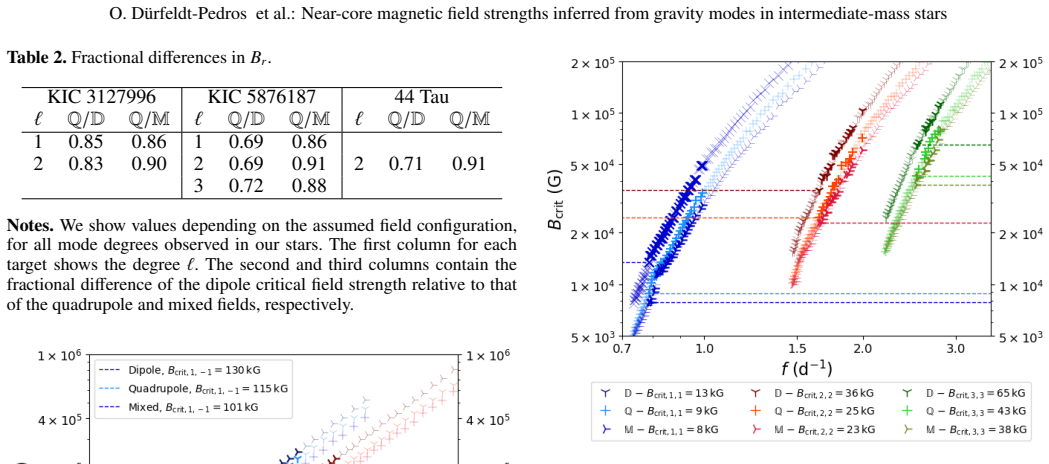
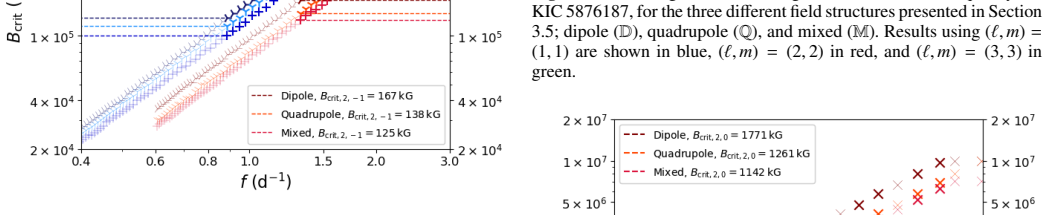
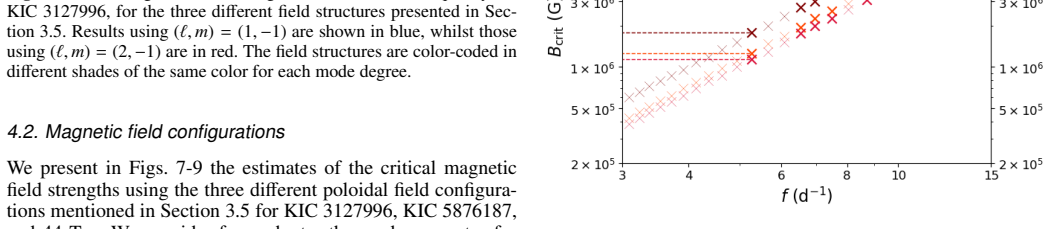
The central claim is that the critical magnetic field strength at which high-order g-modes become fully suppressed can be calculated for observed frequencies in best-fit stellar models, thereby converting non-detection of certain modes into quantitative upper limits on the near-core radial field. For KIC 3127996 and KIC 5876187 the dipole-configuration limits are Br ~ 130 kG and Br ~ 13 kG; for 44 Tau the mixed-mode analysis gives Br ~ 1771 kG. Both poloidal and toroidal field components are included, and the toroidal field must be more than 200 times stronger than the radial component before it affects the modes.
What carries the argument
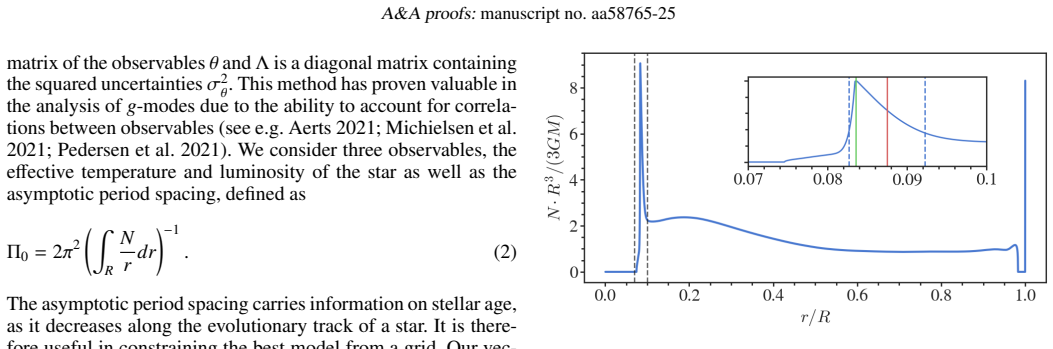
The critical magnetic field strength for complete g-mode suppression, obtained by solving the magnetohydrodynamic oscillation equations in Dedalus for dipole and other field configurations inside MESA models whose frequencies have been matched to observations with GYRE.
If this is right
- The radial field component alone sets the suppression threshold for the observed g-modes.
- Toroidal fields must exceed the radial component by a factor greater than 200 to influence g-mode visibility.
- The derived limits for the two main-sequence gamma Doradus stars overlap with core-dynamo estimates previously obtained for red giants.
- The stronger limit inferred for 44 Tau may indicate an additional contribution from a fossil field.
- Mode degree and azimuthal order change the numerical value of the upper limit for any given field configuration.
Where Pith is reading between the lines
- Extending the same suppression calculation to a larger sample of gamma Doradus stars could test whether near-core field strength scales with mass or rotation rate.
- If future observations reveal g-modes at frequencies the models predict should be suppressed, the discrepancy would point either to a weaker field or to a non-dipolar geometry.
- The method supplies an independent check on whether magnetic fields generated in the core during the main sequence survive into the red-giant phase.
Load-bearing premise
The chosen magnetic field geometry and the best-fit MESA interior structure correctly locate the region where the observed modes are most sensitive to the field.
What would settle it
Detection of a high-order g-mode whose frequency lies above the computed critical field for the inferred Br value in any of the three stars would directly contradict the upper limit.
Figures





read the original abstract
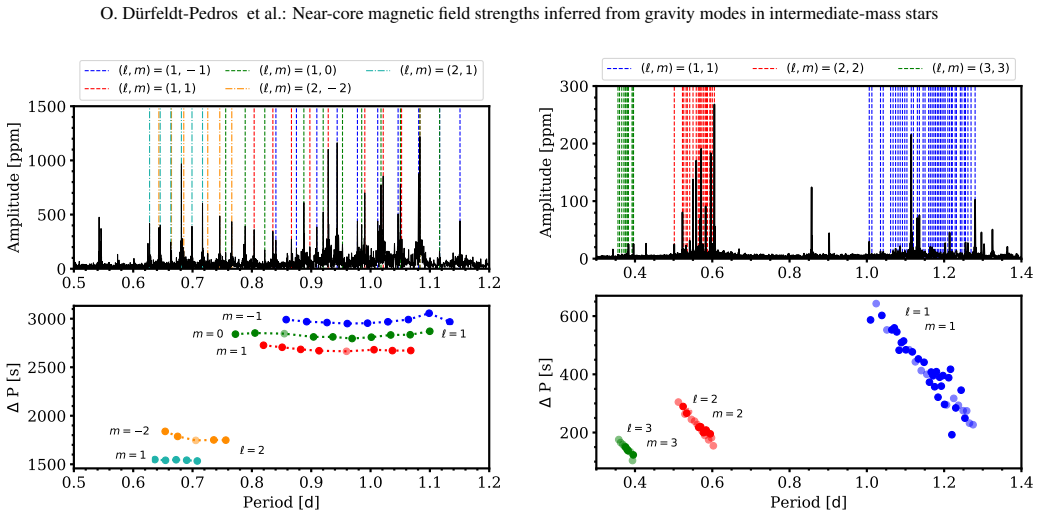
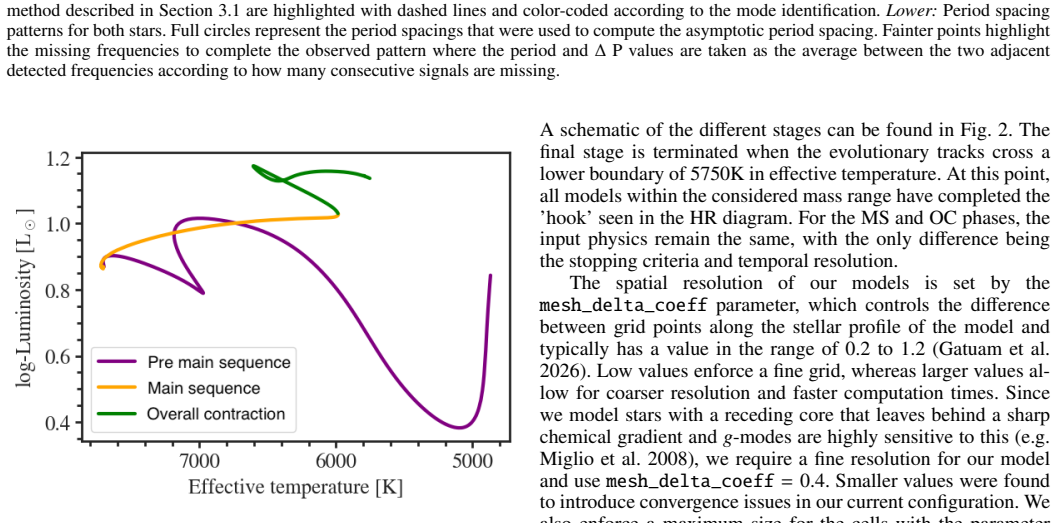
In this work, we derive upper limits for the strength of the near-core magnetic field in intermediate-mass stars, since high-order g-modes can be fully suppressed by a critical magnetic field. Both poloidal and toroidal components of the magnetic field are included. We examine how the upper limits on magnetic field strengths are affected by the degree and azimuthal order of the oscillations, as well as the magnetic field configuration. We consider two gamma-Doradus stars hosting high-order g-modes and an evolved delta-Scuti star with mixed modes, all with prior mode identification from observations. We determine the best structural model from their stellar parameters through grid-based modeling with MESA. Frequencies for the best models are extracted using GYRE and matched to the observed modes. The critical magnetic fields for all calculated frequencies in our models are obtained from the Dedalus code, from which we can infer an upper limit on the near-core field strength. We find an upper limit on the near-core radial field strength of Br ~ 130 kG and Br ~ 13 kG, assuming a dipole field configuration, for the two gamma-Doradus stars KIC 3127996 and KIC 5876187, respectively. For 44 Tau, analysis of mixed modes yields a field strength of Br ~ 1771 kG. Different magnetic field configurations and mode degrees lead to different estimates. The results for the radial component of the magnetic field in the main sequence gamma-Doradus stars are consistent with estimates of magnetic field strengths in red giant stars that assume an internal field generated by a core dynamo, although the stronger of the two inferred magnetic fields may require some enhancement by a fossil field. The toroidal component does not affect g-modes significantly and is required to be more than 200 times stronger than the radial component to suppress g-modes. (abridged for arXiv)
Editorial analysis
A structured set of objections, weighed in public.
Referee Report
Summary. The paper derives upper limits on near-core radial magnetic field strengths (Br ~130 kG for KIC 3127996, Br ~13 kG for KIC 5876187, and Br ~1771 kG for 44 Tau) by identifying the critical field at which observed high-order g-modes or mixed modes are fully suppressed. It fits best structural models via grid-based MESA modeling to match observed frequencies with GYRE, then computes critical fields with Dedalus MHD simulations including both poloidal and toroidal components under dipole and other configurations.
Significance. If robust, the results supply direct observational upper bounds on internal magnetic fields in main-sequence intermediate-mass stars via g-mode suppression, extending prior red-giant estimates and testing core-dynamo versus fossil-field scenarios. The work employs standard public codes (MESA, GYRE, Dedalus) on observationally constrained models and explicitly varies field geometry and mode degree.
major comments (3)
- [Stellar modeling and frequency matching] Stellar modeling section: Upper limits are computed from the near-core N(r), density, and eigenfunctions of a single best-fit MESA model whose GYRE frequencies match the observations. No exploration is reported of other models consistent with the same frequencies (via changes in overshooting, mixing length, or metallicity) that would alter mode trapping and therefore the Dedalus critical Br values; this directly affects the quoted numerical limits.
- [Abstract and § on magnetic field calculations] Abstract and results section: The reported Br limits (130 kG, 13 kG, 1771 kG) are given for the dipole case only, with the statement that other configurations yield different estimates but without tabulated ranges or propagated uncertainties from the structural modeling choices; the central claim therefore rests on unquantified sensitivity to both model structure and field geometry.
- [Magnetic field calculations] Dedalus critical-field computation: The suppression criterion is applied to the specific eigenfunctions of the chosen best model; because the near-core buoyancy profile remains under-constrained even after frequency matching, the resulting Br thresholds are not shown to be stable under plausible structural variations that preserve the observed frequencies.
minor comments (2)
- [Abstract] The abstract states results for the radial component but does not specify the exact definition of Br (e.g., at what radius or averaged) used for the quoted limits.
- [Results on field components] Notation for toroidal versus poloidal components should be clarified when stating that the toroidal field must be >200 times stronger to affect g-modes.
Simulated Author's Rebuttal
We thank the referee for their insightful comments, which highlight important aspects of the robustness of our inferred magnetic field upper limits. We address each major comment below, agreeing that additional exploration of model sensitivities would improve the manuscript. We will incorporate revisions accordingly.
read point-by-point responses
-
Referee: Stellar modeling section: Upper limits are computed from the near-core N(r), density, and eigenfunctions of a single best-fit MESA model whose GYRE frequencies match the observations. No exploration is reported of other models consistent with the same frequencies (via changes in overshooting, mixing length, or metallicity) that would alter mode trapping and therefore the Dedalus critical Br values; this directly affects the quoted numerical limits.
Authors: We agree that the choice of stellar model parameters can influence the mode trapping and thus the critical magnetic field values. Our grid-based modeling identifies the best-fit model, but to quantify the impact, we will add an analysis of a small set of alternative models that also match the observed frequencies within uncertainties, by varying overshooting and metallicity. This will provide a range for the Br limits. revision: yes
-
Referee: Abstract and § on magnetic field calculations: The reported Br limits (130 kG, 13 kG, 1771 kG) are given for the dipole case only, with the statement that other configurations yield different estimates but without tabulated ranges or propagated uncertainties from the structural modeling choices; the central claim therefore rests on unquantified sensitivity to both model structure and field geometry.
Authors: The manuscript does note that different configurations lead to different estimates, but we acknowledge the lack of tabulated values and uncertainties. In the revision, we will include a table with critical Br values for dipole, quadrupole, and other configurations, as well as for different mode degrees. We will also discuss the sensitivity to structural parameters and provide estimated uncertainties based on the model grid. revision: yes
-
Referee: Dedalus critical-field computation: The suppression criterion is applied to the specific eigenfunctions of the chosen best model; because the near-core buoyancy profile remains under-constrained even after frequency matching, the resulting Br thresholds are not shown to be stable under plausible structural variations that preserve the observed frequencies.
Authors: This point overlaps with the first comment. The frequency matching does constrain the overall structure, but the near-core buoyancy frequency has some freedom. We will revise the manuscript to include tests showing the stability of the Br thresholds under small variations in the near-core N(r) that keep the frequencies matched, using the Dedalus simulations on perturbed profiles where feasible. revision: partial
Circularity Check
No circularity: upper limits computed via independent MHD numerics on fitted models
full rationale
The paper's chain proceeds by (1) grid-based MESA modeling to select a best-fit structure from stellar parameters, (2) GYRE frequency matching to observations, and (3) Dedalus computation of critical Br at which g-modes or mixed modes are suppressed, using the model's N(r), density, and eigenfunctions. These steps produce numerical upper limits (130 kG, 13 kG, 1771 kG) that are outputs of the MHD solver rather than algebraic identities or direct renamings of the fitted frequencies or parameters. No self-citations, self-definitional equations, or fitted-input-as-prediction reductions appear in the described method. The structural uncertainty noted by the skeptic is a modeling limitation, not a circularity that collapses the result to its inputs by construction.
Axiom & Free-Parameter Ledger
free parameters (2)
- Best-fit stellar model parameters (mass, age, composition) =
various values fitted per star
- Magnetic field geometry parameters =
dipole assumed for quoted limits
axioms (2)
- domain assumption High-order g-modes are fully suppressed above a critical magnetic field strength computed from MHD equations
- domain assumption The best-fit MESA models accurately represent the internal structure probed by the observed g-modes or mixed modes
Forward citations
Cited by 1 Pith paper
-
Wildly Oscillating Stars -- Unexplained dense ridge-like frequency agglomerations in A and F type pulsators
A subset of A and F pulsating stars exhibit dense unexplained frequency agglomerations forming ridges below the fundamental mode, indicating a pulsational regime not captured by existing models.
Reference graph
Works this paper leans on
-
[1]
2021, Reviews of Modern Physics, 93, 015001
Aerts, C. 2021, Reviews of Modern Physics, 93, 015001
2021
-
[2]
2018, ApJS, 237, 15
Aerts, C., Molenberghs, G., Michielsen, M., et al. 2018, ApJS, 237, 15
2018
-
[3]
2007, A&A, 463, 225
Antoci, V ., Breger, M., Rodler, F., Bischof, K., & Garrido, R. 2007, A&A, 463, 225
2007
-
[4]
2025, A&A, 696, A111 Astropy Collaboration, Price-Whelan, A
Antoci, V ., Cantiello, M., Khalack, V ., et al. 2025, A&A, 696, A111 Astropy Collaboration, Price-Whelan, A. M., Sip˝ocz, B. M., et al. 2018, AJ, 156, 123 Astropy Collaboration, Robitaille, T. P., Tollerud, E. J., et al. 2013, A&A, 558, A33
2025
-
[5]
C., Brun, A
Augustson, K. C., Brun, A. S., & Toomre, J. 2016, ApJ, 829, 92 Aurière, M., Wade, G. A., Silvester, J., et al. 2007, A&A, 475, 1053
2016
-
[6]
D., Mason, E., et al
Bagnulo, S., Landstreet, J. D., Mason, E., et al. 2006, A&A, 450, 777
2006
-
[7]
Barrault, L., Bugnet, L., Mathis, S., & Mombarg, J. S. G. 2025, A&A, 701, A253
2025
-
[8]
1978, A&A, 70, 597 Blazère, A., Petit, P., Lignières, F., et al
Berthomieu, G., Gonczi, G., Graff, P., Provost, J., & Rocca, A. 1978, A&A, 70, 597 Blazère, A., Petit, P., Lignières, F., et al. 2016, A&A, 586, A97 Böhm-Vitense, E. 1958, ZAp, 46, 108
1978
-
[9]
J., Koch, D., Basri, G., et al
Borucki, W. J., Koch, D., Basri, G., et al. 2010, Science, 327, 977
2010
-
[10]
P., Dupret, M
Bouabid, M. P., Dupret, M. A., Salmon, S., et al. 2013, MNRAS, 429, 2500
2013
-
[11]
& Spruit, H
Braithwaite, J. & Spruit, H. C. 2004, Nature, 431, 819
2004
-
[12]
& Spruit, H
Braithwaite, J. & Spruit, H. C. 2017, Royal Society Open Science, 4, 160271
2017
-
[13]
I., & MiMeS Collaboration
Briquet, M., Neiner, C., Leroy, B., Pápics, P. I., & MiMeS Collaboration. 2013, A&A, 557, L16
2013
-
[14]
S., Browning, M
Brun, A. S., Browning, M. K., & Toomre, J. 2005, ApJ, 629, 461
2005
-
[15]
2021, A&A, 650, A53
Bugnet, L., Prat, V ., Mathis, S., et al. 2021, A&A, 650, A53
2021
-
[16]
J., Vasil, G
Burns, K. J., Vasil, G. M., Oishi, J. S., Lecoanet, D., & Brown, B. P. 2020, Phys. Rev. Res., 2, 023068
2020
-
[17]
M., et al
Buysschaert, B., Aerts, C., Bowman, D. M., et al. 2018, A&A, 616, A148
2018
-
[18]
2017, A&A, 605, A104
Buysschaert, B., Neiner, C., Briquet, M., & Aerts, C. 2017, A&A, 605, A104
2017
-
[19]
& Braithwaite, J
Cantiello, M. & Braithwaite, J. 2019, ApJ, 883, 106
2019
-
[20]
2014, The Astrophysical Journal, 788, 93
Cantiello, M., Mankovich, C., Bildsten, L., Christensen-Dalsgaard, J., & Paxton, B. 2014, The Astrophysical Journal, 788, 93
2014
-
[21]
A., & Mathis, S
Ceillier, T., Eggenberger, P., García, R. A., & Mathis, S. 2013, A&A, 555, A54
2013
-
[22]
M., Antoci, V ., & Salmon, S
Christophe, S., Ballot, J., Ouazzani, R. M., Antoci, V ., & Salmon, S. J. A. J. 2018, A&A, 618, A47
2018
-
[23]
& Torres, G
Claret, A. & Torres, G. 2019, ApJ, 876, 134
2019
-
[24]
Cox, J. P. & Giuli, R. T. 1968, Principles of stellar structure
1968
-
[25]
2024, in 8th TESS/15th Kepler Asteroseismic Science Consortium Workshop, 116
Deheuvels, S. 2024, in 8th TESS/15th Kepler Asteroseismic Science Consortium Workshop, 116
2024
-
[26]
2023, A&A, 670, L16
Deheuvels, S., Li, G., Ballot, J., & Lignières, F. 2023, A&A, 670, L16
2023
-
[27]
2022, A&A, 661, A133
Dhouib, H., Mathis, S., Bugnet, L., Van Reeth, T., & Aerts, C. 2022, A&A, 661, A133
2022
-
[28]
A., Grigahcène, A., Garrido, R., Gabriel, M., & Scuflaire, R
Dupret, M. A., Grigahcène, A., Garrido, R., Gabriel, M., & Scuflaire, R. 2005, A&A, 435, 927
2005
-
[29]
A., Daszy ´nska-Daszkiewicz, J., & Pamyatnykh, A
Dziembowski, W. A., Daszy ´nska-Daszkiewicz, J., & Pamyatnykh, A. A. 2007, MNRAS, 374, 248
2007
-
[30]
& Gillis, J
Eckart, C. & Gillis, J. 1960, in Hydrodynamics of oceans and atmospheres
1960
-
[31]
2012, A&A, 544, L4
Eggenberger, P., Montalbán, J., & Miglio, A. 2012, A&A, 544, L4
2012
-
[32]
& Mazeh, T
Faigler, S. & Mazeh, T. 2011, MNRAS, 415, 3921 Article number, page 14 of 18 O. Dürfeldt-Pedros et al.: Near-core magnetic field strengths inferred from gravity modes in intermediate-mass stars
2011
-
[33]
A., Browning, M
Featherstone, N. A., Browning, M. K., Brun, A. S., & Toomre, J. 2009, ApJ, 705, 1000
2009
-
[34]
2023, A&A, 674, A28
Fouesneau, M., Frémat, Y ., Andrae, R., et al. 2023, A&A, 674, A28
2023
-
[35]
2016, A&A, 594, A39
Frasca, A., Molenda- ˙Zakowicz, J., De Cat, P., et al. 2016, A&A, 594, A39
2016
-
[36]
A., & Bildsten, L
Fuller, J., Cantiello, M., Stello, D., Garcia, R. A., & Bildsten, L. 2015, Science, 350, 423
2015
-
[37]
L., & Jermyn, A
Fuller, J., Piro, A. L., & Jermyn, A. S. 2019, MNRAS, 485, 3661
2019
-
[38]
2014, A&A, 569, A63 Gaia Collaboration, Vallenari, A., Brown, A
Gabriel, M., Noels, A., Montalbán, J., & Miglio, A. 2014, A&A, 569, A63 Gaia Collaboration, Vallenari, A., Brown, A. G. A., et al. 2022, Gaia Data Re- lease 3: Summary of the content and survey properties
2014
-
[39]
2022, A&A, 662, A82
Garcia, S., Van Reeth, T., De Ridder, J., et al. 2022, A&A, 662, A82
2022
-
[40]
J., & Bedding, T
Gatuam, A., Murphy, S. J., & Bedding, T. R. 2026, Monthly Notices of the Royal Astronomical Society, 545, staf2001
2026
-
[41]
& Sauval, A
Grevesse, N. & Sauval, A. J. 1998, Space Sci. Rev., 85, 161
1998
-
[42]
2021, A&A, 648, A97
Henneco, J., Van Reeth, T., Prat, V ., et al. 2021, A&A, 648, A97
2021
-
[43]
I., Antoci, V ., Saio, H., et al
Henriksen, A. I., Antoci, V ., Saio, H., et al. 2023, MNRAS, 520, 216
2023
-
[44]
Navarrete, F. H. 2024, A&A, 691, A326
2024
-
[45]
Navarrete, F. H. 2025, A&A, 699, A250
2025
-
[46]
Iglesias, C. A. & Rogers, F. J. 1993, ApJ, 412, 752
1993
-
[47]
S., Bauer, E
Jermyn, A. S., Bauer, E. B., Schwab, J., et al. 2023, ApJS, 265, 15
2023
-
[48]
2016, AJ, 151, 68
Kirk, B., Conroy, K., Prša, A., et al. 2016, AJ, 151, 68
2016
-
[49]
G., Borucki, W
Koch, D. G., Borucki, W. J., Basri, G., et al. 2010, ApJ, 713, L79
2010
-
[50]
Labadie-Bartz, J., Hümmerich, S., Bernhard, K., Paunzen, E., & Shultz, M. E. 2023, A&A, 676, A55
2023
-
[51]
2013, A&A, 549, A104
Lampens, P., Tkachenko, A., Lehmann, H., et al. 2013, A&A, 549, A104
2013
-
[52]
M., & Van Reeth, T
Lecoanet, D., Bowman, D. M., & Van Reeth, T. 2022, MNRAS, 512, L16
2022
-
[53]
M., Burns, K
Lecoanet, D., Vasil, G. M., Burns, K. J., Brown, B. P., & Oishi, J. S. 2019, Journal of Computational Physics: X, 3, 100012
2019
-
[54]
M., Fuller, J., Cantiello, M., & Burns, K
Lecoanet, D., Vasil, G. M., Fuller, J., Cantiello, M., & Burns, K. J. 2017, MN- RAS, 466, 2181
2017
-
[55]
A., Zdravkov, T., & Breger, M
Lenz, P., Pamyatnykh, A. A., Zdravkov, T., & Breger, M. 2010, A&A, 509, A90
2010
-
[56]
2022, Nature, 610, 43
Li, G., Deheuvels, S., Ballot, J., & Lignières, F. 2022, Nature, 610, 43
2022
-
[57]
2023, A&A, 680, A26
Li, G., Deheuvels, S., Li, T., Ballot, J., & Lignières, F. 2023, A&A, 680, A26
2023
-
[58]
R., et al
Li, G., Van Reeth, T., Bedding, T. R., et al. 2020, MNRAS, 491, 3586 Lignières, F., Ballot, J., Deheuvels, S., & Galoy, M. 2024, A&A, 683, A2 Lignières, F., Petit, P., Aurière, M., Wade, G. A., & Böhm, T. 2014, in IAU Sym- posium, V ol. 302, Magnetic Fields throughout Stellar Evolution, ed. P. Petit, M. Jardine, & H. C. Spruit, 338–347
2020
-
[59]
Loi, S. T. 2020, MNRAS, 496, 3829
2020
-
[60]
& Meynet, G
Maeder, A. & Meynet, G. 2005, A&A, 440, 1041
2005
-
[61]
P., Goupil, M
Marques, J. P., Goupil, M. J., Lebreton, Y ., et al. 2013, A&A, 549, A74
2013
-
[62]
Michielsen, M., Aerts, C., & Bowman, D. M. 2021, A&A, 650, A175
2021
-
[63]
2008, MNRAS, 386, 1487
Miglio, A., Montalbán, J., Noels, A., & Eggenberger, P. 2008, MNRAS, 386, 1487
2008
-
[64]
Mombarg, J. S. G., Van Reeth, T., & Aerts, C. 2021, A&A, 650, A58
2021
-
[65]
Mombarg, J. S. G., Van Reeth, T., Pedersen, M. G., et al. 2019, MNRAS, 485, 3248
2019
-
[66]
I., Triana, S
Moravveji, E., Aerts, C., Pápics, P. I., Triana, S. A., & Vandoren, B. 2015, A&A, 580, A27
2015
-
[67]
Moravveji, E., Townsend, R. H. D., Aerts, C., & Mathis, S. 2016, ApJ, 823, 130
2016
-
[68]
1989, MNRAS, 236, 629
Moss, D. 1989, MNRAS, 236, 629
1989
-
[69]
2001, in Astronomical Society of the Pacific Conference Series, V ol
Moss, D. 2001, in Astronomical Society of the Pacific Conference Series, V ol. 248, Magnetic Fields Across the Hertzsprung-Russell Diagram, ed. G. Mathys, S. K. Solanki, & D. T. Wickramasinghe, 305
2001
-
[70]
J., Belkacem, K., et al
Mosser, B., Goupil, M. J., Belkacem, K., et al. 2012, A&A, 548, A10
2012
-
[71]
& Lampens, P
Neiner, C. & Lampens, P. 2015, MNRAS, 454, L86
2015
-
[72]
A., & Sikora, J
Neiner, C., Wade, G. A., & Sikora, J. 2017, MNRAS, 468, L46
2017
-
[73]
M., Lignières, F., Dupret, M
Ouazzani, R. M., Lignières, F., Dupret, M. A., et al. 2020, A&A, 640, A49
2020
-
[74]
Ouazzani, R.-M., Salmon, S. J. A. J., Antoci, V ., et al. 2017, MNRAS, 465, 2294
2017
-
[75]
Pamyatnykh, A. A. 2000, in Astronomical Society of the Pacific Conference
2000
-
[76]
2024, Modules for Experiments in Stellar Astrophysics (MESA)
Paxton, B. 2024, Modules for Experiments in Stellar Astrophysics (MESA)
2024
-
[77]
2011, ApJS, 192, 3
Paxton, B., Bildsten, L., Dotter, A., et al. 2011, ApJS, 192, 3
2011
-
[78]
2013, ApJS, 208, 4
Paxton, B., Cantiello, M., Arras, P., et al. 2013, ApJS, 208, 4
2013
-
[79]
2015, ApJS, 220, 15
Paxton, B., Marchant, P., Schwab, J., et al. 2015, ApJS, 220, 15
2015
-
[80]
B., et al
Paxton, B., Schwab, J., Bauer, E. B., et al. 2018, ApJS, 234, 34
2018
discussion (0)
Sign in with ORCID, Apple, or X to comment. Anyone can read and Pith papers without signing in.